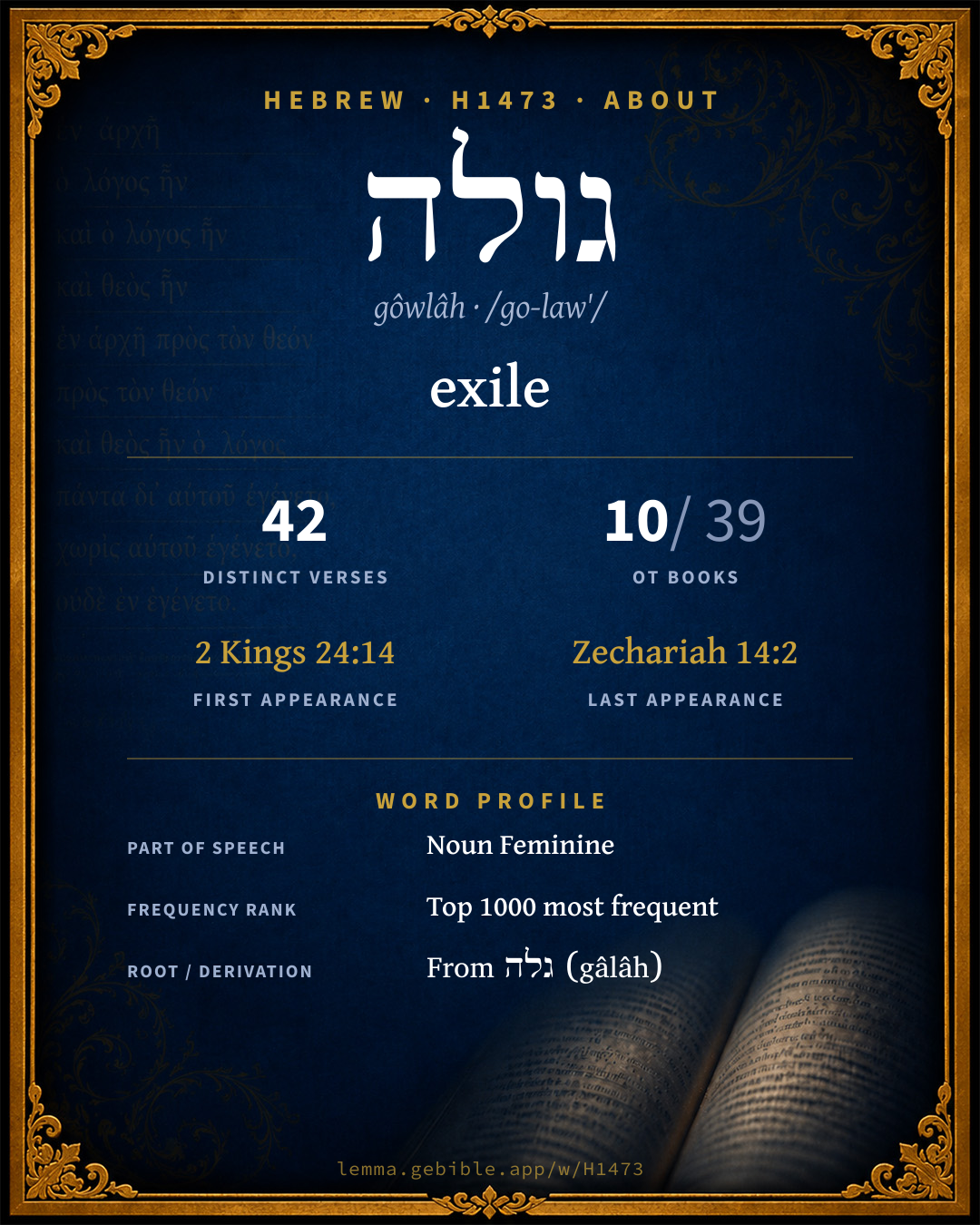
גּוֹלָה
exile
also: exiles, captivity fuller range ↓
Full lexicon entry — Brown-Driver-Briggs (BDB)
From Brown-Driver-Briggs (BDB)
Where this word appears
Grammar key — what these labels mean
Part of speech
- Noun
- A naming word — a person, place, thing, or idea.
- Verb
- An action or state-of-being word.
Noun type
- Common
- A common noun — a general class of person, place, or thing (“king,” “city,” “water”), not a specific name.
Stem
- Qal
- The basic, simple active stem — the plain form of the verb (“he wrote”).
Form
- Participle Active
- A verbal adjective expressing ongoing or characteristic action (“writing / one who writes”).
State
- Absolute
- The independent form of a noun, not bound to a following word.
Gender
- Feminine
- Grammatically feminine.
- Masculine
- Grammatically masculine.
Number
- Singular
- One.
Grammatical forms
- Noun, Common, Feminine, Singular, Absolute 42 times (98%)
- Verb, Qal, Participle Active, Masculine, Singular, Absolute 1 time (2%)
Parsed forms decoded from the imported morphology (morphhb / Westminster Leningrad Codex — WLC text public domain, morphhb tagging CC BY 4.0), counted across 43 parsed occurrences — not distinct verses.
Every verse where H1473 appears — 42 distinct verses across 10 books. Click any verse to open its interlinear word-by-word view. Verse text shown in the World English Bible for context — . Each verse’s Hebrew form is shown with its reference; the English is not keyword-highlighted, since the data carries no word-level English alignment. Use “Compare translations” on any verse to read it across multiple English versions. This concordance covers the Hebrew Bible; Septuagint (Greek Old Testament) occurrences are not indexed here.
2 Kings 3 verses
- 2 Kings 24:14 גּוֹלֶ֔ה Qal ptcp.act ms He carried away all Jerusalem, and all the princes, and all the mighty men of valor, even ten thousand captives, and all the craftsmen and the smiths; none remained, save the poorest sort of the people of the land.
- 2 Kings 24:15 גּוֹלָ֥ה n c fs He carried away Jehoiachin to Babylon; and the king's mother, and the king's wives, and his officers, and the chief men of the land, carried he into captivity from Jerusalem to Babylon.
- 2 Kings 24:16 גּוֹלָ֖ה n c fs All the men of might, even seven thousand, and the craftsmen and the smiths one thousand, all of them strong and apt for war, even them the king of Babylon brought captive to Babylon.
1 Chronicles 1 verse
Ezra 12 verses
- Ezra 1:11 הַ/גּוֹלָ֔ה ptcl def.art + n c fs All the vessels of gold and of silver were five thousand and four hundred. All these did Sheshbazzar bring up, when they of the captivity were brought up from Babylon to Jerusalem.
- Ezra 2:1 הַ/גּוֹלָ֔ה ptcl def.art + n c fs Now these are the children of the province, who went up out of the captivity of those who had been carried away, whom Nebuchadnezzar the king of Babylon had carried away to Babylon, and who returned to Jerusalem and Judah, everyone to his city;
- Ezra 4:1 הַ/גּוֹלָה֙ ptcl def.art + n c fs Now when the adversaries of Judah and Benjamin heard that the children of the captivity were building a temple to Yahweh, the God of Israel;
- Ezra 6:19 הַ/גּוֹלָ֖ה ptcl def.art + n c fs The children of the captivity kept the Passover on the fourteenth [day] of the first month.
- Ezra 6:20 הַ/גּוֹלָ֔ה ptcl def.art + n c fs For the priests and the Levites had purified themselves together; all of them were pure: and they killed the Passover for all the children of the captivity, and for their brothers the priests, and for themselves.
- Ezra 6:21 מֵֽ/הַ/גּוֹלָ֔ה prep + ptcl def.art + n c fs The children of Israel who had come again out of the captivity, and all such as had separated themselves to them from the filthiness of the nations of the land, to seek Yahweh, the God of Israel, ate,
- Ezra 8:35 הַ/גּוֹלָ֜ה ptcl def.art + n c fs The children of the captivity, who had come out of exile, offered burnt offerings to the God of Israel, twelve bulls for all Israel, ninety-six rams, seventy-seven lambs, and twelve male goats for a sin-offering: all this was a burnt offering to Yahweh.
- Ezra 9:4 הַ/גּוֹלָ֑ה ptcl def.art + n c fs Then were assembled to me everyone who trembled at the words of the God of Israel, because of the trespass of them of the captivity; and I sat confounded until the evening offering.
- Ezra 10:6 הַ/גּוֹלָֽה ptcl def.art + n c fs Then Ezra rose up from before the house of God, and went into the chamber of Jehohanan the son of Eliashib: and [when] he came there, he ate no bread, nor drink water; for he mourned because of the trespass of them of the captivity.
- Ezra 10:7 הַ/גּוֹלָ֔ה ptcl def.art + n c fs They made proclamation throughout Judah and Jerusalem to all the children of the captivity, that they should gather themselves together to Jerusalem;
- Ezra 10:8 הַ/גּוֹלָֽה ptcl def.art + n c fs and that whoever didn't come within three days, according to the counsel of the princes and the elders, all his substance should be forfeited, and himself separated from the assembly of the captivity.
- Ezra 10:16 הַ/גּוֹלָה֒ ptcl def.art + n c fs The children of the captivity did so. Ezra the priest, [with] certain heads of fathers' [houses], after their fathers' houses, and all of them by their names, were set apart; and they sat down in the first day of the tenth month to examine the matter.
Nehemiah 1 verse
Esther 1 verse
Jeremiah 10 verses
- Jeremiah 28:6 הַ/גּוֹלָ֔ה ptcl def.art + n c fs even the prophet Jeremiah said, Amen: Yahweh do so; Yahweh perform your words which you have prophesied, to bring again the vessels of Yahweh's house, and all them of the captivity, from Babylon to this place.
- Jeremiah 29:1 הַ/גּוֹלָ֗ה ptcl def.art + n c fs Now these are the words of the letter that Jeremiah the prophet sent from Jerusalem to the residue of the elders of the captivity, and to the priests, and to the prophets, and to all the people, whom Nebuchadnezzar had carried away captive from Jerusalem to Babylon,
- Jeremiah 29:4 הַ֨/גּוֹלָ֔ה ptcl def.art + n c fs Thus says Yahweh of Hosts, the God of Israel, to all the captivity, whom I have caused to be carried away captive from Jerusalem to Babylon:
- Jeremiah 29:16 בַּ/גּוֹלָֽה prep det + n c fs thus says Yahweh concerning the king who sits on the throne of David, and concerning all the people who dwell in this city, your brothers who haven't gone forth with you into captivity;
- Jeremiah 29:20 הַ֨/גּוֹלָ֔ה ptcl def.art + n c fs Hear you therefore the word of Yahweh, all you of the captivity, whom I have sent away from Jerusalem to Babylon.
- Jeremiah 29:31 הַ/גּוֹלָה֙ ptcl def.art + n c fs Send to all them of the captivity, saying, Thus says Yahweh concerning Shemaiah the Nehelamite: Because Shemaiah has prophesied to you, and I didn't send him, and he has caused you to trust in a lie;
- Jeremiah 46:19 גוֹלָה֙ n c fs You daughter who dwell in Egypt, furnish yourself to go into captivity; for Memphis shall become a desolation, and shall be burnt up, without inhabitant.
- Jeremiah 48:7 בַּ/גּוֹלָ֔ה prep det + n c fs For, because you have trusted in your works and in your treasures, you also shall be taken: and Chemosh shall go forth into captivity, his priests and his princes together.
- Jeremiah 48:11 וּ/בַ/גּוֹלָ֖ה conj + prep det + n c fs Moab has been at ease from his youth, and he has settled on his lees, and has not been emptied from vessel to vessel, neither has he gone into captivity: therefore his taste remains in him, and his scent is not changed.
- Jeremiah 49:3 בַּ/גּוֹלָ֣ה prep det + n c fs Wail, Heshbon, for Ai is laid waste; cry, you daughters of Rabbah, gird you with sackcloth: lament, and run back and forth among the fences; for Malcam shall go into captivity, his priests and his princes together.
Ezekiel 10 verses
- Ezekiel 1:1 הַ/גּוֹלָ֖ה ptcl def.art + n c fs Now it happened in the thirtieth year, in the fourth [month], in the fifth [day] of the month, as I was among the captives by the river Chebar, that the heavens were opened, and I saw visions of God.
- Ezekiel 3:11 הַ/גּוֹלָה֙ ptcl def.art + n c fs Go, get you to them of the captivity, to the children of your people, and speak to them, and tell them, Thus says the Lord Yahweh; whether they will hear, or whether they will forbear.
- Ezekiel 3:15 הַ/גּוֹלָ֜ה ptcl def.art + n c fs Then I came to them of the captivity at Tel Aviv, that lived by the river Chebar, and to where they lived; and I sat there overwhelmed among them seven days.
- Ezekiel 11:24 הַ/גּוֹלָ֔ה ptcl def.art + n c fs The Spirit lifted me up, and brought me in the vision by the Spirit of God into Chaldea, to them of the captivity. So the vision that I had seen went up from me.
- Ezekiel 11:25 הַ/גּוֹלָ֑ה ptcl def.art + n c fs Then I spoke to them of the captivity all the things that Yahweh had shown me.
- Ezekiel 12:3 גוֹלָ֔ה n c fs Therefore, you son of man, prepare you stuff for removing, and remove by day in their sight; and you shall remove from your place to another place in their sight: it may be they will consider, though they are a rebellious house.
- Ezekiel 12:4 גוֹלָ֛ה גּוֹלָֽה n c fs n c fs You shall bring forth your stuff by day in their sight, as stuff for removing; and you shall go forth yourself at even in their sight, as when men go forth into exile.
- Ezekiel 12:7 גוֹלָה֙ n c fs I did so as I was commanded: I brought forth my stuff by day, as stuff for removing, and in the even I dug through the wall with my hand; I brought it forth in the dark, and bore it on my shoulder in their sight.
- Ezekiel 12:11 בַּ/גּוֹלָ֥ה prep det + n c fs Say, I am your sign: like as I have done, so shall it be done to them; they shall go into exile, into captivity.
- Ezekiel 25:3 בַּ/גּוֹלָֽה prep det + n c fs and tell the children of Ammon, Hear the word of the Lord Yahweh: Thus says the Lord Yahweh, Because you said, Aha, against my sanctuary, when it was profaned; and against the land of Israel, when it was made desolate; and against the house of Judah, when they went into captivity:
Amos 1 verse
Nahum 1 verse
Zechariah 2 verses
- Zechariah 6:10 הַ/גּוֹלָ֔ה ptcl def.art + n c fs "Take of them of the captivity, even of Heldai, of Tobijah, and of Jedaiah; and come the same day, and go into the house of Josiah the son of Zephaniah, where they have come from Babylon.
- Zechariah 14:2 בַּ/גּוֹלָ֔ה prep det + n c fs For I will gather all nations against Jerusalem to battle; and the city will be taken, the houses rifled, and the women ravished. half of the city will go out into captivity, and the rest of the people will not be cut off from the city.
About this entry
At a glance — auto-summarized from this page’s data, not written by a person. Every figure links to its source below. This summary describes the numbers; it doesn’t interpret them.
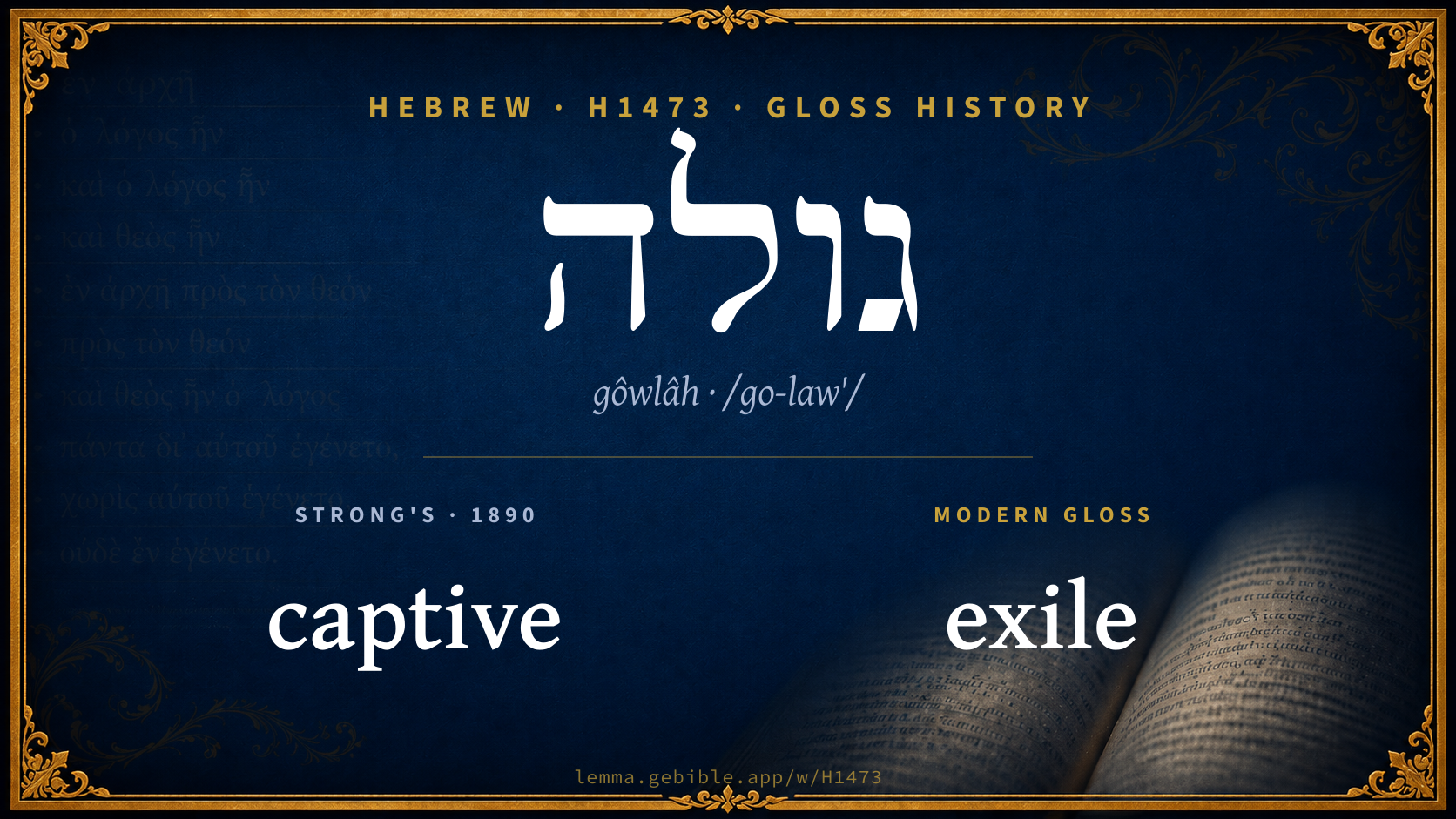
גולה — transliterated gôwlâh — is a Hebrew noun carrying the sense “exile.” Translators differ — “captivity” in the King James Version, then “exile” (Berean Standard Bible), as the renderings breakdown shows. With 42 verses in 10 books, it is a moderately common word in the Hebrew Bible. Its uses concentrate in Ezra (29% of all occurrences). It also covers “exiles” and “captivity”, alongside “exile” — see its full sense range. See the sense tree, 42-verse concordance, and the renderings breakdown below.
Gloss history
Strong's 1890 vs modern scholarship
About this word
Strong's H1473 catalogs a Hebrew word from the Hebrew Old Testament.
These counts are not copied from any lexicon or concordance. They are computed here, from the morphology-tagged Hebrew Old Testament. What Lemma adds →
- 42
- distinct verses
- The word appears in 42 distinct verses.
- 10 / 39
- OT books
- The word appears in 10 of 39 Old Testament books.
- #837
- by frequency
- Top 1000 most frequent Hebrew words (rank 837 of 8,640 Hebrew words by occurrence).
View all 42 occurrences in the concordance →
By section of the Old Testament
By traditional corpus
Conventional, traditional groupings — biblical authorship is debated, so this is a traditional corpus grouping, not an authorship claim. Each share is this word’s portion of its verses in that division of the Hebrew canon. Each figure is a share of the word’s 42 distinct verses.
- Prophets (Nevi'im) 27 verses · 64%
- Writings (Ketuvim) 15 verses · 36%
How translations render this word
Counts come from each version’s own published word-to-Strong’s tagging or interlinear alignment — an approximate guide to how each version renders this word, not a word-level alignment the data otherwise carries. Because each total is that version’s own tagged count, the per-version totals vary from one another and need not match the appearance or distinct-verse counts above. These counts may also differ from a printed concordance because Lemma counts each distinctly tagged rendering and does not collapse phrase taggings into a single head-word total. This is a fixed set of word-tagged versions (KJV, ASV, BSB, ULT) and does not change with the reading translation you choose elsewhere. Each version’s license is shown beside its name below (and on Sources).
- King James Version: Captivity 20×, Had been carried away 6×, Removing 2×
- American Standard Version: Captivity 21×, Removing 3×, All them of the captivity 2×
- Berean Standard Bible: Exile 17×, Exiles 15×
- unfoldingWord Literal Text: Exile 17×, Exiles 11×, Captives 3×
King James Version Public Domain
Renders H1473 across 41 tagged occurrences — most commonly:
Plus 13 renderings that appear only once — usually multi-word phrases or single function words the recovered tagging swept in, not distinct renderings. Not rendered by a distinct English word in 1 further occurrence.
American Standard Version Public Domain
Renders H1473 across 41 tagged occurrences — most commonly:
Plus 11 renderings that appear only once — usually multi-word phrases or single function words the recovered tagging swept in, not distinct renderings.
Berean Standard Bible Public Domain
Renders H1473 across 37 tagged occurrences — most commonly:
Plus 5 renderings that appear only once — usually multi-word phrases or single function words the recovered tagging swept in, not distinct renderings. Not rendered by a distinct English word in 6 further occurrences.
unfoldingWord Literal Text CC BY-SA 4.0
Renders H1473 across 34 tagged occurrences — most commonly:
Plus 1 rendering that appears only once — usually multi-word phrases or single function words the recovered tagging swept in, not distinct renderings.
Senses in the full BDB
What do BDB’s symbols mean?
BDB uses these scholarly abbreviations:
| Symbol | Meaning |
|---|---|
| 𝔊 | the Septuagint (the ancient Greek translation, LXX) |
| 𝔙 | the Vulgate (the Latin translation) |
| 𝔖 | the Syriac version (the Peshitta) |
| 𝔗 | the Targum (the Aramaic translation) |
| ψ | the Psalms |
| √ | root (the underlying root or stem) |
| ‖ | parallel passage (a synonymous or contrasted parallel) |
| † | the dagger: every passage where the word occurs is cited |
The 2 senses and sub-senses the full Brown-Driver-Briggs lexicon distinguishes for this word, in lexicon order (not ranked by frequency), with BDB’s own verbatim wording and sub-sense lettering. Shown in Hebrew script with BDB’s own scholarly abbreviations. The condensed entry is in the Lexicon Entry tab. See also the Forms in the corpus table below.
- 1. coll. exiles, Est 2:6 Je 29:1 Ez 1:1; 3:11, 15; 11:24, 25 Na 3:10; כל־הגולה Je 28:6; 29:4, 20, 31, קהל הגולה Ezr 10:8. e.g. Esther 2:6
- 2. abstract, exile, Ezr 6:21; 9:4; 10:6 Zc 6:10; הלך בגולה go into exile Je 48:11; 49:3; Ez 12:11; 25:3 Am 1:15; יצא בג׳ Je 29:16; 48:7 Zc 14:2; הוליך גולה carry into exile 2 K 24:15, הביא ג׳ 2 K 24:16, הוציא ג׳ Ez 12:4, העלה ג׳ Ezr 1:11; כלי גולה equipment for exile Je 46:19 Ez 12:3, 4, 7; עד הגלה until the exile 1 Ch 5:22; בני הגולה exiles Ezr 4:1; 6:19, 20; 8:35; 10:7, 16; שׁבי הגולה captivity of the exile Ezr 2:1 Ne 7:6. e.g. Ezra 6:21
Senses from the full Brown-Driver-Briggs lexicon (Brown, Driver, Briggs; Oxford 1906 — public domain), digitized via Sefaria, supplemented by the OpenScriptures HebrewLexicon (CC BY 4.0). Full attribution on Sources.
Word origin
n.f. exiles, exile—(cf. Arabic جَالٍ one emigrating, جَالِيَةٌ a company of exiles)—Je 28:6 + 38 times, גֹּלָה Is 49:21 1 Ch 5:22 Est 2:6 Na 3:10;—
— Brown-Driver-Briggs (Oxford 1906, public domain), digitized via Sefaria, supplemented by the OpenScriptures HebrewLexicon (CC BY 4.0). See Sources.
Derived from גלה (gâlâh) (H1540) — to uncover.
Jastrow Dictionary
A second Hebrew/Aramaic lexicon for comparison, covering Aramaic and post-biblical (Talmudic, Targumic, Midrashic) usage that the biblical-Hebrew BDB does not. Matched by lemma rather than by Strong’s number, so a lemma may carry more than one Jastrow headword (shown separately below), and the entries cover usage well beyond the Bible.
גּוֹלֶה
- , part. of גָּלָה.
גּוֹלָה
- exile, esp. (with or without בני) the diaspora, Jews living abroad, esp. Babylonians. Ab. Zar. 30ᵇ. R. Hash. 18ᵇ באת שמועה לַגּ׳ the report came to the captivity (in Babylonia); a. fr.—ראש ג׳ (ch. ריש גלותא) chief of the Babylonian Jews, Resh G’lutha. Snh. 38ᵃ; Ḥull. 92ᵃ ר׳ ג׳ שבבבל; a. e.—עולי ג׳ those returning from Babylonian captivity. B. Bath. 15ᵃ bot.—V. גָּלוּת.
גּוּלָּה
- cup, bowl. Lev. R. s. 32, a. e. (used for play on גּולֶה, a. גּוֹאֲלָהּ), v. גּוֹאֵל.
A Dictionary of the Targumim, the Talmud Babli and Yerushalmi, and the Midrashic Literature (Marcus Jastrow; London, Luzac, 1903) — Public Domain. Digitized via Sefaria. Digitized via Sefaria. Full attribution on Sources.
Forms in the corpus
The 26 distinct written forms H1473 takes in the Hebrew Bible, most frequent first — each parse links to that state’s occurrences in the concordance. Hebrew forms include their vowel points and cantillation, so a single lemma takes many written forms.
| Form | Parsing | Example | Uses |
|---|---|---|---|
| הַ/גּוֹלָ֔ה | Noun, Common, Feminine, Singular, Absolute | Ezekiel 11:24 | 8 |
| הַ/גּוֹלָה֙ | Noun, Common, Feminine, Singular, Absolute | Ezekiel 3:11 | 3 |
| בַּ/גּוֹלָ֔ה | Noun, Common, Feminine, Singular, Absolute | Jeremiah 48:7 | 2 |
| בַּ/גּוֹלָֽה | Noun, Common, Feminine, Singular, Absolute | Ezekiel 25:3 | 2 |
| גוֹלָה֙ | Noun, Common, Feminine, Singular, Absolute | Ezekiel 12:7 | 2 |
| הַ/גּוֹלָ֑ה | Noun, Common, Feminine, Singular, Absolute | Ezekiel 11:25 | 2 |
| הַ/גּוֹלָ֖ה | Noun, Common, Feminine, Singular, Absolute | Ezekiel 1:1 | 2 |
| הַ/גּוֹלָ֜ה | Noun, Common, Feminine, Singular, Absolute | Ezekiel 3:15 | 2 |
| הַ/גּוֹלָֽה | Noun, Common, Feminine, Singular, Absolute | Ezra 10:6 | 2 |
| הַ֨/גּוֹלָ֔ה | Noun, Common, Feminine, Singular, Absolute | Jeremiah 29:4 | 2 |
| בַּ/גּוֹלָ֑ה | Noun, Common, Feminine, Singular, Absolute | Amos 1:15 | 1 |
| בַּ/גּוֹלָ֣ה | Noun, Common, Feminine, Singular, Absolute | Jeremiah 49:3 | 1 |
| בַּ/גּוֹלָ֥ה | Noun, Common, Feminine, Singular, Absolute | Ezekiel 12:11 | 1 |
| גּוֹלֶ֔ה | Verb, Qal, Participle Active, Masculine, Singular, Absolute | 2 Kings 24:14 | 1 |
| גּוֹלָ֖ה | Noun, Common, Feminine, Singular, Absolute | 2 Kings 24:16 | 1 |
| גּוֹלָ֥ה | Noun, Common, Feminine, Singular, Absolute | 2 Kings 24:15 | 1 |
| גּוֹלָֽה | Noun, Common, Feminine, Singular, Absolute | Ezekiel 12:4 | 1 |
| גוֹלָ֔ה | Noun, Common, Feminine, Singular, Absolute | Ezekiel 12:3 | 1 |
| גוֹלָ֛ה | Noun, Common, Feminine, Singular, Absolute | Ezekiel 12:4 | 1 |
| הַ/גֹּלָֽה | Noun, Common, Feminine, Singular, Absolute | 1 Chronicles 5:22 | 1 |
| הַ/גֹּלָה֙ | Noun, Common, Feminine, Singular, Absolute | Esther 2:6 | 1 |
| הַ/גּוֹלָ֗ה | Noun, Common, Feminine, Singular, Absolute | Jeremiah 29:1 | 1 |
| הַ/גּוֹלָה֒ | Noun, Common, Feminine, Singular, Absolute | Ezra 10:16 | 1 |
| וּ/בַ/גּוֹלָ֖ה | Noun, Common, Feminine, Singular, Absolute | Jeremiah 48:11 | 1 |
| לַ/גֹּלָה֙ | Noun, Common, Feminine, Singular, Absolute | Nahum 3:10 | 1 |
| מֵֽ/הַ/גּוֹלָ֔ה | Noun, Common, Feminine, Singular, Absolute | Ezra 6:21 | 1 |
Same root — word family
Other BDB entries built from the same root as H1473, grouped by Strong’s listed origin. These share a root / origin per the lexicon — not necessarily a shared meaning. Each links to that word’s own entry.
Derives from
Shares the same root
Proper names from this root
People and places named from this root — a name, not an additional meaning of the word.
Compare all same-root words → Showing 4 of 9 — not the complete family. 4 of the same-root words are proper names (people or places). They share a root, not necessarily a meaning.
Septuagint verse parallels
This word appears in 37 verses that also exist in the Greek Old Testament (Septuagint), out of the 42 Hebrew verses it occurs in. You can read those verses in Greek by switching the Old Testament edition to the Septuagint.
Read these verses in the Septuagint
- 2 Kings 24:14
- 1 Chronicles 5:22
- Ezra 1:11
- Esther 2:6
- Jeremiah 28:6
- Ezekiel 1:1
- Amos 1:15
- Nahum 3:10
- Zechariah 6:10
This is a verse-level parallel only — the same verses exist in both the Hebrew and Greek Old Testaments. No word-level Hebrew↔Greek correspondence is claimed: the data carries no such alignment, so no Greek word is shown as this Hebrew word’s translation. Coverage is not total — the Septuagint omits the deuterocanon and renumbers the Psalms, so some Hebrew verses have no direct Greek parallel.