
Jeremiah 39:9

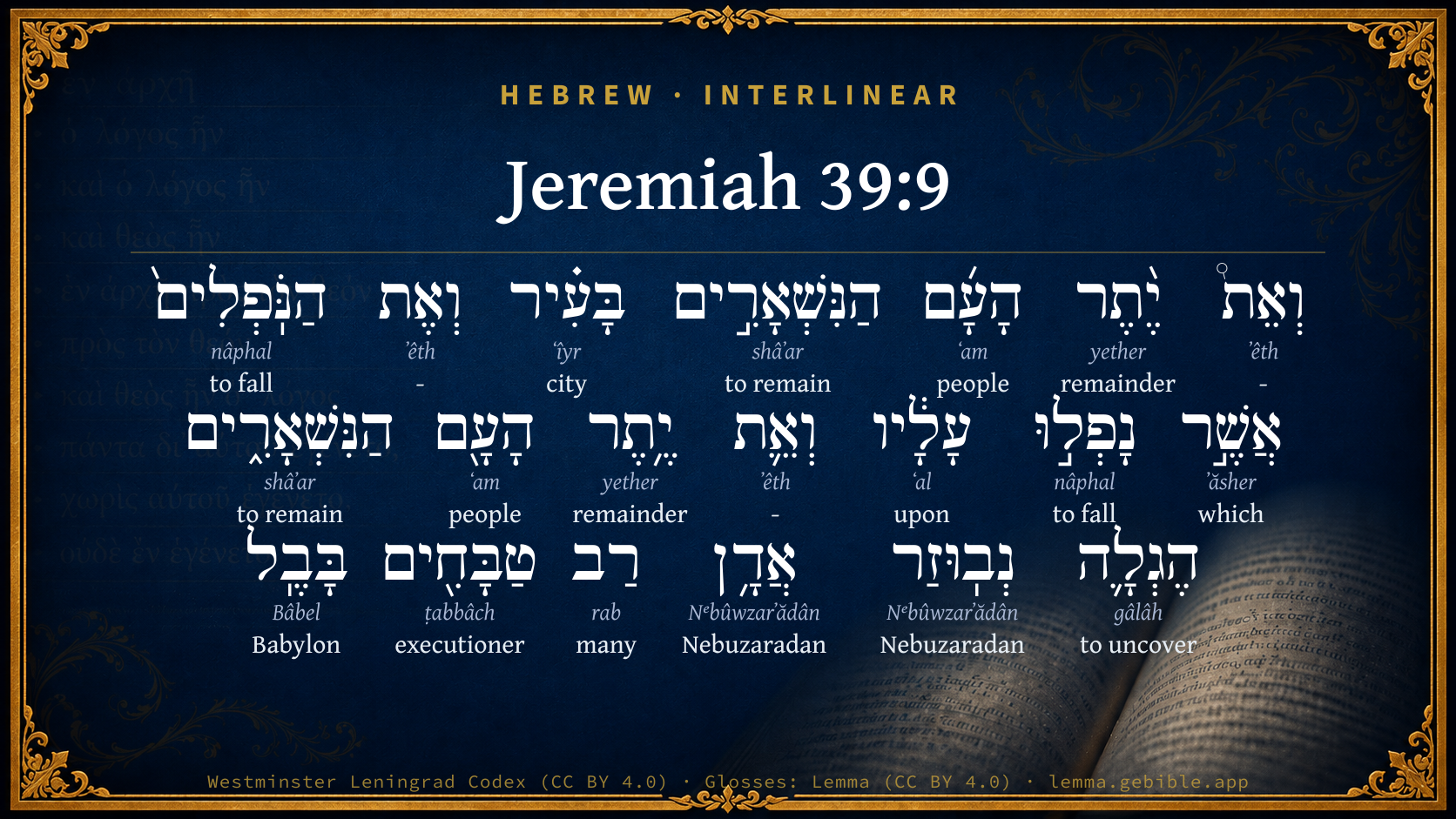
Hebrew (Westminster Leningrad Codex) Jeremiah 39:9 appears in the Hebrew Old Testament. The text above is from the Westminster Leningrad Codex. Each word links to its Strong’s number, a concise gloss, and parsing drawn from the Open Scriptures Hebrew Bible morphology. Click any word for its full Brown-Driver-Briggs (BDB) entry.
Download image
Cite this verse

Jeremiah 39:9 (World English Bible). Public Domain. Lemma interlinear Bible study tool, https://lemma.gebible.app/v/jeremiah/39/9.

Show BibTeX & RIS
BibTeX
RIS
English Translation
Then Nebuzaradan the captain of the guard carried away captive into Babylon the residue of the people who remained in the city, the deserters also who fell away to him, and the residue of the people who remained.
World English Bible · Public Domain
Download a study sheet

One document with this verse’s original text, its word-by-word gloss line, the meaning frame, cross-references with their text, attributed commentary, and full source and license credits — printable, and it pastes into notes with its structure intact.

This verse Autodidact and up

Study sheet (.html) Plain text (.txt)

A passage Seminary Student

Up to 50 verses in one chapter. A passage sheet keeps up to 6 commentary sources and 12 cross-references per verse, in the order this page ranks them, and says so on the sheet whenever that leaves anything out. Ask for a single verse and you get the Autodidact verse sheet above.

Everything on this page stays free to read, with no account — the sheet is a download of what is already on screen, not access to it.

Want to remove ads? Support Godless Engineer
Compare translations 3

The same verse in 3 English versions, stacked beneath the original-language interlinear above. Click any original word for its lexicon entry.

Each is an independent rendering of the whole verse — the interlinear is not word-aligned to these translations.

Highlighted words mark where these versions differ — a whole-verse word diff, not a word-by-word alignment.

  • World English Bible Public Domain
    Then Nebuzaradan the captain of the guard carried away captive into Babylon the residue of the people who remained in the city, the deserters also who fell away to him, and the residue of the people who remained.
  • King James Version Public Domain
    Then Nebuzaradan the captain of the guard carried away captive into Babylon the remnant of the people that remained in the city, and those that fell away, that fell to him, with the rest of the people that remained.
  • unfoldingWord Literal Text CC BY-SA 4.0
    Nebuzaradan, the commander of the king’s bodyguards, took into exile the rest of the people who were left in the city. This included the people who had deserted to the Chaldeans and the rest of the people who were left in the city.

unfoldingWord Literal Text — © unfoldingWord, licensed CC BY-SA 4.0. Word-aligned USFM3 via Door43 (git.door43.org/unfoldingWord/en_ult).

Versions to compare (up to 4)

3 of 4 selected

Show all 18 translations

Every available English version of this verse, each an independent rendering of the whole verse.

  • World English Bible Public Domain
    Then Nebuzaradan the captain of the guard carried away captive into Babylon the residue of the people who remained in the city, the deserters also who fell away to him, and the residue of the people who remained.
  • Berean Standard Bible Public Domain
    Then Nebuzaradan captain of the guard carried away to Babylon the remnant of the people who had remained in the city, along with the deserters who had defected to him.
  • Majority Standard Bible Public Domain
    Then Nebuzaradan captain of the guard carried away to Babylon the remnant of the people who had remained in the city, along with the deserters who had defected to him.
  • King James Version Public Domain
    Then Nebuzaradan the captain of the guard carried away captive into Babylon the remnant of the people that remained in the city, and those that fell away, that fell to him, with the rest of the people that remained.
  • American Standard Version (1901) Public Domain
    Then Nebuzaradan the captain of the guard carried away captive into Babylon the residue of the people that remained in the city, the deserters also that fell away to him, and the residue of the people that remained.
  • Revised Version (1885) Public Domain
    Then Nebuzaradan the captain of the guard carried away captive into Babylon the residue of the people that remained in the city, the deserters also, that fell away to him, and the residue of the people that remained.
  • Geneva Bible (1599) Public Domain
    Then Nebuzar-adan the chiefe stewarde caried away captiue into Babel the remnant of the people, that remained in the citie, and those that were fled and fallen vnto him, with the rest of the people that remained.
  • Douay-Rheims (1899) Public Domain
    And Nabuzardan the general of the army carried away captive to Babylon the remnant of the people that remained in the city, and the fugitives that had gone over to him, and the rest of the people that remained.
  • Young's Literal Translation Public Domain
    And the remnant of the people who are left in the city, and those falling who have fallen to him, and the remnant of the people who are left, hath Nebuzar-Adan, chief of the executioners, removed `to' Babylon.
  • Literal Standard Version CC BY-SA 4.0
    And the remnant of the people who are left in the city, and those defecting who have defected to him, and the remnant of the people who are left, Nebuzar-Adan, chief of the executioners, has removed [to] Babylon.
  • Unlocked Literal Bible CC BY-SA 4.0
    Nebuzaradan, the commander of the king's bodyguards, took into exile the rest of the people who were left in the city. This included the people who had deserted to the Chaldeans and the rest of the people who were left in the city.
  • unfoldingWord Literal Text CC BY-SA 4.0
    Nebuzaradan, the commander of the king’s bodyguards, took into exile the rest of the people who were left in the city. This included the people who had deserted to the Chaldeans and the rest of the people who were left in the city.
  • Darby Bible Public Domain
    And Nebuzar-adan the captain of the body-guard carried away captive into Babylon the rest of the people that were left in the city, and the deserters that had deserted to him, with the rest of the people that were left.
  • World Messianic Bible Public Domain
    Then Nebuzaradan the captain of the guard carried away captive into Babylon the rest of the people who remained in the city, the deserters also who fell away to him, and the rest of the people who remained.
  • Webster's Bible Public Domain
    Then Nebuzar-adan the captain of the guard carried away captive into Babylon the remnant of the people that remained in the city, and those that fell away, that fell to him, with the rest of the people that remained.
  • Free Bible Version CC BY-SA 4.0
    Then Nebuzaradan the commander of the guard carried off to Babylon the rest of the people who had stayed in the city, together with those who had deserted and gone over to him.
  • Bible in Basic English Public Domain
    Then Nebuzaradan, the captain of the armed men, took away to Babylon as prisoners, all the rest of the workmen who were still in the town, as well as those who had given themselves up to him, and all the rest of the people.
  • JPS Tanakh (1917) Public Domain
    Then Nebuzaradan the captain of the guard carried away captive into Babylon the remnant of the people that remained in the city, the deserters also, that fell away to him, with the rest of the people that remained.

Literal Standard Version (2020), Covenant Press — licensed CC BY-SA 4.0. Text via the HelloAO Bible API (eBible.org). Unlocked Literal Bible (unfoldingWord) — licensed CC BY-SA 4.0. Text via the HelloAO Bible API (eBible.org). unfoldingWord Literal Text — © unfoldingWord, licensed CC BY-SA 4.0. Word-aligned USFM3 via Door43 (git.door43.org/unfoldingWord/en_ult). Free Bible Version, Dr. Jonathan Gallagher — licensed CC BY-SA 4.0. Text via the HelloAO Bible API (eBible.org).

Word by word

More ways to search: Search by grammar → Find every occurrence → Compare this word →

Practice this passage: Drill this verse → Learn its vocabulary →

נְבֽוּזַר
Nᵉbûwzarʼădân
H5018
“Nebuzaradan”
Noun, Proper
Part of Speech
Noun
Type
Proper
Full BDB Definition

Origin: of foreign origin

TWOT: None

Nebuzaradan = "Nebo has given seed" - a general of Nebuchadnezzar's army at the capture of Jerusalem
  1. וְאֵת֩ ʼêth H853 “and · -” Conjunction + Particle, Direct Object
  2. יֶ֨תֶר yether H3499 “remainder of” Noun, Common, Masculine, Singular, Construct
  3. הָעָ֜ם ʻam H5971 “the · people” Particle, Definite Article + Noun, Common, Masculine, Singular, Absolute
  4. הַנִּשְׁאָרִ֣ים shâʼar H7604 “the · remaining” Particle, Definite Article + Verb, Niphal, Participle Active, Masculine, Plural, Absolute
  5. בָּעִ֗יר ʻîyr H5892 “in/at the · city” Preposition, Determined + Noun, Common, Feminine, Singular, Absolute
  6. וְאֶת ʼêth H853 “and · -” Conjunction + Particle, Direct Object
  7. הַנֹּֽפְלִים֙ nâphal H5307 “the · falling” Particle, Definite Article + Verb, Qal, Participle Active, Masculine, Plural, Absolute
  8. אֲשֶׁ֣ר ʼăsher H834 “which” Particle, Relative
  9. נָפְל֣וּ nâphal H5307 “to fall” Verb, Qal, Perfect, 3rd Person, Common, Plural
  10. עָלָ֔יו ʻal H5921 “upon · him” Preposition + Suffix, Personal, 3rd Person, Masculine, Singular
  11. וְאֵ֛ת ʼêth H853 “and · -” Conjunction + Particle, Direct Object
  12. יֶ֥תֶר yether H3499 “remainder of” Noun, Common, Masculine, Singular, Construct
  13. הָעָ֖ם ʻam H5971 “the · people” Particle, Definite Article + Noun, Common, Masculine, Singular, Absolute
  14. הַנִּשְׁאָרִ֑ים shâʼar H7604 “the · remaining” Particle, Definite Article + Verb, Niphal, Participle Active, Masculine, Plural, Absolute
  15. הֶגְלָ֛ה gâlâh H1540 “to uncover” Verb, Hiphil, Perfect, 3rd Person, Masculine, Singular
  16. אֲדָ֥ן Nᵉbûwzarʼădân H5018 “Nebuzaradan” Noun, Proper
  17. רַב rab H7227 “many of” Noun, Common, Masculine, Singular, Construct
  18. טַבָּחִ֖ים ṭabbâch H2876 “executioners” Noun, Common, Masculine, Plural, Absolute
  19. בָּבֶֽל Bâbel H894 “Babylon” Noun, Proper

About this verse

These counts appear in no published source. They are computed here, from the morphology-tagged text and Lemma’s own curated glosses. What Lemma adds →

20
words
13
distinct lemmas
Prophets
section

Notable vocabulary

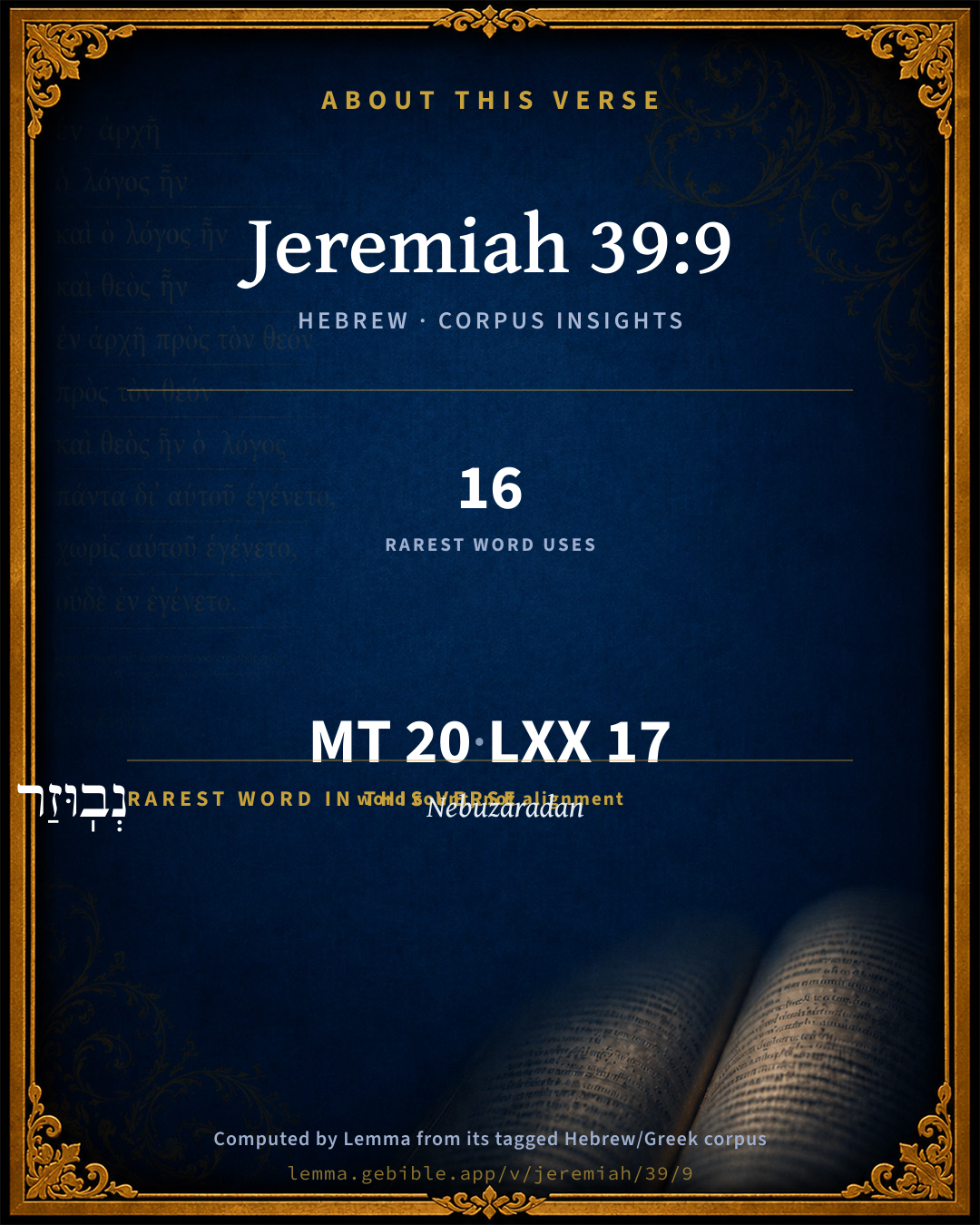
The rarest word here is נְבֽוּזַר Nebuzaradan H5018 — appearing just 16 times in the whole Hebrew Bible.

Shared distinctive vocabulary

נְבֽוּזַר Nebuzaradan H5018 occurs in 15 verses of the Hebrew Bible. Also found in:

Grammatical profile

  • 5 verbs
  • 10 nouns
  • 1 preposition
  • 4 particles

Verb forms

  • הַנִּשְׁאָרִ֣ים Niphal · Participle Active
  • הַנֹּֽפְלִים֙ Qal · Participle Active
  • נָפְל֣וּ Qal · Perfect
  • הַנִּשְׁאָרִ֑ים Niphal · Participle Active
  • הֶגְלָ֛ה Hiphil · Perfect

Repetition

Words recur within this verse — often emphatic in Hebrew:

  • יֶ֨תֶר remainder H3499 ×2
  • הָעָ֜ם people H5971 ×2
  • הַנִּשְׁאָרִ֣ים to remain H7604 ×2
  • הַנֹּֽפְלִים֙ to fall H5307 ×2
  • נְבֽוּזַר Nebuzaradan H5018 ×2

Hebrew & Septuagint length

In the original languages it is 20 Hebrew tokens and 17 Greek tokens — but the two are counted differently (Hebrew bundles its prefixes and suffixes into one token; the Greek is in lemma form), so that isn’t a like-for-like length.

Cross-references

15

Topical passages linked to Jeremiah 39:9 in the Treasury of Scripture Knowledge — connected by theme and wording, ordered by reader-vote popularity; previews shown in the World English Bible.

  • Jeremiah 40:1 The word which came to Jeremiah from Yahweh, after that Nebuzaradan the captain of the guard had let him go from Ramah, when he had taken him being bound in chains among all the captives of Jerusalem and Judah, who were carried away captive to Babylon.
  • Genesis 37:36 The Midianites sold him into Egypt to Potiphar, an officer of Pharaoh's, the captain of the guard.
  • 2 Kings 25:11 The residue of the people who were left in the city, and those who fell away, who fell to the king of Babylon, and the residue of the multitude, did Nebuzaradan the captain of the guard carry away captive.
  • 2 Kings 25:20 Nebuzaradan the captain of the guard took them, and brought them to the king of Babylon to Riblah.
  • Jeremiah 10:18 For thus says Yahweh, Behold, I will sling out the inhabitants of the land at this time, and will distress them, that they may feel [it].
  • Jeremiah 52:26 Nebuzaradan the captain of the guard took them, and brought them to the king of Babylon to Riblah.
  • Leviticus 26:33 I will scatter you among the nations, and I will draw out the sword after you: and your land will be a desolation, and your cities shall be a waste.
  • Deuteronomy 4:27 Yahweh will scatter you among the peoples, and you shall be left few in number among the nations, where Yahweh shall lead you away.
  • 2 Kings 20:18 Of your sons who shall issue from you, whom you shall father, shall they take away; and they shall be eunuchs in the palace of the king of Babylon.
  • Isaiah 5:13 Therefore my people go into captivity for lack of knowledge; Their honorable men are famished, And their multitudes are parched with thirst.
  • Jeremiah 16:13 therefore will I cast you forth out of this land into the land that you have not known, neither you nor your fathers; and there shall you serve other gods day and night; for I will show you no favor.
  • Jeremiah 20:4–6 For thus says Yahweh, Behold, I will make you a terror to yourself, and to all your friends; and they shall fall by the sword of their enemies, and your eyes shall see it; and I will give all Judah into the hand of the king of Babylon, and he shall carry them captive to Babylon, and shall kill them with the sword.
  • Jeremiah 39:10–14 But Nebuzaradan the captain of the guard left of the poor of the people, who had nothing, in the land of Judah, and gave them vineyards and fields at the same time.
  • Jeremiah 52:12–16 Now in the fifth month, in the tenth day of the month, which was the nineteenth year of king Nebuchadrezzar, king of Babylon, came Nebuzaradan the captain of the guard, who stood before the king of Babylon, into Jerusalem:
  • Jeremiah 52:28–30 This is the people whom Nebuchadrezzar carried away captive: in the seventh year three thousand twenty-three Jews;

Cross-references courtesy of OpenBible.info (CC BY 4.0).

Hebrew and Greek witnesses Masoretic Hebrew ↔ Greek Septuagint

The same verse in the two great witnesses to the Old Testament, shown verse-for-verse.

These are two independent witnesses, not word-aligned to each other, and the Septuagint is shown in lemma (dictionary) form.

Hebrew Jeremiah 39:9 Masoretic · Westminster Leningrad Codex

וְאֵת֩ יֶ֨תֶר הָעָ֜ם הַנִּשְׁאָרִ֣ים בָּעִ֗יר וְאֶת הַנֹּֽפְלִים֙ אֲשֶׁ֣ר נָפְל֣וּ עָלָ֔יו וְאֵ֛ת יֶ֥תֶר הָעָ֖ם הַנִּשְׁאָרִ֑ים הֶגְלָ֛ה נְבֽוּזַר אֲדָ֥ן רַב טַבָּחִ֖ים בָּבֶֽל

Then Nebuzaradan the captain of the guard carried away captive into Babylon the residue of the people who remained in the city, the deserters also who fell away to him, and the residue of the people who remained.

World English Bible · Public Domain

Greek LXX Structure differs

In the Septuagint, Jeremiah is about an eighth shorter than the Hebrew and arranges its material differently — the Oracles Against the Nations (Hebrew chapters 46–51) appear in the middle of the Greek book, after 25:13. Because the chapter and verse boundaries do not line up, a verse-for-verse comparison with the Hebrew is not shown.

A verse-for-verse comparison isn’t shown here because the chapters and verses don’t line up. Switch to the LXX edition with the MT / LXX toggle above to read the Greek directly.

Hebrew: Westminster Leningrad Codex (CC BY 4.0). Greek: Septuagint (public domain); English from a public-domain English Septuagint. How the Septuagint differs from the Hebrew →

Targum (Aramaic paraphrase)

1

The Targum is the ancient Jewish Aramaic paraphrase of the Hebrew Scriptures — an interpretive translation, not the Hebrew text itself. Onkelos (literal) and Pseudo-Jonathan (expansive) render the Torah, and Jonathan the Prophets. Coverage is partial: where no permissively-licensed English translation exists for a verse, only the Aramaic is shown. This is verse-level text, not a word-by-word alignment to the Hebrew.

  1. Targum Jonathan Prophets (Joshua–Malachi)
    וְיַת שְׁאָר עַמָא דְאִשְׁתָּאֲרוּ בְקַרְתָּא וְיַת שְׁמִיעַיָא דְאִשְׁתְּמָעוּ עֲלוֹהִי וְיַת שְׁאָר עַמָא דְאִשְׁתְּאָרוּ אַגְלֵי נְבוּזַרְאֲדָן רַב קָטוֹלַיָא לְבָבֶל:

    (no public-domain English translation for this verse)

    Targum Jonathan — Aramaic: “Mikraot Gedolot” (public domain). English: “Sefaria Community Translation” (CC0 1.0 (public-domain dedication)); “London "Chaldee Paraphrase," 1871” (public domain). Text via Sefaria.

Commentary

Notes on Jeremiah 39:9 from classic Christian and Jewish commentators (each source and its license shown beneath its notes). The classic Christian expositions comment on the surrounding passage and are grouped to its opening verse, so a note may address several verses; the Jewish commentaries on the Tanakh (Rashi and others) are per-verse, so they appear only where the commentator wrote on this verse.

Lemma curates 59 commentaries, every one of them public domain or Creative Commons licensed, each selected and text-cleaned for this edition rather than reprinted as found. About our sources →

Trapp's Complete Commentary

John Trapp

Jer 39:9 Then Nebuzaradan the captain of the guard carried away captive into Babylon the remnant of the people that remained in the city, and those that fell away, that fell to him, with the rest of the people that remained.

Ver. 9. See on 2Ki 25:11-12.

John Trapp, A Commentary or Exposition upon All the Books of the Old and New Testament (1647–1656) — public domain. Text from a community e-Sword module.

Tyndale Open Study Notes

Tyndale Open Resources

39:9 took as exiles to Babylon the rest of the people: The usual practice in that time was to tie a person’s hands together, and then tie him or her to the person in front, making a long line of grief-stricken captives.

Tyndale Open Study Notes — © Tyndale Open Resources, licensed CC BY-SA 4.0. Text via the HelloAO Bible API.

Geneva Bible (1599)

Geneva Bible translators

Or, captain of the guard.

Geneva Bible (1599) marginal notes — public domain. Text via Bolls.life.

Jamieson, Fausset & Brown

Robert Jamieson, A. R. Fausset & David Brown

remnant--excepting the poorest (Jer 39:10), who caused Nebuchadnezzar no apprehensions.

those . . . that fell to him--the deserters were distrusted; or they may have been removed at their own request, lest the people should vent their rage on them as traitors, after the departure of the Chaldeans.

rest . . . that remained--distinct from the previous "remnant"; there he means the remnant of those besieged in the city, whom Nebuchadnezzar spared; here, those scattered through various districts of the country which had not been besieged [CALVIN].

Jamieson, Fausset & Brown — Commentary Critical and Explanatory on the Whole Bible (1871) — public domain (CC PDM 1.0). Text via the HelloAO Bible API.

Adam Clarke's Commentary

Verse 9. Those that fell away] That deserted to the Chaldeans during the siege.

Adam Clarke's Commentary on the Bible (1810–1826) — public domain. Text from a community e-Sword/MySword module.

John Calvin's Commentaries

The Prophet now relates also what happened to others, even those who remained in the city, and whom Nebuchadnezzar and his army had spared: he says that they were brought to Babylon. There were those who had fled and went over to the Chaldeans before the city was taken; for we have seen that so great was the despair of many, that they revolted, and those were they whom Zedekiah chiefly feared, lest he should be, as we have seen, an object of mockery to them, had he gone to the Chaldeans and made a willing surrender. Jeremiah now says that those also were led into Chaldea. Nebuchadnezzar might have removed them on this account, because he could not confide in traitors. He had found out their inconstancy, for they had revolted from their own real and legitimate king. As then they had. thus once violated their faith, he could not but regard them with suspicion, and therefore removed them, lest they should afterwards attempt something new, and create disturbance; or, it may be, that it was done according to their request, because they feared lest, after the departure of the Chal-deans, the common people should rage against them, as they had helped the enemies, and thus had become perfidious and ungrateful towards their own country. It might then be, that they themselves had made this request, and that it was granted them: they might then live quietly in a far country, but they could not be safe in Judea. However, whatever may have been the reason, Jeremiah tells us, that they were led with the rest into Babylon and Chaldea.

he afterwards names the head or general of the army, even Nebuzaradan, whom he calls the prince of the killers, or of the cooks. The Greek translators have rendered it ἀρχιμάγειρον, the prince of the cooks, who at this day is called Grand Master in the courts of princes. But their opinion is more probable, who render the words, the prince of the killers. The verb טבח, thebech, means to slay, to kill, and to kill men as well as to slay beasts; and for this reason some have applied it to cookery. But as Nebuzaradan is mentioned here as the chief among military men, the probability is that he was the judge of all capital offenses in the army. Hence Jeremiah names him when he says that they were removed who remained in the city.

But there seems to be here an unnecessary repetition, as he mentions twice, the rest of the people which remained There is, however, a difference, for in the first clause he says, in the city He then means those who had been besieged, and whom Nebuchadnezzar had pardoned so as not to put them to death. The last clause embraces more, even all the inhabitants of the land; for there were many scattered abroad, on whom Nebuchadnezzar might have vented his rage, but he removed them as slaves into Chaldea. Then our Prophet speaks here of these two parties, for he says that there were some remaining in the city, and that others were remaining, even those who were found scattered through various parts of the country, and had not been besieged by the Chaldean army. He afterwards adds, —

John Calvin's Commentaries (1540-1563) — public domain. Text from the Calvin Translation Society English edition (1840s-50s) via the Christian Classics Ethereal Library (ccel.org). Calvin's coverage is partial (roughly two-thirds of the Bible); uncommented books and verses are honest gaps, never fabricated. The 19th-century editor's footnotes and remarks are omitted so the notes are faithfully Calvin's own voice.

Ellicott's Commentary for English Readers

(9) Then Nebuzar-adan the captain of the guard.—Here again the title in the Hebrew—Bab-tab-bachim—takes a form like that of Rab-saris and Rab-shaken, and means literally, “chief of the slaughterers” The title is given to Potiphar in Gen_37:36, and probably answered to our “commander of the king’s body-guard.” The name has been interpreted as “the prince-lord, or the worshipper, of Nebo,” but the etymology of the last three syllables is uncertain, He does not appear as taking part with the other generals in the siege of Jerusalem, but comes on the capture of the city, arriving a month afterwards (Jer_52:12) to direct, even in its minute details, the work of destruction (2Ki_25:9). The defenders and deserters were involved in the same doom of exile. It need scarcely be said that, as in the case of the conquests of Tiglath-pileser (2Ki_15:29), Shalmaneser (2Ki_17:6), Esar-haddon (2Ki_17:24), and Sennacherib (2Ki_18:32), this wholesale deportation was part of the systematic policy of the great Assyrian and Babylonian monarchs. So Darius carried off the Pæonians from Thrace (Herod. v. 14). To distribute the lands of the exiles thus dispossessed among “the poor of the people,” was, it was thought, likely to enlist their interests on the side of the conqueror; and, by keeping up the cultivation of the soil, secured the payment of tribute.

A Bible Commentary for English Readers, edited by Charles John Ellicott (1878–1897) — public domain. Text from a community e-Sword module.

The Cambridge Bible for Schools and Colleges

gen. ed. J. J. S. Perowne

9. Nebuzaradan] He did not, however, arrive (Jer_52:12; 2Ki_25:8) till a month later.

captain of the guard] Heb. chief of the executioners.

that fell away to him] i.e. that went over to the Chaldaeans, and so were under Nebuzaradan from such time as he appeared in command.

The Cambridge Bible for Schools and Colleges (gen. ed. J. J. S. Perowne; Cambridge University Press, 1878–1918) — public domain. Text from a community e-Sword module.

John Gill's Exposition

Then Nebuzaradan the captain of the guard,.... The Targum is,

"the captain of those that kill;''

of the soldiers, of the militia. Some render it, the captain of the "cooks"; others, of the "butchers" (l); but no doubt it was a military office he bore; he was captain of the forces that were left in Jerusalem, after the other part went in pursuit of the king and those with him; or the captain of a company, being sent by the king of Babylon to execute a commission of his: the same

carried away into Babylon the remnant of the people that remained in the city; that were left of the pestilence, famine, and sword; and who were found in it when it was taken:

and those that fell away, that fell to him; that fell to the Chaldean army during the siege of the city; and those that betook themselves to Nebuzaradan, and voluntarily surrendered themselves to him afterwards:

with the rest of the people that remained; in other cities in the land of Judah.

(l) "praefectus coquorum"; so some in Vatablus; "magister laniorum", Pagninus, Montanus.

John Gill's Exposition of the Whole Bible (1746–1763) — public domain (CC PDM 1.0). Text via the HelloAO Bible API.

Haydock's Catholic Bible Commentary

Army. Hebrew, "slayers," denoting soldiers, cooks, and sacrificers, Genesis xxxvii. 36. --- Remained, having escaped the sword, &c. They had been spared when Joakim and Jechonias were taken.

George Leo Haydock (1774–1849), Haydock's Catholic Family Bible and Commentary, 1859 edition — public domain. Excludes Psalms (Douay-Rheims chapter numbering differs from Protestant) and Deuterocanonical books (Catholic canon only).

Matthew Poole's English Annotations

This Nebuzar-adan was in that place which we call the provost-marshal, with them it was called

the captain of the guard; and here are two sorts of prisoners reckoned up whom he carried away:

1. Such as, after the armies were come into Judea, had yielded themselves.

2. Such as, when they took the city, remained in it, not being before consumed by the sword, famine, and pestilence; and so were taken upon the storming or surprisal of the city. Both sorts were carried away prisoners, although it is probable that the conqueror treated the former much more gently than he treated the latter, as is usual in those cases.

Matthew Poole's English Annotations on the Holy Bible (1683–1685) — public domain. Text from a community e-Sword/MySword module.

Whedon's Commentary on the Bible

Daniel D. Whedon

9. Nebuzar-adan seems to have been the highest officer under Nebuchadnezzar — the commander in chief of his army and his secretary of state. He was not at the capture of Jerusalem, but was sent there immediately upon its downfall. He decided as to the booty to be carried away; he appointed the governor to be left in charge; he released Jeremiah from his confinement, making to him at the same time a speech, which, as coming from a heathen man, was certainly most remarkable. From all we know of him he certainly stands in a very attractive light.

Captain of the guard — Literally, chief of the executioners — a phrase fearfully suggestive of the bloody and cruel nature of oriental administration.

Those that fell… to him — That is, deserters.

Daniel D. Whedon (gen. ed.), Commentary on the Old and New Testaments (1874–1909) — public domain. Text from a community e-Sword module.

The Pulpit Commentary

Nebuzar-adan; i.e. Nabu-zira-iddina, "Nebo gave a seed.

HOMILIES BY A.F. MUIR Vers. 9, 10. The poor better off than the rich.

I IN WHAT SENSE THEY WERE SO.

1. They were spared because of their insignificance.

2. Pitied because of their helplessness and privations.

3. Their condition could hardly be altered otherwise than for the better.

II OF WHAT THESE WERE THE TYPE.

1. They represent the meek who inherit the earth, and the poor in spirit whose is the kingdom of heaven. Christ the Conqueror will enrich them.

2. Their fortune represented the law of reversal in the kingdom of God. The first shall be last, and the last first; but not universally. "Many that are first," etc. Christ"s servants will be most numerous amongst the poor and the despised. They will be recognized and honoured by him, when others are put to shame. But it will not be their poverty, but the virtues of their poverty, which shall be rewarded. They who know themselves poor will receive all things at his hands. M. (cf. Rev_3:17, Rev_3:18)

The Pulpit Commentary (1880–1919), ed. H.D.M. Spence-Jones & Joseph S. Exell — public domain. Text from a community e-Sword module.

Lesson kit

Teaching starters — assembled from the data on this page, not authored interpretation. Every prompt links to the verse data it draws on. Edit before teaching.

Jeremiah, in the Prophets, opens this verse with 20 words (13 distinct Hebrew lemmas). Its most distinctive word is Nᵉbûwzarʼădân (“Nebuzaradan”). A historical commentator’s framing appears above. Read the whole chapter for the surrounding context.

Discussion questions

  1. The word Nᵉbûwzarʼădân carries the sense “Nebuzaradan.” How does it shape the verse?
  2. 2 Kings 25:8 shares the word «Nebuzaradan» with this verse. How do the two illuminate each other?
  3. “remainder” occurs 2× in this one verse. What is the effect of the repetition?
  4. These translations render this verse differently; the difference is in the English rendering, not the original. What questions does that raise?
  5. The verb «הַנִּשְׁאָרִ֣ים» is Niphal Participle Active. How does its form color the action?
  6. Reading how Trapp's Complete Commentary and Tyndale Open Study Notes read this verse, where do the two commentators agree and where do they part?

Things to notice

Reading settings

Reading text

Shown beneath each verse's original-language words.

Old Testament
Old Testament edition

Read the OT as the Masoretic Hebrew (MT) or the Greek Septuagint (LXX).

English shown for the Greek Septuagint (in the Hebrew ↔ Greek comparison).

Comparing translations? Open the Compare panel on any verse page to stack up to four side by side.