Leviticus 18:15

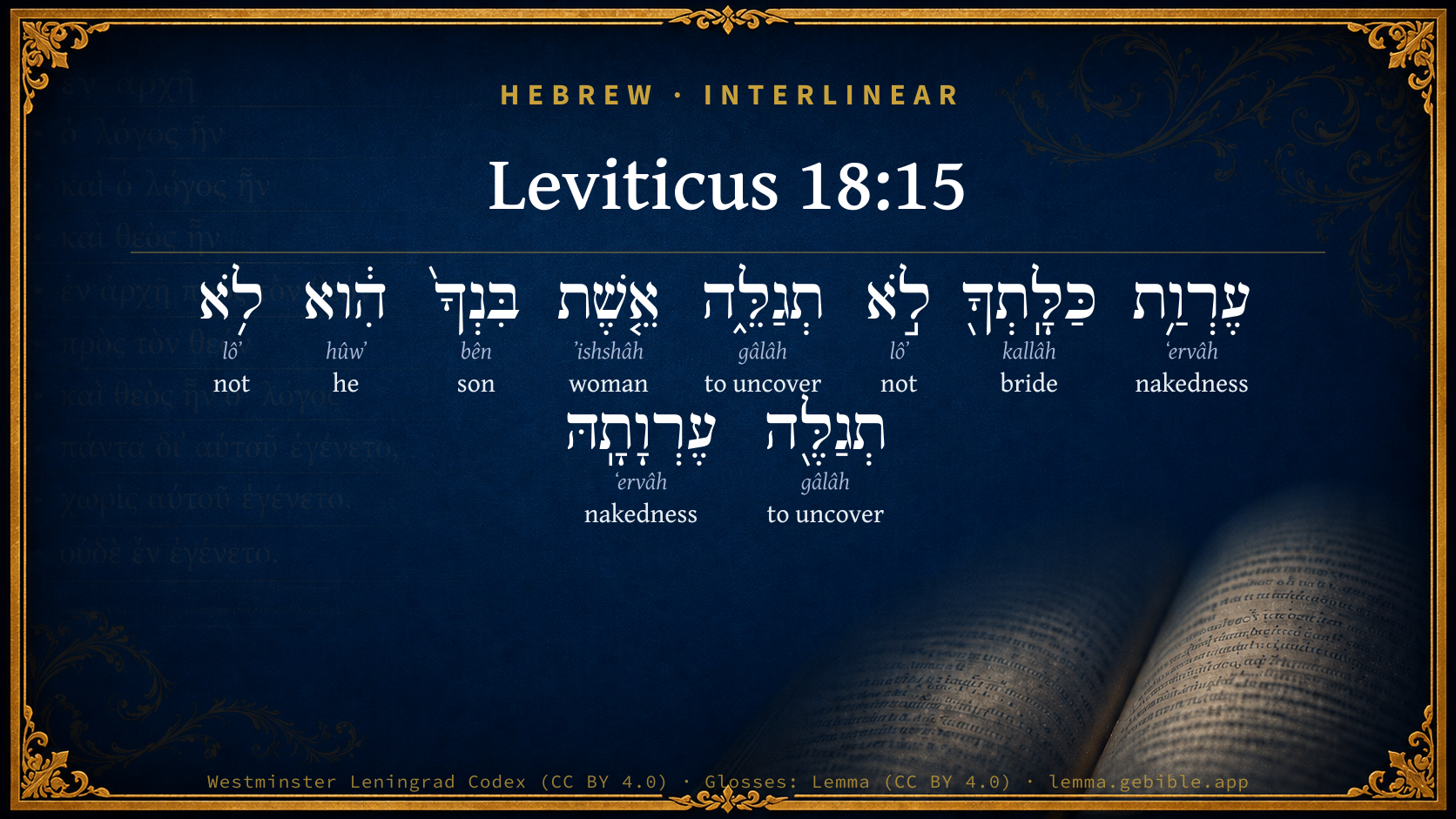
Hebrew (Westminster Leningrad Codex) Leviticus 18:15 appears in the Hebrew Old Testament. The text above is from the Westminster Leningrad Codex. Each word links to its Strong’s number, a concise gloss, and parsing drawn from the Open Scriptures Hebrew Bible morphology. Click any word for its full Brown-Driver-Briggs (BDB) entry.
Download image
Cite this verse

Leviticus 18:15 (World English Bible). Public Domain. Lemma interlinear Bible study tool, https://lemma.gebible.app/v/leviticus/18/15.

Show BibTeX & RIS
BibTeX
RIS
English Translation
"'You shall not uncover the nakedness of your daughter-in-law: she is your son's wife. You shall not uncover her nakedness.
World English Bible · Public Domain
Download a study sheet

One document with this verse’s original text, its word-by-word gloss line, the meaning frame, cross-references with their text, attributed commentary, and full source and license credits — printable, and it pastes into notes with its structure intact.

This verse Autodidact and up

Study sheet (.html) Plain text (.txt)

A passage Seminary Student

Up to 50 verses in one chapter. A passage sheet keeps up to 6 commentary sources and 12 cross-references per verse, in the order this page ranks them, and says so on the sheet whenever that leaves anything out. Ask for a single verse and you get the Autodidact verse sheet above.

Everything on this page stays free to read, with no account — the sheet is a download of what is already on screen, not access to it.

Want to remove ads? Support Godless Engineer
Compare translations 3

The same verse in 3 English versions, stacked beneath the original-language interlinear above. Click any original word for its lexicon entry.

Each is an independent rendering of the whole verse — the interlinear is not word-aligned to these translations.

Highlighted words mark where these versions differ — a whole-verse word diff, not a word-by-word alignment.

  • World English Bible Public Domain
    "'You shall not uncover the nakedness of your daughter-in-law: she is your son's wife. You shall not uncover her nakedness.
  • King James Version Public Domain
    Thou shalt not uncover the nakedness of thy daughter in law: she is thy son's wife; thou shalt not uncover her nakedness.
  • unfoldingWord Literal Text CC BY-SA 4.0
    The nakedness of your daughter-in-law, you shall not uncover. She is the wife of your son. You shall not uncover her nakedness.

unfoldingWord Literal Text — © unfoldingWord, licensed CC BY-SA 4.0. Word-aligned USFM3 via Door43 (git.door43.org/unfoldingWord/en_ult).

Versions to compare (up to 4)

3 of 4 selected

Show all 18 translations

Every available English version of this verse, each an independent rendering of the whole verse.

  • World English Bible Public Domain
    "'You shall not uncover the nakedness of your daughter-in-law: she is your son's wife. You shall not uncover her nakedness.
  • Berean Standard Bible Public Domain
    You must not have sexual relations with your daughter-in-law. She is your son’s wife; you are not to have sexual relations with her.
  • Majority Standard Bible Public Domain
    You must not have sexual relations with your daughter-in-law. She is your son’s wife; you are not to have sexual relations with her.
  • King James Version Public Domain
    Thou shalt not uncover the nakedness of thy daughter in law: she is thy son's wife; thou shalt not uncover her nakedness.
  • American Standard Version (1901) Public Domain
    Thou shalt not uncover the nakedness of thy daughter-in-law: she is thy son's wife; thou shalt not uncover her nakedness.
  • Revised Version (1885) Public Domain
    Thou shalt not uncover the nakedness of thy daughter in law: she is thy son’s wife; thou shalt not uncover her nakedness.
  • Geneva Bible (1599) Public Domain
    Thou shalt not discouer the shame of thy daughter in lawe: for she is thy sonnes wife: therefore shalt thou not vncouer her shame.
  • Douay-Rheims (1899) Public Domain
    Thou shalt not uncover the nakedness of thy daughter in law: because she is thy son's wife, neither shalt thou discover her shame.
  • Young's Literal Translation Public Domain
    `The nakedness of thy daughter-in-law thou dost not uncover; she `is' thy son's wife; thou dost not uncover her nakedness.
  • Literal Standard Version CC BY-SA 4.0
    You do not uncover the nakedness of your daughter-in-law; she [is] your son’s wife; you do not uncover her nakedness.
  • Unlocked Literal Bible CC BY-SA 4.0
    Do not sleep with your daughter-in-law. She is your son's wife; do not sleep with her.
  • unfoldingWord Literal Text CC BY-SA 4.0
    The nakedness of your daughter-in-law, you shall not uncover. She is the wife of your son. You shall not uncover her nakedness.
  • Darby Bible Public Domain
    The nakedness of thy daughter-in-law shalt thou not uncover: she is thy son's wife; thou shalt not uncover her nakedness.
  • World Messianic Bible Public Domain
    “‘You shall not uncover the nakedness of your daughter-in-law. She is your son’s wife. You shall not uncover her nakedness.
  • Webster's Bible Public Domain
    Thou shalt not uncover the nakedness of thy daughter-in-law: she is thy son's wife, thou shalt not uncover her nakedness.
  • Free Bible Version CC BY-SA 4.0
    Don't have sex with your daughter-in-law. She is your son's wife. Don't have sex with her.
  • Bible in Basic English Public Domain
    Or with your daughter-in-law, for she is your son's wife, and you may not take her.
  • JPS Tanakh (1917) Public Domain
    Thou shalt not uncover the nakedness of thy daughter-in-law: she is thy son' wife; thou shalt not uncover her nakedness.

Literal Standard Version (2020), Covenant Press — licensed CC BY-SA 4.0. Text via the HelloAO Bible API (eBible.org). Unlocked Literal Bible (unfoldingWord) — licensed CC BY-SA 4.0. Text via the HelloAO Bible API (eBible.org). unfoldingWord Literal Text — © unfoldingWord, licensed CC BY-SA 4.0. Word-aligned USFM3 via Door43 (git.door43.org/unfoldingWord/en_ult). Free Bible Version, Dr. Jonathan Gallagher — licensed CC BY-SA 4.0. Text via the HelloAO Bible API (eBible.org).

Word by word

More ways to search: Search by grammar → Find every occurrence → Compare this word →

Practice this passage: Drill this verse → Learn its vocabulary →

כַּלָּֽתְךָ֖
kallâh
H3618
“bride · your”
Noun, Common, Feminine, Singular, Construct + Suffix, Personal, 2nd Person, Masculine, Singular
Part of Speech
Noun
Type
Common
Gender
Feminine
Number
Singular
State
Construct
Full BDB Definition

Origin: from H3634

TWOT: 986a

bride, daughter-in-law - daughter-in-law - bride, young wife
  1. עֶרְוַ֥ת ʻervâh H6172 “nakedness of” Noun, Common, Feminine, Singular, Construct
  2. לֹ֣א lôʼ H3808 “not” Particle, Negative
  3. תְגַלֵּ֑ה gâlâh H1540 “to uncover” Verb, Piel, Imperfect, 2nd Person, Masculine, Singular
  4. אֵ֤שֶׁת ʼishshâh H802 “woman of” Noun, Common, Feminine, Singular, Construct
  5. בִּנְךָ֙ bên H1121 “son · your” Noun, Common, Masculine, Singular, Construct + Suffix, Personal, 2nd Person, Masculine, Singular
  6. הִ֔וא hûwʼ H1931 “he” Pronoun, Personal, 3rd Person, Feminine, Singular
  7. לֹ֥א lôʼ H3808 “not” Particle, Negative
  8. תְגַלֶּ֖ה gâlâh H1540 “to uncover” Verb, Piel, Imperfect, 2nd Person, Masculine, Singular
  9. עֶרְוָתָֽהּ ʻervâh H6172 “nakedness · her” Noun, Common, Feminine, Singular, Construct + Suffix, Personal, 3rd Person, Feminine, Singular

About this verse

These counts appear in no published source. They are computed here, from the morphology-tagged text and Lemma’s own curated glosses. What Lemma adds →

10
words
7
distinct lemmas
Pentateuch
section

Shared distinctive vocabulary

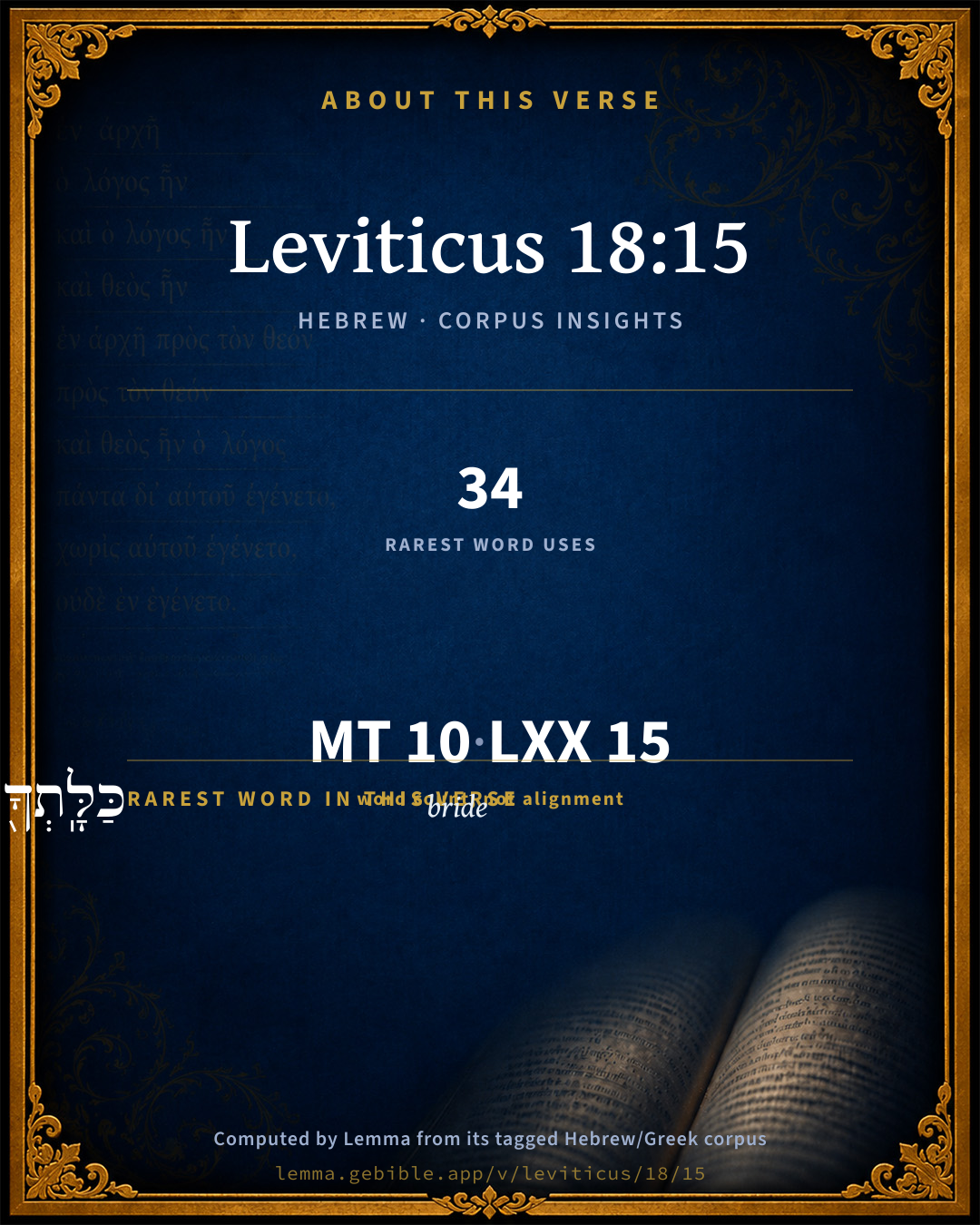
כַּלָּֽתְךָ֖ bride H3618 occurs in 34 verses of the Hebrew Bible. Also found in:

Grammatical profile

  • 2 verbs
  • 5 nouns
  • 1 pronoun
  • 2 particles

Verb forms

  • תְגַלֵּ֑ה Piel · Imperfect
  • תְגַלֶּ֖ה Piel · Imperfect

Repetition

Words recur within this verse — often emphatic in Hebrew:

  • עֶרְוַ֥ת nakedness H6172 ×2
  • תְגַלֵּ֑ה to uncover H1540 ×2
  • לֹ֣א not H3808 ×2

Hebrew & Septuagint length

In English translation the verse runs 20 words from the Hebrew and 21 from the Septuagint (LXX English) — closely comparable.

A rough comparison of the two English renderings, which tokenize alike — not a word-level alignment.

Word counts can differ between the Hebrew and the Greek without any difference in meaning — e.g. the Hebrew direct-object marker אֵת has no separate Greek word, and Greek often adds the article ὁ.

In the original languages it is 10 Hebrew tokens and 15 Greek tokens — but the two are counted differently (Hebrew bundles its prefixes and suffixes into one token; the Greek is in lemma form), so that isn’t a like-for-like length.

Cross-references

4

Topical passages linked to Leviticus 18:15 in the Treasury of Scripture Knowledge — connected by theme and wording, ordered by reader-vote popularity; previews shown in the World English Bible.

  • Leviticus 20:12 "'If a man lies with his daughter-in-law, both of them shall surely be put to death: they have committed a perversion; their blood shall be upon them.
  • Genesis 38:26 Judah acknowledged them, and said, "She is more righteous than I, because I didn't give her to Shelah, my son." He knew her again no more.
  • Ezekiel 22:11 One has committed abomination with his neighbor's wife; and another has lewdly defiled his daughter-in-law; and another in you has humbled his sister, his father's daughter.
  • Genesis 38:18–19 He said, "What pledge will I give you?" She said, "Your signet and your cord, and your staff that is in your hand." He gave them to her, and came in to her, and she conceived by him.

Cross-references courtesy of OpenBible.info (CC BY 4.0).

Hebrew and Greek witnesses Masoretic Hebrew ↔ Greek Septuagint

The same verse in the two great witnesses to the Old Testament, shown verse-for-verse.

These are two independent witnesses, not word-aligned to each other, and the Septuagint is shown in lemma (dictionary) form.

Hebrew Leviticus 18:15 Masoretic · Westminster Leningrad Codex

עֶרְוַ֥ת כַּלָּֽתְךָ֖ לֹ֣א תְגַלֵּ֑ה אֵ֤שֶׁת בִּנְךָ֙ הִ֔וא לֹ֥א תְגַלֶּ֖ה עֶרְוָתָֽהּ

"'You shall not uncover the nakedness of your daughter-in-law: she is your son's wife. You shall not uncover her nakedness.

World English Bible · Public Domain

Greek LXX Leviticus 18:15 Septuagint · lemma form

ἀσχημοσύνη νύμφη σύ οὐ ἀποκαλύπτω γυνή γάρ υἱός σύ εἰμί οὐ ἀποκαλύπτω ὁ ἀσχημοσύνη αὐτός

You shall not uncover the nakedness of your daughter-in-law, for she is your son's wife, you shall not uncover her nakedness.

LXX2012 (modern English Septuagint) · Public Domain

Hebrew: Westminster Leningrad Codex (CC BY 4.0). Greek: Septuagint (public domain); English from LXX2012 (modern English Septuagint) (Public Domain). How the Septuagint differs from the Hebrew →

Targum (Aramaic paraphrase)

2

The Targum is the ancient Jewish Aramaic paraphrase of the Hebrew Scriptures — an interpretive translation, not the Hebrew text itself. Onkelos (literal) and Pseudo-Jonathan (expansive) render the Torah, and Jonathan the Prophets. Coverage is partial: where no permissively-licensed English translation exists for a verse, only the Aramaic is shown. This is verse-level text, not a word-by-word alignment to the Hebrew.

  1. Targum Onkelos Torah (Genesis–Deuteronomy)
    עֶרְיַת כַּלָתָךְ לָא תְגַלֵי אִתַּת בְּרָךְ הִיא לָא תְגַלֵי עֶרְיָתָהּ

    (no public-domain English translation for this verse)

    Targum Onkelos — Aramaic: “Onkelos Genesis” (public domain); “Onkelos Exodus” (public domain); “Onkelos Leviticus” (public domain); “Onkelos Numbers” (public domain); “Onkelos Deuteronomy” (public domain). English: “Sefaria Community Translation” (CC0 1.0 (public-domain dedication)); “J.W. Etheridge. The Targums of Onkelos and Jonathan Ben Uzziel on the Pentateuch. London: Longmans, Green, 1862” (public domain). Text via Sefaria.

  2. Targum Pseudo-Jonathan Torah (Genesis–Deuteronomy)
    עֶרְיַית כַּלָתָךְ לָא תִבְזֵי אִתַּת בְּרָךְ הִיא לָא תִבְזֵי עִירְיְיתָהּ

    The nakedness of thy daughter-in-law thou shalt not dishonour; she is the wife of thy son, thou shalt not dishonour her nakedness.

    Targum Pseudo-Jonathan — Aramaic: “Targum Jonathan on Genesis” (public domain); “Targum Jonathan on Exodus” (public domain); “Targum Jonathan on Leviticus” (public domain); “Targum Jonathan on Numbers” (public domain); “Targum Jonathan on Deuteronomy” (public domain). English: “The Targum of Jonathan ben Uzziel, trans. J. W. Etheridge, London, 1862” (public domain). Text via Sefaria.

Commentary

Notes on Leviticus 18:15 from classic Christian and Jewish commentators (each source and its license shown beneath its notes). The classic Christian expositions comment on the surrounding passage and are grouped to its opening verse, so a note may address several verses; the Jewish commentaries on the Tanakh (Rashi and others) are per-verse, so they appear only where the commentator wrote on this verse.

Lemma curates 59 commentaries, every one of them public domain or Creative Commons licensed, each selected and text-cleaned for this edition rather than reprinted as found. About our sources →

Trapp's Complete Commentary

John Trapp

Lev 18:15 Thou shalt not uncover the nakedness of thy daughter in law: she [is] thy son’s wife; thou shalt not uncover her nakedness.

Ver. 15. Son’s wife.] Whether he be dead or alive.

John Trapp, A Commentary or Exposition upon All the Books of the Old and New Testament (1647–1656) — public domain. Text from a community e-Sword module.

Tyndale Open Study Notes

Tyndale Open Resources

18:15 Just as having sexual relations with your father’s wife would dishonor your father, having sexual relations with your daughter-in-law would dishonor your son. The law called for daughters-in-law to be treated like natural daughters (Exod 21:9; cp. Gen 38:1-30).

Tyndale Open Study Notes — © Tyndale Open Resources, licensed CC BY-SA 4.0. Text via the HelloAO Bible API.

Ellicott's Commentary for English Readers

(15) Thy daughter-in-law.—The legislators in the time of Christ defined this prohibition as applicable not only to cases where marriage between them had actually been consummated, but to cases where the maiden had only been espoused, or when the daughter-in-law had been divorced by the son, or had become a widow. For an offence of this kind both parties were punished with death. (See Lev_20:12.) Other nations regarded such alliances with the same abhorrence. (See Koran, 4:27.)

A Bible Commentary for English Readers, edited by Charles John Ellicott (1878–1897) — public domain. Text from a community e-Sword module.

John Gill's Exposition

Thou shall not uncover the nakedness of thy daughter in law,.... Shall not he with her in his son's lifetime, or marry her after his death:

she is that son's wife; and so one flesh with him, and who is of the same flesh and blood with his father, and therefore the nearness of the relation forbids such incestuous copulation or marriage:

thou shall not uncover her nakedness; or have carnal knowledge of her, whether in the life or after the death of his son, even then marriage with her is not lawful.

John Gill's Exposition of the Whole Bible (1746–1763) — public domain (CC PDM 1.0). Text via the HelloAO Bible API.

Haydock's Catholic Bible Commentary

CHAPTER XVIII.

George Leo Haydock (1774–1849), Haydock's Catholic Family Bible and Commentary, 1859 edition — public domain. Excludes Psalms (Douay-Rheims chapter numbering differs from Protestant) and Deuterocanonical books (Catholic canon only).

Keil & Delitzsch

C. F. Keil & F. Delitzsch

Sexual connection with a daughter-in-law, a son's wife, is called תּבל in Lev 20:12, and threatened with death to both the parties concerned. תּבל, from בּלל to mix, to confuse, signifies a sinful mixing up or confusing of the divine ordinances by unnatural unchastity, like the lying of a woman with a beast, which is the only other connection in which the word occurs (Lev 18:23).

Keil & Delitzsch — Biblical Commentary on the Old Testament (1861–1891) — public domain (CC PDM 1.0). Text via the HelloAO Bible API. (Old Testament only.)

unfoldingWord translationNotes

Door43 World Missions Community

do not sleep with her

Yahweh repeats this in order to emphasize the command. (See: Parallelism)

translationWords

had relations with

dishonor

unfoldingWord translationNotes — © Distant Shores Media and the Door43 World Missions Community, licensed CC BY-SA 4.0. Source: git.door43.org/Door43/en_tn.

Rashi

Rabbi Shlomo Yitzchaki (Rashi)

אשת בנך [THE NAKEDNESS OF THY DAUGHTER-IN-LAW THOU SHALT NOT UNCOVER; SHE IS] THY SON'S WIFE — By using the apparently redundant words: “she is thy son's wife" Scripture says, as it were: I command this about such a woman only when thy son has a legal matrimonial relation (אישות) to her, thus excluding a woman who has been raped by him (אנוסה) or a Canaanitish maid-servant, or a non-Jewess (cf. Sifra, Kedoshim, Chapter 10 10)).

Rashi on the Tanakh — English translations: “The Judaica Press complete Tanach with Rashi, translated by A. J. Rosenberg” (CC BY 4.0); “Pentateuch with Rashi's commentary by M. Rosenbaum and A.M. Silbermann, 1929-1934” (public domain); “The Metsudah Tanach series, Lakewood, N.J” (CC BY 4.0); and “The Book of Joshua, Metsudah Publications, 1997” (CC BY 4.0). Text via Sefaria.

Lesson kit

Teaching starters — assembled from the data on this page, not authored interpretation. Every prompt links to the verse data it draws on. Edit before teaching.

Leviticus, in the Pentateuch, opens this verse with 10 words (7 distinct Hebrew lemmas). Its most distinctive word is kallâh (“bride”). A historical commentator’s framing appears above. Read the whole chapter for the surrounding context.

Discussion questions

  1. How does “bride” (kallâh) shape what this verse is saying?
  2. How does Genesis 11:31, which shares the word «bride», read alongside this verse?
  3. What does the repetition of “nakedness” (2× in this one verse) do in this verse?
  4. These translations render this verse differently; the difference is in the English rendering, not the original. What questions does that raise?
  5. «תְגַלֵּ֑ה» is a Piel Imperfect verb. How does that grammatical form shape the action described?
  6. Compare how Trapp's Complete Commentary and Tyndale Open Study Notes read this verse. Where do they agree or differ?

Things to notice

Reading settings

Reading text

Shown beneath each verse's original-language words.

Old Testament
Old Testament edition

Read the OT as the Masoretic Hebrew (MT) or the Greek Septuagint (LXX).

English shown for the Greek Septuagint (in the Hebrew ↔ Greek comparison).

Comparing translations? Open the Compare panel on any verse page to stack up to four side by side.