
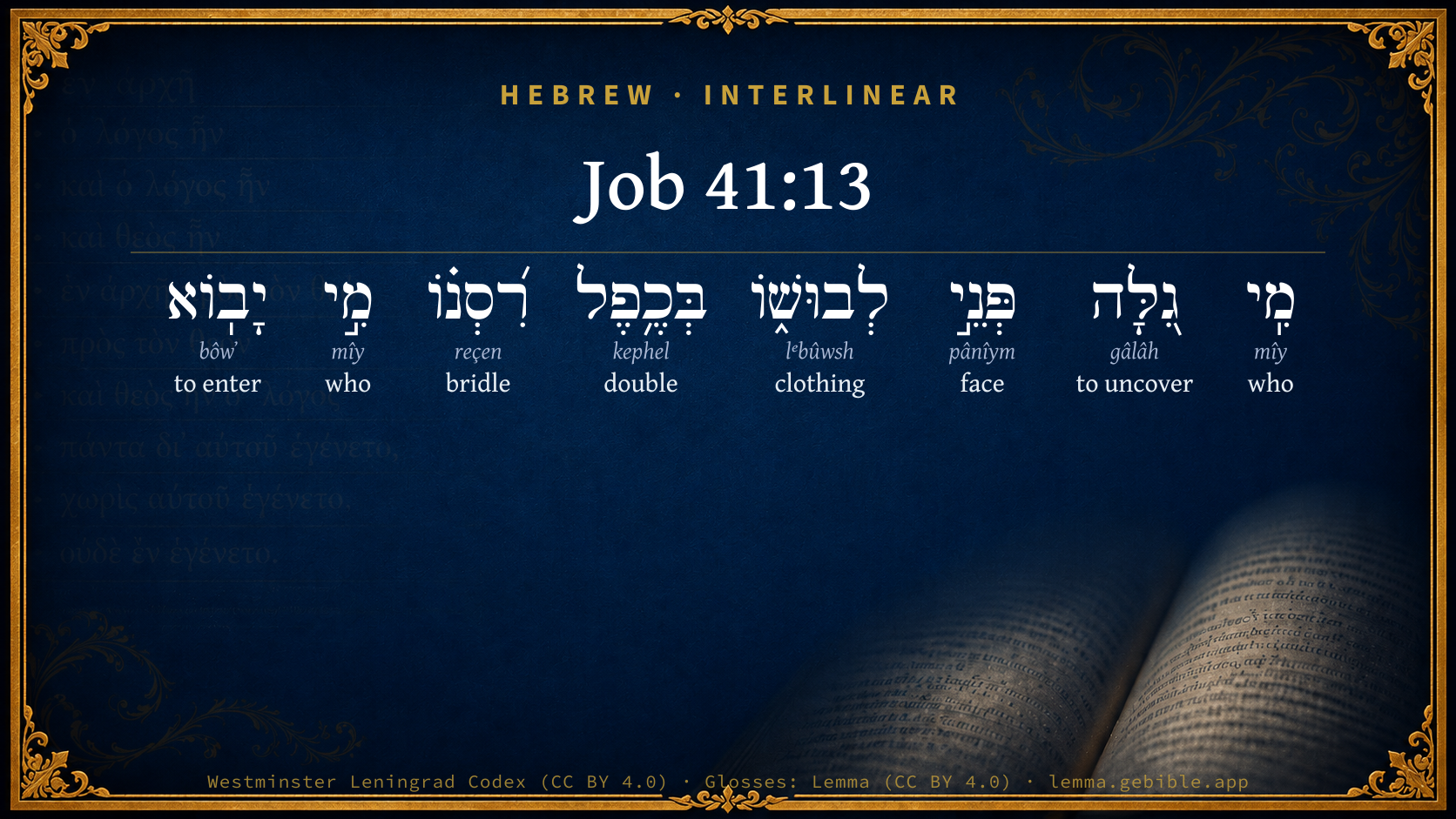
Job 41:13

Hebrew (Westminster Leningrad Codex) Job 41:13 appears in the Hebrew Old Testament. The text above is from the Westminster Leningrad Codex. Each word links to its Strong’s number, a concise gloss, and parsing drawn from the Open Scriptures Hebrew Bible morphology. Click any word for its full Brown-Driver-Briggs (BDB) entry.
Download image
Cite this verse

Job 41:13 (World English Bible). Public Domain. Lemma interlinear Bible study tool, https://lemma.gebible.app/v/job/41/13.

Show BibTeX & RIS
BibTeX
RIS
English Translation
Who can strip off his outer garment? Who shall come within his jaws?
World English Bible · Public Domain
Download a study sheet

One document with this verse’s original text, its word-by-word gloss line, the meaning frame, cross-references with their text, attributed commentary, and full source and license credits — printable, and it pastes into notes with its structure intact.

This verse Autodidact and up

Study sheet (.html) Plain text (.txt)

A passage Seminary Student

Up to 50 verses in one chapter. A passage sheet keeps up to 6 commentary sources and 12 cross-references per verse, in the order this page ranks them, and says so on the sheet whenever that leaves anything out. Ask for a single verse and you get the Autodidact verse sheet above.

Everything on this page stays free to read, with no account — the sheet is a download of what is already on screen, not access to it.

Want to remove ads? Support Godless Engineer
Compare translations 3

The same verse in 3 English versions, stacked beneath the original-language interlinear above. Click any original word for its lexicon entry.

Each is an independent rendering of the whole verse — the interlinear is not word-aligned to these translations.

Highlighted words mark where these versions differ — a whole-verse word diff, not a word-by-word alignment.

  • World English Bible Public Domain
    Who can strip off his outer garment? Who shall come within his jaws?
  • King James Version Public Domain
    Who can discover the face of his garment? or who can come to him with his double bridle?
  • unfoldingWord Literal Text CC BY-SA 4.0
    Who has removed the face of its clothing? Into the double of its bridle, who has entered?

unfoldingWord Literal Text — © unfoldingWord, licensed CC BY-SA 4.0. Word-aligned USFM3 via Door43 (git.door43.org/unfoldingWord/en_ult).

Versions to compare (up to 4)

3 of 4 selected

Show all 18 translations

Every available English version of this verse, each an independent rendering of the whole verse.

  • World English Bible Public Domain
    Who can strip off his outer garment? Who shall come within his jaws?
  • Berean Standard Bible Public Domain
    Who can strip off his outer coat? Who can approach him with a bridle?
  • Majority Standard Bible Public Domain
    Who can strip off his outer coat? Who can approach him with a bridle?
  • King James Version Public Domain
    Who can discover the face of his garment? or who can come to him with his double bridle?
  • American Standard Version (1901) Public Domain
    Who can strip off his outer garment? Who shall come within his jaws?
  • Revised Version (1885) Public Domain
    Who can strip off his outer garment? who shall come within his double bridle?
  • Geneva Bible (1599) Public Domain
    In his necke remayneth strength, and labour is reiected before his face.
  • Douay-Rheims (1899) Public Domain
    In his neck strength shall dwell, and want goeth before his face.
  • Young's Literal Translation Public Domain
    Who hath uncovered the face of his clothing? Within his double bridle who doth enter?
  • Literal Standard Version CC BY-SA 4.0
    Who has uncovered the face of his clothing? Who enters within his double bridle?
  • Unlocked Literal Bible CC BY-SA 4.0
    Who can strip off his outer covering? Who can penetrate his double armor?
  • unfoldingWord Literal Text CC BY-SA 4.0
    Who has removed the face of its clothing? Into the double of its bridle, who has entered?
  • Darby Bible Public Domain
    Who can uncover the surface of his garment? who can come within his double jaws?
  • World Messianic Bible Public Domain
    Who can strip off his outer garment? Who will come within his jaws?
  • Webster's Bible Public Domain
    \\41:22\\In his neck remaineth strength, and sorrow is turned into joy before him.
  • Free Bible Version CC BY-SA 4.0
    Who can remove its hide? Who can penetrate its double coat of armor?
  • Bible in Basic English Public Domain
    Strength is in his neck, and fear goes dancing before him.
  • JPS Tanakh (1917) Public Domain
    (41-5) Who can uncover the face of his garment? Who shall come within his double bridle?

Literal Standard Version (2020), Covenant Press — licensed CC BY-SA 4.0. Text via the HelloAO Bible API (eBible.org). Unlocked Literal Bible (unfoldingWord) — licensed CC BY-SA 4.0. Text via the HelloAO Bible API (eBible.org). unfoldingWord Literal Text — © unfoldingWord, licensed CC BY-SA 4.0. Word-aligned USFM3 via Door43 (git.door43.org/unfoldingWord/en_ult). Free Bible Version, Dr. Jonathan Gallagher — licensed CC BY-SA 4.0. Text via the HelloAO Bible API (eBible.org).

Word by word

More ways to search: Search by grammar → Find every occurrence → Compare this word →

Practice this passage: Drill this verse → Learn its vocabulary →

About this verse

These counts appear in no published source. They are computed here, from the morphology-tagged text and Lemma’s own curated glosses. What Lemma adds →

8
words
7
distinct lemmas
Wisdom
section

Notable vocabulary

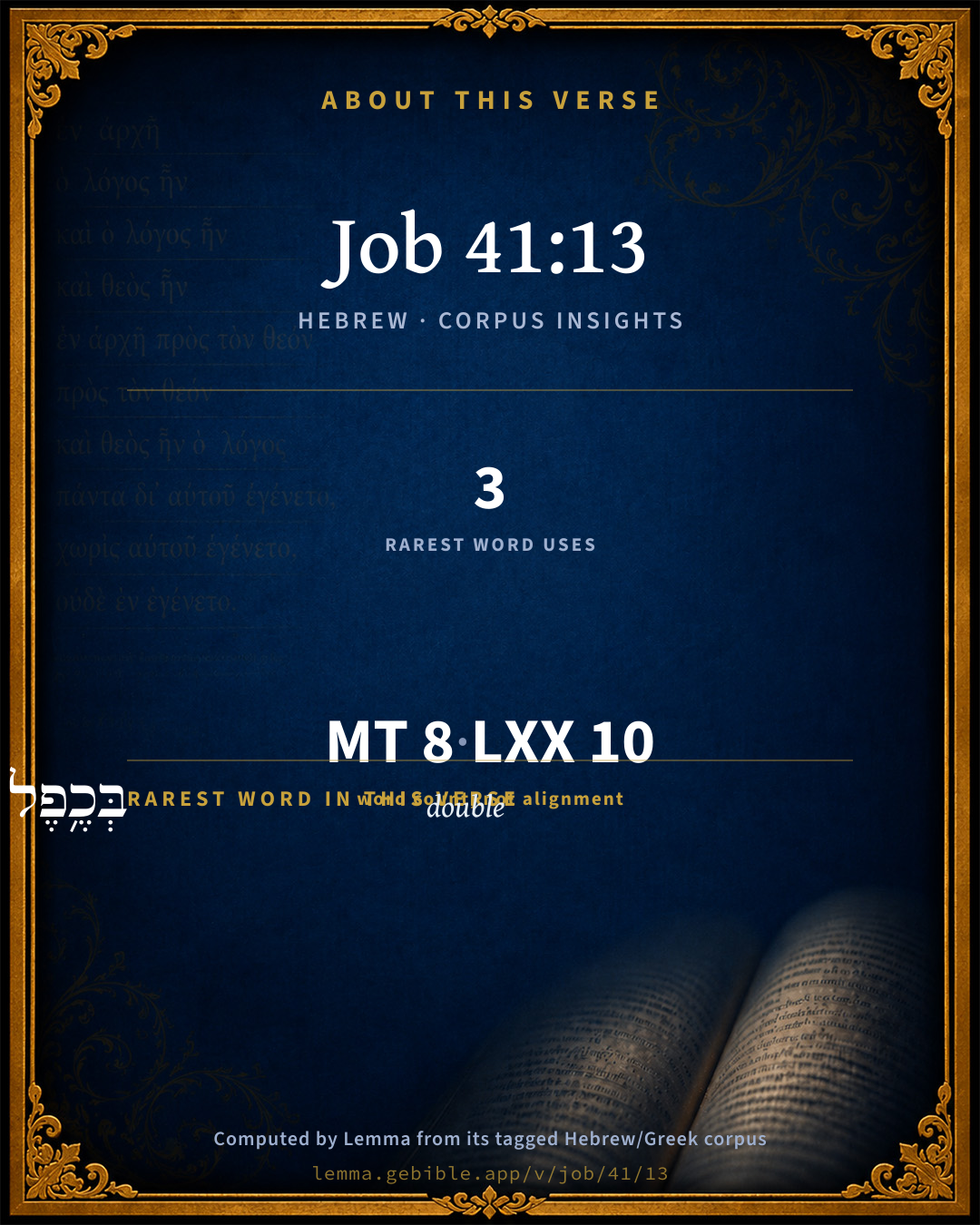
The rarest word here is בְּכֶ֥פֶל double H3718 — appearing just 3 times in the whole Hebrew Bible.

Shared distinctive vocabulary

בְּכֶ֥פֶל double H3718 occurs in 3 verses of the Hebrew Bible. Also found in:

Grammatical profile

  • 2 verbs
  • 4 nouns
  • 2 particles

Verb forms

  • גִ֭לָּה Piel · Perfect
  • יָבֽוֹא Qal · Imperfect

Repetition

A word recurs within this verse — often emphatic in Hebrew:

Hebrew & Septuagint length

In English translation the verse runs 13 words from the Hebrew and 11 from the Septuagint (LXX English) — closely comparable.

A rough comparison of the two English renderings, which tokenize alike — not a word-level alignment.

Word counts can differ between the Hebrew and the Greek without any difference in meaning — e.g. the Hebrew direct-object marker אֵת has no separate Greek word, and Greek often adds the article ὁ.

In the original languages it is 8 Hebrew tokens and 10 Greek tokens — but the two are counted differently (Hebrew bundles its prefixes and suffixes into one token; the Greek is in lemma form), so that isn’t a like-for-like length.

Cross-references

3

Topical passages linked to Job 41:13 in the Treasury of Scripture Knowledge — connected by theme and wording, ordered by reader-vote popularity; previews shown in the World English Bible.

  • 2 Kings 19:28 Because of your raging against me, and because your arrogance is come up into my ears, therefore will I put my hook in your nose, and my bridle in your lips, and I will turn you back by the way by which you came.
  • Psalms 32:9 Don't be like the horse, or like the mule, which have no understanding, Who are controlled by bit and bridle, or else they will not come near to you.
  • James 3:3 Indeed, we put bits into the horses' mouths so that they may obey us, and we guide their whole body.

Cross-references courtesy of OpenBible.info (CC BY 4.0).

Hebrew and Greek witnesses Masoretic Hebrew ↔ Greek Septuagint

The same verse in the two great witnesses to the Old Testament, shown verse-for-verse.

These are two independent witnesses, not word-aligned to each other, and the Septuagint is shown in lemma (dictionary) form.

Hebrew Job 41:13 Masoretic · Westminster Leningrad Codex

מִֽי גִ֭לָּה פְּנֵ֣י לְבוּשׁ֑וֹ בְּכֶ֥פֶל רִ֝סְנ֗וֹ מִ֣י יָבֽוֹא

Who can strip off his outer garment? Who shall come within his jaws?

World English Bible · Public Domain

Greek LXX Job 41:13 Septuagint · lemma form

ὁ ψυχή αὐτός ἄνθραξ φλόξ δέ ἐκ στόμα αὐτός ἐκπορεύομαι

And power is lodged in his neck, before him destruction runs.

LXX2012 (modern English Septuagint) · Public Domain

On this verse, Haydock's Catholic Bible Commentary discusses the Septuagint’s reading. Read the note in Commentary ↓

Hebrew: Westminster Leningrad Codex (CC BY 4.0). Greek: Septuagint (public domain); English from LXX2012 (modern English Septuagint) (Public Domain). How the Septuagint differs from the Hebrew →

Commentary

Notes on Job 41:13 from classic Christian and Jewish commentators (each source and its license shown beneath its notes). The classic Christian expositions comment on the surrounding passage and are grouped to its opening verse, so a note may address several verses; the Jewish commentaries on the Tanakh (Rashi and others) are per-verse, so they appear only where the commentator wrote on this verse.

Lemma curates 59 commentaries, every one of them public domain or Creative Commons licensed, each selected and text-cleaned for this edition rather than reprinted as found. About our sources →

Trapp's Complete Commentary

John Trapp

Job 41:13 Who can discover the face of his garment? [or] who can come [to him] with his double bridle?

Ver. 13. Who can discover the face of his garment?] That is, saith Piscator, who can pull him out of the sea, wherewith he is covered as with a garment? Who can slip off his skin while he is alive, as men do the eel’s skin, say others? Who (as men use to do when horses are to be saddled) will take off his cloth, and set the saddle upon his back? This last is Beza’s paraphrase; and it suits best with that which followeth.

Or who can come to him with his double bridle?] Let it be never so large or strong, his mouth is too wide, his jaws too strong, to be held in with bit and bridle, lest he come near unto thee.

John Trapp, A Commentary or Exposition upon All the Books of the Old and New Testament (1647–1656) — public domain. Text from a community e-Sword module.

Joseph Benson's Commentary

Job 41:13. Who can discover — מי גלה, mi gillah, Quis retexit, vel nudavit, Who hath uncovered, or made naked, or hath taken off from him, the face of his garment? — That is, his skin, which covers the whole body, and may be taken off from it like a garment. Who dare attempt to touch even his outward skin? much less dare any venture to endeavour to strip it off, or to give him a deep or deadly wound. Who can come to him with his double bridle? — To put it into his mouth, and lead him by it to thy stable and service, as he might do a horse? Or rather, (because he plainly seems to persist in describing the several parts of the leviathan’s body,) Who can come within his double bridle? or, as Heath translates it, his double row of teeth? namely, his vast jaws, which have some resemblance to a double bridle; whence the Greeks call those parts of the face which reach to the jaws on both sides the bridle. The crocodile’s mouth is exceedingly wide: Pliny says, strongly, “When he gapes, fit totum os, he becomes all mouth.”

Joseph Benson's Commentary on the Old and New Testaments (1811–1818) — public domain. Text from a community e-Sword module.

Geneva Bible (1599)

Geneva Bible translators

Nothing is painful or hard unto him.

Geneva Bible (1599) marginal notes — public domain. Text via Bolls.life.

Jamieson, Fausset & Brown

Robert Jamieson, A. R. Fausset & David Brown

discover--rather, "uncover the surface" of his garment (skin, Job 10:11): strip off the hard outer coat with which the inner skin is covered.

with--rather, "within his double jaws"; literally, "bridle"; hence that into which the bridle is put, the double row of teeth; but "bridle" is used to imply that none dare put his hand in to insert a bridle where in other animals it is placed (Job 41:4; Job 39:10).

Jamieson, Fausset & Brown — Commentary Critical and Explanatory on the Whole Bible (1871) — public domain (CC PDM 1.0). Text via the HelloAO Bible API.

Adam Clarke's Commentary

Verse 13. Who can discover the face of his garment?] Who can rip up the hide of this terrible monster? Who can take away his covering, in order to pierce his vitals?

Adam Clarke's Commentary on the Bible (1810–1826) — public domain. Text from a community e-Sword/MySword module.

Ellicott's Commentary for English Readers

(13) Who can discover . . . ?—Rather, Who can strip off his outer garment? i.e., his scales, which are the covering of his skin. Who shall come within his double bridle, i.e., the doubling of his jaw? Who would venture a limb within his jaws? This seems to be the meaning, rather than “Who shall come to him with his double bridle,” forsooth to take him therewith?

A Bible Commentary for English Readers, edited by Charles John Ellicott (1878–1897) — public domain. Text from a community e-Sword module.

The Cambridge Bible for Schools and Colleges

gen. ed. J. J. S. Perowne

13. The verse reads,

Who hath uncovered the face of his garment?

Or who will enter into his double jaw?

The “face of his garment” seems to mean the upper side or surface of his coat of scales, his armour; and the question is, Who has turned back, or removed this scaly covering? The question seems a general, preliminary one, as the scales are more particularly described in Job_41:15 seq. His “double jaw” is lit. his double bridle, the term “bridle” referring particularly perhaps to the corners of his jaws.

13, 14. The terrible jaws of the animal.

The Cambridge Bible for Schools and Colleges (gen. ed. J. J. S. Perowne; Cambridge University Press, 1878–1918) — public domain. Text from a community e-Sword module.

John Gill's Exposition

Who can discover the face of his garment?.... Or rather uncover it? Not the sea, which Mr. Broughton represents as the garment of the whale; who can strip him of it, or take him out of that, and bring him to land? which, though not impossible, is difficult: but either the garment of his face, the large bulk or prominence that hangs over his eyes; or rather his skin. Who dare venture to take off his skin, or flay him alive? or take off the scaly coat of the crocodile, which is like a coat of mail to him, and which he never of himself casts off, as serpents do?

or who can come to him with his double bridle? either go within his jaws, which, when opened, are like a double bridle; or go near and open his jaws, and put a curb bridle into them, and lead, direct, and rule him at pleasure. This is not to be done either to the whale or crocodile; yet the Tentyritae had a way of getting upon the back of the crocodile; and by putting a stick across its mouth, as it opened it to bite them, and so holding both the ends of it with the right and left hands, as with a bridle, brought them to land, as Pliny (s) relates; and so the Nereides are represented as sitting on the backs of whales by Theocritus (t).

(s) Ut supra. (Plin. l. 8. c. 25.) (t) Idyll. 19.

John Gill's Exposition of the Whole Bible (1746–1763) — public domain (CC PDM 1.0). Text via the HelloAO Bible API.

Albert Barnes' Notes on the Bible

Who can discern the face of his garment? - literally, “Who can reveal the face, that is, the appearance, of his garment?” This “garment” is undoubtedly his skin. The meaning seems to be, “His hard and rough skin is his defense, and no one can so strip off that as to have access to him.” The word rendered “discover” (גלה gâlâh) means “to make naked”; then “to reveal”; and the idea is, that he cannot be made naked of that covering, or deprived of it so that one could attack him.

Or who can come to him with his double bridle? - Margin, “within” Gesenius renders this, “The doubling of his jaws;” that is. his double row of teeth. Umbreit, “His double bit.” Noyes, “Who will approach his jaws?” So Rosenmuller. Schultens and Prof. Lee, however, suppose it means that no one can come near to him and “double the bit” upon him, “i. e.” cast the bit or noose over his nose, so as to secure him by doubling it, or passing it around him. The former seems to me to be the true meaning. “Into the doubling of his jaws, who can enter?” That is, Who will dare approach a double row of teeth so formidable?” The word rendered “bridle” (רסן resen) means properly a curb or halter, which goes over a horse’s nose, and hence, a bit or bridle. But it may be used to denote the interior of the mouth, the jaws, where the bit is placed, and then the phrase denotes the double row of teeth of the animal. Thus, the description of the “parts of defense” of the animal is kept up.

Albert Barnes' Notes on the Bible (1834–1885) — public domain. Text from a community e-Sword/MySword module.

Haydock's Catholic Bible Commentary

Neck. Some deny that the crocodile has any, being formed like a lizard. But it is a dispute about words. The animal turns with difficulty, so that Thomas Gage assures us he escaped one by going in different directions. --- Want. It ravages a whole country. Hebrew, "fear." (Calmet) --- Protestants, "sorrow is turned into joy before him;" which seems strange. Septuagint, "destruction runs before him." (Haydock) --- The poets place fear, carnage, &c., in the train of Mars. (Calmet)

George Leo Haydock (1774–1849), Haydock's Catholic Family Bible and Commentary, 1859 edition — public domain. Excludes Psalms (Douay-Rheims chapter numbering differs from Protestant) and Deuterocanonical books (Catholic canon only).

Matthew Poole's English Annotations

Discover, or, uncover, or take off from him.

The face of his garment; the upper or outward part of his garment, or the garment itself; the word face being oft redundant, as Gen 1:2; 23:3, and oft elsewhere. And by the garment is meant the skin, which covers the whole body, and may be taken off from the body like a garment. Who dare attempt to touch his very outward skin? much less dare any venture to approach him to give him a deep or deadly wound.

With his double bridle; to put it into his mouth, and lead him by it to thy stable and service, as thou dost by a horse. Or rather, (because he plainly seems to persist in describing the several parts of his body; of which he speaks both in the foregoing and following words,) who can come within his double bridle, to wit, his vast jaws, which have some resemblance to a double bridle; whence the Greeks call those parts of the face which reach to the jaws on both sides the bridles.

Matthew Poole's English Annotations on the Holy Bible (1683–1685) — public domain. Text from a community e-Sword/MySword module.

Whedon's Commentary on the Bible

Daniel D. Whedon

13. Who can discover — Rather, uncover, in the sense of lift up, as one would a veil, his outside garment; his closely wrought and scaly coat of mail. The text beautifully calls it his “garment” — לבושׁ— a description of which is given at large, Job_41:15-17. The double bridle — Literally, the double of his bridle, is here used figuratively for the jaws, each of which contained a double row of teeth, numbering, in the upper jaw, as many as thirty-six, and in the lower, thirty; and as they were uncovered by the lip, presenting a frightful appearance. Into his double jaws, who enters?

Daniel D. Whedon (gen. ed.), Commentary on the Old and New Testaments (1874–1909) — public domain. Text from a community e-Sword module.

The Pulpit Commentary

Who can discover the face of his garment? Some critics understand this in a general sense, "Who can lay him open to assault?" Others suggest a more definite meaning," Who can strip off his outer covering?" the scaly coat, that is, which forms his special defence, and expose the comparatively tender skin below? If this were done, he would then be at the hunter"s mercy; but who will undertake to do it? Who, again, can come to him with his double bridle? Come, i.e. , with a double bridle in his hand, and place it in the monster"s jaws. (So Schultens and Professor Lee.) Others translate, "Who will come within the range of his double bridle? and understand by "his double bridle" his two rows of teeth Homer"s erkov odontwn (Rosenmuller, Canon Cook, Professor Stanley Leathes, etc.).

The Pulpit Commentary (1880–1919), ed. H.D.M. Spence-Jones & Joseph S. Exell — public domain. Text from a community e-Sword module.

John Wesley's Explanatory Notes

Discover - Or, uncover, or take off from him. Face - The upper or outward part of his garment, or, the garment itself: the word face being often redundant. And by the garment is meant the skin which covers the whole body; who dare attempt to touch his very skin? Much less to give him a wound. His double bridle - His fast jaws, which have some resemblance to a double bridle: whence the Greeks call those parts of the face which reach to the jaws on both sides, the bridles.

John Wesley, Explanatory Notes Upon the Whole Bible (1754–1765) — public domain. Text via the GEBible commentary corpus.

unfoldingWord translationNotes

Door43 World Missions Community

Connecting Statement:

Yahweh continues to rebuke Job by asking him rhetorical questions.

Who can strip off his outer covering?

This question can be translated as a statement. AT: "No one can strip off his outer clothing." (See: Rhetorical Question)

his

The word "his" refers to Leviathan.

Who can penetrate his double armor?

The word "armor" is a metaphor for the hard scales or hide on his back. This question can be translated as a statement. AT: "No one can penetrate his very thick hide." (See: Metaphor and Rhetorical Question)

Who can open the doors of his face ... terror?

This question can be translated as a statement. AT: "No one can pry his jaws apart ... terror." (See: Rhetorical Question)

shields

The word "shields" is a metaphor for Leviathan's hide. Both shields and Leviathan's hide protect well and deflect arrows and other weapons. (See: Metaphor)

tight together as with a close seal

This means the "shields" are very close to one another and nothing can get between them.

translationWords

armor

face

terror

seal

unfoldingWord translationNotes — © Distant Shores Media and the Door43 World Missions Community, licensed CC BY-SA 4.0. Source: git.door43.org/Door43/en_tn.

Rashi

Rabbi Shlomo Yitzchaki (Rashi)

His breath kindles coals Burning and blazing coals. and flame And burning flames emerge from his mouth.

Rashi on the Tanakh — English translations: “The Judaica Press complete Tanach with Rashi, translated by A. J. Rosenberg” (CC BY 4.0); “Pentateuch with Rashi's commentary by M. Rosenbaum and A.M. Silbermann, 1929-1934” (public domain); “The Metsudah Tanach series, Lakewood, N.J” (CC BY 4.0); and “The Book of Joshua, Metsudah Publications, 1997” (CC BY 4.0). Text via Sefaria.

Lesson kit

Teaching starters — assembled from the data on this page, not authored interpretation. Every prompt links to the verse data it draws on. Edit before teaching.

Job, in the Wisdom, opens this verse with 8 words (7 distinct Hebrew lemmas). Its most distinctive word is kephel (“double”). A historical commentator’s framing appears above. Read the whole chapter for the surrounding context.

Discussion questions

  1. The word kephel carries the sense “double.” How does it shape the verse?
  2. Job 11:6 shares the word «double» with this verse. How do the two illuminate each other?
  3. “who” occurs 2× in this one verse. What is the effect of the repetition?
  4. These translations render this verse differently; the difference is in the English rendering, not the original. What questions does that raise?
  5. The verb «גִ֭לָּה» is Piel Perfect. How does its form color the action?
  6. Reading how Trapp's Complete Commentary and Joseph Benson's Commentary read this verse, where do the two commentators agree and where do they part?

Things to notice

Reading settings

Reading text

Shown beneath each verse's original-language words.

Old Testament
Old Testament edition

Read the OT as the Masoretic Hebrew (MT) or the Greek Septuagint (LXX).

English shown for the Greek Septuagint (in the Hebrew ↔ Greek comparison).

Comparing translations? Open the Compare panel on any verse page to stack up to four side by side.