Isaiah 16:3

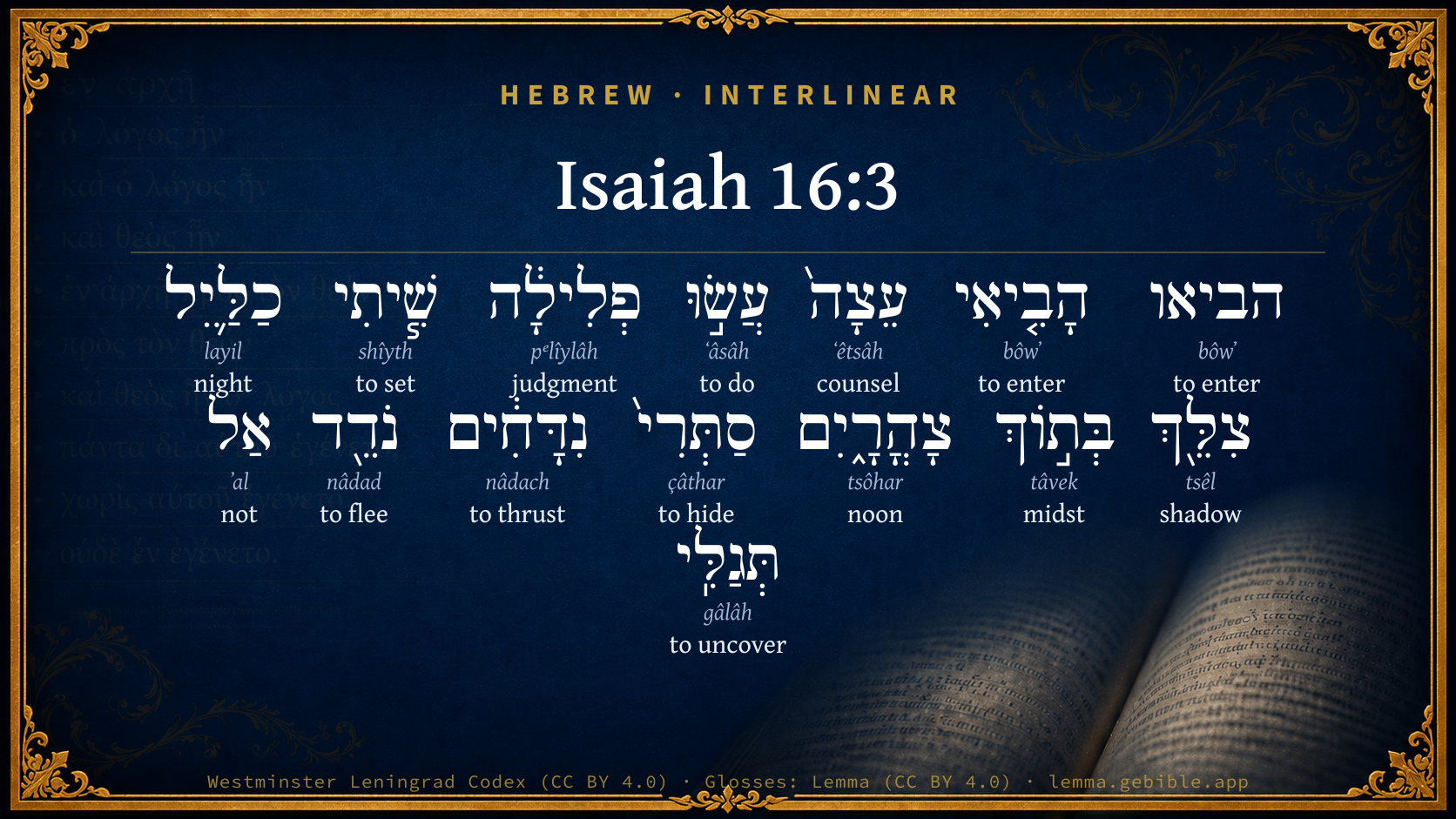
Hebrew (Westminster Leningrad Codex) Isaiah 16:3 appears in the Hebrew Old Testament. The text above is from the Westminster Leningrad Codex. Each word links to its Strong’s number, a concise gloss, and parsing drawn from the Open Scriptures Hebrew Bible morphology. Click any word for its full Brown-Driver-Briggs (BDB) entry.
Download image
Cite this verse

Isaiah 16:3 (World English Bible). Public Domain. Lemma interlinear Bible study tool, https://lemma.gebible.app/v/isaiah/16/3.

Show BibTeX & RIS
BibTeX
RIS
English Translation
Give counsel, execute justice; make your shade as the night in the midst of the noonday; hide the outcasts; don't betray the fugitive.
World English Bible · Public Domain
Highlights
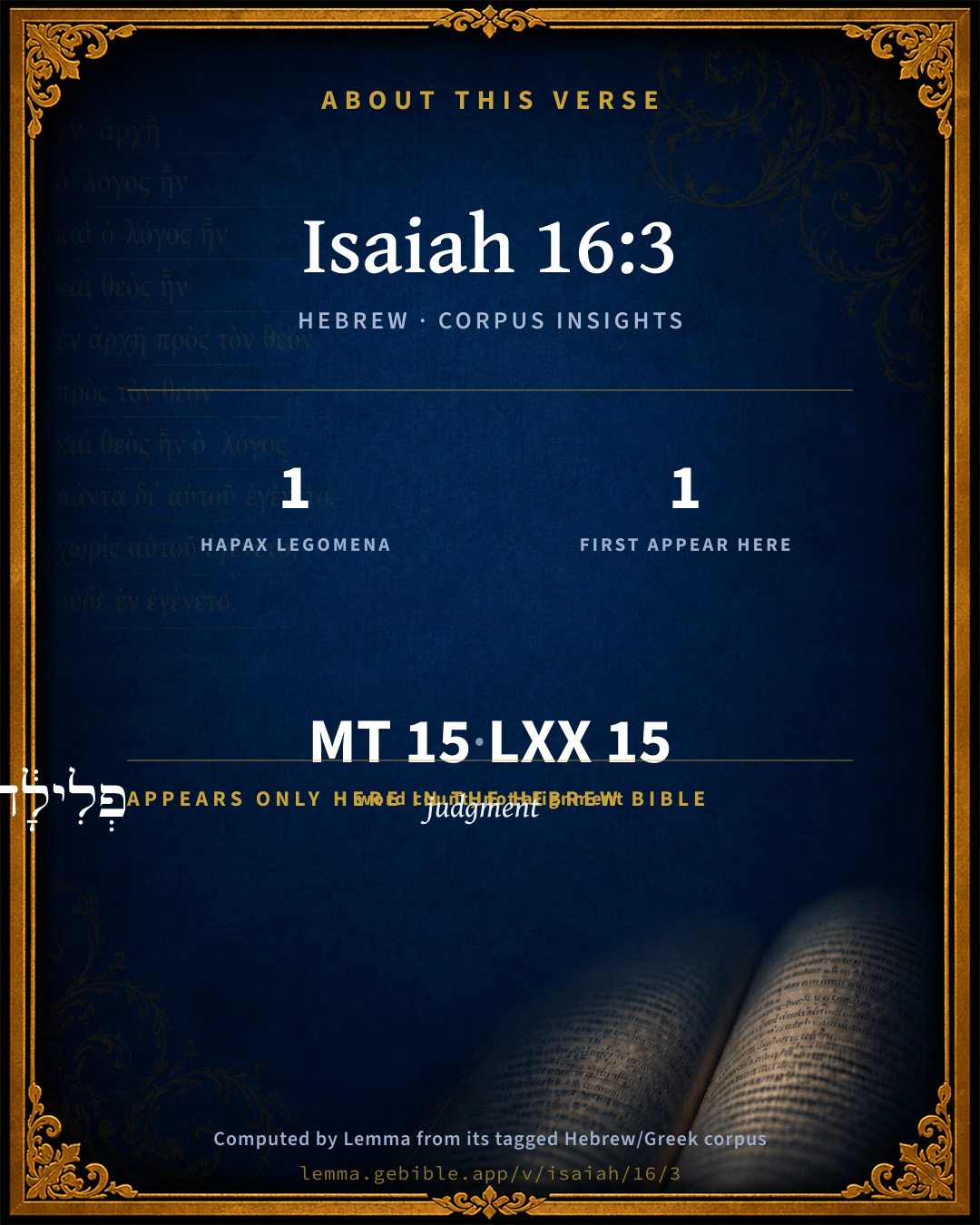
  • 1 hapax legomenon — only here in the Hebrew Bible
  • 1 first appearance in the Hebrew Bible
Full analysis ↓
Download a study sheet

One document with this verse’s original text, its word-by-word gloss line, the meaning frame, cross-references with their text, attributed commentary, and full source and license credits — printable, and it pastes into notes with its structure intact.

This verse Autodidact and up

Study sheet (.html) Plain text (.txt)

A passage Seminary Student

Up to 50 verses in one chapter. A passage sheet keeps up to 6 commentary sources and 12 cross-references per verse, in the order this page ranks them, and says so on the sheet whenever that leaves anything out. Ask for a single verse and you get the Autodidact verse sheet above.

Everything on this page stays free to read, with no account — the sheet is a download of what is already on screen, not access to it.

Want to remove ads? Support Godless Engineer
Compare translations 3

The same verse in 3 English versions, stacked beneath the original-language interlinear above. Click any original word for its lexicon entry.

Each is an independent rendering of the whole verse — the interlinear is not word-aligned to these translations.

Highlighted words mark where these versions differ — a whole-verse word diff, not a word-by-word alignment.

  • World English Bible Public Domain
    Give counsel, execute justice; make your shade as the night in the midst of the noonday; hide the outcasts; don't betray the fugitive.
  • King James Version Public Domain
    Take counsel, execute judgment; make thy shadow as the night in the midst of the noonday; hide the outcasts; bewray not him that wandereth.
  • unfoldingWord Literal Text CC BY-SA 4.0
    “Bring counsel, do justice. Make your shadow like night in the midst of noon. Hide the outcast ones; may you not reveal the wanderer.

unfoldingWord Literal Text — © unfoldingWord, licensed CC BY-SA 4.0. Word-aligned USFM3 via Door43 (git.door43.org/unfoldingWord/en_ult).

Versions to compare (up to 4)

3 of 4 selected

Show all 18 translations

Every available English version of this verse, each an independent rendering of the whole verse.

  • World English Bible Public Domain
    Give counsel, execute justice; make your shade as the night in the midst of the noonday; hide the outcasts; don't betray the fugitive.
  • Berean Standard Bible Public Domain
    “Give us counsel; render a decision. Shelter us at noonday with shade as dark as night. Hide the refugees; do not betray the one who flees.
  • Majority Standard Bible Public Domain
    “Give us counsel; render a decision. Shelter us at noonday with shade as dark as night. Hide the refugees; do not betray the one who flees.
  • King James Version Public Domain
    Take counsel, execute judgment; make thy shadow as the night in the midst of the noonday; hide the outcasts; bewray not him that wandereth.
  • American Standard Version (1901) Public Domain
    Give counsel, execute justice; make thy shade as the night in the midst of the noonday; hide the outcasts; betray not the fugitive.
  • Revised Version (1885) Public Domain
    Give counsel, execute judgment; make thy shadow as the night in the midst of the noonday: hide the outcasts; bewray not the wanderer.
  • Geneva Bible (1599) Public Domain
    Gather a cousel, execute iudgement: make thy shadowe as the night in the midday: hide them that are chased out: bewray not him that is fled.
  • Douay-Rheims (1899) Public Domain
    Take counsel, gather a council: make thy shadow as the night in the midday: hide them that flee, and betray not them that wander about.
  • Young's Literal Translation Public Domain
    Bring ye in counsel, do judgment, Make as night thy shadow in the midst of noon, Hide outcasts, the wanderer reveal not.
  • Literal Standard Version CC BY-SA 4.0
    Bring in counsel, do judgment, || Make your shadow as night in the midst of noon, || Hide outcasts, do not reveal the wanderer.
  • Unlocked Literal Bible CC BY-SA 4.0
    “Give instruction, execute justice; provide some shade like night in the middle of the day; hide the fugitives; do not betray the fugitives.
  • unfoldingWord Literal Text CC BY-SA 4.0
    “Bring counsel, do justice. Make your shadow like night in the midst of noon. Hide the outcast ones; may you not reveal the wanderer.
  • Darby Bible Public Domain
    Bring in counsel, execute justice; make thy shadow as the night in the midst of noonday; hide the outcasts, discover not the fugitive.
  • World Messianic Bible Public Domain
    Give counsel! Execute justice! Make your shade like the night in the middle of the noonday! Hide the outcasts! Don’t betray the fugitive!
  • Webster's Bible Public Domain
    Take counsel, execute judgment; make thy shadow as the night in the midst of the noon-day; hide the outcasts; discover not him that wandereth.
  • Free Bible Version CC BY-SA 4.0
    Think about it and make a decision. Make your shadow as invisible at midday as during the night. Hide the refugees; don't betray them as they run away.
  • Bible in Basic English Public Domain
    Give wise directions, make a decision; let your shade be as night in full day: keep safe those who are in flight; do not give up the wandering ones.
  • JPS Tanakh (1917) Public Domain
    'Give counsel, execute justice; make thy shadow as the night in the midst of the noonday; hide the outcasts; betray not the fugitive.

Literal Standard Version (2020), Covenant Press — licensed CC BY-SA 4.0. Text via the HelloAO Bible API (eBible.org). Unlocked Literal Bible (unfoldingWord) — licensed CC BY-SA 4.0. Text via the HelloAO Bible API (eBible.org). unfoldingWord Literal Text — © unfoldingWord, licensed CC BY-SA 4.0. Word-aligned USFM3 via Door43 (git.door43.org/unfoldingWord/en_ult). Free Bible Version, Dr. Jonathan Gallagher — licensed CC BY-SA 4.0. Text via the HelloAO Bible API (eBible.org).

Word by word

More ways to search: Search by grammar → Find every occurrence → Compare this word →

Practice this passage: Drill this verse → Learn its vocabulary →

פְלִילָ֔ה
pᵉlîylâh
H6415
“judgment”
Noun, Common, Feminine, Singular, Absolute
Part of Speech
Noun
Type
Common
Gender
Feminine
Number
Singular
State
Absolute
Full BDB Definition

Origin: from H6414

TWOT: 1776c

office of judge or umpire - (CLBL) judgment, decision
  1. הביאו bôwʼ H935 “enter” Verb, Hiphil, Imperative, 2nd Person, Masculine, Plural
  2. הָבִ֤יאִי bôwʼ H935 “enter” Verb, Hiphil, Imperative, 2nd Person, Feminine, Singular
  3. עֵצָה֙ ʻêtsâh H6098 “counsel” Noun, Common, Feminine, Singular, Absolute
  4. עֲשׂ֣וּ ʻâsâh H6213 “do” Verb, Qal, Imperative, 2nd Person, Masculine, Plural
  5. שִׁ֧יתִי shîyth H7896 “set” Verb, Qal, Imperative, 2nd Person, Feminine, Singular
  6. כַלַּ֛יִל layil H3915 “like/as the · night” Preposition, Determined + Noun, Common, Masculine, Singular, Absolute
  7. צִלֵּ֖ךְ tsêl H6738 “shadow · your” Noun, Common, Masculine, Singular, Construct + Suffix, Personal, 2nd Person, Feminine, Singular
  8. בְּת֣וֹךְ tâvek H8432 “in/at · midst of” Preposition + Noun, Common, Masculine, Singular, Construct
  9. צָהֳרָ֑יִם tsôhar H6672 “noon” Noun, Common, Masculine, Plural, Absolute
  10. סַתְּרִי֙ çâthar H5641 “hide” Verb, Piel, Imperative, 2nd Person, Feminine, Singular
  11. נִדָּחִ֔ים nâdach H5080 “thrusting” Verb, Niphal, Participle Active, Masculine, Plural, Absolute
  12. נֹדֵ֖ד nâdad H5074 “fleeing” Verb, Qal, Participle Active, Masculine, Singular, Absolute
  13. אַל ʼal H408 “not” Particle, Negative
  14. תְּגַלִּֽי gâlâh H1540 “to uncover” Verb, Piel, Jussive, 2nd Person, Feminine, Singular

About this verse

These counts appear in no published source. They are computed here, from the morphology-tagged text and Lemma’s own curated glosses. What Lemma adds →

15
words
14
distinct lemmas
Prophets
section

Notable vocabulary

1 hapax legomenon — a word that appears only here in the entire Hebrew Bible:

  • פְלִילָ֔ה judgment H6415

First appearance in Scripture

This word makes its first canonical appearance in the Hebrew Bible here:

  • פְלִילָ֔ה judgment H6415

Shared distinctive vocabulary

צָהֳרָ֑יִם noon H6672 occurs in 24 verses of the Hebrew Bible. Also found in:

Grammatical profile

  • 8 verbs
  • 6 nouns
  • 1 particle

Verb forms

  • הביאו Hiphil · Imperative
  • הָבִ֤יאִי Hiphil · Imperative
  • עֲשׂ֣וּ Qal · Imperative
  • שִׁ֧יתִי Qal · Imperative
  • סַתְּרִי֙ Piel · Imperative
  • נִדָּחִ֔ים Niphal · Participle Active
  • נֹדֵ֖ד Qal · Participle Active
  • תְּגַלִּֽי Piel · Jussive

Repetition

A word recurs within this verse — often emphatic in Hebrew:

  • הביאו to enter H935 ×2

Hebrew & Septuagint length

In English translation the verse runs 23 words from the Hebrew and 25 from the Septuagint (LXX English) — closely comparable.

A rough comparison of the two English renderings, which tokenize alike — not a word-level alignment.

Word counts can differ between the Hebrew and the Greek without any difference in meaning — e.g. the Hebrew direct-object marker אֵת has no separate Greek word, and Greek often adds the article ὁ.

In the original languages it is 15 Hebrew tokens and 15 Greek tokens — but the two are counted differently (Hebrew bundles its prefixes and suffixes into one token; the Greek is in lemma form), so that isn’t a like-for-like length.

Cross-references

17

Topical passages linked to Isaiah 16:3 in the Treasury of Scripture Knowledge — connected by theme and wording, ordered by reader-vote popularity; previews shown in the World English Bible.

  • 1 Kings 18:4 for it was so, when Jezebel cut off the prophets of Yahweh, that Obadiah took one hundred prophets, and hid them by fifty in a cave, and fed them with bread and water.)
  • Isaiah 32:2 A man shall be as a hiding-place from the wind, and a covert from the tempest, as streams of water in a dry place, as the shade of a great rock in a weary land.
  • Judges 9:15 The bramble said to the trees, If in truth you anoint me king over you, then come and take refuge in my shade; and if not, let fire come out of the bramble, and devour the cedars of Lebanon.
  • Psalms 82:3–4 "Defend the weak, the poor, and the fatherless. Maintain the rights of the poor and oppressed.
  • Isaiah 1:17 Learn to do well. Seek justice, Relieve the oppressed, Judge the fatherless, Plead for the widow."
  • Isaiah 9:6 For to us a child is born, to us a son is given; and the government shall be on his shoulder: and his name shall be called Wonderful, Counselor, Mighty God, Everlasting Father, Prince of Peace.
  • Isaiah 25:4 For you have been a stronghold to the poor, a stronghold to the needy in his distress, a refuge from the storm, a shade from the heat, when the blast of the awesome ones is as a storm against the wall.
  • Isaiah 56:8 The Lord Yahweh, who gathers the outcasts of Israel, says, Yet will I gather [others] to him, besides his own who are gathered.
  • Jeremiah 21:12 House of David, thus says Yahweh, Execute justice in the morning, and deliver him who is robbed out of the hand of the oppressor, lest my wrath go forth like fire, and burn so that none can quench it, because of the evil of your doings.
  • Jeremiah 22:3 Thus says Yahweh: Execute you justice and righteousness, and deliver him who is robbed out of the hand of the oppressor: and do no wrong, do no violence, to the foreigner, the fatherless, nor the widow; neither shed innocent blood in this place.
  • Ezekiel 45:9–12 Thus says the Lord Yahweh: Let it suffice you, princes of Israel: remove violence and spoil, and execute justice and righteousness; dispossessing my people, says the Lord Yahweh.
  • Daniel 4:27 Therefore, O king, let my counsel be acceptable to you, and break off your sins by righteousness, and your iniquities by showing mercy to the poor; if there may be a lengthening of your tranquillity.
  • Obadiah 1:12–14 But don't look down on your brother in the day of his disaster, and don't rejoice over the children of Judah in the day of their destruction. Don't speak proudly in the day of distress.
  • Jonah 4:5–8 Then Jonah went out of the city, and sat on the east side of the city, and there made himself a booth, and sat under it in the shade, until he might see what would become of the city.
  • Zechariah 7:9 "Thus has Yahweh of Hosts spoken, saying, 'Execute true judgment, and show kindness and compassion every man to his brother.
  • Matthew 25:35 for I was hungry, and you gave me food to eat; I was thirsty, and you gave me drink; I was a stranger, and you took me in;
  • Hebrews 13:2 Don't forget to show hospitality to strangers, for in doing so, some have entertained angels without knowing it.

Cross-references courtesy of OpenBible.info (CC BY 4.0).

Hebrew and Greek witnesses Masoretic Hebrew ↔ Greek Septuagint

The same verse in the two great witnesses to the Old Testament, shown verse-for-verse.

These are two independent witnesses, not word-aligned to each other, and the Septuagint is shown in lemma (dictionary) form.

Hebrew Isaiah 16:3 Masoretic · Westminster Leningrad Codex

הביאו הָבִ֤יאִי עֵצָה֙ עֲשׂ֣וּ פְלִילָ֔ה שִׁ֧יתִי כַלַּ֛יִל צִלֵּ֖ךְ בְּת֣וֹךְ צָהֳרָ֑יִם סַתְּרִי֙ נִדָּחִ֔ים נֹדֵ֖ד אַל תְּגַלִּֽי

Give counsel, execute justice; make your shade as the night in the midst of the noonday; hide the outcasts; don't betray the fugitive.

World English Bible · Public Domain

Greek LXX Isaiah 16:3 Septuagint · lemma form

πολύς βουλεύω ποιέω σκέπης πένθος αὐτός διά πᾶς ἐν μεσημβρινός σκοτία φεύγω ἐκἵστημι μή ἀποἄγω

take farther counsel, and continually make you a shelter from grief: they flee in darkness at mid-day; they are amazed; be not you led captive.

LXX2012 (modern English Septuagint) · Public Domain

Hebrew: Westminster Leningrad Codex (CC BY 4.0). Greek: Septuagint (public domain); English from LXX2012 (modern English Septuagint) (Public Domain). How the Septuagint differs from the Hebrew →

Targum (Aramaic paraphrase)

1

The Targum is the ancient Jewish Aramaic paraphrase of the Hebrew Scriptures — an interpretive translation, not the Hebrew text itself. Onkelos (literal) and Pseudo-Jonathan (expansive) render the Torah, and Jonathan the Prophets. Coverage is partial: where no permissively-licensed English translation exists for a verse, only the Aramaic is shown. This is verse-level text, not a word-by-word alignment to the Hebrew.

  1. Targum Jonathan Prophets (Joshua–Malachi)
    אִתְמְלִיכוּ מְלַךְ עֱבִידוּ עֵצָה שַׁוִיאוּ כְלֵילְיָא טוּלֵיךְ בִּימָמָא בְּגוֹ טִיהֲרָא טַמְרֵי מְטַלְטְלַיָא וּמְבַדְרַיָא לָא תִקְרְבוּן:

    Take counsel, execute counsel. Make thy shadow as the night in the day, in the midst of the noonday: hide the outcasts; touch not the dispersed.

    Targum Jonathan — Aramaic: “Mikraot Gedolot” (public domain). English: “Sefaria Community Translation” (CC0 1.0 (public-domain dedication)); “London "Chaldee Paraphrase," 1871” (public domain). Text via Sefaria.

Commentary

Notes on Isaiah 16:3 from classic Christian and Jewish commentators (each source and its license shown beneath its notes). The classic Christian expositions comment on the surrounding passage and are grouped to its opening verse, so a note may address several verses; the Jewish commentaries on the Tanakh (Rashi and others) are per-verse, so they appear only where the commentator wrote on this verse.

Lemma curates 59 commentaries, every one of them public domain or Creative Commons licensed, each selected and text-cleaned for this edition rather than reprinted as found. About our sources →

Jamieson, Fausset & Brown

Robert Jamieson, A. R. Fausset & David Brown

GESENIUS, MAURER, &c., regard these verses as an address of the fugitive Moabites to the Jews for protection; they translate Isa 16:4, "Let mine outcasts of Moab dwell with thee, Judah"; the protection will be refused by the Jews, for the pride of Moab (Isa 16:6). VITRINGA makes it an additional advice to Moab, besides paying tribute. Give shelter to the Jewish outcasts who take refuge in thy land (Isa 16:3-4); so "mercy" will be shown thee in turn by whatever king sits on the "throne" of "David" (Isa 16:5). Isaiah foresees that Moab will be too proud to pay the tribute, or conciliate Judah by sheltering its outcasts (Isa 16:6); therefore judgment shall be executed. However, as Moab just before is represented as itself an outcast in Idumea, it seems incongruous that it should be called on to shelter Jewish outcasts. So that it seems rather to foretell the ruined state of Moab when its people should beg the Jews for shelter, but be refused for their pride.

make . . . shadow as . . . night . . . in . . . noonday--emblem of a thick shelter from the glaring noonday heat (Isa 4:6; Isa 25:4; Isa 32:2).

bewray . . . wandereth--Betray not the fugitive to his pursuer.

Jamieson, Fausset & Brown — Commentary Critical and Explanatory on the Whole Bible (1871) — public domain (CC PDM 1.0). Text via the HelloAO Bible API.

Trapp's Complete Commentary

John Trapp

Isa 16:3 Take counsel, execute judgment; make thy shadow as the night in the midst of the noonday; hide the outcasts; bewray not him that wandereth.

Ver. 3. Take counsel, execute judgment.] Or, Make a decree, or deal equally and uprightly; shoew the like kindness to Abraham’s posterity as he once did to your progenitor Lot, whom he rescued; or as Lot did to the angels whom, as strangers, he entertained, fac, inquam, quod suggero, dum subdo.

Make thy shadow as the night in the midst of noonday,] i.e., Shelter and shade my persecuted people, este illis securum perfugium, et iucundum refrigerium, protect them, refresh them, do all kind offices for them, which your fathers did not, but the contrary. {Deu 23:3-4}

John Trapp, A Commentary or Exposition upon All the Books of the Old and New Testament (1647–1656) — public domain. Text from a community e-Sword module.

Albert Barnes' Notes on the Bible

Take counsel - Hebrew, ‘Bring counsel;’ or cause it to come (הבאו hâbı̂'ı̂û, or as it is in the keri הביאי). The Vulgate, renders this in the singular number, and so is the keri, and so many manuscripts J. D. Michaelis, Lowth, Etchhorn, Gesenius, and Noyes, regard Isa 16:3-5 as a supplicatory address of the fugitive Moabites to the Jews to take them under their protection, and as imploring a blessing on the Jewish people if they would do it; and Isa 16:6 as the negative answer of the Jews, or as a refusal to protect them on account of their pride. But most commentators regard it as addressed to the Moabites by the prophet, or by the Jews, calling upon the Moabites to afford such protection to the Jews who might be driven from their homes as to secure their favor, and confirm the alliance between them; and Isa 16:6 as an intimation of the prophet, that the pride of Moab is such that there is no reason to suppose the advice will be followed. It makes no difference in the sense here, whether the verb ‘give counsel’ be in the singular or the plural number.

If singular, it may be understood as addressed to “Moab” itself; if plural, to the “inhabitants” of Moab. Vitringa supposes that this an additional advice given to the Moabites by the prophet, or by a chorus of the Jews, to exercise the offices of kindness and humanity toward the Jews, that thus they might avoid the calamities which were impending. The “first” counsel was Isa 16:1, to pay the proper tribute to the Jewish nation; “this” is Isa 16:3-5 to show to those Jews who might be driven from their land kindness and protection, and thus preserve the friendship of the Jewish nation. This is, probably, the correct interpretation, as if he had said, ‘ake counsel; seek advice in your circumstances; be not hasty, rash, impetuous, unwise; do not cast off the friendship of the Jews; do not deal unkindly with those who may seek a refuge in your land, and thus provoke the nation to enmity; but let your land be an asylum, and thus conciliate and secure the friendship of the Jewish nation, and thus mercy shall be reciprocated and shown to you by him who shall occupy the throne of David’ Isa 16:5. The “design” is, to induce the Moabites to show kindness to the fugitive Jews who might seek a refuge there, that thus, in turn, the Jews might show them kindness. But the prophet foresaw Isa 16:6 that Moab was so proud that he would neither pay the accustomed tribute to the Jews, nor afford them protection; and, therefore, the judgment is threatened against them which is finally to overthrow them.

Execute judgment - That is, do that which is equitable and right; which you would desire to be done in like circumstances.

Make thy shadow - A “shadow or shade,” is often in the Scriptures an emblem of protection from the burning heat of the sun, and thence, of these burning, consuming judgments, which are represented by the intense heat of the sun (note, Isa 4:6; compare Isa 25:4; Isa 32:2; Lam 4:20).

As the night - That is, a deep, dense shade, such as the night is, compared with the intense heat of noon. This idea was one that was very striking in the East. Nothing, to travelers crossing the burning deserts, could be more refreshing than the shade of a far-projecting rock, or of a grove, or of the night. Thus Isaiah counsels the Moabites to be to the Jews - to furnish protection to them which may be like the grateful shade furnished to the traveler by the rock in the desert. The figure used here is common in the East. Thus it is said in praise of a nobleman: ‘Like the sun, he warmed in the cold; and when Sirius shone, then was he coolness and shade.’ In the “Sunna” it is said: ‘Seven classes of people will the Lord overshadow with his shade, when no shade will be like his; the upright Imam, the youth,’ etc.

Hide the outcasts - The outcasts of Judah - those of the Jews who may be driven away from their own homes, and who may seek protection in your land. Moab is often represented as a place of refuge to the outcast Hebrews (see the Analysis to Isa 15:1-9.)

Bewray not him that wandereth - Reveal not (תגלי tegalı̂y), do not show them to their pursuer; that is, give them concealment and protection.

Albert Barnes' Notes on the Bible (1834–1885) — public domain. Text from a community e-Sword/MySword module.

Joseph Benson's Commentary

Isa 16:3-4. Take counsel, &c. — We have here the second counsel given to the Moabites, which “contains a complex of various offices, equity, justice, humanity, to be exercised toward those of the Israelites whom the Assyrian affliction had driven, or should drive, to their borders and cities, and who should seek refuge among them: which counsel is so given to the Moabites, by the prophet, as evidently to upbraid them for the fault of having neglected these offices; the pernicious consequences of which they were sure to feel in the ensuing calamities, if they altered not so bad a practice.” — Dodd, Execute judgment — Hebrew, עשׂי פלילה, make a distinction. The expression denotes that act of the mind whereby it “discriminates truth from falsehood, right from wrong;” as if he had said, “Consider what becomes you, what is your duty in this case; what you owe to exiles and outcasts, both by the laws of equity and reason, of humanity and brotherly love.” Make thy shadow as the night — Or, as the shadow of the night, large and dark, as the shadow of the earth is in the night-season. “Afford my exiled and afflicted people, who shall flee to you for safety, a safe retreat, defence, and succour against the extreme, the noon-day heat of the sharp persecution which so heavily oppresses them.” The idea is taken from the comfort of a shady situation in those hot countries; and the metaphor is fully explained in what follows. Vitringa is of opinion that the prophet here refers to the distress of the Reubenites, Gadites, and Manassites under Tiglath-pileser. But it is more probable that he refers to the distress which should be caused in Judah by Pekah and Rezin, in the days of Ahaz, (Isa 9:1,) or that by the Assyrians? when Sennacherib came up against the defenced cities of Judah, and took them, Isa 36:1; during which distresses, undoubtedly, many of the Jews sought shelter among the Moabites and other neighbouring nations. For the extortioner is at an end — Hebrew, אפס המצ, the presser, wringer, or oppressor hath left off, or, as Bishop Lowth translates it, is no more; that is, shall shortly be destroyed, and my people shall ere long be restored, and then thou wilt not lose the fruit of thy kindness. The bishop renders the next two clauses, “The destroyer ceaseth, he that trampled under foot is perished from the land.” The present tense is put for the future, as it often is in prophecies. Thus “the prophet supports his counsel by a reason, the sum of which is, that oppression should cease, the spoilers of the earth be cut off, and the throne of clemency and grace established, on which a king of righteousness and equity should sit.”

Joseph Benson's Commentary on the Old and New Testaments (1811–1818) — public domain. Text from a community e-Sword module.

Tyndale Open Study Notes

Tyndale Open Resources

16:3-4 Do not betray us . . . Hide them: Moab’s situation would become so dire that they would beg for asylum in other lands.

Tyndale Open Study Notes — © Tyndale Open Resources, licensed CC BY-SA 4.0. Text via the HelloAO Bible API.

Geneva Bible (1599)

Geneva Bible translators

He showeth what Moab should have done, when Israel their neighbor was in affliction, to whom because they would give no shadow nor comfort, they are now left comfortless.

Geneva Bible (1599) marginal notes — public domain. Text via Bolls.life.

Adam Clarke's Commentary

Verse 3. Take counsel - "Impart counsel"] The Vulgate renders the verbs in the beginning of this verse in the singular number, So the Keri; and so likewise sixty-one MSS. of Kennicott's and De Rossi's have it, and nineteen editions, and the Syriac. The verbs throughout the verse are also in the feminine gender; agreeing with Zion, which I suppose to be understood.

Adam Clarke's Commentary on the Bible (1810–1826) — public domain. Text from a community e-Sword/MySword module.

Ellicott's Commentary for English Readers

(3) Make thy shadow as the night . . .—The whole verse is addressed, as the context shows, not by the prophet to Moab, but by Moab to the rulers of Judah. The fugitives call on those rulers to plead for them and act as umpires, to be to them “as the shadow of a great rock in a weary land” (Isa_32:2), black as night whilst the hot sun glares all around. Some critics, however, hold that the prophet still speaks to the Moabites and calls on them to protect the fugitives from Judah as they had done of old (Rth_1:2; 1Sa_22:3), and so to secure a return of like protection (Kay).

A Bible Commentary for English Readers, edited by Charles John Ellicott (1878–1897) — public domain. Text from a community e-Sword module.

The Cambridge Bible for Schools and Colleges

gen. ed. J. J. S. Perowne

3. Take counsel, execute judgment] Or, apply counsel, perform arbitration; i.e. “adopt wise and effectual measures to defend us from our enemies.”

make thy shadow as the night …] Be to us as “the shadow of a great rock in a weary land” (ch. Isa_32:2).

bewray not] lit. “uncover not.”

3–5. The address of Moab, through its ambassadors, to the court of Judah. Most of the older commentators took a different view of these verses, holding that here the prophet points out to the Moabites the way of national salvation through the practice of righteousness, and exhorts them in particular to shew kindness to any Israelitish refugees who might seek a home in that country. This interpretation appears to be followed by the A.V. (see on Isa_16:4). But such an exhortation is altogether out of keeping with the tone of the prophecy, and would be very ill-timed in the circumstances to which Moab was then reduced. The continuity of thought is far better maintained on the view given above, which is that of most recent scholars.

The Cambridge Bible for Schools and Colleges (gen. ed. J. J. S. Perowne; Cambridge University Press, 1878–1918) — public domain. Text from a community e-Sword module.

John Gill's Exposition

Take counsel, execute judgment,.... This refers either to what goes before, that they would take the counsel given, and do that which was just and right, by paying tribute to the king of Judah; or to what follows, that they would enter into a consultation, the king of Moab with his nobles, and resolve upon what was right, and do it, by protecting and harbouring the distressed Jews, who would flee unto them from the enemy:

make thy shadow as the night in the midst of the noonday; a time of the greatest heat, to which the Assyrian army, for its force and fury, and the mischief done by it, is compared: and the Moabites they are advised to make a shadow, as large and as strong as the dark night, that is, to protect the Jews in their distress, and to refresh and comfort them under it; see Isa 4:6,

hide the outcasts; such as were driven out of their land through the fury and persecution of the enemy, receive and conceal, as Rahab did the spies:

bewray not him that wandereth; from his native place, as a bird from its nest, being forced to it; such an one, or as many as may be, in such a case, do not discover them where they are, or betray them, and deliver them up into the hands of their enemy.

John Gill's Exposition of the Whole Bible (1746–1763) — public domain (CC PDM 1.0). Text via the HelloAO Bible API.

Haydock's Catholic Bible Commentary

Night. Seek a retreat in the darkest places; or protect Israel when they shall flee before the Assyrians. Their cruelty is thus insinuated, Amos i.

George Leo Haydock (1774–1849), Haydock's Catholic Family Bible and Commentary, 1859 edition — public domain. Excludes Psalms (Douay-Rheims chapter numbering differs from Protestant) and Deuterocanonical books (Catholic canon only).

Matthew Poole's English Annotations

Take counsel; consider seriously among yourselves what course to take to prevent your utter ruin.

Execute judgment; do those things which are just and right, as to all men, so particularly to my people, to whom you have been most unrighteous and unmerciful.

As the night; or, as the shadow of the night, large and dark, as the shadow of the earth is in the night season. The meaning is, Conceal and protect my people in the time of their distress and danger, as this metaphor is explained in the rest of this and in the following verse.

The outcasts; mine outcasts, as it follows, Isa 16:4, those of my people which are driven out of their land.

Bewray not him that wandereth unto their enemies, as thou hast treacherously done in former times.

Matthew Poole's English Annotations on the Holy Bible (1683–1685) — public domain. Text from a community e-Sword/MySword module.

The Pulpit Commentary

Take counsel, execute judgment, etc. According to most critics, these are the words of the Moabites, or of a Moabite ambassador at Jerusalem, and are a call on Judaea to give shelter to the fugitives from Moab. Some, however, as Dr. Kay, maintain that the words are the prophet"s, addressed to Moab, calling on her to treat kindly fugitives from Judaea. Make thy shadow as the night. (comp. Isa_4:6) In the hot land of Moab the sun is an enemy, and "the shadow of a great rock" a welcome refuge.

Practical righteousness.

It does not seem certain whether this counsel is addressed to Moab in relation to the people fleeing for shelter from the invasion of Sennacherib, or to Israel in relation to the outcasts from Moab. Whichever it be, the point of the counsel is that they should act kindly, considerately, charitably. Righteousness is like "pure religion and undefiled;" it is doing something visiting the fatherless and widows in their affliction." "He that doeth righteousness is righteous, even as he is righteous;" "If ye know these things, happy are ye if ye do them. Absolute righteousness, as before the all-searching God, is not a human possibility; but Scripture uses the term in reference to men. The psalmist says, "Judge me according to mine integrity, and according to my righteousness which is in me." And our Lord pleaded thus, "Except your righteousness shall exceed the righteousness of the scribes and Pharisees, ye shall in no case enter into the kingdom of heaven.

I RIGHTEOUSNESS MAY BE MERE SENTIMENT. A delusion of excited feeling, as it too often is with persons who take up with "holiness theories." The danger of sentiment is that too often it satisfies, and in the pleasant enjoyment of it a man has no care about giving righteousness its due expression. No fruits ever grew on the tree of sentimentality, and its leaves have no virtue for the healing of the nations.

II RIGHTEOUSNESS MAY BE A PROFESSION. It is assumed in our being Christians. It is the state into which we are called. It is guaranteed in our regeneration. Why, then, may we not be satisfied with this profession? Because such righteousness is, at the best, something belonging to a class, and not to the individual; and the only righteousness worth having is something which the individual has for himself alone.

III RIGHTEOUSNESS MUST BE A PRACTICE. "Even as he Christ is righteous;" and his righteousness was distinctly conduct, and the spirit of conduct. Righteousness is truth, brotherliness, service, charity, self-denial, purity; it is God-likeness, and God is righteous in all his works. It is well for us to have and to cherish right feelings and good resolves, but the question to ask ourselves is this If we have the opportunity, do we give these good resolves, do we find for these good thoughts and feelings practical expression? The message sent to David has often been misunderstood and misused. In connection with building the temple God said, "Thou didst well that it was in thine heart." But we forget that David went as far as he was allowed, in giving practical expression to what was in his heart; he made preparations for what he might not himself accomplish. R.T.

The Pulpit Commentary (1880–1919), ed. H.D.M. Spence-Jones & Joseph S. Exell — public domain. Text from a community e-Sword module.

John Wesley's Explanatory Notes

Take counsel - Consider seriously what course to take. Shadow - Or, as the shadow of the night, large and dark, as the shadow of the earth is in the night-season. Conceal and protect my people in the time of their distress. The out-casts - Those of my people who are driven out of their land. Wandereth - Unto their enemies.

John Wesley, Explanatory Notes Upon the Whole Bible (1754–1765) — public domain. Text via the GEBible commentary corpus.

Keil & Delitzsch

C. F. Keil & F. Delitzsch

There they show themselves, on the spot to which their land once reached before it passed into the possession of Israel - there, on its farthest boundary in the direction towards Judah, which was seated above; and taking heart, address the following petitions to Zion, or to the Davidic court, on the other side. "Give counsel, form a decision, make thy shadow like night in the midst of noon; hide the outcasts, do not betray the wanderers. Let mine outcasts tarry in thee, Moab; be a covert to it from before the spoiler." In their extremity they appeal to Zion for counsel, and the once proud but now thoroughly humbled Moabites place the decision of their fate in the hands of the men of Judah (so according to the Keri), and stand before Zion praying most earnestly for shelter and protection. Their fear of the enemy is so great, that in the light of the noon-day sun they desire to be covered with the protecting shade of Zion as with the blackness of night, that they may not be seen by the foe. The short-sentences correspond to the anxious urgency of the prayer (cf., Isa 33:8). Pelilâh (cf., peililyyâh, Isa 28:7) is the decision of a judge (pâlil); just as in Isa 15:5 sheilshiyyâh is the age and standing of three years. The figure of the shadow is the same as in Isa 30:2-3; Isa 32:2, etc.; nōdēd is the same as in Isa 21:14; niddâchai as in Isa 11:12; sēther as in Isa 32:2, and other passages; shōdēd as in Isa 33:1; mippenē as in Isa 21:15. The whole is word for word Isaiah's. There is no necessity to read nidchē instead of niddâc Mo'âb in Isa 16:4; still less is ay a collective termination, as in Isa 20:4. Nor are the words to be rendered "my outcasts ... of Moab," and the expression to be taken as a syntaxis ornata (cf., Isa 17:6). On the contrary, such an expression is absolutely impossible here, where the speaker is alluding to himself. It is better to abide by the punctuation as we have it, with niddâchai (zakeph) closing the first clause of Isa 16:4, and Moab (tebir, which is subordinate to the following tiphchah, and with this to athnach) opening the second as an absolute noun. This is the way in which we have rendered it above: "Moab ... be a shield to it ... " (though without taking lâmō as equivalent to lō).

The question then arises, By what means has Zion awakened such reverence and confidence on the part of Moab? This question is answered in Isa 16:4, Isa 16:5 : "For the extortioner is at an end, desolation has disappeared, treaders down are away from the land. And a throne is established by grace, and there sits thereon in truth in the tent of David one judging, and zealous for right, and practised in righteousness." The imperial world-power, which pressed out both marrow and blood (mētz, a noun of the same form as lētz, like mı̄tz in Pro 30:33, pressure), and devastated and trod down everything (Isa 29:20; Isa 10:6; Isa 33:1, cf., Isa 16:8), is swept away from the land on this side of the Jordan; Jerusalem is not subject to it now, but has come forth more gloriously out of all her oppressions than ever she did before. And the throne of the kingdom of Judah has not fallen down, but by the manifestation of Jehovah's grace has been newly established. There no longer sits thereon a king who dishonours Him, and endangers His kingdom; but the tent-roof of the fallen and now re-erected hut of David (Amo 9:11) is spread over a King in whom the truth of the promise of Jehovah is verified, inasmuch as justice and righteousness are realized through all that He does. The Messianic times must therefore have dawned (so the Targum understands it), since grace and truth (chesed ve'emeth) and "justice and righteousness" (mishpât ūtzedâkâh) are the divino-human signs of those times, and as it were their kindred genii; and who can here fail to recall to mind the words of Isa 9:6 (cf., Isa 33:5-6)? The king depicted here is the same as "the lion out of Judah," threatened against Moab in Isa 15:9. Only by thus submitting to Him and imploring His grace will it escape the judgment.

Keil & Delitzsch — Biblical Commentary on the Old Testament (1861–1891) — public domain (CC PDM 1.0). Text via the HelloAO Bible API. (Old Testament only.)

J. A. Alexander on Isaiah

Joseph Addison Alexander

Most of the older writers from Jerome downwards, understand this verse as a continuation of the advice to the Moabites, in which they are urged to act with prudence as well as justice, “to take counsel (i.e., provide for their own safety) as well as execute judgment (i.e., act right towards others).” In other words, they are exhorted to prepare for the day of their own calamity, by exercising mercy towards the Jews in theirs. But the explanation of the verse as the words of the Moabites addressed to the Jews, is favored by the foregoing context, which relates throughout to the sufferings of Moab, whereas on the other supposition, the prophet suddenly exhorts the sufferers to harbor the fugitives of that very nation, with whom they had themselves been exhorted to seek refuge. This interpretation also relieves us from the necessity of determining historically what particular affliction of the Israelites or Jews is here referred to, a question which has occasioned much perplexity, and which can be solved only by conjecture. As noonday heat is a common oriental figure to denote distress (Isa 4:6; Isa 25:4; Isa 32:20, so a shadow is a relief from it. Possibly, however, the allusion here is to the light of noonday, and the shadow dark as night denotes concealment. If so, the clause is equivalent in meaning to the one which follows.

Joseph Addison Alexander, The Prophecies of Isaiah (1846–1847; New York: Scribner, 1870–1878) — public domain. Text from a community e-Sword module.

unfoldingWord translationNotes

Door43 World Missions Community

General Information:

This continues the prophecy about the people of Moab. God describes events that will happen in the future as if it is happening in the present. Verses 3 and 4 is probably the message that the Moabite rulers send to the king of Judah. (See: Isaiah 15:1-2)

provide some shade like night in the middle of the day

The heat of the middle of the day represents the Moabites' suffering from their enemies, and shade represents protection from their enemies. Comparing the shade to night shows that they want strong protection. AT: "protect us completely from our enemies as a large shadow protects people from the hot sun" (See: Metaphor and Simile)

Let them live among you, the refugees from Moab

"Allow the refugees from Moab to live with you." Here "you" refers to the people of Judah.

be a hiding place for them from the destroyer

Providing a hiding place is spoken of as being a hiding place. AT: "give them a place to hide from those who are trying to destroy them" or "hide them from those who want to destroy them" (See: Metaphor)

translationWords

instruct

just

Moab

oppress

unfoldingWord translationNotes — © Distant Shores Media and the Door43 World Missions Community, licensed CC BY-SA 4.0. Source: git.door43.org/Door43/en_tn.

Rashi

Rabbi Shlomo Yitzchaki (Rashi)

deliberate judgment This is an expression of a debate of judgment, to choose for yourself what is good. Comp. (Job 34:4) “Let us choose for ourselves what is just.” [derajjsnement in O.F., discernment.]

make like the night your shadow Make yourself a shadow at noon that will darken your shadow like night, to hide therein from before your enemies.

conceal the exiles If the exiles of My people flee again through your land in the days of Nebuchadnezzar, do not turn them over to the Chaldees but conceal them.

Rashi on the Tanakh — English translations: “The Judaica Press complete Tanach with Rashi, translated by A. J. Rosenberg” (CC BY 4.0); “Pentateuch with Rashi's commentary by M. Rosenbaum and A.M. Silbermann, 1929-1934” (public domain); “The Metsudah Tanach series, Lakewood, N.J” (CC BY 4.0); and “The Book of Joshua, Metsudah Publications, 1997” (CC BY 4.0). Text via Sefaria.

Ibn Ezra

Rabbi Abraham ibn Ezra

Take counsel, etc. The prophet says to Moab, Before this misfortune befalls thee, take counsel for thyself.

פלילה Judgment. The form of the word is like that of אכילה eating (1 Kings 21:32); comp. פלילים judges (Deut. 32:21).

Thy shadow. To hide the Israelites, when they take refuge with thee. נדחים Outcasts. People that are banished from their home.

נודד Him that wandereth, without being banished. Bewray not, when he cometh unto thee.

Ibn Ezra on the Tanakh — English translations: “Sefaria Community Translation” (CC0 1.0 (public-domain dedication)); “Yalkut, Sifsei Chachomim Chumash, Metsudah Publications, 2009” (CC BY 4.0); and “Commentary of Ibn Ezra on Isaiah - trans. by M. Friedlander, 1873” (public domain). Text via Sefaria.

Lesson kit

Teaching starters — assembled from the data on this page, not authored interpretation. Every prompt links to the verse data it draws on. Edit before teaching.

Isaiah, in the Prophets, opens this verse with 15 words (14 distinct Hebrew lemmas). Its most distinctive word is pᵉlîylâh (“judgment”). A historical commentator’s framing appears above. Read the whole chapter for the surrounding context.

Discussion questions

  1. The word pᵉlîylâh carries the sense “judgment.” How does it shape the verse?
  2. 1 word here appears nowhere else in the Hebrew Bible. Why might the author reach for such rare wording?
  3. This is the first place “judgment” appears in Scripture (first appears here). What does its debut here establish?
  4. How does Genesis 6:16, which shares the word «noon», read alongside this verse?
  5. What does the repetition of “to enter” (2× in this one verse) do in this verse?
  6. These translations render this verse differently; the difference is in the English rendering, not the original. What questions does that raise?
  7. «הביאו» is a Hiphil Imperative verb. How does that grammatical form shape the action described?
  8. Compare how Jamieson, Fausset & Brown and Trapp's Complete Commentary read this verse. Where do they agree or differ?

Things to notice

  • 1 word in this verse appears nowhere else in the Hebrew Bible.
  • 1 word makes its first canonical appearance in Scripture here.
  • This verse counts 15 Hebrew ↔ 15 Greek words.
  • These translations choose different wording for 25 words in this verse.
  • “to enter” occurs 2× in this single verse.

Reading settings

Reading text

Shown beneath each verse's original-language words.

Old Testament
Old Testament edition

Read the OT as the Masoretic Hebrew (MT) or the Greek Septuagint (LXX).

English shown for the Greek Septuagint (in the Hebrew ↔ Greek comparison).

Comparing translations? Open the Compare panel on any verse page to stack up to four side by side.