Leviticus 18:10

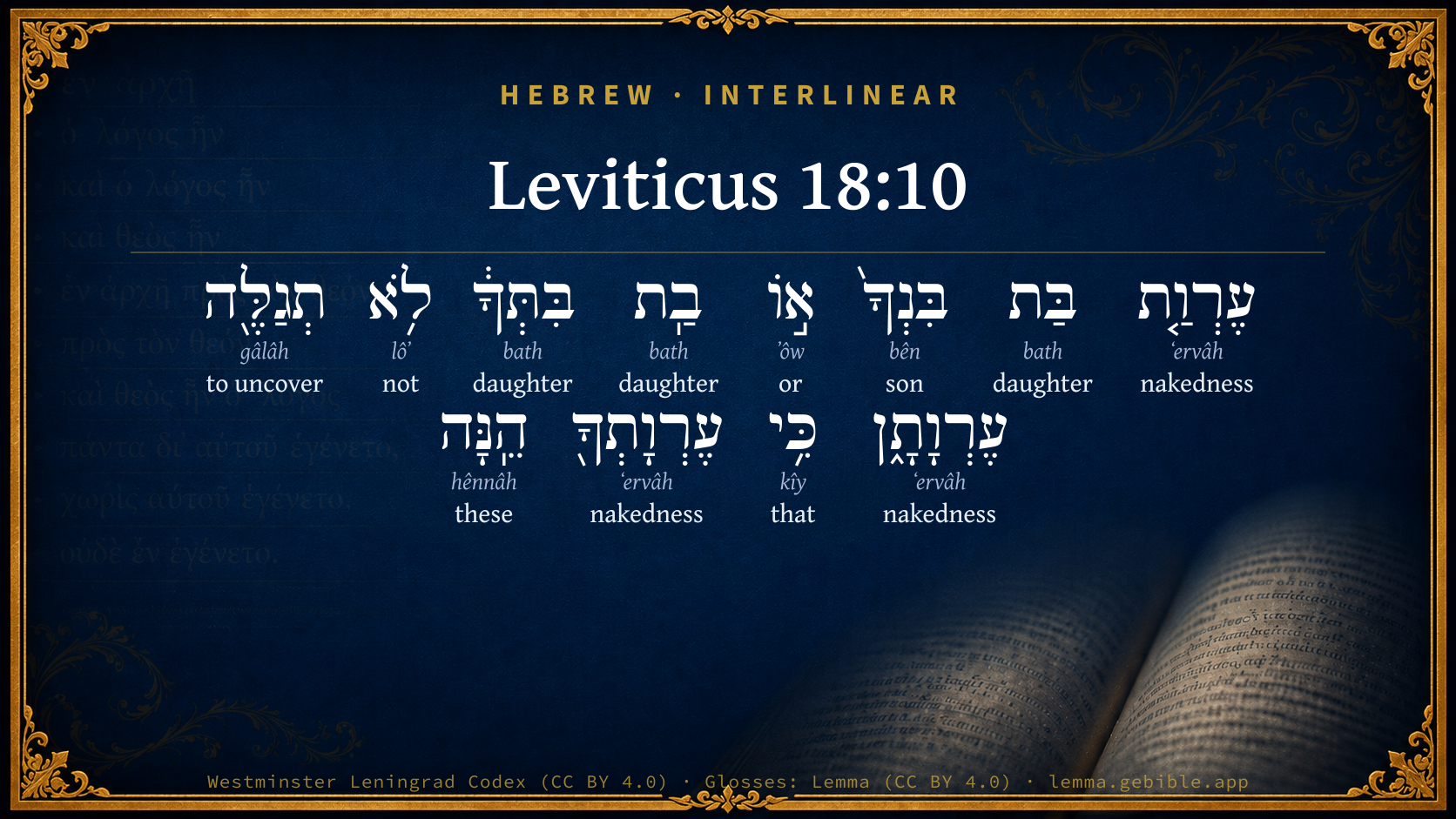
Hebrew (Westminster Leningrad Codex) Leviticus 18:10 appears in the Hebrew Old Testament. The text above is from the Westminster Leningrad Codex. Each word links to its Strong’s number, a concise gloss, and parsing drawn from the Open Scriptures Hebrew Bible morphology. Click any word for its full Brown-Driver-Briggs (BDB) entry.
Download image
Cite this verse

Leviticus 18:10 (World English Bible). Public Domain. Lemma interlinear Bible study tool, https://lemma.gebible.app/v/leviticus/18/10.

Show BibTeX & RIS
BibTeX
RIS
English Translation
"'You shall not uncover the nakedness of your son's daughter, or of your daughter's daughter, even their nakedness: for theirs is your own nakedness.
World English Bible · Public Domain
Download a study sheet

One document with this verse’s original text, its word-by-word gloss line, the meaning frame, cross-references with their text, attributed commentary, and full source and license credits — printable, and it pastes into notes with its structure intact.

This verse Autodidact and up

Study sheet (.html) Plain text (.txt)

A passage Seminary Student

Up to 50 verses in one chapter. A passage sheet keeps up to 6 commentary sources and 12 cross-references per verse, in the order this page ranks them, and says so on the sheet whenever that leaves anything out. Ask for a single verse and you get the Autodidact verse sheet above.

Everything on this page stays free to read, with no account — the sheet is a download of what is already on screen, not access to it.

Want to remove ads? Support Godless Engineer
Compare translations 3

The same verse in 3 English versions, stacked beneath the original-language interlinear above. Click any original word for its lexicon entry.

Each is an independent rendering of the whole verse — the interlinear is not word-aligned to these translations.

Highlighted words mark where these versions differ — a whole-verse word diff, not a word-by-word alignment.

  • World English Bible Public Domain
    "'You shall not uncover the nakedness of your son's daughter, or of your daughter's daughter, even their nakedness: for theirs is your own nakedness.
  • King James Version Public Domain
    The nakedness of thy son's daughter, or of thy daughter's daughter, even their nakedness thou shalt not uncover: for theirs is thine own nakedness.
  • unfoldingWord Literal Text CC BY-SA 4.0
    The nakedness of the daughter of your son or the daughter of your daughter— you shall not uncover their nakedness, for they your nakedness.

unfoldingWord Literal Text — © unfoldingWord, licensed CC BY-SA 4.0. Word-aligned USFM3 via Door43 (git.door43.org/unfoldingWord/en_ult).

Versions to compare (up to 4)

3 of 4 selected

Show all 18 translations

Every available English version of this verse, each an independent rendering of the whole verse.

  • World English Bible Public Domain
    "'You shall not uncover the nakedness of your son's daughter, or of your daughter's daughter, even their nakedness: for theirs is your own nakedness.
  • Berean Standard Bible Public Domain
    You must not have sexual relations with your son’s daughter or your daughter’s daughter, for that would shame your family.
  • Majority Standard Bible Public Domain
    You must not have sexual relations with your son’s daughter or your daughter’s daughter, for that would shame your family.
  • King James Version Public Domain
    The nakedness of thy son's daughter, or of thy daughter's daughter, even their nakedness thou shalt not uncover: for theirs is thine own nakedness.
  • American Standard Version (1901) Public Domain
    The nakedness of thy son's daughter, or of thy daughter's daughter, even their nakedness thou shalt not uncover: for theirs is thine own nakedness.
  • Revised Version (1885) Public Domain
    The nakedness of thy son’s daughter, or of thy daughter’s daughter, even their nakedness thou shalt not uncover: for theirs is thine own nakedness.
  • Geneva Bible (1599) Public Domain
    The shame of thy sonnes daughter, or of thy daughters daughter, thou shalt not, I say, vncouer their shame: for it is thy shame.
  • Douay-Rheims (1899) Public Domain
    Thou shalt not uncover the nakedness of thy son's daughter, or thy daughter's daughter: because it is thy own nakedness.
  • Young's Literal Translation Public Domain
    `The nakedness of thy son's daughter, or of thy daughter's daughter: thou dost not uncover their nakedness; for theirs `is' thy nakedness.
  • Literal Standard Version CC BY-SA 4.0
    The nakedness of your son’s daughter, or of your daughter’s daughter—you do not uncover their nakedness; for theirs [is] your nakedness.
  • Unlocked Literal Bible CC BY-SA 4.0
    Do not sleep with your son's daughter or with your daughter's daughter. That would be your own shame.
  • unfoldingWord Literal Text CC BY-SA 4.0
    The nakedness of the daughter of your son or the daughter of your daughter— you shall not uncover their nakedness, for they your nakedness.
  • Darby Bible Public Domain
    The nakedness of thy son's daughter, or of thy daughter's daughter -- their nakedness shalt thou not uncover; for theirs is thy nakedness.
  • World Messianic Bible Public Domain
    “‘You shall not uncover the nakedness of your son’s daughter, or of your daughter’s daughter, even their nakedness; for theirs is your own nakedness.
  • Webster's Bible Public Domain
    The nakedness of thy son's daughter, or of thy daughter's daughter, even their nakedness thou shalt not uncover: for theirs is thy own nakedness.
  • Free Bible Version CC BY-SA 4.0
    Don't have sex with your granddaughter, your son's daughter or your daughter's daughter, because that would be a shameful thing for you.
  • Bible in Basic English Public Domain
    You may not have sex relations with your son's daughter or your daughter's daughter, for they are part of yourself;
  • JPS Tanakh (1917) Public Domain
    The nakedness of thy son's daughter, or of thy daughter's daughter, even their nakedness thou shalt not uncover; for theirs is thine own nakedness.

Literal Standard Version (2020), Covenant Press — licensed CC BY-SA 4.0. Text via the HelloAO Bible API (eBible.org). Unlocked Literal Bible (unfoldingWord) — licensed CC BY-SA 4.0. Text via the HelloAO Bible API (eBible.org). unfoldingWord Literal Text — © unfoldingWord, licensed CC BY-SA 4.0. Word-aligned USFM3 via Door43 (git.door43.org/unfoldingWord/en_ult). Free Bible Version, Dr. Jonathan Gallagher — licensed CC BY-SA 4.0. Text via the HelloAO Bible API (eBible.org).

Word by word

More ways to search: Search by grammar → Find every occurrence → Compare this word →

Practice this passage: Drill this verse → Learn its vocabulary →

הֵֽנָּה
hênnâh
H2007
“these”
Pronoun, Personal, 3rd Person, Feminine, Plural
Part of Speech
Pronoun
Type
Personal
Person
3rd Person
Gender
Feminine
Number
Plural
Full BDB Definition

Origin: prolongation for H2004

TWOT: 504

they, these, the same, who
  1. עֶרְוַ֤ת ʻervâh H6172 “nakedness of” Noun, Common, Feminine, Singular, Construct
  2. בַּת bath H1323 “daughter of” Noun, Common, Feminine, Singular, Construct
  3. בִּנְךָ֙ bên H1121 “son · your” Noun, Common, Masculine, Singular, Construct + Suffix, Personal, 2nd Person, Masculine, Singular
  4. א֣וֹ ʼôw H176 “or” Conjunction
  5. בַֽת bath H1323 “daughter of” Noun, Common, Feminine, Singular, Construct
  6. בִּתְּךָ֔ bath H1323 “daughter · your” Noun, Common, Feminine, Singular, Construct + Suffix, Personal, 2nd Person, Masculine, Singular
  7. לֹ֥א lôʼ H3808 “not” Particle, Negative
  8. תְגַלֶּ֖ה gâlâh H1540 “to uncover” Verb, Piel, Imperfect, 2nd Person, Masculine, Singular
  9. עֶרְוָתָ֑ן ʻervâh H6172 “nakedness · their” Noun, Common, Feminine, Singular, Construct + Suffix, Personal, 3rd Person, Feminine, Plural
  10. כִּ֥י kîy H3588 “that” Conjunction
  11. עֶרְוָתְךָ֖ ʻervâh H6172 “nakedness · your” Noun, Common, Feminine, Singular, Construct + Suffix, Personal, 2nd Person, Masculine, Singular

About this verse

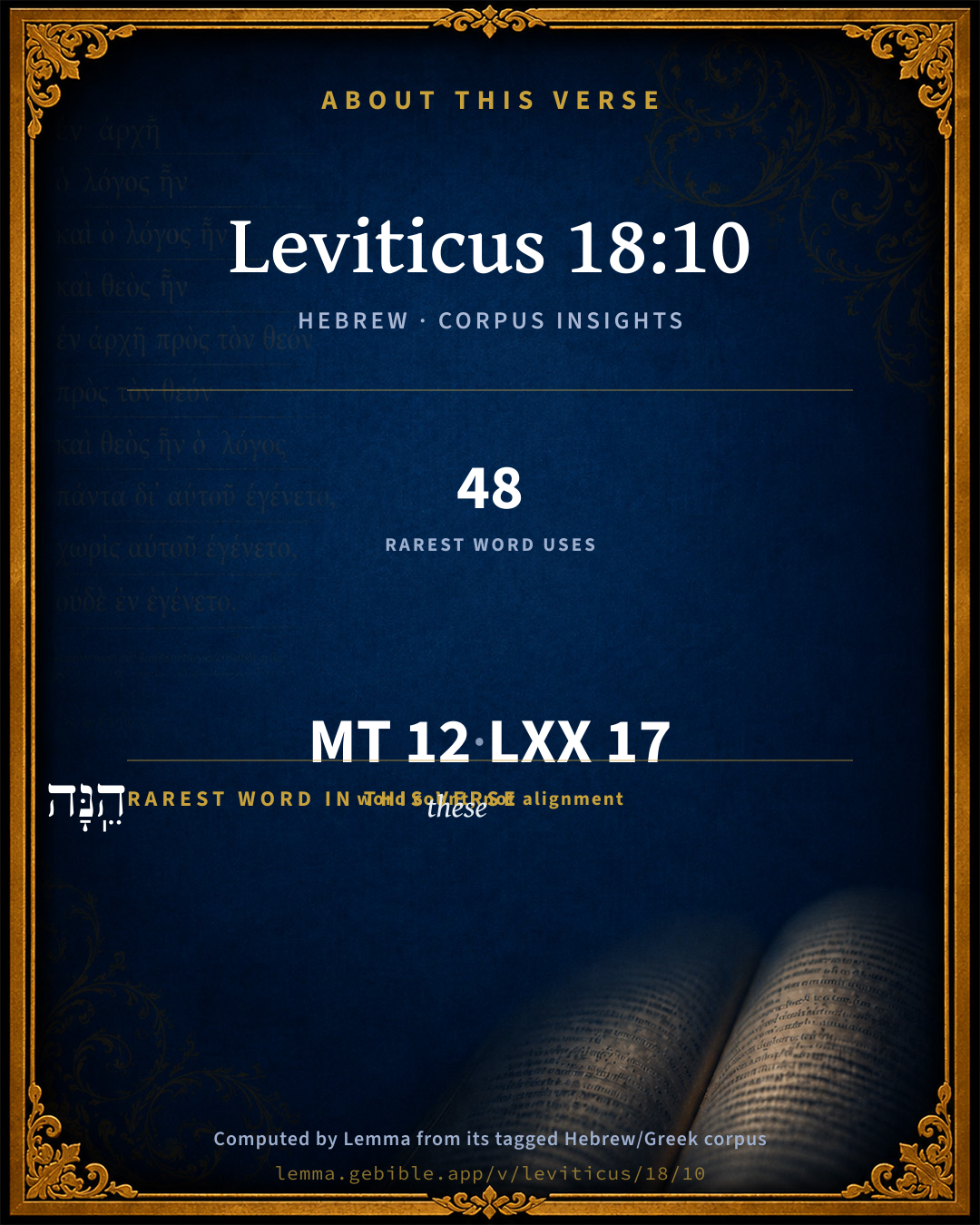
These counts appear in no published source. They are computed here, from the morphology-tagged text and Lemma’s own curated glosses. What Lemma adds →

12
words
8
distinct lemmas
Pentateuch
section

Shared distinctive vocabulary

הֵֽנָּה these H2007 occurs in 44 verses of the Hebrew Bible. Also found in:

Grammatical profile

  • 1 verb
  • 7 nouns
  • 1 pronoun
  • 2 conjunctions
  • 1 particle

Verb forms

  • תְגַלֶּ֖ה Piel · Imperfect

Repetition

Words recur within this verse — often emphatic in Hebrew:

  • עֶרְוַ֤ת nakedness H6172 ×3
  • בַּת daughter H1323 ×3

Hebrew & Septuagint length

In English translation the verse runs 24 words from the Hebrew and 21 from the Septuagint (LXX English) — closely comparable.

A rough comparison of the two English renderings, which tokenize alike — not a word-level alignment.

Word counts can differ between the Hebrew and the Greek without any difference in meaning — e.g. the Hebrew direct-object marker אֵת has no separate Greek word, and Greek often adds the article ὁ.

In the original languages it is 12 Hebrew tokens and 17 Greek tokens — but the two are counted differently (Hebrew bundles its prefixes and suffixes into one token; the Greek is in lemma form), so that isn’t a like-for-like length.

Hebrew and Greek witnesses Masoretic Hebrew ↔ Greek Septuagint

The same verse in the two great witnesses to the Old Testament, shown verse-for-verse.

These are two independent witnesses, not word-aligned to each other, and the Septuagint is shown in lemma (dictionary) form.

Hebrew Leviticus 18:10 Masoretic · Westminster Leningrad Codex

עֶרְוַ֤ת בַּת בִּנְךָ֙ א֣וֹ בַֽת בִּתְּךָ֔ לֹ֥א תְגַלֶּ֖ה עֶרְוָתָ֑ן כִּ֥י עֶרְוָתְךָ֖ הֵֽנָּה

"'You shall not uncover the nakedness of your son's daughter, or of your daughter's daughter, even their nakedness: for theirs is your own nakedness.

World English Bible · Public Domain

Greek LXX Leviticus 18:10 Septuagint · lemma form

ἀσχημοσύνη θυγάτηρ υἱός σύ ἤ θυγάτηρ θυγάτηρ σύ οὐ ἀποκαλύπτω ὁ ἀσχημοσύνη αὐτός ὅτι σός ἀσχημοσύνη εἰμί

The nakedness of your son's daughter, or your daughter's daughter, their nakedness you shall not uncover; because it is your nakedness.

LXX2012 (modern English Septuagint) · Public Domain

Hebrew: Westminster Leningrad Codex (CC BY 4.0). Greek: Septuagint (public domain); English from LXX2012 (modern English Septuagint) (Public Domain). How the Septuagint differs from the Hebrew →

Targum (Aramaic paraphrase)

2

The Targum is the ancient Jewish Aramaic paraphrase of the Hebrew Scriptures — an interpretive translation, not the Hebrew text itself. Onkelos (literal) and Pseudo-Jonathan (expansive) render the Torah, and Jonathan the Prophets. Coverage is partial: where no permissively-licensed English translation exists for a verse, only the Aramaic is shown. This is verse-level text, not a word-by-word alignment to the Hebrew.

  1. Targum Onkelos Torah (Genesis–Deuteronomy)
    עֶרְיַת בַּת בְּרָךְ אוֹ בַת בְּרַתָּךְ לָא תְגַלֵי עֶרְיַתְהֶן אֲרֵי עֶרְיְתָךְ אִנוּן

    (no public-domain English translation for this verse)

    Targum Onkelos — Aramaic: “Onkelos Genesis” (public domain); “Onkelos Exodus” (public domain); “Onkelos Leviticus” (public domain); “Onkelos Numbers” (public domain); “Onkelos Deuteronomy” (public domain). English: “Sefaria Community Translation” (CC0 1.0 (public-domain dedication)); “J.W. Etheridge. The Targums of Onkelos and Jonathan Ben Uzziel on the Pentateuch. London: Longmans, Green, 1862” (public domain). Text via Sefaria.

  2. Targum Pseudo-Jonathan Torah (Genesis–Deuteronomy)
    עֶרְיַית בְּרַת בְּנָךְ אוֹ בְּרַת בְּרַתָּךְ לָא תִבְזֵי עֶרְיַיתְהֶן אֲרוּם הֵי כְעִרְיָיתָךְ הִינוּן

    The nakedness of thy son's daughter, or the daughter of thy daughter, thou shalt not dishonour, because they are as thy own nakedness.

    Targum Pseudo-Jonathan — Aramaic: “Targum Jonathan on Genesis” (public domain); “Targum Jonathan on Exodus” (public domain); “Targum Jonathan on Leviticus” (public domain); “Targum Jonathan on Numbers” (public domain); “Targum Jonathan on Deuteronomy” (public domain). English: “The Targum of Jonathan ben Uzziel, trans. J. W. Etheridge, London, 1862” (public domain). Text via Sefaria.

Commentary

Notes on Leviticus 18:10 from classic Christian and Jewish commentators (each source and its license shown beneath its notes). The classic Christian expositions comment on the surrounding passage and are grouped to its opening verse, so a note may address several verses; the Jewish commentaries on the Tanakh (Rashi and others) are per-verse, so they appear only where the commentator wrote on this verse.

Lemma curates 59 commentaries, every one of them public domain or Creative Commons licensed, each selected and text-cleaned for this edition rather than reprinted as found. About our sources →

Trapp's Complete Commentary

John Trapp

Lev 18:10 The nakedness of thy son’s daughter, or of thy daughter’s daughter, [even] their nakedness thou shalt not uncover: for theirs [is] thine own nakedness.

Ver. 10. For theirs is thine own nakedness.] Children are but the father multiplied; the father of another edition.

John Trapp, A Commentary or Exposition upon All the Books of the Old and New Testament (1647–1656) — public domain. Text from a community e-Sword module.

Geneva Bible (1599)

Geneva Bible translators

They are her children whose shame thou hast uncovered.

Geneva Bible (1599) marginal notes — public domain. Text via Bolls.life.

Ellicott's Commentary for English Readers

(10) The nakedness of thy son’s daughter. From this prohibition it is inferred that a man must not marry his own daughter. If a granddaughter, who is a degree further removed from him, is proscribed, how much more his own daughter. Hence the canonical law during the second Temple deduced from this passage that “whoso companieth with a woman, even by way of fornication, and begetteth a daughter, she is forbidden to him.” Still, when the mother is expressly forbidden to the son (see Lev_18:7), it is strange that the daughter should have been passed over in silence, and be left to inference. It is therefore more than probable that a word has dropped out of the text, and that originally it stood here, “the nakedness of thy daughter and of thy son’s daughter,” &c. That this is not a solitary instance where the text has suffered from disarrangement we shall presently have occasion to see in Lev_18:11.

A Bible Commentary for English Readers, edited by Charles John Ellicott (1878–1897) — public domain. Text from a community e-Sword module.

The Cambridge Bible for Schools and Colleges

gen. ed. J. J. S. Perowne

10. The prohibition in the case of a daughter was probably omitted accidentally by a copyist from the beginning of this v.

The Cambridge Bible for Schools and Colleges (gen. ed. J. J. S. Perowne; Cambridge University Press, 1878–1918) — public domain. Text from a community e-Sword module.

John Gill's Exposition

The nakedness of thy son's daughter, or of thy daughter's daughter,.... A man might not marry his granddaughter, whether a descendant of his son or of his daughter, nor any further off descending from him in a right line, not his great-granddaughter, and so on; and if he might not marry his granddaughter, much less his own daughter, as Jarchi observes, for the relation is still nearer; therefore that being prohibited, this in course must, though not mentioned:

even their nakedness thou shalt not uncover; neither debauch nor marry such an one:

for theirs is thine own nakedness; which sprung from his, being the descendants either of his son or daughter; the Targum of Jonathan is,"for they are as thy nakedness,''his own flesh and blood.

John Gill's Exposition of the Whole Bible (1746–1763) — public domain (CC PDM 1.0). Text via the HelloAO Bible API.

Matthew Poole's English Annotations

And consequently of all thy children and children’s children, and all downwards; for they are a part of thyself, as coming out of thy loins, and out of thy wife, whose nakedness is thine own.

Matthew Poole's English Annotations on the Holy Bible (1683–1685) — public domain. Text from a community e-Sword/MySword module.

The Pulpit Commentary

The fourth case of incest which is prohibited is that with a granddaughter, whether the daughter of son or daughter, for, as they are descended from the grandfather, their"s is thine own nakedness.

The Pulpit Commentary (1880–1919), ed. H.D.M. Spence-Jones & Joseph S. Exell — public domain. Text from a community e-Sword module.

Keil & Delitzsch

C. F. Keil & F. Delitzsch

The prohibition of marriage with a granddaughter, whether the daughter of a son or daughter, is explained in the words, "for they are thy nakedness," the meaning of which is, that as they were directly descended from the grandfather, carnal intercourse with them would be equivalent to dishonouring his own flesh and blood.

Keil & Delitzsch — Biblical Commentary on the Old Testament (1861–1891) — public domain (CC PDM 1.0). Text via the HelloAO Bible API. (Old Testament only.)

Rashi

Rabbi Shlomo Yitzchaki (Rashi)

ערות בת בנך THE NAKEDNESS OF THE DAUGHTER OF THY SON [OR THE DAUGHTER OF THY DAUGHTER THOU SHALT NOT UNCOVER] — When it states "thy daughter״ Scripture is speaking of his daughter born of a woman whom he had outraged (similarly "the daughter of thy son" means, the son born of such a woman). This must be so, for that one is forbidden to marry one's daughter or the daughter of one's daughter who was born of one's wife we may learn from the prohibition (v. 17) in the verse beginning אשה ובתה ערות "the nakedness of a woman and her daughter" of whom it is stated "thou shalt not uncover" and which thus implies the prohibition to marry one's daughter (and forbids one's marriage with one's daughter's daughter; for Scripture continues there: “neither shalt thou take her son's daughter or her daughter's daughter) whether she be begotten by him or by another man (cf. Yevamot 22b and Rashi von v. 17).

ערות בת בנך THE NAKEDNESS OF THY SON'S DAUGHTER [… THOU SHALT NOT UNCOVER] — Since even thy son's daughter (the former being born from an אנוסה) is forbidden, the prohibition concerning thy own daughter born of thy אנוסה could be derived by a conclusion a minori ad majus (ק״ו). But because there is a rule אין מזהירין מן הדין “no prohibition can be derived by a logical conclusion" they (the Rabbis) derived it in Treatise Yevamot 3a by an analogy (גזירה שוה) based on the similar expression הנה — הנה used here and in v. 17.

Rashi on the Tanakh — English translations: “The Judaica Press complete Tanach with Rashi, translated by A. J. Rosenberg” (CC BY 4.0); “Pentateuch with Rashi's commentary by M. Rosenbaum and A.M. Silbermann, 1929-1934” (public domain); “The Metsudah Tanach series, Lakewood, N.J” (CC BY 4.0); and “The Book of Joshua, Metsudah Publications, 1997” (CC BY 4.0). Text via Sefaria.

Lesson kit

Teaching starters — assembled from the data on this page, not authored interpretation. Every prompt links to the verse data it draws on. Edit before teaching.

Leviticus, in the Pentateuch, opens this verse with 12 words (8 distinct Hebrew lemmas). Its most distinctive word is hênnâh (“these”). A historical commentator’s framing appears above. Read the whole chapter for the surrounding context.

Discussion questions

  1. The word hênnâh carries the sense “these.” How does it shape the verse?
  2. Genesis 6:2 shares the word «these» with this verse. How do the two illuminate each other?
  3. “nakedness” occurs 3× in this one verse. What is the effect of the repetition?
  4. These translations render this verse differently. What is at stake in choosing one wording over another?
  5. The verb «תְגַלֶּ֖ה» is Piel Imperfect. How does its form color the action?
  6. Reading how Trapp's Complete Commentary and Geneva Bible (1599) read this verse, where do the two commentators agree and where do they part?

Things to notice

Reading settings

Reading text

Shown beneath each verse's original-language words.

Old Testament
Old Testament edition

Read the OT as the Masoretic Hebrew (MT) or the Greek Septuagint (LXX).

English shown for the Greek Septuagint (in the Hebrew ↔ Greek comparison).

Comparing translations? Open the Compare panel on any verse page to stack up to four side by side.