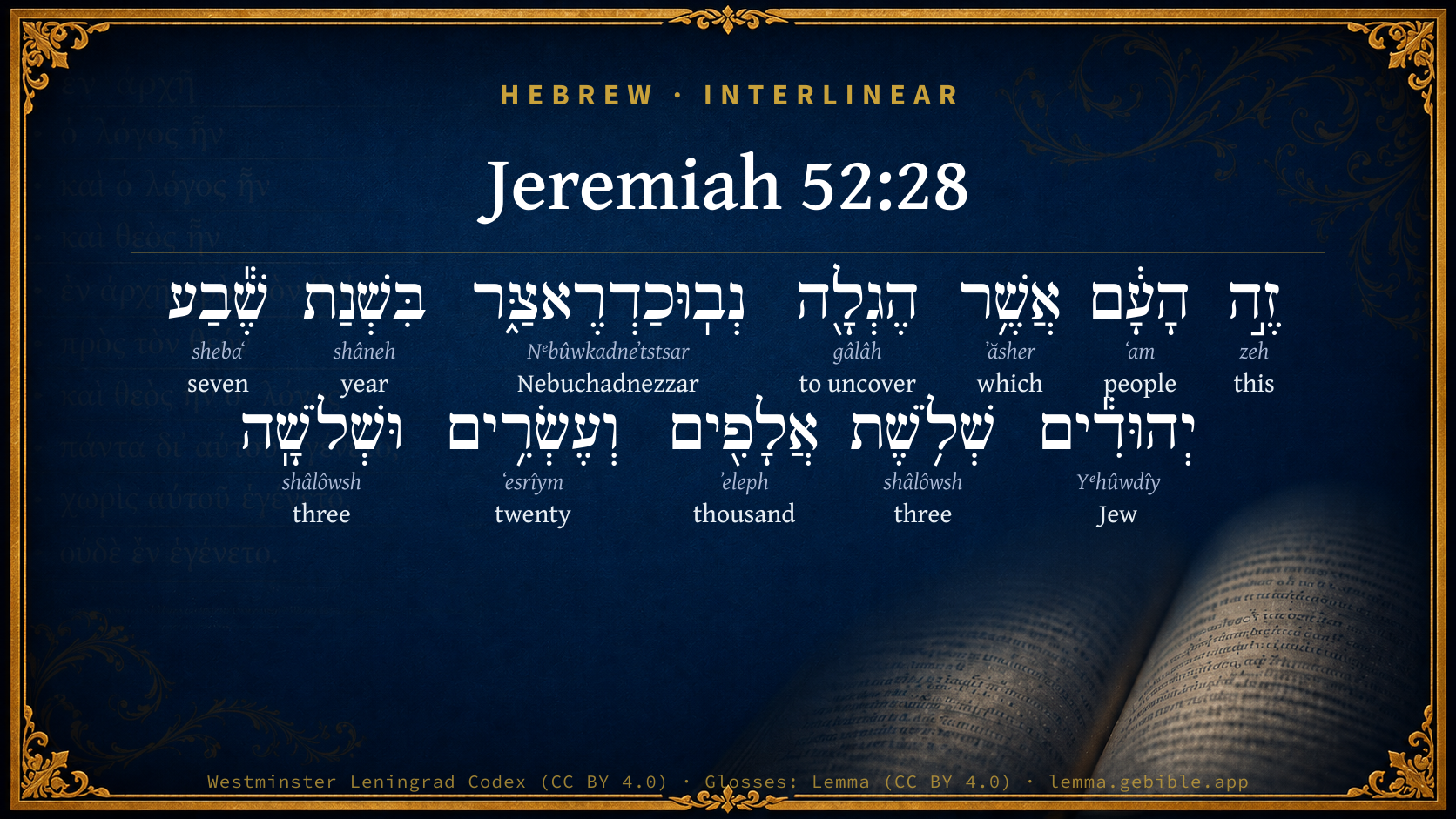
Jeremiah 52:28

Hebrew (Westminster Leningrad Codex) Jeremiah 52:28 appears in the Hebrew Old Testament. The text above is from the Westminster Leningrad Codex. Each word links to its Strong’s number, a concise gloss, and parsing drawn from the Open Scriptures Hebrew Bible morphology. Click any word for its full Brown-Driver-Briggs (BDB) entry.
Download image
Cite this verse

Jeremiah 52:28 (World English Bible). Public Domain. Lemma interlinear Bible study tool, https://lemma.gebible.app/v/jeremiah/52/28.

Show BibTeX & RIS
BibTeX
RIS
English Translation
This is the people whom Nebuchadrezzar carried away captive: in the seventh year three thousand twenty-three Jews;
World English Bible · Public Domain
Download a study sheet

One document with this verse’s original text, its word-by-word gloss line, the meaning frame, cross-references with their text, attributed commentary, and full source and license credits — printable, and it pastes into notes with its structure intact.

This verse Autodidact and up

Study sheet (.html) Plain text (.txt)

A passage Seminary Student

Up to 50 verses in one chapter. A passage sheet keeps up to 6 commentary sources and 12 cross-references per verse, in the order this page ranks them, and says so on the sheet whenever that leaves anything out. Ask for a single verse and you get the Autodidact verse sheet above.

Everything on this page stays free to read, with no account — the sheet is a download of what is already on screen, not access to it.

Want to remove ads? Support Godless Engineer
Compare translations 3

The same verse in 3 English versions, stacked beneath the original-language interlinear above. Click any original word for its lexicon entry.

Each is an independent rendering of the whole verse — the interlinear is not word-aligned to these translations.

Highlighted words mark where these versions differ — a whole-verse word diff, not a word-by-word alignment.

  • World English Bible Public Domain
    This is the people whom Nebuchadrezzar carried away captive: in the seventh year three thousand twenty-three Jews;
  • King James Version Public Domain
    This is the people whom Nebuchadrezzar carried away captive: in the seventh year three thousand Jews and three and twenty:
  • unfoldingWord Literal Text CC BY-SA 4.0
    These were the people who Nebuchadnezzar exiled: In the seventh year, 3, 023 Judeans.

unfoldingWord Literal Text — © unfoldingWord, licensed CC BY-SA 4.0. Word-aligned USFM3 via Door43 (git.door43.org/unfoldingWord/en_ult).

Versions to compare (up to 4)

3 of 4 selected

Show all 18 translations

Every available English version of this verse, each an independent rendering of the whole verse.

  • World English Bible Public Domain
    This is the people whom Nebuchadrezzar carried away captive: in the seventh year three thousand twenty-three Jews;
  • Berean Standard Bible Public Domain
    These are the people Nebuchadnezzar carried away: in the seventh year, 3,023 Jews;
  • Majority Standard Bible Public Domain
    These are the people Nebuchadnezzar carried away: in the seventh year, 3,023 Jews;
  • King James Version Public Domain
    This is the people whom Nebuchadrezzar carried away captive: in the seventh year three thousand Jews and three and twenty:
  • American Standard Version (1901) Public Domain
    This is the people whom Nebuchadrezzar carried away captive: in the seventh year three thousand Jews and three and twenty;
  • Revised Version (1885) Public Domain
    This is the people whom Nebuchadrezzar carried away captive: in the seventh year three thousand Jews and three and twenty:
  • Geneva Bible (1599) Public Domain
    This is the people, whome Nebuchad-nezzar caried away captiue, in the seuenth yeere, euen three thousande Iewes, and three and twentie.
  • Douay-Rheims (1899) Public Domain
    This is the people whom Nabuchodonosor carried away captive: in the seventh year, three thousand and twenty-three Jews.
  • Young's Literal Translation Public Domain
    This `is' the people whom Nebuchadrezzar hath removed: in the seventh year, of Jews, three thousand and twenty and three;
  • Literal Standard Version CC BY-SA 4.0
    This [is] the people whom Nebuchadnezzar has removed: in the seventh year, of Jews, three thousand and twenty-three;
  • Unlocked Literal Bible CC BY-SA 4.0
    These were the people who Nebuchadnezzar exiled: In the seventh year, 3,023 Judeans.
  • unfoldingWord Literal Text CC BY-SA 4.0
    These were the people who Nebuchadnezzar exiled: In the seventh year, 3, 023 Judeans.
  • Darby Bible Public Domain
    This is the people whom Nebuchadrezzar carried away captive: in the seventh year three thousand and twenty-three Jews;
  • World Messianic Bible Public Domain
    This is the number of the people whom Nebuchadnezzar carried away captive: in the seventh year, three thousand twenty-three Jews;
  • Webster's Bible Public Domain
    This is the people whom Nebuchadrezzar carried away captive: in the seventh year three thousand Jews and three and twenty:
  • Free Bible Version CC BY-SA 4.0
    This is a record of the number of people Nebuchadnezzar took into exile. In the seventh year of his reign he took 3,023 Judeans.
  • Bible in Basic English Public Domain
    These are the people whom Nebuchadrezzar took away prisoner: in the seventh year, three thousand and twenty-three Jews:
  • JPS Tanakh (1917) Public Domain
    This is the people whom Nebuchadrezzar carried away captive: in the seventh year three thousand Jews and three and twenty;

Literal Standard Version (2020), Covenant Press — licensed CC BY-SA 4.0. Text via the HelloAO Bible API (eBible.org). Unlocked Literal Bible (unfoldingWord) — licensed CC BY-SA 4.0. Text via the HelloAO Bible API (eBible.org). unfoldingWord Literal Text — © unfoldingWord, licensed CC BY-SA 4.0. Word-aligned USFM3 via Door43 (git.door43.org/unfoldingWord/en_ult). Free Bible Version, Dr. Jonathan Gallagher — licensed CC BY-SA 4.0. Text via the HelloAO Bible API (eBible.org).

Word by word

More ways to search: Search by grammar → Find every occurrence → Compare this word →

Practice this passage: Drill this verse → Learn its vocabulary →

נְבֽוּכַדְרֶאצַּ֑ר
Nᵉbûwkadneʼtstsar
H5019
“Nebuchadnezzar”
Noun, Proper
Part of Speech
Noun
Type
Proper
Full BDB Definition

Origin: of foreign derivation

TWOT: None

Nebuchadnezzar or Nebuchadrezzar = "may Nebo protect the crown" - the great king of Babylon who captured Jerusalem and carried Judah captive
  1. זֶ֣ה zeh H2088 “this” Pronoun, Demonstrative, Masculine, Singular
  2. הָעָ֔ם ʻam H5971 “the · people” Particle, Definite Article + Noun, Common, Masculine, Singular, Absolute
  3. אֲשֶׁ֥ר ʼăsher H834 “which” Particle, Relative
  4. הֶגְלָ֖ה gâlâh H1540 “to uncover” Verb, Hiphil, Perfect, 3rd Person, Masculine, Singular
  5. בִּשְׁנַת shâneh H8141 “in/at · year of” Preposition + Noun, Common, Feminine, Singular, Construct
  6. שֶׁ֕בַע shebaʻ H7651 “seven” Adjective, Cardinal number, Feminine, Singular, Absolute
  7. יְהוּדִ֕ים Yᵉhûwdîy H3064 “Jews” Noun, Gentilic, Masculine, Plural, Absolute
  8. שְׁלֹ֥שֶׁת shâlôwsh H7969 “three” Adjective, Cardinal number, Masculine, Singular, Construct
  9. אֲלָפִ֖ים ʼeleph H505 “thousand” Adjective, Cardinal number, Both, Plural, Absolute
  10. וְעֶשְׂרִ֥ים ʻesrîym H6242 “and · twenty” Conjunction + Adjective, Cardinal number, Both, Plural, Absolute
  11. וּשְׁלֹשָֽׁה shâlôwsh H7969 “and · three” Conjunction + Adjective, Cardinal number, Masculine, Singular, Absolute

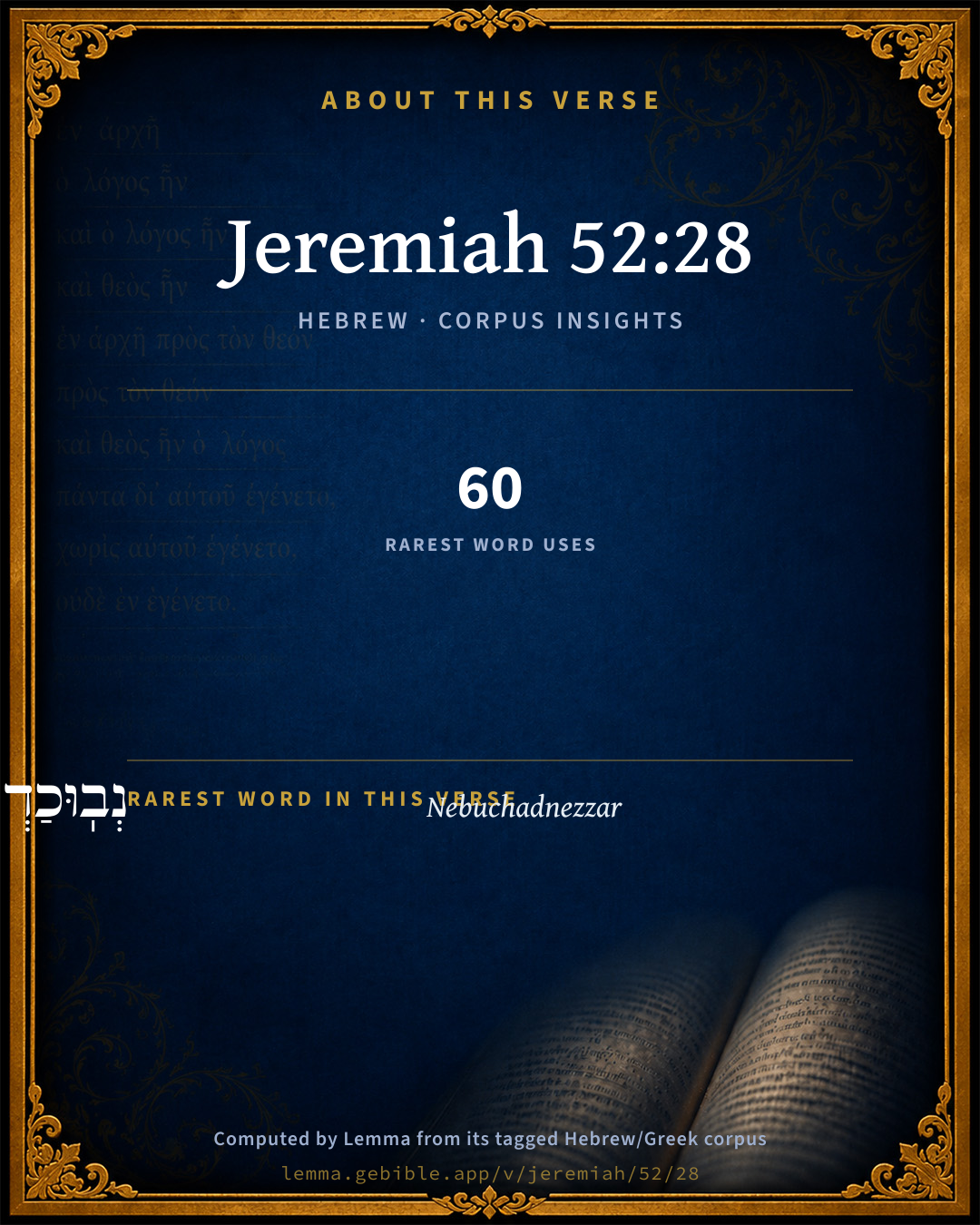
About this verse

These counts appear in no published source. They are computed here, from the morphology-tagged text and Lemma’s own curated glosses. What Lemma adds →

12
words
11
distinct lemmas
Prophets
section

Shared distinctive vocabulary

נְבֽוּכַדְרֶאצַּ֑ר Nebuchadnezzar H5019 occurs in 58 verses of the Hebrew Bible. Also found in:

Grammatical profile

  • 1 verb
  • 4 nouns
  • 5 adjectives
  • 1 pronoun
  • 1 particle

Verb forms

  • הֶגְלָ֖ה Hiphil · Perfect

Repetition

A word recurs within this verse — often emphatic in Hebrew:

  • שְׁלֹ֥שֶׁת three H7969 ×2

Cross-references

4

Topical passages linked to Jeremiah 52:28 in the Treasury of Scripture Knowledge — connected by theme and wording, ordered by reader-vote popularity; previews shown in the World English Bible.

  • 2 Kings 24:2–3 Yahweh sent against him bands of the Chaldeans, and bands of the Syrians, and bands of the Moabites, and bands of the children of Ammon, and sent them against Judah to destroy it, according to the word of Yahweh, which he spoke by his servants the prophets.
  • 2 Kings 24:12–16 and Jehoiachin the king of Judah went out to the king of Babylon, he, and his mother, and his servants, and his princes, and his officers: and the king of Babylon took him in the eighth year of his reign.
  • Daniel 1:1–3 In the third year of the reign of Jehoiakim king of Judah came Nebuchadnezzar king of Babylon to Jerusalem, and besieged it.
  • 2 Chronicles 36:20 Those who had escaped from the sword carried he away to Babylon; and they were servants to him and his sons until the reign of the kingdom of Persia:

Cross-references courtesy of OpenBible.info (CC BY 4.0).

Hebrew and Greek witnesses Masoretic Hebrew ↔ Greek Septuagint

The same verse in the two great witnesses to the Old Testament, shown verse-for-verse.

These are two independent witnesses, not word-aligned to each other, and the Septuagint is shown in lemma (dictionary) form.

Hebrew Jeremiah 52:28 Masoretic · Westminster Leningrad Codex

זֶ֣ה הָעָ֔ם אֲשֶׁ֥ר הֶגְלָ֖ה נְבֽוּכַדְרֶאצַּ֑ר בִּשְׁנַת שֶׁ֕בַע יְהוּדִ֕ים שְׁלֹ֥שֶׁת אֲלָפִ֖ים וְעֶשְׂרִ֥ים וּשְׁלֹשָֽׁה

This is the people whom Nebuchadrezzar carried away captive: in the seventh year three thousand twenty-three Jews;

World English Bible · Public Domain

Greek LXX Structure differs

In the Septuagint, Jeremiah is about an eighth shorter than the Hebrew and arranges its material differently — the Oracles Against the Nations (Hebrew chapters 46–51) appear in the middle of the Greek book, after 25:13. Because the chapter and verse boundaries do not line up, a verse-for-verse comparison with the Hebrew is not shown.

A verse-for-verse comparison isn’t shown here because the chapters and verses don’t line up. Switch to the LXX edition with the MT / LXX toggle above to read the Greek directly.

On this verse, Albert Barnes' Notes on the Bible discusses the Septuagint’s reading. Read the note in Commentary ↓

Hebrew: Westminster Leningrad Codex (CC BY 4.0). Greek: Septuagint (public domain); English from a public-domain English Septuagint. How the Septuagint differs from the Hebrew →

Targum (Aramaic paraphrase)

1

The Targum is the ancient Jewish Aramaic paraphrase of the Hebrew Scriptures — an interpretive translation, not the Hebrew text itself. Onkelos (literal) and Pseudo-Jonathan (expansive) render the Torah, and Jonathan the Prophets. Coverage is partial: where no permissively-licensed English translation exists for a verse, only the Aramaic is shown. This is verse-level text, not a word-by-word alignment to the Hebrew.

  1. Targum Jonathan Prophets (Joshua–Malachi)
    דֵין עַמָא דְאַגְלֵי נְבוּכַדְרֶאצַר בִּשְׁנַת שְׁבַע יְהוּדָאֵי תִּלְתָא אַלְפִין וְעַסְרִין וּתְלָתָא:

    (no public-domain English translation for this verse)

    Targum Jonathan — Aramaic: “Mikraot Gedolot” (public domain). English: “Sefaria Community Translation” (CC0 1.0 (public-domain dedication)); “London "Chaldee Paraphrase," 1871” (public domain). Text via Sefaria.

Commentary

Notes on Jeremiah 52:28 from classic Christian and Jewish commentators (each source and its license shown beneath its notes). The classic Christian expositions comment on the surrounding passage and are grouped to its opening verse, so a note may address several verses; the Jewish commentaries on the Tanakh (Rashi and others) are per-verse, so they appear only where the commentator wrote on this verse.

Lemma curates 59 commentaries, every one of them public domain or Creative Commons licensed, each selected and text-cleaned for this edition rather than reprinted as found. About our sources →

Albert Barnes' Notes on the Bible

Seventh year - The suggestion is now generally received, that the word ten has dropped out before seven, and that the deportations mentioned here are all connected with the final war against Zedekiah. The calculation of Nebuchadnezzars reign is different from that used elsewhere, showing that the writer had access to a document not known to the compiler of the Book of Kings. In each date there is a difference of one year. The Septuagint omits Jer 52:28-30.

The number of the exiles carried away is small compared with the 42,360 men who returned Ezr 2:64-65, leaving a large Jewish population behind at Babylon. But a continual drain of people from Judaea was going on, and the 10,000 carried away with Jehoiachin formed the nucleus and center, and gave tone to the whole (see 2Ki 24:14). When they began to thrive in Babylon, large numbers would emigrate there of their own accord.

A comparison of this chapter with the parallel portion of 2 Kings shows that though not free from clerical errors and mistakes of copyists the body of the text is remarkably sound. Many of the differences between the two texts are abbreviations made purposely by the compiler of the Book of Kings; others are the result of negligence; and upon the whole the text of the Book of Kings is inferior to that of the Appendix to the Book of Jeremiah. Bearing in mind, however, that possibly they are not two transcripts of the same text, but the result of an independent use by two different writers of the same original authority, their complete agreement, except in trivial matters and mistakes easy of correction, is a satisfactory proof of the general trust-worthiness of the Masoretic Text in all more important particulars.

Albert Barnes' Notes on the Bible (1834–1885) — public domain. Text from a community e-Sword/MySword module.

Joseph Benson's Commentary

Jer 52:28-30. This is the people whom Nebuchadnezzar carried away captive — “These verses are not inserted in 2 Kings 25. Nor are they to be found here, according to the Roman and Alexandrian editions of the LXX.; but in the Complutensian they are, and in two MSS. collated by Dr. Grabe; also in Theodotion’s version in the Hexapla. All the other ancient versions acknowledge them; and they are not omitted in any of the collated Hebrew MSS.; so that there is no doubt of their being genuine. But are we to conclude from them, that the whole number of the Jews, whom Nebuchadnezzar, in all his expeditions, carried into captivity, was no more than four thousand six hundred? This cannot be true, for he carried away more than twice that number at one time; which is expressly said to have been in the eighth year of his reign, 2Ki 24:12-16. Before that time he had carried off a number of captives from Jerusalem in the first year of his reign, among whom were Daniel and his companions, Dan 1:3-6. And of these Berosus, the Chaldean historian, speaks, as cited by Josephus, Ant., lib. 10. cap. 11. These are confessedly not taken notice of here. And as the taking and burning of Jerusalem are in this very chapter said to have been in the fourth and fifth months of the 19th year of Nebuchadnezzar, those who were carried into captivity, at the date of those events, cannot possibly be the same with those that are said to be carried away either in the 18th or 23d year of that prince. Nor indeed is it credible, that the number carried away at the time the city was taken, and the whole country reduced, could be so few as eight hundred and thirty-two. Here then we have three deportations, and those the most considerable ones, in the 1st, the 8th, and 19th years of Nebuchadnezzar, sufficiently distinguished from those in his 7th, 18th, and 23d years. So that it seems most reasonable to conclude, with Archbishop Usher, that by the latter three the historian meant to point out deportations of a lesser kind, not elsewhere noticed in direct terms in Scripture.” — Blaney.

Joseph Benson's Commentary on the Old and New Testaments (1811–1818) — public domain. Text from a community e-Sword module.

Tyndale Open Study Notes

Tyndale Open Resources

52:28-30 The numbers in these verses amplify the data given in 2 Kgs 24:14-16 regarding the deportation of exiles in 597 BC. The deportation in Jer 52:30 is not mentioned elsewhere in Scripture; it was probably a Babylonian reprisal for Gedaliah’s murder (41:1-3). This suggests that the person(s) responsible for making this adaptation lived after 581 BC, probably in Babylon.

52:28 The account in 2 Kgs 24:12-14 states that this event occurred in Nebuchadnezzar’s eighth year. This difference reflects two ancient Near Eastern methods of calculating the beginning of a king’s reign. In 2 Kings, the year in which Nebuchadnezzar ascended the throne is treated as the first year of his reign. Jeremiah apparently started counting the first full year as Nebuchadnezzar’s first year.

Tyndale Open Study Notes — © Tyndale Open Resources, licensed CC BY-SA 4.0. Text via the HelloAO Bible API.

Geneva Bible (1599)

Geneva Bible translators

Which was the latter end of the seventh year of his reign, and the beginning of the eighth.

Geneva Bible (1599) marginal notes — public domain. Text via Bolls.life.

Jamieson, Fausset & Brown

Robert Jamieson, A. R. Fausset & David Brown

seventh year--in Kg2 24:12, Kg2 24:14, Kg2 24:16, it is said "the eighth year" of Nebuchadnezzar. No doubt it was in part about the end of the seventh year, in part about the beginning of the eighth. Also in 2Ki. 24:1-20, ten thousand (Jer 52:14), and seven thousand men of might, and a thousand craftsmen (Jer 52:16), are said to have been carried away, But here three thousand twenty-three. Probably the latter three thousand twenty-three were of the tribe of Judah, the remaining seven thousand out of the ten thousand were of the other tribes, out of which many Israelites still had been left in the land. The a thousand "craftsmen" were exclusive of the ten thousand, as appears, by comparing Kg2 24:14 with Jer 52:16. Probably the three thousand twenty-three of Judah were first removed in the end of "the seventh year"; the seven thousand and a thousand craftsmen in the "eighth year." This was at the first captivity under Jehoiachin.

Jamieson, Fausset & Brown — Commentary Critical and Explanatory on the Whole Bible (1871) — public domain (CC PDM 1.0). Text via the HelloAO Bible API.

Adam Clarke's Commentary

Verse 28. - 30. On these verses Dr. Blayney has some sensible remarks; I will extract the substance. These verses are not inserted in 2 Kings xxv. Are we to conclude from these verses that the whole number of the Jews which Nebuchadnezzar, in all his expeditions, carried away, was no more than four thousand six hundred? This cannot be true; for he carried away more than twice that number at one time and this is expressly said to have been in the eighth year of his reign, 2Kg 24:12-16. Before that time he had carried off a number of captives from Jerusalem, in the first year of his reign, among whom were Daniel and his companions, Da 1:3-6. These are confessedly not noticed here. And as the taking and burning of Jerusalem is in this very chapter said to have been in the fourth and fifth months of the nineteenth year of the reign of Nebuchadnezzar, those who were carried into captivity at the date of those events cannot possibly be the same with those that are said to be carried away either in the eighteenth or twenty-third year of that prince. Nor, indeed, is it credible that the number carried away at the time that the city was taken, and the whole country reduced, could be so few as eight hundred and thirty-two, (see Jer 52:29;) supposing a mistake in the date of the year, which some are willing to do without sufficient grounds.

Here then we have three deportations, and those the most considerable ones, in the first, in the eighth, and nineteenth years of Nebuchadnezzar, sufficiently distinguished from those in the seventh, eighteenth, and twenty-third years. So that it seems most reasonable to conclude with Abp. Usher, in Chronologia Sacra, that by the latter three the historian meant to point out deportations of a minor kind, not elsewhere noticed in direct terms in Scripture.

The first of these, said to have been in the seventh year of Nebuchadnezzar, was one of those that had been picked up in several parts of Judah by the band of Chaldeans, Syrians, and others, whom the king of Babylon sent against the land previously to his own coming, 2Kg 24:2.

That in the eighteenth year corresponds with the time when the Chaldean army broke off the siege before Jerusalem, and marched to meet the Egyptian army, at which time they might think it proper to send off the prisoners that were in camp, under a guard to Babylon.

And the last, in the twenty-third year of Nebuchadnezzar, was when that monarch, being engaged in the siege of Tyre, sent off Nebuzaradan against the Moabites, Ammonites, and other neighbouring nations, who at the same time carried away the gleanings of Jews that remained in their own land, amounting in all to no more than seven hundred and forty-five.

Josephus speaks of this expedition against the Moabites and Ammonites, which he places in the twenty-third year or Nebuchadnezzar; but mentions nothing done in the land of Israel at that time. Only he says that after the conquest of those nations, Nebuchadnezzar carried his victorious arms against Egypt, which he in some measure reduced, and carried the Jews whom he found there captives to Babylon. But the Egyptian expedition was not till the twenty-seventh year of Jehoiachin's captivity, i.e., the thirty-fifth of Nebuchadnezzar, as may be collected from Eze 29:17; so that those who were carried away in the twenty-third year were not from Egypt, but were, as before observed, the few Jews that remained in the land of Judah.

Adam Clarke's Commentary on the Bible (1810–1826) — public domain. Text from a community e-Sword/MySword module.

Ellicott's Commentary for English Readers

(28) This is the people . . .—Here the parallelism with 2 Kings 25, which goes on to give a brief summary of the history of Gedaliah and Ishmael, as narrated in Jeremiah 40-43, ceases, and the writer of the appendix goes on to give particulars as to the various stages of the deportation of the captives. It presents some difficulties in detail. (1) The date given here, the “seventh year” of Nebuchadnezzar, does not agree with 2Ki_24:12, which gives the “eighth year” as the time of the first deportation after the defeat of Jehoiachin. (2) The number of the captives then carried into exile, given in 2Ki_24:14 at 10,000, besides the craftsmen and the smiths, is given here as 3,023. The precision of the number seems to imply reference to a register or record of some kind, and so far bears primâ facie evidence of accuracy. Probably the word “ten” has dropped out before “seven,” and we have here the record of a second deportation in the seventeenth year of Nebuchadnezzar, while the siege of Jerusalem was going on, and made up in part of prisoners taken in skirmishes, and partly of the numerous Jews who “fell away to the Chaldæans” (Jer_37:13).

A Bible Commentary for English Readers, edited by Charles John Ellicott (1878–1897) — public domain. Text from a community e-Sword module.

The Cambridge Bible for Schools and Colleges

gen. ed. J. J. S. Perowne

28–30. Enumeration of Nebuchadnezzar’s captives

28. in the seventh year] These vv. are absent from the LXX and from 2 Kings 25 and apparently come out of a separate document from the rest. For “seventh” we should read seventeenth, for in Jehoiachin’s captivity the number was far greater than is here specified (2Ki_24:14; 2Ki_24:16). Thus the first deportation would consist of the men of Judah taken prisoners outside Jerusalem in the first year of the siege (Jer_39:1), the second (Jer_52:29) of those carried captive “from Jerusalem” itself, but not including those taken into exile after the capture of the city. Of the third occurring some years later we have no other clear account, though we know from Josephus (Ant. X. ix. 7) that Nebuchadnezzar in his 23rd year carried on considerable warlike operations in the direction of Palestine and in Egypt, carrying off Jews from that country to Babylon.

The Cambridge Bible for Schools and Colleges (gen. ed. J. J. S. Perowne; Cambridge University Press, 1878–1918) — public domain. Text from a community e-Sword module.

John Gill's Exposition

In the eighteenth year of Nebuchadnezzar,.... Said to be the nineteenth, Jer 52:12; it was at the end of the eighteenth, and the beginning of the nineteenth, as Kimchi; or this was before the taking of the city, when he raised the siege, and departed to meet the king of Egypt, at which time he might carry captive many, as here said:

he carried away captive from Jerusalem, eight hundred thirty and two persons; which is more likely to be then done than at the taking of the city; when it is very probable a greater number was carried captive, which are not here taken notice of.

John Gill's Exposition of the Whole Bible (1746–1763) — public domain (CC PDM 1.0). Text via the HelloAO Bible API.

Haydock's Catholic Bible Commentary

Seventh year of Nabuchodonosor, and last of Joakim, 4 Kings. Roman Septuagint omits this and the next verse, which are found in Theodoret and the Complutensian edition. (Calmet) --- Grabe supplies all from, And Juda, ver 27, to 31. (Haydock) --- Zuinglius observes that the Septuagint have not a fragment of it, and that it has been added by some one to hide the ignominy of the Jews. It is interpolated in the Arabic of the Lond. Polyglot, and seems contrary to the true history, 4 Kings xxiv. 14. (Kennicott, Diss. 2.)

George Leo Haydock (1774–1849), Haydock's Catholic Family Bible and Commentary, 1859 edition — public domain. Excludes Psalms (Douay-Rheims chapter numbering differs from Protestant) and Deuterocanonical books (Catholic canon only).

Matthew Poole's English Annotations

That is, in the time of Jehoiachin, 2Ki 24:12-14; here it is said to be in the seventh year, there in the eighth year, it might be in part of both. But there is a difference in the number of the captives, which are here said to be three thousand and twenty-three, and 2Ki 24:14,16, seven thousand, or eight. It is thought by some that the number here mentioned were such as properly belonged to Judah, and the number mentioned 2Ki 24, were the number of the captives of Judah and Benjamin. See the English Annotations.

Matthew Poole's English Annotations on the Holy Bible (1683–1685) — public domain. Text from a community e-Sword/MySword module.

Whedon's Commentary on the Bible

Daniel D. Whedon

28-30. In these verses we have an enumeration of the different deportations of Jews by Nebuchadrezzar, namely, first, 3,023 in the seventh year of his reign; second, 832 in the eighteenth year of his reign; and third, 745 in the twenty-third year of his rule; thus giving for the total, 4,600.

In this statement there are, as all confess, serious, if not inexplicable, difficulties. For example, in Jer_52:12 the second deportation is represented as occurring in the nineteenth year of Nebuchadrezzar, instead of the eighteenth as here; and the first deportation was, as we learn from 2Ki_24:12, in the eighth, and not in the seventh, year of his reign, and was much more numerous than is here stated. Hence many accept the suggestion of Ewald, that the word ten before seven has been dropped out of the Hebrew text, and that the true reading should be seventeenth. This would lead to the conclusion that we have mentioned here, simply three deportations in the final war of Zedekiah, occurring in the seventeenth, eighteenth, and twenty-third years of Nebuchadrezzar’s reign. The first took place a year before the fall of Jerusalem, and probably embraced people taken from the country districts of Judea. This accounts for the smallness of the number, three thousand and twenty-three. In the following year were added eight hundred and thirty-two others, who may have been selected because they were judged to be turbulent and dangerous men. Finally, at a later time, probably on the occasion of the war with the Ammonites and Moabites mentioned by Josephus, (Antiq., Jer_10:9; Jer_10:7,) seven hundred and forty-five more were carried away, perhaps because they too were judged likely to become disturbers of the peace.

Daniel D. Whedon (gen. ed.), Commentary on the Old and New Testaments (1874–1909) — public domain. Text from a community e-Sword module.

The Pulpit Commentary

In the seventh year. As Ewald and Keil agree, we should correct "seventh" into "seventeenth" (just as in 2Ch_36:9, for "eight" we should read "eighteen"). On the small number of Jews deported Ewald remarks, "Nothing so clearly shows the extent to which the best men from the upper classes had been already despatched by the Chaldeans across the Euphrates, as the fact that in all the years of the second, and, if it be insisted on, of the third revolt, put together, they found only 4600 men more whom they thought worth the trouble of transporting" ("History of Israel," 4:265). As to the third deportation, see on Jer_41:1.

The Pulpit Commentary (1880–1919), ed. H.D.M. Spence-Jones & Joseph S. Exell — public domain. Text from a community e-Sword module.

unfoldingWord translationNotes

Door43 World Missions Community

seventh ... eighteenth ... twenty-third

(See: Ordinal Numbers)

Nebuzaradan

See how you translated this man's name in Jeremiah 39:9.

3,023 ... 832 ... 745 ... 4,600

"three thousand and twenty-three ... eight hundred and thirty-two ... seven hundred and forty-five ... four thousand six hundred" (See: Numbers)

translationWords

Nebuchadnezzar

year

Jerusalem

unfoldingWord translationNotes — © Distant Shores Media and the Door43 World Missions Community, licensed CC BY-SA 4.0. Source: git.door43.org/Door43/en_tn.

Lesson kit

Teaching starters — assembled from the data on this page, not authored interpretation. Every prompt links to the verse data it draws on. Edit before teaching.

Jeremiah, in the Prophets, opens this verse with 12 words (11 distinct Hebrew lemmas). Its most distinctive word is Nᵉbûwkadneʼtstsar (“Nebuchadnezzar”). A historical commentator’s framing appears above. Read the whole chapter for the surrounding context.

Discussion questions

  1. How does “Nebuchadnezzar” (Nᵉbûwkadneʼtstsar) shape what this verse is saying?
  2. 2 Kings 24:1 shares the word «Nebuchadnezzar» with this verse. How do the two illuminate each other?
  3. “three” occurs 2× in this one verse. What is the effect of the repetition?
  4. The translations on this page render this verse differently — a whole-verse word diff, not a word-by-word alignment. What might account for the different wordings?
  5. The verb «הֶגְלָ֖ה» is Hiphil Perfect. How does its form color the action?
  6. Reading how Albert Barnes' Notes on the Bible and Joseph Benson's Commentary read this verse, where do the two commentators agree and where do they part?

Things to notice

Reading settings

Reading text

Shown beneath each verse's original-language words.

Old Testament
Old Testament edition

Read the OT as the Masoretic Hebrew (MT) or the Greek Septuagint (LXX).

English shown for the Greek Septuagint (in the Hebrew ↔ Greek comparison).

Comparing translations? Open the Compare panel on any verse page to stack up to four side by side.