
Nahum 3:5

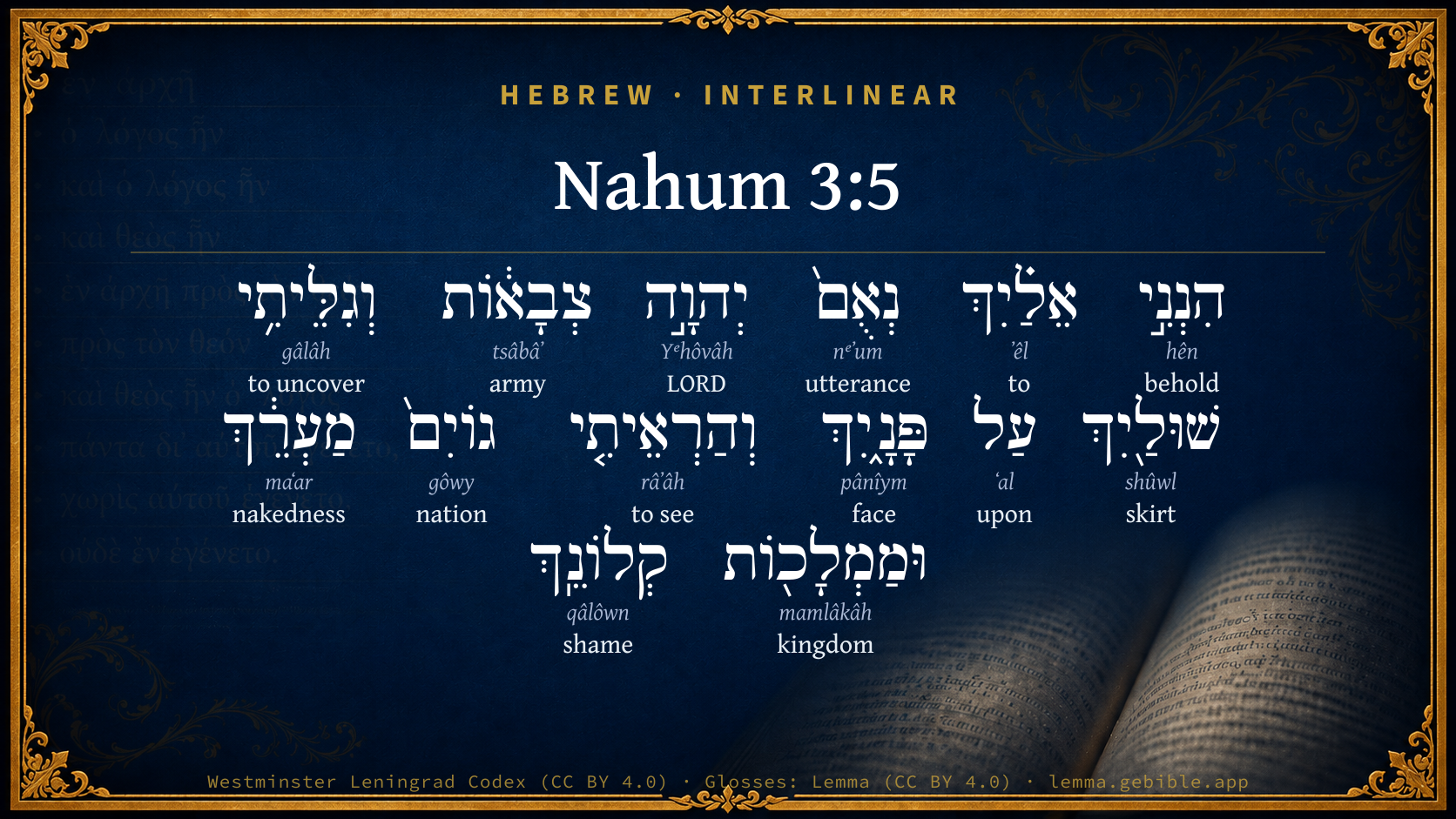
Hebrew (Westminster Leningrad Codex) Nahum 3:5 appears in the Hebrew Old Testament. The text above is from the Westminster Leningrad Codex. Each word links to its Strong’s number, a concise gloss, and parsing drawn from the Open Scriptures Hebrew Bible morphology. Click any word for its full Brown-Driver-Briggs (BDB) entry.
Download image
Cite this verse

Nahum 3:5 (World English Bible). Public Domain. Lemma interlinear Bible study tool, https://lemma.gebible.app/v/nahum/3/5.

Show BibTeX & RIS
BibTeX
RIS
English Translation
"Behold, I am against you," says Yahweh of Hosts, "and I will lift your skirts over your face. I will show the nations your nakedness, and the kingdoms your shame.
World English Bible · Public Domain
Download a study sheet

One document with this verse’s original text, its word-by-word gloss line, the meaning frame, cross-references with their text, attributed commentary, and full source and license credits — printable, and it pastes into notes with its structure intact.

This verse Autodidact and up

Study sheet (.html) Plain text (.txt)

A passage Seminary Student

Up to 50 verses in one chapter. A passage sheet keeps up to 6 commentary sources and 12 cross-references per verse, in the order this page ranks them, and says so on the sheet whenever that leaves anything out. Ask for a single verse and you get the Autodidact verse sheet above.

Everything on this page stays free to read, with no account — the sheet is a download of what is already on screen, not access to it.

Want to remove ads? Support Godless Engineer
Compare translations 3

The same verse in 3 English versions, stacked beneath the original-language interlinear above. Click any original word for its lexicon entry.

Each is an independent rendering of the whole verse — the interlinear is not word-aligned to these translations.

Highlighted words mark where these versions differ — a whole-verse word diff, not a word-by-word alignment.

  • World English Bible Public Domain
    "Behold, I am against you," says Yahweh of Hosts, "and I will lift your skirts over your face. I will show the nations your nakedness, and the kingdoms your shame.
  • King James Version Public Domain
    Behold, I am against thee, saith the LORD of hosts; and I will discover thy skirts upon thy face, and I will shew the nations thy nakedness, and the kingdoms thy shame.
  • unfoldingWord Literal Text CC BY-SA 4.0
    “Behold me, against you—the declaration of Yahweh of armies—I will remove your skirt over your face and show the nations your nakedness and the kingdoms your shame.

unfoldingWord Literal Text — © unfoldingWord, licensed CC BY-SA 4.0. Word-aligned USFM3 via Door43 (git.door43.org/unfoldingWord/en_ult).

Versions to compare (up to 4)

3 of 4 selected

Show all 18 translations

Every available English version of this verse, each an independent rendering of the whole verse.

  • World English Bible Public Domain
    "Behold, I am against you," says Yahweh of Hosts, "and I will lift your skirts over your face. I will show the nations your nakedness, and the kingdoms your shame.
  • Berean Standard Bible Public Domain
    “Behold, I am against you,” declares the LORD of Hosts. “I will lift your skirts over your face. I will show your nakedness to the nations and your shame to the kingdoms.
  • Majority Standard Bible Public Domain
    “Behold, I am against you,” declares the LORD of Hosts. “I will lift your skirts over your face. I will show your nakedness to the nations and your shame to the kingdoms.
  • King James Version Public Domain
    Behold, I am against thee, saith the LORD of hosts; and I will discover thy skirts upon thy face, and I will shew the nations thy nakedness, and the kingdoms thy shame.
  • American Standard Version (1901) Public Domain
    Behold, I am against thee, saith Jehovah of hosts, and I will uncover thy skirts upon thy face; and I will show the nations thy nakedness, and the kingdoms thy shame.
  • Revised Version (1885) Public Domain
    Behold, I am against thee, saith the LORD of hosts, and I will discover thy skirts upon thy face; and I will shew the nations thy nakedness, and the kingdoms thy shame.
  • Geneva Bible (1599) Public Domain
    Beholde, I come vpon thee, saith the Lord of hostes, and will discouer thy skirtes vpon thy face, and will shewe the nations thy filthines, and the kingdomes thy shame.
  • Douay-Rheims (1899) Public Domain
    Behold I come against thee, saith the Lord of hosts: and I will discover thy shame to thy face, and will shew thy nakedness to the nations, and thy shame to kingdoms.
  • Young's Literal Translation Public Domain
    Lo, I `am' against thee, An affirmation of Jehovah of Hosts, And have removed thy skirts before thy face, And have shewed nations thy nakedness, And kingdoms thy shame,
  • Literal Standard Version CC BY-SA 4.0
    “Behold, I [am] against you,” || A declaration of YHWH of Hosts, || “And have removed your skirts before your face, || And have showed nations your nakedness, || And kingdoms your shame,
  • Unlocked Literal Bible CC BY-SA 4.0
    “See, I am against you—this is the declaration of Yahweh of hosts—I will raise up your skirt over your face and show your private parts to the nations, your shame to the kingdoms.
  • unfoldingWord Literal Text CC BY-SA 4.0
    “Behold me, against you—the declaration of Yahweh of armies—I will remove your skirt over your face and show the nations your nakedness and the kingdoms your shame.
  • Darby Bible Public Domain
    behold, I am against thee, saith Jehovah of hosts; and I will uncover thy skirts upon thy face, and I will shew the nations thy nakedness, and the kingdoms thy shame.
  • World Messianic Bible Public Domain
    “Behold, I am against you,” says the LORD of Hosts, “and I will lift your skirts over your face. I will show the nations your nakedness, and the kingdoms your shame.
  • Webster's Bible Public Domain
    Behold, I am against thee, saith the LORD of hosts; and I will remove thy skirts upon thy face, and I will show the nations thy nakedness, and the kingdoms thy shame.
  • Free Bible Version CC BY-SA 4.0
    Watch out! For I am against you, declares the Lord Almighty. I will lift your skirts over your face and let the nations see your nakedness, and kingdoms see your shame.
  • Bible in Basic English Public Domain
    See, I am against you, says the Lord of armies, and I will have your skirts pulled over your face, and let the nations see you unclothed, and the kingdoms your shame.
  • JPS Tanakh (1917) Public Domain
    Behold, I am against thee, saith the LORD of hosts, and I will uncover thy skirts upon thy face, and I will shew the nations thy nakedness, and the kingdoms thy shame.

Literal Standard Version (2020), Covenant Press — licensed CC BY-SA 4.0. Text via the HelloAO Bible API (eBible.org). Unlocked Literal Bible (unfoldingWord) — licensed CC BY-SA 4.0. Text via the HelloAO Bible API (eBible.org). unfoldingWord Literal Text — © unfoldingWord, licensed CC BY-SA 4.0. Word-aligned USFM3 via Door43 (git.door43.org/unfoldingWord/en_ult). Free Bible Version, Dr. Jonathan Gallagher — licensed CC BY-SA 4.0. Text via the HelloAO Bible API (eBible.org).

Word by word

More ways to search: Search by grammar → Find every occurrence → Compare this word →

Practice this passage: Drill this verse → Learn its vocabulary →

מַעְרֵ֔ךְ
maʻar
H4626
“nakedness · your”
Noun, Common, Masculine, Singular, Construct + Suffix, Personal, 2nd Person, Feminine, Singular
Part of Speech
Noun
Type
Common
Gender
Masculine
Number
Singular
State
Construct
Full BDB Definition

Origin: from H6168

TWOT: 1692d

bare, naked place, nakedness - bare place - nakedness, pudenda (exposed in punishment)
  1. הִנְנִ֣י hên H2005 “behold · me” Particle, Demonstrative + Suffix, Personal, 1st Person, Common, Singular
  2. אֵלַ֗יִךְ ʼêl H413 “to · you” Preposition + Suffix, Personal, 2nd Person, Feminine, Singular
  3. נְאֻם֙ nᵉʼum H5002 “utterance of” Noun, Common, Masculine, Singular, Construct
  4. יְהוָ֣ה Yᵉhôvâh H3068 “LORD” Noun, Proper
  5. צְבָא֔וֹת tsâbâʼ H6635 “armies” Noun, Common, Both, Plural, Absolute
  6. וְגִלֵּיתִ֥י gâlâh H1540 “and · to uncover” Conjunction + Verb, Piel, Perfect, 1st Person, Common, Singular
  7. שׁוּלַ֖יִךְ shûwl H7757 “skirts · your” Noun, Common, Masculine, Plural, Construct + Suffix, Personal, 2nd Person, Feminine, Singular
  8. עַל ʻal H5921 “upon” Preposition
  9. פָּנָ֑יִךְ pânîym H6440 “face(s) · your” Noun, Common, Both, Plural, Construct + Suffix, Personal, 2nd Person, Feminine, Singular
  10. וְהַרְאֵיתִ֤י râʼâh H7200 “and · to see” Conjunction + Verb, Hiphil, Perfect, 1st Person, Common, Singular
  11. גוֹיִם֙ gôwy H1471 “nations” Noun, Common, Masculine, Plural, Absolute
  12. וּמַמְלָכ֖וֹת mamlâkâh H4467 “and · kingdoms” Conjunction + Noun, Common, Feminine, Plural, Absolute
  13. קְלוֹנֵֽךְ qâlôwn H7036 “shame · your” Noun, Common, Masculine, Singular, Construct + Suffix, Personal, 2nd Person, Feminine, Singular

About this verse

These counts appear in no published source. They are computed here, from the morphology-tagged text and Lemma’s own curated glosses. What Lemma adds →

14
words
14
distinct lemmas
Prophets
section

Notable vocabulary

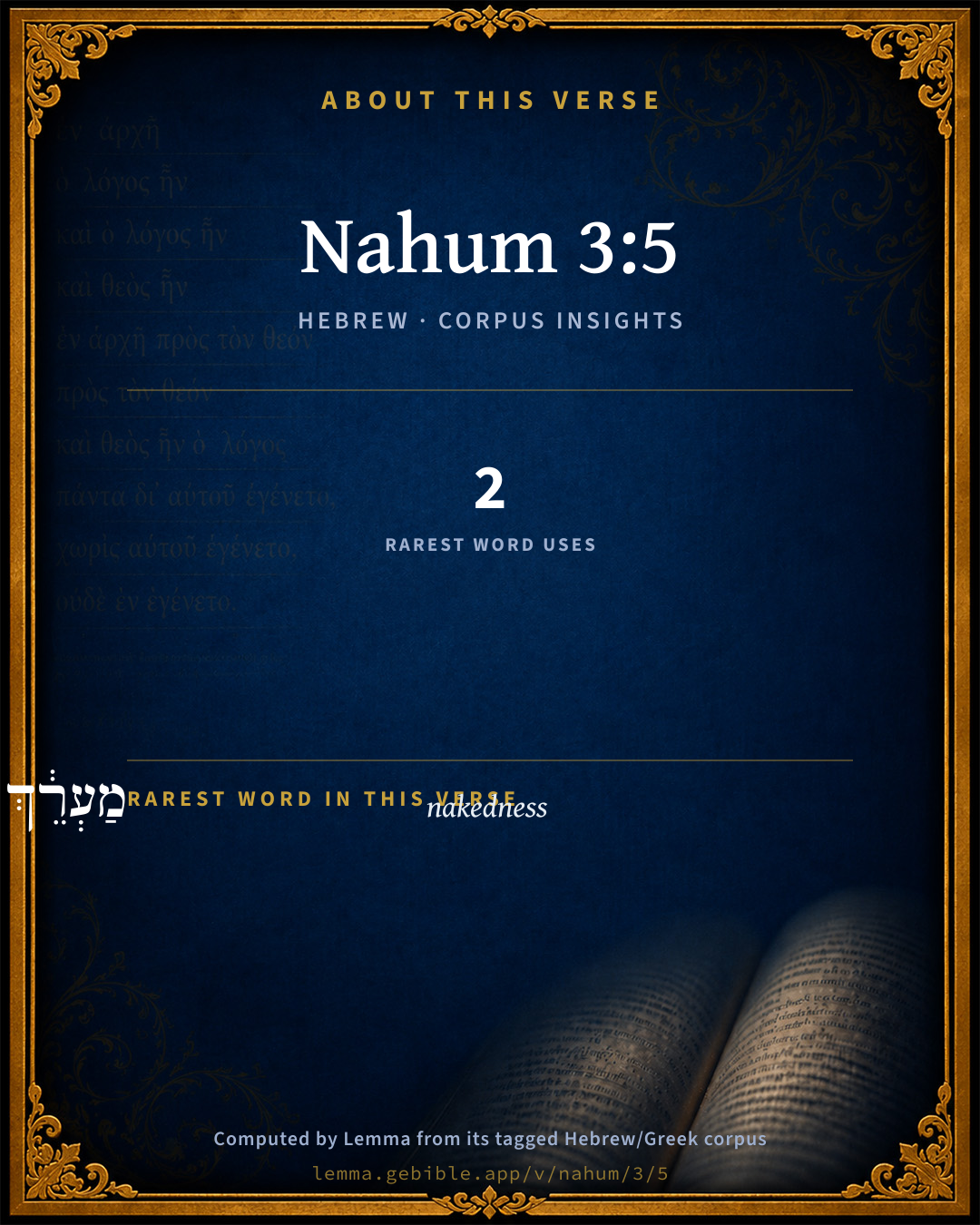
The rarest word here is מַעְרֵ֔ךְ nakedness H4626 — appearing just 2 times in the whole Hebrew Bible.

Shared distinctive vocabulary

מַעְרֵ֔ךְ nakedness H4626 occurs in 2 verses of the Hebrew Bible. Also found in:

Grammatical profile

  • 2 verbs
  • 9 nouns
  • 2 prepositions
  • 1 particle

Verb forms

  • וְגִלֵּיתִ֥י Piel · Perfect
  • וְהַרְאֵיתִ֤י Hiphil · Perfect

Hebrew & Septuagint length

In English translation the verse runs 30 words from the Hebrew and 32 from the Septuagint (LXX English) — closely comparable.

A rough comparison of the two English renderings, which tokenize alike — not a word-level alignment.

Word counts can differ between the Hebrew and the Greek without any difference in meaning — e.g. the Hebrew direct-object marker אֵת has no separate Greek word, and Greek often adds the article ὁ.

Cross-references

9

Topical passages linked to Nahum 3:5 in the Treasury of Scripture Knowledge — connected by theme and wording, ordered by reader-vote popularity; previews shown in the World English Bible.

  • Jeremiah 13:26 Therefore will I also uncover your skirts on your face, and your shame shall appear.
  • Jeremiah 13:22 If you say in your heart, Why are these things come on me? for the greatness of your iniquity are your skirts uncovered, and your heels suffer violence.
  • Ezekiel 23:29 and they shall deal with you in hatred, and shall take away all your labor, and shall leave you naked and bare; and the nakedness of your prostitution shall be uncovered, both your lewdness and your prostitution.
  • Isaiah 47:2–3 Take the millstones, and grind meal; remove your veil, strip off the train, uncover the leg, pass through the rivers.
  • Ezekiel 16:37 therefore see, I will gather all your lovers, with whom you have taken pleasure, and all those who you have loved, with all those who you have hated; I will even gather them against you on every side, and will uncover your nakedness to them, that they may see all your nakedness.
  • Nahum 2:13 "Behold, I am against you," says Yahweh of Hosts, "and I will burn her chariots in the smoke, and the sword will devour your young lions; and I will cut off your prey from the earth, and the voice of your messengers will no longer be heard."
  • Habakkuk 2:16 You are filled with shame, and not glory. You will also drink, and be exposed! The cup of Yahweh's right hand will come around to you, and disgrace will cover your glory.
  • Ezekiel 23:25 I will set my jealousy against you, and they shall deal with you in fury; they shall take away your nose and your ears; and your residue shall fall by the sword: they shall take your sons and your daughters; and your residue shall be devoured by the fire.
  • Micah 1:11 Pass on, inhabitant of Shaphir, in nakedness and shame. The inhabitant of Zaanan won't come out. The wailing of Beth Ezel will take from you his protection.

Cross-references courtesy of OpenBible.info (CC BY 4.0).

Hebrew and Greek witnesses Masoretic Hebrew ↔ Greek Septuagint

The same verse in the two great witnesses to the Old Testament, shown verse-for-verse.

These are two independent witnesses, not word-aligned to each other, and the Septuagint is shown in lemma (dictionary) form.

Hebrew Nahum 3:5 Masoretic · Westminster Leningrad Codex

הִנְנִ֣י אֵלַ֗יִךְ נְאֻם֙ יְהוָ֣ה צְבָא֔וֹת וְגִלֵּיתִ֥י שׁוּלַ֖יִךְ עַל פָּנָ֑יִךְ וְהַרְאֵיתִ֤י גוֹיִם֙ מַעְרֵ֔ךְ וּמַמְלָכ֖וֹת קְלוֹנֵֽךְ

"Behold, I am against you," says Yahweh of Hosts, "and I will lift your skirts over your face. I will show the nations your nakedness, and the kingdoms your shame.

World English Bible · Public Domain

Greek LXX Nahum 3:5 Septuagint · lemma form

ὁράω ἐγώ ἐπί σύ λέγω κύριος ὁ θεός ὁ παντοκράτωρ καί ἀποκαλύπτω ὁ ὀπίσω σύ ἐπί ὁ πρόσωπον σύ καί δεικνύω ἔθνος ὁ αἰσχύνη σύ καί βασιλεία ὁ ἀτιμία σύ

Behold, I am against you, says the Lord God Almighty, and I will uncover your skirts in your presence, and I will show the nations your shame, and the kingdoms your disgrace.

LXX2012 (modern English Septuagint) · Public Domain

Hebrew: Westminster Leningrad Codex (CC BY 4.0). Greek: Septuagint (public domain); English from LXX2012 (modern English Septuagint) (Public Domain). How the Septuagint differs from the Hebrew →

Targum (Aramaic paraphrase)

1

The Targum is the ancient Jewish Aramaic paraphrase of the Hebrew Scriptures — an interpretive translation, not the Hebrew text itself. Onkelos (literal) and Pseudo-Jonathan (expansive) render the Torah, and Jonathan the Prophets. Coverage is partial: where no permissively-licensed English translation exists for a verse, only the Aramaic is shown. This is verse-level text, not a word-by-word alignment to the Hebrew.

  1. Targum Jonathan Prophets (Joshua–Malachi)
    הָא אֲנָא שָׁלֵחַ רוּגְזִי עֲלָךְ אֲמַר יְיָ צְבָאוֹת וַאֲגַלֵי בַּהֲתַת חוֹבָךְ עַל אַפָּךְ וְאַחֲזֵי עַמְמַיָא בַּהֲתָתִיךְ וּמַלְכְּוָתָא קְלָנִיךְ:

    (no public-domain English translation for this verse)

    Targum Jonathan — Aramaic: “Mikraot Gedolot” (public domain). English: “Sefaria Community Translation” (CC0 1.0 (public-domain dedication)); “London "Chaldee Paraphrase," 1871” (public domain). Text via Sefaria.

Commentary

Notes on Nahum 3:5 from classic Christian and Jewish commentators (each source and its license shown beneath its notes). The classic Christian expositions comment on the surrounding passage and are grouped to its opening verse, so a note may address several verses; the Jewish commentaries on the Tanakh (Rashi and others) are per-verse, so they appear only where the commentator wrote on this verse.

Lemma curates 59 commentaries, every one of them public domain or Creative Commons licensed, each selected and text-cleaned for this edition rather than reprinted as found. About our sources →

Trapp's Complete Commentary

John Trapp

Nah 3:5 Behold, I [am] against thee, saith the LORD of hosts; and I will discover thy skirts upon thy face, and I will shew the nations thy nakedness, and the kingdoms thy shame.

Ver. 5. Behold, I am against thee, saith the Lord] And I need say no more, wert thou but sensible of thy misery herein. Be not thou a terror to me, O Lord, saith Jeremiah, and then let what will else befall me, I shall the better bear it. Do not you fall upon me yourselves, said Samson to his countrymen that came to bind him; and then for the Philistines I shall order them well enough, Jdg 15:12 : so saith the good soul, Let not God set against me. Tyrants and oppressors shall be sure to have him their enemy; and this he tells them here again and again, to beat down their vain confidence in their greatness, whereby they think to bear down all before them.

And I will discover thy skirts upon thy face] i.e. I will turn up thy clothes about thy ears, and so show to all thine utter disgrace, a fit punishment for so filthy a harlot, Isa 47:3 Jer 13:22 Eze 16:37.

And I will show the nations thy nakedness] Which nature teacheth to cover; therefore when a man hath committed a sin he blusheth, the blood, as it were, would cover the sin, that mother of shame: Rev 3:18, that the shame of thy nakedness may not appear. The whore of Babylon is, and more and more shall be, served on this sort, Rev 17:16. Before God ye are all bare souled, said Mr Philpot, martyr, to the Popish synod, before whom he was convented. The kings of the earth shall make Rome desolate and naked. Luther and many other Protestant writers have done it already by laying her open in her colours to the world, taking the same boldness and liberty to discover her lewdness that she did to commit it.

And the kingdoms thy shame] Who shall therehence slight thee and hate thee, together with all thy policies and superstitions, whereby thou hast enslaved them.

John Trapp, A Commentary or Exposition upon All the Books of the Old and New Testament (1647–1656) — public domain. Text from a community e-Sword module.

Joseph Benson's Commentary

Nah 3:5-7. Behold, I will discover thy skirts, &c., upon thy face — Nineveh, as a harlot, had been proud, and appeared beautiful and gay in the gifts of her lovers, but now God would deal with her according to her ways, would send her into captivity naked and bare, exposed to the greatest infamy, or would deal with her as inhuman soldiers deal with captive women. And I will show, &c. — I will expose thy shame to the world, a punishment often inflicted upon harlots: see note on Eze 16:37. I will cast abominable filth upon thee — I will deprive thee of all thine ornaments, and cover thee with shame and reproach. And will set thee as a gazing-stock — I will make a public example of thee. All they that look upon thee shall flee from thee — As being affrighted at the sight of thy dismal condition, and not willing to lend thee any assistance. Who will bemoan her? &c. — Thou didst so offend all people in thy prosperity, that all will rejoice at thy fall, and none will be found to lament or condole with thee.

Joseph Benson's Commentary on the Old and New Testaments (1811–1818) — public domain. Text from a community e-Sword module.

The Preacher's Complete Homiletical Commentary

Joseph S. Exell (gen. ed.)

CRITICAL NOTES.]

Nah_3:5. Discover] Language suggested by preceding metaphor of an harlot; referring to the custom of stripping captives, male and female, and exposing them to nakedness and insult.

Nah_3:6. Gazing-stock] A warning to others (Eze_28:17).

Nah_3:7.] She will be an object of disgust, none will pity the devastated city, for her doom is deserved.

HOMILETICS

RETRIBUTIVE PUNISHMENT.—Nah_3:5-7

Nineveh is represented in her virgin splendour, and her punishment under the figure of that which is disgraceful to a woman (cf. Isa_47:3, and Hab_2:10). God is against her, and her shame shall correspond to her conduct. As she uncovered others, so shall she be uncovered.

I. She will be exposed to nakedness and shame. “I will discover thy skirts upon thy face.” Her long flowing robes, which were part of her pomp and dignity, but which veiled her misdeeds and pride, shall be lifted up as high as possible (Jer_13:22). She will be treated as a harlot, and stripped of her glory and defence. Her face shall blush in fear, and the consciousness of guilt will be read in her features. Nations shall see her nakedness, avoid and despise her. The same means will be taken to display her lewdness that she used to commit it. “I will even gather them round about against thee, will discover thy nakedness unto them, that they may see all thy nakedness.”

II. She will be disgraced and insulted. As infamous harlots will she be treated.

1. Made a gazing-stock to men. “I will set thee as a gazing-stock.” The city once feared and renowned shall become a warning to others, and exposed to public infamy. “I will cast thee to the ground; before kings will I give thee, for them to gaze upon thee.”

2. Treated with contempt by God himself. “I will cast abominable filth upon thee.” She had done abominable things before God (Jer_13:27), which she had forgotten, but God will punish her with abominable things. Filth shall be cast upon her and she will be made vile.

III. She will be unpitied and forsaken. “It shall come to pass that all they that look upon thee shall flee from thee.” She would be set to be gazed at, and the effects on those who gaze are described.

1. Unpitied. “Who will bemoan her?” There will be none to comfort and relieve her. Unwept and unhonoured, she will fall into the grave. Human misery excites pity, but none pay Nineveh the tribute of sympathy. Those who show no pity to others will find none for themselves.

2. Forsaken. She had measured friendship by profit, and forsaken those who did not trust in her. Now she is repayed, and becomes a terror to all round about her. Such will be the portion of all who disregard God and live for self. They will be stripped of all adornments, bereft of all comfort, and thrown into eternal misery. “These two things are come unto thee; who shall be sorry for thee?—desolation and destruction, and the famine, and the sword; by whom shall I comfort thee?”

The Preacher's Complete Homiletical Commentary (gen. ed. Joseph S. Exell; Funk & Wagnalls, c. 1892) — public domain (pre-1929). A full-Bible homiletical/sermon-outline anthology covering 65 of 66 books (2 John is absent from the source module). Text from a community e-Sword module.

Keil & Delitzsch

C. F. Keil & F. Delitzsch

The Lord will plunge Nineveh into shameful misery in consequence. Nah 3:5. "Behold, I come to thee, is the saying of Jehovah of hosts; and uncover thy skirts over thy face, and let nations see they nakedness, and kingdoms thy shame. Nah 3:6. And cast horrible things upon thee, and shame thee, and make thee a gazing-stock. Nah 3:7. And it comes to pass, every one who sees thee will flee before thee, and say, Is Nineveh laid waste? Who will bewail her? whence do I seek comforters for thee?" Nah 3:5.a as in Nah 2:13. The punishment of Nineveh will correspond to her conduct. Her coquetry shall be repaid to her by the uncovering of her nakedness before the nations (cf. Jer 13:26; Isa 47:3; Hos 2:5). Gillâh, to uncover. Shūlı̄m, fimbriae, the skirts, borders, or lower end of the long sweeping dress (cf. Exo 28:33-34; Isa 6:1). על פּניך, over thy countenance, so that the train when lifted up is drawn over the face. מער, a contraction of מערה, from ערה, signifies in Kg1 7:36 an empty space, here nakedness or shame equivalent to ערוה. This thought is carried out still further in literal terms in Nah 3:6, Nah 3:7. Shiqqutsı̄m, objects of abhorrence, is used most frequently of idols; but here it is used in a more general sense for unclean or repulsive things, dirt and filth. Throwing dirt upon any one is a figurative expression for the most ignominious treatment or greatest contempt. Nibbēl, to treat contemptuously, not with words, as in Mic 7:6, but with deeds, equivalent to insult or abuse (cf. Jer 14:21). To make it כּראי, the object of sight, i.e., to give up to open shame, παραδειγματίζειν (Mat 1:19). ראי, a pausal form of ראי, the seeing, here the spectacle, like θέατρον in Co1 4:9. This is evident from Nah 3:7, where ראיך contains a play upon ראי. Every one who looks at her will flee from her as an object of disgust. שׁדּדה, a rare form of the pual for שׁדּדה (for the fact, compare Jer 48:20). The last two clauses express the thought that no one will take pity upon the devastated city, because its fate is so well deserved; compare Isa 51:19, where the same words are used of Jerusalem. Nineveh will not be able to protect herself from destruction even by her great power. The prophet wrests this vain hope away from her by pointing in Isa 51:8. to the fall of the mighty Thebes in Egypt.

Keil & Delitzsch — Biblical Commentary on the Old Testament (1861–1891) — public domain (CC PDM 1.0). Text via the HelloAO Bible API. (Old Testament only.)

Tyndale Open Study Notes

Tyndale Open Resources

3:5 Twice God tells Nineveh, I am your enemy (also 2:13). Nineveh’s judgment stands as a historical reminder that the Lord abhors sin and will deal with people and nations according to their deeds (Pss 9:7-8; 62:12; Jer 46:28; Acts 17:31). One day, God’s justice will fall worldwide on those who have rebelled against him (Rev 17–19).

Tyndale Open Study Notes — © Tyndale Open Resources, licensed CC BY-SA 4.0. Text via the HelloAO Bible API.

Jamieson, Fausset & Brown

Robert Jamieson, A. R. Fausset & David Brown

I will discover thy skirts upon thy face--that is, discover thy nakedness by throwing up thy skirts upon thy face (the greatest possible insult), pulling them up as as high as thy head (Jer 13:22; Eze 16:37-41). I will treat thee not as a matron, but as a harlot whose shame is exposed; her gaudy finery being lifted up off her (Isa 47:2-3). So Nineveh shall be stripped of all her glory and defenses on which she prides herself.

Jamieson, Fausset & Brown — Commentary Critical and Explanatory on the Whole Bible (1871) — public domain (CC PDM 1.0). Text via the HelloAO Bible API.

Adam Clarke's Commentary

Verse 5. I will discover thy skirts upon thy face] It was an ancient, though not a laudable custom, to strip prostitutes naked, or throw their clothes over their heads, and expose them to public view, and public execration. This verse alludes to such a custom.

Adam Clarke's Commentary on the Bible (1810–1826) — public domain. Text from a community e-Sword/MySword module.

John Calvin's Commentaries

The Prophet confirms here what he has said of the fall of Nineveh; but, as it was stated yesterday, he introduces God as the speaker, that his address might be more powerful. God then testifies here to the Assyrians, that they should have no strife or contention with any mortal being, but with their own judgment; as though he said, “There is no reason for thee to compare thy forces with those of the Chaldeans; but think of this — that I am the punisher of thy crimes. The Chaldeans indeed shall come; chariots shall make a noise and horses shall leap, and horsemen shall shake the earth; they shall brandish the flaming swords, and their spears shall be like lightning; but there is no reason for thee to think that the Chaldeans will, of themselves, break in upon thee: for I guide them by my hidden providence, as it is my purpose to destroy thee; and now the time is come when I shall execute on thee my judgment.”

I am, he says, Jehovah of hosts. The epithet צבאות tsabaut, must be referred to the circumstance of this passage; for God declares here his own power, that the Assyrians might not think that they could by any means escape. He then adds, I will disclose thy extremities on thy face He alludes to the similitude which we have lately observed; for harlots appear very fine, and affect neatness and elegance in their dress; they not only put on costly apparel, but also add disguises. Though then this fine dress conceals the baseness of strumpets, yet, were any to take the clothes of a harlot and throw them over her head, all her beauty would disappear, and all men would abhor the sight: to see her concealed parts disclosed would be a base and filthy spectacle. So God declares that he would strip Nineveh of its magnificent dress, that she might be a detestable sight, only exhibiting her own reproach. We now then apprehend the Prophet’s meaning; as though he said, “Nineveh thinks not that she is to perish. — How so? Because her own splendor blinds her: and she has willfully deceived herself, and, by her deceits, has dazzled the eyes of all nations. As then this splendor seems to be a defense to the city Nineveh, I the Lord, he says, will disclose her hidden parts; I will deprive the Assyrians of all this splendor in which they now glory, and which is in high esteem and admiration among other nations.”

And this passage ought to be especially noticed; for, as I have said, true dignity is not to be found in the highest princes. Princes ought, indeed, to seek respect for themselves by justice, integrity, mercy, and a magnanimous spirit: but they only excel in mean artifices; then they shamelessly deceive, lie, and swear falsely; they also flatter, even meanly, when circumstances require; they insinuate themselves by various crafty means, and by large promises decoy the simple. Since then their true dignity is not commonly regarded by princes, this passage ought to be observed, so that we may know that their elevation, which captivates the minds of men, is an abomination before God; for they do not discern things, but are blind, being dazzled by empty splendor.

Disclose, then, he says, will I thy shame He says first, Disclose will I thy fringes on thy face; and then I will show to the nations thy nakedness And the nakedness of great kings is shown to the nations when the Lord executes his vengeance: for then even the lowest of the low will dare to pass judgment, — “He deserved to perish with shame, for he exercised tyranny on his own subjects, and spared not his own neighbors; he never was a good prince; nay, he only employed deceits and perjuries.” When, therefore princes are cast down, every one, however low, becomes a judge, and ascends as it were, the tribunal to burden and load them with reproaches. And hence the Prophet says, in the person of God, Disclose will I thy fringes on thy face, and will show to the nations thy nakedness, and to kingdoms thy filthiness.

John Calvin's Commentaries (1540-1563) — public domain. Text from the Calvin Translation Society English edition (1840s-50s) via the Christian Classics Ethereal Library (ccel.org). Calvin's coverage is partial (roughly two-thirds of the Bible); uncommented books and verses are honest gaps, never fabricated. The 19th-century editor's footnotes and remarks are omitted so the notes are faithfully Calvin's own voice.

The Cambridge Bible for Schools and Colleges

gen. ed. J. J. S. Perowne

5. discover thy skirts] or, uncover. The term means here to remove that which forms a covering, viz. the skirts; the effect is stated in the next clause. Jer_13:22; Jer_13:26; Eze_16:37; Eze_16:39; Mic_1:11; Hab_2:15. Reference is probably to the practice of exposing the harlot or adulteress. Eze_16:37-41 (cf. Cambridge Bible).

The Cambridge Bible for Schools and Colleges (gen. ed. J. J. S. Perowne; Cambridge University Press, 1878–1918) — public domain. Text from a community e-Sword module.

John Gill's Exposition

Behold, I am against thee, saith the Lord of hosts,.... Because her doings were against him; See Gill on Nah 2:13,

and I will discover thy skirts upon thy face; turn up the skirts of her garments over her head, and thereby discover what should be concealed, than which nothing is more disagreeable and abominable to modest persons; it is here threatened she should be used in character as a harlot, or as women oftentimes are by rude soldiers, when a city is taken by them:

and I will show the nations thy nakedness, and the kingdoms thy shame; all her charms shall be taken away, and she become odious as a harlot to her former lovers; all her impostures, arts, and tricks, and shameful actions, will be discovered; and her aims and views at universal monarchy will be seen and her weakness to effect it made to appear; and, upon the whole, will become the object of the scorn and derision of kingdoms and nations.

John Gill's Exposition of the Whole Bible (1746–1763) — public domain (CC PDM 1.0). Text via the HelloAO Bible API.

Albert Barnes' Notes on the Bible

Behold I am against thee, saith the Lord of Hosts - Jerome: “I will not send an Angel, nor give thy destruction to others; I Myself will come to destroy thee.” Cyril: “She has not to do with man, or war with man: He who is angered with her is the Lord of hosts. But who would meet God Almighty, who hath power over all, if He would war against him?” In the Medes and Persians it was God who was against them. “Behold I am against thee,” literally, “toward thee.” It is a new thing which God was about to do. “Behold!” God in His long-suffering had seemed to overlook her. Now, He says, I am toward thee, looking at her with His all-searching eye, as her Judge. Violence is punished by suffering; deeds of shame by shame. All sin is a whited sepulchre, fair without, foul within. God will strip off the outward fairness, and lay bare the inward foulness. The deepest shame is to lay bare, what the sinner or the world veiled within. “I will discover thy skirts,” i. e., the long-flowing robes which were part of her pomp and dignity, but which were only the veil of her misdeeds. “Through the greatness of thine iniquity have thy skirts been discovered,” says Jeremiah in answer to the heart’s question, “why have these things come upon me?” Upon thy face, where shame is felt. The conscience of thy foulness shall be laid bare before thy face, thy eyes, thy memory continually, so that thou shalt be forced to read therein, whatsoever thou hast done, said, thought. “I will show the nations thy nakedness,” that all may despise, avoid, take example by thee, and praise God for His righteous judgments upon thee. The Evangelist heard “much people in heaven saying Alleluia” to God that “He hath judged the whore which did corrupt the earth with her fornication” Rev 19:1-2. And Isaiah saith, “They shall go forth and look upon the carcasses of the men that hath trangsressed against Me” Isa 66:24.

Albert Barnes' Notes on the Bible (1834–1885) — public domain. Text from a community e-Sword/MySword module.

Matthew Poole's English Annotations

Behold, I am against thee, saith the Lord of hosts: see Nah 2:13.

I will discover: Nineveh as a harlot had been proud, and appeared beautiful and gay in the gifts of her lovers; but now God will deal with her according to her ways, and (as men provoked use to do with harlots) strip her naked, and expose her to greatest infamy, or deal with her as inhuman soldiers do deal with captive women: see Annot. in Eze 16:37.

The nations, which once did reverence thy greatness, shall now abhor thy nakedness which they behold. Thy nakedness; thy vileness and thy shame, as in the next words.

Matthew Poole's English Annotations on the Holy Bible (1683–1685) — public domain. Text from a community e-Sword/MySword module.

The Pulpit Commentary

I am against thee. (see note on Nah_2:13) The Lord will punish Nineveh with the utmost ignominy, treating her ("the whore," ver. 4) like a harlot or adulteress. Thy skirts. The borders of the long flowing dress which added to her pomp. (comp. Isa_47:2, etc.; Lam_1:8) Upon (before) thy face. So that thou mayst know thine own shame. I will show the nations. All men shall see what thou really art, like an adulteress haled before the congregation.

The Pulpit Commentary (1880–1919), ed. H.D.M. Spence-Jones & Joseph S. Exell — public domain. Text from a community e-Sword module.

John Wesley's Explanatory Notes

Discover - l will strip thee naked, and deal with thee as inhuman soldiers deal with captive women.

John Wesley, Explanatory Notes Upon the Whole Bible (1754–1765) — public domain. Text via the GEBible commentary corpus.

unfoldingWord translationNotes

Door43 World Missions Community

See

"Look" or "Listen" or "Pay attention to what I am about to tell you"

I will raise up your skirt over your face and show your private parts to the nations

This refers to the practice of publicly humiliating prostitutes by stripping them naked in front of the community. This continues the metaphor of Yahweh speaking of the city of Nineveh as if it were a prostitute. AT: "I will publicly humiliate you, as one would humiliate a prostitute by raising up her skirt over her face and showing her private parts to all the people" (See: Metaphor)

your shame to the kingdoms

This phrase explains the purpose of lifting up Nineveh's skirt. The verb may be supplied from the previous phrase. AT: "I will show your shame to the kingdoms" (See: Ellipsis)

I will throw disgusting filth on you

The words "disgusting filth" refer to all kinds of garbage. Throwing garbage at a person was a sign of strong contempt. AT: "I will show my contempt for you, like a person would throw disgusting filth at another" (See: Symbolic Action)

who will weep for her?

The people ask this rhetorical question to emphasize the negative answer. AT: "no one will weep for her." (See: Rhetorical Question)

Where can I find anyone to comfort you?

Yahweh uses this rhetorical question to emphasize that there will be no one who will be able to comfort Nineveh. AT: "There will be no one to comfort you." (See: Rhetorical Question)

translationWords

Yahweh of hosts

nation

kingdom

Nineveh

unfoldingWord translationNotes — © Distant Shores Media and the Door43 World Missions Community, licensed CC BY-SA 4.0. Source: git.door43.org/Door43/en_tn.

Rashi

Rabbi Shlomo Yitzchaki (Rashi)

your skirts Heb. שׁוּלַיִךְ. They are the hems of a woman’s garments.

your nakedness Heb. מַעֲרֵךְ, your exposure, as in (Micah 1:11) “With your private parts exposed (עֶרְיָה).”

Rashi on the Tanakh — English translations: “The Judaica Press complete Tanach with Rashi, translated by A. J. Rosenberg” (CC BY 4.0); “Pentateuch with Rashi's commentary by M. Rosenbaum and A.M. Silbermann, 1929-1934” (public domain); “The Metsudah Tanach series, Lakewood, N.J” (CC BY 4.0); and “The Book of Joshua, Metsudah Publications, 1997” (CC BY 4.0). Text via Sefaria.

Lesson kit

Teaching starters — assembled from the data on this page, not authored interpretation. Every prompt links to the verse data it draws on. Edit before teaching.

Nahum, in the Prophets, opens this verse with 14 words (14 distinct Hebrew lemmas). Its most distinctive word is maʻar (“nakedness”). A historical commentator’s framing appears above. Read the whole chapter for the surrounding context.

Discussion questions

  1. How does “nakedness” (maʻar) shape what this verse is saying?
  2. How does 1 Kings 7:36, which shares the word «nakedness», read alongside this verse?
  3. These translations render this verse differently; the difference is in the English rendering, not the original. What questions does that raise?
  4. «וְגִלֵּיתִ֥י» is a Piel Perfect verb. How does that grammatical form shape the action described?
  5. Compare how Trapp's Complete Commentary and Joseph Benson's Commentary read this verse. Where do they agree or differ?

Things to notice

Reading settings

Reading text

Shown beneath each verse's original-language words.

Old Testament
Old Testament edition

Read the OT as the Masoretic Hebrew (MT) or the Greek Septuagint (LXX).

English shown for the Greek Septuagint (in the Hebrew ↔ Greek comparison).

Comparing translations? Open the Compare panel on any verse page to stack up to four side by side.