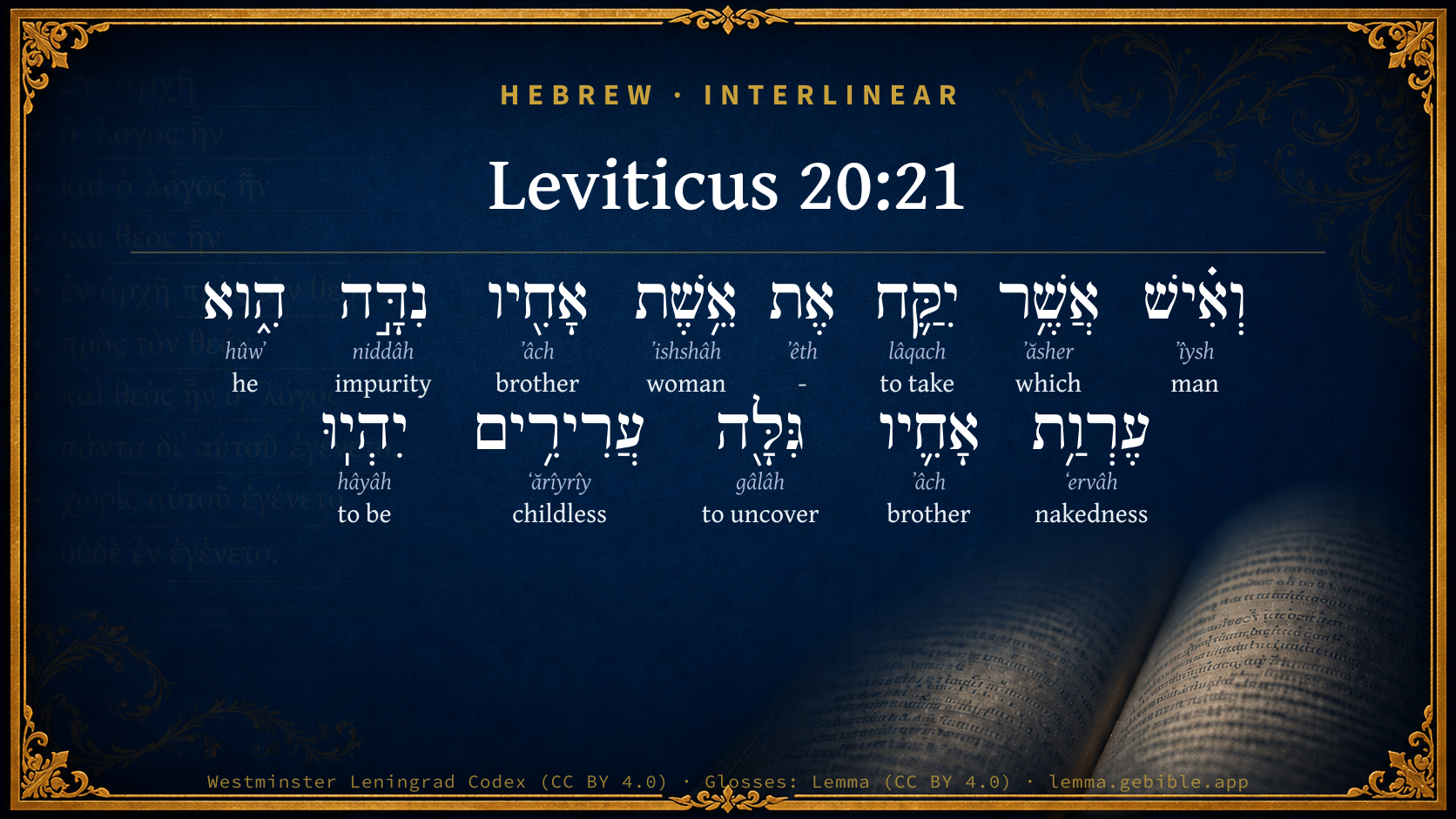
Leviticus 20:21

Hebrew (Westminster Leningrad Codex) Leviticus 20:21 appears in the Hebrew Old Testament. The text above is from the Westminster Leningrad Codex. Each word links to its Strong’s number, a concise gloss, and parsing drawn from the Open Scriptures Hebrew Bible morphology. Click any word for its full Brown-Driver-Briggs (BDB) entry.
Download image
Cite this verse

Leviticus 20:21 (World English Bible). Public Domain. Lemma interlinear Bible study tool, https://lemma.gebible.app/v/leviticus/20/21.

Show BibTeX & RIS
BibTeX
RIS
English Translation
"'If a man takes his brother's wife, it is an impurity: he has uncovered his brother's nakedness; they shall be childless.
World English Bible · Public Domain
Download a study sheet

One document with this verse’s original text, its word-by-word gloss line, the meaning frame, cross-references with their text, attributed commentary, and full source and license credits — printable, and it pastes into notes with its structure intact.

This verse Autodidact and up

Study sheet (.html) Plain text (.txt)

A passage Seminary Student

Up to 50 verses in one chapter. A passage sheet keeps up to 6 commentary sources and 12 cross-references per verse, in the order this page ranks them, and says so on the sheet whenever that leaves anything out. Ask for a single verse and you get the Autodidact verse sheet above.

Everything on this page stays free to read, with no account — the sheet is a download of what is already on screen, not access to it.

Want to remove ads? Support Godless Engineer
Compare translations 3

The same verse in 3 English versions, stacked beneath the original-language interlinear above. Click any original word for its lexicon entry.

Each is an independent rendering of the whole verse — the interlinear is not word-aligned to these translations.

Highlighted words mark where these versions differ — a whole-verse word diff, not a word-by-word alignment.

  • World English Bible Public Domain
    "'If a man takes his brother's wife, it is an impurity: he has uncovered his brother's nakedness; they shall be childless.
  • King James Version Public Domain
    And if a man shall take his brother's wife, it is an unclean thing: he hath uncovered his brother's nakedness; they shall be childless.
  • unfoldingWord Literal Text CC BY-SA 4.0
    And a man who takes the wife of his brother, it is menstruation. He has uncovered the nakedness of his brother; they will be childless.

unfoldingWord Literal Text — © unfoldingWord, licensed CC BY-SA 4.0. Word-aligned USFM3 via Door43 (git.door43.org/unfoldingWord/en_ult).

Versions to compare (up to 4)

3 of 4 selected

Show all 18 translations

Every available English version of this verse, each an independent rendering of the whole verse.

  • World English Bible Public Domain
    "'If a man takes his brother's wife, it is an impurity: he has uncovered his brother's nakedness; they shall be childless.
  • Berean Standard Bible Public Domain
    If a man marries his brother’s wife, it is an act of impurity. He has uncovered the nakedness of his brother; they shall be childless.
  • Majority Standard Bible Public Domain
    If a man marries his brother’s wife, it is an act of impurity. He has uncovered the nakedness of his brother; they shall be childless.
  • King James Version Public Domain
    And if a man shall take his brother's wife, it is an unclean thing: he hath uncovered his brother's nakedness; they shall be childless.
  • American Standard Version (1901) Public Domain
    And if a man shall take his brother's wife, it is impurity: he hath uncovered his brother's nakedness; they shall be childless.
  • Revised Version (1885) Public Domain
    And if a man shall take his brother’s wife, it is impurity: he hath uncovered his brother’s nakedness; they shall be childless.
  • Geneva Bible (1599) Public Domain
    So the man that taketh his brothers wife, committeth filthines, because he hath vncouered his brothers shame: they shalbe childles.
  • Douay-Rheims (1899) Public Domain
    He that marrieth his brother's wife, doth an unlawful thing, he hath uncovered his brother's nakedness: they shall be without children.
  • Young's Literal Translation Public Domain
    `And a man who taketh his brother's wife -- it `is' impurity; the nakedness of his brother he hath uncovered; childless they are.
  • Literal Standard Version CC BY-SA 4.0
    And a man who takes his brother’s wife—it [is] impurity; he has uncovered the nakedness of his brother; they are childless.
  • Unlocked Literal Bible CC BY-SA 4.0
    If a man marries his brother's wife while his brother is still living, that is disgraceful. He has dishonored his brother, and I will take away from their children any property they may have inherited from their parents.
  • unfoldingWord Literal Text CC BY-SA 4.0
    And a man who takes the wife of his brother, it is menstruation. He has uncovered the nakedness of his brother; they will be childless.
  • Darby Bible Public Domain
    And if a man take his brother's wife, it is an unclean thing: he hath uncovered his brother's nakedness: they shall be childless.
  • World Messianic Bible Public Domain
    “‘If a man takes his brother’s wife, it is an impurity. He has uncovered his brother’s nakedness. They shall be childless.
  • Webster's Bible Public Domain
    And if a man shall take his brother's wife, it is an unclean thing: he hath uncovered his brother's nakedness; they shall be childless.
  • Free Bible Version CC BY-SA 4.0
    A man who marries his brother's wife does something that is unclean. He has brought shame on his brother; the couple will have no children.
  • Bible in Basic English Public Domain
    And if a man takes his brother's wife, it is an unclean act; he has put shame on his brother; they will have no children.
  • JPS Tanakh (1917) Public Domain
    And if a man shall take his brother's wife, it is impurity: he hath uncovered his brother's nakedness; they shall be childless.

Literal Standard Version (2020), Covenant Press — licensed CC BY-SA 4.0. Text via the HelloAO Bible API (eBible.org). Unlocked Literal Bible (unfoldingWord) — licensed CC BY-SA 4.0. Text via the HelloAO Bible API (eBible.org). unfoldingWord Literal Text — © unfoldingWord, licensed CC BY-SA 4.0. Word-aligned USFM3 via Door43 (git.door43.org/unfoldingWord/en_ult). Free Bible Version, Dr. Jonathan Gallagher — licensed CC BY-SA 4.0. Text via the HelloAO Bible API (eBible.org).

Word by word

More ways to search: Search by grammar → Find every occurrence → Compare this word →

Practice this passage: Drill this verse → Learn its vocabulary →

עֲרִירִ֥ים
ʻărîyrîy
H6185
“childless”
Adjective, Adjective, Masculine, Plural, Absolute
Part of Speech
Adjective
Type
Adjective
Gender
Masculine
Number
Plural
State
Absolute
Full BDB Definition

Origin: from H6209

TWOT: 1705a

stripped, childless, bare of children
  1. וְאִ֗ישׁ ʼîysh H376 “and · man” Conjunction + Noun, Common, Masculine, Singular, Absolute
  2. אֲשֶׁ֥ר ʼăsher H834 “which” Particle, Relative
  3. יִקַּ֛ח lâqach H3947 “to take” Verb, Qal, Imperfect, 3rd Person, Masculine, Singular
  4. אֶת ʼêth H853 “-” Particle, Direct Object
  5. אֵ֥שֶׁת ʼishshâh H802 “woman of” Noun, Common, Feminine, Singular, Construct
  6. אָחִ֖יו ʼâch H251 “brother · his” Noun, Common, Masculine, Singular, Construct + Suffix, Personal, 3rd Person, Masculine, Singular
  7. נִדָּ֣ה niddâh H5079 “impurity” Noun, Common, Feminine, Singular, Absolute
  8. הִ֑וא hûwʼ H1931 “he” Pronoun, Personal, 3rd Person, Feminine, Singular
  9. עֶרְוַ֥ת ʻervâh H6172 “nakedness of” Noun, Common, Feminine, Singular, Construct
  10. אָחִ֛יו ʼâch H251 “brother · his” Noun, Common, Masculine, Singular, Construct + Suffix, Personal, 3rd Person, Masculine, Singular
  11. גִּלָּ֖ה gâlâh H1540 “to uncover” Verb, Piel, Perfect, 3rd Person, Masculine, Singular
  12. יִהְיֽוּ hâyâh H1961 “to be” Verb, Qal, Imperfect, 3rd Person, Masculine, Plural

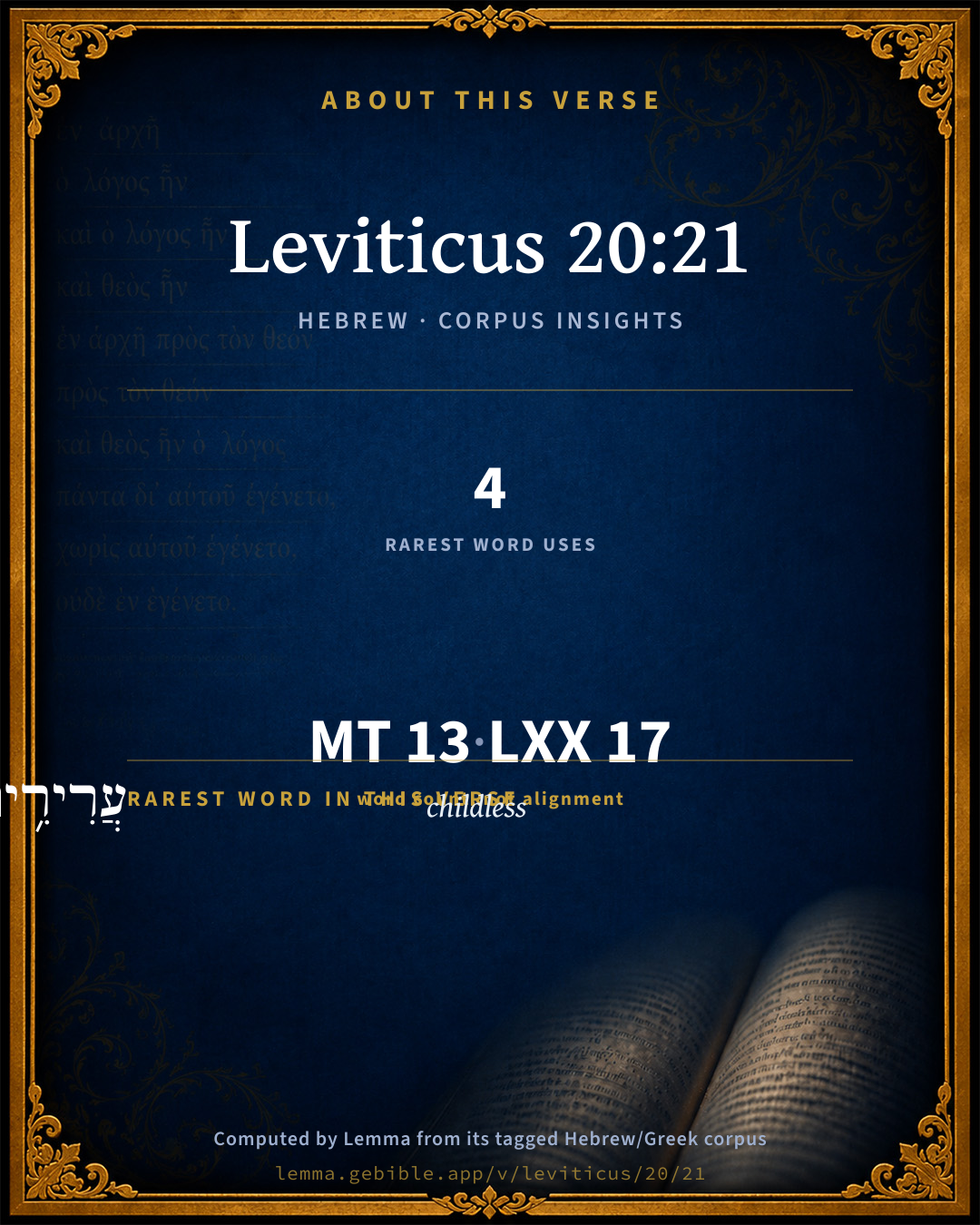
About this verse

These counts appear in no published source. They are computed here, from the morphology-tagged text and Lemma’s own curated glosses. What Lemma adds →

13
words
12
distinct lemmas
Pentateuch
section

Notable vocabulary

The rarest word here is עֲרִירִ֥ים childless H6185 — appearing just 4 times in the whole Hebrew Bible.

Shared distinctive vocabulary

עֲרִירִ֥ים childless H6185 occurs in 4 verses of the Hebrew Bible. Also found in:

Grammatical profile

  • 3 verbs
  • 6 nouns
  • 1 adjective
  • 1 pronoun
  • 2 particles

Verb forms

  • יִקַּ֛ח Qal · Imperfect
  • גִּלָּ֖ה Piel · Perfect
  • יִהְיֽוּ Qal · Imperfect

Repetition

A word recurs within this verse — often emphatic in Hebrew:

  • אָחִ֖יו brother H251 ×2

Hebrew & Septuagint length

In English translation the verse runs 21 words from the Hebrew and 19 from the Septuagint (LXX English) — closely comparable.

A rough comparison of the two English renderings, which tokenize alike — not a word-level alignment.

Word counts can differ between the Hebrew and the Greek without any difference in meaning — e.g. the Hebrew direct-object marker אֵת has no separate Greek word, and Greek often adds the article ὁ.

In the original languages it is 13 Hebrew tokens and 17 Greek tokens — but the two are counted differently (Hebrew bundles its prefixes and suffixes into one token; the Greek is in lemma form), so that isn’t a like-for-like length.

Cross-references

2

Topical passages linked to Leviticus 20:21 in the Treasury of Scripture Knowledge — connected by theme and wording, ordered by reader-vote popularity; previews shown in the World English Bible.

  • Leviticus 18:16 "'You shall not uncover the nakedness of your brother's wife: it is your brother's nakedness.
  • Matthew 14:3–4 For Herod had laid hold of John, and bound him, and put him in prison for the sake of Herodias, his brother Philip's wife.

Cross-references courtesy of OpenBible.info (CC BY 4.0).

Hebrew and Greek witnesses Masoretic Hebrew ↔ Greek Septuagint

The same verse in the two great witnesses to the Old Testament, shown verse-for-verse.

These are two independent witnesses, not word-aligned to each other, and the Septuagint is shown in lemma (dictionary) form.

Hebrew Leviticus 20:21 Masoretic · Westminster Leningrad Codex

וְאִ֗ישׁ אֲשֶׁ֥ר יִקַּ֛ח אֶת אֵ֥שֶׁת אָחִ֖יו נִדָּ֣ה הִ֑וא עֶרְוַ֥ת אָחִ֛יו גִּלָּ֖ה עֲרִירִ֥ים יִהְיֽוּ

"'If a man takes his brother's wife, it is an impurity: he has uncovered his brother's nakedness; they shall be childless.

World English Bible · Public Domain

Greek LXX Leviticus 20:21 Septuagint · lemma form

ὅς ἄν λαμβάνω ὁ γυνή ὁ ἀδελφός αὐτός ἀκαθαρσία εἰμί ἀσχημοσύνη ὁ ἀδελφός αὐτός ἀποκαλύπτω ἄτεκνος ἀποθνήσκω

Whoever shall take his brother's wife, it is uncleanness; he has uncovered his brother's nakedness; they shall die childless.

LXX2012 (modern English Septuagint) · Public Domain

Hebrew: Westminster Leningrad Codex (CC BY 4.0). Greek: Septuagint (public domain); English from LXX2012 (modern English Septuagint) (Public Domain). How the Septuagint differs from the Hebrew →

Targum (Aramaic paraphrase)

2

The Targum is the ancient Jewish Aramaic paraphrase of the Hebrew Scriptures — an interpretive translation, not the Hebrew text itself. Onkelos (literal) and Pseudo-Jonathan (expansive) render the Torah, and Jonathan the Prophets. Coverage is partial: where no permissively-licensed English translation exists for a verse, only the Aramaic is shown. This is verse-level text, not a word-by-word alignment to the Hebrew.

  1. Targum Onkelos Torah (Genesis–Deuteronomy)
    וּגְבַר דִי יִסַב יָת אִתַּת אֲחוּהִי מְרָחָקָא הִיא עֶרְיְתָא דַאֲחוּהִי גַלִי בְּלָא וְלָד יְהוֹן

    (no public-domain English translation for this verse)

    Targum Onkelos — Aramaic: “Onkelos Genesis” (public domain); “Onkelos Exodus” (public domain); “Onkelos Leviticus” (public domain); “Onkelos Numbers” (public domain); “Onkelos Deuteronomy” (public domain). English: “Sefaria Community Translation” (CC0 1.0 (public-domain dedication)); “J.W. Etheridge. The Targums of Onkelos and Jonathan Ben Uzziel on the Pentateuch. London: Longmans, Green, 1862” (public domain). Text via Sefaria.

  2. Targum Pseudo-Jonathan Torah (Genesis–Deuteronomy)
    וּגְבַר דִי יִסַב יַת אִתַּת אַחְבוֹי בְּחַיוֹי מְרַחְקָא הִיא עֶרְיְיתָא דַאֲחוֹי בְּזֵי בְּלָא וְלַד יְהוֹן

    And if a man take the wife of his brother during his life, it is an abomination: he hath dishonoured the nakedness of his brother; without children shall they be.

    Targum Pseudo-Jonathan — Aramaic: “Targum Jonathan on Genesis” (public domain); “Targum Jonathan on Exodus” (public domain); “Targum Jonathan on Leviticus” (public domain); “Targum Jonathan on Numbers” (public domain); “Targum Jonathan on Deuteronomy” (public domain). English: “The Targum of Jonathan ben Uzziel, trans. J. W. Etheridge, London, 1862” (public domain). Text via Sefaria.

Commentary

Notes on Leviticus 20:21 from classic Christian and Jewish commentators (each source and its license shown beneath its notes). The classic Christian expositions comment on the surrounding passage and are grouped to its opening verse, so a note may address several verses; the Jewish commentaries on the Tanakh (Rashi and others) are per-verse, so they appear only where the commentator wrote on this verse.

Lemma curates 59 commentaries, every one of them public domain or Creative Commons licensed, each selected and text-cleaned for this edition rather than reprinted as found. About our sources →

Trapp's Complete Commentary

John Trapp

Lev 20:21 And if a man shall take his brother’s wife, it [is] an unclean thing: he hath uncovered his brother’s nakedness; they shall be childless.

Ver. 21. They shall be childless.] Either barren or bereft; for this is a sin, saith Job, that roots out all a man’s increase. {Job 31:12} Hence that of Hosea, They shall commit whoredom, velo iepparedu, they shall not increase. Pered is a mule, which is a beast very libidinous, but begetting nothing. Solomon had many concubines, yet but one son and two daughters. So had our Henry VIII. He had uncovered his brother’s nakedness, and was well-nigh childless by her. Afterwards he married many wives, and was blameworthy for women, but left no more children than Solomon did. More happy he was in them than Solomon; for he had Rehoboam, a man neither wise nor fortunate, as they call it: his daughters but obscure, and both of them subjects. But Henry had a peerless prince to his son, viz., Edward VI, and his two daughters were both sovereigns of an imperial crown.

John Trapp, A Commentary or Exposition upon All the Books of the Old and New Testament (1647–1656) — public domain. Text from a community e-Sword module.

Joseph Benson's Commentary

Lev 20:21. His brother’s wife — Except in the case allowed by God, Deu 25:5.

Joseph Benson's Commentary on the Old and New Testaments (1811–1818) — public domain. Text from a community e-Sword module.

Geneva Bible (1599)

Geneva Bible translators

Read Lev. 18:16.

Geneva Bible (1599) marginal notes — public domain. Text via Bolls.life.

Ellicott's Commentary for English Readers

(21) His brother’s wife.—See Lev_18:16.

A Bible Commentary for English Readers, edited by Charles John Ellicott (1878–1897) — public domain. Text from a community e-Sword module.

John Gill's Exposition

And if a man shall take his brother's wife,.... To his wife, whether in his life, as the Targum of Jonathan adds, or whether after his death, unless when there is no issue, then he was obliged to it by another law, Deu 25:5; which is now ceased, and the law in Lev 18:16; here referred to, stands clear of all exceptions:

it is an unclean thing; or a "separation" (k) from which a man should remove and keep at a distance, as from menstruous women, of whom this word is used; and so denotes that it is by all means to be avoided, as an abominable and detestable thing; and it is observed that of all copulations it is only used of this: and the Jewish writers, as Aben Ezra and others, observe that this case is somewhat like that of a menstruous woman, who in the time of her separation is unlawful, but when out of it lawful; and so, in this case, a brother's wife might not be taken, he being alive; but after his death she might, if she had no son, according to the law before referred to, but that is now abolished:

he hath uncovered his brother's nakedness; his wife's, which was his brother's; which through nearness of kin, he ought not to have done; and the same holds good of a wife's sister, the relation being the same:

they shall be childless; they shall have none by such a marriage or copulation, and die without any; and as this supposes the brother's wife to have children by her first husband, or otherwise while the Jewish law lasted, it would not have been unlawful to marry her husband's brother; the meaning may be, that these should die before them, or rather, as some think, those that might be born of such a marriage should not be reckoned legitimate, and so not inherit.

(k) "separatio", Drusius,

John Gill's Exposition of the Whole Bible (1746–1763) — public domain (CC PDM 1.0). Text via the HelloAO Bible API.

Matthew Poole's English Annotations

Except in the case allowed by God, Deu 25:5.

An unclean thing; an abominable thing, like the uncleanness of a menstruous woman, which is oft expressed by this word: Heb. a separation or removing, i.e. a thing deserving separation or exclusion from society with others; or a thing to be removed out of sight or out of the world.

Matthew Poole's English Annotations on the Holy Bible (1683–1685) — public domain. Text from a community e-Sword/MySword module.

John Wesley's Explanatory Notes

His brother's wife - Except in the case allowed by God, Deut. xxv, 5.

John Wesley, Explanatory Notes Upon the Whole Bible (1754–1765) — public domain. Text via the GEBible commentary corpus.

Rashi

Rabbi Shlomo Yitzchaki (Rashi)

נדה הוא means, this cohabitation ought to be kept at a distance (avoided) and is loathsome. Our Rabbis explained that these words prohibit the slightest approach to her [I.e. one is liable for superficial contact, as is defined in the commentary on verse 18] just as though she were a נדה in the case of whom such intimacy is expressly stated as forbidden, as it says, (v. 18) “he hath uncovered her fountain” (cf. Yevamot 54a).

Rashi on the Tanakh — English translations: “The Judaica Press complete Tanach with Rashi, translated by A. J. Rosenberg” (CC BY 4.0); “Pentateuch with Rashi's commentary by M. Rosenbaum and A.M. Silbermann, 1929-1934” (public domain); “The Metsudah Tanach series, Lakewood, N.J” (CC BY 4.0); and “The Book of Joshua, Metsudah Publications, 1997” (CC BY 4.0). Text via Sefaria.

Lesson kit

Teaching starters — assembled from the data on this page, not authored interpretation. Every prompt links to the verse data it draws on. Edit before teaching.

Leviticus, in the Pentateuch, opens this verse with 13 words (12 distinct Hebrew lemmas). Its most distinctive word is ʻărîyrîy (“childless”). A historical commentator’s framing appears above. Read the whole chapter for the surrounding context.

Discussion questions

  1. How does “childless” (ʻărîyrîy) shape what this verse is saying?
  2. How does Genesis 15:2, which shares the word «childless», read alongside this verse?
  3. What does the repetition of “brother” (2× in this one verse) do in this verse?
  4. The translations on this page render this verse differently — a whole-verse word diff, not a word-by-word alignment. What might account for the different wordings?
  5. «יִקַּ֛ח» is a Qal Imperfect verb. How does that grammatical form shape the action described?
  6. Compare how Trapp's Complete Commentary and Joseph Benson's Commentary read this verse. Where do they agree or differ?

Things to notice

Reading settings

Reading text

Shown beneath each verse's original-language words.

Old Testament
Old Testament edition

Read the OT as the Masoretic Hebrew (MT) or the Greek Septuagint (LXX).

English shown for the Greek Septuagint (in the Hebrew ↔ Greek comparison).

Comparing translations? Open the Compare panel on any verse page to stack up to four side by side.