
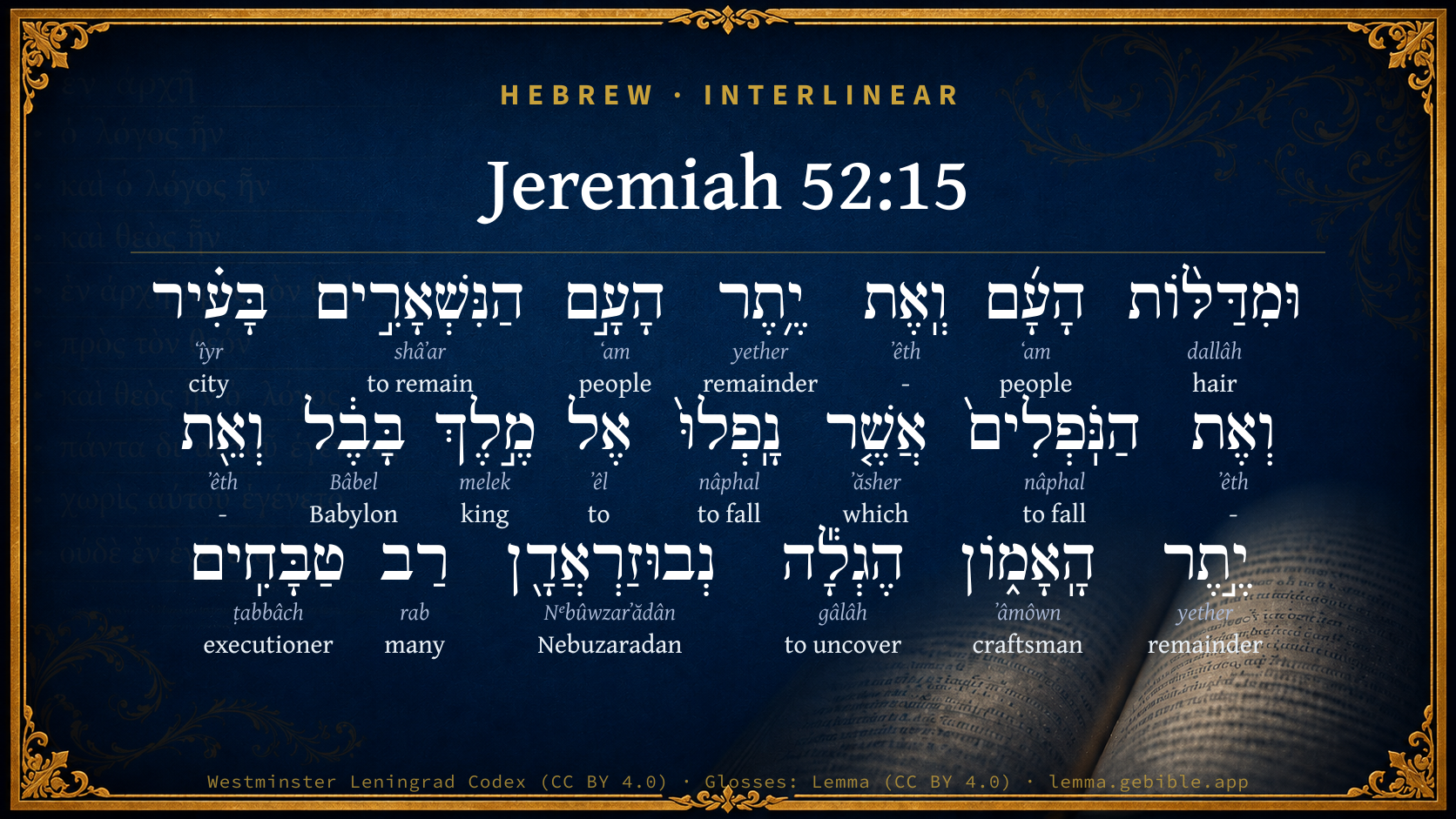
Jeremiah 52:15

Hebrew (Westminster Leningrad Codex) Jeremiah 52:15 appears in the Hebrew Old Testament. The text above is from the Westminster Leningrad Codex. Each word links to its Strong’s number, a concise gloss, and parsing drawn from the Open Scriptures Hebrew Bible morphology. Click any word for its full Brown-Driver-Briggs (BDB) entry.
Download image
Cite this verse

Jeremiah 52:15 (World English Bible). Public Domain. Lemma interlinear Bible study tool, https://lemma.gebible.app/v/jeremiah/52/15.

Show BibTeX & RIS
BibTeX
RIS
English Translation
Then Nebuzaradan the captain of the guard carried away captive of the poorest of the people, and the residue of the people who were left in the city, and those who fell away, who fell to the king of Babylon, and the residue of the multitude.
World English Bible · Public Domain
Highlights
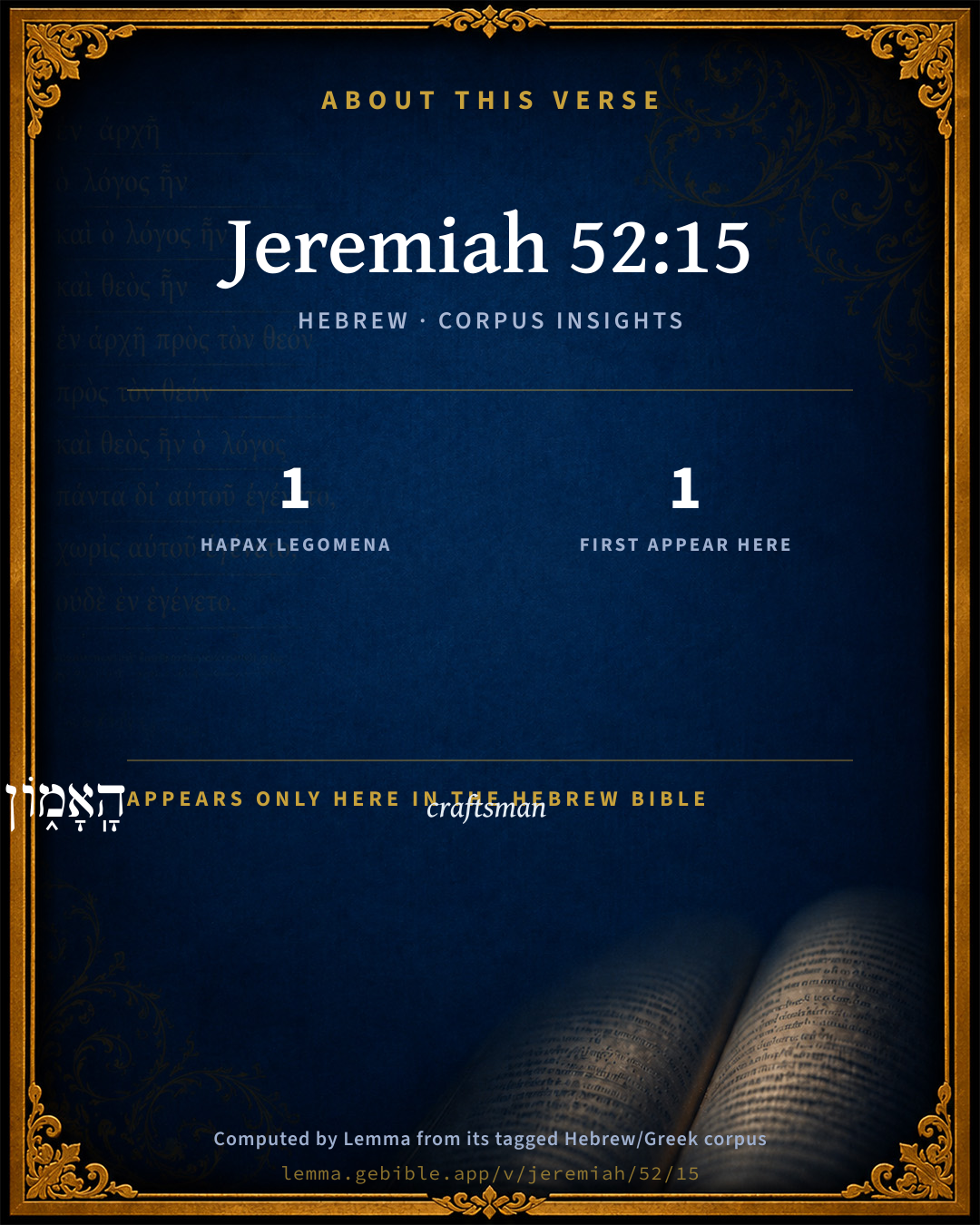
  • 1 hapax legomenon — only here in the Hebrew Bible
  • 1 first appearance in the Hebrew Bible
Full analysis ↓
Download a study sheet

One document with this verse’s original text, its word-by-word gloss line, the meaning frame, cross-references with their text, attributed commentary, and full source and license credits — printable, and it pastes into notes with its structure intact.

This verse Autodidact and up

Study sheet (.html) Plain text (.txt)

A passage Seminary Student

Up to 50 verses in one chapter. A passage sheet keeps up to 6 commentary sources and 12 cross-references per verse, in the order this page ranks them, and says so on the sheet whenever that leaves anything out. Ask for a single verse and you get the Autodidact verse sheet above.

Everything on this page stays free to read, with no account — the sheet is a download of what is already on screen, not access to it.

Want to remove ads? Support Godless Engineer
Compare translations 3

The same verse in 3 English versions, stacked beneath the original-language interlinear above. Click any original word for its lexicon entry.

Each is an independent rendering of the whole verse — the interlinear is not word-aligned to these translations.

Highlighted words mark where these versions differ — a whole-verse word diff, not a word-by-word alignment.

  • World English Bible Public Domain
    Then Nebuzaradan the captain of the guard carried away captive of the poorest of the people, and the residue of the people who were left in the city, and those who fell away, who fell to the king of Babylon, and the residue of the multitude.
  • King James Version Public Domain
    Then Nebuzaradan the captain of the guard carried away captive certain of the poor of the people, and the residue of the people that remained in the city, and those that fell away, that fell to the king of Babylon, and the rest of the multitude.
  • unfoldingWord Literal Text CC BY-SA 4.0
    As for the poorest people, the rest of the people who were left in the city, those who had deserted to the king of Babylon, and the rest of the craftsmen— Nebuzaradan, the commander of the bodyguards, took some of them away into exile.

unfoldingWord Literal Text — © unfoldingWord, licensed CC BY-SA 4.0. Word-aligned USFM3 via Door43 (git.door43.org/unfoldingWord/en_ult).

Versions to compare (up to 4)

3 of 4 selected

Show all 18 translations

Every available English version of this verse, each an independent rendering of the whole verse.

  • World English Bible Public Domain
    Then Nebuzaradan the captain of the guard carried away captive of the poorest of the people, and the residue of the people who were left in the city, and those who fell away, who fell to the king of Babylon, and the residue of the multitude.
  • Berean Standard Bible Public Domain
    Then Nebuzaradan captain of the guard carried into exile some of the poorest people and those who remained in the city, along with the deserters who had defected to the king of Babylon and the rest of the craftsmen.
  • Majority Standard Bible Public Domain
    Then Nebuzaradan captain of the guard carried into exile some of the poorest people and those who remained in the city, along with the deserters who had defected to the king of Babylon and the rest of the craftsmen.
  • King James Version Public Domain
    Then Nebuzaradan the captain of the guard carried away captive certain of the poor of the people, and the residue of the people that remained in the city, and those that fell away, that fell to the king of Babylon, and the rest of the multitude.
  • American Standard Version (1901) Public Domain
    Then Nebuzaradan the captain of the guard carried away captive of the poorest of the people, and the residue of the people that were left in the city, and those that fell away, that fell to the king of Babylon, and the residue of the multitude.
  • Revised Version (1885) Public Domain
    Then Nebuzaradan the captain of the guard carried away captive of the poorest sort of the people, and the residue of the people that were left in the city, and those that fell away, that fell to the king of Babylon, and the residue of the multitude.
  • Geneva Bible (1599) Public Domain
    Then Nebuzar-adan the chiefe steward caried away captiue certaine of the poore of the people, and the residue of the people that remayned in the citie, and those that were fled, and fallen to the king of Babel, with the rest of the multitude.
  • Douay-Rheims (1899) Public Domain
    But Nabuzardan the general carried away captives some of the poor people, and of the rest of the common sort who remained in the city, and of the fugitives that were fled over to the king of Babylon, and the rest of the multitude.
  • Young's Literal Translation Public Domain
    And of the poor of the people, and the remnant of the people who are left in the city, and those who are falling away, who have fallen unto the king of Babylon, and the remnant of the multitude, hath Nebuzar-Adan chief of the executioners, removed;
  • Literal Standard Version CC BY-SA 4.0
    And of the poor of the people, and the remnant of the people who are left in the city, and those who are defecting, who have defected to the king of Babylon, and the remnant of the multitude, Nebuzar-Adan, chief of the executioners, has removed;
  • Unlocked Literal Bible CC BY-SA 4.0
    As for the poorest people, the rest of the people who were left in the city, those who had deserted to the king of Babylon, and the rest of the craftsmen— Nebuzaradan, the commander of the bodyguards, took some of them away into exile.
  • unfoldingWord Literal Text CC BY-SA 4.0
    As for the poorest people, the rest of the people who were left in the city, those who had deserted to the king of Babylon, and the rest of the craftsmen— Nebuzaradan, the commander of the bodyguards, took some of them away into exile.
  • Darby Bible Public Domain
    And Nebuzar-adan the captain of the body-guard carried away captive of the poorest sort of the people, and the rest of the people that were left in the city, and the deserters that had deserted to the king of Babylon, and the rest of the multitude.
  • World Messianic Bible Public Domain
    Then Nebuzaradan the captain of the guard carried away captive of the poorest of the people, and the rest of the people who were left in the city, and those who fell away, who defected to the king of Babylon, and the rest of the multitude.
  • Webster's Bible Public Domain
    Then Nebuzar-adan the captain of the guard carried away captive certain of the poor of the people, and the residue of the people that remained in the city, and those that fell away, that fell to the king of Babylon, and the rest of the multitude.
  • Free Bible Version CC BY-SA 4.0
    Nebuzaradan, the commander of the guard, deported some of the poor people and those who were left in the city, even those who had gone over to the side of the king of Babylon, as well as the rest of the craftsmen.
  • Bible in Basic English Public Domain
    Then Nebuzaradan, the captain of the armed men, took away as prisoners the rest of the people who were still in the town, and those who had given themselves up to the king of Babylon, and the rest of the workmen.
  • JPS Tanakh (1917) Public Domain
    Then Nebuzaradan the captain of the guard carried away captive of the poorest sort of the people, and the residue of the people that remained in the city, and those that fell away, that fell to the king of Babylon, and the residue of the multitude.

Literal Standard Version (2020), Covenant Press — licensed CC BY-SA 4.0. Text via the HelloAO Bible API (eBible.org). Unlocked Literal Bible (unfoldingWord) — licensed CC BY-SA 4.0. Text via the HelloAO Bible API (eBible.org). unfoldingWord Literal Text — © unfoldingWord, licensed CC BY-SA 4.0. Word-aligned USFM3 via Door43 (git.door43.org/unfoldingWord/en_ult). Free Bible Version, Dr. Jonathan Gallagher — licensed CC BY-SA 4.0. Text via the HelloAO Bible API (eBible.org).

Word by word

More ways to search: Search by grammar → Find every occurrence → Compare this word →

Practice this passage: Drill this verse → Learn its vocabulary →

הָֽאָמ֑וֹן
ʼâmôwn
H527
“the · craftsman”
Particle, Definite Article + Noun, Common, Masculine, Singular, Absolute
Part of Speech
Particle + Noun
Type
Common
Gender
Masculine
Number
Singular
State
Absolute
Full BDB Definition

Origin: a variation for H1995

TWOT: 116 L

artificer, architect, master workman - (CLBL) throng, multitude
  1. וּמִדַּלּ֨וֹת dallâh H1803 “and · from · poor of” Conjunction + Preposition + Noun, Common, Feminine, Plural, Construct
  2. הָעָ֜ם ʻam H5971 “the · people” Particle, Definite Article + Noun, Common, Masculine, Singular, Absolute
  3. וְֽאֶת ʼêth H853 “and · -” Conjunction + Particle, Direct Object
  4. יֶ֥תֶר yether H3499 “remainder of” Noun, Common, Masculine, Singular, Construct
  5. הָעָ֣ם ʻam H5971 “the · people” Particle, Definite Article + Noun, Common, Masculine, Singular, Absolute
  6. הַנִּשְׁאָרִ֣ים shâʼar H7604 “the · remaining” Particle, Definite Article + Verb, Niphal, Participle Active, Masculine, Plural, Absolute
  7. בָּעִ֗יר ʻîyr H5892 “in/at the · city” Preposition, Determined + Noun, Common, Feminine, Singular, Absolute
  8. וְאֶת ʼêth H853 “and · -” Conjunction + Particle, Direct Object
  9. הַנֹּֽפְלִים֙ nâphal H5307 “the · falling” Particle, Definite Article + Verb, Qal, Participle Active, Masculine, Plural, Absolute
  10. אֲשֶׁ֤ר ʼăsher H834 “which” Particle, Relative
  11. נָֽפְלוּ֙ nâphal H5307 “to fall” Verb, Qal, Perfect, 3rd Person, Common, Plural
  12. אֶל ʼêl H413 “to” Preposition
  13. מֶ֣לֶךְ melek H4428 “king of” Noun, Common, Masculine, Singular, Construct
  14. בָּבֶ֔ל Bâbel H894 “Babylon” Noun, Proper
  15. וְאֵ֖ת ʼêth H853 “and · -” Conjunction + Particle, Direct Object
  16. יֶ֣תֶר yether H3499 “remainder of” Noun, Common, Masculine, Singular, Construct
  17. הֶגְלָ֕ה gâlâh H1540 “to uncover” Verb, Hiphil, Perfect, 3rd Person, Masculine, Singular
  18. נְבוּזַרְאֲדָ֖ן Nᵉbûwzarʼădân H5018 “Nebuzaradan” Noun, Proper
  19. רַב rab H7227 “many of” Noun, Common, Masculine, Singular, Construct
  20. טַבָּחִֽים ṭabbâch H2876 “executioners” Noun, Common, Masculine, Plural, Absolute

About this verse

These counts appear in no published source. They are computed here, from the morphology-tagged text and Lemma’s own curated glosses. What Lemma adds →

21
words
16
distinct lemmas
Prophets
section

Notable vocabulary

1 hapax legomenon — a word that appears only here in the entire Hebrew Bible:

  • הָֽאָמ֑וֹן craftsman H527

First appearance in Scripture

This word makes its first canonical appearance in the Hebrew Bible here:

  • הָֽאָמ֑וֹן craftsman H527

Shared distinctive vocabulary

וּמִדַּלּ֨וֹת hair H1803 occurs in 8 verses of the Hebrew Bible. Also found in:

Grammatical profile

  • 4 verbs
  • 12 nouns
  • 1 preposition
  • 4 particles

Verb forms

  • הַנִּשְׁאָרִ֣ים Niphal · Participle Active
  • הַנֹּֽפְלִים֙ Qal · Participle Active
  • נָֽפְלוּ֙ Qal · Perfect
  • הֶגְלָ֕ה Hiphil · Perfect

Repetition

Words recur within this verse — often emphatic in Hebrew:

  • הָעָ֜ם people H5971 ×2
  • יֶ֥תֶר remainder H3499 ×2
  • הַנֹּֽפְלִים֙ to fall H5307 ×2

Cross-references

2

Topical passages linked to Jeremiah 52:15 in the Treasury of Scripture Knowledge — connected by theme and wording, ordered by reader-vote popularity; previews shown in the World English Bible.

  • Jeremiah 15:1–2 Then said Yahweh to me, Though Moses and Samuel stood before me, yet my mind would not be toward this people: cast them out of my sight, and let them go forth.
  • Zechariah 14:2 For I will gather all nations against Jerusalem to battle; and the city will be taken, the houses rifled, and the women ravished. half of the city will go out into captivity, and the rest of the people will not be cut off from the city.

Cross-references courtesy of OpenBible.info (CC BY 4.0).

Hebrew and Greek witnesses Masoretic Hebrew ↔ Greek Septuagint

The same verse in the two great witnesses to the Old Testament, shown verse-for-verse.

These are two independent witnesses, not word-aligned to each other, and the Septuagint is shown in lemma (dictionary) form.

Hebrew Jeremiah 52:15 Masoretic · Westminster Leningrad Codex

וּמִדַּלּ֨וֹת הָעָ֜ם וְֽאֶת יֶ֥תֶר הָעָ֣ם הַנִּשְׁאָרִ֣ים בָּעִ֗יר וְאֶת הַנֹּֽפְלִים֙ אֲשֶׁ֤ר נָֽפְלוּ֙ אֶל מֶ֣לֶךְ בָּבֶ֔ל וְאֵ֖ת יֶ֣תֶר הָֽאָמ֑וֹן הֶגְלָ֕ה נְבוּזַרְאֲדָ֖ן רַב טַבָּחִֽים

Then Nebuzaradan the captain of the guard carried away captive of the poorest of the people, and the residue of the people who were left in the city, and those who fell away, who fell to the king of Babylon, and the residue of the multitude.

World English Bible · Public Domain

Greek LXX Structure differs

In the Septuagint, Jeremiah is about an eighth shorter than the Hebrew and arranges its material differently — the Oracles Against the Nations (Hebrew chapters 46–51) appear in the middle of the Greek book, after 25:13. Because the chapter and verse boundaries do not line up, a verse-for-verse comparison with the Hebrew is not shown.

A verse-for-verse comparison isn’t shown here because the chapters and verses don’t line up. Switch to the LXX edition with the MT / LXX toggle above to read the Greek directly.

On this verse, The Cambridge Bible for Schools and Colleges discusses the Septuagint’s reading. Read the note in Commentary ↓

Hebrew: Westminster Leningrad Codex (CC BY 4.0). Greek: Septuagint (public domain); English from a public-domain English Septuagint. How the Septuagint differs from the Hebrew →

Targum (Aramaic paraphrase)

1

The Targum is the ancient Jewish Aramaic paraphrase of the Hebrew Scriptures — an interpretive translation, not the Hebrew text itself. Onkelos (literal) and Pseudo-Jonathan (expansive) render the Torah, and Jonathan the Prophets. Coverage is partial: where no permissively-licensed English translation exists for a verse, only the Aramaic is shown. This is verse-level text, not a word-by-word alignment to the Hebrew.

  1. Targum Jonathan Prophets (Joshua–Malachi)
    וּמַחֲשִׁיכֵי עַמָא וְיַת שְׁאָרָא דְעַמָא דְאִשְׁתַּאֲרוּ בְקַרְתָּא וְיַת שְׁמִיעַיָא דְאִשְׁתַּמָעוּ עַל מַלְכָּא דְבָבֶל וְיַת שְׁאָר הֲמוֹנָא אַגְלֵי נְבוּזַרְאֲדָן רַב קָטוֹלַיָא:

    (no public-domain English translation for this verse)

    Targum Jonathan — Aramaic: “Mikraot Gedolot” (public domain). English: “Sefaria Community Translation” (CC0 1.0 (public-domain dedication)); “London "Chaldee Paraphrase," 1871” (public domain). Text via Sefaria.

Commentary

Notes on Jeremiah 52:15 from classic Christian and Jewish commentators (each source and its license shown beneath its notes). The classic Christian expositions comment on the surrounding passage and are grouped to its opening verse, so a note may address several verses; the Jewish commentaries on the Tanakh (Rashi and others) are per-verse, so they appear only where the commentator wrote on this verse.

Lemma curates 59 commentaries, every one of them public domain or Creative Commons licensed, each selected and text-cleaned for this edition rather than reprinted as found. About our sources →

Keil & Delitzsch

C. F. Keil & F. Delitzsch

The first words, "And of the poor of the people," are wanting in Kings, and have been brought here, through an error on the part of the copyist, from the beginning of the next verse; for "the poor of the people" are first treated of in Jer 52:16, where it is stated that Nebuzaradan left them in the land, while Jer 52:15 treats of those who were carried away to Babylon. The word האמון, instead of ההמון (Kings), seems to have originated simply through the exchange of א for ה, and to mean, like the other, the multitude of people. Hitzig and Graf are of opinion that אמון here, as in Pro 8:30, means workmaster or artificer, and that האמון denotes the same persons (collectively) who are designated החרשׁ והמּסגּר in Pro 24:1; Pro 29:2, and Kg2 24:14. But this view is opposed by the parallel passage, Jer 39:9, where the whole of this verse occurs, and יתר העם הנּשׁארים stands instead of יתר האמון. "The rest of the people of Jerusalem" are divided, by ואת־ואת, into those who went over to the Chaldeans, and the rest of the people who were taken prisoners by the Chaldeans at the capture of the city. The statement that both of these two classes of the population of Jerusalem were carried away to Babylon is so far limited by the further declaration, in Jer 52:16, that Nebuzaradan did not carry away every one, without exception, but let a portion of the humbler inhabitants of the country, who had no property, remain in the land, as vinedressers and husbandmen, that they might till the land. Instead of מדּלּות הארץ there occurs in Kings מדּלּת, and in Jer 39:10, more distinctly, מן העם הדּלּים, "some of the people, the humbler ones," who had no property of their own. דּלּה, pl. דּלּות, is an abstract noun, "poverty;" the singular is used collectively, hence the plural is here used to supply the deficiency. For יגבים, from יגב, to plough, there is found instead, in Kg2 25:12, Kethib גּבים, from גּוּב, with the same meaning.

Keil & Delitzsch — Biblical Commentary on the Old Testament (1861–1891) — public domain (CC PDM 1.0). Text via the HelloAO Bible API. (Old Testament only.)

Tyndale Open Study Notes

Tyndale Open Resources

52:15 some of the poorest of the people: Jeremiah added this phrase (cp. 2 Kgs 25:11) and changed “population” to craftsmen.

Tyndale Open Study Notes — © Tyndale Open Resources, licensed CC BY-SA 4.0. Text via the HelloAO Bible API.

Jamieson, Fausset & Brown

Robert Jamieson, A. R. Fausset & David Brown

poor of . . . people--added to the account in Kg2 25:11. "The poor of the people" are of the city, as distinguished from "the poor of the land," that is, of the country.

Jamieson, Fausset & Brown — Commentary Critical and Explanatory on the Whole Bible (1871) — public domain (CC PDM 1.0). Text via the HelloAO Bible API.

Adam Clarke's Commentary

Verse 15. Those that fell away] The deserters to the Chaldeans during the siege.

Adam Clarke's Commentary on the Bible (1810–1826) — public domain. Text from a community e-Sword/MySword module.

Ellicott's Commentary for English Readers

(15) Certain of the poor of the people.—Omitted in 2Ki_25:11, and probably inserted here by an error of transcription, as the next verse states that the “poor of the land” were left in their own country.

The rest of the multitude.—Better, perhaps, the remnant of the work-people, as in Pro_8:30, where many commentators so render the word, “I was with him as a worker” and Song Son_7:1. The versions, however, agree in giving “multitude.”

A Bible Commentary for English Readers, edited by Charles John Ellicott (1878–1897) — public domain. Text from a community e-Sword module.

The Cambridge Bible for Schools and Colleges

gen. ed. J. J. S. Perowne

15. The whole v. is omitted by the LXX. The words “of the poorest sort of the people and” seem to have come in from the next v. through an error of sight on the part of a copyist. The three classes of persons actually spoken of in the v. appear to be (a) those found within the city at the time of its capture, (b) those who had gone out to the Chaldaeans during the siege (see note on Jer_39:9), (c) the “residue of the multitude.” But for “multitude” read, as mg. artificers. Cp. Pro_8:30 (R. V. “a master workman”). The original differs by but one consonant from “multitude” which is the reading in Kings.

The Cambridge Bible for Schools and Colleges (gen. ed. J. J. S. Perowne; Cambridge University Press, 1878–1918) — public domain. Text from a community e-Sword module.

John Gill's Exposition

But Nebuzaradan the captain of the guard left certain of the poor of the land,.... Of the land of Judea, who lived in the country, and had not been concerned in defending the city against the Chaldeans:

for vinedressers, and for husbandmen; to look after the vineyards and fields, and dress and manure them, that the king of Babylon might receive some advantage by the conquest he had made; See Gill on Jer 39:10.

John Gill's Exposition of the Whole Bible (1746–1763) — public domain (CC PDM 1.0). Text via the HelloAO Bible API.

Albert Barnes' Notes on the Bible

Certain of the poor of the people, and - Omit (as in 2Ki 25:11), being inserted through some confusion with Jer 52:16.

Multitude - Possibly workmen. The object of Nebuchadnezzar was to people Babylon, not with paupers, but with men of a better class, artisans and workmen, who would enrich it.

Albert Barnes' Notes on the Bible (1834–1885) — public domain. Text from a community e-Sword/MySword module.

Haydock's Catholic Bible Commentary

Poor. He took those of the city, and left the poor of the country, ver. 16. (Calmet) --- Alexandrian Septuagint omits this verse, which Grabe inserts: 16. "And the rest of the people, the chief cook or general, left for," &c. (Haydock)

George Leo Haydock (1774–1849), Haydock's Catholic Family Bible and Commentary, 1859 edition — public domain. Excludes Psalms (Douay-Rheims chapter numbering differs from Protestant) and Deuterocanonical books (Catholic canon only).

unfoldingWord translationNotes

Door43 World Missions Community

craftsmen

This refers to people who make beautiful objects used in the worship of Yahweh.

Nebuzaradan

This is the name of a man. (See: How to Translate Names)

the poorest of the land

"the poorest people who lived on the land"

translationWords

exile

works

vineyard

unfoldingWord translationNotes — © Distant Shores Media and the Door43 World Missions Community, licensed CC BY-SA 4.0. Source: git.door43.org/Door43/en_tn.

Lesson kit

Teaching starters — assembled from the data on this page, not authored interpretation. Every prompt links to the verse data it draws on. Edit before teaching.

Jeremiah, in the Prophets, opens this verse with 21 words (16 distinct Hebrew lemmas). Its most distinctive word is ʼâmôwn (“craftsman”). A historical commentator’s framing appears above. Read the whole chapter for the surrounding context.

Discussion questions

  1. The word ʼâmôwn carries the sense “craftsman.” How does it shape the verse?
  2. This verse holds 1 word here found nowhere else in the Hebrew Bible. What might the rare word draw attention to?
  3. The word “craftsman” first appears here in Scripture. What is being introduced at this debut?
  4. Genesis 41:19 shares the word «hair» with this verse. How do the two illuminate each other?
  5. “people” occurs 2× in this one verse. What is the effect of the repetition?
  6. These translations render this verse differently. What is at stake in choosing one wording over another?
  7. The verb «הַנִּשְׁאָרִ֣ים» is Niphal Participle Active. How does its form color the action?
  8. Reading how Keil & Delitzsch and Tyndale Open Study Notes read this verse, where do the two commentators agree and where do they part?

Things to notice

  • 1 word in this verse appears nowhere else in the Hebrew Bible.
  • 1 word makes its first canonical appearance in Scripture here.
  • These translations choose different wording for 23 words in this verse.
  • “people” occurs 2× in this single verse.
  • 16 distinct Hebrew lemmas span 21 words in this verse.

Reading settings

Reading text

Shown beneath each verse's original-language words.

Old Testament
Old Testament edition

Read the OT as the Masoretic Hebrew (MT) or the Greek Septuagint (LXX).

English shown for the Greek Septuagint (in the Hebrew ↔ Greek comparison).

Comparing translations? Open the Compare panel on any verse page to stack up to four side by side.