
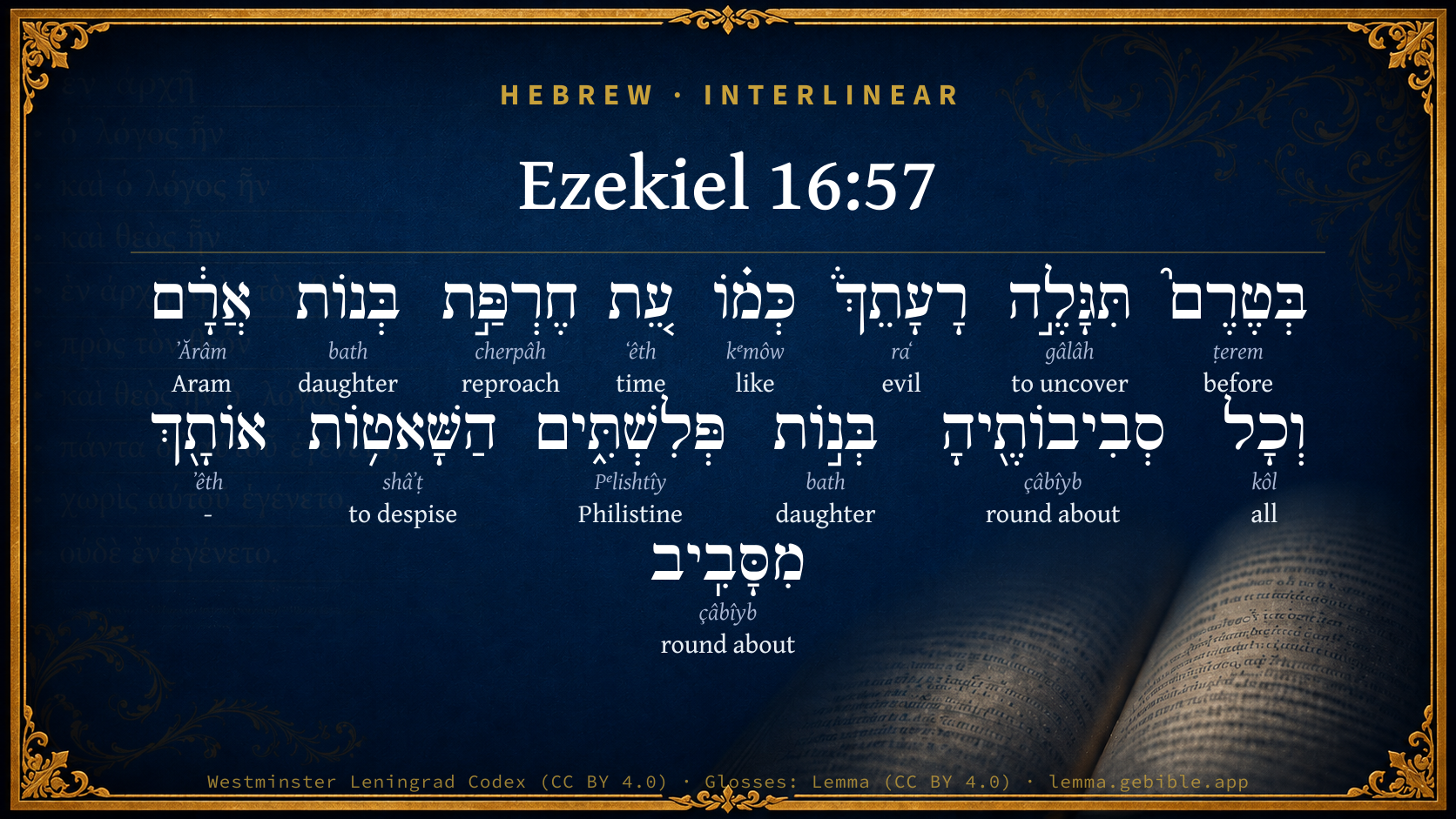
Ezekiel 16:57

Hebrew (Westminster Leningrad Codex) Ezekiel 16:57 appears in the Hebrew Old Testament. The text above is from the Westminster Leningrad Codex. Each word links to its Strong’s number, a concise gloss, and parsing drawn from the Open Scriptures Hebrew Bible morphology. Click any word for its full Brown-Driver-Briggs (BDB) entry.
Download image
Cite this verse

Ezekiel 16:57 (World English Bible). Public Domain. Lemma interlinear Bible study tool, https://lemma.gebible.app/v/ezekiel/16/57.

Show BibTeX & RIS
BibTeX
RIS
English Translation
before your wickedness was uncovered, as at the time of the reproach of the daughters of Syria, and of all who are round about her, the daughters of the Philistines, who do despite to you round about.
World English Bible · Public Domain
Highlights
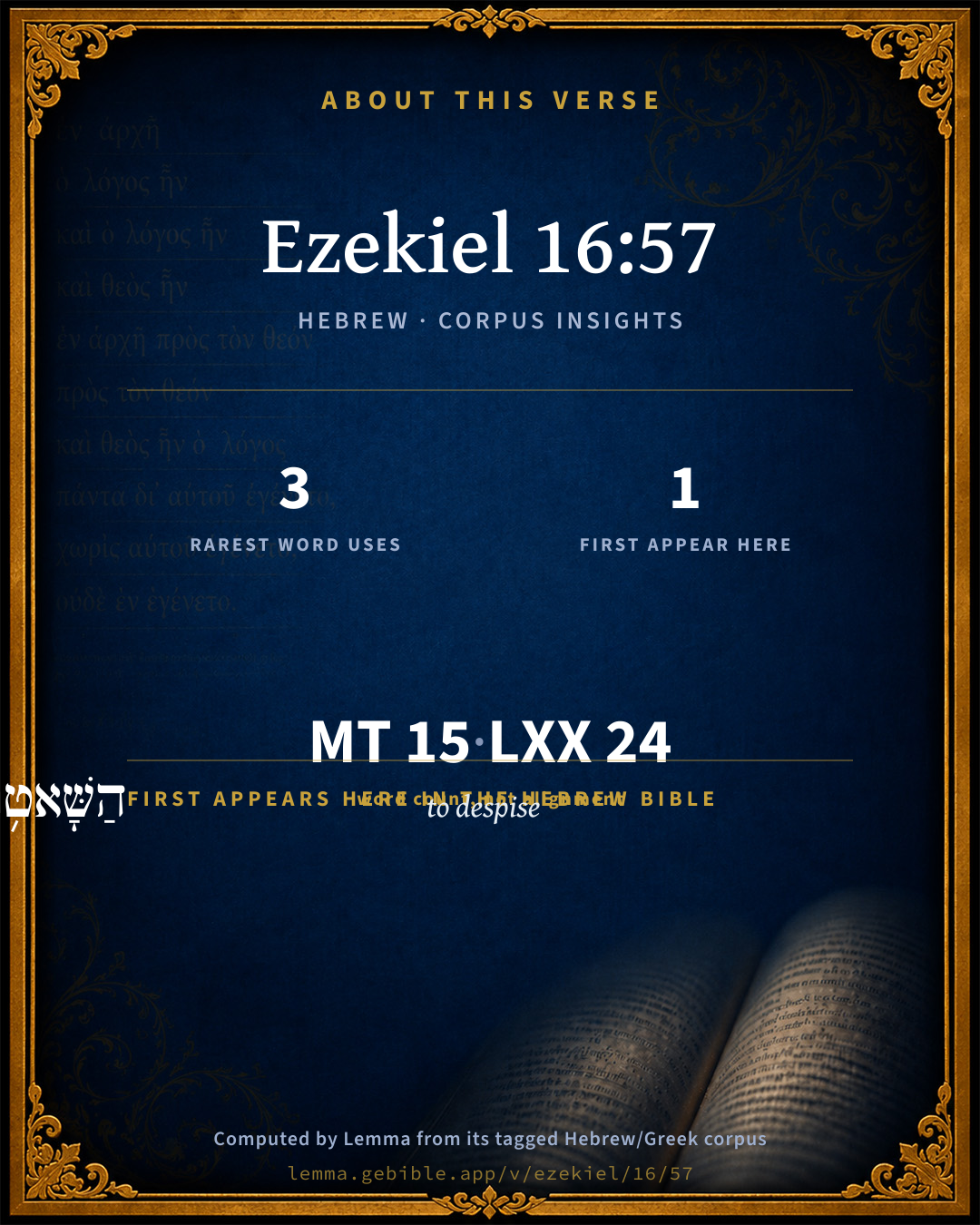
  • 1 first appearance in the Hebrew Bible
Full analysis ↓
Download a study sheet

One document with this verse’s original text, its word-by-word gloss line, the meaning frame, cross-references with their text, attributed commentary, and full source and license credits — printable, and it pastes into notes with its structure intact.

This verse Autodidact and up

Study sheet (.html) Plain text (.txt)

A passage Seminary Student

Up to 50 verses in one chapter. A passage sheet keeps up to 6 commentary sources and 12 cross-references per verse, in the order this page ranks them, and says so on the sheet whenever that leaves anything out. Ask for a single verse and you get the Autodidact verse sheet above.

Everything on this page stays free to read, with no account — the sheet is a download of what is already on screen, not access to it.

Want to remove ads? Support Godless Engineer
Compare translations 3

The same verse in 3 English versions, stacked beneath the original-language interlinear above. Click any original word for its lexicon entry.

Each is an independent rendering of the whole verse — the interlinear is not word-aligned to these translations.

Highlighted words mark where these versions differ — a whole-verse word diff, not a word-by-word alignment.

  • World English Bible Public Domain
    before your wickedness was uncovered, as at the time of the reproach of the daughters of Syria, and of all who are round about her, the daughters of the Philistines, who do despite to you round about.
  • King James Version Public Domain
    Before thy wickedness was discovered, as at the time of thy reproach of the daughters of Syria, and all that are round about her, the daughters of the Philistines, which despise thee round about.
  • unfoldingWord Literal Text CC BY-SA 4.0
    before your wickedness was revealed. But now you are an object of scorn to the daughters of Edom and to all the daughters of the Philistines around her. People all about despise you.

unfoldingWord Literal Text — © unfoldingWord, licensed CC BY-SA 4.0. Word-aligned USFM3 via Door43 (git.door43.org/unfoldingWord/en_ult).

Versions to compare (up to 4)

3 of 4 selected

Show all 18 translations

Every available English version of this verse, each an independent rendering of the whole verse.

  • World English Bible Public Domain
    before your wickedness was uncovered, as at the time of the reproach of the daughters of Syria, and of all who are round about her, the daughters of the Philistines, who do despite to you round about.
  • Berean Standard Bible Public Domain
    before your wickedness was uncovered? Even so, you are now scorned by the daughters of Edom and all those around her, and by the daughters of the Philistines—all those around you who despise you.
  • Majority Standard Bible Public Domain
    before your wickedness was uncovered? Even so, you are now scorned by the daughters of Edom and all those around her, and by the daughters of the Philistines—all those around you who despise you.
  • King James Version Public Domain
    Before thy wickedness was discovered, as at the time of thy reproach of the daughters of Syria, and all that are round about her, the daughters of the Philistines, which despise thee round about.
  • American Standard Version (1901) Public Domain
    before thy wickedness was uncovered, as at the time of the reproach of the daughters of Syria, and of all that are round about her, the daughters of the Philistines, that do despite unto thee round about.
  • Revised Version (1885) Public Domain
    before thy wickedness was discovered, as at the time of the reproach of the daughters of Syria, and of all that are round about her, the daughters of the Philistines, which do despite unto thee round about.
  • Geneva Bible (1599) Public Domain
    Before thy wickednes was discouered, as in that same time of the reproch of the daughters of Aram, and of all the daughters of the Philistims round about her which despise thee on all sides.
  • Douay-Rheims (1899) Public Domain
    Before thy malice was laid open: as it is at this time, making thee a reproach of the daughters of Syria, and of all the daughters of Palestine round about thee, that encompass thee on all sides.
  • Young's Literal Translation Public Domain
    Before thy wickedness is revealed, As `at' the time of the reproach of the daughters of Aram, And of all her neighbours, the daughters of the Philistines, Who are despising thee round about.
  • Literal Standard Version CC BY-SA 4.0
    Before your wickedness is revealed, || As [at] the time of the reproach of the daughters of Aram, || And of all her neighbors, the daughters of the Philistines, || Who are despising you all around.
  • Unlocked Literal Bible CC BY-SA 4.0
    before your wickedness was revealed. But now you are an object of scorn to the daughters of Edom and to all the daughters of the Philistines around her. People all about despise you.
  • unfoldingWord Literal Text CC BY-SA 4.0
    before your wickedness was revealed. But now you are an object of scorn to the daughters of Edom and to all the daughters of the Philistines around her. People all about despise you.
  • Darby Bible Public Domain
    before thy wickedness was discovered, as at the time of the reproach of the daughters of Syria, and of all that are round about her, the daughters of the Philistines, who despise thee on every side.
  • World Messianic Bible Public Domain
    before your wickedness was uncovered, as at the time of the reproach of the daughters of Syria, and of all who are around her, the daughters of the Philistines, who despise you all around.
  • Webster's Bible Public Domain
    Before thy wickedness was disclosed, as at the time of thy reproach of the daughters of Syria, and all that are around her, the daughters of the Philistines, who despise thee on every side.
  • Free Bible Version CC BY-SA 4.0
    before you were shown to be so wicked yourselves? Of course now you are mocked by the Edomites and the surrounding nations, as well as by the Philistines. Everyone around you looks down on you.
  • Bible in Basic English Public Domain
    Before your shame was uncovered? Now you have become like her a word of shame to the daughters of Edom and all who are round about you, the daughters of the Philistines who put shame on you round about.
  • JPS Tanakh (1917) Public Domain
    before thy wickedness was uncovered, as at the time of the taunt of the daughters of Aram, and of all that are round about her, the daughters of the Philistines, that have thee in disdain round about.

Literal Standard Version (2020), Covenant Press — licensed CC BY-SA 4.0. Text via the HelloAO Bible API (eBible.org). Unlocked Literal Bible (unfoldingWord) — licensed CC BY-SA 4.0. Text via the HelloAO Bible API (eBible.org). unfoldingWord Literal Text — © unfoldingWord, licensed CC BY-SA 4.0. Word-aligned USFM3 via Door43 (git.door43.org/unfoldingWord/en_ult). Free Bible Version, Dr. Jonathan Gallagher — licensed CC BY-SA 4.0. Text via the HelloAO Bible API (eBible.org).

Word by word

More ways to search: Search by grammar → Find every occurrence → Compare this word →

Practice this passage: Drill this verse → Learn its vocabulary →

הַשָּׁאט֥וֹת
shâʼṭ
H7590
“the · despising”
Particle, Definite Article + Verb, Qal, Participle Active, Feminine, Plural, Absolute
Part of Speech
Particle + Verb
Stem
Qal
Form
Participle Active
Gender
Feminine
Number
Plural
State
Absolute
Full BDB Definition

Origin: for active part of H7750 [compare H7589 ]

TWOT: 2345

to treat with contempt or despite - (Qal) - to treat with contempt or despite - haters (participle)
  1. בְּטֶרֶם֮ ṭerem H2962 “in/at · before” Preposition + Adverb
  2. תִּגָּלֶ֣ה gâlâh H1540 “to uncover” Verb, Niphal, Imperfect, 3rd Person, Feminine, Singular
  3. רָעָתֵךְ֒ raʻ H7451 “evil · your” Noun, Common, Feminine, Singular, Construct + Suffix, Personal, 2nd Person, Feminine, Singular
  4. כְּמ֗וֹ kᵉmôw H3644 “like” Preposition
  5. עֵ֚ת ʻêth H6256 “time of” Noun, Common, Both, Singular, Construct
  6. חֶרְפַּ֣ת cherpâh H2781 “reproach of” Noun, Common, Feminine, Singular, Construct
  7. בְּנוֹת bath H1323 “daughters of” Noun, Common, Feminine, Plural, Construct
  8. אֲרָ֔ם ʼĂrâm H758 “Aram” Noun, Proper
  9. וְכָל kôl H3605 “and · all of” Conjunction + Noun, Common, Masculine, Singular, Construct
  10. סְבִיבוֹתֶ֖יהָ çâbîyb H5439 “surroundings · her” Noun, Common, Both, Plural, Construct + Suffix, Personal, 3rd Person, Feminine, Singular
  11. בְּנ֣וֹת bath H1323 “daughters of” Noun, Common, Feminine, Plural, Construct
  12. פְּלִשְׁתִּ֑ים Pᵉlishtîy H6430 “Philistines” Noun, Gentilic, Masculine, Plural, Absolute
  13. אוֹתָ֖ךְ ʼêth H853 “- · you” Particle, Direct Object + Suffix, Personal, 2nd Person, Feminine, Singular
  14. מִסָּבִֽיב çâbîyb H5439 “from · round about” Preposition + Noun, Common, Both, Singular, Absolute

About this verse

These counts appear in no published source. They are computed here, from the morphology-tagged text and Lemma’s own curated glosses. What Lemma adds →

15
words
13
distinct lemmas
Prophets
section

Notable vocabulary

The rarest word here is הַשָּׁאט֥וֹת to despise H7590 — appearing just 3 times in the whole Hebrew Bible.

First appearance in Scripture

This word makes its first canonical appearance in the Hebrew Bible here:

  • הַשָּׁאט֥וֹת to despise H7590

Shared distinctive vocabulary

הַשָּׁאט֥וֹת to despise H7590 occurs in 3 verses of the Hebrew Bible. Also found in:

Grammatical profile

  • 2 verbs
  • 10 nouns
  • 1 preposition
  • 1 adverb
  • 1 particle

Verb forms

  • תִּגָּלֶ֣ה Niphal · Imperfect
  • הַשָּׁאט֥וֹת Qal · Participle Active

Repetition

Words recur within this verse — often emphatic in Hebrew:

  • בְּנוֹת daughter H1323 ×2
  • סְבִיבוֹתֶ֖יהָ round about H5439 ×2

Hebrew & Septuagint length

In English translation the verse runs 37 words from the Hebrew and 36 from the Septuagint (LXX English) — closely comparable.

A rough comparison of the two English renderings, which tokenize alike — not a word-level alignment.

Word counts can differ between the Hebrew and the Greek without any difference in meaning — e.g. the Hebrew direct-object marker אֵת has no separate Greek word, and Greek often adds the article ὁ.

In the original languages it is 15 Hebrew tokens and 24 Greek tokens — but the two are counted differently (Hebrew bundles its prefixes and suffixes into one token; the Greek is in lemma form), so that isn’t a like-for-like length.

Cross-references

16

Topical passages linked to Ezekiel 16:57 in the Treasury of Scripture Knowledge — connected by theme and wording, ordered by reader-vote popularity; previews shown in the World English Bible.

  • 2 Kings 16:5–7 Then Rezin king of Syria and Pekah son of Remaliah king of Israel came up to Jerusalem to war: and they besieged Ahaz, but could not overcome him.
  • 2 Chronicles 28:5–6 Therefore Yahweh his God delivered him into the hand of the king of Syria; and they struck him, and carried away of his a great multitude of captives, and brought them to Damascus. He was also delivered into the hand of the king of Israel, who struck him with a great slaughter.
  • 2 Chronicles 28:18–23 The Philistines also had invaded the cities of the lowland, and of the South of Judah, and had taken Beth-shemesh, and Aijalon, and Gederoth, and Soco with the towns of it, and Timnah with the towns of it, Gimzo also and the towns of it: and they lived there.
  • Isaiah 7:1 It happened in the days of Ahaz the son of Jotham, the son of Uzziah, king of Judah, that Rezin the king of Syria, and Pekah the son of Remaliah, king of Israel, went up to Jerusalem to war against it, but could not prevail against it.
  • Ezekiel 16:36–37 Thus says the Lord Yahweh, Because your filthiness was poured out, and your nakedness uncovered through your prostitution with your lovers; and because of all the idols of your abominations, and for the blood of your children, that you gave to them;
  • Genesis 10:22–23 The sons of Shem: Elam, Asshur, Arpachshad, Lud, and Aram.
  • Numbers 23:7 He took up his parable, and said, From Aram has Balak brought me, The king of Moab from the mountains of the East: Come, curse me Jacob, Come, defy Israel.
  • Isaiah 14:28 In the year that king Ahaz died was this burden.
  • Jeremiah 33:24 Don't you consider what this people has spoken, saying, The two families which Yahweh did choose, he has cast them off? thus do they despise my people, that they should be no more a nation before them.
  • Lamentations 4:22 The punishment of your iniquity is accomplished, daughter of Zion; he will no more carry you away into captivity: He will visit your iniquity, daughter of Edom; he will uncover your sins.
  • Ezekiel 21:24 Therefore thus says the Lord Yahweh: Because you have made your iniquity to be remembered, in that your transgressions are uncovered, so that in all your doings your sins do appear; because you have come to memory, you shall be taken with the hand.
  • Ezekiel 23:18–19 So she uncovered her prostitution, and uncovered her nakedness: then my soul was alienated from her, like as my soul was alienated from her sister.
  • Hosea 2:10 Now I will uncover her lewdness in the sight of her lovers, And no one will deliver her out of my hand.
  • Hosea 7:1 When I would heal Israel, Then the iniquity of Ephraim is uncovered, Also the wickedness of Samaria; For they commit falsehood, And the thief enters in, And the gang of robbers ravages outside.
  • 1 Corinthians 4:5 Therefore judge nothing before the time, until the Lord comes, who will both bring to light the hidden things of darkness, and reveal the counsels of the hearts. Then each man will get his praise from God.
  • Psalms 50:21 You have done these things, and I kept silent. You thought that the "I AM" was just like you. I will rebuke you, and accuse you in front of your eyes.

Cross-references courtesy of OpenBible.info (CC BY 4.0).

Hebrew and Greek witnesses Masoretic Hebrew ↔ Greek Septuagint

The same verse in the two great witnesses to the Old Testament, shown verse-for-verse.

These are two independent witnesses, not word-aligned to each other, and the Septuagint is shown in lemma (dictionary) form.

Hebrew Ezekiel 16:57 Masoretic · Westminster Leningrad Codex

בְּטֶרֶם֮ תִּגָּלֶ֣ה רָעָתֵךְ֒ כְּמ֗וֹ עֵ֚ת חֶרְפַּ֣ת בְּנוֹת אֲרָ֔ם וְכָל סְבִיבוֹתֶ֖יהָ בְּנ֣וֹת פְּלִשְׁתִּ֑ים הַשָּׁאט֥וֹת אוֹתָ֖ךְ מִסָּבִֽיב

before your wickedness was uncovered, as at the time of the reproach of the daughters of Syria, and of all who are round about her, the daughters of the Philistines, who do despite to you round about.

World English Bible · Public Domain

Greek LXX Ezekiel 16:57 Septuagint · lemma form

πρό ὁ ἀποκαλύπτω ὁ κακία σύ ὅς τρόπος νῦν ὄνειδος εἰμί θυγάτηρ συρία καί πᾶς ὁ κύκλος αὐτός θυγάτηρ ἀλλόφυλος ὁ περιἔχω σύ κύκλος

before your wickedness was revealed, even now you are the reproach of the daughters of Syria, and of all that are round about her, even of the daughters of the Philistines that compass you round about.

LXX2012 (modern English Septuagint) · Public Domain

On this verse, The Cambridge Bible for Schools and Colleges discusses the Septuagint’s reading. Read the note in Commentary ↓

Hebrew: Westminster Leningrad Codex (CC BY 4.0). Greek: Septuagint (public domain); English from LXX2012 (modern English Septuagint) (Public Domain). How the Septuagint differs from the Hebrew →

Targum (Aramaic paraphrase)

1

The Targum is the ancient Jewish Aramaic paraphrase of the Hebrew Scriptures — an interpretive translation, not the Hebrew text itself. Onkelos (literal) and Pseudo-Jonathan (expansive) render the Torah, and Jonathan the Prophets. Coverage is partial: where no permissively-licensed English translation exists for a verse, only the Aramaic is shown. This is verse-level text, not a word-by-word alignment to the Hebrew.

  1. Targum Jonathan Prophets (Joshua–Malachi)
    עַד לָא תִתְגְלֵי בִישְׁתִּיךְ כְּעִדַן דַחֲסִידוּ כַּפְרָנֵי אֲרָם וְכָל סָחְרָנָהָא כַּפְרָנֵי פְּלִשְׁתָּאֵי דְבָזוּ יָתִיךְ מִסְחוֹר סְחוֹר:

    (no public-domain English translation for this verse)

    Targum Jonathan — Aramaic: “Mikraot Gedolot” (public domain). English: “Sefaria Community Translation” (CC0 1.0 (public-domain dedication)); “London "Chaldee Paraphrase," 1871” (public domain). Text via Sefaria.

Commentary

Notes on Ezekiel 16:57 from classic Christian and Jewish commentators (each source and its license shown beneath its notes). The classic Christian expositions comment on the surrounding passage and are grouped to its opening verse, so a note may address several verses; the Jewish commentaries on the Tanakh (Rashi and others) are per-verse, so they appear only where the commentator wrote on this verse.

Lemma curates 59 commentaries, every one of them public domain or Creative Commons licensed, each selected and text-cleaned for this edition rather than reprinted as found. About our sources →

Trapp's Complete Commentary

John Trapp

Eze 16:57 Before thy wickedness was discovered, as at the time of [thy] reproach of the daughters of Syria, and all [that are] round about her, the daughters of the Philistines, which despise thee round about.

Ver. 57. Before thy wickedness was discovered,] sc., By my punishments, by my sending the Syrians and Philistines upon thee, in the days of Ahaz, to despoil and despise thee. Compare Isa 9:12.

John Trapp, A Commentary or Exposition upon All the Books of the Old and New Testament (1647–1656) — public domain. Text from a community e-Sword module.

Joseph Benson's Commentary

Eze 16:57-59. As at the time of thy reproach, &c. — These words appear to begin a new sentence; which may be translated more intelligibly thus, by joining them to the following verse: “But when it was the time of thy becoming the reproach of the daughters of Syria,” &c. The words, with regard to what goes before, import thus much: In thy prosperity thou didst despise those who were no worse than thyself; but thou hast since, in thy turn, been insulted and invaded by thy neighbours, both Syrians and Philistines, whom God hath made use of as executioners of his judgments upon thee; thou hast been a remarkable instance of his vengeance, and God’s hand hath been heavy upon thee for all thine idolatries and abominations. The words relate to the frequent inroads which the Syrians and Philistines made into Judea, in the time of King Ahaz. Thou hast borne — Or, Thou shalt bear, thy lewdness, &c. — Thou shalt be punished according to thy wickedness. I will even deal with thee as thou hast done, which hast despised the oath, &c. — That solemn oath and covenant you entered into with me, to be my people, and serve no other god besides, Deu 29:12; Deu 29:14. Hereupon God threatens her, that since she had broken her oath and promise, he should not think himself obliged to make good any of the promises of favour and protection which he had made to her, but would give her up to ruin and desolation.

Joseph Benson's Commentary on the Old and New Testaments (1811–1818) — public domain. Text from a community e-Sword module.

Geneva Bible (1599)

Geneva Bible translators

That is, till thou wast brought under by the Syrians and Philistines, 2 Chron. 28:19.

Which joined with the Syrians, or compassed about Jerusalem.

Geneva Bible (1599) marginal notes — public domain. Text via Bolls.life.

Jamieson, Fausset & Brown

Robert Jamieson, A. R. Fausset & David Brown

Before thy wickedness was discovered--manifested to all, namely, by the punishment inflicted on thee.

thy reproach of . . . Syria and . . . Philistines--the indignity and injuries done thee by Syria and the Philistines (Kg2 16:5; Ch2 28:18; Isa 9:11-12).

Jamieson, Fausset & Brown — Commentary Critical and Explanatory on the Whole Bible (1871) — public domain (CC PDM 1.0). Text via the HelloAO Bible API.

Ellicott's Commentary for English Readers

(57) Thy reproach of the daughters of Syria—The pronoun should be omitted, and the phrase read, “the reproach.” The time referred to, when Jerusalem was too proud to make mention of Sodom, was in the days of her prosperity. Later her “wickedness was discovered,” and her pride humbled by such disasters. as fell upon her, especially from the days of Ahaz onward. At that time she was hard pressed both by the Syrians and by the Philistines (2Ki_15:37; 2Ch_28:18-19), and impoverished herself to obtain aid from Assyria (2Ki_16:8); and such straits continued to mark her subsequent history. (See 2Ki_24:2.) In the weakness and disasters towards the close of her kingdom, Judah became an object of contempt to the surrounding nations, “despised “by Syria and Philistia alike. Another view less probably refers “thy reproach” to Judah’s exultation at the fall of Syria and the Philistines before the march of the Assyrians.

A Bible Commentary for English Readers, edited by Charles John Ellicott (1878–1897) — public domain. Text from a community e-Sword module.

The Cambridge Bible for Schools and Colleges

gen. ed. J. J. S. Perowne

57. was discovered] i.e. manifested. According to modes of thinking then prevalent calamity was the accepted proof of wickedness. Jerusalem’s wickedness was laid bare when her great calamities fell upon her, Lam_1:8-9.

the time of thy reproach] Better, with R.V. as at the time of the reproach of the daughters of Syria—which is that which they cast upon Jerusalem, not conversely as A.V. The “time” must be the present, not any previous time, and the language expresses this awkwardly. LXX. read: as now thou art the reproach (“now” for “time,” and either finding or inserting the pron. “thou”). The rendering: before thy wickedness was discovered as (it is) now, a reproach &c. (Hitz. Corn.), is scarcely a Heb. construction. It would be easiest to change “time” into “thou” (cf. the opposite change “which” into “ten” ch. Eze_40:49): as thou art the reproach.

Syria, and … round about her] The mention of Syria (Heb. Aram) is strange when the reference is to the downfall of Jerusalem. For Aram Syriac gives Edom (d. for r, cf. ch. Eze_27:16) which is more natural (cf. ch. Eze_35:12 seq., Eze_25:5; Eze_25:12; Eze_25:15). Vulg. reads, round about thee, while Syr. wants the whole phrase. The ref. is to Jerusalem in any case. Ezekiel nowhere else brings Syria into connexion with Israel.

which despise thee] Or, do despite unto thee; cf. ch. Eze_25:15.

The Cambridge Bible for Schools and Colleges (gen. ed. J. J. S. Perowne; Cambridge University Press, 1878–1918) — public domain. Text from a community e-Sword module.

John Gill's Exposition

Thou hast borne thy lewdness and thine abominations,.... Openly and publicly; their abominable iniquities were written as it were upon their foreheads, and were to be seen of all men; their sin was to be read in their punishment, which is meant by bearing their lewdness and abominations; namely, the punishment due unto them:

saith the Lord; who always speaks what is just and true; this is added to denote the truth of what had been, and the certainty of what would be, as follows:

John Gill's Exposition of the Whole Bible (1746–1763) — public domain (CC PDM 1.0). Text via the HelloAO Bible API.

Albert Barnes' Notes on the Bible

Thy reproach - Rather, the “reproach.” In his march toward Jerusalem, Nebuchadnezzar attacked and overthrew Damascus and other Syrian towns. The Jews exulted, not foreseeing that this was but a precursor of that ruin which should discover their own wickedness.

Albert Barnes' Notes on the Bible (1834–1885) — public domain. Text from a community e-Sword/MySword module.

Matthew Poole's English Annotations

The time of her pride, security, and sin was when they were not afflicted, and despised by the Syrians.

Thy wickedness; thy abominable doings were made known to thyself, to thy friends and enemies too, by the execution of the severe menaces and sad predictions of my prophets, who foretold what punishments and what shame this sinful people should suffer by the hands of the Syrians, who should waste the Jews, and deride them, burn their cities, and carry citizens captives, as in the time of Ahaz over Judah, and Rezin over Syria.

All that are round about; the nations that were round about in vicinity, and combined in league against the house of David.

Her; either Jerusalem or Syria; rather this latter, the chief whereof were the Philistines, called here the daughters of the Philistines, as Isa 9:12.

Despise thee; contemn thee, as an impotent as well as wicked people, a people which had deserved to be enslaved, and over whom they might at pleasure make a king.

Matthew Poole's English Annotations on the Holy Bible (1683–1685) — public domain. Text from a community e-Sword/MySword module.

Whedon's Commentary on the Bible

Daniel D. Whedon

57. Before thy wickedness was discovered — Jerusalem was very disdainful of others’ sins before her own wickedness was made manifest; but now the very “daughters of the Philistines” despise her.

As at the time of thy reproach — LXX, and Vulgate, as now to be the reproach. Better, R.V., “as at the time of the reproach.”

Daniel D. Whedon (gen. ed.), Commentary on the Old and New Testaments (1874–1909) — public domain. Text from a community e-Sword module.

The Pulpit Commentary

For thy reproach, read, with the Revised Version, the reproach. The words point primarily to the disasters, not of Judah, but to those that fell on the cities of Syria and Philistia the Assyrian and Chaldean invasions. (For the grouping of the two nations as enemies of Judab, see Isa_9:12; and for special acts of hostility. (2Ki_15:37 2Ki_16:6; and 2Ch_28:18, 2Ch_28:19)

The Pulpit Commentary (1880–1919), ed. H.D.M. Spence-Jones & Joseph S. Exell — public domain. Text from a community e-Sword module.

John Wesley's Explanatory Notes

Before - The time of her pride was, when they were not yet afflicted, and despised by the Syrians. And all - The nations that were round about and combined in league against the house of David. Her - Syria, the chief whereof were the Philistines.

John Wesley, Explanatory Notes Upon the Whole Bible (1754–1765) — public domain. Text via the GEBible commentary corpus.

Rashi

Rabbi Shlomo Yitzchaki (Rashi)

like [at] the time of the taunt by the daughters of Aram As it was revealed when I delivered you into the hands of the kings of Aram, who attacked Ahaz (II Kings 15:36); “In those days, the Lord began to incite Rezin the king of Aram. etc.”; (II Chron. 28:5), “And the Lord his God delivered him into the hands of the king of Aram, etc.”; (ibid. verse 18), “And the Philistines invaded the cities of the plain and the south, etc.

who disgraced you Heb. הֳשָּׁאטוֹת, an expression for disgrace. The ‘aleph’ is not sounded. וַיִבֶז, despised (Gen. 25:34), is translated as וְשָּׁט [in Targum Onkelos].

Rashi on the Tanakh — English translations: “The Judaica Press complete Tanach with Rashi, translated by A. J. Rosenberg” (CC BY 4.0); “Pentateuch with Rashi's commentary by M. Rosenbaum and A.M. Silbermann, 1929-1934” (public domain); “The Metsudah Tanach series, Lakewood, N.J” (CC BY 4.0); and “The Book of Joshua, Metsudah Publications, 1997” (CC BY 4.0). Text via Sefaria.

Lesson kit

Teaching starters — assembled from the data on this page, not authored interpretation. Every prompt links to the verse data it draws on. Edit before teaching.

Ezekiel, in the Prophets, opens this verse with 15 words (13 distinct Hebrew lemmas). Its most distinctive word is shâʼṭ (“to despise”). A historical commentator’s framing appears above. Read the whole chapter for the surrounding context.

Discussion questions

  1. How does “to despise” (shâʼṭ) shape what this verse is saying?
  2. The word “to despise” first appears here in Scripture. What is being introduced at this debut?
  3. Ezekiel 28:24 shares the word «to despise» with this verse. How do the two illuminate each other?
  4. “daughter” occurs 2× in this one verse. What is the effect of the repetition?
  5. The translations on this page render this verse differently — a whole-verse word diff, not a word-by-word alignment. What might account for the different wordings?
  6. The verb «תִּגָּלֶ֣ה» is Niphal Imperfect. How does its form color the action?
  7. Reading how Trapp's Complete Commentary and Joseph Benson's Commentary read this verse, where do the two commentators agree and where do they part?

Things to notice

Reading settings

Reading text

Shown beneath each verse's original-language words.

Old Testament
Old Testament edition

Read the OT as the Masoretic Hebrew (MT) or the Greek Septuagint (LXX).

English shown for the Greek Septuagint (in the Hebrew ↔ Greek comparison).

Comparing translations? Open the Compare panel on any verse page to stack up to four side by side.