
Jeremiah 40:1

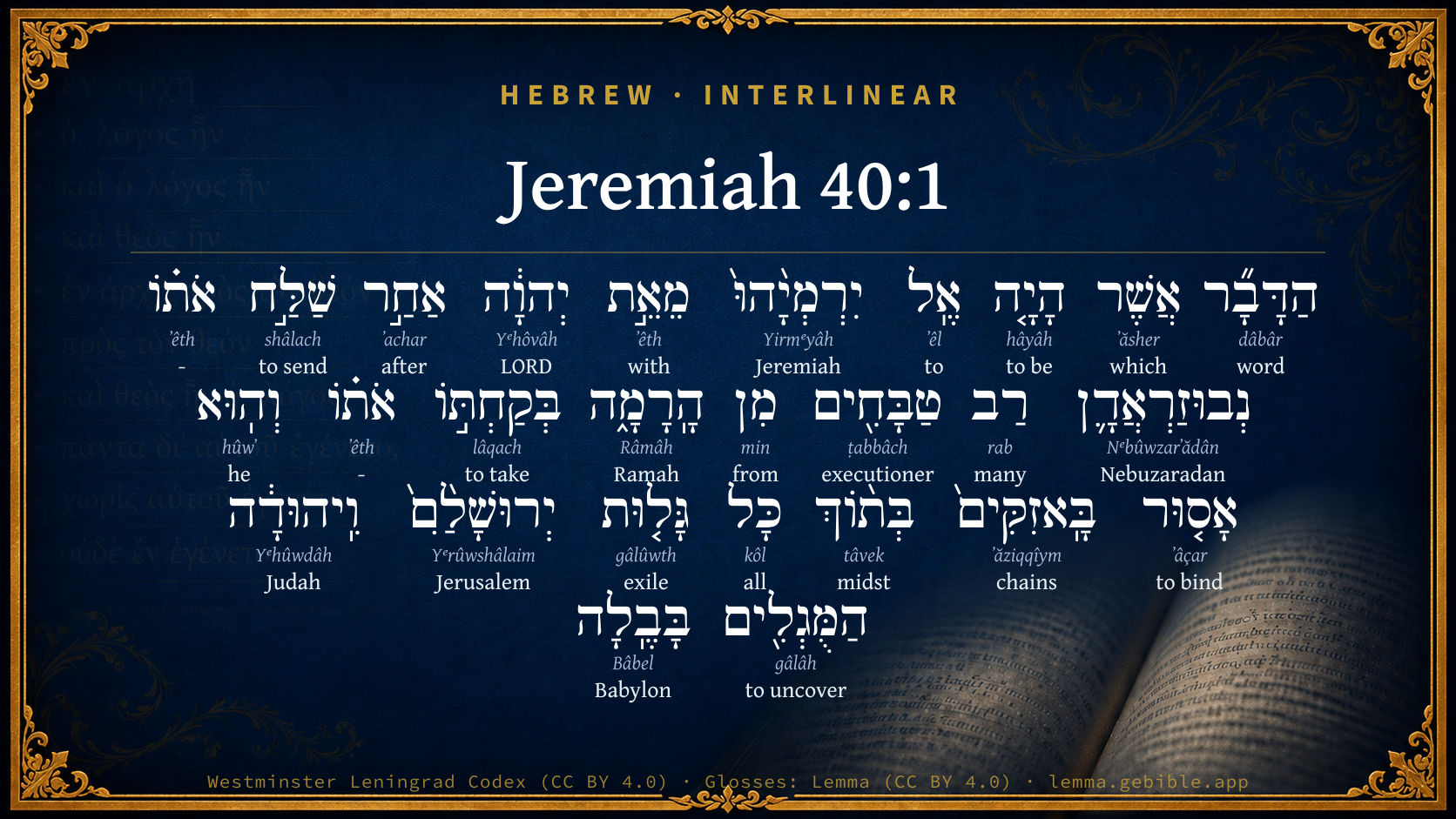
Hebrew (Westminster Leningrad Codex) Jeremiah 40:1 appears in the Hebrew Old Testament. The text above is from the Westminster Leningrad Codex. Each word links to its Strong’s number, a concise gloss, and parsing drawn from the Open Scriptures Hebrew Bible morphology. Click any word for its full Brown-Driver-Briggs (BDB) entry.
Download image
Cite this verse

Jeremiah 40:1 (World English Bible). Public Domain. Lemma interlinear Bible study tool, https://lemma.gebible.app/v/jeremiah/40/1.

Show BibTeX & RIS
BibTeX
RIS
English Translation
The word which came to Jeremiah from Yahweh, after that Nebuzaradan the captain of the guard had let him go from Ramah, when he had taken him being bound in chains among all the captives of Jerusalem and Judah, who were carried away captive to Babylon.
World English Bible · Public Domain
Highlights
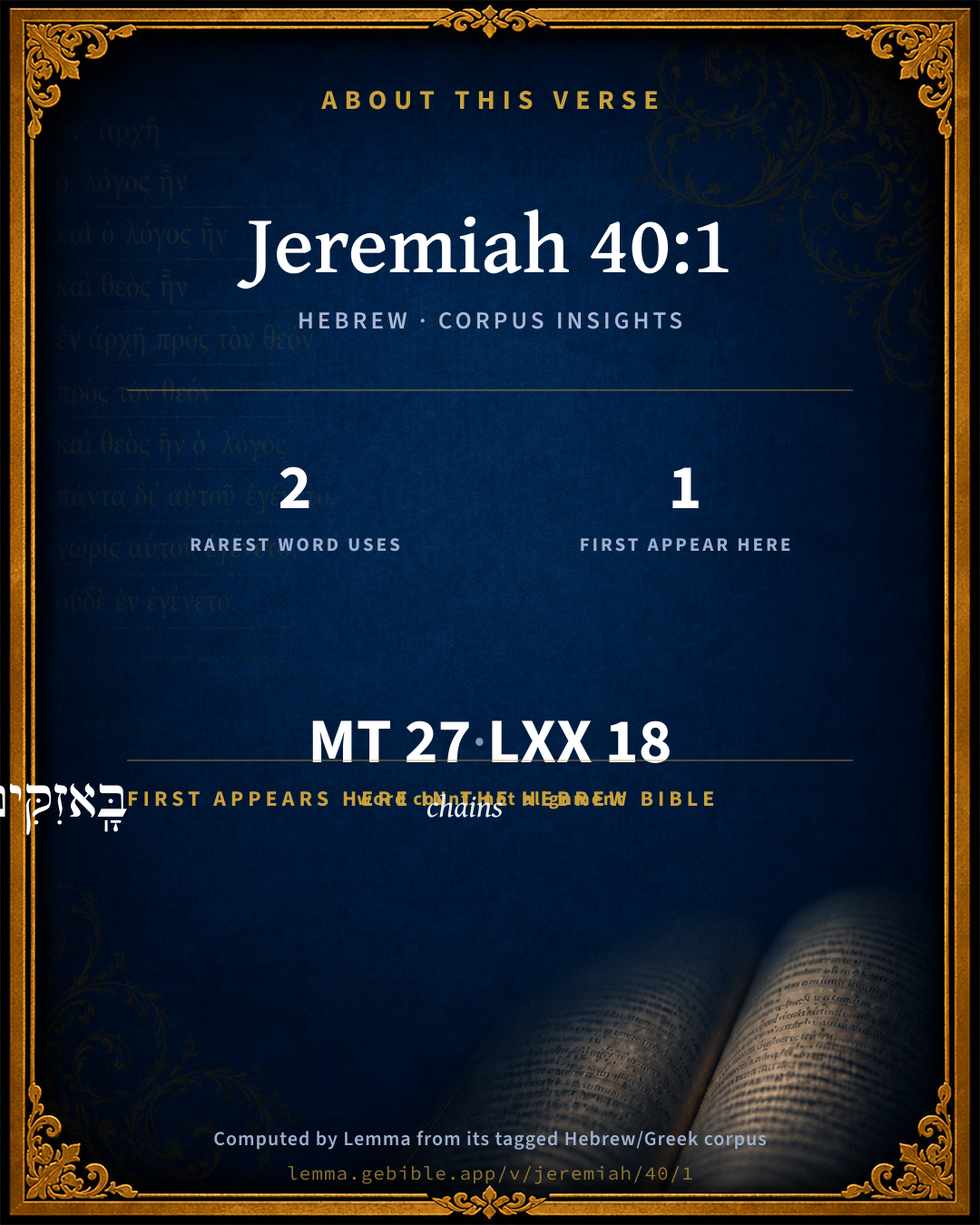
  • 1 first appearance in the Hebrew Bible
Full analysis ↓
Download a study sheet

One document with this verse’s original text, its word-by-word gloss line, the meaning frame, cross-references with their text, attributed commentary, and full source and license credits — printable, and it pastes into notes with its structure intact.

This verse Autodidact and up

Study sheet (.html) Plain text (.txt)

A passage Seminary Student

Up to 50 verses in one chapter. A passage sheet keeps up to 6 commentary sources and 12 cross-references per verse, in the order this page ranks them, and says so on the sheet whenever that leaves anything out. Ask for a single verse and you get the Autodidact verse sheet above.

Everything on this page stays free to read, with no account — the sheet is a download of what is already on screen, not access to it.

Want to remove ads? Support Godless Engineer
Compare translations 3

The same verse in 3 English versions, stacked beneath the original-language interlinear above. Click any original word for its lexicon entry.

Each is an independent rendering of the whole verse — the interlinear is not word-aligned to these translations.

Highlighted words mark where these versions differ — a whole-verse word diff, not a word-by-word alignment.

  • World English Bible Public Domain
    The word which came to Jeremiah from Yahweh, after that Nebuzaradan the captain of the guard had let him go from Ramah, when he had taken him being bound in chains among all the captives of Jerusalem and Judah, who were carried away captive to Babylon.
  • King James Version Public Domain
    The word that came to Jeremiah from the LORD, after that Nebuzaradan the captain of the guard had let him go from Ramah, when he had taken him being bound in chains among all that were carried away captive of Jerusalem and Judah, which were carried away captive unto Babylon.
  • unfoldingWord Literal Text CC BY-SA 4.0
    The word came to Jeremiah from Yahweh after Nebuzaradan the commander of the king’s bodyguards had released him at Ramah. He had found Jeremiah bound with chains among all the captives of Jerusalem and Judah who were being carried into exile to Babylon.

unfoldingWord Literal Text — © unfoldingWord, licensed CC BY-SA 4.0. Word-aligned USFM3 via Door43 (git.door43.org/unfoldingWord/en_ult).

Versions to compare (up to 4)

3 of 4 selected

Show all 18 translations

Every available English version of this verse, each an independent rendering of the whole verse.

  • World English Bible Public Domain
    The word which came to Jeremiah from Yahweh, after that Nebuzaradan the captain of the guard had let him go from Ramah, when he had taken him being bound in chains among all the captives of Jerusalem and Judah, who were carried away captive to Babylon.
  • Berean Standard Bible Public Domain
    This is the word that came to Jeremiah from the LORD after Nebuzaradan captain of the guard had released him at Ramah, having found him bound in chains among all the captives of Jerusalem and Judah who were being exiled to Babylon.
  • Majority Standard Bible Public Domain
    This is the word that came to Jeremiah from the LORD after Nebuzaradan captain of the guard had released him at Ramah, having found him bound in chains among all the captives of Jerusalem and Judah who were being exiled to Babylon.
  • King James Version Public Domain
    The word that came to Jeremiah from the LORD, after that Nebuzaradan the captain of the guard had let him go from Ramah, when he had taken him being bound in chains among all that were carried away captive of Jerusalem and Judah, which were carried away captive unto Babylon.
  • American Standard Version (1901) Public Domain
    The word which came to Jeremiah from Jehovah, after that Nebuzaradan the captain of the guard had let him go from Ramah, when he had taken him being bound in chains among all the captives of Jerusalem and Judah, that were carried away captive unto Babylon.
  • Revised Version (1885) Public Domain
    The word which came to Jeremiah from the LORD, after that Nebuzaradan the captain of the guard had let him go from Ramah, when he had taken him being bound in chains among all the captives of Jerusalem and Judah, which were carried away captive unto Babylon.
  • Geneva Bible (1599) Public Domain
    The worde which came to Ieremiah from the Lord after that Nebuzar-adan the chiefe stewarde had let him goe from Ramath, when hee had taken him being bound in chaines among all that were caried away captiue of Ierusalem and Iudah, which were caried away captiue vnto Babel.
  • Douay-Rheims (1899) Public Domain
    The word that came to Jeremias from the Lord, after that Nabuzardan the general had let him go from Rama, when he had taken him, being bound with chains, among all them that were carried away from Jerusalem and Juda, and were carried to Babylon.
  • Young's Literal Translation Public Domain
    The word that hath been unto Jeremiah from Jehovah, after Nebuzar-Adan, chief of the executioners, hath sent him from Ramah, in his taking him -- and he a prisoner in chains -- in the midst of all the removal of Jerusalem and of Judah, who are removed to Babylon.
  • Literal Standard Version CC BY-SA 4.0
    The word that has been to Jeremiah from YHWH, after Nebuzar-Adan, chief of the executioners, has sent him from Ramah, in his taking him—and he a prisoner in chains—in the midst of all the expulsion of Jerusalem and of Judah, who are removed to Babylon.
  • Unlocked Literal Bible CC BY-SA 4.0
    The word came to Jeremiah from Yahweh after Nebuzaradan the commander of the king's bodyguards had released him at Ramah. He had found Jeremiah bound with chains among all the captives of Jerusalem and Judah who were being carried into exile to Babylon.
  • unfoldingWord Literal Text CC BY-SA 4.0
    The word came to Jeremiah from Yahweh after Nebuzaradan the commander of the king’s bodyguards had released him at Ramah. He had found Jeremiah bound with chains among all the captives of Jerusalem and Judah who were being carried into exile to Babylon.
  • Darby Bible Public Domain
    The word that came to Jeremiah from Jehovah, after that Nebuzar-adan the captain of the body-guard had let him go from Ramah, when he had taken him, being bound in chains, among all the captivity of Jerusalem and Judah, that were carried away captive to Babylon.
  • World Messianic Bible Public Domain
    The word which came to Jeremiah from the LORD, after Nebuzaradan the captain of the guard had let him go from Ramah, when he had taken him being bound in chains among all the captives of Jerusalem and Judah who were carried away captive to Babylon.
  • Webster's Bible Public Domain
    The word which came to Jeremiah from the LORD, after that Nebuzar-adan the captain of the guard had let him go from Ramah, when he had taken him being bound in chains among all that were carried away captive of Jerusalem and Judah, who were carried away captive to Babylon.
  • Free Bible Version CC BY-SA 4.0
    This is the Lord's message that came to Jeremiah after Nebuzaradan the commander of the guard had released him at Ramah Nebuzaradan had discovered Jeremiah bound in chains along with all the prisoners from Jerusalem and Judah who were being taken into exile in Babylon.
  • Bible in Basic English Public Domain
    The word which came to Jeremiah from the Lord, after Nebuzaradan, the captain of the armed men, had let him go from Ramah, when he had taken him; for he had been put in chains, among all the prisoners of Jerusalem and Judah who were taken away prisoners to Babylon.
  • JPS Tanakh (1917) Public Domain
    The word which came to Jeremiah from the LORD, after that Nebuzaradan the captain of the guard had let him go from Ramah, when he had taken him being bound in chains among all the captives of Jerusalem and Judah, that were carried away captive unto Babylon.

Literal Standard Version (2020), Covenant Press — licensed CC BY-SA 4.0. Text via the HelloAO Bible API (eBible.org). Unlocked Literal Bible (unfoldingWord) — licensed CC BY-SA 4.0. Text via the HelloAO Bible API (eBible.org). unfoldingWord Literal Text — © unfoldingWord, licensed CC BY-SA 4.0. Word-aligned USFM3 via Door43 (git.door43.org/unfoldingWord/en_ult). Free Bible Version, Dr. Jonathan Gallagher — licensed CC BY-SA 4.0. Text via the HelloAO Bible API (eBible.org).

Word by word

More ways to search: Search by grammar → Find every occurrence → Compare this word →

Practice this passage: Drill this verse → Learn its vocabulary →

בָּֽאזִקִּים֙
ʼăziqqîym
H246
“in/at the · chains”
Preposition, Determined + Noun, Common, Masculine, Plural, Absolute
Part of Speech
Preposition + Noun
Type
Common
Gender
Masculine
Number
Plural
State
Absolute
Full BDB Definition

Origin: a variation for H2131

TWOT: 577b

chains, manacles
  1. הַדָּבָ֞ר dâbâr H1697 “the · word” Particle, Definite Article + Noun, Common, Masculine, Singular, Absolute
  2. אֲשֶׁר ʼăsher H834 “which” Particle, Relative
  3. הָיָ֤ה hâyâh H1961 “to be” Verb, Qal, Perfect, 3rd Person, Masculine, Singular
  4. אֶֽל ʼêl H413 “to” Preposition
  5. יִרְמְיָ֨הוּ֙ Yirmᵉyâh H3414 “Jeremiah” Noun, Proper
  6. מֵאֵ֣ת ʼêth H854 “from · with” Preposition + Preposition
  7. יְהוָ֔ה Yᵉhôvâh H3068 “LORD” Noun, Proper
  8. אַחַ֣ר ʼachar H310 “after” Preposition
  9. שַׁלַּ֣ח shâlach H7971 “to send” Verb, Piel, Infinitive Construct
  10. אֹת֗וֹ ʼêth H853 “- · him” Particle, Direct Object + Suffix, Personal, 3rd Person, Masculine, Singular
  11. נְבוּזַרְאֲדָ֛ן Nᵉbûwzarʼădân H5018 “Nebuzaradan” Noun, Proper
  12. רַב rab H7227 “many of” Noun, Common, Masculine, Singular, Construct
  13. טַבָּחִ֖ים ṭabbâch H2876 “executioners” Noun, Common, Masculine, Plural, Absolute
  14. מִן min H4480 “from” Preposition
  15. הָֽרָמָ֑ה Râmâh H7414 “the · Ramah” Particle, Definite Article + Noun, Proper
  16. בְּקַחְתּ֣וֹ lâqach H3947 “in/at · to take · him” Preposition + Verb, Qal, Infinitive Construct + Suffix, Personal, 3rd Person, Masculine, Singular
  17. אֹת֗וֹ ʼêth H853 “- · him” Particle, Direct Object + Suffix, Personal, 3rd Person, Masculine, Singular
  18. וְהֽוּא hûwʼ H1931 “and · he” Conjunction + Pronoun, Personal, 3rd Person, Masculine, Singular
  19. אָס֤וּר ʼâçar H631 “bound” Verb, Qal, Participle Passive, Masculine, Singular, Absolute
  20. בְּת֨וֹךְ tâvek H8432 “in/at · midst of” Preposition + Noun, Common, Masculine, Singular, Construct
  21. כָּל kôl H3605 “all of” Noun, Common, Masculine, Singular, Construct
  22. גָּל֤וּת gâlûwth H1546 “exile of” Noun, Common, Feminine, Singular, Construct
  23. יְרוּשָׁלִַ֨ם֙ Yᵉrûwshâlaim H3389 “Jerusalem” Noun, Proper
  24. וִֽיהוּדָ֔ה Yᵉhûwdâh H3063 “and · Judah” Conjunction + Noun, Proper
  25. הַמֻּגְלִ֖ים gâlâh H1540 “the · uncovered” Particle, Definite Article + Verb, Hophal, Participle Passive, Masculine, Plural, Absolute
  26. בָּבֶֽלָה Bâbel H894 “Babylon · toward” Noun, Proper + Suffix, Demonstrative

About this verse

These counts appear in no published source. They are computed here, from the morphology-tagged text and Lemma’s own curated glosses. What Lemma adds →

27
words
26
distinct lemmas
Prophets
section

Notable vocabulary

The rarest word here is בָּֽאזִקִּים֙ chains H246 — appearing just 2 times in the whole Hebrew Bible.

First appearance in Scripture

This word makes its first canonical appearance in the Hebrew Bible here:

  • בָּֽאזִקִּים֙ chains H246

Shared distinctive vocabulary

בָּֽאזִקִּים֙ chains H246 occurs in 2 verses of the Hebrew Bible. Also found in:

Grammatical profile

  • 5 verbs
  • 14 nouns
  • 1 pronoun
  • 4 prepositions
  • 3 particles

Verb forms

  • הָיָ֤ה Qal · Perfect
  • שַׁלַּ֣ח Piel · Infinitive Construct
  • בְּקַחְתּ֣וֹ Qal · Infinitive Construct
  • אָס֤וּר Qal · Participle Passive
  • הַמֻּגְלִ֖ים Hophal · Participle Passive

Hebrew & Septuagint length

In the original languages it is 27 Hebrew tokens and 18 Greek tokens — but the two are counted differently (Hebrew bundles its prefixes and suffixes into one token; the Greek is in lemma form), so that isn’t a like-for-like length.

Cross-references

10

Topical passages linked to Jeremiah 40:1 in the Treasury of Scripture Knowledge — connected by theme and wording, ordered by reader-vote popularity; previews shown in the World English Bible.

  • Joshua 18:25 Gibeon, and Ramah, and Beeroth,
  • Jeremiah 31:15 Thus says Yahweh: A voice is heard in Ramah, lamentation, and bitter weeping, Rachel weeping for her children; she refuses to be comforted for her children, because they are no more.
  • Acts 12:6–7 The same night when Herod was about to bring him out, Peter was sleeping between two soldiers, bound with two chains. Guards in front of the door kept the prison.
  • Acts 21:13 Then Paul answered, "What are you doing, weeping and breaking my heart? For I am ready not only to be bound, but also to die at Jerusalem for the name of the Lord Jesus."
  • Ephesians 6:20 for which I am an ambassador in chains; that in it I may speak boldly, as I ought to speak.
  • 1 Samuel 7:17 His return was to Ramah, for there was his house; and there he judged Israel: and he built there an altar to Yahweh.
  • Psalms 68:6 God sets the lonely in families. He brings out the prisoners with singing, But the rebellious dwell in a sun-scorched land.
  • Psalms 107:16 For he has broken the gates of brass, And cut through bars of iron.
  • Jeremiah 39:11–14 Now Nebuchadrezzar king of Babylon gave charge concerning Jeremiah to Nebuzaradan the captain of the guard, saying,
  • Acts 28:20 For this cause therefore I asked to see you and to speak with you. For because of the hope of Israel I am bound with this chain."

Cross-references courtesy of OpenBible.info (CC BY 4.0).

Hebrew and Greek witnesses Masoretic Hebrew ↔ Greek Septuagint

The same verse in the two great witnesses to the Old Testament, shown verse-for-verse.

These are two independent witnesses, not word-aligned to each other, and the Septuagint is shown in lemma (dictionary) form.

Hebrew Jeremiah 40:1 Masoretic · Westminster Leningrad Codex

הַדָּבָ֞ר אֲשֶׁר הָיָ֤ה אֶֽל יִרְמְיָ֨הוּ֙ מֵאֵ֣ת יְהוָ֔ה אַחַ֣ר שַׁלַּ֣ח אֹת֗וֹ נְבוּזַרְאֲדָ֛ן רַב טַבָּחִ֖ים מִן הָֽרָמָ֑ה בְּקַחְתּ֣וֹ אֹת֗וֹ וְהֽוּא אָס֤וּר בָּֽאזִקִּים֙ בְּת֨וֹךְ כָּל גָּל֤וּת יְרוּשָׁלִַ֨ם֙ וִֽיהוּדָ֔ה הַמֻּגְלִ֖ים בָּבֶֽלָה

The word which came to Jeremiah from Yahweh, after that Nebuzaradan the captain of the guard had let him go from Ramah, when he had taken him being bound in chains among all the captives of Jerusalem and Judah, who were carried away captive to Babylon.

World English Bible · Public Domain

Greek LXX Structure differs

In the Septuagint, Jeremiah is about an eighth shorter than the Hebrew and arranges its material differently — the Oracles Against the Nations (Hebrew chapters 46–51) appear in the middle of the Greek book, after 25:13. Because the chapter and verse boundaries do not line up, a verse-for-verse comparison with the Hebrew is not shown.

A verse-for-verse comparison isn’t shown here because the chapters and verses don’t line up. Switch to the LXX edition with the MT / LXX toggle above to read the Greek directly.

On this verse, Lange's Commentary on the Holy Scriptures discusses the Septuagint’s reading. Read the note in Commentary ↓

Hebrew: Westminster Leningrad Codex (CC BY 4.0). Greek: Septuagint (public domain); English from a public-domain English Septuagint. How the Septuagint differs from the Hebrew →

Targum (Aramaic paraphrase)

1

The Targum is the ancient Jewish Aramaic paraphrase of the Hebrew Scriptures — an interpretive translation, not the Hebrew text itself. Onkelos (literal) and Pseudo-Jonathan (expansive) render the Torah, and Jonathan the Prophets. Coverage is partial: where no permissively-licensed English translation exists for a verse, only the Aramaic is shown. This is verse-level text, not a word-by-word alignment to the Hebrew.

  1. Targum Jonathan Prophets (Joshua–Malachi)
    פִּתְגַם נְבוּאָה דַהֲוָה עִם יִרְמְיָה מִן קֳדָם יְיָ בָּתַר דִשְׁלַח יָתֵיהּ נְבוּזַרְאֲדָן רַב קָטוֹלַיָא מִן רָמָתָא כַּד דְבַר יָתֵיהּ וְהוּא אֲסִיר בְּעִזְקַיָא בְּגוֹ כָל גַלְוַת יְרוּשְׁלֵם וִיהוּדָה דְאִתְגְלִיאוּ לְבָבֶל:

    (no public-domain English translation for this verse)

    Targum Jonathan — Aramaic: “Mikraot Gedolot” (public domain). English: “Sefaria Community Translation” (CC0 1.0 (public-domain dedication)); “London "Chaldee Paraphrase," 1871” (public domain). Text via Sefaria.

Commentary

Notes on Jeremiah 40:1 from classic Christian and Jewish commentators (each source and its license shown beneath its notes). The classic Christian expositions comment on the surrounding passage and are grouped to its opening verse, so a note may address several verses; the Jewish commentaries on the Tanakh (Rashi and others) are per-verse, so they appear only where the commentator wrote on this verse.

Lemma curates 59 commentaries, every one of them public domain or Creative Commons licensed, each selected and text-cleaned for this edition rather than reprinted as found. About our sources →

Trapp's Complete Commentary

John Trapp

Jer 40:1 The word that came to Jeremiah from the LORD, after that Nebuzaradan the captain of the guard had let him go from Ramah, when he had taken him being bound in chains among all that were carried away captive of Jerusalem and Judah, which were carried away captive unto Babylon.

Ver. 1. The word of the Lord which came to Jeremiah.] This word, what it was, Jeremiah will show, {Jer 42:7} after the circumstances of his enlargement related, and other matters of story premised. Vatablus rendereth it, Actio quam gessit Dominus cum Ieremiah.

After that Nebuzaradan had let him go from Ramah.] Which was the place of rendezvous, whither Jeremiah was also brought, with the rest of the captives, and manacled also - as he was found in the court of the prison - but soon set free and dismissed. A difference shall one day - at that great day especially - be discerned "between the righteous and the wicked; between him that serveth God, and him that serveth him not." {Mal 3:18} Jeremiah is here, by some oversight of the officers, contrary to Nebuchadnezzar’s command, {Jer 39:11; Jer 39:14} but not without a special providence of God, brought bound to Ramah, ad opprobrium gentis, et in gloriam suam: that the Jews, now captives, and to be carried to Babylon, might see their madness in persecuting so true a prophet, and persevering in their sinful practices, to their so utter undoing, against all admonition.

John Trapp, A Commentary or Exposition upon All the Books of the Old and New Testament (1647–1656) — public domain. Text from a community e-Sword module.

The Biblical Illustrator

Joseph S. Exell

Jer_40:1

Being bound in chains.

Jeremiah in chains

There is sadness In a shackle and bitterness In bonds. Many men part with life rather than liberty. Speaking humanly, Pauls lot In chains would have been intolerably irksome; but his soul was free! They could not chain his spirit. It is melancholy to watch the attitude of a caged eagle; its eye is dull, its plumage droops. The chain is round the spirit of the creature of the skies. Not so with the Christian soul. It is not the shackle on the wrist that constitutes the slave, said Robertson of Brighton, but the loss of self-respect. In Christian service we learn to reverence self. Our only bonds are the bonds of love. Our manhood is exalted, our service is liberty. (Christian Commonwealth.)

The Biblical Illustrator, edited by Joseph S. Exell (c. 1880s–1900s) — public domain. Text from a community e-Sword module.

Joseph Benson's Commentary

Jer 40:1. The word which came to Jeremiah, &c. — This relates to the prophecy recorded Jer 42:7, which was occasioned by the story that here follows concerning Ishmael’s conspiracy against Gedaliah. After that Nebuzar-adan had let him go from Ramah — After Jeremiah was taken out of the court of the prison, he was carried, probably by mistake, expressly contrary to Nebuchadnezzar’s orders, among the other prisoners to Ramah, a city in the tribe of Benjamin near Gibeon. Here, it seems, the mistake was discovered, and the prophet was discharged by the special order of the court.

Joseph Benson's Commentary on the Old and New Testaments (1811–1818) — public domain. Text from a community e-Sword module.

The Preacher's Complete Homiletical Commentary

Joseph S. Exell (gen. ed.)

CRITICAL AND EXEGETICAL NOTES.—A purely historical chapter, of events following the city’s ruin. It records the out-gleaming of a ray of hope upon the appalling gloom which had befallen the land, in the appointment of Gedaliah as its governor; and also its quick extinction in the conspiracy of Ishmael, a prince of the royal family (chap. Jer_40:1).

Personal Allusions.—Jer_40:5. “Gedaliah” (vide note on chap. Jer_39:14).

Jer_40:8. “Ishmael, the son of Nethaniah.” The most conspicuous of a band of well-known chiefs, who during the siege had fled across the Jordan. Here he had become closely leagued with Baalis, king of Ammon (Josephus, Antiq. x. 9, 2). Prompted by Baalis (Jer_40:14), and coveting Gedaliah’s place and power, be plotted Gedaliah’s assassination.

“Johanan and Jonathan:” Jewish chiefs and brothers. Johanan warned Gedaliah of Ishmael’s treachery, and subsequently pursued the assassin (chap. Jer_41:13, &c.)

Geographical References.—Jer_40:6. “Mizpah.” Asa had fortified it as an outpost of his capital against the northern kingdom (chap Jer_41:9; 2Ch_16:6). A ridge north-east of Jerusalem, and immediately overlooking the city.

Jer_40:8. “The Netophathite.” Netophah, a village near Bethlehem (1Ch_2:54).

Literary Criticisms.—Jer_40:5. “Now while he was not yet gone back”—Ewald’s correction of the Hebrew text, substituting ושיב for וָשׁוּב; “And as he yet answered nothing:” or, “Before he made any reply” (Henderson).

Jer_40:10. “To serve the Chaldeans,” לַעֲמֹד לַפֲנֵי הַכַּשְׂדִּים, “to stand before the Chaldeans,” i.e. to act as their representative, to negotiate with them.

Ver., 14. “Slay thee:” lit. “strike thee in the soul,” i.e. a deadly stroke.

SECTIONS OF CHAPTER 40

Section

Jer_40:1-6.

Jeremiah’s release and patriotism.

Section

Jer_40:7-16.

Gedaliah’s elevation and peril.

Jer_40:1-6. JEREMIAH’S RELEASE AND PATRIOTISM

(See on previous chapter, “Kindness shown to the Lord’s Prophet.”)

Jer_40:1. Theme: THE CHRISTIAN IN THE TUMULT OF THE WORLD.

(i.) He is regarded externally like others. Treated as a captive. Carried away with the exiles to Ramah.

(ii.) Watched over by God with especial care; so that he is unharmed; kindly dealt with; his worth recognised and rewarded.

(iii.) Directs all his efforts to the welfare of God’s kingdom. His concern being to preserve God’s honour, to vindicate His righteousness, and to be useful to his own people.

From this patriotic purpose, neither the violence nor the friendliness of the world can turn him aside. (Comp. Naegelsbach in Lange.)

Jer_40:2-3. Theme: GOD RECOGNISED IN HIS JUDGMENTS. And this by a heathen! Thus God makes the very heathen testify for Him against His rebellious people. Out of even great and terrible calamities, such as Jerusalem’s overthrow, good is brought; this heathen captain’s eyes are opened to Divine truths.

His hopeful progress towards conversion—

(i.) He acknowledges Jehovah as God (Jer_40:2).

(ii.) That the Lord foresees future events (Jer_40:2).

(iii.) That it is in His name that God’s servants speak (Jer_40:2), and pronounce upon future events.

(iv.) He recognises the Divine Hand in judgments (Jer_40:3). No claiming that the Chaldeans had wrought the overthrow; no! “The Lord,” &c.

(v.) Traces calamities to their cause: the moral degeneracy and spiritual apostasy of the people (Jer_40:3).

(vi.) Declares that disobedience to God brings doom (Jer_40:3).

Jer_40:4. Theme: GOD’S HIDDEN HAND IN HUMAN KINDNESS.

I. Benefactors are God’s benefactions. They come from Him, at the right moment, to supply our pressing wants.

II. Unconscious agencies of Divine kindness. This captain knew not that he worked out God’s designs and administered God’s mercies.

III. God’s disguised Hand. He conceals Himself in His works; there is “a hiding of His power”—

In Nature. Stored out of sight in flowers, fruits, delights of creation.

In Providence. “Men are Thy hand.” He works through them. For He uses His creatures as channels of His help.

In Grace. Light and peace come into human souls through human words; from “sermons in stones, books in the running brooks,” &c. Yet all grace is God’s gift.

“Every good gift and every perfect gift cometh down from the Father of lights.”

Jer_40:5-6. Theme: A PATRIOTIC CHOICE.

I. Contrasted offers.

1. Of location. In Babylonia, honour and comfort; in Judea, sadness and privation.

2. Of service. In Babylonia, among the noblest of his countrymen, and in the favour of royalty; in Judea, amid the poor and rabble.

II. A difficult choice. Hence his faltering a moment (Jer_40:5).

1. A heart drawn in opposite directions: in pity towards his exiled people; in love for his dear but dishonoured land.

2. In perplexity concerning God’s will. Not easy to see where he could best serve God; not clear as to God’s purpose.

III. A patriotic decision.

1. Thus he disproved his sympathy with the Chaldeans, notwithstanding his advice to his countrymen to surrender to them. For his counsel had proceeded from purest love to his fatherland.

2. Thus he proved his devotion to his suffering people, imitating Moses (Heb_11:25).

3. Thus he kept alive God’s word amid a despondent remnant. In Babylon the exiles had Ezekiel and Daniel; but had he gone, these scattered remnants would have been “as sheep having no shepherd.” In all this “he looked not on his own things, but also on the things of others.”

Jer_40:7-16. GEDALIAH’S EXALTATION AND PERIL

I. Integrity rewarded (Jer_40:5). His faithfulness to Chaldea had arisen from the consciousness that God willed it so. His obedience to duty won him human confidence and high exaltation.

II. A renewal of hope (Jer_40:13). Under Gedaliah’s wise administration the desolation might have been in part repaired. God gives to the downcast agleam of hope (Jer_40:9-11). It is well to make the best of our misfortunes, and wisely accept the facts of Providence (Jer_40:10).

III. Treachery in ambush.

1. Envy covets what it has no right to claim.

2. A generous nature finds it difficult to be suspicious (Jer_40:14).

3. It is a mystery in God’s Providence that He suffers the righteous to act unwisely, and thus fall into the hands of malignant and envious men (Jer_40:16). But an explanation is indicated in Isa_57:1.

Comments—

“Those who are of a pious disposition cannot believe so much evil as is told of people. But we must not trust too much, for the world is full of falseness (Wis_11:22). He who believes too easily will be often deceived; and he who believes no one is also deceived. Therefore is he the happy man who can preserve the golden mean.”—Cramer.

“Gedaliah seems to have been of our Queen Elizabeth’s temper, who was heard to declare that she could believe nothing of her people which mothers could not believe of their children.”—Trapp.

“Gedaliah thought that Ishmael durst not attempt anything against him because of the Babylonians; besides he knew his own innocency; and he believed in Ishmael’s pretended familiarity with him, which, he might think, other captains envied. Sure it is that good Gedaliah was too secure. ‘Nam qui omnia credit, et qui nihil credit, ex œquo peccat’ (Seneca). It is no less a fault to believe nothing than to believe everything. Reports are to be neither over-heeded nor overslighted, especially when life is concerned.”—Trapp.

GENERAL REFLECTIONS: ISRAEL’S MISFORTUNES TYPICAL OF HUMAN LIFE

This overthrow of the people has its analogies:—

I. The deportation of the whole people in chains and fetters is a type of our universal human misery, from which no one (not even Jeremiah) is free.

II. The fate of Gedaliah and the journey to Egypt is a type of the insufficiency of all human help.

III. As the Jews after Gedaliah’s murder, so men at all times find protection and deliverance in the Lord alone.—Naegelsbach.

“Misfortune is like the waves of the sea: when one is broken another follows, and the end of one trouble is the beginning of another.”—Cramer.

The Preacher's Complete Homiletical Commentary (gen. ed. Joseph S. Exell; Funk & Wagnalls, c. 1892) — public domain (pre-1929). A full-Bible homiletical/sermon-outline anthology covering 65 of 66 books (2 John is absent from the source module). Text from a community e-Sword module.

Lange's Commentary on the Holy Scriptures

3. Jeremiah liberated in Ramah and committed the second lime to Gedaliah

Jer_40:1-6

1The word that came to Jeremiah from the Lord, after that Nebuzar-adan the captain of the guard had let him go from Ramah, when1 he had taken him being bound in chains2 among all that were carried away captive of Jerusalem and Judah, 2which were carried away captive unto Babylon. And the captain of the guard took3 Jeremiah, and said unto him, The Lord [Jehovah] thy God hath pronounced 3this evil upon this place. Now the Lord [Jehovah] hath brought it,4 and done according as he hath said: because ye have [had] sinned against the Lord [Jehovah], and have not obeyed his voice, therefore this thing is come upon you. 4And now, behold, I loose thee this day from the chains which were upon thine hand.5 If it seem good unto thee to come with me into Babylon, come; and I will look well unto thee: but if it seem ill unto thee to come with me into Babylon, forbear: behold, all the land is before thee: whither it seemeth good and convenient 5[right] for thee to go, thither go. Now while he was not yet gone back [answered],6 he said, Go back also to Gedaliah the son of Ahikam the son of Shaphan, whom the king of Babylon hath made governor over the cities of Judah, and dwell with him among the people: or go wheresoever it seemeth convenient unto thee to go. So the captain of the guard gave him victuals and a reward [present], and let him 6go. Then went Jeremiah unto Gedaliah the son of Ahikam to Mizpah; and dwelt with him among the people that were left in the land.

EXEGETICAL AND CRITICAL

In the unavoidable confusion Jeremiah, contrary to the command of the king (Jer_39:11-14), is included among the captives, and bound with chains. This error is first remarked in Ramah. The captain of the halberdiers has him immediately liberated, and gives him the choice to go with them to Babylon or remain in the country. As Jeremiah, as it appears, hesitated in answering, the captain of halberdiers, guessing the wish of the prophet, decides himself that he is to remain. Provided with a supply of food and presents, Jeremiah hereupon betakes himself to Gedaliah, who was appointed by Nebuchadnezzar governor over the country, in Mizpah.

Jer_40:1. The word … unto Babylon. The superscription is of the larger kind. It extends over the four chh. 40–43, for a similar one recurs only in Jer_44:1. Since the formula, “the word that came,” etc., appears constantly as the superscription to the longer sections (comp. Jer_7:1; Jer_11:1 [Jer_14:1]; Jer_18:1; Jer_21:1, etc.), it has gradually assumed a double character. It is primarily, according to the meaning of the words, the announcement of a word of God spoken to the prophet. Since, however, these words represent at the same time the main sections of the prophetic book, historical narrative being annexed only as introductory or supplementary commentary, the formula has gradually become the superscription of a main section, even where historical narrative predominates. This is certainly nowhere to so great an extent the case as here. In a less degree it is found also in Jer_21:1-3 (comp. “And Jeremiah said,” Jer_40:3). The formula is certainly never found as a superscription of a purely historical section. Nor are chh. 40–43. such. For in Jer_42:7-22 we have an account of a revelation made to the prophet, to which all the previous and subsequent context is related as historical background. In Jer_43:8-13 is a second oracle, from which it again follows, that we are to regard the formula in this verse as a comprehensive title of a section, which may refer not only to other matter besides a revelation, but also to more than one revelation. Moreover the superscription here is related also to Jer_1:3. For there the narrative of the events till the deportation in the fifth month of the eleventh year of Zedekiah is announced. Our section, being written at a later date, records the events immediately after this date, and till the arrival in Egypt.—When he had taken him. This is to explain why a liberation of Jeremiah can be spoken of, after what is narrated in Jer_39:11-14. Nebuzar-adan had to liberate the prophet in Ramah, because he had taken him captive (by a misunderstanding. Comp. rems. on Jer_39:11-13), and bound him with chains.—Being bound, etc., more particularly describes in what condition Jeremiah was in consequence of being taken, and when he was liberated by Nebuzaradan.—Among all, etc. This addition also is evidently to contribute to the explanation of Jeremiah’s being bound. Jeremiah standing alone would not have suffered this indignity. It was only in consequence of his remaining “among the people” (Jer_39:14), and was contrary to the purpose of the general. It has been already remarked above that Ramah, being the first station after Jerusalem, served as the place of assembly and final arrangement of the caravan, (in reference to its position. Comp. rems. on Jer_31:15).

Jer_40:2-4. And the captain … thither go. What Nebuzar-adan here says to Jeremiah presupposes that he was well acquainted with the purport of his prophecies, and that he acknowledged their fulfilment as a manifestation of the power of the God in whose name they had been pronounced. It could not be difficult for a heathen to admit that the national deity of the Jews, enraged because this people preferred other deities to Him, had given them up to their enemies. Nebuzar-adan may also have spoken Hebrew, though the mode of expression betrays that Jeremiah gives only the sense, not the precise words of his speech. Comp. Jer_16:10; Jer_19:15; Jer_32:42; Jer_36:31; Jer_39:16; Jer_44:2.

Jer_40:5-6. Now while … in the land. The words וְעוֹדֶנּוּ לֹא יָשׁוּבּ mock at every attempt to explain them according to the grammar and lexicon. For 1. It is contrary to rule to take עוֹדֶנּוּ as simply equivalent to עוֹד, since it is a complete sentence (and he is still), and either requires no predicate or it can have one only in the form of a participle or adjective. It must be וְעוד לֹא יֲשׁוּב, or וְעוֹד הוּא לֹא יָשׁוּב, or וְעוֹדֶנּוּ לְֹא שָׁכ, or מֵשִׁיב, or something like this. 2. The connection with the following שֻׁבָה by the mere וְ is likewise abnormal. We should expect, since in sense וְשֻׁבָה cannot simply continue the speech interrupted by a parenthesis—as a contradiction would thus be produced—some connective formula like וַאֹמֶר. 3. The meaning of יָשׁוּב is enigmatical. For whomsoever we take as the subject, Jeremiah or the king of Judah or Gedaliah, or (with Seb. Schmidt) the inhabitants of the place of residence selected by Jeremiah, or an indefinite “they,” no satisfactory meaning is obtained. The ancient translators therefore rendered with arbitrary freedom, LXX. ἐι δὲ μὴ, ἀπότρεχε, ἀνάστρεφον πρὸς τὸν Γοδολίαν. Vulg.: et mecum noli venire, sed habita apud Godoljam. Syr.: dixit etiam ad eum: si maneas, commorare in medio populi apud Gedaljam. Chald.: et si tu non vis reverti, revertere ad Gedaljam. I consider the text corrupt. Since in Jer_40:4 Nebuzar-adan leaves it to Jeremiah to go wherever he wishes, but Jer_40:4 says distinctly that he must return to Gedaliah, there must have stood between the two a sentence reporting the preference, which Jeremiah somehow intimated, to remain in the country. How this sentence read is no longer to be ascertained. Since from Jeremiah’s not returning it could not be concluded that he wished to return, while from his not answering this conclusion might easily be drawn, since more honor would be done to the Chaldeans if Jeremiah preferred a residence in their country to one in his desolated home, I am of opinion, that originally some form of שׁוּב stood here, involving the idea of answering.—Nebuzar-adan now dismisses the prophet with a supply of food (אִַרְחָה, comp. Jer_52:34; Pro_15:17) and presents (מַשְׂאֵת, literally load, what is carried away, i.e. presents. Comp. Est_2:18; Amo_5:11). Jeremiah, following the advice given him, betakes himself to Gedaliah in Mizpah, doubtless that city among the five of this name which was situated in Benjamin, and is named together with Gibeon and Ramah in Jos_18:25-26; comp. 1Sa_7:16; 1Sa_10:17; 1Ki_15:22; 1Ma_3:46; Raumer, Paläst., S. 213. [This Ramah is supposed to have been about six miles north of Jerusalem, on the road to Bethel. Comp. Smith, Dict.—S. R. A.]

Footnotes:

[1]Jer_40:1.—כְּ is here causal. Comp. 2Ch_16:7; 2Ch_28:6.

[2]Jer_40:1.—אזקים. The form with א only here and in Jer_40:4. Besides זִקִים in Job_36:8; Isa_45:14; Nah_3:10. From עַל־יָדֶךָ, Jer_40:4, we see that hand-fetters are meant.

[3]Jer_40:3.—The construction of לקח with לְ is an Aramaism. Comp. Ewald, §277, e.

[4]Jer_40:3.—The pronominal object of וַיָבֵא is to be supplied from the foregoing context. Comp. Naegelsb. Gr., § 78, 2, Anm. The absence of the article before דָּבָר to which the Masoretes object, is no rare occurrence. Comp. Jer_32:14; Jer_38:14; Jer_50:16 : Naegelsb. Gr., 72, 2, Anm.

[5]Jer_40:4.—יָדֶךָ ver. 4 may be taken both grammatically (comp. Naegelsb. Gr., § 44,4, Anm.), and according to the sense either as singular or plural. On אלִ־טב. Comp. Ewald, § 335, a.

[6]Jer_40:5.—[Naegelsb.: Since, however, he had not yet answered. See Exeg. and Crit. “So J. D. Micraelis, Dahler, Umbreit, Neumann. But Jeremiah never uses the verb שׁוּב in this sense, but always in the sense of returning.” Wordsworth.—S. R. A.]

DOCTRINAL AND ETHICAL

1. On Jer_40:1-3. “Although the calamity, which has come upon Jerusalem, is great and terrible, God does not allow such evil to befal it that good will not result from it, as the Chaldean captain not obscurely intimates, that he has made a fair beginning in the knowledge of the true God. For he confesses, first, that the God of the prophet is a lord; secondly, that He knows future things; thirdly, that He causes His servants to proclaim these beforehand; fourthly, that God has conducted the war and done everything; fifthly, that He was displeased with the sinful manners of the people (among which idolatry was the worst); sixthly, that He has punished their disobedience to His word.” Cramer.

2. On Jer_40:4. “The friendliness, shown to the prophet, appears to proceed from men, but it comes from God. For God’s works are all made so that they are hidden among the creatures; for as He conceals His wisdom in the creation of heaven and earth, as He hides His kindness in the fruits of the earth, so also He disguises His help in the king of Babylon. For God executes. His works now by rational and anon by irrational creatures. As when He fed Elijah by the widow and by the ravens and by the angels (1Ki_17:3 sqq.; 14 sqq. and Jer_19:5). For all are His instruments.” Cramer.

3. On Jer_40:2-3. “Nebusaradan attestatione sua comprobat et confirmat veritatem ac certitudinem prædictionum prophetæ. Unde haud inscite colligi conjicique potest, quod Satrapa ille Babylonicus præditus fuerit agnitione veri Dei eâque salvatus. Et sic Deus subinde aliquos ex Magnatibus ad sui agnitionem et æternam salutem traducit (Psalms 68). Potest istud exemplum ἐλεγκτικῶς obverti absoluto Calvinianorum decreto.” Förster.

4. On Jer_40:5. “In this, that Jeremiah preferred remaining in the country to going to Babylon, it strikes me further—that a discreet man, who knows the world and his heart and the true interest of God’s cause—is as much as possible contented, and does not think to better himself by going further. He is willing to remain at court unknown, and at any rate he would rather be taken away than go away.—The advice, which Solomon gives, is verified, ‘Stand not in the place of great men.’ We are a generation of the cross, and our symbol is ‘an evil name and little understood.’ ” Zinzendorf.

5. On Jer_40:5. In Babylonia honor and a comfortable life invited the prophet, in Judea danger, dishonor and need in the desolated country. In Babylonia a respectable field of labor was opened to him among the great mass of his people, in Judea he had only rabble and condottieri about him. Jeremiah, however, was not a bad patriot, as many accused him of being. By remaining in Judea he showed that the import of his prophecies, apparently friendly to the Chaldeans and hostile to the Jews, had proceeded from the purest love to his people and his fatherland. Thus he imitated Moses, of whom it is written in Heb_11:25, that he chose rather to suffer affliction with the people of God than to enjoy the pleasures of sin for a season. The holy ground of the fatherland bound him to it, and in addition—if he went, who was to take spiritual oversight of the poor forsaken remnant, to proclaim the word of God and bestow on them consolation and admonition? Those who were in Babylon had Ezekiel. And could not the Lord raise up other prophets for them? So he remained with the sheep, who had no shepherd. Jeremiah had not sought his own through his whole life, nor did he here.

6. On Jer_40:7 sqq. “Human reason, and indeed nature shows, that in worldly government men cannot be without a head. For as the been cannot be without a queen, or the sheep without a shepherd, so no large number of people can exist without a head and government. God has wisely ordered it, and we should be thankful for the authorities.” Cramer.

7. On Jer_40:11 sqq. We may well perceive in this “remnant of Judah” a fulfilment of the prophecy in Isa_6:11 sqq.: “Then said I, Lord, how long? And he answered, Until the cities be wasted without inhabitant, and the houses without man, and the land be utterly desolate, and Jehovah have removed men far away, and great is the forsaking in the midst of the land. And if a tenth remains in it, this again must be removed. Yet as the terebinth and the oak, in which when they are felled, a ground-stock still remains, so is its stock a holy scion.”

8. On Jer_40:13 sqq. Gedaliah, in whom not only Nebuchadnezzar, but also his people, had confidence, must have been a noble man, to whom it was difficult to think evil of his neighbor. “Those who are of a pious disposition, cannot believe so much evil, as is told of people. But we must not trust too much, for the world is full of falseness (Wisd. 37:3). He who believes too easily, will be often deceived, and he who believes no one is also deceived. Therefore is he indeed a happy man, who can preserve the golden mean.” Cramer.

9. On Jer_40:13 sqq. “Misfortune is like the waves of the sea; when one is broken another follows, and the end of one trouble is the beginning of others.” Cramer.

10. On Jer_41:1-3. “Judas’s kiss and Jacob’s brethren are very common in the world and take after their grandfather Cain, who spake kindly to Abel and yet had blood-thirsty thoughts (Gen_4:8). Yea, they take after their father, the devil, who is a murderous spirit (Joh_8:44), and disguises himself as an angel of light (2Co_11:14).” Cramer.

11. On Jer_41:1 sqq. “Similia perfidiæ exempla (simulatæ fraternitatis): 2Sa_13:24; 2Sa_20:9 sq. Quadrat etiam huc historia nuptiarum Parisiensium celebratum 1572 mense Augusto.” Förster.

12. On Jer_41:4 sqq.

“Murder and avarice love to go with each other,

And one crime is often a prolific mother.”—Cramer.

13. On Jer_41:16 sqq. It is very remarkable that even this last centre and rendezvous of the unfortunate people must be destroyed. It might be supposed that with the destruction of the city and deportation of the people the judgments would have terminated. It seems as if the deed of Ishmael and the removal of the remnant to Egypt transcended the measure of punishment fixed by Jehovah, for the Lord did not send Ishmael, and the removal to Egypt He directly forbade. And yet it seems that only by Ishmael’s act and the flight to Egypt could the land obtain its Sabbath rest, which is spoken of in Lev_26:34-35.

14. On Jer_42:1-6. “Had not Johanan and his people asked for advice, but gone directly to Egypt, their sin would not have been so great. They feigned, however, submission to the will of God, while they yet adhered to their own will. It is a common fault for people to ask advice while they are firmly resolved what they will do. For they inquire not to learn what is right, but only to receive encouragement to do what they wish. If we advise them according to their inclination they take our advice, if not, they reject it.—We must be on our guard when we appeal to God’s decision, that we do not previously decide for ourselves. For thus we fall into hypocrisy, which is the most fatal intoxication and blindness.” Heim and Hoffman, The Major Prophets. [“Those will justly lose their comfort in real fears, that excuse themselves in sin with pretended fears.” Henry.—S. R. A.]

15. On Jer_42:7. After the murder of Gedaliah the anger of Nebuchadnezzar seemed inevitable. But the Lord, to whom nothing is impossible (Jer_32:17), promises to perform a miracle, and restore Israel to new prosperity in their land if they will give Him the honor and trust in Him. Nebuchadnezzar’s heart is indeed in His hand. If this is not acknowledged and Nebuchadnezzar more feared than the Lord, their sin is then against the first commandment.

16. On Jer_42:13 sqq. “God reminds His people of the favor with which He adopted them as His people, which was the most sacred obligation to obedience; that Egypt was to them a land of destruction, a forbidden land, as indeed all confidence in human aid is forbidden to those who would live by faith, which was known to them from the history of their fathers and all the prophets. It is a great sin to deem one’s self safer under the protection of man than under that of God. It is incomprehensible, how blind unbelief makes people, so that the Jews have not yet learned the truth in the destruction of Jerusalem and the temple of God.” Heim and Hoffman. “Fides futurorum certa est ex præcedentibus.” Tertull. “Venient hæc quoque sicut ista venerunt.” Augustin.—Förster.

17. On Jer_43:2 sqq. “Hypocrites forsooth do not wish to be regarded as rejecting and setting themselves in opposition to God’s word, or accusing God of falsehood. For then is all the world pious, and no one refuses to be submissive to the dear Lord. God is truly God and remains so. It is only against this parson Jeremiah that they must act he lies, he is not sent, his ruling and preaching cannot be endured.” Cramer.

18. On Jer_43:3. “Observe the old diabolical trick: when preachers practice God’s word and their office with zeal, the world understands how to baptize it with another name and call it personal interest, as even here Baruch must bear the blame, as if he only wished to vent his anger on them and be contrary,” Cramer.

19. On Jer_43:6. The ancients here examine the question why Jeremiah accompanied the people to Egypt and take occasion to discuss the 1 Comm. de fuga ministrorum with reference to Augustin. Epist. 150 ad Honorar. With respect to Jeremiah, it is clear that he did all in his power to avert the journey to Egypt. After the whole people, however, were once on their way it was impossible for him and Baruch to remain alone in the deserted country. They were obliged to go with their flock. The more these were wandering, the more need they had of the shepherds. Thus, even if they were not compelled, they had to go with them. It seems, however, to follow from the expression וַיִַּקּח, Jer_43:5, that no choice was given them. The people wished to have the prophet with them. In no case can we say that Jeremiah fled, for according to his own prophecy, he knew that he was going to meet ruin in Egypt.

20. On Jer_43:8-13. At the present day when we wish to convey to posterity the account of some accomplished fact, or the prediction of some fact to be accomplished (ex. gr. a last testament), we take paper and ink, write it down, seal it, have it subscribed by witnesses and preserve it in the registrar’s or recorder’s office. In ancient times they took a simpler and surer way. Jacob and Laban simply erected a heap of stones (Genesis 31), the two and a half tribes (Joshua 22) built an altar on the bank of the Jordan. As long as the heap and the altar were standing, the record was transmitted from generation to generation for what object these stone witnesses were set up, and thus, that which it was desired to convey to posterity lived in the memory of men. Jeremiah also knows how to use ink and pen (Jeremiah 32), but here he returns once more to the old manner of preserving archives. He simply places great stones in the clay, declaring what they signify, viz., that here, on this spot, Nebuchadnezzar’s tent shall stand. Whether the Egyptians and Jews then believed him or not, is of no consequence. The record of these stones and their meaning at any rate remained alive, and the Lord’s word was thus safely preserved till the day of its fulfilment.

HOMILETICAL AND PRACTICAL

1. On Jer_40:1-12; Jer_41:1-3; Jer_42:1-16. Israel, the chosen nation, is in its destinies a type of human life in general. Consider only the exodus from Egypt. So also the destinies of the people of Israel, after the destruction of Jerusalem by Nebuchadnezzar, are pretypical. For 1. The deportation of the whole people in chains and fetters is a type of our universal human misery, from which no one (not even Jeremiah) is free. 2. The fate of Gedaliah and the journey to Egypt is a type of the insufficiency of all mere human help. 3. As the Jews after Gedaliah’s murder, so men at all times, find protection and deliverance in the Lord alone.

2. On Jer_40:1-6. The Christian in the tumult of the world. 1. He is regarded externally like others. 2. The eye of the Lord watches with special care over him, so that (a) not a hair of his head is bent, (b) all his wants are provided for. 3. He, however, on his part directs all his efforts to the kingdom of God and His righteousness, and will not be turned aside from this either by the violence or the friendliness of the world.

3. On Jer_40:7 to Jer_41:3. Gedaliah’s fate an example of what befals even the most noble in times of deep corruption. 1. They enjoy general confidence. 2. They are incapable of attributing extreme wickedness to men. 3. They become a sacrifice to their confidence. 4. They are therefore not in a condition to stay the divine judgments.

4. On Jer_42:1-16. What is the surest way of coming to the right conclusion in difficult cases? 1. To inquire of the Lord. 2. To obey unconditionally the direction which the Lord communicates. [“We must still in faith pray to be guided by a spirit of wisdom in our hearts, and the hints of Providence.” Henry.—S. R. A.]

5. On Jer_43:1-7. Characteristic example of the artfulness of the human heart: the Jews inquire of the Lord and promise to obey His direction (Jer_42:20). But when the direction does not accord with their wish, they at once declare it to be supposititious, not from the Lord. The prophet must be a liar, an alleged enemy has incited him. But what was long previously determined in the heart is obstinately brought to execution. [“Those that are resolved to contradict the great ends of the ministry, are industrious to bring a bad name upon it. It is well for persons who are thus misrepresented that their witness is in heaven, and their record on high.” Henry.—S. R. A.].

6. On Jer_43:8-13. The ways of the Lord are wonderful. Israel flees before Nebuchadnezzar far away to Egypt. But there they are not safe. The Lord causes it to be proclaimed to them that at the entrance of the king’s palace at Tahpanhes Nebuchadnezzar’s tent shall stand. Now indeed there is a brick-kiln there, in the clay of which Jeremiah is to place stones, the foundation stones, as it were, for the Chaldean king’s pavilion. Thus the Lord lays the germs of future events, and whatever He prepares in secret He reveals in His own time to the glory of His wisdom, omniscience and omnipotence.

Lange's Commentary on the Holy Scriptures (Critical, Doctrinal, and Homiletical), ed. John Peter Lange, English translation edited by Philip Schaff (1864–1880) — public domain. Text from a community e-Sword module.

The Annotated Bible

Arno C. Gaebelein

III. AFTER THE FALL OF JERUSALEM (40-45)

CHAPTERS 40-41

The Treachery in the Land and the Flight to Egypt

1. Jeremiah’s choice (Jer 40:1-6)

2. Gedaliah and Ishmael’s deed (Jer 40:7-16; Jer 41:1-3)

3. Ishmael’s further atrocities and retreat (Jer 41:4-18)

Jer 40:1-6. The opening paragraph of this chapter tells us of the choice which was given to Jeremiah. He was loosed from the prisoner’s chains and told by the captain of the guard “If it seems good unto thee to come with me into Babylon, come and I will look well unto thee, but if it seem ill unto thee to come with me to Babylon, forbear; behold all the land is before thee, whither it seemeth good and convenient for thee to go, thither go.” Jeremiah decided to stay with his people in the land.

Jer 40:7-16; Jer 41:1-3. The history of this section is as follows: Gedaliah had been made governor by the victorious king. When the captains heard it they came to him at Mizpah and Gedaliah exhorted them to loyalty to the Chaldeans. Then Gedaliah is warned that Baalis, the King of Ammon, has sent Ishmael to assassinate him, but Gedaliah refuses to believe the report. Then Johanan declares himself ready to kill Ishmael, so that the dreadful results of the murder of the governor Gedaliah might be averted. Gedaliah thinks it is all slander and forbids it. In the seventh month Ishmael, with ten men, who are being entertained by Gedaliah, murders him and all the Jews and Chaldeans, who are present. It is a horrible story.

Jer 41:4-18. The next day Ishmael met eighty men who came from the north; he invited them to come to Gedaliah, who was dead in his house. When they came to the place he slew them, except ten men, who offered to reveal to him hidden treasures of food. Then he carried off all the rest of the people who were left in Mizpah, to go to the land of Ammon. When Johanan and the captains heard of what Ishmael had done, they pursued him unto Gibeon, but Ishmael with eight men escaped to the Ammonites. Johanan took those whom they had rescued out of the clutches of the monster Ishmael, and, fearing the Chaldeans, purposed to go to Egypt.

Arno C. Gaebelein, The Annotated Bible (1913–1922) — public domain. Text from a community e-Sword module.

Tyndale Open Study Notes

Tyndale Open Resources

40:1-6 This passage provides some details about what happened to Jeremiah immediately after the fall of Jerusalem.

Tyndale Open Study Notes — © Tyndale Open Resources, licensed CC BY-SA 4.0. Text via the HelloAO Bible API.

Matthew Henry's Commentary

The title of this part of the book, which begins the chapter, seems misapplied (The word which came to Jeremiah), for here is nothing of prophecy in this chapter, but it is to be referred to Jer 42:7, where we have a message that God sent by Jeremiah to the captains and the people that remained. The story between is only to introduce that prophecy and show the occasion of it, that it may be the better understood, and Jeremiah, being himself concerned in the story, was the better able to give an account of it.

In these verses we have Jeremiah's adhering, by the advice of Nebuzar-adan, to Gedaliah. It should seem that Jeremiah was very honourably fetched out of the court of the prison by the king of Babylon's princes (Jer 39:13, Jer 39:14), but afterwards, being found among the people in the city, when orders were given to the inferior officers to bind all they found that were of any fashion, in order to their being carried captives to Babylon, he, through ignorance and mistake, was bound among the rest and hurried away. Poor man! he seems to have been born to hardship and abuse - man of sorrows indeed! But when the captives were brought manacled to Ramah, not far off, where a council of war, or court-martial, was held for giving orders concerning them, Jeremiah was soon distinguished from the rest, and, by special order of the court, was discharged. 1. The captain of the guard solemnly owns him to be a true prophet (Jer 40:2, Jer 40:3): "The Lord thy God, whose messenger thou has been and in whose name thou hast spoken, has by thee pronounced this evil upon this place; they had fair warning given them of it, but they would not take the warning, and now the Lord hath brought it, and, as by thy mouth he said it, so by my hand he hath done what he said." He seems thus to justify what he had done, and to glory in it, that he had been God's instrument to fulfil that which Jeremiah had been his messenger to foretell; and upon that account it was indeed the most glorious action he had ever done. He tells all the people that were now in chains before him It is because you have sinned against the Lord that this thing has come upon you. The princes of Israel would never be brought to acknowledge this, though it was as evident as if it had been written with a sun-beam; but this heathen prince plainly sees it, that a people that had been so favoured as they had been by the divine goodness would never have been abandoned thus had they not been very provoking. The people of Israel had been often told this from the pulpit by their prophets, and they would not regard it; now they are told it from the bench by the conqueror, whom they dare not contradict and who will make them regard it. Note, Sooner or later men shall be made sensible that their sin is the cause of all their miseries. 2. He gives him free leave to dispose of himself as he thought fit. he loosed him from his chains a second time (Jer 40:4), invited him to come along with him to Babylon, not as a captive, but as a friend, as a companion; and I will set my eye upon thee (so the word is), not only, "I will look well to thee," but "I will show thee respect, will countenance thee, and will see that thou be safe and well provided for." If he was not disposed to go to Babylon, he might dwell where he pleased in his own country, for it was all now at the disposal of the conquerors. He may go to Anathoth if he please, and enjoy the field he has purchased there. A great change with this good man! He that but lately was tossed from one prison to another may now walk at liberty from one possession to another. 3. He advised him to go to Gedaliah and settle with him. This Gedaliah, made governor of the land under the king of Babylon, was an honest Jew, who (it is probably) betimes went over with his friends to the Chaldeans, and approved himself so well that he had this great trust put into his hands, Jer 40:5. While Jeremiah had not yet gone back, but stood considering what he should do, Nebuzar-adan, perceiving him neither inclined to go to Babylon nor determined whither to go, turned the scale for him, and bade him by all means go to Gedaliah. Sudden thoughts sometimes prove wise ones. But when he gave this counsel he did not design to bind him by it, nor will he take ill if he do not follow it: Go wheresoever it seemeth convenient unto thee. It is friendly in such cases to give advice, but unfriendly to prescribe and to be angry if our advice be not take. Let Jeremiah steer what course he pleases, Nebuzar-adan will agree to it, and believe he does for the best. Nor does he only give him his liberty, and an approbation of the measures he shall take, but provides for his support: He gave him victuals and a present, either in clothes or money, and so let him go. See how considerate the captain of the guard was in his kindness to Jeremiah. He set him at liberty, but it was in a country that was laid waste, and in which, as the posture of it now was, he might have perished, though it was his own country, if he had not been thus kindly furnished with necessaries. Jeremiah not only accepted his kindness, but took his advice, and went to Gedaliah, to Mizpah, and dwelt with him, Jer 40:6. Whether we may herein commend his prudence I know not; the event does not commend it, for it did not prove at all to his comfort. However, we may commend his pious affection to the land of Israel, that unless he were forced out of it, as Ezekiel, and Daniel, and other good men were, he would not forsake it, but chose rather to dwell with the poor in the holy land than with princes in an unholy one.

Matthew Henry's Commentary on the Whole Bible (1708–1710) — public domain (CC PDM 1.0). Text via the HelloAO Bible API.

Adam Clarke's Commentary

CHAPTER XL

This and the four following chapters contain a distinct account

of what passed in the land of Judah from the taking of

Jerusalem to the retreat of the remnant of the people to Egypt;

together with the prophecies of Jeremiah concerning that place,

whither he himself accompanied them. In this chapter we have an

account of the enlargement of Jeremiah by Nebuzar-adan, the

captain of the guard, who advises him to put himself under the

jurisdiction of Gedaliah, the son of Ahikam, whom the king of

Babylon had made governor over the land of Judea, 1-5.

The prophet and many of the dispersed Jews repair to Gedaliah,

6-12.

Johanan acquaints the governor of a conspiracy against him, but

is not believed, 13-16.

NOTES ON CHAP. XL.

Verse 1. The word that came to Jeremiah] This and the four following chapters contain a particular account of what passed in the land of Judea from the taking of the city to the retreat of the people into Egypt, and the prophecies of Jeremiah concerning them there.

Had let him go from Ramah] This has embarrassed most of the commentators. Dr. Blayney has thrown much light upon it by his translation and note:-

"The word that came to Jeremiah from Jehovah, after that Nebu-Zaradan captain of the guards had taken him, and let him go from Ramah: for he had been bound with chains among all the captives of Jerusalem and Judah, who were carried away captive to Babylon."

"HAD TAKEN HIM, AND LET HIM GO. - Most interpreters have understood בקחתו אתו bekachto otho of Nebuchadnezzar's having first taken Jeremiah as a captive unto Ramah. But if the order of the sentence be well observed, as well as the more common use of the verb לקח lakach, it will, I think, rather appear that those words relate to his taking or having him brought to him, in order to give him his discharge."

Adam Clarke's Commentary on the Bible (1810–1826) — public domain. Text from a community e-Sword/MySword module.

John Calvin's Commentaries

Here Jeremiah pursues more at large what he had briefly touched upon before; for the Hebrews were wont, in a few words, to state the substance of the whole, and then to explain more diffusely what, they had briefly said. Jeremiah had before told us that some of the Babylonian generals had been sent to release him from prison; and he added that he had been committed to the care of Gedaliah, who had been set over the poor of the land. He now tells us, that he, as yet bound with chains, had been brought forth to Ramah in that miserable condition. These things appear inconsistent, but, as I have said, we must bear in mind, that there is an omission in that summary, which we have noticed. For, in the first instance, Jeremiah only said, that he had been freed from his chains; but he now states the manner more distinctly, and, as it were, the different parts of the transaction. Then this order ought to be especially noticed.

Moreover, this chapter so begins, that he seems throughout the chapter to have forgotten the introduction. He says, that a word came to him; he afterwards declares historically, how he had been brought to Ramah, and then that he had been released there, and also that Gedaliah was set over the remainder of the people: in short, there is not in this long’ passage any mention made of any prophecy; but there is inserted a whole historical narrative before the Prophet expresses what God had committed to him, after the city was taken, and after he had been restored to his former liberty. When, therefore, he says here, that a word came to him, we must wait until he has completed what we find in this chapter; for he will then return to this prophecy.

Let us now consider the words. After Nebuzaradan, he says, dismissed him from Ramah, etc.; into which place he had been brought by the guards, when he was as yet bound with chains. There is then no doubt but that the leaders of the army had ordered Jeremiah to be brought there, after he was taken out of the court of the prison, and that he was brought there in the presence of all the people; for it is probable also that all the Jews, who were to be led into exile, were brought there too, and that they were there mustered, that none might escape, for they would have slipped off here and there, had they not been delivered to guards. When, therefore, all the captives were there, Nebuzaradan ordered Jeremiah to be brought forth, not for the sake of degrading him, for, as we have seen, the king had been solicitous about his life; and no doubt this coutier wished to gratify his king in every way: but it was, on the contrary, for the purpose of an indirect reproof to all the people, as though he would honor the servant of God, who had so faithfully warned them, and for so long a time, even above forty years, and would set before them their wickedness, and also their ingratitude, for having so cruelly treated God’s servant.

This then was the reason why Nebuzaradan wished Jeremiah to come bound with chains, and to be released in the presence of all the people; it was that the Jews might at length be ashamed of their pride and impiety against God, and of their ingratitude towards the holy Prophet. Nebu-zaradan then did not treat Jeremiah reproachfully; but he brought him forth in chains, that he might publicly expose the wickedness of the whole nation.

He says, that an option was given him by Nebuzaradan; so that if he wished, he might remain in his own country, and choose the best place for himself, and the situation which was most agreeable to him; but if he chose rather to go to Babylon, there he might go. This, certainly, was a liberal offer. The Prophet was not only freed from prison and loosed from His chains; but liberty was so given him, that he alone was free, while the whole nation was reduced to bondage. For they who remained had no liberty to go elsewhere. But Nebuzaradan gave here a free option to Jere-mime, so that he was at liberty either to live in Chaldea, or to remain in any place he wished, or in any part of the earth.

John Calvin's Commentaries (1540-1563) — public domain. Text from the Calvin Translation Society English edition (1840s-50s) via the Christian Classics Ethereal Library (ccel.org). Calvin's coverage is partial (roughly two-thirds of the Bible); uncommented books and verses are honest gaps, never fabricated. The 19th-century editor's footnotes and remarks are omitted so the notes are faithfully Calvin's own voice.

Ellicott's Commentary for English Readers

XL.

(1) The word that came to Jeremiah from the Lord.—It is noticeable that this introduction is not followed by any specific utterance of prophecy until we come to Jer_42:7. It is a natural conclusion that it stands as a kind of heading to the section of the collected prophecies subsequent to the capture of the city.

Had let him go from Ramah.—The town so named was in the tribe of Benjamin (Jos_18:25), about six miles from Jerusalem, and retains its old name in the form Er-Ram. It was used on this occasion as a depot for the prisoners who were brought to it from Jerusalem, to await the orders of Nebuzaradan as to their ultimate disposal. The captain of the guard and the prophet had apparently not met before, and the latter had been brought in chains (literally, manacles, chains fastened to the wrists, Jer_40:4), like the other captives.

(2–4) The Lord thy God . . .—It is significant that the Chaldæan general speaks as if recognising Jehovah as the God of Israel, and the prophet’s mission from Him. Such a recognition did not, however, imply more than the belief of the polytheist, that each nation had its own guardian deity. We find language of a like kind, though spoken with a tone of sarcasm, coming even from the lips of Rab-shakeh (2Ki_18:25). As a prophet, however, Jeremiah is treated with marked respect—in part, perhaps, due to the policy he had advocated; in part, possibly, to the influence of men like Daniel and his friends at Babylon—and offered the option of going, with the promise of honourable treatment. to that city, from which, however, it is assumed, that he would not return, or remaining in Judaea, to go where he will. The prophet obviously chooses the second alternative, but before he acts on it another plan occurs to Nebuzar-adan.

A Bible Commentary for English Readers, edited by Charles John Ellicott (1878–1897) — public domain. Text from a community e-Sword module.

The Cambridge Bible for Schools and Colleges

gen. ed. J. J. S. Perowne

1. Ramah] See on Jer_31:15.

The Cambridge Bible for Schools and Colleges (gen. ed. J. J. S. Perowne; Cambridge University Press, 1878–1918) — public domain. Text from a community e-Sword module.

John Gill's Exposition

The word which came to Jeremiah from the Lord,.... The word of prophecy, as the Targum; but there being no prophecy in this and the following chapter, only a narration of facts, this is generally referred to what came ten days after, and which begins Jer 42:7; so Jarchi and Kimchi; all between being included in a parenthesis, or a relation of facts preparatory, to lead on to it; though Abarbinel takes it to be a general title to all histories and prophecies in this book, from henceforward to the end of it. Jarchi and Kimchi make mention of a Midrash, which refers it to the special word of the Lord to Jeremiah to go to Gedaliah, Jer 40:5; interpreting that passage as the words of the Lord, and not of Nebuzaradan; but Abarbinel's sense seems best. The time of this prophecy was

after that Nebuzaradan the captain of the guard had let him go from Ramah; which was a city in the land of Benjamin near Gibeon, seven miles from Jerusalem, as Jerom (q) says; here Nebuzaradan had his rendezvous, whither he brought his captives as they fell into his hands, among whom were Jeremiah:

when he had taken him; out of the court of the prison, and out of Jerusalem, and brought him to Ramah:

being bound in chains among all them that were carried away captive of Jerusalem and Judah, that were carried away captive unto Babylon; how it came to pass is not certain, but so it was; that, though by the orders of Nebuzaradan and the princes, agreeably to the command of the king of Babylon, Jeremiah was taken out of the court of the prison, yet was not set free; but without the knowledge of Nebuzaradan, and through the inadvertency of inferior officers, he was taken and bound, and with other prisoners brought to Ramah, in order to be transported to Babylon, which lay in the way to it; for Ramah was to the north of Jerusalem, as Babylon was: these chains were for the hands, or what we call handcuffs, as Kimchi, Abarbinel, and Ben Melech observe, and as appears from Jer 40:4.

(q) Comment in Hos. v. 8,

John Gill's Exposition of the Whole Bible (1746–1763) — public domain (CC PDM 1.0). Text via the HelloAO Bible API.

Albert Barnes' Notes on the Bible

As what follows is mainly a historical narrative, it seems that the title “The word ...” was appropriate not merely to a prediction of the future, but to an account of the past, if written by a prophet. The Jews regarded history as inspired if written by a seer, and thus their historical books are called “the early prophets.”

Ramah - Probably all the prisoners of note were collected at Ramah indiscriminately, and examined there.

Bound in chains - The prisoners were probably fastened together in couples by one hand, and a rope passed down the center to bind them in a long line, and prevent attempts at escape.

Albert Barnes' Notes on the Bible (1834–1885) — public domain. Text from a community e-Sword/MySword module.

Haydock's Catholic Bible Commentary

Word. This happened to Jeremias; (Raban) or the prophet rather interrupts what he was about to say, to let the reader know the state of affairs, when he was consulted about the journey into Egypt, chap. xlii. 9. --- Rama; probably in Benjamin, near Bethel, Judges xix. 12. (Calmet) --- In this last part, Jeremias foretells what would befall the Jews in Egypt, and other nations. (Worthington)

George Leo Haydock (1774–1849), Haydock's Catholic Family Bible and Commentary, 1859 edition — public domain. Excludes Psalms (Douay-Rheims chapter numbering differs from Protestant) and Deuterocanonical books (Catholic canon only).

Matthew Poole's English Annotations

These words refer to the forty-second chapter, where begins the revelation which Jeremiah had from God, for all this chapter and the next are no prophecy, but only an historical narration of some passages after the taking of the city, and so cannot be called a prophecy, but are a piece of history previous to that prophecy.

Ramah was a city in the tribe of Benjamin near Gibeon. See Jer 31:15. Jeremiah was by mistake, and expressly contrary to the king’s orders, Jer 39:11, manacled and carried away amongst the other prisoners; probably the captain of the guard at that place called over his prisoners, and amongst them he found the prophet, contrary to his expectation.

Matthew Poole's English Annotations on the Holy Bible (1683–1685) — public domain. Text from a community e-Sword/MySword module.

Dummelow's Commentary on the Holy Bible

J. R. Dummelow

Gedaliah as Governor (586 b.c.)

Jer_40:7 to Jer_43:6 are briefly summarised in 2Ki_25:22-26. The account in the book of Kings mentions merely the accomplished results; while here the process by which these results were brought about are fully detailed. We learn here in particular that Ishmael benNethaniah was prompted to assassinate Gedaliah by the Ammonite king, Baalis, and that Gedaliah was warned of the plot by Johanan, but that he refused to believe that Ishmael would do such a thing. Full details of the slaughter of the people at Mizpah are also given here, as well as an account of the pursuit of Ishmael by Johanan and the recovery of the captives. We are told here also what is omitted in Kings that when Johanan desired to go to Egypt for safety, Jeremiah sought to dissuade him, promising safety if the people remained in Judah, but destruction if they went to Egypt. Johanan, however, was incredulous, and took the remnant of Judah down to Tahpanhes in Egypt, and with them Jeremiah and Baruch.

1. The word that came] including the history which follows. No prophetic utterance comes till Jer_42:9. To the Jews history and prophecy were intimately connected; e.g. they included most of the historical books of the Bible under the title of Prophets.

5. Reward] RV 'present.'

6. Mizpah] a city of Benjamin, NW. of Jerusalem, and the chief scene of the events now to be described.

7. Forces which were in the fields] keeping out of the way until the Babylonian army departed, and they should have learned the nature of the new government: cp. Jer_40:13.

8. The Netophathite] Netophah was a village near Bethlehem (Neh_7:26).

10. Gather ye wine, etc.] Make provision for the winter.

12. Returned] reassured by the fact that the new governor was their own countryman.

14. Ishmael felt aggrieved that he, though of royal birth (see Jer_41:1), had been set aside in favour of Gedaliah. The instigation by Baalis may have arisen through designs of conquest.

J. R. Dummelow, A Commentary on the Holy Bible (Macmillan, 1909) — public domain. Text from a community e-Sword module.

Whedon's Commentary on the Bible

Daniel D. Whedon

THE RELEASE OF Jeremiah , vv1-5.

1. The word which came — A general caption covering the four following chapters. This section is not all prophecy, but contains also the related history. Ramah is about five miles north from Jerusalem. On the release of Jeremiah here, see notes on the preceding chapter.

Chains — The marginal reading, manacles, gives the precise sense.

Captive unto Babylon — The poor had been left, and the persons of consequence were gathered at Ramah to be carried away. The fact that Jeremiah was among them indicates that he was a person of some distinction.

Daniel D. Whedon (gen. ed.), Commentary on the Old and New Testaments (1874–1909) — public domain. Text from a community e-Sword module.

The Pulpit Commentary

The first of a series of chapters (40-45) describing Jeremiah"s fortunes and ministry after the fall of Jerusalem.

Vers. 1-6. The liberation of Jeremiah.

The word that came to Jeremiah. The formula seems to announce a prophecy; but no prophecy follows. It is not allowable to suppose, with Keil and others, that "the word" describes the entire body of prophetic utterance in ch. 40-45 (in spite of the fact that Jer 44 and Jer 45 have special headings). The use would be unexampled; and a prologue of forty verses (see Jer_42:7) is equally contrary to prophetic analogy. Apparently the "word," or prophecy, which originally followed the heading has been lost or removed to some other place. Had let him go from Ramah. Here is an apparent discrepancy with the account in Jer_39:14. The brevity of the latter seems to account for it. No doubt the more precise statement in our passage is to be followed. After the capture of the city, a number of captives, including Jeremiah, were probably conducted to Ramah (see on Jer_31:15), where they had to wait for the royal decision as to their fate. Jeremiah, however, had already been in custody in the "court of the watch," and the writer of Jer_29:14 simply omits the second stage of his captivity (Keil). In chains. See ver. 4, "The chains which were upon thine hand.

Vers. 1-5. Jeremiah"s release.

I THE INNOCENT OFTEN SUFFER WITH THE GUILTY. It would seem that orders had been given in Jerusalem for the liberation of the prophet, (Jer_39:11-14) but that, in the confusion of the sack of the city, inferior officers had led off Jeremiah in chains with the rest of the captives. Thus he shared the indignities and hardships of companions who deserved a fate from which his innocence should have saved him. It is part of the discipline of life that we should suffer one with another. Amongst men justice is irregular; ignorance and mistakes often result in unintentional cruelty. Men are dealt with in masses, and the individual must suffer with the multitude.

II JUSTICE WILL BE ULTIMATELY EFFECTED. Jeremiah is discovered at Ramah, and the mistake rectified. This does not always happen so soon. It is sad to think that, even with our enlightened system of justice, there may be innocent men suffering long years of penal servitude in convict establishments, without a chance of clearing their character this side the grave. How much more often must such mistakes occur in more barbarous countries! But it is a consolation for all who are unjustly treated to know that this is but one of the trials of life, overruled to work wholesome discipline, and is but transitory. Ultimately God will visit each man individually with strict fairness and no possibility of error. There were mistakes made in the sack of Jerusalem; there will be none in the judgment of all men at the end of the world. All will be judged, but in the vast crowd of cases there can then be no error, for "shall not the Judge of all the earth do right?

III A RECOGNITION OF THE JUSTICE OF GOD TENDS TO MAKE MEN MORE JUST. The captain of the guard had given sufficient attention to the teaching of Jeremiah to see that the destruction of Jerusalem was predicted by him as a punishment for the sins of the Jews. It may appear hypocritical for one of the soldiers, who had been engaged in the cruel carnage, to reflect piously on the Divine justice of the fate of his victims. But is it not quite possible that the impressive words of an inspired prophet of which his own are evidently a literal repetition may have led to his sincere adoption of this view? Alaric seemed to have honestly believed in his mission as a scourge of God. Might not some such idea have taken possession of Nebuchadnezzar and his soldiers, if only as an after thought? Then it would raise their minds to the sense of the obligations of justice.

IV LIBERTY IS ONE OF THE FIRST OF EARTHLY BLESSINGS. This is now accorded to Jeremiah. Like health and wealth, it is not appreciated till it is lost. We who enjoy it, however, should remember to be more grateful, and to fulfil our noble mission of carrying it to others who are yet languishing under tyranny or in slavery. One of the first promises of the gospel is the gift of liberty to captives. (Isa_61:1) Physical freedom is but the smaller half of the liberty we need. We may have this and yet be slaves. Jeremiah could enjoy it to the full, because he was also possessed of that higher, glorious liberty of the sons of God.

The Pulpit Commentary (1880–1919), ed. H.D.M. Spence-Jones & Joseph S. Exell — public domain. Text from a community e-Sword module.

John Wesley's Explanatory Notes

Jeremiah being set free by Nebuchadnezzar, goes to Gedaliah, ver. 1-6. to whom the remaining Jews repair, ver. 7-12. Johanan revealing Ishmael's conspiracy, is not believed, ver. 13-16.

Ramah - Ramah was a city in the tribe of Benjamin near Gibeon. Babylon - Jeremiah was by mistake and expressly contrary to the king's orders carried amongst the other prisoners; probably the captain of the guard at that place called over his prisoners, and among them found the prophet contrary to his expectation.

John Wesley, Explanatory Notes Upon the Whole Bible (1754–1765) — public domain. Text via the GEBible commentary corpus.

Keil & Delitzsch

C. F. Keil & F. Delitzsch

The liberation of Jeremiah by Nebuzaradan, the chief of the body-guards. - The superscription, "The word which came to Jeremiah from the Lord, after that Nebuzaradan, the captain of the body-guard, had let him go from Ramah," does not seem to be appropriate; for in what follows there is no word of God declared by Jeremiah, but first, Jer 1:2-6, we are told that Jeremiah was liberated and given in charge to Gedaliah; then is told, Jer 40:7-41:18, the story of the murder of Gedaliah the governor by Ishmael, together with its consequences; and not till Jer 42:7. is there communicated a word of God, which Jeremiah uttered regarding the Jews who wished to flee to Egypt, and had besought him for some revelation from God (Jer 42:1-6). The heading of our verse cannot refer to this prophecy, not merely for the reason that it is too far removed, but still more because it has a historical notice introducing it, Jer 42:1-6. Our superscription rather refers to Jer 1:1-3; and דּבר here, as well as there, means, not a single prophecy, but a number of prophecies. Just as דבר in Jer 1:2 forms the heading for all the prophecies uttered by Jeremiah from the thirteenth year of Josiah till the destruction of Jerusalem and the carrying away of the people in the eleventh year of Zedekiah, so the words 'הדּבר אשׁר וגו of this verse form the superscription for the prophecies which Jeremiah uttered after the destruction of Jerusalem, i.e., to the section formed by Jer 40-45, although Jer 44; Jer 45:1-5 have headings of their own; these, however, are subordinate to the heading of this chapter, in the same way as the titles in Jer 7:1; Jer 11:11; Jer 14:1, etc. fall under the general title given in Jer 1:2-3. - Regarding Nebuzaradan and the discharge of Jeremiah at Ramah (i.e., er Rm, see on Jer 31:15), cf. the explanations given on Jer 39:13 (p. 335 of this volume). In what follows, from בּקחתּו onwards, further details are given regarding Jeremiah's liberation. "When he (Nebuzaradan) sent for him, he (Jeremiah), bound with fetters, was among all the captives of Jerusalem and Judah who were being carried away to Babylon." Those who were to be carried away had been gathered together to Ramah, which lies about five miles north from Jerusalem; thence they were to set out for Babylon. אזקּים (= זקּים, Job 36:8; Isa 45:14), "fetters," - here, according to Jer 40:4, "manacles," by which, perhaps, two or more prisoners were fastened to one another.

Jer 40:2-3

When Jeremiah had been brought, the commander of the guards said to him, "The Lord thy God hath declared this evil against this place, and the Lord hath brought it on (brought it to pass), and hath done as He spake; for ye have sinned against the Lord, and have not hearkened to His voice: thus hath this thing happened to you." The mode of expression is that of Jeremiah; but Nebuzaradan may have expressed the thought, that now there had been fulfilled what Jeremiah had predicted in the name of God, because the people, by their rebellion, had broken the oath they had sworn before their God (cf. Eze 17:13.), and had thereby sinned against Him. The article before דּבר, required by the Qeri, is unnecessary; cf. Ewald, 293, a; Gesenius, 112, 2, a.

Jer 40:4-6

Nebuzaradan then declared him free: "And now, behold, I free thee this day from the shackles on thine hands. If it please thee to come with me to Babylon, then come, and I will set mine eye upon thee (i.e., take thee under my protection, cf. Jer 39:12). But if it please thee not to come with me to Babylon, then let it be so. See, the whole country is before thee (cf. Gen 13:9; Gen 20:5, etc.); whithersoever it pleases thee, and seems right to thee to go, go." Jer 40:5. And because Jeremiah had not yet returned, he said, "Go back to Gedaliah,...whom the king of Babylon hath set over the cities of Judah, and remain with him among the people; or go wherever it seemeth right to thee to go." And the commander of the guard gave him what provisions he required and a present, and sent him away; thereafter Jeremiah went to Gedaliah to Mizpah, and remained there among the people who had been left behind in the land (Jer 40:6). The words ועדנּוּ were certainly misunderstood by the old translators, who made various conjectures as to their meaning; even yet, Dahler, Movers, Graf, and Nהgelsbach are of opinion that "it is impossible to understand" this sentence, and that the text is plainly corrupt. Luther renders: "for no one will any longer return thither." Hitzig considers this translation substantially correct, and only requiring to be a little more exactly rendered: "but there, no one returns home again." Apart, however, from the consideration that on this view עדנּוּ, which stands at the head of the sentence, does not get full justice paid to it, the thought does not accord with what precedes, and the reference of the suffix to the indefinite "person" or "one" is extremely forced. According to what goes before, in which Nebuzaradan gives the prophet full liberty of choosing whether he would go with him to Babylon or remain in the country, in whatever part he likes, and from the following advice which he gives him, "Go, or return, to Gedaliah," the words עדנּוּ לא ישׁוּב, on account of the third person (ישׁוּב), cannot certainly be an address of the chief captain to Jeremiah, and as little can they contain a remark about going to Babylon. The words are evidently, both as to their form and their contents, a circumstantial clause, containing a statement regarding the relation of Jeremiah to the proposal of the chief captain (and this is the view taken long ago by Kimchi), i.e., a parenthetical remark of the narrator, according to which Nebuzaradan demands that he shall remain with Gedaliah, in the sense, "and yet he was not going back," or, still better, on account of the imperfect ישׁוּב, "because he was still unwilling to go back," namely, to this or that place indefinitely; then Nebuzaradan further said, "Return, then, to Gedaliah." If we supply ויּאמר before 'ושׁוּבה וגו, with which Nebuzaradan brings the matter to a close, the meaning is quite clear. It is evident from Jer 40:4 that Nebuzaradan stopped a little in order to let Jeremiah decide; but since the prophet did not return, i.e., neither decided in the one way nor the other, he adds 'ושׁוּבה וגו, and thereby puts an end to the indecision. ארחה means a portion of food, or victuals; cf. Jer 52:34 and Pro 15:17. Mizpah, where Gedaliah had taken up his position, is the Mizpah of the tribe of Benjamin, where Samuel judged the people and chose Saul to be king (Sa1 7:15., Jer 10:17); doubtless the modern Neby Samwil, five miles north-west from Jerusalem, a short distance south-west from Ramah; see on Jos 18:26.

Keil & Delitzsch — Biblical Commentary on the Old Testament (1861–1891) — public domain (CC PDM 1.0). Text via the HelloAO Bible API. (Old Testament only.)

Scofield Reference Notes

C. I. Scofield

trust

(See Scofield "Psa 2:12").

The Scofield Reference Bible (1917 edition), notes by C. I. Scofield — public domain. Text from a community e-Sword module.

Kretzmann's Popular Commentary

Paul E. Kretzmann

Jeremiah Set Free

v. 1. The word that came to Jeremiah from the Lord, this being the heading or superscription of the entire next section of Jeremiah’s book of prophecies, of which chapters 40 and 41 are the historical introduction, after that Nebuzar-adan, the captain of the guard, had let him go from Ramah, when he had taken him, being bound in chains, fetters for the hands or arms such as were used to tie captives together on the march, among all that were carried away captive of Jerusalem and Judah, which were carried away captive unto Babylon. The command to release Jeremiah seems to have been given while he was still in the court of the prison in Jerusalem, but He was not actually set at liberty until the company of captives reached the city of Ramah.

v. 2. And the captain of the guard took Jeremiah and said unto him, The Lord, thy God, hath pronounced this evil upon this place, for the Chaldean general was evidently familiar with the prophecies concerning the destruction of the Jewish capital.

v. 3. Now, the Lord hath brought it, let the calamity come upon Judah, and done according as He hath said; because ye have sinned against the Lord and have not obeyed His voice, therefore this thing is come upon you. The Chaldean general expressed it as his conviction that the evil which had come upon the Jews was the result of their disobeying the command of the Lord.

v. 4. And now, behold, I loose thee this day from the chains which were upon thine hand, those of the Jews which had been placed upon him in malicious persecution as well as those of the Chaldeans which he had carried along on account of the negligence or ignorance of his Chaldean captors. If it seem good unto thee to come with me unto Babylon, come, and I will look well unto thee, taking good care of him; but if it seem ill unto thee to come with me into Babylon, that is, if it did not please Jeremiah for any reason whatever, forbear. The matter was entirely for the prophet to decide, and no one would interfere with his choice. Behold, all the land is before thee; whither it seemeth good and convenient for thee to go, thither go. Thus Nebuzar-adan carried out the command of Nebuchadnezzar concerning Jer 39:12.

v. 5. Now, while he was not yet gone back, that is, when Jeremiah hesitated about making up his mind, while he was trying to reach a decision, he said, in suggesting a solution, Go back also to Gedaliah, the son of Ahikam, the son of Shaphan, whom the king of Babylon hath made governor over the cities of Judah, as the victor’s representative in a province now entirely in his hand, and dwell with him among the people; or go wheresoever it seemeth convenient unto thee to go. So the captain of the guard gave him victuals, a supply of food for the return journey, and a reward and let him go.

v. 6. Then went Jeremiah unto Gedaliah, the son of Ahikam, to Mizpah, the city in Benjamin known from the history of Samuel and Saul, 1Sa 7:15 ff; 1Sa 10:17, and dwelt with him, Gedaliah, among the people that were left in the land. Jeremiah showed himself a true patriot in choosing to remain in his own country in the midst of adverse conditions and in spite of the ingratitude of the Jews, rather than to enjoy honors and pleasures at a heathen court. Christian patriotism is properly patterned after this behavior of the prophet.

Paul E. Kretzmann, Popular Commentary of the Bible (1921–1924) — public domain. Text from a community e-Sword module.

unfoldingWord translationNotes

Door43 World Missions Community

The word came to Jeremiah from Yahweh

This idiom is used to announce that God gave messages to Jeremiah. See how you translated this in Jeremiah 32:1 AT: "Yahweh gave messages to Jeremiah" or "Yahweh spoke to Jeremiah" (See: Idiom)

Nebuzaradan

This is the name of a man. See how you translated this in Jeremiah 39:9. (See: How to Translate Names)

who were being carried into exile to Babylon

This can be stated in active form. AT: "whom the soldiers were about to take to Babylon as exiles" (See: Active or Passive)

translationWords

word

Jeremiah

Yahweh

send

Ramah

bind

exile

Jerusalem

kingdom of Judah

Babylon

chief

God

decree

unfoldingWord translationNotes — © Distant Shores Media and the Door43 World Missions Community, licensed CC BY-SA 4.0. Source: git.door43.org/Door43/en_tn.

Rashi

Rabbi Shlomo Yitzchaki (Rashi)

The word that came What is stated at the end of the section (42:7): “And it was at the end of ten days that the word of the Lord came etc.,” but he first wrote on account of what it was said to him. And the Midrash Aggadah in Lamentations Rabbah (Proem 34): What was the word? “And return to Gedaliah.” He said to him: Either you go down with them and I will remain (?) here, or you remain here and I will go down with them. He replied: If I go down with them, what will I help them? Rather, let their Creator go down with them, for He will help them exceedingly.

from Ramah Where he went into exile by himself with them. He would see a group [of youths] joined by a collar and would put his neck between them, etc., as is stated in Pesikta of the Haftarah Divrei Yirmiyahu (p. 113). For it is impossible to say that Nebuzaradan put him in chains since Nebuchadnezzar commanded him, “Do him no harm” (above 39:12).

in fetters Heb. באזקים, ceps in French, fetters.

Rashi on the Tanakh — English translations: “The Judaica Press complete Tanach with Rashi, translated by A. J. Rosenberg” (CC BY 4.0); “Pentateuch with Rashi's commentary by M. Rosenbaum and A.M. Silbermann, 1929-1934” (public domain); “The Metsudah Tanach series, Lakewood, N.J” (CC BY 4.0); and “The Book of Joshua, Metsudah Publications, 1997” (CC BY 4.0). Text via Sefaria.

Lesson kit

Teaching starters — assembled from the data on this page, not authored interpretation. Every prompt links to the verse data it draws on. Edit before teaching.

Jeremiah, in the Prophets, opens this verse with 27 words (26 distinct Hebrew lemmas). Its most distinctive word is ʼăziqqîym (“chains”). A historical commentator’s framing appears above. Read the whole chapter for the surrounding context.

Discussion questions

  1. How does “chains” (ʼăziqqîym) shape what this verse is saying?
  2. The word “chains” first appears here in Scripture. What is being introduced at this debut?
  3. Jeremiah 40:4 shares the word «chains» with this verse. How do the two illuminate each other?
  4. These translations render this verse differently. What is at stake in choosing one wording over another?
  5. The verb «הָיָ֤ה» is Qal Perfect. How does its form color the action?
  6. Reading how Trapp's Complete Commentary and The Biblical Illustrator read this verse, where do the two commentators agree and where do they part?

Things to notice

Reading settings

Reading text

Shown beneath each verse's original-language words.

Old Testament
Old Testament edition

Read the OT as the Masoretic Hebrew (MT) or the Greek Septuagint (LXX).

English shown for the Greek Septuagint (in the Hebrew ↔ Greek comparison).

Comparing translations? Open the Compare panel on any verse page to stack up to four side by side.