Isaiah 47:2

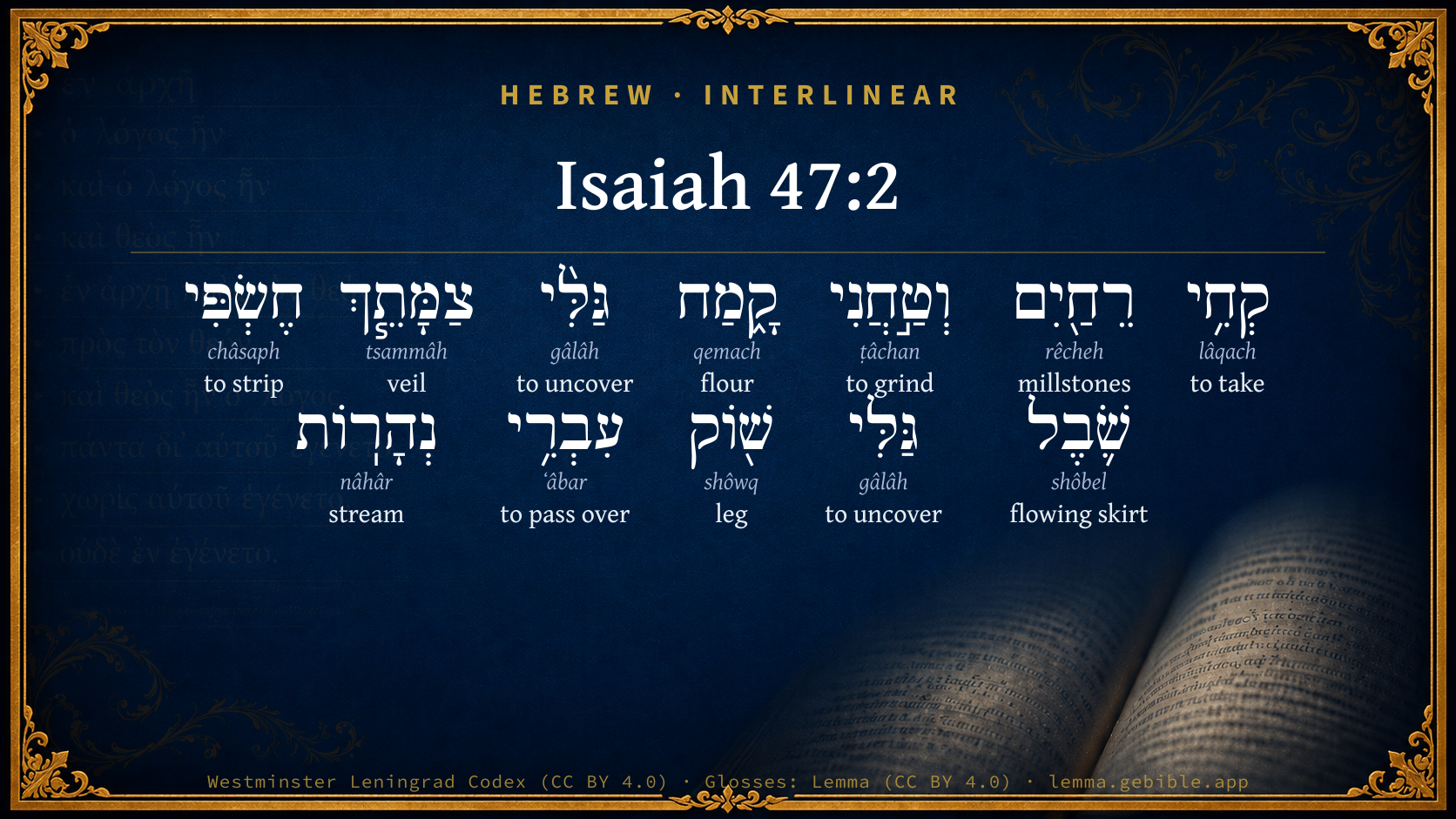
Hebrew (Westminster Leningrad Codex) Isaiah 47:2 appears in the Hebrew Old Testament. The text above is from the Westminster Leningrad Codex. Each word links to its Strong’s number, a concise gloss, and parsing drawn from the Open Scriptures Hebrew Bible morphology. Click any word for its full Brown-Driver-Briggs (BDB) entry.
Download image
Cite this verse

Isaiah 47:2 (World English Bible). Public Domain. Lemma interlinear Bible study tool, https://lemma.gebible.app/v/isaiah/47/2.

Show BibTeX & RIS
BibTeX
RIS
English Translation
Take the millstones, and grind meal; remove your veil, strip off the train, uncover the leg, pass through the rivers.
World English Bible · Public Domain
Highlights
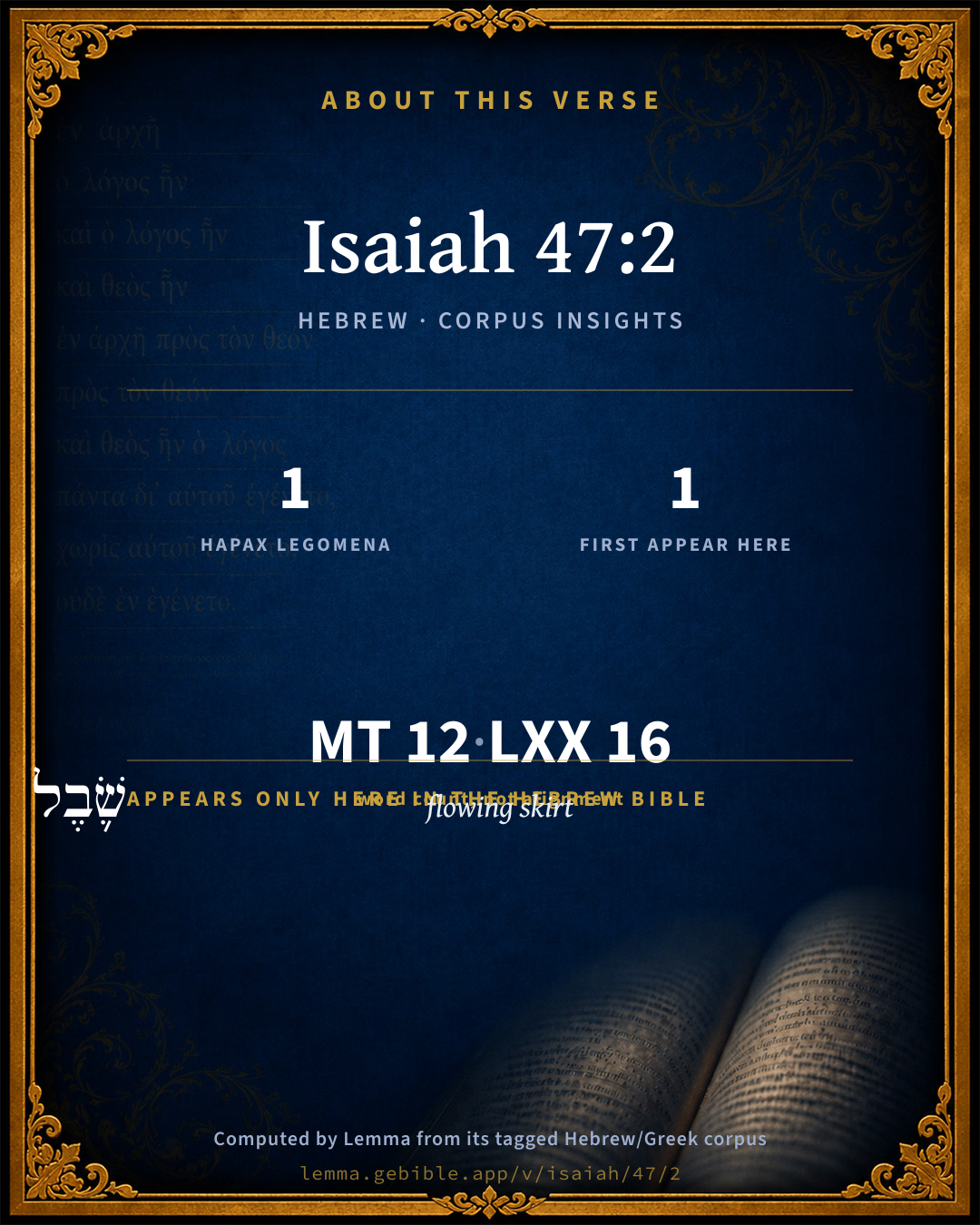
  • 1 hapax legomenon — only here in the Hebrew Bible
  • 1 first appearance in the Hebrew Bible
Full analysis ↓
Download a study sheet

One document with this verse’s original text, its word-by-word gloss line, the meaning frame, cross-references with their text, attributed commentary, and full source and license credits — printable, and it pastes into notes with its structure intact.

This verse Autodidact and up

Study sheet (.html) Plain text (.txt)

A passage Seminary Student

Up to 50 verses in one chapter. A passage sheet keeps up to 6 commentary sources and 12 cross-references per verse, in the order this page ranks them, and says so on the sheet whenever that leaves anything out. Ask for a single verse and you get the Autodidact verse sheet above.

Everything on this page stays free to read, with no account — the sheet is a download of what is already on screen, not access to it.

Want to remove ads? Support Godless Engineer
Compare translations 3

The same verse in 3 English versions, stacked beneath the original-language interlinear above. Click any original word for its lexicon entry.

Each is an independent rendering of the whole verse — the interlinear is not word-aligned to these translations.

Highlighted words mark where these versions differ — a whole-verse word diff, not a word-by-word alignment.

  • World English Bible Public Domain
    Take the millstones, and grind meal; remove your veil, strip off the train, uncover the leg, pass through the rivers.
  • King James Version Public Domain
    Take the millstones, and grind meal: uncover thy locks, make bare the leg, uncover the thigh, pass over the rivers.
  • unfoldingWord Literal Text CC BY-SA 4.0
    Take the millstones and grind flour. Remove your veil, strip off the skirt, uncover the thigh, pass through rivers.

unfoldingWord Literal Text — © unfoldingWord, licensed CC BY-SA 4.0. Word-aligned USFM3 via Door43 (git.door43.org/unfoldingWord/en_ult).

Versions to compare (up to 4)

3 of 4 selected

Show all 18 translations

Every available English version of this verse, each an independent rendering of the whole verse.

  • World English Bible Public Domain
    Take the millstones, and grind meal; remove your veil, strip off the train, uncover the leg, pass through the rivers.
  • Berean Standard Bible Public Domain
    Take millstones and grind flour; remove your veil; strip off your skirt, bare your thigh, and wade through the streams.
  • Majority Standard Bible Public Domain
    Take millstones and grind flour; remove your veil; strip off your skirt, bare your thigh, and wade through the streams.
  • King James Version Public Domain
    Take the millstones, and grind meal: uncover thy locks, make bare the leg, uncover the thigh, pass over the rivers.
  • American Standard Version (1901) Public Domain
    Take the millstones, and grind meal; remove thy veil, strip off the train, uncover the leg, pass through the rivers.
  • Revised Version (1885) Public Domain
    Take the millstones, and grind meal: remove thy veil, strip off the train, uncover the leg, pass through the rivers.
  • Geneva Bible (1599) Public Domain
    Take the mill stones, and grinde meale: loose thy lockes: make bare the feete: vncouer the legge, and passe through the floods.
  • Douay-Rheims (1899) Public Domain
    Take a millstone and grind meal: uncover thy shame, strip thy shoulder, make bare thy legs, pass over the rivers.
  • Young's Literal Translation Public Domain
    Take millstones, and grind flour, Remove thy veil, draw up the skirt, Uncover the leg, pass over the floods.
  • Literal Standard Version CC BY-SA 4.0
    Take millstones, and grind flour, || Remove your veil, draw up the skirt, || Uncover the leg, pass over the floods.
  • Unlocked Literal Bible CC BY-SA 4.0
    Take the millstone and grind flour; remove your veil, strip off your flowing robe, uncover your legs, cross the streams.
  • unfoldingWord Literal Text CC BY-SA 4.0
    Take the millstones and grind flour. Remove your veil, strip off the skirt, uncover the thigh, pass through rivers.
  • Darby Bible Public Domain
    Take the millstones, and grind meal; remove thy veil, lift up the train, uncover the leg, pass over rivers:
  • World Messianic Bible Public Domain
    Take the millstones and grind flour. Remove your veil, lift up your skirt, uncover your legs, and wade through the rivers.
  • Webster's Bible Public Domain
    Take the millstones, and grind meal: uncover thy locks, make bare the leg, uncover the thigh, pass over the rivers.
  • Free Bible Version CC BY-SA 4.0
    Go to work grinding flour with millstones. Remove your veil. Strip off your skirt, bare your legs, wade through rivers.
  • Bible in Basic English Public Domain
    Take the crushing-stones and get the meal crushed: take off your veil, put away your robe, let your legs be uncovered, go through the rivers.
  • JPS Tanakh (1917) Public Domain
    Take the millstones, and grind meal; remove thy veil, strip off the train, uncover the leg, pass through the rivers.

Literal Standard Version (2020), Covenant Press — licensed CC BY-SA 4.0. Text via the HelloAO Bible API (eBible.org). Unlocked Literal Bible (unfoldingWord) — licensed CC BY-SA 4.0. Text via the HelloAO Bible API (eBible.org). unfoldingWord Literal Text — © unfoldingWord, licensed CC BY-SA 4.0. Word-aligned USFM3 via Door43 (git.door43.org/unfoldingWord/en_ult). Free Bible Version, Dr. Jonathan Gallagher — licensed CC BY-SA 4.0. Text via the HelloAO Bible API (eBible.org).

Word by word

More ways to search: Search by grammar → Find every occurrence → Compare this word →

Practice this passage: Drill this verse → Learn its vocabulary →

שֹׁ֛בֶל
shôbel
H7640
“flowing skirt”
Noun, Common, Masculine, Singular, Absolute
Part of Speech
Noun
Type
Common
Gender
Masculine
Number
Singular
State
Absolute
Full BDB Definition

Origin: from an unused root meaning to flow

TWOT: 2316a

flowing skirt, train
  1. קְחִ֥י lâqach H3947 “take” Verb, Qal, Imperative, 2nd Person, Feminine, Singular
  2. רֵחַ֖יִם rêcheh H7347 “millstones” Noun, Common, Masculine, Dual, Absolute
  3. וְטַ֣חֲנִי ṭâchan H2912 “and · grind” Conjunction + Verb, Qal, Imperative, 2nd Person, Feminine, Singular
  4. קָ֑מַח qemach H7058 “flour” Noun, Common, Masculine, Singular, Absolute
  5. גַּלִּ֨י gâlâh H1540 “uncover” Verb, Piel, Imperative, 2nd Person, Feminine, Singular
  6. צַמָּתֵ֧ךְ tsammâh H6777 “veil · your” Noun, Common, Feminine, Singular, Construct + Suffix, Personal, 2nd Person, Feminine, Singular
  7. חֶשְׂפִּי châsaph H2834 “strip” Verb, Qal, Imperative, 2nd Person, Feminine, Singular
  8. גַּלִּי gâlâh H1540 “uncover” Verb, Piel, Imperative, 2nd Person, Feminine, Singular
  9. שׁ֖וֹק shôwq H7785 “leg” Noun, Common, Feminine, Singular, Absolute
  10. עִבְרִ֥י ʻâbar H5674 “pass over” Verb, Qal, Imperative, 2nd Person, Feminine, Singular
  11. נְהָרֽוֹת nâhâr H5104 “streams” Noun, Common, Masculine, Plural, Absolute

About this verse

These counts appear in no published source. They are computed here, from the morphology-tagged text and Lemma’s own curated glosses. What Lemma adds →

12
words
11
distinct lemmas
Prophets
section

Notable vocabulary

1 hapax legomenon — a word that appears only here in the entire Hebrew Bible:

  • שֹׁ֛בֶל flowing skirt H7640

First appearance in Scripture

This word makes its first canonical appearance in the Hebrew Bible here:

  • שֹׁ֛בֶל flowing skirt H7640

Shared distinctive vocabulary

צַמָּתֵ֧ךְ veil H6777 occurs in 4 verses of the Hebrew Bible. Also found in:

Grammatical profile

  • 6 verbs
  • 6 nouns

Verb forms

  • קְחִ֥י Qal · Imperative
  • וְטַ֣חֲנִי Qal · Imperative
  • גַּלִּ֨י Piel · Imperative
  • חֶשְׂפִּי Qal · Imperative
  • גַּלִּי Piel · Imperative
  • עִבְרִ֥י Qal · Imperative

Repetition

A word recurs within this verse — often emphatic in Hebrew:

  • גַּלִּ֨י to uncover H1540 ×2

Hebrew & Septuagint length

In English translation the verse runs 20 words from the Hebrew and 20 from the Septuagint (LXX English) — the same length.

A rough comparison of the two English renderings, which tokenize alike — not a word-level alignment.

Word counts can differ between the Hebrew and the Greek without any difference in meaning — e.g. the Hebrew direct-object marker אֵת has no separate Greek word, and Greek often adds the article ὁ.

In the original languages it is 12 Hebrew tokens and 16 Greek tokens — but the two are counted differently (Hebrew bundles its prefixes and suffixes into one token; the Greek is in lemma form), so that isn’t a like-for-like length.

Cross-references

17

Topical passages linked to Isaiah 47:2 in the Treasury of Scripture Knowledge — connected by theme and wording, ordered by reader-vote popularity; previews shown in the World English Bible.

  • Exodus 11:5 and all the firstborn in the land of Egypt shall die, from the firstborn of Pharaoh who sits on his throne, even to the firstborn of the maid-servant who is behind the mill; and all the firstborn of cattle.
  • Judges 16:21 The Philistines laid hold on him, and put out his eyes; and they brought him down to Gaza, and bound him with fetters of brass; and he did grind in the prison-house.
  • Isaiah 20:4 so shall the king of Assyria lead away the captives of Egypt, and the exiles of Ethiopia, young and old, naked and barefoot, and with buttocks uncovered, to the shame of Egypt.
  • Matthew 24:41 two women grinding at the mill, one will be taken and one will be left.
  • Genesis 24:65 She said to the servant, "Who is the man who is walking in the field to meet us?" The servant said, "It is my master." She took her veil, and covered herself.
  • Job 31:10 Then let my wife grind for another, And let others sleep with her.
  • Isaiah 32:11 Tremble, you women who are at ease; be troubled, you careless ones; strip yourselves, and make yourselves naked, and gird [sackcloth] on your loins.
  • Ezekiel 16:37–39 therefore see, I will gather all your lovers, with whom you have taken pleasure, and all those who you have loved, with all those who you have hated; I will even gather them against you on every side, and will uncover your nakedness to them, that they may see all your nakedness.
  • Hosea 2:3 Lest I strip her naked, And make her bare as in the day that she was born, And make her like a wilderness, And set her like a dry land, And kill her with thirst.
  • Nahum 3:5–6 "Behold, I am against you," says Yahweh of Hosts, "and I will lift your skirts over your face. I will show the nations your nakedness, and the kingdoms your shame.
  • Luke 17:35 There will be two grinding grain together. One will be taken, and the other will be left."
  • Isaiah 3:17 Therefore the Lord brings sores on the crown of the head of the women of Zion, And Yahweh will make their scalps bald."
  • Jeremiah 13:22 If you say in your heart, Why are these things come on me? for the greatness of your iniquity are your skirts uncovered, and your heels suffer violence.
  • Jeremiah 13:26 Therefore will I also uncover your skirts on your face, and your shame shall appear.
  • Jeremiah 27:7 All the nations shall serve him, and his son, and his son's son, until the time of his own land come: and then many nations and great kings shall make him their bondservant.
  • Lamentations 5:13 The young men bare the mill; The children stumbled under the wood.
  • Micah 1:11 Pass on, inhabitant of Shaphir, in nakedness and shame. The inhabitant of Zaanan won't come out. The wailing of Beth Ezel will take from you his protection.

Cross-references courtesy of OpenBible.info (CC BY 4.0).

Hebrew and Greek witnesses Masoretic Hebrew ↔ Greek Septuagint

The same verse in the two great witnesses to the Old Testament, shown verse-for-verse.

These are two independent witnesses, not word-aligned to each other, and the Septuagint is shown in lemma (dictionary) form.

Hebrew Isaiah 47:2 Masoretic · Westminster Leningrad Codex

קְחִ֥י רֵחַ֖יִם וְטַ֣חֲנִי קָ֑מַח גַּלִּ֨י צַמָּתֵ֧ךְ חֶשְׂפִּי שֹׁ֛בֶל גַּלִּי שׁ֖וֹק עִבְרִ֥י נְהָרֽוֹת

Take the millstones, and grind meal; remove your veil, strip off the train, uncover the leg, pass through the rivers.

World English Bible · Public Domain

Greek LXX Isaiah 47:2 Septuagint · lemma form

λαμβάνω μύλος ἀλέω ἄλευρον ἀποκαλύπτω ὁ κατακάλυμμα σύ ἀνακαλύπτω ὁ πολιά ἀνασύρω ὁ κνήμη διαβαίνω ποταμός

Take a millstone, grind meal: remove your veil, uncover your white hairs, make bare the leg, pass through the rivers.

LXX2012 (modern English Septuagint) · Public Domain

On this verse, Adam Clarke's Commentary discusses the Septuagint’s reading. Read the note in Commentary ↓

Hebrew: Westminster Leningrad Codex (CC BY 4.0). Greek: Septuagint (public domain); English from LXX2012 (modern English Septuagint) (Public Domain). How the Septuagint differs from the Hebrew →

Targum (Aramaic paraphrase)

1

The Targum is the ancient Jewish Aramaic paraphrase of the Hebrew Scriptures — an interpretive translation, not the Hebrew text itself. Onkelos (literal) and Pseudo-Jonathan (expansive) render the Torah, and Jonathan the Prophets. Coverage is partial: where no permissively-licensed English translation exists for a verse, only the Aramaic is shown. This is verse-level text, not a word-by-word alignment to the Hebrew.

  1. Targum Jonathan Prophets (Joshua–Malachi)
    קַבִּילִי מְרוֹעָא וְעוּלִי בְשִׁעְבּוּד גְלָא יְקַר מַלְכוּתִיךְ אִתְּבַּרוּ שִׁלְטוֹנִיךְ אִתְבַּדְרוּ עַם מַשִׁרְיָתֵיךְ גְלוֹ כְמֵי נַהֲרָא:

    Receive this calamity and go into servitude; put away the glory of thy kingdom, thy princes are overthrown, the people of thy armies are scattered, they have vanished away like waters of the river.

    Targum Jonathan — Aramaic: “Mikraot Gedolot” (public domain). English: “Sefaria Community Translation” (CC0 1.0 (public-domain dedication)); “London "Chaldee Paraphrase," 1871” (public domain). Text via Sefaria.

Commentary

Notes on Isaiah 47:2 from classic Christian and Jewish commentators (each source and its license shown beneath its notes). The classic Christian expositions comment on the surrounding passage and are grouped to its opening verse, so a note may address several verses; the Jewish commentaries on the Tanakh (Rashi and others) are per-verse, so they appear only where the commentator wrote on this verse.

Lemma curates 59 commentaries, every one of them public domain or Creative Commons licensed, each selected and text-cleaned for this edition rather than reprinted as found. About our sources →

Trapp's Complete Commentary

John Trapp

Isa 47:2 Take the millstones, and grind meal: uncover thy locks, make bare the leg, uncover the thigh, pass over the rivers.

Ver. 2. Take the millstone.] As the most abject slaves used to do, qui in pistrinum trudebantur. Neither is this an end of thy sorrows; for out of the mill house thou must be carried captive into a far country, and therefore, in order thereunto,

Uncover thy locks.] Cast away thy diadem.

Make bare thy leg.] Denuda turpitudinem, the Vulgate rendereth it; that thou mayest pass through the waters naked and squalid into captivity.

John Trapp, A Commentary or Exposition upon All the Books of the Old and New Testament (1647–1656) — public domain. Text from a community e-Sword module.

Geneva Bible (1599)

Geneva Bible translators

Thou shalt be brought to most vile servitude: for to turn the mill was the office of slaves.

The things wherein she setteth her greatest pride, shall be made vile, even from the head to the foot.

Geneva Bible (1599) marginal notes — public domain. Text via Bolls.life.

Jamieson, Fausset & Brown

Robert Jamieson, A. R. Fausset & David Brown

millstones--like the querns or hand-mills, found in this country, before the invention of water mills and windmills: a convex stone, made by the hand to turn in a concave stone, fitted to receive it, the corn being ground between them: the office of a female slave in the East; most degrading (Job 31:10; Mat 24:41).

uncover thy locks--rather, "take off thy veil" [HORSLEY]: perhaps the removal of the plaited hair worn round the women's temples is included; it, too, is a covering (Co1 11:15); to remove it and the veil is the badge of the lowest female degradation; in the East the head is the seat of female modesty; the face of a woman is seldom, the whole head almost never, seen bare (see on Isa 22:8).

make bare the leg--rather "lift up (literally, 'uncover'; as in lifting up the train the leg is uncovered) thy flowing train." In Mesopotamia, women of low rank, as occasion requires, wade across the rivers with stript legs, or else entirely put off their garments and swim across. "Exchange thy rich, loose, queenly robe, for the most abject condition, that of one going to and fro through rivers as a slave, to draw water," &c.

uncover . . . thigh--gather up the robe, so as to wade across.

Jamieson, Fausset & Brown — Commentary Critical and Explanatory on the Whole Bible (1871) — public domain (CC PDM 1.0). Text via the HelloAO Bible API.

Adam Clarke's Commentary

Verse 2. Take the millstones, and grind meal - "Take the mill, and grind corn"] It was the work of slaves to grind the corn. They used hand-mills: water-mills were not invented till a little before the time of Augustus, (see the Greek epigram of Antipater, which seems to celebrate it as a new invention, Anthol. Cephalae, 653;) wind-mills, not until long after. It was not only the work of slaves, but the hardest work; and often inflicted upon them as a severe punishment: -

Molendum in pistrino; vapulandum; habendae compedes.

TERENT. Phorm. ii. 1. 19.

Hominem pistrino dignum.

Id. Heaut. iii. 2. 19.

To grind in the mill, to be scourged, to be put in the stocks, were punishments for slaves. Hence a delinquent was said to be a man worthy of the mill. The tread-mill, now in use in England, is a revival of this ancient usage. But in the east grinding was the work of the female slaves. See Ex 11:5; Ex 12:29, (in the version of the Septuagint; Mt 24:41; Homer, Odyss. xx. 105-108. And it is the same to this day. "Women alone are employed to grind their corn;" Shaw's Algiers and Tunis, p. 287. "They are the female slaves, that are generally employed in the east at those hand-mills for grinding corn; it is extremely laborious, and esteemed the lowest employment in the house;" Sir J. Chardin, Harmer's Observ. i., p. 153. The words denote that state of captivity to which the Babylonians should be reduced.

Make bare the leg, uncover the thigh] This is repeatedly seen in Bengal, where there are few bridges, and both sexes, having neither shoes nor stockings, truss up their loose garments, and walk across, where the waters are not deep. In the deeper water they are obliged to truss very high, to which there seems a reference in the third verse: Thy nakedness shall be uncovered.

Adam Clarke's Commentary on the Bible (1810–1826) — public domain. Text from a community e-Sword/MySword module.

Ellicott's Commentary for English Readers

(2) Take the millstones.—Always the most servile form of female labour (Exo_11:5; Job_31:10; Mat_24:41).

Uncover thy locks.—The picture of suffering is heightened by the fact that the female slave has to wade unveiled, and bare-legged, all sense of shame outraged, to the scene of her labours. The picture is, of course, to be taken symbolically, not literally.

A Bible Commentary for English Readers, edited by Charles John Ellicott (1878–1897) — public domain. Text from a community e-Sword module.

The Cambridge Bible for Schools and Colleges

gen. ed. J. J. S. Perowne

2. Take the millstones &c.] The luxurious lady must betake herself to the occupation of the meanest female slaves in the household: Exo_11:5; Job_31:10.

uncover thy locks] Rather: take off thy veil (Son_4:1; Son_4:3; Son_6:7).

make bare the leg] remove the skirt. The last word does not occur elsewhere. pass over the rivers] Render: pass through streams, omitting the article. The words are commonly taken to describe the hardships of a journey into exile, but they may simply refer to the degradations which she would have to undergo in performing the drudgery of a common slave (so Dillmann).

The Cambridge Bible for Schools and Colleges (gen. ed. J. J. S. Perowne; Cambridge University Press, 1878–1918) — public domain. Text from a community e-Sword module.

John Gill's Exposition

Take the millstones, and grind meal,.... Foretelling that the Chaldeans should be taken captives, and used as such, and sent to prison houses, where they should turn the mill, and grind corn into meal; a very servile work, and which used to be done by captives and slaves, even by female ones, Exo 11:5. The Targum is,

"go into servitude;''

of which this was a sign:

uncover thy locks: the attire and dress of the head, by which the locks were bound up and kept together; but being taken off, would hang loose, and be dishevelled, as in captives and mourners. The Targum is,

"uncover the glory of thy kingdom:''

make bare the leg; or the shoulder, as the Vulgate Latin version, to be scourged by the Persians:

uncover the thigh, pass over the rivers: they are bid to tuck up their clothes so high, that they might pass over the rivers which lay between them and Persia, whither they were carried captives. The Targum is,

"thy princes are broken, the people of their army are scattered, they pass away as the waters of the river.''

John Gill's Exposition of the Whole Bible (1746–1763) — public domain (CC PDM 1.0). Text via the HelloAO Bible API.

Albert Barnes' Notes on the Bible

Take the millstones, and grind meal - The design of this is plain. Babylon, that had been regarded as a delicately-trained female, was to be reduced to the lowest condition of poverty and wretchedness - represented here by being compelled to perform the most menial and laborious offices, and submitting to the deepest disgrace and ignominy. There is an allusion here to the custom of grinding in the East. The mills which were there commonly used, and which are also extensively used to this day, consisted of two stones, of which the lower one was convex on the upper side, and the upper one was concave on thee lower side, so that they fitted into each other. The hole for receiving the grain was in the center of the upper stone, and in the process of grinding the lower one was fixed, and the upper one was turned round, usually by two women (see Mat 24:41), with considerable velocity by means of a handle. Watermills were not invented until a little before the time of Augustus Caesar; and windmills long after. The custom of using handmills is the primitive custom everywhere, and they are still in use in some parts of Scotland, and generally in the East. (See Mr. Pennant’s “Tour to the Hebrides,” and the Oriental travelers generally. Grinding was usually performed by the women, though it was often regarded as the work of slaves. It was often inflicted on slaves as a punishment.

Molendum in pistrino; vapulandum; habendae compedes.

Terent. Phormio ii. 1. 19.

In the East it was the usual work of female slaves see (Exo 11:5, in the Septuagint) ‘Women alone are employed to grind their corn.’ (Shaw, “Algiers and Tunis,” p. 297) ‘They are the female slaves that are generally employed in the East at those handmills. It is extremely laborious, and esteemed the lowest employment in the house.’ (Sir John Chardin, Harmer’s Obs. i. 153) Compare Lowth, and Gesen. “Commentary uber Isaiah.” This idea of its being a low employment is expressed by Job 31:10 : ‘Let my wife grind unto another.’ The idea of its being a most humble and laborious employment was long since exhibited by Homer:

A woman next, then laboring at the mill,

Hard by, where all his numerous mills he kept.

Gave him the sign propitious from within.

twelve damsels toiled to turn them, day by day

Meal grinding, some of barley, some of wheat,

Marrow of man The rest (their portion ground)

All slept, one only from her task as yet

Ceased not, for she was feeblest of them all;

She rested on her mill, and thus pronounced:

‘Jove, Father, Governor, of heaven and earth!

‘O grant the prayer

Of a poor bond-woman. Appoint their feast,

This day the last, that in Ulysses’ house,

The suitors shall enjoy, for whom I drudge,

Grinding, to weariness of heart and limb,

Meal for their use.’

Cowper

The sense here is, that Babylon should be reduced to the lowest state, like that of reducing a female delicately and tenderly reared, to the hard and laborious condition of working the handmill - the usual work of slaves.

Uncover thy locks - Gesenius renders this, ‘Raise thy veil.’ The word used here (צמה tsamâh) is rendered ‘locks,’ in Son 4:1, Son 4:3; Son 6:7, as well as here. It occurs nowhere else in the Bible. Gesenius derives it from צמם tsāmam, “to braid, to plaid,” and then “to bind fast,” as a veil; to veil. Jerome renders it, Denuda turpetudinem tuam. The Septuagint renders it, Τὸ κατακάλυμμα σου To katakalumma sou - ‘Thy veil.’ The Syriac also renders it, ‘Thy veil.’ The Chaldee has paraphrased the whole verse thus: ‘Go into servitude; reveal the glory of thy kingdom. Broken are thy princes; dispersed are the people of thy host; they have gone into captivity like the waters of a river.’ Jarchi says, that the word used here (צמה tsamâh) denotes whatever is bound up, or tied together Kimchi says that it means the hair, which a woman disposes around her temples over her face, and which she covers with a veil, deeming it an ornament; but that when a female goes into captivity this is removed, as a sign of an abject condition.

It properly means that which is plaited, or gathered together; and it may refer either to the hair so plaited as an ornament, or a covering for the head and face (compare the note at 1Co 11:15); or it may denote a veil. To remove either would be regarded as disgraceful. It is known that oriental females pay great attention to their hair, and also that it is a universal custom to wear a close veil. To remove either, and to leave the head bare, or the face exposed, was deemed highly humiliating and dishonorable (see the notes at Isa 3:24). ‘The head,’ says the Editor of the “Pictorial Bible,” ‘is the seat of female modesty in the East; and no woman allows her head to be seen bare. In our traveling experience, we saw the faces of very many women, but never the bare head of any except one - a female servant, whose face we were in the constant habit of seeing, and whom we accidentally surprised while dressing her hair. The perfect consternation, and deep sense of humiliation which she expressed on that occasion, could not easily be forgotten, and furnish a most striking illustration of the present text.’

Make bare the leg - In the interpretation of this, also, commentators vary. Jerome renders it, “Discoopteri humerum” - ‘Uncover the shoulder.’ The Septuagint, Ἀνακάλυψαι τὰς πολιάς Anakalupsai tas polias - ‘Uncover thy gray locks.’ The Syriac, ‘Cut off thy hoary hairs.’ Jarchi and Kimchi suppose it means, ‘Remove the waters from the paths, so that they might pass over them.’ The word used here (שׁבל shobel), is derived from שׁבל shâbal, “to go; to go up, to rise; to grow; to flow copiously.” Hence, the noun in its various forms means a path Psa 77:19; Jer 18:15; ears of corn, שׁבלת shibbôleth Gen 41:5, Jdg 12:6; Rth 2:2; Job 24:24; Isa 17:5; floods Psa 69:15; branches Zec 4:12. In no place has it the certain signification of a leg; but it rather refers to that which flows: flows copiously; and probably here means the train of a robe (Gesenius, and Rosenmuller): and the expression means ‘uncover, or make bare the train;’ that is, lift it up, as would be necessary in passing through a stream, so that the leg would be made bare. The Orientals, as is well known, wore a long, loose, flowing robe, and in passing through waters, it would be necessary to lift, or gather it up, so that the legs would be bare. The idea is, that she who had sat as a queen, and who had been clad in the rich, loose, and flowing robe which those usually wore who were in the most elevated ranks of life, would now be compelled to leave the seat of magnificence, and in such a manner as to be subject to the deepest shame and disgrace.

Uncover the thigh - By collecting, and gathering up the train of the robe, so as to pass through the streams.

Pass over the rivers - Hebrew, ‘Pass the rivers;’ that is, by wading, or fording them. This image is taken from the fact that Babylon was surrounded by many artificial rivers or streams, and that one in passing from it would be compelled to ford many of them. It does not mean that the population of Babylon would be removed into captivity by the conquerors - for there is no evidence that this was done; but the image is that of Babylon, represented as a delicately-reared and magnificently attired female, compelled to ford the streams. The idea is, that the power and magnificence of the city would be transferred to other places. Rosenmuller remarks that it is common in the countries bordering on the Tigris and the Euphrates, for females of bumble rank to ford the streams, or even to swim across them.

Albert Barnes' Notes on the Bible (1834–1885) — public domain. Text from a community e-Sword/MySword module.

Haydock's Catholic Bible Commentary

Shame. Hebrew tsammathec, Canticle of Canticles iv. 1, 4. Protestants, "thy locks, make bare the legs, uncover the thigh, pass," &c. (Haydock) --- Thou shalt be reduced to a state of the most abject slavery, Exodus xi. 5., and Supra[Isaias] iii. 17., and xx. 4. The Barbarians sold their slaves naked.

George Leo Haydock (1774–1849), Haydock's Catholic Family Bible and Commentary, 1859 edition — public domain. Excludes Psalms (Douay-Rheims chapter numbering differs from Protestant) and Deuterocanonical books (Catholic canon only).

Matthew Poole's English Annotations

Take the millstones; betake thyself to the millstones; as we commonly say, Take thy bed, or, Betake thyself to thy bed. The meaning is, Thou shalt be brought down to the basest kind of slavery, which grinding at the mill was esteemed; of which see on Exo 11:5; Jdg 16:21; Job 31:10; Lam 5:13. For this work was not performed by horses, as now it is, but by the labour of slaves and captives.

Grind meal; grind bread corn into meal for thy master’s use. Such metonymical expressions we find Isa 28:28; Hos 8:7, and elsewhere. Uncover thy locks; or, thine hair. Take off the ornaments wherewith such women as were free and of good quality used to cover and dress their heads. This and the following passages, though delivered in the form of a command, are only predictions of what they should be forced to do or suffer, as appears from the next verse.

Make bare the leg, uncover the thigh; gird up thy garments close and short about thee, that thou mayst be fit for service, and for travelling on foot, and, as it follows, for passing over those rivers, through which thou wilt be constrained to wade, in the way to the land of thy captivity.

Matthew Poole's English Annotations on the Holy Bible (1683–1685) — public domain. Text from a community e-Sword/MySword module.

Whedon's Commentary on the Bible

Daniel D. Whedon

2. Grind meal — The figure here is that of servitude, with all the conditions of that state; the highest in rank, equally with the lowest, set to the meanest employments.

Uncover thy locks — Rather, (Hebrews,) thy veil. In the East a token of immodest shame, except with slaves. This uncovering was a dishonouring of the person. The other phrases indicate a march of menial captives onward to exile, wading rivers and bearing burdens.

Daniel D. Whedon (gen. ed.), Commentary on the Old and New Testaments (1874–1909) — public domain. Text from a community e-Sword module.

The Pulpit Commentary

Take the millstones, and grind meal. Do the hard work commonly allotted to female slaves. Turn the heavy upper millstone all day long upon the nether one. (comp. Exo_11:5) Babylon having been personified as a female captive, the details have to be in unison. Uncover thy locks. Babylonian women are represented in the Assyrian sculptures as wearing closefitting caps upon their heads (see "Ancient Monarchies," vol. 2, p. 500). Make bare the leg... pass over the rivers. On the way from their own city to the land of their captivity, they would have to wade through streams, and in so doing to expose parts of their persons which delicacy required to be concealed.

The Pulpit Commentary (1880–1919), ed. H.D.M. Spence-Jones & Joseph S. Exell — public domain. Text from a community e-Sword module.

John Wesley's Explanatory Notes

Millstones - Thou shalt be brought to the basest slavery, which grinding at the mill was esteemed. For this work was not performed by horses, as now it is, but by the labour of slaves and captives. Grind - Grind bread-corn into meal for thy master's use. Uncover - Take off the ornaments wherewith such women as were of good quality, used to cover and dress their heads. These are predictions of what they should be forced to do or suffer. Thigh - Gird up thy garments close and short about thee, that thou mayest be fit for travelling on foot, and for passing over those rivers, through which thou wilt be constrained to wade, in the way to the land of thy captivity.

John Wesley, Explanatory Notes Upon the Whole Bible (1754–1765) — public domain. Text via the GEBible commentary corpus.

J. A. Alexander on Isaiah

Joseph Addison Alexander

“Take mill-stones and grind meat.” Even among the Romans this was considered one of the most servile occupations. In the east it was especially the work of female slaves (Exo 11:5; Mat 24:41). “Uncover (i e. lift up or remove) thy veil!” One of the Arabian poets speaks of certain ladies as appearing unveiled so that they resembled slaves, which is exactly the idea here expressed. “Uncover the leg, cross streams!” The only question as to this clause is whether it refers to the fording of rivers by female captives as they go into exile, or to the habitual exposure of the person, by which women of the lowest class are especially distinguished in the east. The latter explanation is entitled to the preference, not only because we read of no deportation of the Babylonians by Cyrus, but because the other terms of the description are confessedly intended to contrast two conditions of life or classes of society.

Joseph Addison Alexander, The Prophecies of Isaiah (1846–1847; New York: Scribner, 1870–1878) — public domain. Text from a community e-Sword module.

Rashi

Rabbi Shlomo Yitzchaki (Rashi)

Take millstones This is hard labor, i.e., subordinate yourself from now on, to the kings of Persia and Media. Alternatively: And grind flour for supplies on the road of your exile.

bare your covered parts Your arms and your legs, parts veiled, tied, and covered.

uncover the paths Heb. חֶשְׂפִּי שֹׁבֶל. Uncover the paths of the water that is upon them, for that way you shall go out into exile, or bare your leg and cross rivers.

Rashi on the Tanakh — English translations: “The Judaica Press complete Tanach with Rashi, translated by A. J. Rosenberg” (CC BY 4.0); “Pentateuch with Rashi's commentary by M. Rosenbaum and A.M. Silbermann, 1929-1934” (public domain); “The Metsudah Tanach series, Lakewood, N.J” (CC BY 4.0); and “The Book of Joshua, Metsudah Publications, 1997” (CC BY 4.0). Text via Sefaria.

Ibn Ezra

Rabbi Abraham ibn Ezra

Take the millstones, etc., as handmaids do; for thou wilt go into captivity.

Meal. This is a prolepsis. Comp. And stripped the naked of their clothing (Job 22:6).

צמתך Thy crown. The hair upon the head.

שובל Locks. The hair that hangs down over the cheeks. R. Moses Hakkohen compares שובל with שבלת the channel of the river (27:12), but I consider it as hap. leg., and its meaning can only be found from the context, without being supported by any. parallel passage.

Pass over the rivers, in order to grind.

Ibn Ezra on the Tanakh — English translations: “Sefaria Community Translation” (CC0 1.0 (public-domain dedication)); “Yalkut, Sifsei Chachomim Chumash, Metsudah Publications, 2009” (CC BY 4.0); and “Commentary of Ibn Ezra on Isaiah - trans. by M. Friedlander, 1873” (public domain). Text via Sefaria.

Lesson kit

Teaching starters — assembled from the data on this page, not authored interpretation. Every prompt links to the verse data it draws on. Edit before teaching.

Isaiah, in the Prophets, opens this verse with 12 words (11 distinct Hebrew lemmas). Its most distinctive word is shôbel (“flowing skirt”). A historical commentator’s framing appears above. Read the whole chapter for the surrounding context.

Discussion questions

  1. What does “flowing skirt” (shôbel) contribute to the verse as a whole?
  2. This verse holds 1 word here found nowhere else in the Hebrew Bible. What might the rare word draw attention to?
  3. The word “flowing skirt” first appears here in Scripture. What is being introduced at this debut?
  4. Song of Solomon 4:1 shares the word «veil» with this verse. How do the two illuminate each other?
  5. “to uncover” occurs 2× in this one verse. What is the effect of the repetition?
  6. These translations render this verse differently. What is at stake in choosing one wording over another?
  7. The verb «קְחִ֥י» is Qal Imperative. How does its form color the action?
  8. Reading how Trapp's Complete Commentary and Geneva Bible (1599) read this verse, where do the two commentators agree and where do they part?

Things to notice

  • 1 word in this verse appears nowhere else in the Hebrew Bible.
  • 1 word makes its first canonical appearance in Scripture here.
  • This verse counts 12 Hebrew ↔ 16 Greek words.
  • These translations choose different wording for 15 words in this verse.
  • “to uncover” occurs 2× in this single verse.

Reading settings

Reading text

Shown beneath each verse's original-language words.

Old Testament
Old Testament edition

Read the OT as the Masoretic Hebrew (MT) or the Greek Septuagint (LXX).

English shown for the Greek Septuagint (in the Hebrew ↔ Greek comparison).

Comparing translations? Open the Compare panel on any verse page to stack up to four side by side.