2 Kings 18:11

Hebrew (Westminster Leningrad Codex) 2 Kings 18:11 appears in the Hebrew Old Testament. The text above is from the Westminster Leningrad Codex. Each word links to its Strong’s number, a concise gloss, and parsing drawn from the Open Scriptures Hebrew Bible morphology. Click any word for its full Brown-Driver-Briggs (BDB) entry.
Download image
Cite this verse

2 Kings 18:11 (World English Bible). Public Domain. Lemma interlinear Bible study tool, https://lemma.gebible.app/v/2-kings/18/11.

Show BibTeX & RIS
BibTeX
RIS
English Translation
The king of Assyria carried Israel away to Assyria, and put them in Halah, and on the Habor, the river of Gozan, and in the cities of the Medes,
World English Bible · Public Domain
Download a study sheet

One document with this verse’s original text, its word-by-word gloss line, the meaning frame, cross-references with their text, attributed commentary, and full source and license credits — printable, and it pastes into notes with its structure intact.

This verse Autodidact and up

Study sheet (.html) Plain text (.txt)

A passage Seminary Student

Up to 50 verses in one chapter. A passage sheet keeps up to 6 commentary sources and 12 cross-references per verse, in the order this page ranks them, and says so on the sheet whenever that leaves anything out. Ask for a single verse and you get the Autodidact verse sheet above.

Everything on this page stays free to read, with no account — the sheet is a download of what is already on screen, not access to it.

Want to remove ads? Support Godless Engineer
Compare translations 3

The same verse in 3 English versions, stacked beneath the original-language interlinear above. Click any original word for its lexicon entry.

Each is an independent rendering of the whole verse — the interlinear is not word-aligned to these translations.

Highlighted words mark where these versions differ — a whole-verse word diff, not a word-by-word alignment.

  • World English Bible Public Domain
    The king of Assyria carried Israel away to Assyria, and put them in Halah, and on the Habor, the river of Gozan, and in the cities of the Medes,
  • King James Version Public Domain
    And the king of Assyria did carry away Israel unto Assyria, and put them in Halah and in Habor by the river of Gozan, and in the cities of the Medes:
  • unfoldingWord Literal Text CC BY-SA 4.0
    And the king of Assyria exiled Israel to Assyria. And he led them into Halah and into the Habor, the river of Gozan, and the cities of Media,

unfoldingWord Literal Text — © unfoldingWord, licensed CC BY-SA 4.0. Word-aligned USFM3 via Door43 (git.door43.org/unfoldingWord/en_ult).

Versions to compare (up to 4)

3 of 4 selected

Show all 18 translations

Every available English version of this verse, each an independent rendering of the whole verse.

  • World English Bible Public Domain
    The king of Assyria carried Israel away to Assyria, and put them in Halah, and on the Habor, the river of Gozan, and in the cities of the Medes,
  • Berean Standard Bible Public Domain
    The king of Assyria exiled the Israelites to Assyria and settled them in Halah, in Gozan by the Habor River, and in the cities of the Medes.
  • Majority Standard Bible Public Domain
    The king of Assyria exiled the Israelites to Assyria and settled them in Halah, in Gozan by the Habor River, and in the cities of the Medes.
  • King James Version Public Domain
    And the king of Assyria did carry away Israel unto Assyria, and put them in Halah and in Habor by the river of Gozan, and in the cities of the Medes:
  • American Standard Version (1901) Public Domain
    And the king of Assyria carried Israel away unto Assyria, and put them in Halah, and on the Habor, the river of Gozan, and in the cities of the Medes,
  • Revised Version (1885) Public Domain
    And the king of Assyria carried Israel away unto Assyria, and put them in Halah, and in Habor, on the river of Gozan, and in the cities of the Medes:
  • Geneva Bible (1599) Public Domain
    Then the King of Asshur did carry away Israel vnto Asshur, and put them in Halah and in Habor, by the riuer of Gozan, and in the cities of the Medes,
  • Douay-Rheims (1899) Public Domain
    And the king of the Assyrians carried away Israel into Assyria, and placed them in Hale, and in Habor by the rivers of Gozan in the cities of the Medes:
  • Young's Literal Translation Public Domain
    and the king of Asshur removeth Israel to Asshur, and placed them in Halah, and in Habor `by' the river Gozan, and `in' cities of the Medes,
  • Literal Standard Version CC BY-SA 4.0
    and the king of Asshur removes Israel to Asshur, and placed them in Halah, and in Habor [by] the river Gozan, and [in] cities of the Medes,
  • Unlocked Literal Bible CC BY-SA 4.0
    So the king of Assyria carried Israel away to Assyria and put them in Halah, and at the Habor River in Gozan, and in the cities of the Medes.
  • unfoldingWord Literal Text CC BY-SA 4.0
    And the king of Assyria exiled Israel to Assyria. And he led them into Halah and into the Habor, the river of Gozan, and the cities of Media,
  • Darby Bible Public Domain
    And the king of Assyria carried away Israel to Assyria, and settled them in Halah and by the Habor, the river of Gozan, and in the cities of the Medes;
  • World Messianic Bible Public Domain
    The king of Assyria carried Israel away to Assyria, and put them in Halah, and on the Habor, the river of Gozan, and in the cities of the Medes,
  • Webster's Bible Public Domain
    And the king of Assyria carried away Israel to Assyria, and put them in Halah and in Habor by the river of Gozan, and in the cities of the Medes:
  • Free Bible Version CC BY-SA 4.0
    The king of Assyria deported the Israelites to Assyria. He settled them in Halah, in Gozan on the Habor River, and in the towns of the Medes.
  • Bible in Basic English Public Domain
    And the king of Assyria took Israel away as prisoners into Assyria, placing them in Halah and in Habor on the river Gozan, and in the towns of the Medes;
  • JPS Tanakh (1917) Public Domain
    And the king of Assyria carried Israel away unto Assyria, and put them in Halah, and in Habor, on the river of Gozan, and in the cities of the Medes;

Literal Standard Version (2020), Covenant Press — licensed CC BY-SA 4.0. Text via the HelloAO Bible API (eBible.org). Unlocked Literal Bible (unfoldingWord) — licensed CC BY-SA 4.0. Text via the HelloAO Bible API (eBible.org). unfoldingWord Literal Text — © unfoldingWord, licensed CC BY-SA 4.0. Word-aligned USFM3 via Door43 (git.door43.org/unfoldingWord/en_ult). Free Bible Version, Dr. Jonathan Gallagher — licensed CC BY-SA 4.0. Text via the HelloAO Bible API (eBible.org).

Word by word

More ways to search: Search by grammar → Find every occurrence → Compare this word →

Practice this passage: Drill this verse → Learn its vocabulary →

בַּחְלַ֧ח
Chălach
H2477
“in/at · Halah”
Preposition + Noun, Proper
Part of Speech
Preposition + Noun
Type
Proper
Full BDB Definition

Origin: probably of foreign origin

TWOT: None

Halah = "painful" - a city or district in Mesopotamia under Assyrian control where the Israelite captives were taken
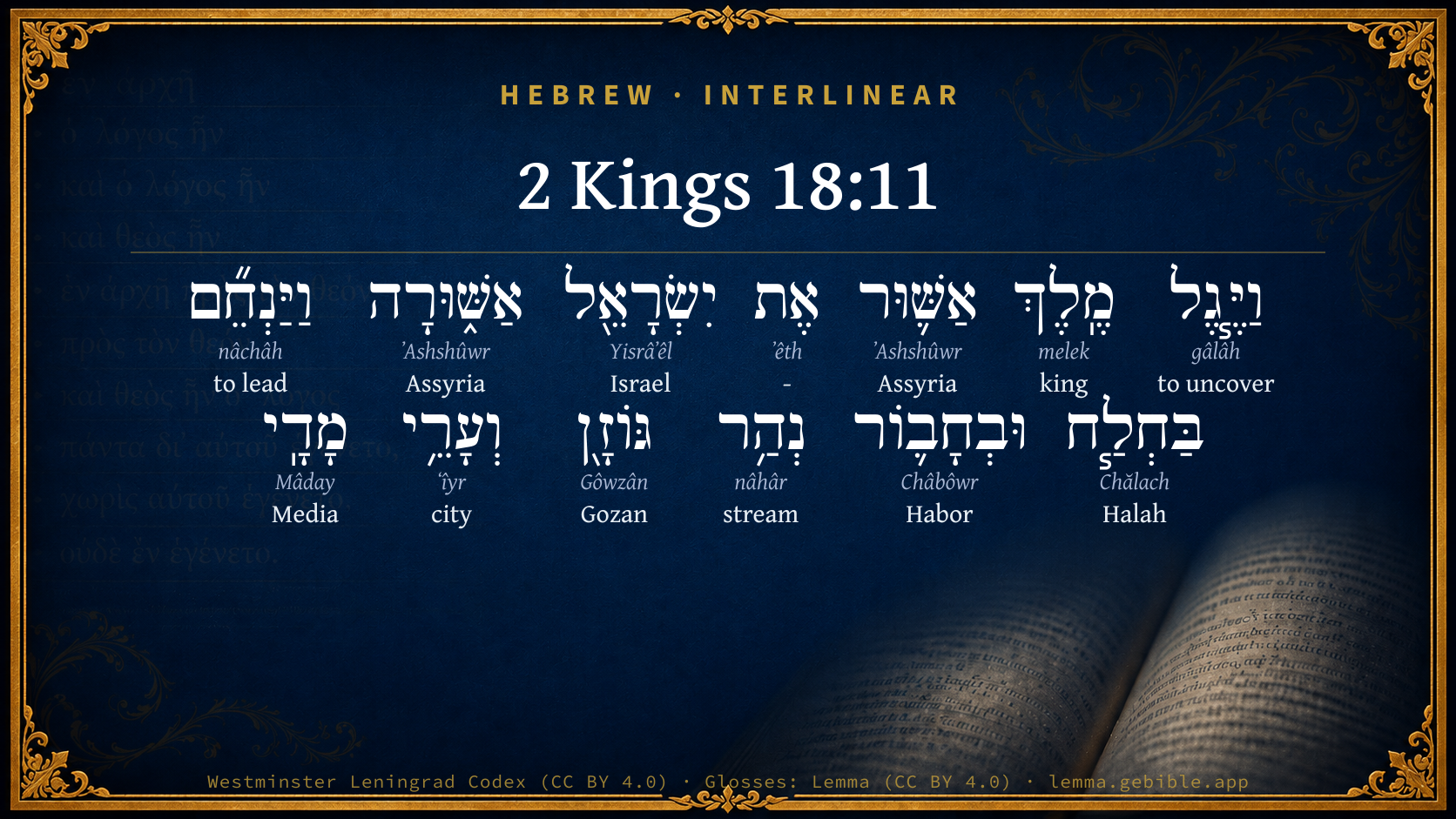
  1. וַיֶּ֧גֶל gâlâh H1540 “and · to uncover” Conjunction + Verb, Hiphil, Sequential Imperfect, 3rd Person, Masculine, Singular
  2. מֶֽלֶךְ melek H4428 “king of” Noun, Common, Masculine, Singular, Construct
  3. אַשּׁ֛וּר ʼAshshûwr H804 “Assyria” Noun, Proper
  4. אֶת ʼêth H853 “-” Particle, Direct Object
  5. יִשְׂרָאֵ֖ל Yisrâʼêl H3478 “Israel” Noun, Proper
  6. אַשּׁ֑וּרָה ʼAshshûwr H804 “Assyria · toward” Noun, Proper + Suffix, Demonstrative
  7. וַיַּנְחֵ֞ם nâchâh H5148 “and · to lead · them” Conjunction + Verb, Hiphil, Sequential Imperfect, 3rd Person, Masculine, Singular + Suffix, Personal, 3rd Person, Masculine, Plural
  8. וּבְחָב֛וֹר Châbôwr H2249 “and · in/at · Habor” Conjunction + Preposition + Noun, Proper
  9. נְהַ֥ר nâhâr H5104 “stream of” Noun, Common, Masculine, Singular, Construct
  10. גּוֹזָ֖ן Gôwzân H1470 “Gozan” Noun, Proper
  11. וְעָרֵ֥י ʻîyr H5892 “and · cities of” Conjunction + Noun, Common, Feminine, Plural, Construct
  12. מָדָֽי Mâday H4074 “Media” Noun, Proper

About this verse

These counts appear in no published source. They are computed here, from the morphology-tagged text and Lemma’s own curated glosses. What Lemma adds →

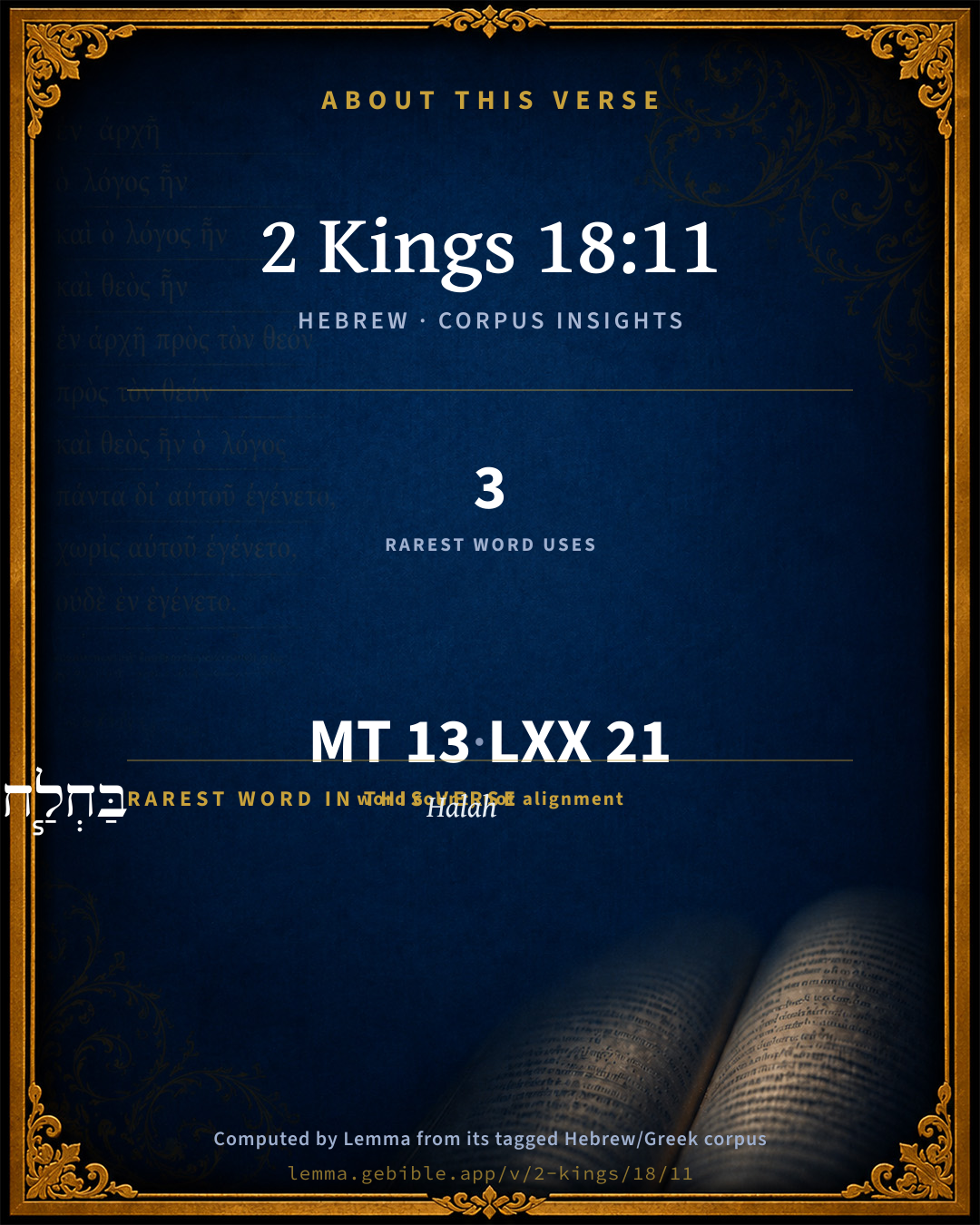
13
words
12
distinct lemmas
Historical
section

Notable vocabulary

The rarest word here is בַּחְלַ֧ח Halah H2477 — appearing just 3 times in the whole Hebrew Bible.

Shared distinctive vocabulary

בַּחְלַ֧ח Halah H2477 occurs in 3 verses of the Hebrew Bible. Also found in:

Grammatical profile

  • 2 verbs
  • 10 nouns
  • 1 particle

Verb forms

  • וַיֶּ֧גֶל Hiphil · Sequential Imperfect
  • וַיַּנְחֵ֞ם Hiphil · Sequential Imperfect

Repetition

A word recurs within this verse — often emphatic in Hebrew:

  • אַשּׁ֛וּר Assyria H804 ×2

Hebrew & Septuagint length

In English translation the verse runs 29 words from the Hebrew and 31 from the Septuagint (LXX English) — closely comparable.

A rough comparison of the two English renderings, which tokenize alike — not a word-level alignment.

Word counts can differ between the Hebrew and the Greek without any difference in meaning — e.g. the Hebrew direct-object marker אֵת has no separate Greek word, and Greek often adds the article ὁ.

In the original languages it is 13 Hebrew tokens and 21 Greek tokens — but the two are counted differently (Hebrew bundles its prefixes and suffixes into one token; the Greek is in lemma form), so that isn’t a like-for-like length.

Cross-references

15

Topical passages linked to 2 Kings 18:11 in the Treasury of Scripture Knowledge — connected by theme and wording, ordered by reader-vote popularity; previews shown in the World English Bible.

  • 1 Chronicles 5:26 The God of Israel stirred up the spirit of Pul king of Assyria, and the spirit of Tilgath Pilneser king of Assyria, and he carried them away, even the Reubenites, and the Gadites, and the half-tribe of Manasseh, and brought them to Halah, and Habor, and Hara, and to the river of Gozan, to this day.
  • 2 Kings 17:6 In the ninth year of Hoshea the king of Assyria took Samaria, and carried Israel away to Assyria, and placed them in Halah, and on the Habor, the river of Gozan, and in the cities of the Medes.
  • Isaiah 37:12 Have the gods of the nations delivered them, which my fathers have destroyed, Gozan, and Haran, and Rezeph, and the children of Eden who were in Telassar?
  • 2 Kings 19:11 Behold, you have heard what the kings of Assyria have done to all lands, by destroying them utterly: and shall you be delivered?
  • Isaiah 7:8 For the head of Syria is Damascus, and the head of Damascus is Rezin; and within sixty-five years Ephraim shall be broken in pieces, so that it shall not be a people;
  • Isaiah 8:4 For before the child shall have knowledge to cry, My father, and, My mother, the riches of Damascus and the spoil of Samaria shall be carried away before the king of Assyria.
  • Isaiah 9:9–21 All the people shall know, [even] Ephraim and the inhabitant of Samaria, who say in pride and in arrogance of heart,
  • Isaiah 10:5 Ho Assyrian, the rod of my anger, the staff in whose hand is my indignation!
  • Isaiah 10:11 shall I not, as I have done to Samaria and her idols, so do to Jerusalem and her idols?
  • Hosea 8:8–9 Israel is swallowed up. Now they are among the nations like a worthless thing.
  • Hosea 9:3 They won't dwell in Yahweh's land; But Ephraim will return to Egypt, And they will eat unclean food in Assyria.
  • Amos 5:1–3 Listen to this word which I take up for a lamentation over you, O house of Israel.
  • Amos 5:6 Seek Yahweh, and you will live; Lest he break out like fire in the house of Joseph, And it devour, and there be no one to quench it in Bethel.
  • Amos 5:25–27 "Did you bring to me sacrifices and offerings in the wilderness forty years, house of Israel?
  • Acts 7:43 You took up the tent of Moloch, The star of your god Rephan, The figures which you made to worship. I will carry you away beyond Babylon.'

Cross-references courtesy of OpenBible.info (CC BY 4.0).

Hebrew and Greek witnesses Masoretic Hebrew ↔ Greek Septuagint

The same verse in the two great witnesses to the Old Testament, shown verse-for-verse.

These are two independent witnesses, not word-aligned to each other, and the Septuagint is shown in lemma (dictionary) form.

Hebrew 2 Kings 18:11 Masoretic · Westminster Leningrad Codex

וַיֶּ֧גֶל מֶֽלֶךְ אַשּׁ֛וּר אֶת יִשְׂרָאֵ֖ל אַשּׁ֑וּרָה וַיַּנְחֵ֞ם בַּחְלַ֧ח וּבְחָב֛וֹר נְהַ֥ר גּוֹזָ֖ן וְעָרֵ֥י מָדָֽי

The king of Assyria carried Israel away to Assyria, and put them in Halah, and on the Habor, the river of Gozan, and in the cities of the Medes,

World English Bible · Public Domain

Greek LXX 2 Kings 18:11 Septuagint · lemma form

καί ἀποοἰκίζω βασιλεύς ἀσσύριος ὁ σαμαρεία εἰς ἀσσύριος καί τίθημι αὐτός ἐν αλαε καί ἐν αβωρ ποταμός γωζαν καί ορη μήδοι

And the king of the Assyrians carried away the Samaritans to Assyria, and put them in Alae and in Abor, by the river Gozan, and in the mountains of the Medes;

LXX2012 (modern English Septuagint) · Public Domain

Hebrew: Westminster Leningrad Codex (CC BY 4.0). Greek: Septuagint (public domain); English from LXX2012 (modern English Septuagint) (Public Domain). How the Septuagint differs from the Hebrew →

Targum (Aramaic paraphrase)

1

The Targum is the ancient Jewish Aramaic paraphrase of the Hebrew Scriptures — an interpretive translation, not the Hebrew text itself. Onkelos (literal) and Pseudo-Jonathan (expansive) render the Torah, and Jonathan the Prophets. Coverage is partial: where no permissively-licensed English translation exists for a verse, only the Aramaic is shown. This is verse-level text, not a word-by-word alignment to the Hebrew.

  1. Targum Jonathan Prophets (Joshua–Malachi)
    וְאַגְלֵי מַלְכָּא דְאַתּוּר יַת יִשְׂרָאֵל לְאַתּוּר וְאַשְׁרִינוּן בַּחֲלַח וּבְחָבוֹר נְהַר גוֹזָן וְקִירְוֵי מָדָי:

    (no public-domain English translation for this verse)

    Targum Jonathan — Aramaic: “Mikraot Gedolot” (public domain). English: “Sefaria Community Translation” (CC0 1.0 (public-domain dedication)); “London "Chaldee Paraphrase," 1871” (public domain). Text via Sefaria.

Commentary

Notes on 2 Kings 18:11 from classic Christian and Jewish commentators (each source and its license shown beneath its notes). The classic Christian expositions comment on the surrounding passage and are grouped to its opening verse, so a note may address several verses; the Jewish commentaries on the Tanakh (Rashi and others) are per-verse, so they appear only where the commentator wrote on this verse.

Lemma curates 59 commentaries, every one of them public domain or Creative Commons licensed, each selected and text-cleaned for this edition rather than reprinted as found. About our sources →

Trapp's Complete Commentary

John Trapp

2Ki 18:11 And the king of Assyria did carry away Israel unto Assyria, and put them in Halah and in Habor [by] the river of Gozan, and in the cities of the Medes:

Ver. 11. And the king of Assyria, &c.] See 2Ki 17:6.

John Trapp, A Commentary or Exposition upon All the Books of the Old and New Testament (1647–1656) — public domain. Text from a community e-Sword module.

The Cambridge Bible for Schools and Colleges

gen. ed. J. J. S. Perowne

11. did carry away Israel] R.V. transposes the last two words that the order may be the same as in 2Ki_17:6 where this verse appears almost word for word. On the changes made there and here in R.V., and on the geographical position of the places mentioned, see notes there.

The Cambridge Bible for Schools and Colleges (gen. ed. J. J. S. Perowne; Cambridge University Press, 1878–1918) — public domain. Text from a community e-Sword module.

John Gill's Exposition

Now in the fourteenth year of King Hezekiah,.... Eight years after the captivity of Israel:

did Sennacherib king of Assyria come up against all the fenced cities of Judah, and took them; many of them, the frontier towns, and proceeded as far as Lachish; ambitious of enlarging his dominions, his father having subdued the kingdom of Israel, and being also provoked by Hezekiah's refusing to pay him tribute. Mention is made of this king by name, by Herodotus and other Heathen writers, see the note on Isa 36:1 in the Apocryha:"Now when Enemessar was dead, Sennacherib his son reigned in his stead; whose estate was troubled, that I could not go into Media.'' (Tobit 1:15)he is called Sennacherib, and is said to be son of Enemassat, that is, Shalmaneser; however, he succeeded him in his kingdom; though some (o) take him to be the same with Shalmaneser: he is said by Metasthenes (p) to reign seven years, and was succeeded by Assaradon, who, according to him, reigned ten years.

(o) Lud. Vives in Aug. de Civ. Dei, l. 18. c. 24. (p) De Judicio Temp. fol. 221. 2.

John Gill's Exposition of the Whole Bible (1746–1763) — public domain (CC PDM 1.0). Text via the HelloAO Bible API.

Haydock's Catholic Bible Commentary

By the rivers. Gozan was the name of the river, as above; (Haydock) so that Salien suspects it should be fluvii, "of the river." (Menochius)

George Leo Haydock (1774–1849), Haydock's Catholic Family Bible and Commentary, 1859 edition — public domain. Excludes Psalms (Douay-Rheims chapter numbering differs from Protestant) and Deuterocanonical books (Catholic canon only).

Matthew Poole's English Annotations

Of which See Poole "2Ki 17:6".

Matthew Poole's English Annotations on the Holy Bible (1683–1685) — public domain. Text from a community e-Sword/MySword module.

The Pulpit Commentary

And the King of Assyriai.e. Sargondid carry away Israel unto Assyria the empire, not the country and put them in Halah and in Habor by the river of Gozan, and in the cities of the Modes. (see the comment on 2Ki_17:6)

The Pulpit Commentary (1880–1919), ed. H.D.M. Spence-Jones & Joseph S. Exell — public domain. Text from a community e-Sword module.

Scofield Reference Notes

C. I. Scofield

did carry

Times of the Gentiles. 2Ki 18:9; 2Ki 18:12; 2Ki 25:1-21; Luk 21:24; Rev 16:19.

The Scofield Reference Bible (1917 edition), notes by C. I. Scofield — public domain. Text from a community e-Sword module.

unfoldingWord translationNotes

Door43 World Missions Community

Halah ... Habor River ... Gozan

These are the names of places. (See: How to Translate Names)

Medes

This is the name of a people group. (See: How to Translate Names)

So the king of Assyria carried Israel away to Assyria

"So the king of Assyria commanded his army to take the Israelites away from their homes, and he made them live in Assyria"

the voice of Yahweh

"Voice" is metonymy for the message about the command of Yahweh. AT: "the command of Yahweh" (See: Metonymy)

translationWords

Medes

obey

voice

Yahweh

transgress

covenant

Moses

servant

command

unfoldingWord translationNotes — © Distant Shores Media and the Door43 World Missions Community, licensed CC BY-SA 4.0. Source: git.door43.org/Door43/en_tn.

Lesson kit

Teaching starters — assembled from the data on this page, not authored interpretation. Every prompt links to the verse data it draws on. Edit before teaching.

2 Kings, in the Historical, opens this verse with 13 words (12 distinct Hebrew lemmas). Its most distinctive word is Chălach (“Halah”). A historical commentator’s framing appears above. Read the whole chapter for the surrounding context.

Discussion questions

  1. What does “Halah” (Chălach) contribute to the verse as a whole?
  2. How does 2 Kings 17:6, which shares the word «Halah», read alongside this verse?
  3. What does the repetition of “Assyria” (2× in this one verse) do in this verse?
  4. The translations on this page render this verse differently — a whole-verse word diff, not a word-by-word alignment. What might account for the different wordings?
  5. «וַיֶּ֧גֶל» is a Hiphil Sequential Imperfect verb. How does that grammatical form shape the action described?
  6. Compare how Trapp's Complete Commentary and The Cambridge Bible for Schools and Colleges read this verse. Where do they agree or differ?

Things to notice

Reading settings

Reading text

Shown beneath each verse's original-language words.

Old Testament
Old Testament edition

Read the OT as the Masoretic Hebrew (MT) or the Greek Septuagint (LXX).

English shown for the Greek Septuagint (in the Hebrew ↔ Greek comparison).

Comparing translations? Open the Compare panel on any verse page to stack up to four side by side.