
Jeremiah 43:3

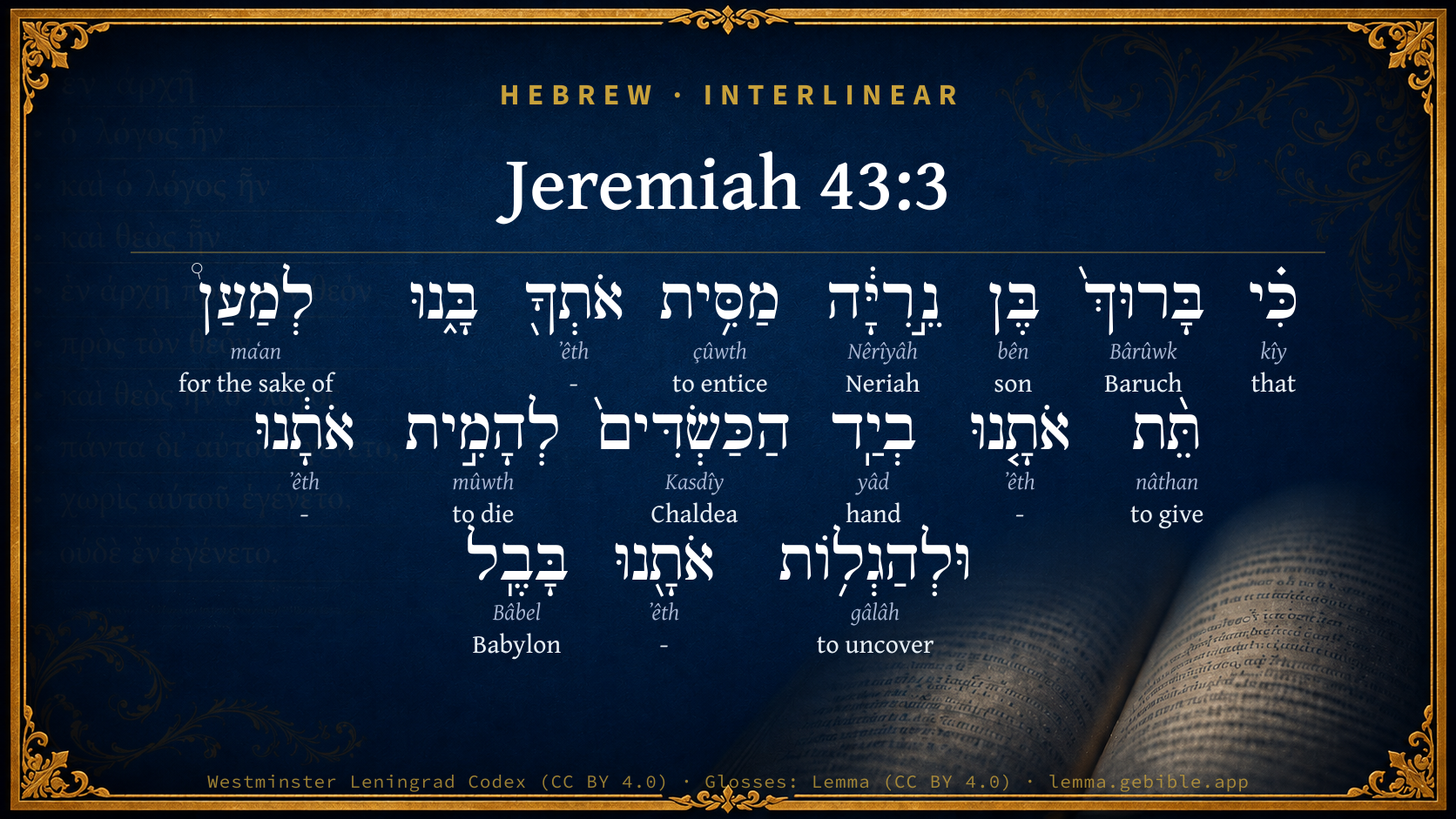
Hebrew (Westminster Leningrad Codex) Jeremiah 43:3 appears in the Hebrew Old Testament. The text above is from the Westminster Leningrad Codex. Each word links to its Strong’s number, a concise gloss, and parsing drawn from the Open Scriptures Hebrew Bible morphology. Click any word for its full Brown-Driver-Briggs (BDB) entry.
Download image
Cite this verse

Jeremiah 43:3 (World English Bible). Public Domain. Lemma interlinear Bible study tool, https://lemma.gebible.app/v/jeremiah/43/3.

Show BibTeX & RIS
BibTeX
RIS
English Translation
but Baruch the son of Neriah sets you on against us, to deliver us into the hand of the Chaldeans, that they may put us to death, and carry us away captive to Babylon.
World English Bible · Public Domain
Download a study sheet

One document with this verse’s original text, its word-by-word gloss line, the meaning frame, cross-references with their text, attributed commentary, and full source and license credits — printable, and it pastes into notes with its structure intact.

This verse Autodidact and up

Study sheet (.html) Plain text (.txt)

A passage Seminary Student

Up to 50 verses in one chapter. A passage sheet keeps up to 6 commentary sources and 12 cross-references per verse, in the order this page ranks them, and says so on the sheet whenever that leaves anything out. Ask for a single verse and you get the Autodidact verse sheet above.

Everything on this page stays free to read, with no account — the sheet is a download of what is already on screen, not access to it.

Want to remove ads? Support Godless Engineer
Compare translations 3

The same verse in 3 English versions, stacked beneath the original-language interlinear above. Click any original word for its lexicon entry.

Each is an independent rendering of the whole verse — the interlinear is not word-aligned to these translations.

Highlighted words mark where these versions differ — a whole-verse word diff, not a word-by-word alignment.

  • World English Bible Public Domain
    but Baruch the son of Neriah sets you on against us, to deliver us into the hand of the Chaldeans, that they may put us to death, and carry us away captive to Babylon.
  • King James Version Public Domain
    But Baruch the son of Neriah setteth thee on against us, for to deliver us into the hand of the Chaldeans, that they might put us to death, and carry us away captives into Babylon.
  • unfoldingWord Literal Text CC BY-SA 4.0
    For Baruch son of Neriah is inciting you against us to deliver us into the hand of the Chaldeans, for you to cause our death and to make us captives in Babylon.”

unfoldingWord Literal Text — © unfoldingWord, licensed CC BY-SA 4.0. Word-aligned USFM3 via Door43 (git.door43.org/unfoldingWord/en_ult).

Versions to compare (up to 4)

3 of 4 selected

Show all 18 translations

Every available English version of this verse, each an independent rendering of the whole verse.

  • World English Bible Public Domain
    but Baruch the son of Neriah sets you on against us, to deliver us into the hand of the Chaldeans, that they may put us to death, and carry us away captive to Babylon.
  • Berean Standard Bible Public Domain
    Rather, Baruch son of Neriah is inciting you against us to deliver us into the hands of the Chaldeans, so that they may put us to death or exile us to Babylon!”
  • Majority Standard Bible Public Domain
    Rather, Baruch son of Neriah is inciting you against us to deliver us into the hands of the Chaldeans, so that they may put us to death or exile us to Babylon!”
  • King James Version Public Domain
    But Baruch the son of Neriah setteth thee on against us, for to deliver us into the hand of the Chaldeans, that they might put us to death, and carry us away captives into Babylon.
  • American Standard Version (1901) Public Domain
    but Baruch the son of Neriah setteth thee on against us, to deliver us into the hand of the Chaldeans, that they may put us to death, and carry us away captive to Babylon.
  • Revised Version (1885) Public Domain
    but Baruch the son of Neriah setteth thee on against us, for to deliver us into the hand of the Chaldeans, that they may put us to death, and carry us away captives to Babylon.
  • Geneva Bible (1599) Public Domain
    But Baruch ye sonne of Neriah prouoketh thee against vs, for to deliuer vs into the hand of the Caldeans, that they might slay vs, and cary vs away captiues into Babel.
  • Douay-Rheims (1899) Public Domain
    But Baruch the son of Nerias setteth thee on against us, to deliver us into the hands of the Chaldeans, to kill us, and to cause us to be carried away captives to Babylon.
  • Young's Literal Translation Public Domain
    for Baruch son of Neriah is moving thee against us, in order to give us up into the hand of the Chaldeans, to put us to death, and to remove us to Babylon.'
  • Literal Standard Version CC BY-SA 4.0
    for Baruch son of Neriah is moving you against us, in order to give us up into the hand of the Chaldeans, to put us to death, and to remove us to Babylon.”
  • Unlocked Literal Bible CC BY-SA 4.0
    For Baruch son of Neriah is inciting you against us to deliver us into the hand of the Chaldeans, for you to cause our death and to make us captives in Babylon.”
  • unfoldingWord Literal Text CC BY-SA 4.0
    For Baruch son of Neriah is inciting you against us to deliver us into the hand of the Chaldeans, for you to cause our death and to make us captives in Babylon.”
  • Darby Bible Public Domain
    but Baruch the son of Nerijah is setting thee on against us, to deliver us into the hand of the Chaldeans, that they may put us to death, and carry us away captives into Babylon.
  • World Messianic Bible Public Domain
    but Baruch the son of Neriah has turned you against us, to deliver us into the hand of the Kasdim, that they may put us to death or carry us away captive to Babylon.”
  • Webster's Bible Public Domain
    But Baruch the son of Neriah setteth thee on against us, to deliver us into the hand of the Chaldeans, that they may put us to death, and carry us away captives into Babylon.
  • Free Bible Version CC BY-SA 4.0
    No, it's Baruch son of Neriah who's turned you against us in order to hand us over to the Babylonians so they can kill us or exile us to Babylon!”
  • Bible in Basic English Public Domain
    But Baruch, the son of Neriah, is moving you against us, to give us up into the hands of the Chaldaeans so that they may put us to death, and take us away prisoners into Babylon.
  • JPS Tanakh (1917) Public Domain
    but Baruch the son of Neriah setteth thee on against us, to deliver us into the hand of the Chaldeans, that they may put us to death, and carry us away captives to Babylon.'

Literal Standard Version (2020), Covenant Press — licensed CC BY-SA 4.0. Text via the HelloAO Bible API (eBible.org). Unlocked Literal Bible (unfoldingWord) — licensed CC BY-SA 4.0. Text via the HelloAO Bible API (eBible.org). unfoldingWord Literal Text — © unfoldingWord, licensed CC BY-SA 4.0. Word-aligned USFM3 via Door43 (git.door43.org/unfoldingWord/en_ult). Free Bible Version, Dr. Jonathan Gallagher — licensed CC BY-SA 4.0. Text via the HelloAO Bible API (eBible.org).

Word by word

More ways to search: Search by grammar → Find every occurrence → Compare this word →

Practice this passage: Drill this verse → Learn its vocabulary →

נֵ֣רִיָּ֔ה
Nêrîyâh
H5374
“Neriah”
Noun, Proper
Part of Speech
Noun
Type
Proper
Full BDB Definition

Origin: from H5216 and H3050

TWOT: None

Neriah = "lamp of Jehovah" - son of Maaseiah and father of Baruch and Seraiah
  1. כִּ֗י kîy H3588 “that” Conjunction
  2. בָּרוּךְ֙ Bârûwk H1263 “Baruch” Noun, Proper
  3. בֶּן bên H1121 “son of” Noun, Common, Masculine, Singular, Construct
  4. מַסִּ֥ית çûwth H5496 “enticing” Verb, Hiphil, Participle Active, Masculine, Singular, Absolute
  5. אֹתְךָ֖ ʼêth H853 “- · you” Particle, Direct Object + Suffix, Personal, 2nd Person, Masculine, Singular
  6. לְמַעַן֩ maʻan H4616 “for the sake of” Preposition
  7. תֵּ֨ת nâthan H5414 “to give” Verb, Qal, Infinitive Construct
  8. אֹתָ֤נוּ ʼêth H853 “- · us” Particle, Direct Object + Suffix, Personal, 1st Person, Common, Plural
  9. בְיַֽד yâd H3027 “in/at · hand of” Preposition + Noun, Common, Both, Singular, Construct
  10. הַכַּשְׂדִּים֙ Kasdîy H3778 “the · Chaldea” Particle, Definite Article + Noun, Proper
  11. לְהָמִ֣ית mûwth H4191 “to die” Preposition + Verb, Hiphil, Infinitive Construct
  12. אֹתָ֔נוּ ʼêth H853 “- · us” Particle, Direct Object + Suffix, Personal, 1st Person, Common, Plural
  13. וּלְהַגְל֥וֹת gâlâh H1540 “and · to uncover” Conjunction + Preposition + Verb, Hiphil, Infinitive Construct
  14. אֹתָ֖נוּ ʼêth H853 “- · us” Particle, Direct Object + Suffix, Personal, 1st Person, Common, Plural
  15. בָּבֶֽל Bâbel H894 “Babylon” Noun, Proper

About this verse

These counts appear in no published source. They are computed here, from the morphology-tagged text and Lemma’s own curated glosses. What Lemma adds →

17
words
13
distinct lemmas
Prophets
section

Notable vocabulary

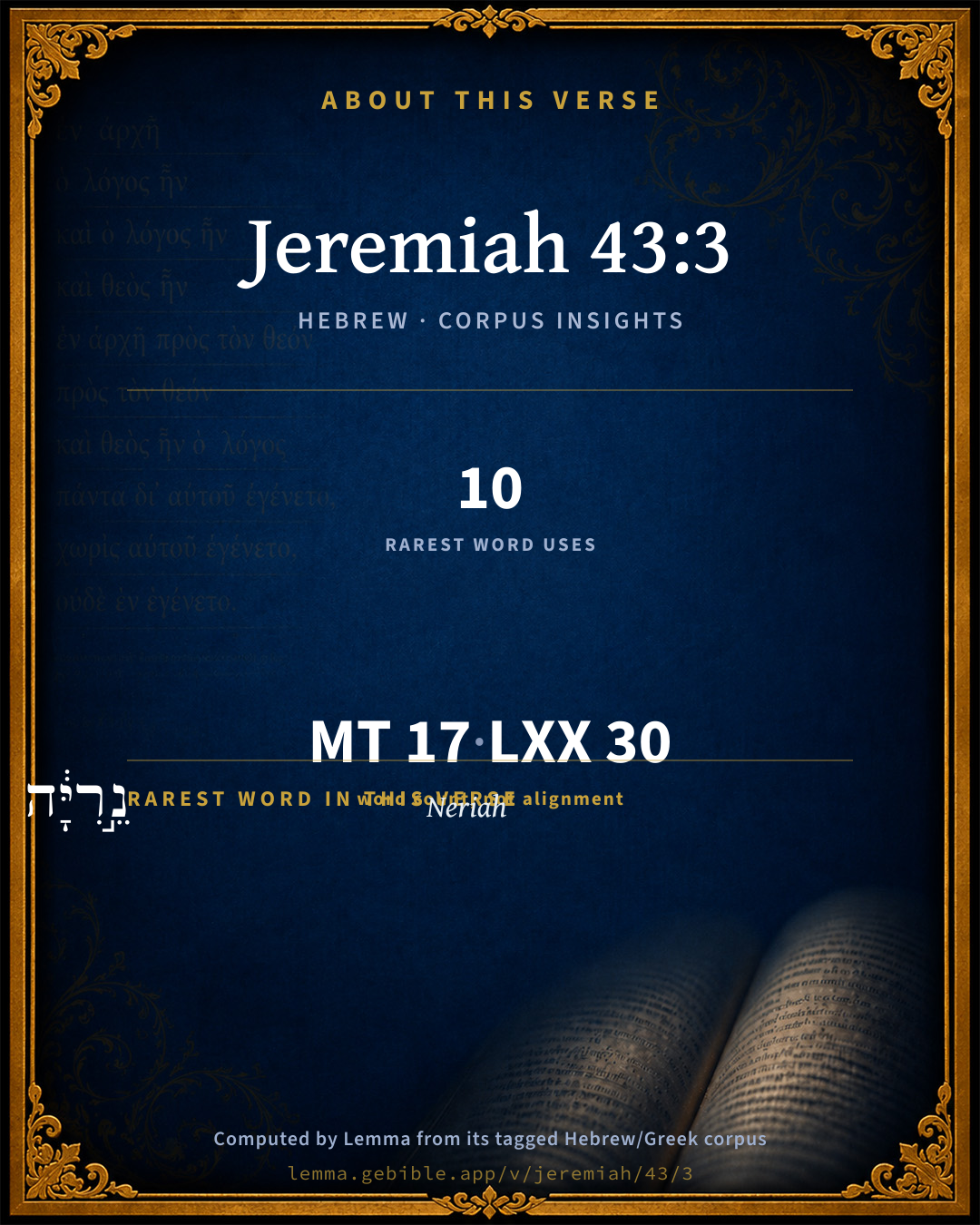
The rarest word here is נֵ֣רִיָּ֔ה Neriah H5374 — appearing just 10 times in the whole Hebrew Bible.

Shared distinctive vocabulary

נֵ֣רִיָּ֔ה Neriah H5374 occurs in 10 verses of the Hebrew Bible. Also found in:

Grammatical profile

  • 4 verbs
  • 6 nouns
  • 2 prepositions
  • 1 conjunction
  • 4 particles

Verb forms

  • מַסִּ֥ית Hiphil · Participle Active
  • תֵּ֨ת Qal · Infinitive Construct
  • לְהָמִ֣ית Hiphil · Infinitive Construct
  • וּלְהַגְל֥וֹת Hiphil · Infinitive Construct

Hebrew & Septuagint length

In the original languages it is 17 Hebrew tokens and 30 Greek tokens — but the two are counted differently (Hebrew bundles its prefixes and suffixes into one token; the Greek is in lemma form), so that isn’t a like-for-like length.

Cross-references

10

Topical passages linked to Jeremiah 43:3 in the Treasury of Scripture Knowledge — connected by theme and wording, ordered by reader-vote popularity; previews shown in the World English Bible.

  • Jeremiah 36:4 Then Jeremiah called Baruch the son of Neriah; and Baruch wrote from the mouth of Jeremiah all the words of Yahweh, which he had spoken to him, on a scroll of a book.
  • Jeremiah 36:10 Then read Baruch in the book the words of Jeremiah in the house of Yahweh, in the chamber of Gemariah the son of Shaphan, the scribe, in the upper court, at the entry of the new gate of Yahweh's house, in the ears of all the people.
  • Jeremiah 36:26 The king commanded Jerahmeel the king's son, and Seraiah the son of Azriel, and Shelemiah the son of Abdeel, to take Baruch the scribe and Jeremiah the prophet; but Yahweh hid them.
  • Jeremiah 38:4 Then the princes said to the king, Let this man, we pray you, be put to death; because he weakens the hands of the men of war who remain in this city, and the hands of all the people, in speaking such words to them: for this man doesn't seek the welfare of this people, but the hurt.
  • Jeremiah 43:6 the men, and the women, and the children, and the king's daughters, and every person who Nebuzaradan the captain of the guard had left with Gedaliah the son of Ahikam, the son of Shaphan; and Jeremiah the prophet, and Baruch the son of Neriah;
  • Jeremiah 45:1–3 The word that Jeremiah the prophet spoke to Baruch the son of Neriah, when he wrote these word in a book at the mouth of Jeremiah, in the fourth year of Jehoiakim the son of Josiah, king of Judah, saying,
  • Psalms 109:4 In return for my love, they are my adversaries; But I am in prayer.
  • Matthew 5:11–12 "Blessed are you when people reproach you, persecute you, and say all kinds of evil against you falsely, for my sake.
  • Luke 6:22–23 Blessed are you when men shall hate you, and when they shall exclude and mock you, and throw out your name as evil, for the Son of Man's sake.
  • Luke 6:26 Woe, when men speak well of you! For their fathers did the same thing to the false prophets.

Cross-references courtesy of OpenBible.info (CC BY 4.0).

Hebrew and Greek witnesses Masoretic Hebrew ↔ Greek Septuagint

The same verse in the two great witnesses to the Old Testament, shown verse-for-verse.

These are two independent witnesses, not word-aligned to each other, and the Septuagint is shown in lemma (dictionary) form.

Hebrew Jeremiah 43:3 Masoretic · Westminster Leningrad Codex

כִּ֗י בָּרוּךְ֙ בֶּן נֵ֣רִיָּ֔ה מַסִּ֥ית אֹתְךָ֖ בָּ֑נוּ לְמַעַן֩ תֵּ֨ת אֹתָ֤נוּ בְיַֽד הַכַּשְׂדִּים֙ לְהָמִ֣ית אֹתָ֔נוּ וּלְהַגְל֥וֹת אֹתָ֖נוּ בָּבֶֽל

but Baruch the son of Neriah sets you on against us, to deliver us into the hand of the Chaldeans, that they may put us to death, and carry us away captive to Babylon.

World English Bible · Public Domain

Greek LXX Structure differs

In the Septuagint, Jeremiah is about an eighth shorter than the Hebrew and arranges its material differently — the Oracles Against the Nations (Hebrew chapters 46–51) appear in the middle of the Greek book, after 25:13. Because the chapter and verse boundaries do not line up, a verse-for-verse comparison with the Hebrew is not shown.

A verse-for-verse comparison isn’t shown here because the chapters and verses don’t line up. Switch to the LXX edition with the MT / LXX toggle above to read the Greek directly.

Hebrew: Westminster Leningrad Codex (CC BY 4.0). Greek: Septuagint (public domain); English from a public-domain English Septuagint. How the Septuagint differs from the Hebrew →

Targum (Aramaic paraphrase)

1

The Targum is the ancient Jewish Aramaic paraphrase of the Hebrew Scriptures — an interpretive translation, not the Hebrew text itself. Onkelos (literal) and Pseudo-Jonathan (expansive) render the Torah, and Jonathan the Prophets. Coverage is partial: where no permissively-licensed English translation exists for a verse, only the Aramaic is shown. This is verse-level text, not a word-by-word alignment to the Hebrew.

  1. Targum Jonathan Prophets (Joshua–Malachi)
    אֲרֵי בָּרוּךְ בַּר נֵרִיָה מְגַרֵי יָתָךְ בָּנָא בְּדִיל לְמִמְסַר יָתָנָא בִּידָא דְכַסְדָאֵי לְמִקְטַל יָתָנָא וּלְאַגְלָאָה יָתָנָא לְבָבֶל:

    (no public-domain English translation for this verse)

    Targum Jonathan — Aramaic: “Mikraot Gedolot” (public domain). English: “Sefaria Community Translation” (CC0 1.0 (public-domain dedication)); “London "Chaldee Paraphrase," 1871” (public domain). Text via Sefaria.

Commentary

Notes on Jeremiah 43:3 from classic Christian and Jewish commentators (each source and its license shown beneath its notes). The classic Christian expositions comment on the surrounding passage and are grouped to its opening verse, so a note may address several verses; the Jewish commentaries on the Tanakh (Rashi and others) are per-verse, so they appear only where the commentator wrote on this verse.

Lemma curates 59 commentaries, every one of them public domain or Creative Commons licensed, each selected and text-cleaned for this edition rather than reprinted as found. About our sources →

Trapp's Complete Commentary

John Trapp

Jer 43:3 But Baruch the son of Neriah setteth thee on against us, for to deliver us into the hand of the Chaldeans, that they might put us to death, and carry us away captives into Babylon.

Ver. 3. But Baruch, the son of Neriah, setteth thee on against us.] A likely matter. What should Baruch gain by that? but malice careth not how truly or rationally it speaketh or acteth, so it may gall or kill Jeremiah and Baruch must be said to be in league together, and to collude for a common disturbance, like as the Papists say Luther and Zuinglius did; whereas they knew nothing one of another for a long time after that they began to stickle against Popery in several climates; and when they did hear of one another, they differed exceedingly, in the doctrine of the sacrament especially.

John Trapp, A Commentary or Exposition upon All the Books of the Old and New Testament (1647–1656) — public domain. Text from a community e-Sword module.

Tyndale Open Study Notes

Tyndale Open Resources

43:3 It is not known why Baruch was blamed.

Tyndale Open Study Notes — © Tyndale Open Resources, licensed CC BY-SA 4.0. Text via the HelloAO Bible API.

Geneva Bible (1599)

Geneva Bible translators

Thus the wicked do not only contemn and hurt the messengers of God, but slander, and speak wickedly of all them that support or favor the godly.

Geneva Bible (1599) marginal notes — public domain. Text via Bolls.life.

Jamieson, Fausset & Brown

Robert Jamieson, A. R. Fausset & David Brown

Baruch--He being the younger spake out the revelations which he received from Jeremiah more vehemently. From this cause, and from their knowing that he was in favor with the Chaldeans, arose their suspicion of him. Their perverse fickleness was astonishing. In the forty-second chapter they acknowledged the trustworthiness of Jeremiah, of which they had for so long so many proofs; yet here they accuse him of a lie. The mind of the unregenerate man is full of deceits.

Jamieson, Fausset & Brown — Commentary Critical and Explanatory on the Whole Bible (1871) — public domain (CC PDM 1.0). Text via the HelloAO Bible API.

John Calvin's Commentaries

They afterwards throw the blame on Baruch, who had been the Prophet’s faithful servant. As they could not find out any reason why Jeremiah should speak falsely, they turned their fury against Baruch. They did not then spare Jeremiah for honor’s sake, but as they had no reason whatever to speak evil of him, they fixed the blame on Baruch, who yet was as innocent as Jeremiah. Baruch, they said, excites thee against us Had Jeremiah so prophesied through the influence of another, yet his crime might have been at least extenuated. Now they said that he was mendacious, and brought forth nothing but impositions; but the ungodly do not regard what they say, for the devil drives them on headlong. And they charged Baruch with a very great crime, that he wished to betray them to the Chaldeans, and then to expose them to slaughter, and to deliver them that they might be driven into exile. All this would have been the greatest cruelty.: But then if we consider what sort of man Baruch had been, and how innocently he had conducted himself, how he had endangered his life in defending the true worship of God and prophetic doctrine, there was surely no reason for loading him with so great a reproach.

But we see that God’s servants have been always exposed to extreme reproaches, even when they have exhibited the greatest integrity. If then, at this day, we hear of evil reports, after having labored to act uprightly, it ought not to appear to us a hard or a new thing to bear them with patience. We must, indeed, do what we can to stop the mouths of the malevolent and the wicked; nor ought we to give occasion, as Paul admonishes us, to the malignant. But when we have done our duty faithfully, if yet dogs bark at us, if we be loaded with many reproaches and crimes, let us learn patiently to endure them. This, then, ought to be done by us, since we see that Baruch was accused of extreme perfidy and cruelty.

What now had Baruch to do with the Chaldeans? Had he fled to them? Was he anxious to gain influence for himself? or to procure favor for himself? There was no such thing; he always followed Jeremiah wherever he went. Jeremiah had indeed obtained some favor; but this was to be attributed to the gratuitous kindness of God. Baruch, then, had got leave from the Chaldeans to remain with the Prophet; for the condition of both was the same. But yet he had not followed the Chaldeans, when his option was given to him. For when the Chaldeans offered quietness and rest to Jeremiah, Baruch might have also gone to that fertile country; but he chose to remain in the land. We hence see that he had removed from himself every suspicion, and yet he could not stop the mouths of the malevolent, but they slandered and. calumniated him. Let us then know that God’s servants prove their firmness and constancy, when they are assailed on every side by the calumnies of men, and yet are satisfied with the testimony of their own conscience, and go on in their course, and look forward to the judgment of God, and care not what men think or speak, provided God approves of them, and is their judge in heaven.

John Calvin's Commentaries (1540-1563) — public domain. Text from the Calvin Translation Society English edition (1840s-50s) via the Christian Classics Ethereal Library (ccel.org). Calvin's coverage is partial (roughly two-thirds of the Bible); uncommented books and verses are honest gaps, never fabricated. The 19th-century editor's footnotes and remarks are omitted so the notes are faithfully Calvin's own voice.

Ellicott's Commentary for English Readers

(3) Baruch the son of Neriah setteth thee on against us.—This was the solution which presented itself to the suspicions of the murmurers. The prophet’s amanuensis had become his leader, and was making use of him as a tool for the furtherance of his own designs, and those designs were to court the favour of the conqueror by delivering the remnant of the people into his hands. The warning of Jer_45:5 may perhaps be taken as an indication that there was a certain ambition and love of eminence in Baruch’s character which gave a colour to the suspicion. Baruch himself has not appeared on the scene since the days of Jehoiakim (Jer_36:32), but it lies in the nature of the case that he would be known as advocating, like Jeremiah, the policy of submission to Nebuchadnezzar. The apocryphal Book of Baruch (Bar_1:1) represents him as being actually at Babylon at the time of the capture of Jerusalem, and this was in itself probable enough. On this assumption Jeremiah was perhaps suspected of actually receiving instructions from the Babylonian Court through Baruch, who in Jer_43:6 suddenly re-appears as the prophet’s companion. Prophet and scribe were apparently seized and carried off by force, to prevent their carrying out the schemes of which they were suspected. The “remnant of Judah returned from all nations” refers to the fugitives from Moab, Ammon, or Edom, mentioned in Jer_40:11. As the emigration included all who had gathered together under the protection of Gedaliah, it must have left the lands of Judah almost entirely depopulated, and the fear of this result may well have been among the reasons that determined Jeremiah’s counsels.

A Bible Commentary for English Readers, edited by Charles John Ellicott (1878–1897) — public domain. Text from a community e-Sword module.

John Gill's Exposition

But Baruch the son of Neriah setteth thee on against us,.... First they charge the prophet with a lie, and deny his mission from the Lord; and now to lessen the prophet's crime they charged him with, they lay the blame on Baruch, as if he, out of ill will to them, had instigated the prophet to deliver such a message; which is not at all likely, that he should be prevailed upon by a younger person, and his secretary, to take such a step: nor can it be thought that Baruch should have any interest to serve by it; and, besides, both he and the prophet were too good men, the one to instigate, and the other to be instigated, to declare a falsehood in the name of the Lord. The end proposed, they suggest, was

for to deliver us into the hand of the Chaldeans, that they might put us to death, and carry us away captives into Babylon; either that he or the prophet might deliver them into the hands of the Chaldeans, to be put to death by them, or be carried captive; which is not at all probable, it being inconsistent with that piety and humanity which were conspicuous in them both, and with their conduct, who chose rather to abide in their own land, with this small and despicable handful of people, than to go and live in the court of Babylon, where good care would have been taken of them.

John Gill's Exposition of the Whole Bible (1746–1763) — public domain (CC PDM 1.0). Text via the HelloAO Bible API.

Haydock's Catholic Bible Commentary

Baruch. He had been at Babylon, and was liberated with Jeremias, always speaking with moderation of the king of Babylon, and exhorting the people to submission. This was enough to make the populace suspect. They are incapable of reasoning.

George Leo Haydock (1774–1849), Haydock's Catholic Family Bible and Commentary, 1859 edition — public domain. Excludes Psalms (Douay-Rheims chapter numbering differs from Protestant) and Deuterocanonical books (Catholic canon only).

Matthew Poole's English Annotations

Baruch was but a clerk or secretary to Jeremiah, so not very probable to overrule the prophet to a falsifying of his trust, and a betraying of his countrymen into the hands of their enemies; but so fond are wicked men of their lusts, that they will say any thing in justification of them, rather than deny themselves in them, and become obedient to the will of God.

Matthew Poole's English Annotations on the Holy Bible (1683–1685) — public domain. Text from a community e-Sword/MySword module.

Whedon's Commentary on the Bible

Daniel D. Whedon

3. Baruch… setteth thee on — Why Baruch is given this offensive pre-eminence does not appear. He was probably a younger man than Jeremiah, and was to some extent the medium of his communications. He may thus have given offence, and may have infused into the messages something of his own ardour and zeal.

Daniel D. Whedon (gen. ed.), Commentary on the Old and New Testaments (1874–1909) — public domain. Text from a community e-Sword module.

The Pulpit Commentary

Baruch the son of Neriah setteth thee on. A singular supposition Jeremiah leaving the initiative to his secretary! It may be conjectured that Baruch had somehow made himself specially unpopular; he may have been a more practical man (comp. Jer_45:5) than Jeremiah.

The credulity of unbelief.

I UNBELIEF INVOLVES CREDULITY. Johanan and his companions here bring before us a striking instance of the credulity of unbelief. Refusing to admit that Jeremiah was divinely inspired, they asserted that he was instigated by Baruch the scribe. Now, we have seen Baruch acting solely as the amanuensis and spokesman of the prophet indeed, effacing himself with genuine humility and wisdom to serve the prophet the more faithfully; could this man be the inspirer of his master"s most decided utterances? The idea is preposterous. It is an evidence of gross credulity the credulity that believes in one"s own inventions, though they are infinitely less reasonable than the opposite ideas they are set up to oppose. All unbelief is belief it is belief in the negation of a proposition, and it requires as much evidence as the proposition it denies. It also has its consequences in reason which should be followed out remorselessly. Defenders of the faith have been too apologetic. They would often have been wiser if they had turned the flank of opponents and exposed the weakness of their position. It might often be shown that, in accepting this position, the opponents were standing on less firm ground than that which they dispute. For something must be true. If we came down to absolute nihilism, and discovered that nothing existed, even that discovery would be a truth. The absolute rejection of one proposition involves the acceptance of its opposite. But this opposite may be beset with heavier difficulties or favoured with weaker evidences than those which accompany the rejected proposition. If so, to accept the opposite proposition is really a mark of greater credulity than to admit that which presented the first claims.

II THE CREDULITY OF UNBELIEF MAY BE ILLUSTRATED IN THE CONTROVERSIES OF THE AGE. Consider it in relation to the main topics of these controversies, viz.:

1. The being of God. If there be no God, then the world must be eternal or self-created conclusions which may be shown to leave more difficulties than the hypothesis of a Creator and all the best thoughts of the highest orders of minds must be misconceptions a strange result for those who would regard the mind of man as the highest existence in the universe.

2. The immortality of the soul. Difficulties beset the theory of immortaIity. But what greater difficulties they have to face who, first believing in God (and we now have a right to start from that position), hold that the deepest appetite of man is destined never to be satisfied, that his highest aspirations are directed to an impossibility, and that his greatest powers are doomed to be blighted before they have grown to their full development? What credulity is required to make us believe that a good God could create a Tantalus!

3. The inspiration of the Bible. if the Bible be not inspired of God, the first literature of the world, containing by far its deepest, wisest, purest thoughts, and exercising unbounded influence for good, is founded on a delusion or a lie; for the writers of the Bible plainly claim to be inspired.

4. The Divine origin of Christianity. Christianity is the greatest fact in history; it revolutionized the decaying life of the old world, and gave a fresh upward movement to humanity; it is now the leading factor in the highest life of the foremost races of mankind; and it claims to be Divine. It seems to some of us that to say this claim is false, and thus to force upon us the inevitable alternative that its founders were deluded, and that it is a mere growth of human thought and effort, requires a faith which is so irrational as to be justly characterized as credulity.

The Pulpit Commentary (1880–1919), ed. H.D.M. Spence-Jones & Joseph S. Exell — public domain. Text from a community e-Sword module.

Lesson kit

Teaching starters — assembled from the data on this page, not authored interpretation. Every prompt links to the verse data it draws on. Edit before teaching.

Jeremiah, in the Prophets, opens this verse with 17 words (13 distinct Hebrew lemmas). Its most distinctive word is Nêrîyâh (“Neriah”). A historical commentator’s framing appears above. Read the whole chapter for the surrounding context.

Discussion questions

  1. How does “Neriah” (Nêrîyâh) shape what this verse is saying?
  2. How does Jeremiah 32:12, which shares the word «Neriah», read alongside this verse?
  3. These translations render this verse differently. What is at stake in choosing one wording over another?
  4. «מַסִּ֥ית» is a Hiphil Participle Active verb. How does that grammatical form shape the action described?
  5. Compare how Trapp's Complete Commentary and Tyndale Open Study Notes read this verse. Where do they agree or differ?

Things to notice

Reading settings

Reading text

Shown beneath each verse's original-language words.

Old Testament
Old Testament edition

Read the OT as the Masoretic Hebrew (MT) or the Greek Septuagint (LXX).

English shown for the Greek Septuagint (in the Hebrew ↔ Greek comparison).

Comparing translations? Open the Compare panel on any verse page to stack up to four side by side.