

Job 20:28

Hebrew (Westminster Leningrad Codex) Job 20:28 appears in the Hebrew Old Testament. The text above is from the Westminster Leningrad Codex. Each word links to its Strong’s number, a concise gloss, and parsing drawn from the Open Scriptures Hebrew Bible morphology. Click any word for its full Brown-Driver-Briggs (BDB) entry.
Download image
Cite this verse

Job 20:28 (World English Bible). Public Domain. Lemma interlinear Bible study tool, https://lemma.gebible.app/v/job/20/28.

Show BibTeX & RIS
BibTeX
RIS
English Translation
The increase of his house shall depart; They shall rush away in the day of his wrath.
World English Bible · Public Domain
Download a study sheet

One document with this verse’s original text, its word-by-word gloss line, the meaning frame, cross-references with their text, attributed commentary, and full source and license credits — printable, and it pastes into notes with its structure intact.

This verse Autodidact and up

Study sheet (.html) Plain text (.txt)

A passage Seminary Student

Up to 50 verses in one chapter. A passage sheet keeps up to 6 commentary sources and 12 cross-references per verse, in the order this page ranks them, and says so on the sheet whenever that leaves anything out. Ask for a single verse and you get the Autodidact verse sheet above.

Everything on this page stays free to read, with no account — the sheet is a download of what is already on screen, not access to it.

Want to remove ads? Support Godless Engineer
Compare translations 3

The same verse in 3 English versions, stacked beneath the original-language interlinear above. Click any original word for its lexicon entry.

Each is an independent rendering of the whole verse — the interlinear is not word-aligned to these translations.

Highlighted words mark where these versions differ — a whole-verse word diff, not a word-by-word alignment.

  • World English Bible Public Domain
    The increase of his house shall depart; They shall rush away in the day of his wrath.
  • King James Version Public Domain
    The increase of his house shall depart, and his goods shall flow away in the day of his wrath.
  • unfoldingWord Literal Text CC BY-SA 4.0
    The wealth of his house will depart, flowing away on the day of his nose.

unfoldingWord Literal Text — © unfoldingWord, licensed CC BY-SA 4.0. Word-aligned USFM3 via Door43 (git.door43.org/unfoldingWord/en_ult).

Versions to compare (up to 4)

3 of 4 selected

Show all 18 translations

Every available English version of this verse, each an independent rendering of the whole verse.

  • World English Bible Public Domain
    The increase of his house shall depart; They shall rush away in the day of his wrath.
  • Berean Standard Bible Public Domain
    The possessions of his house will be removed, flowing away on the day of God’s wrath.
  • Majority Standard Bible Public Domain
    The possessions of his house will be removed, flowing away on the day of God’s wrath.
  • King James Version Public Domain
    The increase of his house shall depart, and his goods shall flow away in the day of his wrath.
  • American Standard Version (1901) Public Domain
    The increase of his house shall depart; `His goods' shall flow away in the day of his wrath.
  • Revised Version (1885) Public Domain
    The increase of his house shall depart, his goods shall flow away in the day of his wrath.
  • Geneva Bible (1599) Public Domain
    The increase of his house shall go away: it shall flow away in the day of his wrath.
  • Douay-Rheims (1899) Public Domain
    The offspring of his house shall be exposed, he shall be pulled down in the day of God's wrath.
  • Young's Literal Translation Public Domain
    Remove doth the increase of his house, Poured forth in a day of His anger.
  • Literal Standard Version CC BY-SA 4.0
    The increase of his house is removed, || Poured forth in a day of His anger.
  • Unlocked Literal Bible CC BY-SA 4.0
    The wealth of his house will vanish; his goods will flow away on the day of God's wrath.
  • unfoldingWord Literal Text CC BY-SA 4.0
    The wealth of his house will depart, flowing away on the day of his nose.
  • Darby Bible Public Domain
    The increase of his house shall depart, flowing away in the day of his anger.
  • World Messianic Bible Public Domain
    The increase of his house will depart. They will rush away in the day of his wrath.
  • Webster's Bible Public Domain
    The increase of his house shall depart, and his goods shall flow away in the day of his wrath.
  • Free Bible Version CC BY-SA 4.0
    All their possessions will be carried from their homes; they will be dragged off on the day of God's judgment.
  • Bible in Basic English Public Domain
    The produce of his house is taken away into another country, like things given into the hands of others in the day of wrath.
  • JPS Tanakh (1917) Public Domain
    The increase of his house shall depart, his goods shall flow away in the day of his wrath.

Literal Standard Version (2020), Covenant Press — licensed CC BY-SA 4.0. Text via the HelloAO Bible API (eBible.org). Unlocked Literal Bible (unfoldingWord) — licensed CC BY-SA 4.0. Text via the HelloAO Bible API (eBible.org). unfoldingWord Literal Text — © unfoldingWord, licensed CC BY-SA 4.0. Word-aligned USFM3 via Door43 (git.door43.org/unfoldingWord/en_ult). Free Bible Version, Dr. Jonathan Gallagher — licensed CC BY-SA 4.0. Text via the HelloAO Bible API (eBible.org).

Word by word

More ways to search: Search by grammar → Find every occurrence → Compare this word →

Practice this passage: Drill this verse → Learn its vocabulary →

About this verse

These counts appear in no published source. They are computed here, from the morphology-tagged text and Lemma’s own curated glosses. What Lemma adds →

6
words
6
distinct lemmas
Wisdom
section

Notable vocabulary

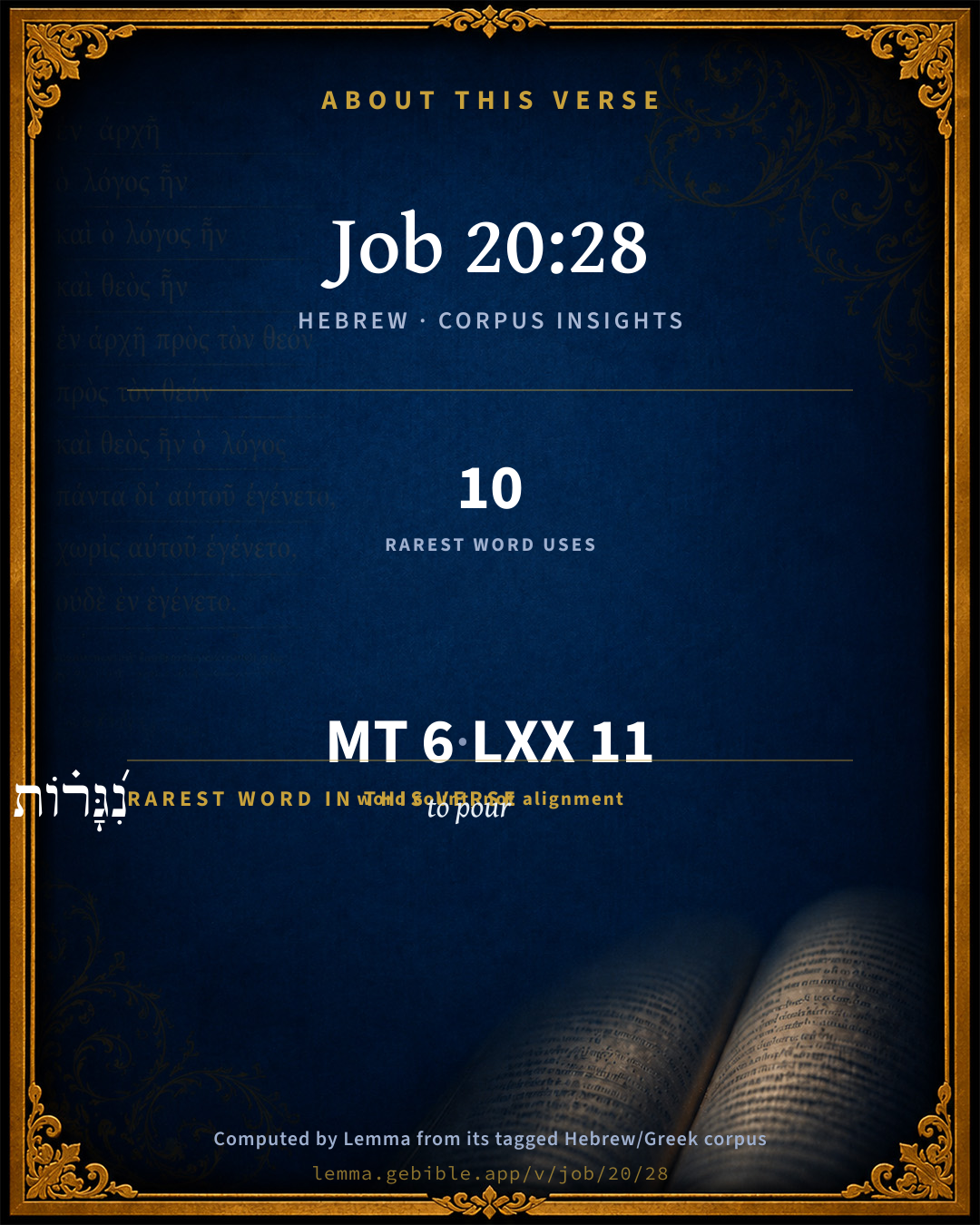
The rarest word here is נִ֝גָּר֗וֹת to pour H5064 — appearing just 10 times in the whole Hebrew Bible.

Shared distinctive vocabulary

נִ֝גָּר֗וֹת to pour H5064 occurs in 10 verses of the Hebrew Bible. Also found in:

Grammatical profile

  • 2 verbs
  • 4 nouns

Verb forms

  • יִ֭גֶל Qal · Imperfect
  • נִ֝גָּר֗וֹת Niphal · Participle Active

Hebrew & Septuagint length

In English translation the verse runs 17 words from the Hebrew and 16 from the Septuagint (LXX English) — closely comparable.

A rough comparison of the two English renderings, which tokenize alike — not a word-level alignment.

Word counts can differ between the Hebrew and the Greek without any difference in meaning — e.g. the Hebrew direct-object marker אֵת has no separate Greek word, and Greek often adds the article ὁ.

In the original languages it is 6 Hebrew tokens and 11 Greek tokens — but the two are counted differently (Hebrew bundles its prefixes and suffixes into one token; the Greek is in lemma form), so that isn’t a like-for-like length.

Cross-references

12

Topical passages linked to Job 20:28 in the Treasury of Scripture Knowledge — connected by theme and wording, ordered by reader-vote popularity; previews shown in the World English Bible.

  • Job 27:14–19 If his children are multiplied, it is for the sword. His offspring shall not be satisfied with bread.
  • Zephaniah 1:18 Neither their silver nor their gold will be able to deliver them in the day of Yahweh's wrath, but the whole land will be devoured by the fire of his jealousy; for he will make an end, yes, a terrible end, of all those who dwell in the land.
  • James 5:1–3 Come now, you rich, weep and howl for your miseries that are coming on you.
  • Revelation 18:17 For in an hour such great riches are made desolate.' Every shipmaster, and everyone who sails anywhere, and mariners, and as many as gain their living by sea, stood far away,
  • Deuteronomy 28:31 Your ox shall be slain before your eyes, and you shall not eat of it: your donkey shall be violently taken away from before your face, and shall not be restored to you: your sheep shall be given to your enemies, and you shall have none to save you.
  • 2 Kings 20:17 Behold, the days come, that all that is in your house, and that which your fathers have laid up in store to this day, shall be carried to Babylon: nothing shall be left, says Yahweh.
  • Job 5:5 Whose harvest the hungry eats up, And take it even out of the thorns; The snare gapes for their substance.
  • Job 20:10 His children shall seek the favor of the poor. His hands shall give back his wealth.
  • Job 20:18–22 That for which he labored he shall restore, and shall not swallow it down; According to the substance that he has gotten, he shall not rejoice.
  • Job 21:30 That the evil man is reserved to the day of calamity? That they are led forth to the day of wrath?
  • Proverbs 11:4 Riches don't profit in the day of wrath, But righteousness delivers from death.
  • Matthew 16:26 For what will it profit a man, if he gains the whole world, and forfeits his life? Or what will a man give in exchange for his life?

Cross-references courtesy of OpenBible.info (CC BY 4.0).

Hebrew and Greek witnesses Masoretic Hebrew ↔ Greek Septuagint

The same verse in the two great witnesses to the Old Testament, shown verse-for-verse.

These are two independent witnesses, not word-aligned to each other, and the Septuagint is shown in lemma (dictionary) form.

Hebrew Job 20:28 Masoretic · Westminster Leningrad Codex

יִ֭גֶל יְב֣וּל בֵּית֑וֹ נִ֝גָּר֗וֹת בְּי֣וֹם אַפּֽוֹ

The increase of his house shall depart; They shall rush away in the day of his wrath.

World English Bible · Public Domain

Greek LXX Job 20:28 Septuagint · lemma form

ἕλκω ὁ οἶκος αὐτός ἀπώλεια εἰς τέλος ἡμέρα ὀργή ἐπιἔρχομαι αὐτός

Let destruction bring his house to an end; let a day of wrath come upon him.

LXX2012 (modern English Septuagint) · Public Domain

On this verse, Albert Barnes' Notes on the Bible discusses the Septuagint’s reading. Read the note in Commentary ↓

Hebrew: Westminster Leningrad Codex (CC BY 4.0). Greek: Septuagint (public domain); English from LXX2012 (modern English Septuagint) (Public Domain). How the Septuagint differs from the Hebrew →

Commentary

Notes on Job 20:28 from classic Christian and Jewish commentators (each source and its license shown beneath its notes). The classic Christian expositions comment on the surrounding passage and are grouped to its opening verse, so a note may address several verses; the Jewish commentaries on the Tanakh (Rashi and others) are per-verse, so they appear only where the commentator wrote on this verse.

Lemma curates 59 commentaries, every one of them public domain or Creative Commons licensed, each selected and text-cleaned for this edition rather than reprinted as found. About our sources →

Trapp's Complete Commentary

John Trapp

Job 20:28 The increase of his house shall depart, [and his goods] shall flow away in the day of his wrath.

Ver. 28. The increase of his house shall depart] All his posterity shall be destroyed, and so shall his prosperity to, even all at once, with a sudden ebb, in the day that God visiteth him with his wrath and righteous judgments. All the wicked man’s wealth and revenue shall be wretchedly wasted and embezzled by one means or other.

And his goods shall flow away] As waters. The apostle saith, The fashion of this world passeth away; viz. as a hasty headlong torrent; or as a picture drawn upon the ice: "Thou carriest them away" (both persons and things) "as with a flood," Psa 90:5.

John Trapp, A Commentary or Exposition upon All the Books of the Old and New Testament (1647–1656) — public domain. Text from a community e-Sword module.

Geneva Bible (1599)

Geneva Bible translators

Meaning, the children of the wicked shall flow away like rivers, and be dispersed in divers places.

Geneva Bible (1599) marginal notes — public domain. Text via Bolls.life.

Jamieson, Fausset & Brown

Robert Jamieson, A. R. Fausset & David Brown

increase--prosperity. Ill got--ill gone.

flow away--like waters that run dry in summer; using Job's own metaphor against himself (Job 6:15-17; Sa2 14:14; Mic 1:4).

his wrath--God's.

Jamieson, Fausset & Brown — Commentary Critical and Explanatory on the Whole Bible (1871) — public domain (CC PDM 1.0). Text via the HelloAO Bible API.

Adam Clarke's Commentary

Verse 28. The increase of his house shall depart, and his goods shall flow away in the day of his wrath.] A farther allusion to the punishment of the rebellious company of Korah, who not only perished themselves, but their houses also, and their goods. Nu 16:32.

These examples were all in point, on the ground assumed by Zophar; and such well-attested facts would not be passed over by him, had he known the record of them; and that he did know it, alludes to it, and quotes the very circumstances, is more than probable.

Adam Clarke's Commentary on the Bible (1810–1826) — public domain. Text from a community e-Sword/MySword module.

The Cambridge Bible for Schools and Colleges

gen. ed. J. J. S. Perowne

28. The increase] i. e. the gain, possessions.

his goods shall flow away] lit. things washed away; his possessions shall be swept away with a flood in the day of God’s wrath.

The Cambridge Bible for Schools and Colleges (gen. ed. J. J. S. Perowne; Cambridge University Press, 1878–1918) — public domain. Text from a community e-Sword module.

John Gill's Exposition

The increase of his house shall depart,.... Either his children or his substance. Some interpret it, as Kimchi (h) observes, of the walls of his house, because of what follows, "they shall flow away", &c. as if he should say, the stones of his house shall fall down, and his habitation shall be destroyed, according to Mic 1:6; where a dilapidation is expressed by a flow, or pouring down of stones:

and his goods shall flow away in the day of his wrath; in the day of the wrath of God upon him, which will come upon him like water split on the ground, of no more use and service to him; the Targum interprets it of oil and wine, which shall flow away and cease, and so Mr. Broughton renders it, "fruits for his house"; all desirable and useful ones, see Rev 18:14.

(h) Sepher Shorash. rad.

John Gill's Exposition of the Whole Bible (1746–1763) — public domain (CC PDM 1.0). Text via the HelloAO Bible API.

Albert Barnes' Notes on the Bible

The increase of his house shall depart - Septuagint, “Destruction shall bring his house to an end.” The word rendered “depart” (יגל yı̂gel from גלה gâlâh), means, properly, “shall go into captivity.” The sense is, that whatever he had laid up in his house would entirely disappear.

His goods shall flow away - What he had gained would seem to flow away like water.

In the day of his wrath - The wrath of God - for so the connection demands.

Albert Barnes' Notes on the Bible (1834–1885) — public domain. Text from a community e-Sword/MySword module.

Haydock's Catholic Bible Commentary

Exposed. Hebrew, "the bud, (Calmet) or increase of his house, shall depart," (Haydock) and be led away into captivity, (Calmet) and ruined. Septuagint, "Let final destruction draw away his house, and the day of wrath overtake him."

George Leo Haydock (1774–1849), Haydock's Catholic Family Bible and Commentary, 1859 edition — public domain. Excludes Psalms (Douay-Rheims chapter numbering differs from Protestant) and Deuterocanonical books (Catholic canon only).

Matthew Poole's English Annotations

The increase of his house; either,

1. His posterity; or rather,

2. His estate, got by the labour, and employed for the use, of his family.

Shall depart; shall be lost or taken away from him. See 2Ki 20:17.

His goods shall flow away like waters, to wit, swiftly and strongly, and so as to return no more.

The day of his wrath, i. e. of God’s wrath, when God shall come to execute judgment upon him.

Matthew Poole's English Annotations on the Holy Bible (1683–1685) — public domain. Text from a community e-Sword/MySword module.

Whedon's Commentary on the Bible

Daniel D. Whedon

28. Omit “and his goods.” The subject of נגרות, flowing away, is not expressed. “Like waters poured forth, his all flows away.” — Cocceius. The figure of the text is rugged and grand, perhaps taking its rise in vivid traditions of the deluge, in which the wealth of the world in like manner dissolved and flowed away. The gain of the ungodly is equally unsubstantial, and liable to be irrecoverably destroyed. See Job_4:19; Job_22:16; comp. Pro_23:5.

Daniel D. Whedon (gen. ed.), Commentary on the Old and New Testaments (1874–1909) — public domain. Text from a community e-Sword module.

The Pulpit Commentary

The increase of his house shall depart. "The increase of his house" may be either his children and descendants; or his substance that which he has accumulated. In the former case, the departure spoken of may be either death (see ver. 26), or carrying into captivity; in the latter, general rapine and destruction. And his goods shall flow away in the day of his wrath. It seems to be necessary to supply some such nominative as "his goods," or "his treasure," wynwpx (see ver. 26). These shall "flow away," i.e. melt and disappear, "in the day of his wrath," i.e. the day when wrath comes upon him.

The Pulpit Commentary (1880–1919), ed. H.D.M. Spence-Jones & Joseph S. Exell — public domain. Text from a community e-Sword module.

John Wesley's Explanatory Notes

Increase of his house - His estate. Depart - Shall be lost. Flow - Like waters, swiftly and strongly, and so as to return no more. His - Of God's wrath.

John Wesley, Explanatory Notes Upon the Whole Bible (1754–1765) — public domain. Text via the GEBible commentary corpus.

unfoldingWord translationNotes

Door43 World Missions Community

General Information:

This concludes Zophar's speech to Job.

vanish

disappear

his goods will flow away on

Here "flow away" represents being taken away from him. AT: "his goods will be taken away from him, like goods that float away in a flood, on" (See: Metaphor)

his goods

"his possessions"

the day of God's wrath

Here "wrath" represents punishment. The abstract noun "wrath" can be expressed with the verb punish. AT: "the day when God punishes people" (See: Metonymy)

This is the wicked man's portion from God

Here "portion from God" represents what God has decided should happen to someone. It is spoken of as if it were something that God would give him. AT: "This is what God has decided should happen to the wicked man" (See: Metaphor)

the heritage reserved for him by God

This represents what God has decided should happen to someone. It is spoken of as if it were something that God would give him as an inheritance. AT: "what God has planned to give to him" or "what God has planned should happen to him" (See: Metaphor)

translationWords

house

wrath

evil

inherit

unfoldingWord translationNotes — © Distant Shores Media and the Door43 World Missions Community, licensed CC BY-SA 4.0. Source: git.door43.org/Door43/en_tn.

Rashi

Rabbi Shlomo Yitzchaki (Rashi)

shall go into exile Heb. יגל, an expression of exile.

shall flow Heb. נגרות. His treasures shall be given to plunder and despoiling, like (Micah 1:4), “like water that flows (המגרים) to the earth” [sic].

Rashi on the Tanakh — English translations: “The Judaica Press complete Tanach with Rashi, translated by A. J. Rosenberg” (CC BY 4.0); “Pentateuch with Rashi's commentary by M. Rosenbaum and A.M. Silbermann, 1929-1934” (public domain); “The Metsudah Tanach series, Lakewood, N.J” (CC BY 4.0); and “The Book of Joshua, Metsudah Publications, 1997” (CC BY 4.0). Text via Sefaria.

Lesson kit

Teaching starters — assembled from the data on this page, not authored interpretation. Every prompt links to the verse data it draws on. Edit before teaching.

Job, in the Wisdom, opens this verse with 6 words (6 distinct Hebrew lemmas). Its most distinctive word is nâgar (“to pour”). A historical commentator’s framing appears above. Read the whole chapter for the surrounding context.

Discussion questions

  1. How does “to pour” (nâgar) shape what this verse is saying?
  2. How does 2 Samuel 14:14, which shares the word «to pour», read alongside this verse?
  3. These translations render this verse differently. What is at stake in choosing one wording over another?
  4. «יִ֭גֶל» is a Qal Imperfect verb. How does that grammatical form shape the action described?
  5. Compare how Trapp's Complete Commentary and Geneva Bible (1599) read this verse. Where do they agree or differ?

Things to notice

Reading settings

Reading text

Shown beneath each verse's original-language words.

Old Testament
Old Testament edition

Read the OT as the Masoretic Hebrew (MT) or the Greek Septuagint (LXX).

English shown for the Greek Septuagint (in the Hebrew ↔ Greek comparison).

Comparing translations? Open the Compare panel on any verse page to stack up to four side by side.