

2 Samuel 15:19

Hebrew (Westminster Leningrad Codex) 2 Samuel 15:19 appears in the Hebrew Old Testament. The text above is from the Westminster Leningrad Codex. Each word links to its Strong’s number, a concise gloss, and parsing drawn from the Open Scriptures Hebrew Bible morphology. Click any word for its full Brown-Driver-Briggs (BDB) entry.
Download image
Cite this verse

2 Samuel 15:19 (World English Bible). Public Domain. Lemma interlinear Bible study tool, https://lemma.gebible.app/v/2-samuel/15/19.

Show BibTeX & RIS
BibTeX
RIS
English Translation
Then said the king to Ittai the Gittite, Why go you also with us? return, and abide with the king: for you are a foreigner, and also an exile; [return] to your own place.
World English Bible · Public Domain
Highlights
  • 1 first appearance in the Hebrew Bible
Full analysis ↓
Download a study sheet

One document with this verse’s original text, its word-by-word gloss line, the meaning frame, cross-references with their text, attributed commentary, and full source and license credits — printable, and it pastes into notes with its structure intact.

This verse Autodidact and up

Study sheet (.html) Plain text (.txt)

A passage Seminary Student

Up to 50 verses in one chapter. A passage sheet keeps up to 6 commentary sources and 12 cross-references per verse, in the order this page ranks them, and says so on the sheet whenever that leaves anything out. Ask for a single verse and you get the Autodidact verse sheet above.

Everything on this page stays free to read, with no account — the sheet is a download of what is already on screen, not access to it.

Want to remove ads? Support Godless Engineer
Compare translations 3

The same verse in 3 English versions, stacked beneath the original-language interlinear above. Click any original word for its lexicon entry.

Each is an independent rendering of the whole verse — the interlinear is not word-aligned to these translations.

Highlighted words mark where these versions differ — a whole-verse word diff, not a word-by-word alignment.

  • World English Bible Public Domain
    Then said the king to Ittai the Gittite, Why go you also with us? return, and abide with the king: for you are a foreigner, and also an exile; [return] to your own place.
  • King James Version Public Domain
    Then said the king to Ittai the Gittite, Wherefore goest thou also with us? return to thy place, and abide with the king: for thou art a stranger, and also an exile.
  • unfoldingWord Literal Text CC BY-SA 4.0
    But the king said to Ittai the Gittite, “Why are you also going with us? Return and dwell with the king, for you a foreigner and you also an exile to your place.

unfoldingWord Literal Text — © unfoldingWord, licensed CC BY-SA 4.0. Word-aligned USFM3 via Door43 (git.door43.org/unfoldingWord/en_ult).

Versions to compare (up to 4)

3 of 4 selected

Show all 18 translations

Every available English version of this verse, each an independent rendering of the whole verse.

  • World English Bible Public Domain
    Then said the king to Ittai the Gittite, Why go you also with us? return, and abide with the king: for you are a foreigner, and also an exile; [return] to your own place.
  • Berean Standard Bible Public Domain
    Then the king said to Ittai the Gittite, “Why should you also go with us? Go back and stay with the new king, since you are both a foreigner and an exile from your homeland.
  • Majority Standard Bible Public Domain
    Then the king said to Ittai the Gittite, “Why should you also go with us? Go back and stay with the new king, since you are both a foreigner and an exile from your homeland.
  • King James Version Public Domain
    Then said the king to Ittai the Gittite, Wherefore goest thou also with us? return to thy place, and abide with the king: for thou art a stranger, and also an exile.
  • American Standard Version (1901) Public Domain
    Then said the king to Ittai the Gittite, Wherefore goest thou also with us? return, and abide with the king: for thou art a foreigner, and also an exile; `return' to thine own place.
  • Revised Version (1885) Public Domain
    Then said the king to Ittai the Gittite, Wherefore goest thou also with us? return, and abide with the king: for thou art a stranger, and also an exile; return to thine own place.
  • Geneva Bible (1599) Public Domain
    Then sayde the King to Ittai the Gittite, Wherefore commest thou also with vs? Returne aud abide with the King, for thou art a stranger: depart thou therefore to thy place.
  • Douay-Rheims (1899) Public Domain
    And the king said to Ethai the Gethite: Why comest thou with us? return and dwell with the king, for thou art a stranger, and art come out of thy own place.
  • Young's Literal Translation Public Domain
    And the king saith unto Ittai the Gittite, `Why dost thou go -- thou also -- with us? turn back -- and abide with the king, for thou `art' a stranger, and also an exile thou -- to thy place.
  • Literal Standard Version CC BY-SA 4.0
    And the king says to Ittai the Gittite, “Why do you go—you also—with us? Return and abide with the king, for you [are] a stranger, and also an exile, you—to your place.
  • Unlocked Literal Bible CC BY-SA 4.0
    Then the king said to Ittai the Gittite, “Why will you come with us? Return and stay with the king, for you are a foreigner and an exile. Return to your own place.
  • unfoldingWord Literal Text CC BY-SA 4.0
    But the king said to Ittai the Gittite, “Why are you also going with us? Return and dwell with the king, for you a foreigner and you also an exile to your place.
  • Darby Bible Public Domain
    And the king said to Ittai the Gittite, Why dost thou also go with us? return to thy place, and abide with the king; for thou art a foreigner, and besides, thou hast emigrated to the place where thou [dwellest].
  • World Messianic Bible Public Domain
    Then the king said to Ittai the Gittite, “Why do you also go with us? Return, and stay with the king; for you are a foreigner and also an exile. Return to your own place.
  • Webster's Bible Public Domain
    Then said the king to Ittai the Gittite, Why goest thou also with us? return to thy place, and abide with the king; for thou art a stranger, and also an exile.
  • Free Bible Version CC BY-SA 4.0
    The king said to Ittai the Gittite, “Why are you coming with us too? Go back and stay with the new king, because you are a foreigner and an exile a long way from home.
  • Bible in Basic English Public Domain
    Then the king said to Ittai the Gittite, Why are you coming with us? go back and keep with the king: for you are a man of another country, you are far from the land of your birth.
  • JPS Tanakh (1917) Public Domain
    Then said the king to Ittai the Gittite: 'Wherefore goest thou also with us? return, and abide with the king; for thou art a foreigner, and also an exile from thine own place.

Literal Standard Version (2020), Covenant Press — licensed CC BY-SA 4.0. Text via the HelloAO Bible API (eBible.org). Unlocked Literal Bible (unfoldingWord) — licensed CC BY-SA 4.0. Text via the HelloAO Bible API (eBible.org). unfoldingWord Literal Text — © unfoldingWord, licensed CC BY-SA 4.0. Word-aligned USFM3 via Door43 (git.door43.org/unfoldingWord/en_ult). Free Bible Version, Dr. Jonathan Gallagher — licensed CC BY-SA 4.0. Text via the HelloAO Bible API (eBible.org).

Word by word

More ways to search: Search by grammar → Find every occurrence → Compare this word →

Practice this passage: Drill this verse → Learn its vocabulary →

אִתַּ֣י
ʼIttay
H863
“Ittai”
Noun, Proper
Part of Speech
Noun
Type
Proper
Full BDB Definition

Origin: from H854

TWOT: None

Ittai or Ithai = "with me" - a Gittite commander from Gath in David's army - one of David's 30 mighty warriors, a Benjamite
  1. וַיֹּ֤אמֶר ʼâmar H559 “and · to say” Conjunction + Verb, Qal, Sequential Imperfect, 3rd Person, Masculine, Singular
  2. הַמֶּ֨לֶךְ֙ melek H4428 “the · king” Particle, Definite Article + Noun, Common, Masculine, Singular, Absolute
  3. אֶל ʼêl H413 “to” Preposition
  4. הַגִּתִּ֔י Gittîy H1663 “the · Gittite” Particle, Definite Article + Noun, Gentilic, Masculine, Singular, Absolute
  5. לָ֧מָּה mâh H4100 “to/for · what” Preposition + Particle, Interrogative
  6. תֵלֵ֛ךְ yâlak H3212 “to walk” Verb, Qal, Imperfect, 2nd Person, Masculine, Singular
  7. גַּם gam H1571 “also” Particle, Accusative
  8. אַתָּ֖ה ʼattâh H859 “you” Pronoun, Personal, 2nd Person, Masculine, Singular
  9. אִתָּ֑נוּ ʼêth H854 “with · us” Preposition + Suffix, Personal, 1st Person, Common, Plural
  10. שׁ֣וּב shûwb H7725 “return” Verb, Qal, Imperative, 2nd Person, Masculine, Singular
  11. וְשֵׁ֤ב yâshab H3427 “and · dwell” Conjunction + Verb, Qal, Imperative, 2nd Person, Masculine, Singular
  12. עִם ʻim H5973 “with” Preposition
  13. הַמֶּ֨לֶךְ֙ melek H4428 “the · king” Particle, Definite Article + Noun, Common, Masculine, Singular, Absolute
  14. כִּֽי kîy H3588 “that” Conjunction
  15. נָכְרִ֣י nokrîy H5237 “foreign” Adjective, Adjective, Masculine, Singular, Absolute
  16. אַ֔תָּה ʼattâh H859 “you” Pronoun, Personal, 2nd Person, Masculine, Singular
  17. וְגַם gam H1571 “and · also” Conjunction + Particle, Accusative
  18. גֹּלֶ֥ה gâlâh H1540 “uncovering” Verb, Qal, Participle Active, Masculine, Singular, Absolute
  19. אַתָּ֖ה ʼattâh H859 “you” Pronoun, Personal, 2nd Person, Masculine, Singular
  20. לִמְקוֹמֶֽךָ mâqôwm H4725 “to/for · place · your” Preposition + Noun, Common, Masculine, Singular, Construct + Suffix, Personal, 2nd Person, Masculine, Singular

About this verse

These counts appear in no published source. They are computed here, from the morphology-tagged text and Lemma’s own curated glosses. What Lemma adds →

21
words
17
distinct lemmas
Historical
section

Notable vocabulary

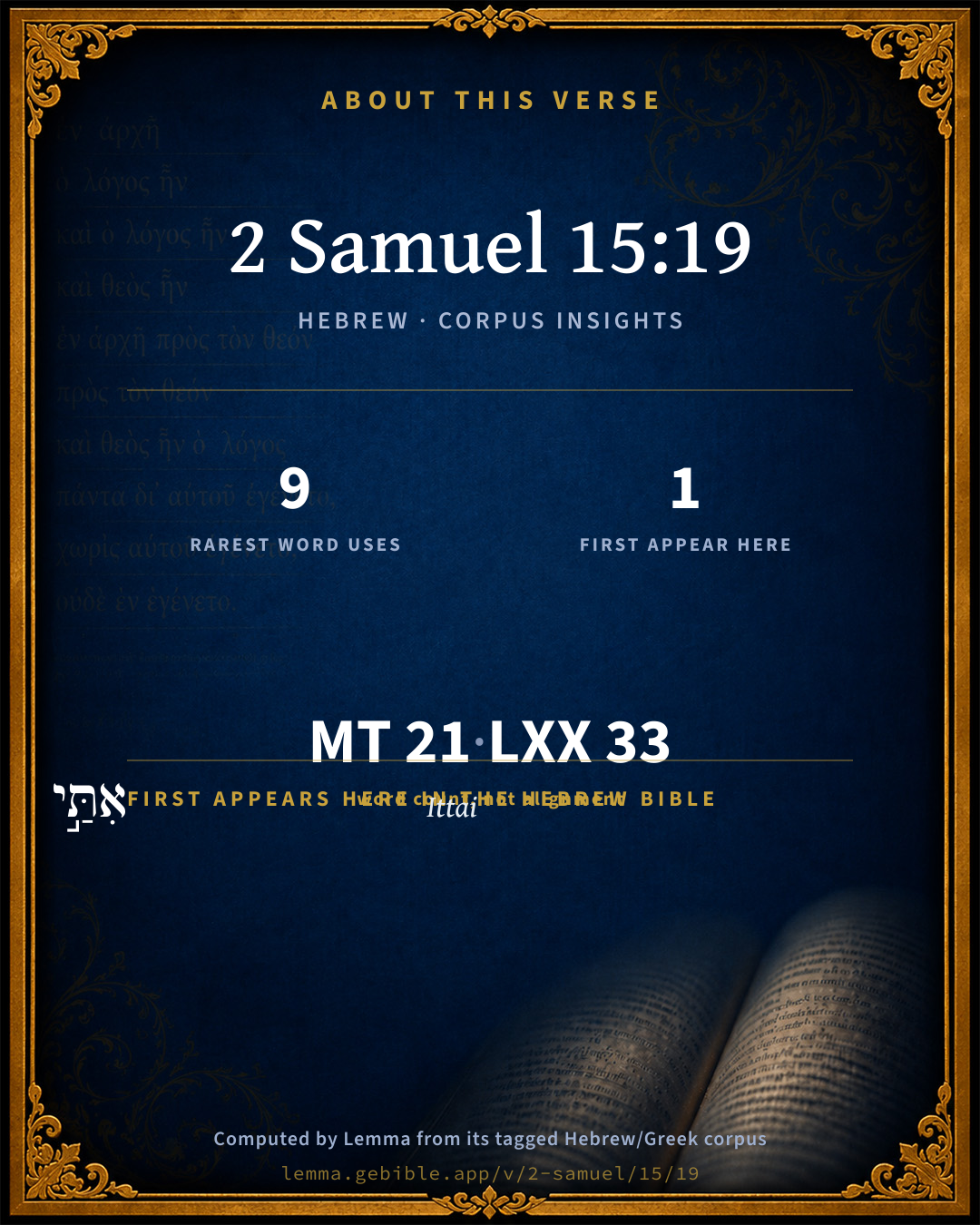
The rarest word here is אִתַּ֣י Ittai H863 — appearing just 9 times in the whole Hebrew Bible.

First appearance in Scripture

This word makes its first canonical appearance in the Hebrew Bible here:

  • אִתַּ֣י Ittai H863

Shared distinctive vocabulary

אִתַּ֣י Ittai H863 occurs in 8 verses of the Hebrew Bible. Also found in:

Grammatical profile

  • 5 verbs
  • 5 nouns
  • 1 adjective
  • 3 pronouns
  • 3 prepositions
  • 1 conjunction
  • 3 particles

Verb forms

  • וַיֹּ֤אמֶר Qal · Sequential Imperfect
  • תֵלֵ֛ךְ Qal · Imperfect
  • שׁ֣וּב Qal · Imperative
  • וְשֵׁ֤ב Qal · Imperative
  • גֹּלֶ֥ה Qal · Participle Active

Repetition

Words recur within this verse — often emphatic in Hebrew:

  • הַמֶּ֨לֶךְ֙ king H4428 ×2
  • גַּם also H1571 ×2
  • אַתָּ֖ה you H859 ×3

Hebrew & Septuagint length

In English translation the verse runs 34 words from the Hebrew and 38 from the Septuagint (LXX English) — closely comparable.

A rough comparison of the two English renderings, which tokenize alike — not a word-level alignment.

Word counts can differ between the Hebrew and the Greek without any difference in meaning — e.g. the Hebrew direct-object marker אֵת has no separate Greek word, and Greek often adds the article ὁ.

In the original languages it is 21 Hebrew tokens and 33 Greek tokens — but the two are counted differently (Hebrew bundles its prefixes and suffixes into one token; the Greek is in lemma form), so that isn’t a like-for-like length.

Cross-references

2

Topical passages linked to 2 Samuel 15:19 in the Treasury of Scripture Knowledge — connected by theme and wording, ordered by reader-vote popularity; previews shown in the World English Bible.

  • 2 Samuel 18:2 David sent forth the people, a third part under the hand of Joab, and a third part under the hand of Abishai the son of Zeruiah, Joab's brother, and a third part under the hand of Ittai the Gittite. The king said to the people, I will surely go forth with you myself also.
  • Ruth 1:11–13 Naomi said, Turn again, my daughters: why will you go with me? have I yet sons in my womb, that they may be your husbands?

Cross-references courtesy of OpenBible.info (CC BY 4.0).

Hebrew and Greek witnesses Masoretic Hebrew ↔ Greek Septuagint

The same verse in the two great witnesses to the Old Testament, shown verse-for-verse.

These are two independent witnesses, not word-aligned to each other, and the Septuagint is shown in lemma (dictionary) form.

Hebrew 2 Samuel 15:19 Masoretic · Westminster Leningrad Codex

וַיֹּ֤אמֶר הַמֶּ֨לֶךְ֙ אֶל אִתַּ֣י הַגִּתִּ֔י לָ֧מָּה תֵלֵ֛ךְ גַּם אַתָּ֖ה אִתָּ֑נוּ שׁ֣וּב וְשֵׁ֤ב עִם הַמֶּ֨לֶךְ֙ כִּֽי נָכְרִ֣י אַ֔תָּה וְגַם גֹּלֶ֥ה אַתָּ֖ה לִמְקוֹמֶֽךָ

Then said the king to Ittai the Gittite, Why go you also with us? return, and abide with the king: for you are a foreigner, and also an exile; [return] to your own place.

World English Bible · Public Domain

Greek LXX 2 Samuel 15:19 Septuagint · lemma form

καί εἶπον ὁ βασιλεύς πρός εθθι ὁ γεθθαῖος ἵνα τίς πορεύομαι καί σύ μετά ἐγώ ἐπιστρέφω καί οἰκέω μετά ὁ βασιλεύς ὅτι ξένος εἰμί σύ καί ὅτι μεταοἰκέω σύ ἐκ ὁ τόπος σύ

And the king said to Ethi, the Gittite, Why do you also go with us? return, and dwell with the king, for you are a stranger, and you have come forth as a sojourner out of your place.

LXX2012 (modern English Septuagint) · Public Domain

On this verse, The Pulpit Commentary discusses the Septuagint’s reading. Read the note in Commentary ↓

Hebrew: Westminster Leningrad Codex (CC BY 4.0). Greek: Septuagint (public domain); English from LXX2012 (modern English Septuagint) (Public Domain). How the Septuagint differs from the Hebrew →

Targum (Aramaic paraphrase)

1

The Targum is the ancient Jewish Aramaic paraphrase of the Hebrew Scriptures — an interpretive translation, not the Hebrew text itself. Onkelos (literal) and Pseudo-Jonathan (expansive) render the Torah, and Jonathan the Prophets. Coverage is partial: where no permissively-licensed English translation exists for a verse, only the Aramaic is shown. This is verse-level text, not a word-by-word alignment to the Hebrew.

  1. Targum Jonathan Prophets (Joshua–Malachi)
    וַאֲמַר מַלְכָּא לְאִתַּי גִיתָּאָה לְמָא תֵיזֵיל אַף אַתְּ עִמָנָא תּוּב וְתֵיב עִם מַלְכָּא אֲרֵי נוּכְרָא אַתְּ וְאַף אִם גָלֵי אַתְּ אֱזֵיל לָךְ לְאַתְרָךְ:

    (no public-domain English translation for this verse)

    Targum Jonathan — Aramaic: “Mikraot Gedolot” (public domain). English: “Sefaria Community Translation” (CC0 1.0 (public-domain dedication)); “London "Chaldee Paraphrase," 1871” (public domain). Text via Sefaria.

Commentary

Notes on 2 Samuel 15:19 from classic Christian and Jewish commentators (each source and its license shown beneath its notes). The classic Christian expositions comment on the surrounding passage and are grouped to its opening verse, so a note may address several verses; the Jewish commentaries on the Tanakh (Rashi and others) are per-verse, so they appear only where the commentator wrote on this verse.

Lemma curates 59 commentaries, every one of them public domain or Creative Commons licensed, each selected and text-cleaned for this edition rather than reprinted as found. About our sources →

Trapp's Complete Commentary

John Trapp

2Sa 15:19 Then said the king to Ittai the Gittite, Wherefore goest thou also with us? return to thy place, and abide with the king: for thou [art] a stranger, and also an exile.

Ver. 19. Then said the king to Ittai the Gittite.] Who is thought by some, saith Martyr, to have been the king of Gath’s son, who was now become a proselyte, and lived in Jerusalem for religion’s sake: but this is uncertain.

And also an exile.] Tremellius rendereth it, Et etiam remigraturus es in locum tuum: and Diodat, And wilt quietly go to thy place; as if he would say, Thou art old and weak, near to thine end.

John Trapp, A Commentary or Exposition upon All the Books of the Old and New Testament (1647–1656) — public domain. Text from a community e-Sword module.

The Biblical Illustrator

Joseph S. Exell

2Sa_15:19

Ittai the Gittite.

Ittai the Gittite

Ittai of Gath was not only a heathen but a heathen of the heathens, a member of a race the most malignant of all the foes of the Church. Yet among the events of this day--a day over which the historian fondly if sadly lingers, more minutely and at greater length described than any other day of Old Testament history--an episode of which he is the hero finds a prominent place. It is not much we can know about him; but what we can that we desire to learn. Let us look at his environment and at himself; his People, his Position, and his Personality.

I. His people. Probably in a degree in which it can be said of no other country, Palestine has been the meeting-place and battleground of nations. From earliest historical times we find wave after wave of conquerors breaking upon, settling down, or passing over it; and there are not wanting indications that long before history began to be written the monotonous process had commenced. The shadowy forms of the earlier races can be dimly discerned, ghost-like, before the rising of the historic sun. Amongst the many pre-Hebrew arrivals and settlers--and, historically, the most important of them all--was the people to whom Ittai belonged, the Philistines. Concerning their origin, the events which led to their migration into Palestine, and the development of their power there, we know almost nothing--barely sufficient to suggest a few guesses. A reference to the genealogical table in Genesis (Gen_10:14) suggests an Egyptian origin, whilst the Book of Deuteronomy and the Prophets Amos and Jeremiah speak of them as Caphtorim out of Caphtor; but the endeavour to fix a site for Caphtor has not yet been attended with success. Cappadocia, Cyprus, and Crete are all claimants; but the balance of opinion seems to incline in favour of the last-mentioned of the three. From whatever race they sprung, from whatever quarter they came, we find a tribe of them at the extreme southern limit of Palestine, on the route down to Egypt, as far back as the time of Abraham, though their very name--strangers, or emigrants--indicates that they were arrivals in the country, and not aboriginals. We shall probably not be far wrong if we suppose a small swarm of Caphtorim from Caphtor (say, Cretans from Crete) hiving off and settling down upon the southern border of Palestine, where the fertile land shades off into the desert on the way to Egypt; there multiplying their number and developing their genius for war; civilising, casting off nomadic habits, and acquiring those of dwellers in cities; and in due course acquiring a greater proficiency in the arts and arms than any of the rude tribes around them. Then comes the great commotion to the North consequent upon the invasion and conquest by Joshua and his Israelites. The Philistines are too far off in their southern corner to feel the shock in any direct way; but their next-door neighbours, the Avites--who occupied the great plain lying between them and the new-comers, and on whose rich corn-fields they had doubtless cast many a longing eye--are shaken to their centre. Already three of their principal towns have fallen; the great Tribe of Judah, under the hero son-in-law of Caleb, presses sore upon them; half of the plain (Shefela) is no longer theirs. We can then conceive of them, in their extremity and desperation, invoking the aid of their warlike and rising rivals along their southern side, who had already begun to intermarry and mingle with themselves. Nothing loth, the desired assistance is given, and soon Philistine swords--for the first time, but not for the last, by many a score--cross and crash with Hebrew spears. Four results follow:--

1. The first is a decided stop to Hebrew extension in that quarter. The captured cities are regained, and for many a day are thorns in the side of Judah, Dan, and Simeon.

2. The next is a permanent occupation by the Philistines of the territory into which they had come as allies. It was the richest part of all Palestine, excelling even the beautiful Esdraelon, and, moreover, its coast embraced the two best harbours between Egypt and Phoenicia.

3. Another result is a new name for that portion, and eventually for the whole, of Canaan. Henceforth the Plain is known from them as Philistia--a name which, thus derived from a heathen tribe in its south-western corner, has, curiously enough, in a slightly altered form, spread over, and to this day covers all of the Holy Land. It is an illustration of the irony of history that a name which we fondly cherish as a name holy and revered, should be thus a child of a pure heathen parentage. In vain Israel cultivated exclusiveness; ever and anon God compelled an indication of the universalism that was wrapped up in His Call. The very name which the Holy Land bears is a standing memorial of that making of both one, which, being one of the counsels of God from the beginning, became realised in Him in whom Jew and Gentile find their meeting-place with one another and both with Him.

4. The fourth result is a great and rapid development of the Philistine power. The supposition of a second migration from Crete, though quite possible, does not seem to be necessary. The fertility of their new possessions--the granary of Palestine--their commercial advantages, the great increase of numbers through the absorption of the Avites, Anakim, and possibly other tribes, including an influx of fugitive Amorites and Canaanites, and the separation of the dominant race as a warrior or fighting castle to the art and practice of war--these are considerations quite sufficient to account for such rapid development of power as the facts of the narrative require. With the institution of the monarchy and the establishment of a central authority in Israel, implying some amount of national cohesion in place of tribal isolation, the tables were turned. Saul inflicted many grievous defeats upon them; and after the accession of David and the perfecting of his military system they had small chance of success, in aggressive warfare at least, against their mere numerous foes. But, cooped up within their narrow borders, and forbidden aggressive war, this nation of soldiers seeks an outlet for its superfluous manhood in foreign service. As it was with Scotland and Switzerland three centuries ago, so was it with Philistia in Ittais time. What the Scottish and Swiss Guards were at the Court of France, what the Varangian Guard was to the Greek Emperors at Constantinople, what the Free Companies were to the cities and princes of Italy, that was the Philistine guard at the Court of Pharaoh and the Court of David--a reliable body of mercenaries, whose duty it was, in a general way, to fight the sovereigns battles, and, in a special way, to guard the royal person. The nucleus of this guard appears to have been enlisted by David during his sojourn at Gath, where for a time he found a refuge from the persecuting jealousy of Saul.

II. Ittais position. He was captain of these mercenaries, the Philistine guard, the Cherethites and Pelethites, in Davids service. We must conceive of him as a stranger among strangers, a soldier in a foreign employ, an exile from home and country--either voluntarily, through a desire to push his fortunes, or by necessity, because of some disagreement or quarrel with the Lords of the Philistines. He is among those who, however much they may appreciate his sword, hate himself, his race, and his religion. He and his comrades belonged to a people who, possessing the qualities of strength and pertinacity, were by temperament sluggish, heavy, and dull-witted. Such is the character everywhere implied in the pictures of them given in Scripture: They were almost the laughing-stock of their livelier and quicker neighbours--the easy prey of the rough humour of Samson, or the agility and cunning of the diminutive David (Stanleys Jewish Church.) In the city, and at the Court of Jerusalem, he and they would feel and would be regarded very much as Hereward and his Varangians felt and were regarded in the City and at the Court of Constantinople, as conceived by the historic imagination and pictured by the faithful pen of Scott in his Count Robert of Paris. Ittai and his guard would be the objects and the butts at once of the contemptuous civility of the courtiers, and the stinging spite of the citizens. Almost inevitably, they would draw off, isolate themselves, and as a caste, hated and hating, live there lives by themselves, reserving all their sympathies for those within the limits of their own order. Thus were these Cherethites and Pelethites--outside the sympathy of the people and remote from the gossip of the bazaar--when the shameful rebellion of Absalom bursts upon the astonished guard as a bolt out of a clear sky. Meanwhile David and Ittai have met. The king looks into the face, illumined with the light of the noblest feelings that shine out from the heart through the windows of the eyes: nobility meets nobility; magnanimity accepts what magnanimity offers. Two great souls meet, embrace, and grapple each to each with hooks of steel. The simple acceptance of the service proffered; the delicate recognition that further remonstrance would have been almost an outrage; the tacit treatment of the question as closed; and the renewed enrollment into a service that is to last for life--all this and much more is enwrapped in the Go, and pass over. The kings son was a rebel, his counsellor a traitor; how heart must have swelled and eye filled in the presence of devotion so unselfish and so strong in the stranger.

III. The Personality That Is Here Presented To Us. We know nothing concerning him save what we gather from these scenes. We see him only twice: once as, beside the brook Kedron, within stone-cast of Gethsemane, he vows the fealty he kept so well, and once as he marches out of Mahanaim at the head of his well-drilled corps. But as the naturalist from a single typical bone can construct the whole physical frame of the animal, so from these scanty yet typical facts the moralist can give the whole moral build of the man. We experience no difficulty in the endeavour to reproduce Ittais moral structure. He is simplicity, fidelity, and affection embodied.

1. Simplicity, for there was no double purpose in his mind, nor double speech in his tongue; he had one loyalty and one only, a soldiers surrender to the king whose soldier he was; one aim and one only, a servants service to the master whose man he was.

2. Fidelity, for selfish views and considerations seem to have found in him no place at all; he never asked, Where is the sunny side of fortune, that I may seek it? or, Where the shady side, that I may shun it? but, Come weal or woe, be it life or be it death, I follow where faith leads.

3. Affection, too, for manifestly this wondrous poet-king had won his love and held his heart. There was about this David a marvellous power of attracting, subduing, and holding men. (G. M. Grant, B. D.)

A specimen of nobleness

It is the darkest period of Davids life. He is fleeing, barefooted, in fear of Absaloms approaching army. Yet he is not altogether alone. A few loyal hearts cling to him. And, amid the desolating sorrow, appears this Ittai. He is not a Hebrew; he is a Gittite--that is, a Philistine. But he is among those who will cast in their fortunes with the fleeing king. Only recently he seems to have come to Jerusalem. David sees the resolve of splendid devotion in Ittai. It will be useless to try to dissuade him further. The noble devotion of Ittai teaches these lessons:--

I. That such devotion i should show toward Jesus Christ. There must have been a singular attractiveness and winningness about the personality of David inspiring devotion to him. There is more attractiveness in Jesus Christ, and to Him, therefore, I ought to be more devoted than Ittai was to David.

1. Think of the purity of Jesus. Tennyson wrote: I am amazed at Christs purity and holiness, and at His infinite beauty. The forms of religion may change, but Christ will grow more and more in the roll of the ages. His character is more wonderful than the greatest miracle.

2. Think of Christs sympathy. I have read how, before they knew of mines of diamonds there, a boy in South Africa flung a stone at a stranger. The man picked up the stone, and found it diamond, and it became his treasure. So Christ finds the diamond in us. Whom others cast away He regards, receives, redeems. Matthew the publican; the woman taken in her sin, etc.

3. Think of the sacrifice of Christ. His atoning cross tells it. This Christ of purity, sympathy, sacrifice, is worthy limitless devotion.

II. What does devotion mean and involve?

1. Definite decision for its object. Ittai decided for David. There were no ifs or buts, about his decision. It was downright. So I should decide for Christ.

2. Confession. And Ittai answered the king and said. A real devotion does not hesitate about telling itself forth.

3. Marching under the standard of its object. Ittai followed Davids flag. If I have real devotion to Christ I will join and march with His church and people.

4. Persistence. Ittai went the whole way with David in that long march from Jerusalem to Mahanaim. So I should persistently follow Christ.

5. Service. Ittai was one of the commanders for David in the subsequent battle with Absalom. So I should give myself to service for Christ. Christ will accept my devotion as David did that of Ittai. And the object of ones devotion is the discriminating and deciding test for life. The ignoble life has other than the highest object of devotion. (Homiletic Review.)

Ittai of Gath

Heartbroken and spiritless, David leaves Jerusalem. And as soon as he has got clear of the city he calls a halt, in order that he may master his followers and see on whom he may depend. Foremost among the little band come six hundred men from Gath--Philistines--from Goliaths city. These men, singularly enough, the king had chosen as his bodyguard; perhaps he was not altogether sure of the loyalty of his own subjects, and possibly felt safer with foreign mercenaries, who could have no secret leanings to the deposed house of Saul. Be that as it may, the narrative tells us that these men had come after him from Gath. Here they are, faithful among the faithless, as foreign soldiers surrounding a king often are--notably, for instance, the Swiss guard in the French Revolution. It is a beautiful nature that in the depth of sorrow shrinks from dragging other people down with itself. Generosity breeds generosity, and this Philistine captain breaks out into a burst of passionate devotion, garnished, in soldier-fashion, with an unnecessary oath or two, but ringing very sincere and meaning a great deal. As for himself and his men, they have chosen their side. Whoever goes, they stay. Davids heart is touched and warmed by their outspoken loyalty; he yields and accepts their service. Ittai and his noble six hundred tramp, on, out of our sight, and all their households behind them.

I. What grand passionate self-sacrifice may be evolved out of the roughest natures.

1. A passionate personal attachment; then, that love, issuing as such love always does, in willing sacrifice that recks not for a moment of personal consequences.

2. And we see in these words a supreme restful delight in the presence of Him whom the heart loves. And wherever, in some humble measure, these emotions are realised, there you get weakness springing up into strength, and the ignoble into loftiness. Astronomers tell us that, sometimes, a star that has shone inconspicuous, and stood low down in their catalogues as of fifth or sixth magnitude, will all at once flame out, having kindled and caught fire somehow, and will blaze in the heavens, outshining Jupiter and Venus. And so some poor, vulgar, narrow nature, touched by this Promethean fire of pure love that leads to perfect sacrifice, will flame in the, forehead of the morning sky, an undying splendour, and a light for ever more, You have all that capacity in you, and you are all responsible for the use of it. What have you done with it? Is there any person or thing in this world that has ever been able to lift you up out of your miserable selves? Is there any magnet that has proved strong enough to raise you from the low levels along which your life creeps? Have you ever known the thrill of resolving to become the bondservant and the slave of some great cause not your own? Or are you, as so many of you are, like spiders living in the midst of your web, mainly intent upon what you can catch in it? You have these capacities slumbering in you. Have you ever set a light to that inert mass of enthusiasm that lies in you? Have you ever woke up the sleeper?

II. These possibilities of love and sacrifice point plainly to God in Christ as their true object.

III. The terrible misdirection of these capacities is the sin and the misery of the world. I will not say that such emotions, even when expended on creatures, are ever wasted. And I am not going to say that when men love each other passionately and deeply, and sacrifice themselves for one another, or for some cause or purpose affecting only temporal matters, the precious elixir of love is wasted. God forbid! But I do say that all these objects, sweet and gracious as some of them are, ennobling and elevating as some of them are, if they are taken apart from God, are insufficient to fill your hearts: and that if they are slipped in between you and God, as they often are, then they bring sin and sorrow. And so let me gather all that I have been saying into the one earnest beseeching of you that you would bring that power of uncalculating love and self-sacrificing affection which is in you, and would fasten it where it ought to fix--on Christ who died on the cross for you. Such a love will bring blessedness to you. (A. Maclaren, D. D.)

Loyal to the core

If Ittai, charmed with Davids person and character, though a foreigner and a stranger, felt that he could enlist beneath his banner for life--yea, and declared that he would do so there and then--how much more may you and I, if we know what Christ has done for us, and who He is and what he deserves at our hands, at this good hour plight our troth to Him and vow, As the Lord liveth, surely in whatsoever place my Lord and Saviour shall be, whether in death or life, even there also shall His servant be.

I. In what form and manner was this declaration made?

1. It was made at a time when Davids fortunes were at their lowest ebb, and consequently it was made unselfishly, without the slightest idea of gain from it. To take up with Christ when everybody cries up His name is what a hypocrite would do, but to take up with Christ when they are shouting, Away with him! away with him! is another matter. There are times in which the simple faith of Christ is at a great discount. It is such a season that we must stand out for Gods.

2. Ittai gave himself up wholly to David when he was but newly come to him. David says, Whereas thou camest but yesterday, should I this day make thee go up and down with us? But Ittai does not care whether he came yesterday or twenty years ago, but he declares, Surely in what place my lord the king shall be, whether In death or life, even there also will thy servant be. It is best to begin the Christian life with thorough consecration. Have any of you professed to be Christians, and have you never given yourselves entirely to Christ? It is time that you began again. This should be one of the earliest forms of our worship of our Master--this total resignation of ourselves to him.

3. Ittai surrendered himself to David in the most voluntary manner. No one persuaded Ittai to do this; in fact, David seems to have persuaded him the other way. David tested and tried him, but he voluntarily, out of the fulness of his heart, said, Where my lord, the king is, there also shall his servant be. If you believe that the Lord Jesus Christ is yours, give yourselves up to him by a distinct act and deed. Feel that one grand impulse without needing pressure or argument The love of Christ constraineth me.

4. Ittai did this very solemnly. He took an oath which we Christians may not do, and may not wish to do, but still we should make the surrender with quite as much solemnity.

5. And this Ittai did publicly. At any rate, he so acted that everybody saw him when David said, Go over, and he marched in front--the first man to pass the brook.

II. What did this declaration involve?

1. He was henceforth to be Davids servant, Of course, as his soldier, he was to fight for him, and to do his bidding, What sayest thou, man? Canst thou lift thy hand to Christ and say, Henceforth I will live as thy servant, not doing my own will, but thy will. Thy command is henceforth my rule? Canst thou say that? If not, do not mock him, but stand back. May the Holy Ghost give thee grace thus to begin, thus to persevere, and thus to end.

2. He was to do his utmost for Davids cause, not to be his servant in name, but his soldier, ready for scars and wounds and death, if need be, on the kings behalf. That is what Ittai meant as in rough soldier-tones, he took the solemn oath that it should be so. Now, if thou wouldst be Christs disciple, determine henceforth by His grace that thou wilt defend His cause.

3. His promise declared that he would give a personal attendance upon the person of his master. That was, indeed, the pith of it. In what place, my lord, the king, shall be, even there also will thy servant be. Brethren, let us make the same resolve in our hearts, that wherever Christ is, there we will be.

4. He intended to share Davids condition. It David was great, Ittai would rejoice. If David was exiled, Ittai would attended his wanderings. Our point must be to resolve in Gods strength to keep to Christ in all weathers and in all companies, and that whether in life or death. (C. H. Spurgeon.)

The Biblical Illustrator, edited by Joseph S. Exell (c. 1880s–1900s) — public domain. Text from a community e-Sword module.

Joseph Benson's Commentary

2Sa 15:19-20. Then said the king to Ittai the Gittite, &c. — He seems to have been the commander of those six hundred men before mentioned. And the Jews make him the son of Achish, king of Gath, who, they say, out of religion and friendship came to David. Return to thy place — To Jerusalem, where thy place of residence is. And abide with the king —

With Absalom, king by usurpation. For thou art a stranger and an exile — Not much concerned in our affairs, and therefore thou oughtest not to be involved in our troubles. And, as a stranger, thou mayest hope to be civilly treated by Absalom. Whereas thou camest but yesterday — That is, very lately; should I this day make thee go up and down with us? — Should I unsettle thee again so soon? Seeing I go whither I may — Or, I know not whither, having now no certain dwelling-place. Take back thy brethren — Thy countrymen the Gittites. Mercy and truth be with thee — Since I am now unable to recompense thy kindness and fidelity to me, my hearty prayer to God is, that he would show to thee his mercy, in blessing thee with all sorts of blessings, and his faithfulness in making good all these promises which he hath made, not to Israelites only, but to all true-hearted proselytes, such as thou art.

Joseph Benson's Commentary on the Old and New Testaments (1811–1818) — public domain. Text from a community e-Sword module.

Tyndale Open Study Notes

Tyndale Open Resources

15:19 Ittai, a Philistine from Gath, was associated with Gibeah in Benjamin (23:29; 1 Chr 11:31); the Philistines had established a garrison in Gibeah at the beginning of Saul’s career (1 Sam 10:5; 13:3). • David was stepping aside for King Absalom, who had successfully swayed the loyalty of Israel.

Tyndale Open Study Notes — © Tyndale Open Resources, licensed CC BY-SA 4.0. Text via the HelloAO Bible API.

Geneva Bible (1599)

Geneva Bible translators

Who as some write was the king’s son of Gath.

Geneva Bible (1599) marginal notes — public domain. Text via Bolls.life.

Adam Clarke's Commentary

Verse 19. Thou art a stranger, and also an exile.] Some suppose that Ittai was the son of Achish, king of Gath, who was very much attached to David, and banished from his father's court on that account. He and his six hundred men are generally supposed to have been proselytes to the Jewish religion.

Adam Clarke's Commentary on the Bible (1810–1826) — public domain. Text from a community e-Sword/MySword module.

Ellicott's Commentary for English Readers

(19) Ittai the Gittite.—The patronymic must here be understood literally, since David calls him “a stranger and also an exile;” he had but comparatively recently (2Sa_15:20) attached himself to David’s service, bringing with him his family and others of his countrymen. From the fact that David afterwards entrusted him with the command of a third of his forces, it is clear that he must have been an experienced general. It cannot be shown positively that he was a proselyte, although this is probable.

In the latter part of this verse the English has unnecessarily changed the order of the words. Read, “Return and abide with the king, for thou art a stranger and an exile at thy place,” viz., at Jerusalem. David neither means to recognise Absalom as king, nor yet to speak of him ironically; he only means to tell Ittai that, as a foreigner, he need not concern himself in such a question, but is quite justified in serving the king de facto, whoever he may be. Ittai’s answer may be compared with Ruth’s (Rth_1:16-17).

A Bible Commentary for English Readers, edited by Charles John Ellicott (1878–1897) — public domain. Text from a community e-Sword module.

The Cambridge Bible for Schools and Colleges

gen. ed. J. J. S. Perowne

19–23. The fidelity of Ittai

19. Ittai the Gittite] A distinguished Philistine who had quite recently (2Sa_15:20) migrated from his home with his family and followers (2Sa_15:22) to enter David’s service. From the fact that he shared the command of the army with Joab and Abishai (ch. 2Sa_18:2) it is clear that he must have been an experienced general.

return to thy place] His new home in Jerusalem. This is the right rendering of the Hebrew text as it stands: but the order of the words is unusual, and both Sept. and Vulg. support a different reading: Return and dwell with the king; for thou art a stranger and also an exile from thy place.

with the king] David’s meaning is that Ittai need not involve himself in the revolutions of a foreign country, but might take service under Absalom or any other reigning king without breach of faith.

an exile] We can only conjecture that Ittai had been compelled to leave his country in consequence of some revolution. If we may suppose this to have been the case, it gives additional delicacy to David’s thought fulness in wishing to spare him the repetition of hardships he had but lately experienced.

The Cambridge Bible for Schools and Colleges (gen. ed. J. J. S. Perowne; Cambridge University Press, 1878–1918) — public domain. Text from a community e-Sword module.

John Gill's Exposition

Then said the king to Ittai the Gittite,.... Who was over the band of Gittites, the six hundred men, Sa2 15:22,

wherefore goest thou also with us? one should think the king should not have discouraged any from joining and following him, when his numbers were not very large, and the in such fear on account of Absalom:

return to this place; to Jerusalem, where his station was:

and abide with the king; with Absalom, who set himself up for king, and whom the people perhaps had proclaimed as such in Hebron, where the conspiracy began:

for thou art a stranger, and also an exile; not a native of Israel, but of another nation, and at a distance from it, and therefore not altogether under the same obligations to attend David in his troubles as others were; and by this it seems that he was a Gittite by nation, whatever the six hundred men were, and rather favours the first sense given of them in Sa2 15:18.

John Gill's Exposition of the Whole Bible (1746–1763) — public domain (CC PDM 1.0). Text via the HelloAO Bible API.

Haydock's Catholic Bible Commentary

Ethai. Many assert that he was the son of Achis, and had embraced the true religion. (Menochius) --- King; Absalom, who will not molest you. (Haydock) --- Some translate the Hebrew, "Return from the king." (Syriac [and] Arabic)

George Leo Haydock (1774–1849), Haydock's Catholic Family Bible and Commentary, 1859 edition — public domain. Excludes Psalms (Douay-Rheims chapter numbering differs from Protestant) and Deuterocanonical books (Catholic canon only).

Matthew Poole's English Annotations

Return to thy place; either, first, To thy native country of Gath, where thou wilt be remote from our broils. Or, secondly, To Jerusalem, where thy settled abode now is.

And abide, or, or abide; for he could not both go to Gath, and tarry in Jerusalem with Absalom. Although this part of the verse lies otherwise in the Hebrew text, and may be rendered thus,

Return (to wit, to Jerusalem) and abide with the king (there);

for thou art a stranger and exile from thy own place; or, in respect of thy own place, or, as concerning thy place, i. e. in regard of the place of thy birth and former habitation. With the king; with Absalom, who is now made king by the choice of the people, and therefore is able to give thee that protection and encouragement which thou deservest; whereas I am in a manner deposed, and unable to do for thee what I desired and intended.

A stranger, and also an exile; not much concerned in our affairs, and therefore not fit to be involved in our troubles.

Matthew Poole's English Annotations on the Holy Bible (1683–1685) — public domain. Text from a community e-Sword/MySword module.

Whedon's Commentary on the Bible

Daniel D. Whedon

19. Ittai the Gititte — A stranger and exile, probably from Gath, who had very recently attached himself to David, and brought with him his family, and a large number of his relatives or fellow-countrymen.

Return to thy place — The place set apart for his residence in Jerusalem.

Abide with the king — That is, with Absalom. David says this to test his loyalty.

Daniel D. Whedon (gen. ed.), Commentary on the Old and New Testaments (1874–1909) — public domain. Text from a community e-Sword module.

The Pulpit Commentary

Ittai the Gittite. Ittai was not one of the six hundred, though there was an Ittai among them, a Benjamite. He was a citizen of Gath, who had lately come ("yesterday," see ver. 20), with all his household of slaves and dependents, his clan, Hebrew, his taf translated in ver. 22 his "little ones." He had evidently been a person of importance in his own country, whence he had been driven, perhaps by political troubles, and was now, therefore, an exile and a foreigner (Authorized Version, "stranger") at Jerusalem. As David made him joint commander of his army with Joab and Abishai, (2Sa_18:2) he must also have been a general of recognized military skill. As he was thus not personally interested in the government of Israel, and, in fact, had only lately come thither, David recommends him to return and abide with the king, that is, with the de facto king, Absalom. But so great was the fascination which David exercised upon those around him, that this foreigner boldly threw in his lot with him, and accompanied him in his flight. Return to thy place. This is a very daring transposition, as the Hebrew is, Return and abide with the king; for thou art a foreigner, and also an exile art thou to thy place. The Revised Version gives the same sense as the Authorized, though it shows more respect to the grammar. But the Septuagint, Syriac, and Vulgate, by "his own place" understand Gath, either taking the words as meaning "an exile as to thy own place," or having a different reading. The Hebrew then proceeds, Yesterday was thy coming, and shall 1 today make thee wander to go with us, seeing I go whither I go? that is, I go I know not whither. Return thou, and take back thy brethren in mercy and truth. This gives a very good sense, but the Septuagint and Vulgate have a different reading: "Take back thy brethren with thee, and the Lord chew thee mercy and truth." The Syriac gives the genera sense of the Hebrew, rendering, "Take back thy brethren well.

Vers. 19-22. (BETH-HAMMERHAK.)

The devotedness of Ittai.

Jehovah liveth," etc. (ver. 21). In his flight from Jerusalem:

1. David experienced much alleviation of his trouble; as in his flight from the court of Saul (nearly forty years before). He was not left alone. (1Sa_22:1, 1Sa_22:2) His "servants" gathered round him, and professed their readiness to follow him (ver. 15). Halting with his household at "the Far House," he found himself accompanied by his bodyguard, the Cretans and Philistines; (under Benaiah, 2Sa_8:18) his six hundred veterans, (under Abishai 2Sa_23:17-39) who had been with him in his early wanderings and followed him from Gath onward (Gittites, equivalent to "Gibborim," (1Sa_23:13 1Sa_27:2 1Sa_30:9; 2Sa_2:3 2Sa_5:6) and a part at least of the regular soldiery the host (under Joab,. (2Sa_8:16 2Sa_18:1, 2Sa_18:2) His attention was arrested by the presence of Ittai the Gittite (who, from some unknown cause, had recently come from Garb) with his brethren (kinsfolk) and children. "The Lord has the hearts of all men in his hands, and if he be our friend, we shall not want friends" (Guild). "Our foremost friends are sometimes raised up among persons from whom we had the least expectations" (Scott).

2. He exhibited noble generosity in his conduct. "Wherefore goest thou with us?" etc. (vers. 19-21). "This unexpected meeting with Ittai appeared to the royal fugitive almost like a friendly greeting of his God, and dropped the first soothing balsam drops into the painful wounds of his deeply lacerated heart" (Krummacher). But David, now himself a wanderer, had no desire to make the condition of this "stranger and exile" more homeless and distressing by dragging him into his own misfortunes; released him from whatever obligations of service he may have incurred; advised him to offer his services to the new king; and expressed the wish, "Mercy and truth from God be with thee". (2Sa_2:6)

I am a poor fallen man, unworthy now To be thy lord and master; seek the king Neglect him not; make use now, and provide For thine own future safety. ("King Henry VIII")

3. He exerted a powerful attraction on his followers; as aforetime. His language was really a pathetic appeal; not unlike that of Jesus, "Will ye also go away?" etc.. (Joh_6:66-69) "Ittai declared his resolution (with a fervour which almost inevitably recalls a like profession made almost on the same spot to the great Descendant of David, (Mat_26:35, centuries afterwards) to follow him in life and death" (Stanley). It was "a beautiful instance of loyal constancy and faithful devotion in a Philistine soldier at a time of apostasy and defection. His truth and fidelity are brought out in a stronger and clearer light by the contrast with the treachery of Absalom, Ahithophel, and eventually of Joab and Abiathar" (Wordsworth). He may be regarded, in his devotion to David, as a pattern of devotion to Christ. It was

I SEVERELY TESTED. Like him, the follower of.Christ is often tried and proved, by:

1. The prospect of difficulties, privations, and perils in his service. These are all known to the Lord, for he has himself endured them; and he forewarns his disciples of them. (Luk_9:57, 58 14:25-33) He would not have them follow him from mere impulse.

2. The promise of ease, safety, and advantage in other service; worldly pleasure, treasure, power, honour, in devotion to the prince and "god of this world.

3. The example and influence of many persons; bound by stronger ties to serve their rightful king; but forsaking their allegiance to him, joining in revolt against his authority, seeking his life, and heaping reproaches on his. (2Sa_16:11) "From that time many of his disciples went back," etc. (Joh_6:66; Mar_14:50; 2Ti_4:10; 2Pe_3:17)

4. The peculiar circumstances.in which he is placed, the special inducements suggested thereby, and the favourable opportunities afforded for the exercise of his freedom. There are times in which the Lord (however much he values and desires his aid) does not urge him to continue, but seems to do the opposite, and give him liberty, if he be disposed, to depart. So he tests his disciples, sifts the false from the true, and, though it cause the former to fall away, it makes the latter cling to him more closely than ever. The decision between Christ and antichrist has to be made, not only at first, but also often afterwards.

II WORTHILY DISPLAYED, as it should be by every follower of "the Son of David," in:

1. The deliberate preference of his service to any other. "Just as in the great French Revolution, the famous Swiss Guard showed a brave, though mercenary fidelity, so Ittai, having eaten of the king"s salt, determines that where his lord the king is, in life or death, he will be.

2. The disinterested motives by which he is actuated. (Rth_1:16) Ittai was not a mere mercenary, serving David for advantage. (Job_1:9) He was influenced possibly by gratitude for the kind reception he met with on coming from Gath as "a stranger and an exile," by a sense of obligation imposed by friendship and previous engagements, by a conviction of the rectitude of the king"s cause; certainly by admiration and affection for his person. Hence he wished to be with him, to share his sufferings and to aid in his defence. He was ready "to lay down his life for his sake." An intelligent, sincere, passionate love to the Person of Christ is essential to his service. "Lovest thou me?

3. The open and solemn pledge of loyalty and fidelity. "As Jehovah liveth," (1Sa_29:6; 2Sa_4:9) Ittai was doubtless a convert to the faith of Israel. "Whosoever shall confess me before men," etc. (Mat_10:32; Rom_10:10)

4. The practical, unconditional, whole hearted consecration of himself and all he possessed to the king"s service. "And Ittai the Gittite passed over, and all his men, and all the little ones that were with him." "Who then is willing to consecrate himself this day unto the Lord?". (1Ch_29:5)

III GRACIOUSLY APPROVED. "And David said to Ittai, Go and pass over" (ver. 22), "with me" (LXX). If he said no more, his look and manner would give peculiar significance to his words. The Lord testifies his reception and approval of every devoted servant by:

1. Giving him the assurance thereof in his heart.

2. Fulfilling his desire to be with him. "If any man serve me," etc. (Joh_12:26).

3. Appointing him to his post of duty, and making his way plain. (Joh_11:9, Joh_11:10)

4. Exalting him to a position of responsibility and honour, (2Sa_18:2) in which he aids the king in gaining a great victory, and shares the joy of a great triumph. The latter, like the former life of this Philistine, is wrapped in obscurity. But his devotion to "the Lord"s anointed" shines like a star among the heathen, and condemns the lukewarmness, selfishness, and unfaithfulness of many "who profess and call themselves Christians.

Lo: of those Who call, "Christ! Christ!" there shall be many found, In judgment, further off from him by far Than such to whom his Name was never known. Christians like these the Ethiop shall condemn; When that the two assemblages shall part One rich eternally, the other poor. (Dante, "Purg.," 19.)

D.

The Pulpit Commentary (1880–1919), ed. H.D.M. Spence-Jones & Joseph S. Exell — public domain. Text from a community e-Sword module.

John Wesley's Explanatory Notes

Thy place - To Jerusalem, where thy settled abode now is. The king - With Absalom who is now made king. An exile - Not much concerned in our affairs, and therefore not fit to be involved in our troubles.

John Wesley, Explanatory Notes Upon the Whole Bible (1754–1765) — public domain. Text via the GEBible commentary corpus.

Keil & Delitzsch

C. F. Keil & F. Delitzsch

A military commander named Ittai, who had emigrated from Gath and come over to David not long before, also accompanied the king from the city. It is evident from Sa2 18:2, where Ittai is said to have commanded a third part of the army sent against Absalom, and to have been placed on an equality with Joab and Abishai the most experienced generals, that Ittai was a Philistian general who had entered David's service. The reason for his going over to David is not known. According to Sa2 15:22 of this chapter, Ittai did not come alone, but brought all his family with him (taph: the little ones). The opinion expressed by Thenius, that he had come to Jerusalem as a hostage, is merely founded upon a false interpretation of the last two clauses of the verse before us. David said to Ittai, "Wherefore goest thou also with us? return and stay with the king; for thou art a stranger, and also emigrating to thy place." There is no irony in the words "stay with the king," as Thenius and Clericus suppose (viz., "with the man who behaves as if he were king"); nor is there an acknowledgment of Absalom as king, which certainly could never have emanated from David. The words contain nothing more than the simple though: Do you remain with whoever is or shall be king, since there is no necessity for you as a stranger to take sides at all. This is the explanation given by Seb. Schmidt: "It is not your place to decide this context as to who ought to be king; but you may remain quiet and see whom God shall appoint as king, and whether it be I or Absalom, you can serve the one that God shall choose." This is the only way in which we can explain the reason assigned for the admonition, viz., "Thou art a stranger," and not an Israelite. There is some difficulty connected with the following words (rendered in the Eng. version "and also an exile"). In the Septuagint and Vulgate they are rendered καὶ ὅτι μετώκησας σὺ ἐκ τοῦ τόπου σου, et egressus es de loco tuo (and thou hast gone out from thine own place); but in adopting this rendering the translators have not only passed over the גּם (also), but have taken למקומך for ממּקומך. Nevertheless Thenius proposes to bring the text into harmony with these versions for the purpose of bringing out the meaning, "and moreover thou art one carried away from his own home." But this is decidedly a mistake; for David would never have made a Philistine - who had just before been carried away from his own home, or, as Thenius understands it, who had been brought to Jerusalem as a hostage - the commander of a third of his army. The meaning is rather the following: "And thou hast still no fatherland," i.e., thou art still wandering about through the earth like an exile from his country: wherever thou findest a place, and art allowed to settle, there only canst thou dwell.

Keil & Delitzsch — Biblical Commentary on the Old Testament (1861–1891) — public domain (CC PDM 1.0). Text via the HelloAO Bible API. (Old Testament only.)

unfoldingWord translationNotes

Door43 World Missions Community

Ittai

This is the name of a man. (See: How to Translate Names)

Gittite

Translate the name of this people group the same as you did in 2 Samuel 6:10.

Why will you come with us?

This rhetorical question indicates that the king does not think they should go along with him. This question can be written as a statement. AT: "You do not need to go with us." (See: Rhetorical Question)

why should I make you wander all over with us?

This rhetorical question emphasizes David did not want Ittai to come. This question can be translated as a statement. AT: "I do not want to cause you to wander around with us." (See: Rhetorical Question)

Since you just left yesterday

Here "yesterday" is an exaggeration that emphasizes a short amount of time. Ittai the Gittite had lived there for several years. AT: "Since you have lived here only a short time" (See: Hyperbole and Generalization)

May loyalty and faithfulness go with you

This is a blessing that David is giving to him. AT: "May Yahweh be faithful and loyal to you always" (See: Assumed Knowledge and Implicit Information)

translationWords

alien

exile

faithful

unfoldingWord translationNotes — © Distant Shores Media and the Door43 World Missions Community, licensed CC BY-SA 4.0. Source: git.door43.org/Door43/en_tn.

Rashi

Rabbi Shlomo Yitzchaki (Rashi)

With the king. With Avsholom.

Because you are a foreigner. We are fleeing without provisions and food, and because you are a foreigner you will not find people that will have pity on you.

And even if you are estranged [from Avsholom]. And even if you are exiled from the king [Avsholom] because you do not want to be with him, then return to your home because it is not good to go with me because you [just] came yesterday.

Rashi on the Tanakh — English translations: “The Judaica Press complete Tanach with Rashi, translated by A. J. Rosenberg” (CC BY 4.0); “Pentateuch with Rashi's commentary by M. Rosenbaum and A.M. Silbermann, 1929-1934” (public domain); “The Metsudah Tanach series, Lakewood, N.J” (CC BY 4.0); and “The Book of Joshua, Metsudah Publications, 1997” (CC BY 4.0). Text via Sefaria.

Lesson kit

Teaching starters — assembled from the data on this page, not authored interpretation. Every prompt links to the verse data it draws on. Edit before teaching.

2 Samuel, in the Historical, opens this verse with 21 words (17 distinct Hebrew lemmas). Its most distinctive word is ʼIttay (“Ittai”). A historical commentator’s framing appears above. Read the whole chapter for the surrounding context.

Discussion questions

  1. The word ʼIttay carries the sense “Ittai.” How does it shape the verse?
  2. This is the first place “Ittai” appears in Scripture (first appears here). What does its debut here establish?
  3. How does 2 Samuel 15:21, which shares the word «Ittai», read alongside this verse?
  4. What does the repetition of “king” (2× in this one verse) do in this verse?
  5. The translations on this page render this verse differently — a whole-verse word diff, not a word-by-word alignment. What might account for the different wordings?
  6. «וַיֹּ֤אמֶר» is a Qal Sequential Imperfect verb. How does that grammatical form shape the action described?
  7. Compare how Trapp's Complete Commentary and The Biblical Illustrator read this verse. Where do they agree or differ?

Things to notice

Reading settings

Reading text

Shown beneath each verse's original-language words.

Old Testament
Old Testament edition

Read the OT as the Masoretic Hebrew (MT) or the Greek Septuagint (LXX).

English shown for the Greek Septuagint (in the Hebrew ↔ Greek comparison).

Comparing translations? Open the Compare panel on any verse page to stack up to four side by side.