
Jeremiah 27:20

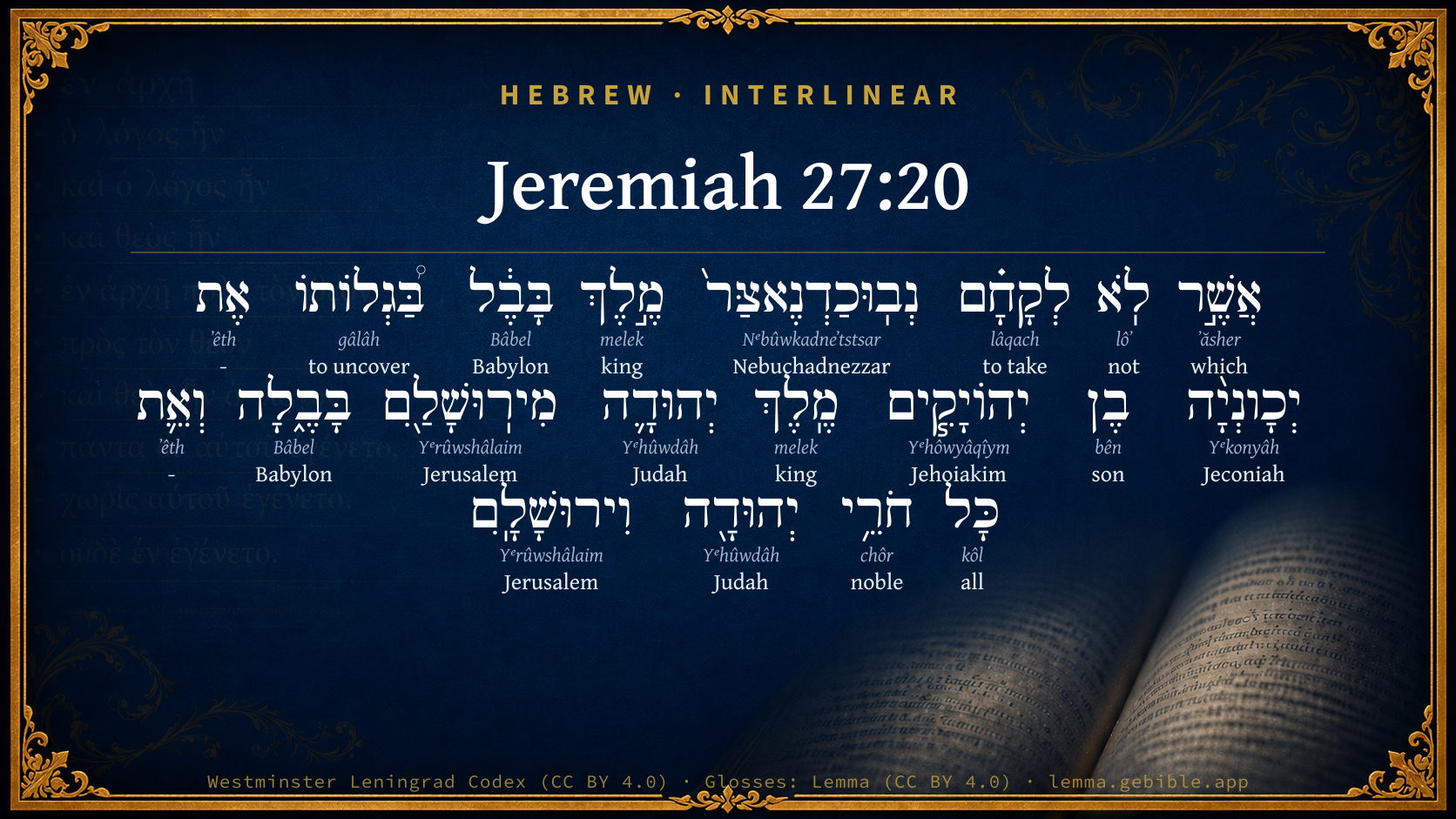
Hebrew (Westminster Leningrad Codex) Jeremiah 27:20 appears in the Hebrew Old Testament. The text above is from the Westminster Leningrad Codex. Each word links to its Strong’s number, a concise gloss, and parsing drawn from the Open Scriptures Hebrew Bible morphology. Click any word for its full Brown-Driver-Briggs (BDB) entry.
Download image
Cite this verse

Jeremiah 27:20 (World English Bible). Public Domain. Lemma interlinear Bible study tool, https://lemma.gebible.app/v/jeremiah/27/20.

Show BibTeX & RIS
BibTeX
RIS
English Translation
which Nebuchadnezzar king of Babylon didn't take, when he carried away captive Jeconiah the son of Jehoiakim, king of Judah, from Jerusalem to Babylon, and all the nobles of Judah and Jerusalem;
World English Bible · Public Domain
Download a study sheet

One document with this verse’s original text, its word-by-word gloss line, the meaning frame, cross-references with their text, attributed commentary, and full source and license credits — printable, and it pastes into notes with its structure intact.

This verse Autodidact and up

Study sheet (.html) Plain text (.txt)

A passage Seminary Student

Up to 50 verses in one chapter. A passage sheet keeps up to 6 commentary sources and 12 cross-references per verse, in the order this page ranks them, and says so on the sheet whenever that leaves anything out. Ask for a single verse and you get the Autodidact verse sheet above.

Everything on this page stays free to read, with no account — the sheet is a download of what is already on screen, not access to it.

Want to remove ads? Support Godless Engineer
Compare translations 3

The same verse in 3 English versions, stacked beneath the original-language interlinear above. Click any original word for its lexicon entry.

Each is an independent rendering of the whole verse — the interlinear is not word-aligned to these translations.

Highlighted words mark where these versions differ — a whole-verse word diff, not a word-by-word alignment.

  • World English Bible Public Domain
    which Nebuchadnezzar king of Babylon didn't take, when he carried away captive Jeconiah the son of Jehoiakim, king of Judah, from Jerusalem to Babylon, and all the nobles of Judah and Jerusalem;
  • King James Version Public Domain
    Which Nebuchadnezzar king of Babylon took not, when he carried away captive Jeconiah the son of Jehoiakim king of Judah from Jerusalem to Babylon, and all the nobles of Judah and Jerusalem;
  • unfoldingWord Literal Text CC BY-SA 4.0
    which Nebuchadnezzar king of Babylon did not take when he exiled Jeconiah son of Jehoiakim, king of Judah, from Jerusalem to Babylon, and all the nobles of Judah and Jerusalem—

unfoldingWord Literal Text — © unfoldingWord, licensed CC BY-SA 4.0. Word-aligned USFM3 via Door43 (git.door43.org/unfoldingWord/en_ult).

Versions to compare (up to 4)

3 of 4 selected

Show all 18 translations

Every available English version of this verse, each an independent rendering of the whole verse.

  • World English Bible Public Domain
    which Nebuchadnezzar king of Babylon didn't take, when he carried away captive Jeconiah the son of Jehoiakim, king of Judah, from Jerusalem to Babylon, and all the nobles of Judah and Jerusalem;
  • Berean Standard Bible Public Domain
    which Nebuchadnezzar king of Babylon did not take when he carried Jeconiah son of Jehoiakim king of Judah into exile from Jerusalem to Babylon, along with all the nobles of Judah and Jerusalem.
  • Majority Standard Bible Public Domain
    which Nebuchadnezzar king of Babylon did not take when he carried Jeconiah son of Jehoiakim king of Judah into exile from Jerusalem to Babylon, along with all the nobles of Judah and Jerusalem.
  • King James Version Public Domain
    Which Nebuchadnezzar king of Babylon took not, when he carried away captive Jeconiah the son of Jehoiakim king of Judah from Jerusalem to Babylon, and all the nobles of Judah and Jerusalem;
  • American Standard Version (1901) Public Domain
    which Nebuchadnezzar king of Babylon took not, when he carried away captive Jeconiah the son of Jehoiakim, king of Judah, from Jerusalem to Babylon, and all the nobles of Judah and Jerusalem;
  • Revised Version (1885) Public Domain
    which Nebuchadnezzar king of Babylon took not, when he carried away captive Jeconiah the son of Jehoiakim, king of Judah, from Jerusalem to Babylon, and all the nobles of Judah and Jerusalem;
  • Geneva Bible (1599) Public Domain
    Which Nebuchad-nezzar King of Babel tooke not, when he caryed away captiue Ieconiah the sonne of Iehoiakim King of Iudah from Ierusalem to Babel, with all the nobles of Iudah and Ierusalem.
  • Douay-Rheims (1899) Public Domain
    Which Nabuchodonosor the king of Babylon did not take, when he carried away Jechonias the son of Joakim the king of Juda, from Jerusalem to Babylon, and all the great men of Juda and Jerusalem.
  • Young's Literal Translation Public Domain
    That Nebuchadnezzar king of Babylon hath not taken, in his removing Jeconiah son of Jehoiakim king of Judah from Jerusalem to Babylon with all the freemen of Judah and Jerusalem,
  • Literal Standard Version CC BY-SA 4.0
    that Nebuchadnezzar king of Babylon has not taken, in his removing Jeconiah son of Jehoiakim king of Judah from Jerusalem to Babylon with all the nobles of Judah and Jerusalem,
  • Unlocked Literal Bible CC BY-SA 4.0
    the objects that Nebuchadnezzar king of Babylon did not take when he carried Jehoiachin son of Jehoiakim, the king of Judah, into captivity from Jerusalem to Babylon with all the nobles of Judah and Jerusalem.
  • unfoldingWord Literal Text CC BY-SA 4.0
    which Nebuchadnezzar king of Babylon did not take when he exiled Jeconiah son of Jehoiakim, king of Judah, from Jerusalem to Babylon, and all the nobles of Judah and Jerusalem—
  • Darby Bible Public Domain
    which Nebuchadnezzar king of Babylon took not, when he carried away captive Jeconiah the son of Jehoiakim, the king of Judah, from Jerusalem to Babylon, along with all the nobles of Judah and Jerusalem;
  • World Messianic Bible Public Domain
    which Nebuchadnezzar king of Babylon didn’t take when he carried away captive Jeconiah the son of Jehoiakim, king of Judah, from Jerusalem to Babylon, and all the nobles of Judah and Jerusalem—
  • Webster's Bible Public Domain
    Which Nebuchadnezzar king of Babylon took not, when he carried away captive Jeconiah the son of Jehoiakim king of Judah from Jerusalem to Babylon, and all the nobles of Judah and Jerusalem;
  • Free Bible Version CC BY-SA 4.0
    everything Nebuchadnezzar king of Babylon didn't take when he took Jehoiachin son of Jehoiakim king of Judah into exile from Jerusalem to Babylon, together with all the nobles of Judah and Jerusalem.
  • Bible in Basic English Public Domain
    Which Nebuchadnezzar, king of Babylon, did not take away, when he took Jeconiah, the son of Jehoiakim, king of Judah, a prisoner from Jerusalem to Babylon, with all the great men of Judah and Jerusalem;
  • JPS Tanakh (1917) Public Domain
    which Nebuchadnezzar king of Babylon took not, when he carried away captive Jeconiah the son of Jehoiakim, king of Judah, from Jerusalem to Babylon, and all the nobles of Judah and Jerusalem;

Literal Standard Version (2020), Covenant Press — licensed CC BY-SA 4.0. Text via the HelloAO Bible API (eBible.org). Unlocked Literal Bible (unfoldingWord) — licensed CC BY-SA 4.0. Text via the HelloAO Bible API (eBible.org). unfoldingWord Literal Text — © unfoldingWord, licensed CC BY-SA 4.0. Word-aligned USFM3 via Door43 (git.door43.org/unfoldingWord/en_ult). Free Bible Version, Dr. Jonathan Gallagher — licensed CC BY-SA 4.0. Text via the HelloAO Bible API (eBible.org).

Word by word

More ways to search: Search by grammar → Find every occurrence → Compare this word →

Practice this passage: Drill this verse → Learn its vocabulary →

יְכָונְיָ֨ה
Yᵉkonyâh
H3204
“Jeconiah”
Noun, Proper
Part of Speech
Noun
Type
Proper
Full BDB Definition

Origin: from H3559 and H3050

TWOT: None

Jeconiah = "Jehovah will establish" - son of king Jehoiakim of Judah and king of Judah for 3 months and 10 days before he surrendered to Nebuchadnezzar and was taken captive to Babylon where he was imprisoned for the next 36 years; released at the death of Nebuchadnezzar and lived in Babylon until his death - primary spelling 'Jehoiachin'
  1. אֲשֶׁ֣ר ʼăsher H834 “which” Particle, Relative
  2. לֹֽא lôʼ H3808 “not” Particle, Negative
  3. לְקָחָ֗ם lâqach H3947 “to take · them” Verb, Qal, Perfect, 3rd Person, Masculine, Singular + Suffix, Personal, 3rd Person, Masculine, Plural
  4. נְבֽוּכַדְנֶאצַּר֙ Nᵉbûwkadneʼtstsar H5019 “Nebuchadnezzar” Noun, Proper
  5. מֶ֣לֶךְ melek H4428 “king of” Noun, Common, Masculine, Singular, Construct
  6. בָּבֶ֔ל Bâbel H894 “Babylon” Noun, Proper
  7. בַּ֠גְלוֹתוֹ gâlâh H1540 “in/at · to uncover · him” Preposition + Verb, Hiphil, Infinitive Construct + Suffix, Personal, 3rd Person, Masculine, Singular
  8. אֶת ʼêth H853 “-” Particle, Direct Object
  9. בֶן bên H1121 “son of” Noun, Common, Masculine, Singular, Construct
  10. יְהוֹיָקִ֧ים Yᵉhôwyâqîym H3079 “Jehoiakim” Noun, Proper
  11. מֶֽלֶךְ melek H4428 “king of” Noun, Common, Masculine, Singular, Construct
  12. יְהוּדָ֛ה Yᵉhûwdâh H3063 “Judah” Noun, Proper
  13. מִירֽוּשָׁלִַ֖ם Yᵉrûwshâlaim H3389 “from · Jerusalem” Preposition + Noun, Proper
  14. בָּבֶ֑לָה Bâbel H894 “Babylon · toward” Noun, Proper + Suffix, Demonstrative
  15. וְאֵ֛ת ʼêth H853 “and · -” Conjunction + Particle, Direct Object
  16. כָּל kôl H3605 “all of” Noun, Common, Masculine, Singular, Construct
  17. חֹרֵ֥י chôr H2715 “nobles of” Noun, Common, Masculine, Plural, Construct
  18. יְהוּדָ֖ה Yᵉhûwdâh H3063 “Judah” Noun, Proper
  19. וִירוּשָׁלִָֽם Yᵉrûwshâlaim H3389 “and · Jerusalem” Conjunction + Noun, Proper

About this verse

These counts appear in no published source. They are computed here, from the morphology-tagged text and Lemma’s own curated glosses. What Lemma adds →

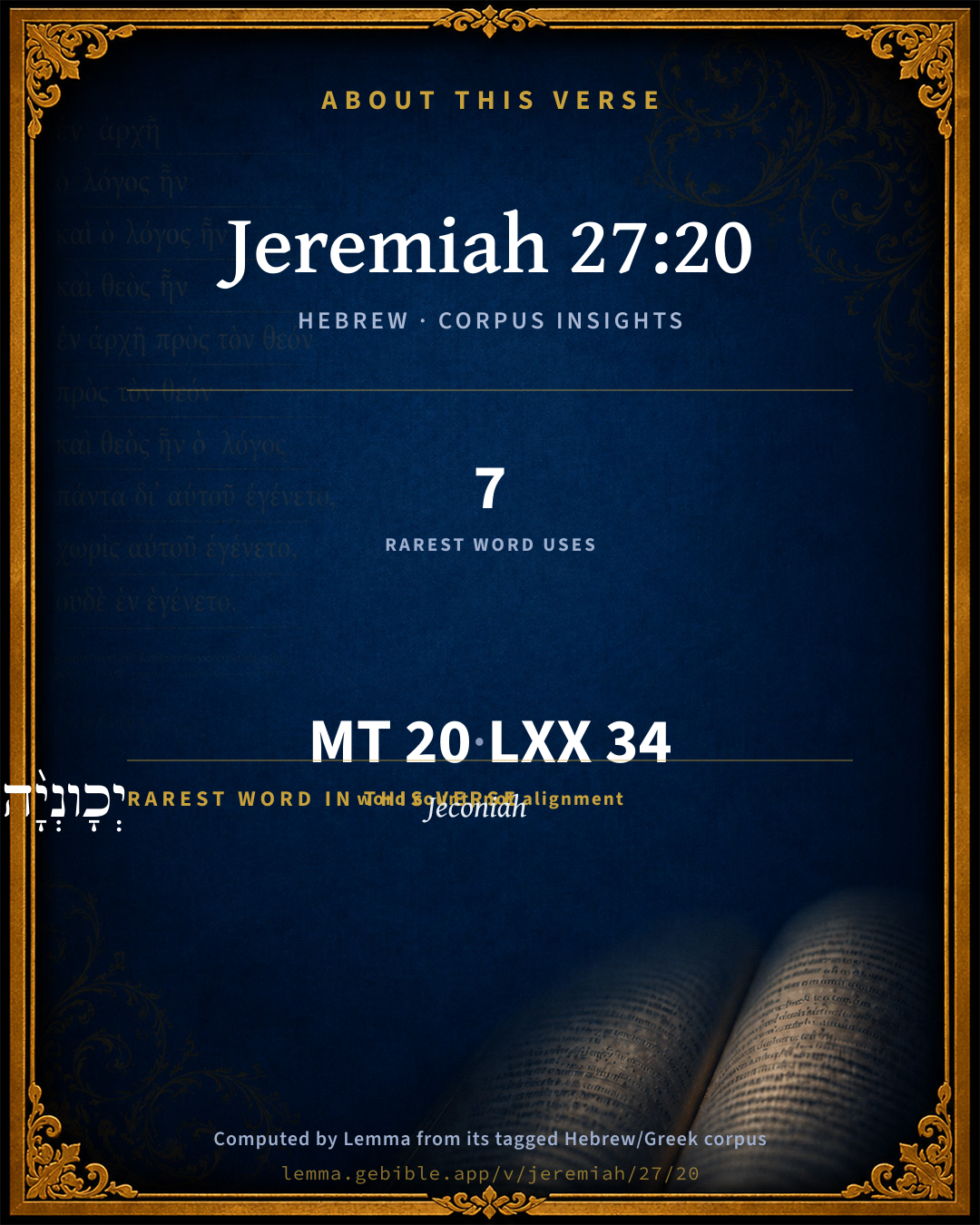
20
words
15
distinct lemmas
Prophets
section

Notable vocabulary

The rarest word here is יְכָונְיָ֨ה Jeconiah H3204 — appearing just 7 times in the whole Hebrew Bible.

Shared distinctive vocabulary

יְכָונְיָ֨ה Jeconiah H3204 occurs in 7 verses of the Hebrew Bible. Also found in:

Grammatical profile

  • 2 verbs
  • 14 nouns
  • 4 particles

Verb forms

  • לְקָחָ֗ם Qal · Perfect
  • בַּ֠גְלוֹתוֹ Hiphil · Infinitive Construct

Repetition

Words recur within this verse — often emphatic in Hebrew:

  • מֶ֣לֶךְ king H4428 ×2
  • בָּבֶ֔ל Babylon H894 ×2
  • יְהוּדָ֛ה Judah H3063 ×2
  • מִירֽוּשָׁלִַ֖ם Jerusalem H3389 ×2

Hebrew & Septuagint length

In the original languages it is 20 Hebrew tokens and 34 Greek tokens — but the two are counted differently (Hebrew bundles its prefixes and suffixes into one token; the Greek is in lemma form), so that isn’t a like-for-like length.

Cross-references

5

Topical passages linked to Jeremiah 27:20 in the Treasury of Scripture Knowledge — connected by theme and wording, ordered by reader-vote popularity; previews shown in the World English Bible.

  • Jeremiah 24:1 Yahweh shown me, and, behold, two baskets of figs set before the temple of Yahweh, after that Nebuchadrezzar king of Babylon had carried away captive Jeconiah the son of Jehoiakim, king of Judah, and the princes of Judah, with the craftsmen and smiths, from Jerusalem, and had brought them to Babylon.
  • 2 Chronicles 36:10 At the return of the year king Nebuchadnezzar sent, and brought him to Babylon, with the goodly vessels of the house of Yahweh, and made Zedekiah his brother king over Judah and Jerusalem.
  • 2 Kings 24:14–16 He carried away all Jerusalem, and all the princes, and all the mighty men of valor, even ten thousand captives, and all the craftsmen and the smiths; none remained, save the poorest sort of the people of the land.
  • 2 Chronicles 36:18 All the vessels of the house of God, great and small, and the treasures of the house of Yahweh, and the treasures of the king, and of his princes, all these he brought to Babylon.
  • Jeremiah 22:28 Is this man Coniah a despised broken vessel? is he a vessel in which none delights? why are they cast out, he and his seed, and are cast into the land which they don't know?

Cross-references courtesy of OpenBible.info (CC BY 4.0).

Hebrew and Greek witnesses Masoretic Hebrew ↔ Greek Septuagint

The same verse in the two great witnesses to the Old Testament, shown verse-for-verse.

These are two independent witnesses, not word-aligned to each other, and the Septuagint is shown in lemma (dictionary) form.

Hebrew Jeremiah 27:20 Masoretic · Westminster Leningrad Codex

אֲשֶׁ֣ר לֹֽא לְקָחָ֗ם נְבֽוּכַדְנֶאצַּר֙ מֶ֣לֶךְ בָּבֶ֔ל בַּ֠גְלוֹתוֹ אֶת יְכָונְיָ֨ה בֶן יְהוֹיָקִ֧ים מֶֽלֶךְ יְהוּדָ֛ה מִירֽוּשָׁלִַ֖ם בָּבֶ֑לָה וְאֵ֛ת כָּל חֹרֵ֥י יְהוּדָ֖ה וִירוּשָׁלִָֽם

which Nebuchadnezzar king of Babylon didn't take, when he carried away captive Jeconiah the son of Jehoiakim, king of Judah, from Jerusalem to Babylon, and all the nobles of Judah and Jerusalem;

World English Bible · Public Domain

Greek LXX Structure differs

In the Septuagint, Jeremiah is about an eighth shorter than the Hebrew and arranges its material differently — the Oracles Against the Nations (Hebrew chapters 46–51) appear in the middle of the Greek book, after 25:13. Because the chapter and verse boundaries do not line up, a verse-for-verse comparison with the Hebrew is not shown.

A verse-for-verse comparison isn’t shown here because the chapters and verses don’t line up. Switch to the LXX edition with the MT / LXX toggle above to read the Greek directly.

Hebrew: Westminster Leningrad Codex (CC BY 4.0). Greek: Septuagint (public domain); English from a public-domain English Septuagint. How the Septuagint differs from the Hebrew →

Targum (Aramaic paraphrase)

1

The Targum is the ancient Jewish Aramaic paraphrase of the Hebrew Scriptures — an interpretive translation, not the Hebrew text itself. Onkelos (literal) and Pseudo-Jonathan (expansive) render the Torah, and Jonathan the Prophets. Coverage is partial: where no permissively-licensed English translation exists for a verse, only the Aramaic is shown. This is verse-level text, not a word-by-word alignment to the Hebrew.

  1. Targum Jonathan Prophets (Joshua–Malachi)
    דְלָא שַׁוִינוּן נְבוּכַדְנֶאצַר מַלְכָּא דְבָבֶל כַּד אַגְלֵי יַת יְכָנְיָה בַּר יְהוֹיָקִים מְלַךְ שִׁבְטָא דְבֵית יְהוּדָה מִירוּשְׁלֵם לְבָבֶל וְיַת כָּל רַבְרְבֵי יְהוּדָה וִירוּשְׁלֵם:

    (no public-domain English translation for this verse)

    Targum Jonathan — Aramaic: “Mikraot Gedolot” (public domain). English: “Sefaria Community Translation” (CC0 1.0 (public-domain dedication)); “London "Chaldee Paraphrase," 1871” (public domain). Text via Sefaria.

Commentary

Notes on Jeremiah 27:20 from classic Christian and Jewish commentators (each source and its license shown beneath its notes). The classic Christian expositions comment on the surrounding passage and are grouped to its opening verse, so a note may address several verses; the Jewish commentaries on the Tanakh (Rashi and others) are per-verse, so they appear only where the commentator wrote on this verse.

Lemma curates 59 commentaries, every one of them public domain or Creative Commons licensed, each selected and text-cleaned for this edition rather than reprinted as found. About our sources →

Trapp's Complete Commentary

John Trapp

Jer 27:20 Which Nebuchadnezzar king of Babylon took not, when he carried away captive Jeconiah the son of Jehoiakim king of Judah from Jerusalem to Babylon, and all the nobles of Judah and Jerusalem;

Ver. 20. Which Nebuchadnezzar took not.] See on Jer 27:19.

John Trapp, A Commentary or Exposition upon All the Books of the Old and New Testament (1647–1656) — public domain. Text from a community e-Sword module.

Tyndale Open Study Notes

Tyndale Open Resources

27:20-22 When Judah’s king Jehoiachin was taken prisoner, King Nebuchadnezzar of Babylon left the large, valuable furniture in the Temple, all of which he carried away in 586 BC.

Tyndale Open Study Notes — © Tyndale Open Resources, licensed CC BY-SA 4.0. Text via the HelloAO Bible API.

John Calvin's Commentaries

And he also adds, The residue of the vessels which remains, in this city By adding, which Nebuchadnezzar king of Babylon took not away, he indirectly condemned the Jews, because they did not acknowledge that the cruelty of their enemy had been moderated by divine power. For we know how cruel were Babylonians, and how insatiable was their avarice, and that nothing would have been left in the Temple had not their hands been in a manner restrained by the hidden power of God. The Jews ought to have duly considered this, and therefore the Prophet alludes to their ingratitude when he says, that Nebuchadnezzar had not taken away the vessels when yet he led captive the king and all the chief men, both of the city and the whole land. There is, indeed, to be understood here a comparison between the less and the greater, as though he had said, “Nebuchadnezzar would not have been so gentle had not God moderated his spirit, for he spared not your king, he led into exile all your chief men; how, then, was it that he left anything to remain in your city, and that the pillars were not taken away? Did he despise them? They have been polished with exquisite skill, and the materials are very costly. Ye hence see that God gave you a proof of his mercy, for some things still remain safe in the city as well as in the Temple; yet ye disregard this so great a benefit bestowed on you by God; what, then, will at length happen to you?” We now perceive the Prophet’s design in these words when he says, that the vessels were not taken away, even when the king was taken captive, and when the chief men of the land were led into exile.

Useful instruction may also be hence gathered. Whenever God chastises us, let us ever consider that he does not proceed to extremities; for the cause of murmuring, and often of despair, is this, — because we think that he deals with us with extreme rigor. But this happens through our sinful and perverted judgment; for God never afflicts us so severely but that some portion of kindness and of moderation ever appears; in a word, his judgments are always founded on his goodness. Were any one, therefore, rightly to call to mind how far he is from suffering extreme evils, it would conduce much to alleviate his sorrows. But when we reject every knowledge of God’s goodness, and only consider his severity, we either murmur or in a manner become furious against him. But this passage teaches us, that when God leaves some residue to us, it is an evidence of his paternal favor, and that therefore something more may be hoped for, provided we from the heart repent.

The design, then, of the Prophet’s warning was, that the Jews might receive this remaining favor of God, and not proceed in their obstinacy until God again stretched forth his hand to destroy them.

John Calvin's Commentaries (1540-1563) — public domain. Text from the Calvin Translation Society English edition (1840s-50s) via the Christian Classics Ethereal Library (ccel.org). Calvin's coverage is partial (roughly two-thirds of the Bible); uncommented books and verses are honest gaps, never fabricated. The 19th-century editor's footnotes and remarks are omitted so the notes are faithfully Calvin's own voice.

The Cambridge Bible for Schools and Colleges

gen. ed. J. J. S. Perowne

20. nobles] The word is not pure Hebrew but Aramaic, and thus may indicate that the clause is a later insertion. It occurs again in Jer_39:6, and in 1Ki_21:8, etc., but is found chiefly in Neh.

The Cambridge Bible for Schools and Colleges (gen. ed. J. J. S. Perowne; Cambridge University Press, 1878–1918) — public domain. Text from a community e-Sword module.

John Gill's Exposition

Which Nebuchadnezzar king of Babylon took not,.... For he seems only to have taken the vessels of gold, and left the vessels of brass, as the above were; see Kg2 24:13;

when he carried away captive Jeconiah, the son of Jehoiakim, king of Judah, from Jerusalem to Babylon, and all the nobles of Judah and Jerusalem; of which see Kg2 24:12.

John Gill's Exposition of the Whole Bible (1746–1763) — public domain (CC PDM 1.0). Text via the HelloAO Bible API.

Matthew Poole's English Annotations

Concerning the persons and things which the king of Babylon then carried away, see 2Ki 24:13-15.

Matthew Poole's English Annotations on the Holy Bible (1683–1685) — public domain. Text from a community e-Sword/MySword module.

Rashi

Rabbi Shlomo Yitzchaki (Rashi)

when he exiled Heb. בַּגְּלוֹתוֹ like בְּהַגְלוֹתוֹ.

the nobles of חֹרֵי, like שָֹרֵי the princes of.

Rashi on the Tanakh — English translations: “The Judaica Press complete Tanach with Rashi, translated by A. J. Rosenberg” (CC BY 4.0); “Pentateuch with Rashi's commentary by M. Rosenbaum and A.M. Silbermann, 1929-1934” (public domain); “The Metsudah Tanach series, Lakewood, N.J” (CC BY 4.0); and “The Book of Joshua, Metsudah Publications, 1997” (CC BY 4.0). Text via Sefaria.

Lesson kit

Teaching starters — assembled from the data on this page, not authored interpretation. Every prompt links to the verse data it draws on. Edit before teaching.

Jeremiah, in the Prophets, opens this verse with 20 words (15 distinct Hebrew lemmas). Its most distinctive word is Yᵉkonyâh (“Jeconiah”). A historical commentator’s framing appears above. Read the whole chapter for the surrounding context.

Discussion questions

  1. How does “Jeconiah” (Yᵉkonyâh) shape what this verse is saying?
  2. 1 Chronicles 3:16 shares the word «Jeconiah» with this verse. How do the two illuminate each other?
  3. “king” occurs 2× in this one verse. What is the effect of the repetition?
  4. These translations render this verse differently. What is at stake in choosing one wording over another?
  5. The verb «לְקָחָ֗ם» is Qal Perfect. How does its form color the action?
  6. Reading how Trapp's Complete Commentary and Tyndale Open Study Notes read this verse, where do the two commentators agree and where do they part?

Things to notice

Reading settings

Reading text

Shown beneath each verse's original-language words.

Old Testament
Old Testament edition

Read the OT as the Masoretic Hebrew (MT) or the Greek Septuagint (LXX).

English shown for the Greek Septuagint (in the Hebrew ↔ Greek comparison).

Comparing translations? Open the Compare panel on any verse page to stack up to four side by side.