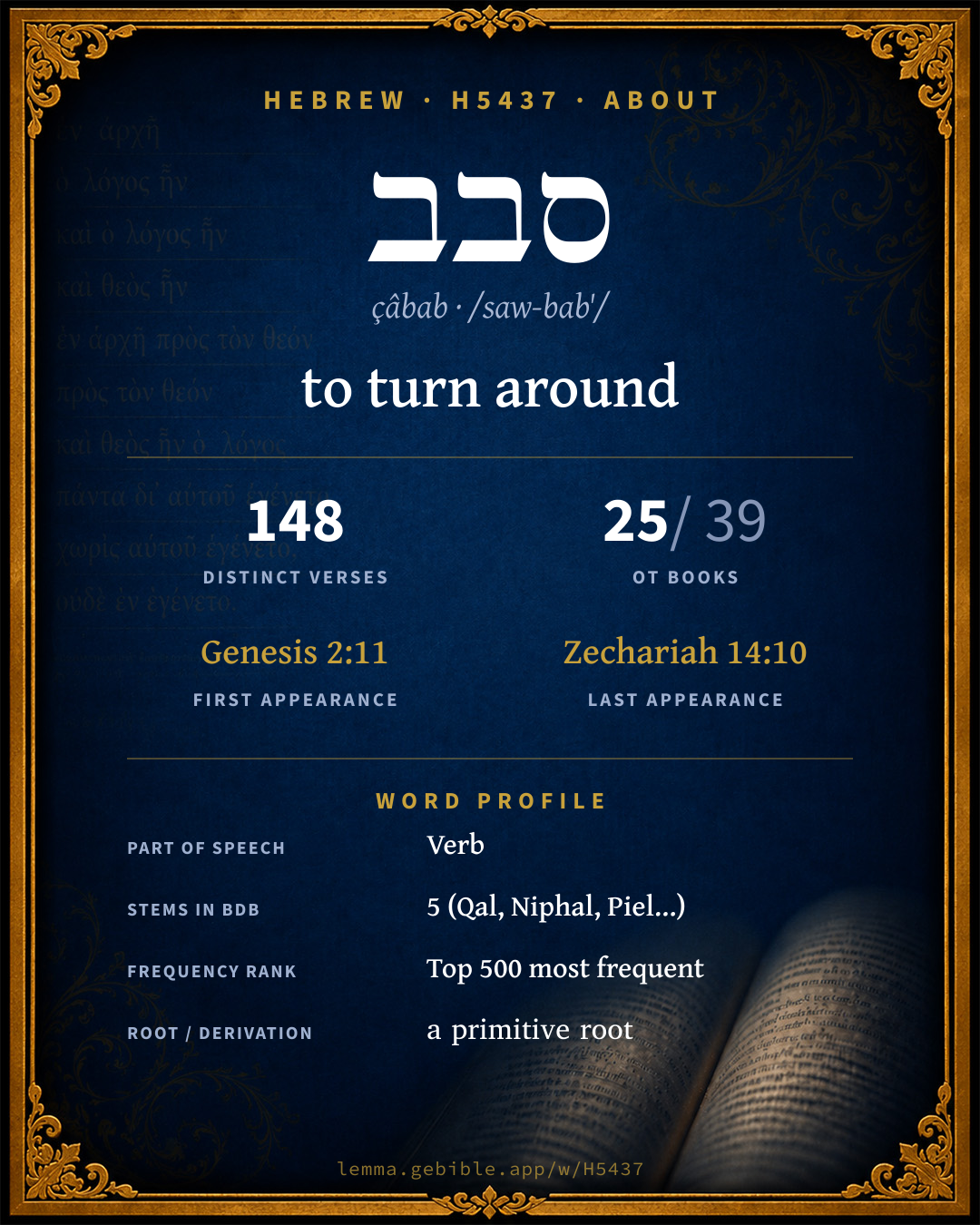
סָבַב
to turn around
‘to turn around’ is one of 2 main senses fuller range ↓
Full lexicon entry — Brown-Driver-Briggs (BDB)
From Brown-Driver-Briggs (BDB)
Where this word appears
See every Qal verb in the Hebrew Bible →
Grammar key — what these labels mean
Part of speech
- Verb
- An action or state-of-being word.
Stem
- Hiphil
- The causative active stem (“he caused / brought about”). Here: ‘turn’
- Qal
- The basic, simple active stem — the plain form of the verb (“he wrote”). Here: ‘turn’
- Niphal
- Usually the simple passive or reflexive of the Qal (“he was written”). Here: ‘turn oneself against’
- Hophal
- The passive counterpart of the Hiphil (“he was caused to…”). Here: ‘be turned’
- Piel
- An intensive or resultative active stem. Here: ‘encompass’
Form
- Sequential Imperfect
- An imperfect with prefixed waw — the standard past-narrative form (waw-consecutive imperfect).
- Perfect
- A completed action or state — Hebrew marks aspect (completeness) more than strict tense (“he wrote”).
- Imperfect
- An incomplete, ongoing, or future action (“he will / would write”).
- Sequential Perfect
- A perfect with prefixed waw continuing a preceding imperfect or command (waw-consecutive perfect).
- Imperative
- A direct command (“write!”).
- Participle Active
- A verbal adjective expressing ongoing or characteristic action (“writing / one who writes”).
- Cohortative
- A first-person volitional form expressing wish or resolve (“let me / let us write”).
- Infinitive Construct
- A bound verbal noun, frequently with prepositions (“to write / in writing”).
- Participle Passive
- A verbal adjective expressing action received (“written”).
- Jussive
- A third- or second-person volitional form expressing wish or command (“let him write”).
State
- Absolute
- The independent form of a noun, not bound to a following word.
- Construct
- A noun bound to a following noun in a possessive / “of” relationship (the construct chain).
Person
- 3rd Person
- The one spoken about (“he / she / it / they”).
- 2nd Person
- The one addressed (“you”).
- 1st Person
- The speaker (“I / we”).
Gender
- Masculine
- Grammatically masculine.
- Common
- Either gender — not distinguished for this form.
- Feminine
- Grammatically feminine.
Number
- Singular
- One.
- Plural
- More than one (in Hebrew, generally three or more).
Grammatical forms 49 distinct
- Verb, Qal, Perfect, 3rd Person, Common, Plural 16 times (10%)
- Verb, Hiphil, Sequential Imperfect, 3rd Person, Masculine, Singular 13 times (8%)
- Verb, Qal, Sequential Imperfect, 3rd Person, Masculine, Plural 11 times (7%)
- Verb, Qal, Sequential Imperfect, 3rd Person, Masculine, Singular 10 times (6%)
- Verb, Qal, Imperfect, 3rd Person, Masculine, Singular 9 times (6%)
- Verb, Qal, Participle Active, Masculine, Singular, Absolute 8 times (5%)
- Verb, Niphal, Imperfect, 3rd Person, Masculine, Plural 6 times (4%)
- Verb, Niphal, Sequential Perfect, 3rd Person, Masculine, Singular 5 times (3%)
+41 more forms (80 occurrences)
Parsed forms decoded from the imported morphology (morphhb / Westminster Leningrad Codex — WLC text public domain, morphhb tagging CC BY 4.0), counted across 158 parsed occurrences — not distinct verses.
Every verse where H5437 appears — 148 distinct verses across 25 books. Click any verse to open its interlinear word-by-word view. Verse text shown in the World English Bible for context — . Each verse’s Hebrew form is shown with its reference; the English is not keyword-highlighted, since the data carries no word-level English alignment. Use “Compare translations” on any verse to read it across multiple English versions. This concordance covers the Hebrew Bible; Septuagint (Greek Old Testament) occurrences are not indexed here.
Genesis 5 verses
- Genesis 2:11 הַ/סֹּבֵ֗ב ptcl def.art + Qal ptcp.act ms The name of the first is Pishon: this is the one which flows through the whole land of Havilah, where there is gold;
- Genesis 2:13 הַ/סּוֹבֵ֔ב ptcl def.art + Qal ptcp.act ms The name of the second river is Gihon: the same river that flows through the whole land of Cush.
- Genesis 19:4 נָסַ֣בּוּ Niphal pf 3cp But before they lay down, the men of the city, the men of Sodom, surrounded the house, both young and old, all the people from every quarter.
- Genesis 37:7 תְסֻבֶּ֨ינָה֙ Qal impf 3fp for, behold, we were binding sheaves in the field, and behold, my sheaf arose and also stood upright; and behold, your sheaves came around, and bowed down to my sheaf."
- Genesis 42:24 וַ/יִּסֹּ֥ב conj + Qal wimpf 3ms He turned himself about from them, and wept, and he returned to them, and spoke to them, and took Simeon from among them, and bound him before their eyes.
Exodus 1 verse
Numbers 6 verses
- Numbers 21:4 לִ/סְבֹ֖ב prep + Qal inf.cs They traveled from Mount Hor by the way to the Red Sea, to compass the land of Edom: and the soul of the people was much discouraged because of the way.
- Numbers 32:38 מֽוּסַבֹּ֥ת Hophal ptcp.pass fp cs and Nebo, and Baal Meon, (their names being changed), and Sibmah: and they gave other names to the cities which they built.
- Numbers 34:4 וְ/נָסַ֣ב conj + Niphal wpf 3ms and your border shall turn about southward of the ascent of Akrabbim, and pass along to Zin; and the goings out of it shall be southward of Kadesh-barnea; and it shall go forth to Hazar Addar, and pass along to Azmon;
- Numbers 34:5 וְ/נָסַ֧ב conj + Niphal wpf 3ms and the border shall turn about from Azmon to the brook of Egypt, and the goings out of it shall be at the sea.
- Numbers 36:7 תִסֹּ֤ב Qal impf 3fs So shall no inheritance of the children of Israel remove from tribe to tribe; for the children of Israel shall cleave everyone to the inheritance of the tribe of his fathers.
- Numbers 36:9 תִסֹּ֧ב Qal impf 3fs So shall no inheritance remove from one tribe to another tribe; for the tribes of the children of Israel shall cleave everyone to his own inheritance.
Deuteronomy 3 verses
- Deuteronomy 2:1 וַ/נָּ֥סָב conj + Qal wimpf 1cs Then we turned, and took our journey into the wilderness by the way to the Red Sea, as Yahweh spoke to me; and we compassed Mount Seir many days.
- Deuteronomy 2:3 סֹ֖ב Qal inf.cs You have compassed this mountain long enough: turn you northward.
- Deuteronomy 32:10 יְסֹֽבְבֶ֨/נְהוּ֙ Poel impf 3ms + sfx pers 3ms He found him in a desert land, In the waste howling wilderness; He compassed him about, he cared for him, He kept him as the apple of his eye.
Joshua 12 verses
- Joshua 6:3 וְ/סַבֹּתֶ֣ם conj + Qal wpf 2mp You shall compass the city, all the men of war, going about the city once. Thus shall you do six days.
- Joshua 6:4 תָּסֹ֥בּוּ Qal impf 2mp Seven priests shall bear seven trumpets of rams' horns before the ark: and the seventh day you shall compass the city seven times, and the priests shall blow the trumpets.
- Joshua 6:7 וְ/סֹ֣בּוּ conj + Qal impv 2mp They said to the people, Pass on, and compass the city, and let the armed men pass on before the ark of Yahweh.
- Joshua 6:11 וַ/יַּסֵּ֤ב conj + Hiphil wimpf 3ms So he caused the ark of Yahweh to compass the city, going about it once: and they came into the camp, and lodged in the camp.
- Joshua 6:14 וַ/יָּסֹ֨בּוּ conj + Qal wimpf 3mp The second day they compassed the city once, and returned into the camp: so they did six days.
- Joshua 6:15 וַ/יָּסֹ֧בּוּ סָבְב֥וּ conj + Qal wimpf 3mp Qal pf 3cp It happened on the seventh day, that they rose early at the dawning of the day, and compassed the city after the same manner seven times: only on the day they compassed the city seven times.
- Joshua 7:9 וְ/נָסַ֣בּוּ conj + Niphal wpf 3cp For the Canaanites and all the inhabitants of the land will hear of it, and will compass us round, and cut off our name from the earth: and what will you do for your great name?
- Joshua 15:3 וְ/נָסַ֖ב conj + Niphal pf 3ms and it went out southward of the ascent of Akrabbim, and passed along to Zin, and went up by the south of Kadesh-barnea, and passed along by Hezron, and went up to Addar, and turned about to Karka;
- Joshua 15:10 וְ/נָסַב֩ conj + Niphal pf 3ms and the border turned about from Baalah westward to Mount Seir, and passed along to the side of Mount Jearim on the north (the same is Chesalon), and went down to Beth-shemesh, and passed along by Timnah;
- Joshua 16:6 וְ/נָסַ֧ב conj + Niphal wpf 3ms and the border went out westward at Michmethath on the north; and the border turned about eastward to Taanath Shiloh, and passed along it on the east of Janoah;
- Joshua 18:14 וְ/נָסַ֨ב conj + Niphal wpf 3ms The border extended [there], and turned about on the west quarter southward, from the mountain that lies before Beth Horon southward; and the goings out of it were at Kiriath Baal (the same is Kiriath Jearim), a city of the children of Judah: this was the west quarter.
- Joshua 19:14 וְ/נָסַ֤ב conj + Niphal pf 3ms and the border turned about it on the north to Hannathon; and the goings out of it were at the valley of Iphtah El;
Judges 5 verses
- Judges 11:18 וַ/יָּ֜סָב conj + Qal wimpf 3ms Then they went through the wilderness, and went around the land of Edom, and the land of Moab, and came by the east side of the land of Moab, and they encamped on the other side of the Arnon; but they didn't come within the border of Moab, for the Arnon was the border of Moab.
- Judges 16:2 וַ/יָּסֹ֛בּוּ conj + Qal wimpf 3mp [It was told] the Gazites, saying, Samson is come here. They compassed him in, and laid wait for him all night in the gate of the city, and were quiet all the night, saying, [Let be] until morning light, then we will kill him.
- Judges 18:23 וַ/יַּסֵּ֖בּוּ conj + Hiphil wimpf 3mp They cried to the children of Dan. They turned their faces, and said to Micah, What ails you, that you come with such a company?
- Judges 19:22 נָסַ֨בּוּ֙ Niphal pf 3cp As they were making their hearts merry, behold, the men of the city, certain base fellows, beset the house round about, beating at the door; and they spoke to the master of the house, the old man, saying, Bring forth the man who came into your house, that we may know him.
- Judges 20:5 וַ/יָּסֹ֧בּוּ conj + Qal wimpf 3mp The men of Gibeah rose against me, and beset the house round about me by night; me they thought to have slain, and my concubine they forced, and she is dead.
1 Samuel 12 verses
- 1 Samuel 5:8 יִסֹּ֔ב וַ/יַּסֵּ֕בּוּ Qal impf 3ms conj + Hiphil wimpf 3mp They sent therefore and gathered all the lords of the Philistines to them, and said, What shall we do with the ark of the God of Israel? They answered, Let the ark of the God of Israel be carried about to Gath. They carried the ark of the God of Israel [there].
- 1 Samuel 5:9 הֵסַ֣בּוּ Hiphil pf 3cp It was so, that after they had carried it about, the hand of Yahweh was against the city with a very great confusion: and he struck the men of the city, both small and great; and tumors broke out on them.
- 1 Samuel 5:10 הֵסַ֤בּוּ Hiphil pf 3cp So they sent the ark of God to Ekron. It happened, as the ark of God came to Ekron, that the Ekronites cried out, saying, They have brought about the ark of the God of Israel to us, to kill us and our people.
- 1 Samuel 7:16 וְ/סָבַב֙ conj + Qal pf 3ms He went from year to year in circuit to Bethel and Gilgal, and Mizpah; and he judged Israel in all those places.
- 1 Samuel 15:12 וַ/יִּסֹּב֙ conj + Qal wimpf 3ms Samuel rose early to meet Saul in the morning; and it was told Samuel, saying, Saul came to Carmel, and, behold, he set him up a monument, and turned, and passed on, and went down to Gilgal.
- 1 Samuel 15:27 וַ/יִּסֹּ֥ב conj + Qal wimpf 3ms As Samuel turned about to go away, [Saul] laid hold on the skirt of his robe, and it tore.
- 1 Samuel 16:11 נָסֹ֖ב Qal impf 1cp Samuel said to Jesse, Are here all your children? He said, There remains yet the youngest, and, behold, he is keeping the sheep. Samuel said to Jesse, Send and get him; for we will not sit down until he come here.
- 1 Samuel 17:30 וַ/יִּסֹּ֤ב conj + Qal wimpf 3ms He turned away from him toward another, and spoke after the same manner: and the people answered him again after the former manner.
- 1 Samuel 18:11 וַ/יִּסֹּ֥ב conj + Qal wimpf 3ms and Saul cast the spear; for he said, I will strike David even to the wall. David avoided out of his presence twice.
- 1 Samuel 22:17 סֹ֥בּוּ Qal impv 2mp The king said to the guard who stood about him, Turn, and kill the priests of Yahweh; because their hand also is with David, and because they knew that he fled, and didn't disclose it to me. But the servants of the king wouldn't put forth their hand to fall on the priests of Yahweh.
- 1 Samuel 22:18 סֹ֣ב וַ/יִּסֹּ֞ב Qal impv 2ms conj + Qal wimpf 3ms The king said to Doeg, Turn you, and fall on the priests. Doeg the Edomite turned, and he fell on the priests, and he killed on that day eighty-five persons who wore a linen ephod.
- 1 Samuel 22:22 סַבֹּ֔תִי Qal pf 1cs David said to Abiathar, I knew on that day, when Doeg the Edomite was there, that he would surely tell Saul: I have occasioned [the death] of all the persons of your father's house.
2 Samuel 8 verses
- 2 Samuel 3:12 לְ/הָסֵ֥ב prep + Hiphil inf.cs Abner sent messengers to David on his behalf, saying, Whose is the land? saying [also], Make your league with me, and, behold, my hand shall be with you, to bring about all Israel to you.
- 2 Samuel 5:23 הָסֵב֙ Hiphil impv 2ms When David inquired of Yahweh, he said, You shall not go up: make a circuit behind them, and come on them over against the mulberry trees.
- 2 Samuel 14:20 סַבֵּב֙ Piel inf.cs to change the face of the matter has your servant Joab done this thing: and my lord is wise, according to the wisdom of an angel of God, to know all things that are in the earth.
- 2 Samuel 14:24 יִסֹּ֣ב וַ/יִּסֹּ֤ב Qal impf 3ms conj + Qal wimpf 3ms The king said, Let him turn to his own house, but let him not see my face. So Absalom turned to his own house, and didn't see the king's face.
- 2 Samuel 18:15 וַ/יָּסֹ֨בּוּ֙ conj + Qal wimpf 3mp Ten young men who bore Joab's armor compassed about and struck Absalom, and killed him.
- 2 Samuel 18:30 סֹ֖ב וַ/יִּסֹּ֖ב Qal impv 2ms conj + Qal wimpf 3ms The king said, Turn aside, and stand here. He turned aside, and stood still.
- 2 Samuel 20:12 וַ/יַּסֵּב֩ conj + Hiphil wimpf 3ms Amasa lay wallowing in his blood in the midst of the highway. When the man saw that all the people stood still, he carried Amasa out of the highway into the field, and cast a garment over him, when he saw that everyone who came by him stood still.
- 2 Samuel 22:6 סַבֻּ֑/נִי Qal pf 3cp + sfx pers 1cs The cords of Sheol were round about me; The snares of death came on me.
1 Kings 8 verses
- 1 Kings 2:15 וַ/תִּסֹּ֤ב conj + Qal wimpf 3fs He said, You know that the kingdom was mine, and that all Israel set their faces on me, that I should reign: however the kingdom is turned about, and is become my brother's; for it was his from Yahweh.
- 1 Kings 5:3 סְבָבֻ֑/הוּ Qal pf 3cp + sfx pers 3ms You know how that David my father could not build a house for the name of Yahweh his God for the wars which were about him on every side, until Yahweh put them under the soles of his feet.
- 1 Kings 7:15 יָסֹ֖ב Qal impf 3ms For he fashioned the two pillars of brass, eighteen cubits high apiece: and a line of twelve cubits compassed either of them about.
- 1 Kings 7:23 יָסֹ֥ב Qal impf 3ms He made the molten sea of ten cubits from brim to brim, round in compass, and the height of it was five cubits; and a line of thirty cubits compassed it round about.
- 1 Kings 7:24 סֹבְבִ֣ים Qal ptcp.act mp Under the brim of it round about there were buds which did compass it, for ten cubits, compassing the sea round about: the buds were in two rows, cast when it was cast.
- 1 Kings 8:14 וַ/יַּסֵּ֤ב conj + Hiphil wimpf 3ms The king turned his face about, and blessed all the assembly of Israel: and all the assembly of Israel stood.
- 1 Kings 18:37 הֲסִבֹּ֥תָ Hiphil pf 2ms Hear me, Yahweh, hear me, that this people may know that you, Yahweh, are God, and [that] you have turned their heart back again.
- 1 Kings 21:4 וַ/יַּסֵּ֥ב conj + Hiphil wimpf 3ms Ahab came into his house sullen and angry because of the word which Naboth the Jezreelite had spoken to him; for he had said, I will not give you the inheritance of my fathers. He laid him down on his bed, and turned away his face, and would eat no bread.
2 Kings 10 verses
- 2 Kings 3:9 וַ/יָּסֹ֕בּוּ conj + Qal wimpf 3mp So the king of Israel went, and the king of Judah, and the king of Edom; and they made a circuit of seven days' journey: and there was no water for the host, nor for the animals that followed them.
- 2 Kings 3:25 וַ/יָּסֹ֥בּוּ conj + Qal wimpf 3mp They beat down the cities; and on every good piece of land they cast every man his stone, and filled it; and they stopped all the springs of water, and felled all the good trees, until in Kir Hareseth [only] they left the stones of it; however the men armed with slings went about it, and struck it.
- 2 Kings 6:15 סוֹבֵ֥ב Qal ptcp.act ms When the servant of the man of God was risen early, and gone forth, behold, a host with horses and chariots was round about the city. His servant said to him, Alas, my master! how shall we do?
- 2 Kings 8:21 הַ/סֹּבֵ֤יב ptcl def.art + Qal ptcp.act ms Then Joram passed over to Zair, and all his chariots with him: and he rose up by night, and struck the Edomites who surrounded him, and the captains of the chariots; and the people fled to their tents.
- 2 Kings 9:18 סֹ֣ב Qal impv 2ms So there went one on horseback to meet him, and said, Thus says the king, Is it peace? Jehu said, What have you to do with peace? turn you behind me. The watchman told, saying, The messenger came to them, but he isn't coming back.
- 2 Kings 9:19 סֹ֥ב Qal impv 2ms Then he sent out a second on horseback, who came to them, and said, Thus says the king, Is it peace? Jehu answered, What have you to do with peace? turn you behind me.
- 2 Kings 16:18 הֵסֵ֖ב Hiphil pf 3ms The covered way for the Sabbath that they had built in the house, and the king's entry outside, turned he to the house of Yahweh, because of the king of Assyria.
- 2 Kings 20:2 וַ/יַּסֵּ֥ב conj + Hiphil wimpf 3ms Then he turned his face to the wall, and prayed to Yahweh, saying,
- 2 Kings 23:34 וַ/יַּסֵּ֥ב conj + Hiphil wimpf 3ms Pharaoh Necoh made Eliakim the son of Josiah king in the room of Josiah his father, and changed his name to Jehoiakim: but he took Jehoahaz away; and he came to Egypt, and died there.
- 2 Kings 24:17 וַ/יַּסֵּ֥ב conj + Hiphil wimpf 3ms The king of Babylon made Mattaniah, [Jehoiachin's] father's brother, king is his place, and changed his name to Zedekiah.
1 Chronicles 5 verses
- 1 Chronicles 10:14 וַ/יַּסֵּב֙ conj + Hiphil wimpf 3ms and didn't inquire of Yahweh: therefore he killed him, and turned the kingdom to David the son of Jesse.
- 1 Chronicles 12:23 לְ/הָסֵ֞ב prep + Hiphil inf.cs These are the numbers of the heads of those who were armed for war, who came to David to Hebron, to turn the kingdom of Saul to him, according to the word of Yahweh.
- 1 Chronicles 13:3 וְ/נָסֵ֛בָּה conj + Hiphil coh 1cp and let us bring again the ark of our God to us: for we didn't seek it in the days of Saul.
- 1 Chronicles 14:14 הָסֵב֙ Hiphil impv 2ms David inquired again of God; and God said to him, You shall not go up after them: turn away from them, and come on them over against the mulberry trees.
- 1 Chronicles 16:43 וַ/יִּסֹּ֥ב conj + Qal wimpf 3ms All the people departed every man to his house: and David returned to bless his house.
2 Chronicles 13 verses
- 2 Chronicles 4:2 יָסֹ֥ב Qal impf 3ms Also he made the molten sea of ten cubits from brim to brim, round in compass; and the height of it was five cubits; and a line of thirty cubits compassed it round about.
- 2 Chronicles 4:3 סוֹבְבִ֣ים Qal ptcp.act mp Under it was the likeness of oxen, which did compass it round about, for ten cubits, compassing the sea round about. The oxen were in two rows, cast when it was cast.
- 2 Chronicles 6:3 וַ/יַּסֵּ֤ב conj + Hiphil wimpf 3ms The king turned his face, and blessed all the assembly of Israel: and all the assembly of Israel stood.
- 2 Chronicles 13:13 הֵסֵב֙ Hiphil pf 3ms But Jeroboam caused an ambush to come about behind them: so they were before Judah, and the ambush was behind them.
- 2 Chronicles 14:7 וְ/נָסֵ֨ב conj + Hiphil impf 1cp For he said to Judah, Let us build these cities, and make about them walls, and towers, gates, and bars; the land is yet before us, because we have sought Yahweh our God; we have sought him, and he has given us rest on every side. So they built and prospered.
- 2 Chronicles 17:9 וַ/יָּסֹ֨בּוּ֙ conj + Qal wimpf 3mp They taught in Judah, having the book of the law of Yahweh with them; and they went about throughout all the cities of Judah, and taught among the people.
- 2 Chronicles 18:31 וַ/יָּסֹ֥בּוּ conj + Qal wimpf 3mp It happened, when the captains of the chariots saw Jehoshaphat, that they said, It is the king of Israel. Therefore they turned about to fight against him: but Jehoshaphat cried out, and Yahweh helped him; and God moved them [to depart] from him.
- 2 Chronicles 21:9 הַ/סּוֹבֵ֣ב ptcl def.art + Qal ptcp.act ms Then Jehoram passed over with his captains, and all his chariots with him: and he rose up by night, and struck the Edomites who surrounded him, along with the captains of the chariots.
- 2 Chronicles 23:2 וַ/יָּסֹ֨בּוּ֙ conj + Qal wimpf 3mp They went about in Judah, and gathered the Levites out of all the cities of Judah, and the heads of fathers' [houses] of Israel, and they came to Jerusalem.
- 2 Chronicles 29:6 וַ/יַּסֵּ֧בּוּ conj + Hiphil wimpf 3mp For our fathers have trespassed, and done that which was evil in the sight of Yahweh our God, and have forsaken him, and have turned away their faces from the habitation of Yahweh, and turned their backs.
- 2 Chronicles 33:14 וְ/סָבַ֣ב conj + Qal pf 3ms Now after this he built an outer wall to the city of David, on the west side of Gihon, in the valley, even to the entrance at the fish gate; and he compassed Ophel about [with it], and raised it up to a very great height: and he put valiant captains in all the fortified cities of Judah.
- 2 Chronicles 35:22 הֵסֵב֩ Hiphil pf 3ms Nevertheless Josiah would not turn his face from him, but disguised himself, that he might fight with him, and didn't listen to the words of Neco from the mouth of God, and came to fight in the valley of Megiddo.
- 2 Chronicles 36:4 וַ/יַּסֵּ֥ב conj + Hiphil wimpf 3ms The king of Egypt made Eliakim his brother king over Judah and Jerusalem, and changed his name to Jehoiakim. Neco took Joahaz his brother, and carried him to Egypt.
Ezra 1 verse
Job 2 verses
Psalms 21 verses
- Psalms 7:7 תְּסוֹבְבֶ֑/ךָּ Poel juss 3fs + sfx pers 2ms Let the congregation of the peoples surround you. Rule over them on high.
- Psalms 17:11 סבבו/ני סְבָב֑וּ/נוּ Qal pf 3cp + sfx pers 1cs Qal pf 3cp + sfx pers 1cp They have now surrounded us in our steps. They set their eyes to cast us down to the earth.
- Psalms 18:5 סְבָב֑וּ/נִי Qal pf 3cp + sfx pers 1cs The cords of Sheol were round about me; The snares of death came on me.
- Psalms 22:12 סְ֭בָבוּ/נִי Qal pf 3cp + sfx pers 1cs Many bulls have surrounded me. Strong bulls of Bashan have encircled me.
- Psalms 22:16 סְבָב֗וּ/נִי Qal pf 3cp + sfx pers 1cs For dogs have surrounded me. A company of evil-doers have enclosed me. They pierced my hands and my feet.
- Psalms 26:6 וַ/אֲסֹבְבָ֖ה conj + Poel coh 1cs I will wash my hands in innocence, So I will go about your altar, Yahweh;
- Psalms 32:7 תְּס֖וֹבְבֵ֣/נִי Poel impf 2ms + sfx pers 1cs You are my hiding place. You will preserve me from trouble. You will surround me with songs of deliverance. Selah.
- Psalms 32:10 יְסוֹבְבֶֽ/נּוּ Poel impf 3ms + sfx pers 3ms Many sorrows shall be to the wicked, But he who trusts in Yahweh, loving kindness shall surround him.
- Psalms 48:12 סֹ֣בּוּ Qal impv 2mp Walk about Zion, and go around her. Number its towers;
- Psalms 49:5 יְסוּבֵּֽ/נִי Qal impf 3ms + sfx pers 1cs Why should I fear in the days of evil, When iniquity at my heels surrounds me?
- Psalms 55:10 יְסוֹבְבֻ֥/הָ Poel impf 3mp + sfx pers 3fs Day and night they prowl around on its walls. Malice and abuse are also within her.
- Psalms 59:6 וִ/יס֥וֹבְבוּ conj + Poel impf 3mp They return at evening, howling like dogs, And prowl around the city.
- Psalms 59:14 וִ/יס֥וֹבְבוּ conj + Poel impf 3mp At evening let them return. Let them howl like a dog, and go around the city.
- Psalms 71:21 וְ/תִסֹּ֥ב conj + Qal impf 2ms Increase my honor, And comfort me again.
- Psalms 88:17 סַבּ֣וּ/נִי Qal pf 3cp + sfx pers 1cs They came around me like water all day long. They completely engulfed me.
- Psalms 109:3 סְבָב֑וּ/נִי Qal pf 3cp + sfx pers 1cs They have also surrounded me with words of hatred, And fought against me without a cause.
- Psalms 114:3 יִסֹּ֥ב Qal impf 3ms The sea saw it, and fled. The Jordan was driven back.
- Psalms 114:5 תִּסֹּ֥ב Qal impf 2ms What was it, you sea, that you fled? You Jordan, that you turned back?
- Psalms 118:10 סְבָב֑וּ/נִי Qal pf 3cp + sfx pers 1cs All the nations surrounded me, But in the name of Yahweh, I cut them off.
- Psalms 118:11 סַבּ֥וּ/נִי סְבָב֑וּ/נִי Qal pf 3cp + sfx pers 1cs Qal pf 3cp + sfx pers 1cs They surrounded me, yes, they surrounded me. In the name of Yahweh I indeed cut them off.
- Psalms 118:12 סַבּ֤וּ/נִי Qal pf 3cp + sfx pers 1cs They surrounded me like bees. They are quenched like the burning thorns. In the name of Yahweh I cut them off.
Proverbs 1 verse
Ecclesiastes 5 verses
- Ecclesiastes 1:6 וְ/סוֹבֵ֖ב סוֹבֵ֤ב סֹבֵב֙ conj + Qal ptcp.act ms Qal ptcp.act ms Qal ptcp.act ms The wind goes toward the south, and turns around to the north. It turns around continually as it goes, and the wind returns again to its courses.
- Ecclesiastes 2:20 וְ/סַבּ֥וֹתִֽי conj + Qal pf 1cs Therefore I began to cause my heart to despair concerning all the labor in which I had labored under the sun.
- Ecclesiastes 7:25 סַבּ֨וֹתִֽי Qal pf 1cs I turned around, and my heart sought to know and to search out, and to seek wisdom and the scheme of things, and to know that wickedness is stupidity, and that foolishness is madness.
- Ecclesiastes 9:14 וְ/סָבַ֣ב conj + Qal pf 3ms There was a little city, and few men within it; and a great king came against it, besieged it, and built great bulwarks against it.
- Ecclesiastes 12:5 וְ/סָבְב֥וּ conj + Qal wpf 3cp Yes, they shall be afraid of heights, And terrors will be in the way; And the almond tree shall blossom, And the grasshopper shall be a burden, And desire shall fail; Because man goes to his everlasting home, And the mourners go about the streets:
Song of Solomon 5 verses
- Song of Solomon 2:17 סֹב֩ Qal impv 2ms Until the day is cool, and the shadows flee away, Turn, my beloved, And be like a roe or a young hart on the mountains of Bether.
- Song of Solomon 3:2 וַ/אֲסוֹבְבָ֣ה conj + Poel coh 1cs I will get up now, and go about the city; In the streets and in the squares I will seek him whom my soul loves. I sought him, but I didn't find him.
- Song of Solomon 3:3 הַ/סֹּבְבִ֖ים ptcl def.art + Qal ptcp.act mp The watchmen who go about the city found me; "Have you seen him whom my soul loves?"
- Song of Solomon 5:7 הַ/סֹּבְבִ֥ים ptcl def.art + Qal ptcp.act mp The watchmen who go about the city found me. They beat me. They bruised me. The keepers of the walls took my cloak away from me.
- Song of Solomon 6:5 הָסֵ֤בִּי Hiphil impv 2fs Turn away your eyes from me, For they have overcome me. Your hair is like a flock of goats, That lie along the side of Gilead.
Isaiah 3 verses
- Isaiah 23:16 סֹ֥בִּי Qal impv 2fs Take a harp, go about the city, you prostitute that has been forgotten; make sweet melody, sing many songs, that you may be remembered.
- Isaiah 28:27 יוּסָּ֑ב Hophal impf 3ms For the dill are not threshed with a sharp [threshing] instrument, neither is a cart wheel turned about on the cumin; but the dill are beaten out with a staff, and the cumin with a rod.
- Isaiah 38:2 וַ/יַּסֵּ֧ב conj + Hiphil wimpf 3ms Then Hezekiah turned his face to the wall, and prayed to Yahweh,
Jeremiah 6 verses
- Jeremiah 6:12 וְ/נָסַ֤בּוּ conj + Niphal wpf 3cp Their houses shall be turned to others, their fields and their wives together; for I will stretch out my hand on the inhabitants of the land, says Yahweh.
- Jeremiah 21:4 מֵסֵב֮ Hiphil ptcp.act ms Thus says Yahweh, the God of Israel, Behold, I will turn back the weapons of war that are in your hands, with which you fight against the king of Babylon, and against the Chaldeans who besiege you, without the walls; and I will gather them into the midst of this city.
- Jeremiah 31:22 תְּס֥וֹבֵֽב Poel impf 3fs How long will you go here and there, you backsliding daughter? for Yahweh has created a new thing in the earth: a woman shall encompass a man.
- Jeremiah 31:39 וְ/נָסַ֖ב conj + Niphal wpf 3ms The measuring line shall go out further straight onward to the hill Gareb, and shall turn about to Goah.
- Jeremiah 41:14 וַ/יָּסֹ֨בּוּ֙ conj + Qal wimpf 3mp So all the people who Ishmael had carried away captive from Mizpah turned about and came back, and went to Johanan the son of Kareah.
- Jeremiah 52:21 יְסֻבֶּ֑/נּוּ Qal impf 3ms + sfx pers 3ms As for the pillars, the height of the one pillar was eighteen cubits; and a line of twelve cubits did compass it; and the thickness of it was four fingers: it was hollow.
Ezekiel 10 verses
- Ezekiel 1:9 יִסַּ֣בּוּ Niphal impf 3mp their wings were joined one to another; they didn't turn when they went; they went everyone straight forward.
- Ezekiel 1:12 יִסַּ֖בּוּ Niphal impf 3mp They went everyone straight forward: where the spirit was to go, they went; they didn't turn when they went.
- Ezekiel 1:17 יִסַּ֖בּוּ Niphal impf 3mp When they went, they went in their four directions: they didn't turn when they went.
- Ezekiel 7:22 וַ/הֲסִבּוֹתִ֤י conj + Hiphil wpf 1cs My face will I turn also from them, and they shall profane my secret [place]; and robbers shall enter into it, and profane it.
- Ezekiel 10:11 יִסַּ֖בּוּ יִסַּ֖בּוּ Niphal impf 3mp Niphal impf 3mp When they went, they went in their four directions: they didn't turn as they went, but to the place where the head looked they followed it; they didn't turn as they went.
- Ezekiel 10:16 יִסַּ֧בּוּ Niphal impf 3mp When the cherubim went, the wheels went beside them; and when the cherubim lifted up their wings to mount up from the earth, the wheels also didn't turn from beside them.
- Ezekiel 26:2 נָסֵ֣בָּה Niphal pf 3fs Son of man, because Tyre has said against Jerusalem, Aha, she is broken: the gate of the peoples; she is turned to me; I shall be replenished, now that she is laid waste:
- Ezekiel 41:7 וְֽ/נָסְבָה֩ conj + Niphal pf 3fs The side-chambers were broader as they encompassed [the house] higher and higher; for the encompassing of the house went higher and higher round about the house: therefore the breadth of the house [continued] upward; and so one went up [from] the lowest [chamber] to the highest by the middle [chamber].
- Ezekiel 42:19 סָבַ֖ב Qal pf 3ms He turned about to the west side, and measured five hundred reeds with the measuring reed.
- Ezekiel 47:2 וַ/יְסִבֵּ֨/נִי֙ conj + Hiphil wimpf 3ms + sfx pers 1cs Then he brought me out by the way of the gate northward, and led me round by the way outside to the outer gate, by the way of [the gate] that looks toward the east; and, behold, there ran out waters on the right side.
Hosea 2 verses
- Hosea 7:2 סְבָב֣וּ/ם Qal pf 3cp + sfx pers 3mp They don't consider in their hearts that I remember all their wickedness. Now their own deeds have engulfed them. They are before my face.
- Hosea 11:12 סְבָבֻ֤/נִי Qal pf 3cp + sfx pers 1cs Ephraim surrounds me with falsehood, And the house of Israel with deceit; And Judah still us unruly with God, And is unfaithful to the Holy One.
Jonah 2 verses
- Jonah 2:3 יְסֹבְבֵ֑/נִי Poel impf 3ms + sfx pers 1cs For you threw me into the depths, In the heart of the seas. The flood was all around me. All your waves and your billows passed over me.
- Jonah 2:5 יְסֹבְבֵ֑/נִי Poel impf 3ms + sfx pers 1cs The waters surrounded me, Even to the soul. The deep was around me. The weeds were wrapped around my head.
Habakkuk 1 verse
Zechariah 1 verse
About this entry
At a glance — auto-summarized from this page’s data, not written by a person. Every figure links to its source below. This summary describes the numbers; it doesn’t interpret them.
סבב — transliterated çâbab — is a Hebrew verb carrying the sense “to turn around.” The King James Version usually renders it “turned,” while modern versions prefer “and” (unfoldingWord Literal Text) — see the renderings breakdown. With 148 verses in 25 books, it is a common word in the Hebrew Bible. Debuting at Genesis 2:11, it then recurs through the corpus. Across 5 stems, its meaning turns on the binyan (Qal, Niphal). Dig into 148-verse concordance and the renderings breakdown below.
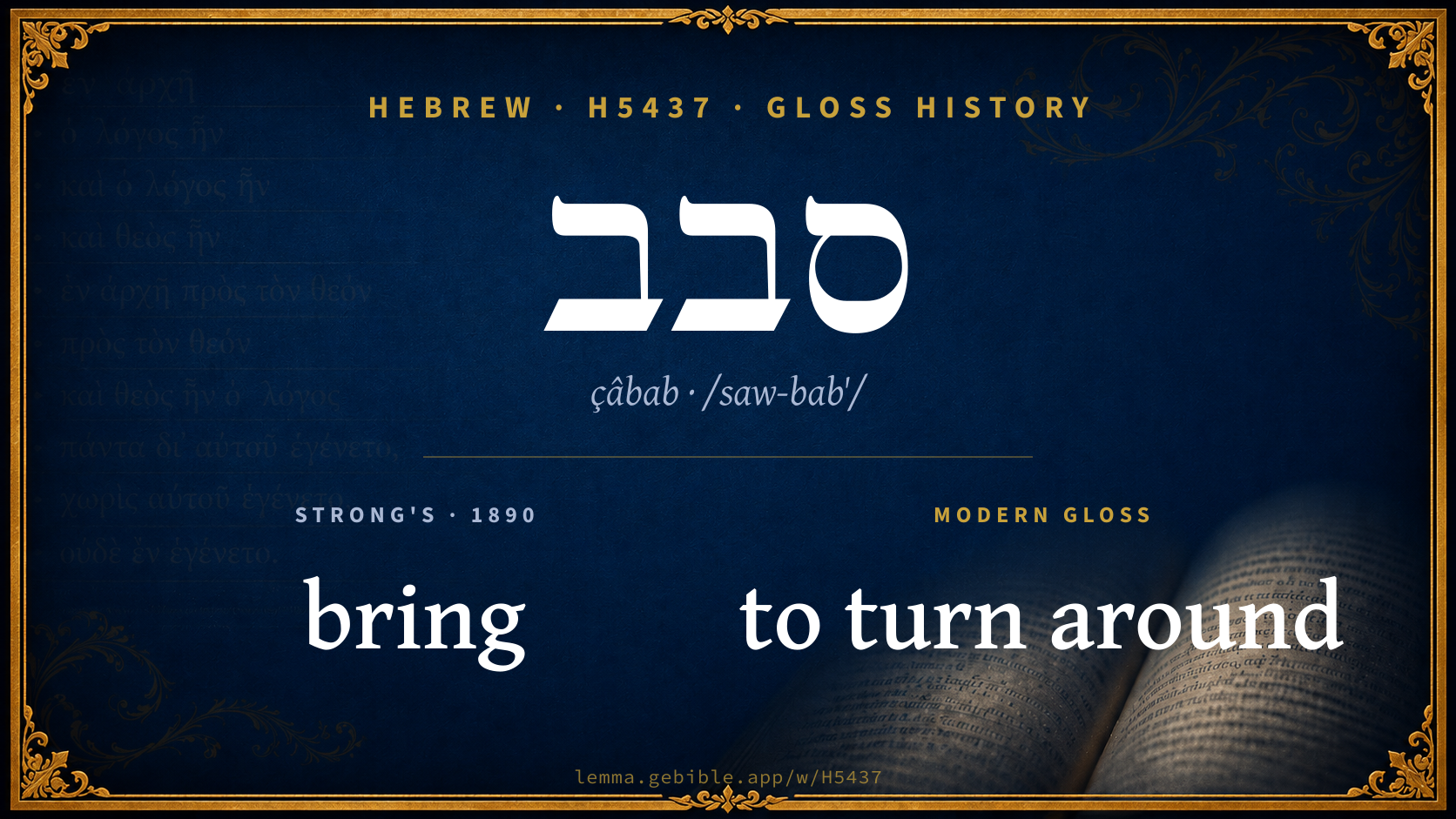
Gloss history
Strong's 1890 vs modern scholarship
About this word
Strong's H5437 catalogs a Hebrew word from the Hebrew Old Testament.
These counts are not copied from any lexicon or concordance. They are computed here, from the morphology-tagged Hebrew Old Testament. What Lemma adds →
- 148
- distinct verses
- The word appears in 148 distinct verses.
- 25 / 39
- OT books
- The word appears in 25 of 39 Old Testament books.
- #290
- by frequency
- Top 500 most frequent Hebrew words (rank 290 of 8,640 Hebrew words by occurrence).
View all 148 occurrences in the concordance →
Most concentrated in
- Psalms 21 verses 14%
- 2 Chronicles 13 verses 9%
- Joshua 12 verses 8%
By section of the Old Testament
By traditional corpus
Conventional, traditional groupings — biblical authorship is debated, so this is a traditional corpus grouping, not an authorship claim. Each share is this word’s portion of its verses in that division of the Hebrew canon. Each figure is a share of the word’s 148 distinct verses.
- Prophets (Nevi'im) 80 verses · 54%
- Writings (Ketuvim) 53 verses · 36%
- Torah (Pentateuch) 15 verses · 10%
How translations render this word
Counts come from each version’s own published word-to-Strong’s tagging or interlinear alignment — an approximate guide to how each version renders this word, not a word-level alignment the data otherwise carries. Because each total is that version’s own tagged count, the per-version totals vary from one another and need not match the appearance or distinct-verse counts above. These counts may also differ from a printed concordance because Lemma counts each distinctly tagged rendering and does not collapse phrase taggings into a single head-word total. This is a fixed set of word-tagged versions (KJV, ASV, BSB, ULT) and does not change with the reading translation you choose elsewhere. Each version’s license is shown beside its name below (and on Sources).
- King James Version: Turned 10×, Compassed 8×, They turned 6×
- American Standard Version: Turned 10×, About 5×, Compassed 5×
- Berean Standard Bible: Turned 8×, Surrounded 6×, Turn 5×
- unfoldingWord Literal Text: And 15×, Turn 12×, Go around 10×
King James Version Public Domain
Renders H5437 across 162 tagged occurrences — most commonly:
Plus other, less common renderings. Plus 80 renderings that appear only once — usually multi-word phrases or single function words the recovered tagging swept in, not distinct renderings.
American Standard Version Public Domain
Renders H5437 across 158 tagged occurrences — most commonly:
Plus other, less common renderings. Plus 81 renderings that appear only once — usually multi-word phrases or single function words the recovered tagging swept in, not distinct renderings.
Berean Standard Bible Public Domain
Renders H5437 across 153 tagged occurrences — most commonly:
Plus other, less common renderings. Plus 90 renderings that appear only once — usually multi-word phrases or single function words the recovered tagging swept in, not distinct renderings. Not rendered by a distinct English word in 8 further occurrences.
unfoldingWord Literal Text CC BY-SA 4.0
Renders H5437 across 191 tagged occurrences — most commonly:
Plus other, less common renderings. Plus 63 renderings that appear only once — usually multi-word phrases or single function words the recovered tagging swept in, not distinct renderings.
30 senses and sub-senses in the full BDB
Hebrew verbs can shift meaning by stem (binyan): Qal is the basic action, Niphal is often passive or reflexive, Piel often intensifies or makes it factitive, and Hiphil is typically causative. The senses below are grouped under the stem BDB assigns to each. This entry also uses Hophal (the passive of Hiphil).
What do BDB’s symbols mean?
BDB uses these scholarly abbreviations:
| Symbol | Meaning |
|---|---|
| 𝔊 | the Septuagint (the ancient Greek translation, LXX) |
| 𝔙 | the Vulgate (the Latin translation) |
| 𝔖 | the Syriac version (the Peshitta) |
| 𝔗 | the Targum (the Aramaic translation) |
| ψ | the Psalms |
| √ | root (the underlying root or stem) |
| ‖ | parallel passage (a synonymous or contrasted parallel) |
| † | the dagger: every passage where the word occurs is cited |
The 30 senses and sub-senses the full Brown-Driver-Briggs lexicon distinguishes for this word, in lexicon order (not ranked by frequency), with BDB’s own verbatim wording and sub-sense lettering. Shown in Hebrew script with BDB’s own scholarly abbreviations. The condensed entry is in the Lexicon Entry tab. See also the Forms in the corpus table below.
Qal
- Pf. 3 ms. ס׳ Ez 42:19 +; 1 s. סַבֹּ֫תִי 1 S 22:22 (but v. infr.), סַבּ֫וֹתִי Ec 2:20; 7:25; 3 pl. סָֽבְבוּ Jos 6:15 + 1 S 14:21; 2 S 24:6 (v. infr.), sf. סְבָבוּנִי ψ 18:6 +, סַבּוּנִי 88:18 + 2 times, סַבֻּנִי 2 S 22:6; 2 mpl. וְסַבֹּתֶם consec. Jos 6:3, etc.; Impf. יָסֹב 1 K 7:15 +, sf. יְסֻבֵּנִי ψ 49:6; oftener יִסֹּב 1 S 5:8 +, וַיִּסֹּב Gn 42:24 +; 3 mpl. יָסֹ֫בּוּ Jb 16:13, וַיָּסֹ֫בּוּ Jos 6:14 +, 3 fpl. תְּסֻבֶּינָה Gn 37:7, etc.; Imv. ms. סֹב 1 S 22:18, fs. סֹ֫בִּי Is 23:16, etc.; Inf. cstr. לִסְבֹּב Nu 21:4, סֹב Dt 2:3; Pt. סוֹבֵב 2 K 6:15 +, הַסֹּבֵיב 8:21 (Ginsb הִסְבִּיב Kt, הַסֹּבֵב Qr), etc.;— e.g. Ezekiel 42:19
- 1. turn, intrans. (Impf. of form יִסֹּב in this sense only):
- a. turn about, often as preliminary to something else 1 S 15:12, 27 (sq. inf.), 1 Ch 16:43 (id.; וַיָּ֫שָׁב in ‖ 2 S 6:20) + 1 S 14:21 (read סָֽבְבוּ גַם for MT סָבִיב וְגַם, 𝔊 𝔖 𝔙 Th We, etc.), Je 41:14a (+ שׁוב v b, but 𝔊 om. v a cf. Gie), Ec 1:6(×2); of door, Pr 26:14 turn on (עַל) its hinge (cf. Niph. Ez 26:2); turn (toward one) 1 S 22:17, 18(×2) 2 S 18:30x2; Ct 2:17 (v. Bu); also c. אֶל־ 2 S 14:24(×2) + 24:6 (read סָֽבְבוּ for סָבִיב We Dr Bu Kit HPS; Klo יָסֹבּוּ, cf. Löhr), Ez 42:19 Ec 1:6, אֶל־אַחֲרָ֑י 2 K 9:18, 19; of cup of י׳, it shall come round unto (עַל־, with hostile implic.; עָבַר עַל La 4:22) Hb 2:16; of Jordan, turn לְאָחוֹר ψ 114:3, 5; turn about from (מֵעַל) Gn 42:24, (מִן) 1 S 18:11, + אֶל־ 17:30; so of inheritance Nu 36:7 it shall not go about from (מִן) tribe to (אֶל־) tribe, also v 9 (לְ for אֶל־); cf. (abs.) וַתִּסֹּב הַמְּלוּכָה וַתְּהִי לְאָחִי 1 K 2:15 (cf. Hiph. 1 b); = be brought round, c. acc. loc. 1 S 5:8 (of ark). e.g. 1 Samuel 15:12
- b. turn = change, only Zc 14:10 (of land, changed like [כְּ, i.e. into] a plain), cf. Hiph. 1 c. e.g. Zechariah 14:10
- c. fig. turn (in a new direction) to do something (inf.) Ec 2:20; 7:25.—ψ 71:21 is dub.; Bae reads וְתָשֻׁב for וְתִסֹּב after 𝔊 𝔖 𝔙; Hup-Now Che al. sub a. supr.: turn, comfort me.—Jb 10:8 read אַחַר תִּסֹּב for MT יחד סביב De al. e.g. Ecclesiastes 2:20
- 2.
- a. march, or walk, around, c. acc. (city) Jos 6:3, 4, 7, 14, 15(×2) (all JE), ψ 48:13; poss. also נָסֹב 1 S 16:11 (of marching about altar? so HPS; turn to do something else Th), but cf. תסוב Ecclus 32:1 sit about a table (v. SchechterBS p. 56, and cf. מֵסַב), or read נֵשֵׁב Weir in Dr Kit Bu Löhr (perhaps). e.g. Joshua 6:3
- b. go partly round, circle about, skirt, c. acc. (land) Nu 21:4 (JE) Ju 11:18, also Dt 2:1, 3; of rivers Gn 2:11, 13. e.g. Numbers 21:4
- c. make a round, or circuit, go about to, c. acc. loc. 1 S 7:16; go about in (בְּ) 2 Ch 17:9, cf. also (c. בְּ) 23:2 Ct 3:5; 5:7 Ec 12:5, so c. acc. Is 23:16; = make a circuitous march 2 K 3:9 (c. acc. דֶּרֶךְ).—Vid. also 2 S 5:23 1 Ch 14:14 Hiph. 2 a. e.g. 1 Samuel 7:16
- d. surround, encompass, abs. Gn 37:7 (E); c. acc. Jb 40:22; with hostile purpose, 2 K 6:15 Ec 9:14 (both of siege), cf. 2 K 3:25; acc. om. Ju 16:2, cf. 2 S 18:15; c. acc. rei + עַל־ pers. Ju 20:5; c. עַל־ pers. alone Jb 16:13 2 Ch 18:31; c. אֶל־ pers. 2 K 8:21 = 2 Ch 21:9; often fig. in poetry, c. acc. Ho 7:2 2 S 22:6 = ψ 18:6, ψ 22:13, 17; 49:6; 88:18; 118:10, 11(×2), 12; so also ψ 17:11 (Kt סְבָבוּנִי, Qr סְבָבוּנוּ; on text v. especially Hup-Now); lit. of cord surrounding (measuring circumf. of), c. acc. 1 K 7:15 = Je 52:21, 1 K 7:23 = 2 Ch 4:2; of ornaments, etc., surrounding something (acc.) 1 K 7:24 2 Ch 4:3; surround one with something (2 acc.) 1 K 5:17 ψ 109:3; acc. + בְּ instr. Ho 12:1; ס׳ לָעֹפֶל 2 Ch 33:14 (i.e. build a wall around it).—1 S 22:22 read חַבְתִּי (√ חוּב), 𝔊 𝔖 Th We Dr Kit Bu Löhr HPS. e.g. Genesis 37:7
Niphal
- Pf. 3 ms. נָסַב Jos 15:3 +; 3 fs. נָסֵ֫בָּה Ez 26:2 (Ges§ 67 t St§ 410 b Köi. 342); וְנָֽסְבָה 41:7 (but read וְנוֹסְפָה Ew Sm Co ToyHpt, cf. Berthol); 3 pl. נָסַ֫בּוּ Gn 19:4 +; Impf. 3 mpl. יִסַּ֫בּוּ Ez 1:9 + 5 times;— e.g. Joshua 15:3
- 1.
- a. turn oneself against (עַל־), close round upon (עַל) Gn 19:4 (J) Jos 7:9 (JE); c. acc. Ju 19:22. e.g. Genesis 19:4
- b. turn round (from a direct course), of wheels Ez 1:9, 12, 17; 10:11(×2), also v 16 (but dub., Co ישׁבו, ToyHpt leave, Symm ἀπελείποντο); נָסַ֫בָּה אֵלַי Ez 26:2 of Jerus. under fig. of door (Sm Co Berthol ToyHpt). e.g. Ezekiel 1:9
- c. especially of boundary (Hex only P): turn round from (מִן), toward (לְ) Nu 34:4, + ה loc. Jos 18:14; c. מִן + ה loc. + אֶל־ 15:10; c. מִן alone Nu 34:5; c. ה loc. alone Je 31:39 Jos 15:3; 16:6; circle about, skirt, c. acc. Jos 19:14. e.g. Numbers 34:4
- 2. pass. be turned over to (לְ, into the power of, Je 6:12. e.g. Jeremiah 6:12
Piel
- Inf. cstr. סַבֵּב אֶת־פְּנֵי הַדָּבָר 2 S 14:20 to change, transform, the aspect of the matter. Poʿ. Impf. 3 ms. sf. יְסֹבְבֵנִי Jon 2:4, 6, יְסֹבְבֶנְהוּ Dt 32:10, יְסוֹבְבֶנּוּ ψ 32:10; 3 fs. תְּסוֹבֵב Je 31:22, etc.;—encompass, surround (poet. and chiefly late):— e.g. 2 Samuel 14:20
- 1. encompass (with protection), c. acc. Dt 32:10 (י׳ subj.), c. 2 acc. חֶסֶד יְסוֹבְבֶנּוּ ψ 32:10, cf. v 7 (but 2nd obj. here dub.); similarly נְקֵבָה תְּסוֹבֵב נָּ֑בֶר Je 31:22 i.e. either shall protect (so most) or (Che, cf. Gf) the woman (fig. of Isr.), instead of holding aloof (הַבַּת הַשּׁוֹבֵבָה v 22), will, in the new future which י׳ creates, with affection press round her divine husband. e.g. Deuteronomy 32:10
- 2. come about, assemble round (acc. pers. י׳) ψ 7:8. e.g. Psalms 7:8
- 3. march or go about, city (acc.) ψ 55:11; 59:7, 15; altar (in solemn procession) 26:6; go about in (בְּ) city Ct 3:2. e.g. Psalms 55:11
- 4. enclose, envelop, c. acc. pers. Jon 2:4, 6 (of waters). e.g. Jonah 2:4
Hiphil
- Pf. 3 ms. הֵסֵב 2 K 16:18 +; 2 ms. הֲסִבֹּ֫תָ 1 K 18:37; 3 pl. הֵסַ֫בּוּ 1 S 5:9, 10, etc.; Impf. 3 ms. וַיַּסֵּב Ex 13:18 +, sf. וַיְסִבֵּ֫נִי Ez 47:2; 3 mpl. וַיַּסֵּ֫בּוּ Ju 18:23 + 2 times; 1 pl. נָסֵב 2 Ch 14:6, cohort. נָסֵ֫בָּה 1 Ch 13:3; Imv. ms. הָסֵב 2 S 5:23 1 Ch 14:14 (but v. infr.); fs. הָסֵ֫בִּי Ct 6:5; Inf. cstr. הָסֵב 2 S 3:12 1 Ch 12:23; Pt. מֵסֵב Je 21:4; perhaps also pl. sf. מְסִבָּ֑י ψ 140:10 (Ginsb);— e.g. 2 Kings 16:18
- 1.
- a. turn (trans.), cause to turn: turn face (acc.) Ju 18:23 1 K 8:14 = 2 Ch 6:3 (all = turn toward); = turn round face 1 K 21:4, + אֶל־הַקִּיר 2 K 20:2 = Is 38:2; + מִן Ez 7:22 (subj. י׳), 2 Ch 29:6 (of neglect), 35:22 (of avoiding battle); turn away eyes from (מִן), Ct 6:5; turn (back), change heart 1 K 18:37 (recall from apostasy; + אֲחֹרַנִּית), Ezr 6:22 (+ עַל־); turn back, reverse (weapons) Je 21:4. e.g. Judges 18:23
- b. bring over (i.e. to allegiance), c. acc. + אֶל־ pers., 2 S 3:12 1 Ch 12:24 (van d. H. v 23); of י׳, turn over kingdom to (לְ) 1 Ch 10:14 (cf. Qal 1 a, 1 K 2:15). e.g. 2 Samuel 3:12
- c. turn into, of changing name, 2 acc. 2 K 23:34 = 2 Ch 36:4, 2 K 24:17. e.g. 2 Kings 23:34
- d. = bring round, c. acc. 1 S 5:8, 9; + מִן 2 S 20:12; + אֶל־ 1 S 5:10 1 Ch 13:3; + acc. loc. 2 K 16:18 (sense obscure). e.g. 1 Samuel 5:8
- 2.
- a. cause to go around: of carrying ark around city (2 acc.) Jos 6:11 (JE; but Qal 𝔊 𝔖 𝔙); lead round, i.e. by a round-about way, acc. pers. + acc. דֶּרֶךְ Ex 13:18 (E) Ez 47:2; c. acc. + inf. of purpose 2 Ch 13:13; acc. om., lead round toward (אֶל־) 2 S 5:23, away from (מֵעַל־) ‖ 1 Ch 14:14 (where, however, perhaps read as S, so Be Öt, and, in both, סֹב for הָסֵב Dr KitKau Hpt Bu HPS Löhr). e.g. Joshua 6:11
- b. surround with (acc.) wall, 2 Ch 14:6 (acc. of city om.). e.g. 2 Chronicles 14:6
- c. perhaps also encompass (as foe), מְסִבָּ֑י ψ 140:10 those encompassing me (others sub מֵסַב infr.). e.g. Psalms 140:10
Hophal
- Impf. 3 ms. יוּסָּ֑ב Is 28:27; Pt. fpl. cstr. מֻסַבֹּת Ex 28:11; 39:6; מוּסַבֹּת v 13 Nu 32:38 (v. infr.); מוּסַבּוֹת Ez 41:24;— e.g. Isaiah 28:27
- 1. be turned, of cart wheel, c. עַל־ upon, over; מוּסַבּוֹת דְּלָתוֹת Ez 41:24 pt. appar. as gerundive, that can be turned, movable (Ges§ 116 e; Co reads צלעות מ׳, cf. ToyHpt); מוּס׳ שֵׁם Nu 32:38 turned (i.e. changed) as to name, but gloss, v. Di. e.g. Ezekiel 41:24
- 2. surrounded, i.e. set, of jewels (pt. cstr.) Ex 28:11; 39:6, 13 (all P). e.g. Exodus 28:11
Senses from the full Brown-Driver-Briggs lexicon (Brown, Driver, Briggs; Oxford 1906 — public domain), digitized via Sefaria, supplemented by the OpenScriptures HebrewLexicon (CC BY 4.0). Full attribution on Sources.
Word origin
vb. turn about, go around, surround (NH id., Pi. Hiph., and deriv.; Aramaic סוֹבְבָא rim, border; Arabic سَبَبٌ rope, سَبِيبٌ lock of hair; poss. also سَبٌّ ii. prepare a means of attaining sthg. Lane1284);—
— Brown-Driver-Briggs (Oxford 1906, public domain), digitized via Sefaria, supplemented by the OpenScriptures HebrewLexicon (CC BY 4.0). See Sources.
Origin: a primitive root
Jastrow Dictionary
A second Hebrew/Aramaic lexicon for comparison, covering Aramaic and post-biblical (Talmudic, Targumic, Midrashic) usage that the biblical-Hebrew BDB does not. Matched by lemma rather than by Strong’s number, so a lemma may carry more than one Jastrow headword (shown separately below), and the entries cover usage well beyond the Bible.
סָבַב
- (b. h.) to go around, turn. Num. R. s. 18 כשהייתי … והולך וסוֹבֵב כל וכ׳ when I travelled … and went around all the towns; הייתי סובב והולך מעיר וכ׳ I went around from town to town. Erub. 56ᵃ וסובב אל צפון בלילה ‘and turns northward’ (Koh. I, 6) by night; a. e. e.g. Ecclesiastes 1:6
- to take a turn. Num. R. s. 4 ונָסַבָּה ורחבה למעלה it turned upward and became wider.
- 1. to surround. Erub. l. c.; B. Bath. 25ᵇ (ref. to Koh. l. c.) פעמים מְסַבַּבְתָּן ופעמים מהלכתן (Rashi סוֹבַבְתָּן, v. Rabb. D. S. a. l. note 4) at seasons the sun goes around them (making a circuitous route), and at seasons it passes straight through (from north-east to south-west). Erub. 23ᵇ; Num. R. s. 13 סַבֵּב tie around; a. e.—Trnsf. to be around a person, to wait upon. Deut. R. s. 1 (play on סב את ההר, Deut. II, 3) הרבה סי׳ עשו את הורו וכ׳ a long while has Esau been around his parent &c.—סי׳ על הפתחים to go around from door to door, to beg. Tosef. Peah IV, 8 המְסַבֵּב על … אין וכ׳ for the poor man that goes begging, the public charities are not bound to do anything. Y. ib. I, 15ᵈ top כבד … אפי׳ את מסבב וכ׳ ‘honor thy father and thy mother’, even if thou have to go begging (thou must support them); Pesik. R. s. 23—24; a. e.—Ruth R. to I, 1 עכשיו … מְסַבְּבִין פתחי וכ׳ now all Israel will surround my gate …, waiting for distribution of food; Yalk. ib. 598 יהיו … מְסוּבִּין. e.g. Deuteronomy 2:3
- 2. to carry around from place to place. Kel. I, 7 ומְסַבְּבִין לתוכן וכ׳ and you may carry a corpse from one (of the fortified places) to another; Tosef. Kel. B. Kam. I, 14 ומס׳ בתוכן.
- 3. to place around. Num. R. s. 2 סי׳ לכסאו וכ׳ he placed four angels around his throne.—Part. pass. מְסוּבָּב, f. מְסוּבֶּבֶת surrounded, closed. B. Bath. 25ᵇ, v. אַכְסַדְרָא.—Pl. מְסוּבִּים, מְסוּבִּין assembled, arranged around. Ab. Zar. 18ᵃ מס׳ לו וכ׳ (Ms. M. מְסוֹבְבִין אותו) (his sins) are arranged around him on the day of judgment (as witnesses). Yalk. Ruth l. c., v. supra.—Esp. reclining on the dining couch around the tables (v. מְסוּבֶּה). Ex. R. s. 25 מס׳ ואוכלין וכ׳ lying on couches and eating and praising &c. Pes. 101ᵇ בני … מס׳ לשתות the members of a party that were assembled for a feast; ib. 102ᵃ. Tosef. ib. X, 12; a. fr.—[Tanḥ. Ḥayé 3 מסביב, read: מכתיב, v. כָּתַב.]
- , הֵיסֵ׳
- 1. [to surround the table,] to recline for dining in company. Ber. VI, 6 (42ᵃ) הֵסֵיבּוּ אחד וכ׳ (Bab. ed. הֵסֵבּוּ; Y. ed. הֵיסֵבּוּ) if they lie down for a meal, one says grace in behalf of all, opp. היו יושבין. Tosef. ib. IV, 20 בעל הבית שהיה מֵיסֵב ואוכל וכ׳ if a host has been reclining in company and eating, and a neighbor called him away to speak to him. Ib. V, 5; Y. Taan. IV, 68ᵃ bot. בזמן שהן שתי … ומיסב וכ׳ when there are two couches, the highest in rank goes up and reclines at the head of the uppermost couch &c., v. הֶסֵּב. Pes. X, 1 אפי׳ עני … עד שיֵסֵב even the poorest man in Israel must not eat (on the Passover night) without reclining (to indicate that he is a free man); a. fr.
- 2. to cause to recline, to invite. Ex. R. s. 25 (ref. to ויסב, Ex. XIII, 18, a. שלחן, Ps. LXXVIII, 19) הסַיבָּן תחת ענני וכ׳ he invited them to recline under the clouds of glory (v. סִיגְמָטִין); a. e. e.g. Exodus 13:18
- 3. to turn around. Pesik. R. s. 14 עתיד אני להָסֵיב על עולמי וכ׳ I shall turn again to my world in mercy.
- to be transferred from tribe to tribe (Num. XXXVI, 7). B. Bath. 112ᵃ כבר הוּסַבָּה the field had been transferred (before the division of the land); שכבר הוסבה לא אמרינן we do not adopt the argument that a transfer before the division made any difference (v. comment., a. Rabb. D. S. a. l. notes 4 a. 5 for Var. Lect.). e.g. Numbers 36:7
- to surround. Ab. Zar. 18ᵃ, v. supra.
סְבַב
- ; Af. אַסִּב to go around (announcing). Y. R. Hash. II, 58ᵃ top דהוון אילין מַסְּבִין יומא דין וכ׳ these went around (as messengers to announce the New-Moon) to-day, and others the day after. Ib. מהו דיַסְּבוּן; למה מַסְּבָה, v. צְפַת.
A Dictionary of the Targumim, the Talmud Babli and Yerushalmi, and the Midrashic Literature (Marcus Jastrow; London, Luzac, 1903) — Public Domain. Digitized via Sefaria. Digitized via Sefaria. Full attribution on Sources.
Forms in the corpus
The 127 distinct written forms H5437 takes in the Hebrew Bible, most frequent first — each parse links to that stem’s occurrences in the concordance. Hebrew forms include their vowel points and cantillation, so a single lemma takes many written forms.
The 60 most common forms are shown; 67 rarer forms follow in the full concordance.
Same root — word family
Other BDB entries built from the same root as H5437, grouped by Strong’s listed origin. These share a root / origin per the lexicon — not necessarily a shared meaning. Each links to that word’s own entry.
Derived from this word
- מוסב mûwçâb H4141 surrounding
- מסב mêçab H4524 surroundings
- נסבה nᵉçibbâh H5252 turn of affairs
- סבה çibbâh H5438 turn of events
- סביב çâbîyb H5439 round about
Compare all same-root words → Showing 4 of 6 — not the complete family. They share a root, not necessarily a meaning.
Septuagint verse parallels
This word appears in 142 verses that also exist in the Greek Old Testament (Septuagint), out of the 148 Hebrew verses it occurs in. You can read those verses in Greek by switching the Old Testament edition to the Septuagint.
Read these verses in the Septuagint
- Genesis 2:11
- Exodus 13:18
- Numbers 21:4
- Deuteronomy 2:1
- Joshua 6:3
- Judges 11:18
- 1 Samuel 5:8
- 2 Samuel 3:12
- 1 Kings 2:15
- 2 Kings 3:9
- 1 Chronicles 10:14
- 2 Chronicles 4:2
This is a verse-level parallel only — the same verses exist in both the Hebrew and Greek Old Testaments. No word-level Hebrew↔Greek correspondence is claimed: the data carries no such alignment, so no Greek word is shown as this Hebrew word’s translation. Coverage is not total — the Septuagint omits the deuterocanon and renumbers the Psalms, so some Hebrew verses have no direct Greek parallel.