
1 Kings 2:15

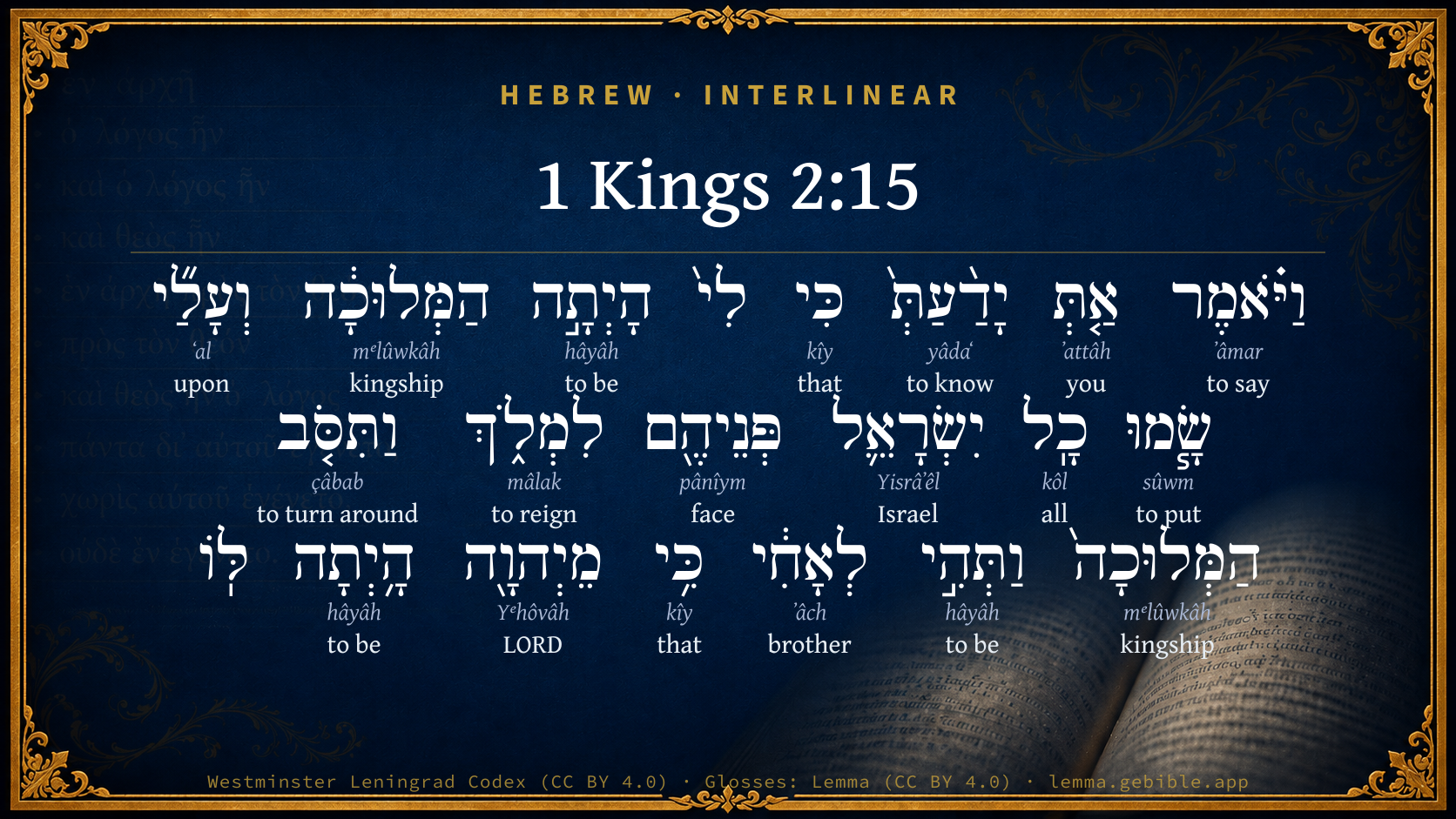
Hebrew (Westminster Leningrad Codex) 1 Kings 2:15 appears in the Hebrew Old Testament. The text above is from the Westminster Leningrad Codex. Each word links to its Strong’s number, a concise gloss, and parsing drawn from the Open Scriptures Hebrew Bible morphology. Click any word for its full Brown-Driver-Briggs (BDB) entry.
Download image
Cite this verse

1 Kings 2:15 (World English Bible). Public Domain. Lemma interlinear Bible study tool, https://lemma.gebible.app/v/1-kings/2/15.

Show BibTeX & RIS
BibTeX
RIS
English Translation
He said, You know that the kingdom was mine, and that all Israel set their faces on me, that I should reign: however the kingdom is turned about, and is become my brother's; for it was his from Yahweh.
World English Bible · Public Domain
Download a study sheet

One document with this verse’s original text, its word-by-word gloss line, the meaning frame, cross-references with their text, attributed commentary, and full source and license credits — printable, and it pastes into notes with its structure intact.

This verse Autodidact and up

Study sheet (.html) Plain text (.txt)

A passage Seminary Student

Up to 50 verses in one chapter. A passage sheet keeps up to 6 commentary sources and 12 cross-references per verse, in the order this page ranks them, and says so on the sheet whenever that leaves anything out. Ask for a single verse and you get the Autodidact verse sheet above.

Everything on this page stays free to read, with no account — the sheet is a download of what is already on screen, not access to it.

Want to remove ads? Support Godless Engineer
Compare translations 3

The same verse in 3 English versions, stacked beneath the original-language interlinear above. Click any original word for its lexicon entry.

Each is an independent rendering of the whole verse — the interlinear is not word-aligned to these translations.

Highlighted words mark where these versions differ — a whole-verse word diff, not a word-by-word alignment.

  • World English Bible Public Domain
    He said, You know that the kingdom was mine, and that all Israel set their faces on me, that I should reign: however the kingdom is turned about, and is become my brother's; for it was his from Yahweh.
  • King James Version Public Domain
    And he said, Thou knowest that the kingdom was mine, and that all Israel set their faces on me, that I should reign: howbeit the kingdom is turned about, and is become my brother's: for it was his from the LORD.
  • unfoldingWord Literal Text CC BY-SA 4.0
    And he said, “You, you know that the kingdom was to me, and all of Israel had set their faces on me to reign. But the kingdom turned and became to my brother, for it was to him from Yahweh.

unfoldingWord Literal Text — © unfoldingWord, licensed CC BY-SA 4.0. Word-aligned USFM3 via Door43 (git.door43.org/unfoldingWord/en_ult).

Versions to compare (up to 4)

3 of 4 selected

Show all 18 translations

Every available English version of this verse, each an independent rendering of the whole verse.

  • World English Bible Public Domain
    He said, You know that the kingdom was mine, and that all Israel set their faces on me, that I should reign: however the kingdom is turned about, and is become my brother's; for it was his from Yahweh.
  • Berean Standard Bible Public Domain
    “You know that the kingship was mine,” he said. “All Israel expected that I should reign, but the kingship has turned to my brother, for it has come to him from the LORD.
  • Majority Standard Bible Public Domain
    “You know that the kingship was mine,” he said. “All Israel expected that I should reign, but the kingship has turned to my brother, for it has come to him from the LORD.
  • King James Version Public Domain
    And he said, Thou knowest that the kingdom was mine, and that all Israel set their faces on me, that I should reign: howbeit the kingdom is turned about, and is become my brother's: for it was his from the LORD.
  • American Standard Version (1901) Public Domain
    And he said, Thou knowest that the kingdom was mine, and that all Israel set their faces on me, that I should reign: howbeit the kingdom is turned about, and is become my brother's; for it was his from Jehovah.
  • Revised Version (1885) Public Domain
    And he said, Thou knowest that the kingdom was mine, and that all Israel set their faces on me, that I should reign: howbeit the kingdom is turned about, and is become my brother’s: for it was his from the LORD.
  • Geneva Bible (1599) Public Domain
    Then he said, Thou knowest that the kingdome was mine, and that all Israel set their faces on me, that I should reigne: howbeit the kingdome is turned away, and is my brothers: for it came to him by the Lord.
  • Douay-Rheims (1899) Public Domain
    Thou knowest that the kingdom was nine, and all Israel had preferred me to be their king: but the kingdom is transferred, and is become my brother's: for it was appointed him by the Lord.
  • Young's Literal Translation Public Domain
    And he saith, `Thou hast known that the kingdom was mine, and towards me set their faces had all Israel for reigning, and the kingdom is turned round about, and is my brother's, for from Jehovah it was his;
  • Literal Standard Version CC BY-SA 4.0
    And he says, “You have known that the kingdom was mine, and all Israel had set their faces toward me for reigning, and the kingdom is turned around, and is my brother’s, for it was his from YHWH;
  • Unlocked Literal Bible CC BY-SA 4.0
    Adonijah said, “You know that the kingdom was mine, and that all Israel expected me to be king. But things changed, and the kingdom was given to my brother, for it was his from Yahweh.
  • unfoldingWord Literal Text CC BY-SA 4.0
    And he said, “You, you know that the kingdom was to me, and all of Israel had set their faces on me to reign. But the kingdom turned and became to my brother, for it was to him from Yahweh.
  • Darby Bible Public Domain
    And he said, Thou knowest that the kingdom was mine, and all Israel had set their faces on me that I should reign; but the kingdom is turned about and is become my brother's, for it was his from Jehovah.
  • World Messianic Bible Public Domain
    He said, “You know that the kingdom was mine, and that all Israel set their faces on me, that I should reign. However, the kingdom is turned around, and has become my brother’s; for it was his from the LORD.
  • Webster's Bible Public Domain
    And he said, Thou knowest that the kingdom was mine, and that all Israel set their faces on me, that I should reign: but the kingdom is turned about, and hath become my brother's: for it was his from the LORD.
  • Free Bible Version CC BY-SA 4.0
    “You know that the kingdom was mine,” he declared, “and everyone in Israel was looking forward to me being their next king. But everything was turned upside down, and the kingdom passed to my brother, because that's what the Lord wanted.
  • Bible in Basic English Public Domain
    And he said, You saw how the kingdom was mine, and all Israel had the idea that I would be their king; but now the kingdom is turned about, and has become my brother's, for it was given to him by the Lord.
  • JPS Tanakh (1917) Public Domain
    And he said: 'Thou knowest that the kingdom was mine, and that all Israel set their faces on me, that I should reign; howbeit the kingdom is turned about, and is become my brother's; for it was his from the LORD.

Literal Standard Version (2020), Covenant Press — licensed CC BY-SA 4.0. Text via the HelloAO Bible API (eBible.org). Unlocked Literal Bible (unfoldingWord) — licensed CC BY-SA 4.0. Text via the HelloAO Bible API (eBible.org). unfoldingWord Literal Text — © unfoldingWord, licensed CC BY-SA 4.0. Word-aligned USFM3 via Door43 (git.door43.org/unfoldingWord/en_ult). Free Bible Version, Dr. Jonathan Gallagher — licensed CC BY-SA 4.0. Text via the HelloAO Bible API (eBible.org).

Word by word

More ways to search: Search by grammar → Find every occurrence → Compare this word →

Practice this passage: Drill this verse → Learn its vocabulary →

הַמְּלוּכָ֔ה
mᵉlûwkâh
H4410
“the · kingship”
Particle, Definite Article + Noun, Common, Feminine, Singular, Absolute
Part of Speech
Particle + Noun
Type
Common
Gender
Feminine
Number
Singular
State
Absolute
Full BDB Definition

Origin: pass. participle of H4427

TWOT: 1199d

kingship, royalty, kingly office
  1. וַיֹּ֗אמֶר ʼâmar H559 “and · to say” Conjunction + Verb, Qal, Sequential Imperfect, 3rd Person, Masculine, Singular
  2. אַ֤תְּ ʼattâh H859 “you” Pronoun, Personal, 2nd Person, Feminine, Singular
  3. יָדַ֨עַתְּ֙ yâdaʻ H3045 “to know” Verb, Qal, Perfect, 2nd Person, Feminine, Singular
  4. כִּי kîy H3588 “that” Conjunction
  5. הָיְתָ֣ה hâyâh H1961 “to be” Verb, Qal, Perfect, 3rd Person, Feminine, Singular
  6. וְעָלַ֞י ʻal H5921 “and · upon · me” Conjunction + Preposition + Suffix, Personal, 1st Person, Common, Singular
  7. שָׂ֧מוּ sûwm H7760 “to put” Verb, Qal, Perfect, 3rd Person, Common, Plural
  8. כָֽל kôl H3605 “all of” Noun, Common, Masculine, Singular, Construct
  9. יִשְׂרָאֵ֛ל Yisrâʼêl H3478 “Israel” Noun, Proper
  10. פְּנֵיהֶ֖ם pânîym H6440 “face(s) · their” Noun, Common, Both, Plural, Construct + Suffix, Personal, 3rd Person, Masculine, Plural
  11. לִמְלֹ֑ךְ mâlak H4427 “to reign” Preposition + Verb, Qal, Infinitive Construct
  12. וַתִּסֹּ֤ב çâbab H5437 “and · to turn around” Conjunction + Verb, Qal, Sequential Imperfect, 3rd Person, Feminine, Singular
  13. הַמְּלוּכָה֙ mᵉlûwkâh H4410 “the · kingship” Particle, Definite Article + Noun, Common, Feminine, Singular, Absolute
  14. וַתְּהִ֣י hâyâh H1961 “and · to be” Conjunction + Verb, Qal, Sequential Imperfect, 3rd Person, Feminine, Singular
  15. לְאָחִ֔י ʼâch H251 “to/for · brother · my” Preposition + Noun, Common, Masculine, Singular, Construct + Suffix, Personal, 1st Person, Common, Singular
  16. כִּ֥י kîy H3588 “that” Conjunction
  17. מֵיְהוָ֖ה Yᵉhôvâh H3068 “from · LORD” Preposition + Noun, Proper
  18. הָ֥יְתָה hâyâh H1961 “to be” Verb, Qal, Perfect, 3rd Person, Feminine, Singular

About this verse

These counts appear in no published source. They are computed here, from the morphology-tagged text and Lemma’s own curated glosses. What Lemma adds →

21
words
15
distinct lemmas
Historical
section

Notable vocabulary

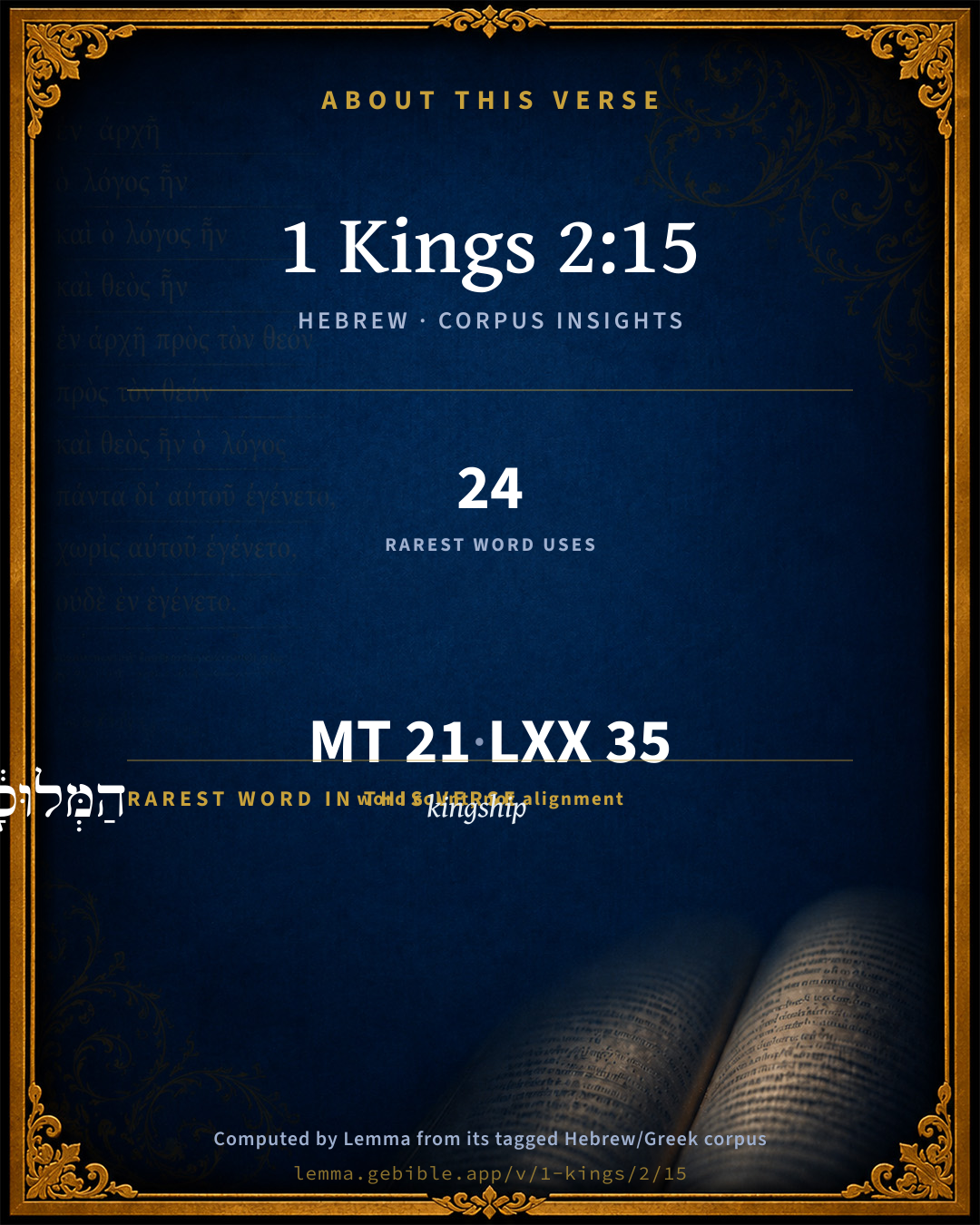
The rarest word here is הַמְּלוּכָ֔ה kingship H4410 — appearing just 24 times in the whole Hebrew Bible.

Shared distinctive vocabulary

הַמְּלוּכָ֔ה kingship H4410 occurs in 23 verses of the Hebrew Bible. Also found in:

Grammatical profile

  • 8 verbs
  • 7 nouns
  • 1 pronoun
  • 3 prepositions
  • 2 conjunctions

Verb forms

  • וַיֹּ֗אמֶר Qal · Sequential Imperfect
  • יָדַ֨עַתְּ֙ Qal · Perfect
  • הָיְתָ֣ה Qal · Perfect
  • שָׂ֧מוּ Qal · Perfect
  • לִמְלֹ֑ךְ Qal · Infinitive Construct
  • וַתִּסֹּ֤ב Qal · Sequential Imperfect
  • וַתְּהִ֣י Qal · Sequential Imperfect
  • הָ֥יְתָה Qal · Perfect

Repetition

Words recur within this verse — often emphatic in Hebrew:

  • הָיְתָ֣ה to be H1961 ×3
  • הַמְּלוּכָ֔ה kingship H4410 ×2
  • כִּי that H3588 ×2

Hebrew & Septuagint length

In English translation the verse runs 39 words from the Hebrew and 43 from the Septuagint (LXX English) — closely comparable.

A rough comparison of the two English renderings, which tokenize alike — not a word-level alignment.

Word counts can differ between the Hebrew and the Greek without any difference in meaning — e.g. the Hebrew direct-object marker אֵת has no separate Greek word, and Greek often adds the article ὁ.

In the original languages it is 21 Hebrew tokens and 35 Greek tokens — but the two are counted differently (Hebrew bundles its prefixes and suffixes into one token; the Greek is in lemma form), so that isn’t a like-for-like length.

Cross-references

12

Topical passages linked to 1 Kings 2:15 in the Treasury of Scripture Knowledge — connected by theme and wording, ordered by reader-vote popularity; previews shown in the World English Bible.

  • 1 Chronicles 22:9–10 Behold, a son shall be born to you, who shall be a man of rest; and I will give him rest from all his enemies round about; for his name shall be Solomon, and I will give peace and quietness to Israel in his days:
  • 1 Chronicles 28:5–7 Of all my sons (for Yahweh has given me many sons), he has chosen Solomon my son to sit on the throne of the kingdom of Yahweh over Israel.
  • 1 Kings 1:5 Then Adonijah the son of Haggith exalted himself, saying, I will be king: and he prepared him chariots and horsemen, and fifty men to run before him.
  • 1 Kings 1:25 For he is gone down this day, and has slain oxen and fatlings and sheep in abundance, and has called all the king's sons, and the captains of the host, and Abiathar the priest; and, behold, they are eating and drinking before him, and say, [Long] live king Adonijah.
  • 2 Samuel 7:12 When your days are fulfilled, and you shall sleep with your fathers, I will set up your seed after you, who shall proceed out of your bowels, and I will establish his kingdom.
  • 2 Samuel 16:18 Hushai said to Absalom, No; but whom Yahweh, and this people, and all the men of Israel have chosen, his will I be, and with him will I abide.
  • Proverbs 21:30 There is no wisdom nor understanding Nor counsel against Yahweh.
  • Jeremiah 27:5–8 I have made the earth, the men and the animals that are on the surface of the earth, by my great power and by my outstretched arm; and I give it to whom it seems right to me.
  • Daniel 2:22 he reveals the deep and secret things; he knows what is in the darkness, and the light dwells with him.
  • 2 Samuel 12:24 David comforted Bathsheba his wife, and went in to her, and lay with her: and she bore a son, and he called his name Solomon. Yahweh loved him;
  • 2 Samuel 15:6 In this manner Absalom did to all Israel who came to the king for judgment: so Absalom stole the hearts of the men of Israel.
  • 2 Samuel 15:13 There came a messenger to David, saying, The hearts of the men of Israel are after Absalom.

Cross-references courtesy of OpenBible.info (CC BY 4.0).

Hebrew and Greek witnesses Masoretic Hebrew ↔ Greek Septuagint

The same verse in the two great witnesses to the Old Testament, shown verse-for-verse.

These are two independent witnesses, not word-aligned to each other, and the Septuagint is shown in lemma (dictionary) form.

Hebrew 1 Kings 2:15 Masoretic · Westminster Leningrad Codex

וַיֹּ֗אמֶר אַ֤תְּ יָדַ֨עַתְּ֙ כִּי לִי֙ הָיְתָ֣ה הַמְּלוּכָ֔ה וְעָלַ֞י שָׂ֧מוּ כָֽל יִשְׂרָאֵ֛ל פְּנֵיהֶ֖ם לִמְלֹ֑ךְ וַתִּסֹּ֤ב הַמְּלוּכָה֙ וַתְּהִ֣י לְאָחִ֔י כִּ֥י מֵיְהוָ֖ה הָ֥יְתָה לּֽוֹ

He said, You know that the kingdom was mine, and that all Israel set their faces on me, that I should reign: however the kingdom is turned about, and is become my brother's; for it was his from Yahweh.

World English Bible · Public Domain

Greek LXX 1 Kings 2:15 Septuagint · lemma form

καί εἶπον αὐτός σύ οἶδα ὅτι ἐγώ εἰμί ὁ βασιλεία καί ἐπί ἐγώ τίθημι πᾶς ἰσραήλ ὁ πρόσωπον αὐτός εἰς βασιλεύς καί στρέφω ὁ βασιλεία καί γίγνομαι ὁ ἀδελφός ἐγώ ὅτι παρά κύριος γίγνομαι αὐτός

And he said to her, You know that the kingdom was mine, and all Israel turned their face toward me for a king; but the kingdom was turned from me and became my brother's: for it was appointed to him from the Lord.

LXX2012 (modern English Septuagint) · Public Domain

Hebrew: Westminster Leningrad Codex (CC BY 4.0). Greek: Septuagint (public domain); English from LXX2012 (modern English Septuagint) (Public Domain). How the Septuagint differs from the Hebrew →

Targum (Aramaic paraphrase)

1

The Targum is the ancient Jewish Aramaic paraphrase of the Hebrew Scriptures — an interpretive translation, not the Hebrew text itself. Onkelos (literal) and Pseudo-Jonathan (expansive) render the Torah, and Jonathan the Prophets. Coverage is partial: where no permissively-licensed English translation exists for a verse, only the Aramaic is shown. This is verse-level text, not a word-by-word alignment to the Hebrew.

  1. Targum Jonathan Prophets (Joshua–Malachi)
    וַאֲמַר אַתְּ יְדַעַתְּ אֲרֵי דִילִי הֲוַת מַלְכוּתָא וַעֲלַי שַׁוִיאוּ כָל יִשְׂרָאֵל אַפֵּיהוֹן לְמֶהֱוֵי מַלְכָּא וְאִסְתְחָרַת מַלְכוּתָא וַהֲוַת לַאֲחִי אֲרֵי מִן קֳדָם יְיָ הֲוַת לֵיהּ:

    (no public-domain English translation for this verse)

    Targum Jonathan — Aramaic: “Mikraot Gedolot” (public domain). English: “Sefaria Community Translation” (CC0 1.0 (public-domain dedication)); “London "Chaldee Paraphrase," 1871” (public domain). Text via Sefaria.

Commentary

Notes on 1 Kings 2:15 from classic Christian and Jewish commentators (each source and its license shown beneath its notes). The classic Christian expositions comment on the surrounding passage and are grouped to its opening verse, so a note may address several verses; the Jewish commentaries on the Tanakh (Rashi and others) are per-verse, so they appear only where the commentator wrote on this verse.

Lemma curates 59 commentaries, every one of them public domain or Creative Commons licensed, each selected and text-cleaned for this edition rather than reprinted as found. About our sources →

Trapp's Complete Commentary

John Trapp

1Ki 2:15 And he said, Thou knowest that the kingdom was mine, and [that] all Israel set their faces on me, that I should reign: howbeit the kingdom is turned about, and is become my brother’s: for it was his from the LORD.

Ver. 15. Thou knowest that the kingdom was mine,] viz., By right of succession, I being the eldest son now alive, {see 1Ki 1:6} and chosen by the people too. {1Ki 1:25}

Howbeit the kingdom is turned about.] By that great Induperator, who putteth down one and setteth up another;

“ Ludit in humanis divina potentia rebus. ”

For it was his from the Lord.] Why then would Adonijah dash against the divine decree, and sin against his own knowledge, by saying, I will be king?

John Trapp, A Commentary or Exposition upon All the Books of the Old and New Testament (1647–1656) — public domain. Text from a community e-Sword module.

Geneva Bible (1599)

Geneva Bible translators

In sign of their favor and consent.

Geneva Bible (1599) marginal notes — public domain. Text via Bolls.life.

Adam Clarke's Commentary

Verse 15. Thou knowest that the kingdom was mine] It certainly was his by the right of primogeniture, and it was his by the voice of the people, and the consent of the high priest. But there was a right paramount to all these, the right of God; it was his kingdom; the kings were his lieutenants, and he had a right to give the crown to whomsoever he pleased, and he was pleased to give it to Solomon.

Adam Clarke's Commentary on the Bible (1810–1826) — public domain. Text from a community e-Sword/MySword module.

Ellicott's Commentary for English Readers

(15) Thou knowest.—Adonijah’s words show craft, flattering Bath-sheba by extolling her influence, and making merit of his surrender to Solomon, in obedience to the Lord’s decree, of a kingdom which, in evident contradiction to fact, he asserts to have been destined to him by popular desire. The petition, however, apparently harmless, and (since Abishag was concubine of David only in name) involving nothing unnatural, had perhaps a covert design: for, by universal Eastern custom, to take a king’s wives was the known privilege or duty of his successor. Hence the counsel, most unseemly but still probably politic, given by Ahithophel to Absalom (2Sa_16:21). If, therefore, Adonijah had publicly espoused Abishag, it might have seemed a virtual renewal of his claim to the crown. This Solomon sees at once, though Bath-sheba, strangely enough, does not see it.

A Bible Commentary for English Readers, edited by Charles John Ellicott (1878–1897) — public domain. Text from a community e-Sword module.

The Cambridge Bible for Schools and Colleges

gen. ed. J. J. S. Perowne

15. Thou knowest that the kingdom was mine] He means that as the eldest living son of David, he could rightly claim it. Thus he in a way apologizes for his previous attempt to secure the succession to himself.

set their faces on me] They looked forward to my accession and were resolved on bringing it about. Comp. Jer_42:17 ‘the men that set their faces to go down into Egypt … shall die.’ Adonijah would thus also make it appear that the voice and goodwill of the people had been on his side.

for it was his from the Lord] He professes his resignation to what has happened, and ascribes it to the Divine will that he may the better cloak his desires and intentions. Perhaps ‘it became his from the Lord’ would give the force of his words better. It is to be noted how, as if in friendship, he speaks of Solomon as his brother.

The Cambridge Bible for Schools and Colleges (gen. ed. J. J. S. Perowne; Cambridge University Press, 1878–1918) — public domain. Text from a community e-Sword module.

John Gill's Exposition

And he said, thou knowest that the kingdom was mine,.... Belonged to him by virtue of his birthright; he was heir to it, being the eldest son:

and that all Israel set their faces on me, that I should reign; which was not true; for, as Bathsheba says, the body of the people were in suspense, their eyes being on David, waiting to hear whom he would declare his successor; and when Solomon was declared and anointed, vast numbers attended him; unless Adonijah thought that the high priest, and general of the army, with the captains, represented the whole people; however this he observes by way of preface, to show how unhappy he was, being disappointed, and to move the compassion of Bathsheba, that she might be the more easily prevailed upon to seek to obtain so small a favour as he was about to ask:

howbeit the kingdom is turned about, and is become my brother's; things had taken another turn, and what was his, and he thought himself sure of the other day, was now become his brother's; such were the uncertainty and vicissitude of human affairs:

for it was his from the Lord; by the appointment of the Lord, by a promise of his, and a prophecy concerning it; which if he knew of, it was both vain and sinful in him to act contrary thereunto; or it was brought about by the overruling providence of God, which he now plainly saw and submitted to; this he said to show that he had laid aside all hopes of the kingdom, and was fully satisfied of the disposition of it in Providence, and so to hide his real design in the petition he was about to make.

John Gill's Exposition of the Whole Bible (1746–1763) — public domain (CC PDM 1.0). Text via the HelloAO Bible API.

Haydock's Catholic Bible Commentary

Mine, according to the ordinary course of things. But I was willing to forego my claims, when I perceived that the Lord had made choice of my brother. (Calmet)

George Leo Haydock (1774–1849), Haydock's Catholic Family Bible and Commentary, 1859 edition — public domain. Excludes Psalms (Douay-Rheims chapter numbering differs from Protestant) and Deuterocanonical books (Catholic canon only).

Matthew Poole's English Annotations

The kingdom was mine, both by birthright and by actual inauguration. It seems he could not yet forget his pretence to the crown, nor his ambition for it, but continues his claim; which, it seems, Solomon did apprehend and resent, though Bath-sheba did not; the wives and concubines of the late king being reputed to appertain to the successor. See 2Sa 12:8.

All Israel set their faces on me; they looked upon me as their king, and David’s successor, expecting that David should confirm my election.

The kingdom is turned about; translated from me to him, by the vicissitude of human affairs, and the changeable humour of the people.

It was his from the Lord; either, first, By God’s providence so disposing David’s mind, and the people’s hearts. Or rather, secondly, By God’s appointment and particular designation, wherein he would seem to acquiesce; which he mentions, not that he made any conscience of it, or had any regard to it; but only that by this pretence he might deceive both her and Solomon, as if he were far from any design of usurping the kingdom.

Matthew Poole's English Annotations on the Holy Bible (1683–1685) — public domain. Text from a community e-Sword/MySword module.

Whedon's Commentary on the Bible

Daniel D. Whedon

15. The kingdom was mine — By the right of primogeniture.

All Israel set their faces on me — A multitude of people had followed the ambitious youth, as we may learn from chapter 1Ki_1:9; but it was a stretching beyond the bounds of truth to call that seditious crowd all Israel.

It was his from the Lord — By these cautious words he seeks to allay suspicion, and win the favour of Bathsheba.

Daniel D. Whedon (gen. ed.), Commentary on the Old and New Testaments (1874–1909) — public domain. Text from a community e-Sword module.

The Pulpit Commentary

And he said, Thou knowest that the kingdom was mine schon so gut wie mein (Bahr). Adonijah evidently made much of the right of primogeniture (cf. ver. 22), which was not unrecognized amongst the Jews. There is possibly in these words, too, a hint at the part Bathsheba had taken in defeating his claims and that all Israel set their faces i.e., eyes upon me that I should reign Heb. upon me all Israel set, etc. The me " is emphatic by its position. So is the mine" just before used. Several commentators remark that Adonijah"s words were not strictly true. But we hardly expect to find truth on such an occasion. Adonijah was adroit and diplomatic, and puts the case as it best serves his purpose. In order to propitiate Bathsheba, he exaggerates his loss and disappointment, just as in the next words, in order to put her off her guard, he plays the saint and obtrudes his piety and resignation: howbeit lit., and, the kingdom is turned about and is become my brother"s, for it was his from the Lord. This verse shows pretty clearly that Adoni-jah had not renounced his pretensions to the throne. Despite the pitiful failure of his first conspiracy, and notwithstanding Solomon"s generous condonation of his treason, he cannot forget that he was, and is, the eldest surviving son, and had been very near the throne. And as to the kingdom being his brother"s by Divine appointment, he cannot have been ignorant of that long ago, (2Sa_12:25) yet he conspired all the same. And it is not difficult to read here between the lines, that he has not relinquished his hopes, and does not acquiesce in Solomon"s supremacy.

The Pulpit Commentary (1880–1919), ed. H.D.M. Spence-Jones & Joseph S. Exell — public domain. Text from a community e-Sword module.

Lesson kit

Teaching starters — assembled from the data on this page, not authored interpretation. Every prompt links to the verse data it draws on. Edit before teaching.

1 Kings, in the Historical, opens this verse with 21 words (15 distinct Hebrew lemmas). Its most distinctive word is mᵉlûwkâh (“kingship”). A historical commentator’s framing appears above. Read the whole chapter for the surrounding context.

Discussion questions

  1. How does “kingship” (mᵉlûwkâh) shape what this verse is saying?
  2. How does 1 Samuel 10:16, which shares the word «kingship», read alongside this verse?
  3. What does the repetition of “to be” (3× in this one verse) do in this verse?
  4. These translations render this verse differently. What is at stake in choosing one wording over another?
  5. «וַיֹּ֗אמֶר» is a Qal Sequential Imperfect verb. How does that grammatical form shape the action described?
  6. Compare how Trapp's Complete Commentary and Geneva Bible (1599) read this verse. Where do they agree or differ?

Things to notice

Reading settings

Reading text

Shown beneath each verse's original-language words.

Old Testament
Old Testament edition

Read the OT as the Masoretic Hebrew (MT) or the Greek Septuagint (LXX).

English shown for the Greek Septuagint (in the Hebrew ↔ Greek comparison).

Comparing translations? Open the Compare panel on any verse page to stack up to four side by side.