
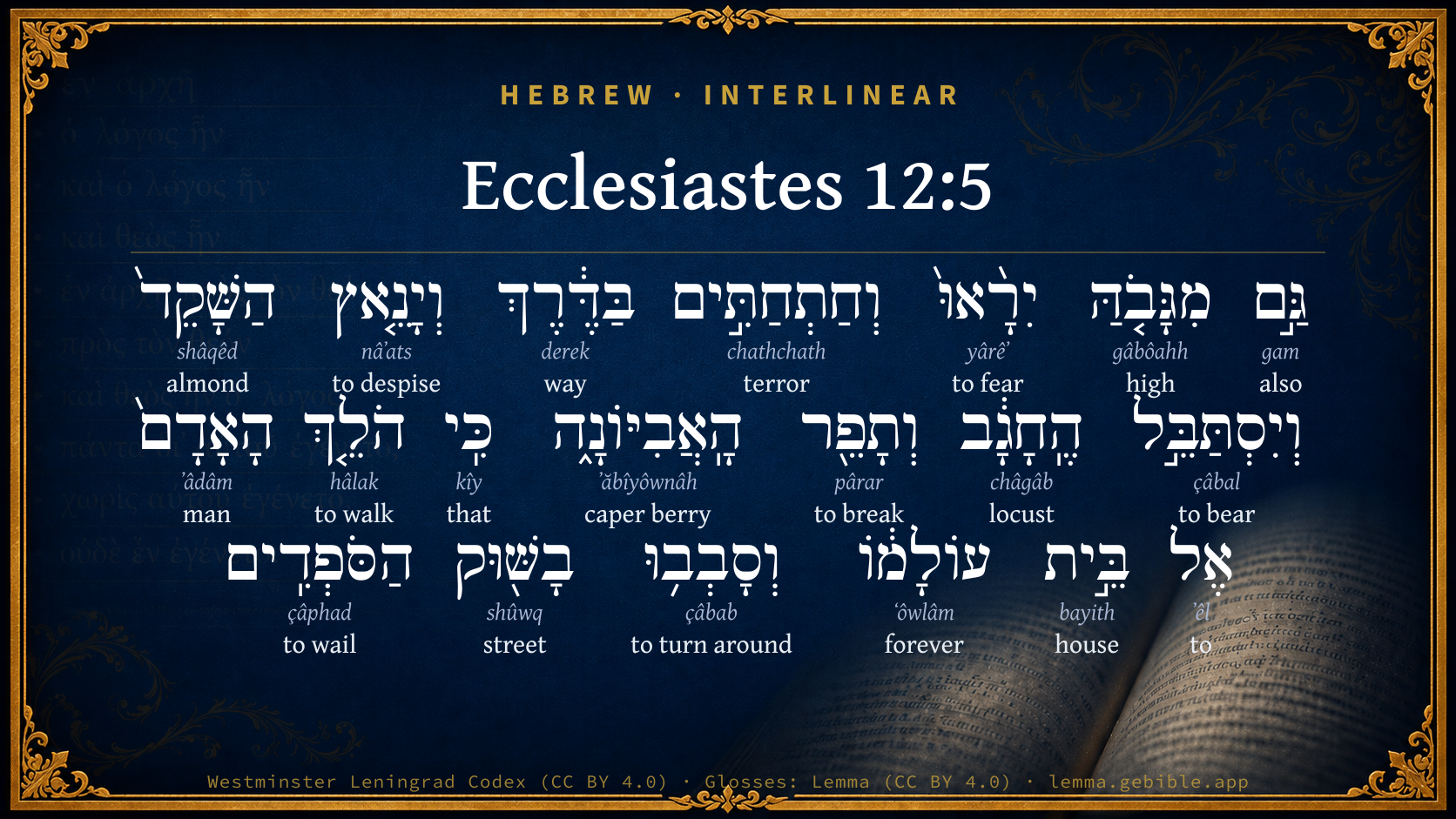
Ecclesiastes 12:5

Hebrew (Westminster Leningrad Codex) Ecclesiastes 12:5 appears in the Hebrew Old Testament. The text above is from the Westminster Leningrad Codex. Each word links to its Strong’s number, a concise gloss, and parsing drawn from the Open Scriptures Hebrew Bible morphology. Click any word for its full Brown-Driver-Briggs (BDB) entry.
Download image
Cite this verse

Ecclesiastes 12:5 (World English Bible). Public Domain. Lemma interlinear Bible study tool, https://lemma.gebible.app/v/ecclesiastes/12/5.

Show BibTeX & RIS
BibTeX
RIS
English Translation
Yes, they shall be afraid of heights, And terrors will be in the way; And the almond tree shall blossom, And the grasshopper shall be a burden, And desire shall fail; Because man goes to his everlasting home, And the mourners go about the streets:
World English Bible · Public Domain
Highlights
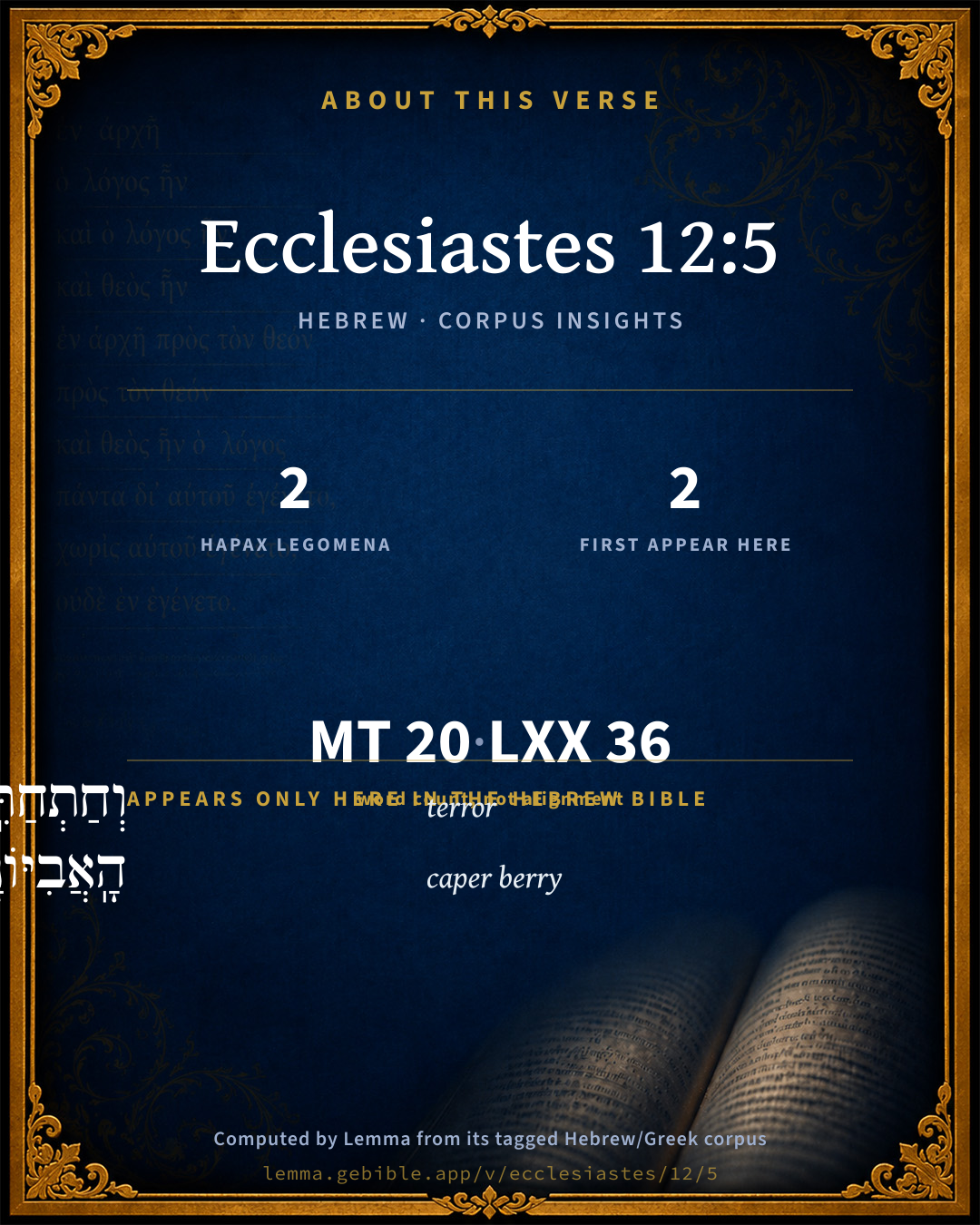
  • 2 hapax legomena — only here in the Hebrew Bible
  • 2 first appearances in the Hebrew Bible
Full analysis ↓
Download a study sheet

One document with this verse’s original text, its word-by-word gloss line, the meaning frame, cross-references with their text, attributed commentary, and full source and license credits — printable, and it pastes into notes with its structure intact.

This verse Autodidact and up

Study sheet (.html) Plain text (.txt)

A passage Seminary Student

Up to 50 verses in one chapter. A passage sheet keeps up to 6 commentary sources and 12 cross-references per verse, in the order this page ranks them, and says so on the sheet whenever that leaves anything out. Ask for a single verse and you get the Autodidact verse sheet above.

Everything on this page stays free to read, with no account — the sheet is a download of what is already on screen, not access to it.

Want to remove ads? Support Godless Engineer
Compare translations 3

The same verse in 3 English versions, stacked beneath the original-language interlinear above. Click any original word for its lexicon entry.

Each is an independent rendering of the whole verse — the interlinear is not word-aligned to these translations.

Highlighted words mark where these versions differ — a whole-verse word diff, not a word-by-word alignment.

  • World English Bible Public Domain
    Yes, they shall be afraid of heights, And terrors will be in the way; And the almond tree shall blossom, And the grasshopper shall be a burden, And desire shall fail; Because man goes to his everlasting home, And the mourners go about the streets:
  • King James Version Public Domain
    Also when they shall be afraid of that which is high, and fears shall be in the way, and the almond tree shall flourish, and the grasshopper shall be a burden, and desire shall fail: because man goeth to his long home, and the mourners go about the streets:
  • unfoldingWord Literal Text CC BY-SA 4.0
    also, they are afraid of a high, and terrors in the way, and the almond tree blossoms, and the locusts moves along, and the caper-fruit fails— for humanity is going to his eternal home, and the mourners go around in the street—

unfoldingWord Literal Text — © unfoldingWord, licensed CC BY-SA 4.0. Word-aligned USFM3 via Door43 (git.door43.org/unfoldingWord/en_ult).

Versions to compare (up to 4)

3 of 4 selected

Show all 18 translations

Every available English version of this verse, each an independent rendering of the whole verse.

  • World English Bible Public Domain
    Yes, they shall be afraid of heights, And terrors will be in the way; And the almond tree shall blossom, And the grasshopper shall be a burden, And desire shall fail; Because man goes to his everlasting home, And the mourners go about the streets:
  • Berean Standard Bible Public Domain
    when men fear the heights and dangers of the road, when the almond tree blossoms, the grasshopper loses its spring, and the caper berry shrivels—for then man goes to his eternal home and mourners walk the streets.
  • Majority Standard Bible Public Domain
    when men fear the heights and dangers of the road, when the almond tree blossoms, the grasshopper loses its spring, and the caper berry shrivels—for then man goes to his eternal home and mourners walk the streets.
  • King James Version Public Domain
    Also when they shall be afraid of that which is high, and fears shall be in the way, and the almond tree shall flourish, and the grasshopper shall be a burden, and desire shall fail: because man goeth to his long home, and the mourners go about the streets:
  • American Standard Version (1901) Public Domain
    yea, they shall be afraid of `that which is' high, and terrors `shall be' in the way; and the almond-tree shall blossom, and the grasshopper shall be a burden, and desire shall fail; because man goeth to his everlasting home, and the mourners go about the streets:
  • Revised Version (1885) Public Domain
    yea, they shall be afraid of that which is high, and terrors shall be in the way; and the almond tree shall blossom, and the grasshopper shall be a burden, and the caper-berry shall fail: because man goeth to his long home, and the mourners go about the streets:
  • Geneva Bible (1599) Public Domain
    Also they shalbe afraide of the hie thing, and feare shalbe in the way, and the almond tree shall flourish, and the grassehopper shall be a burden, and concupiscence shall be driuen away: for man goeth to the house of his age, and the mourners goe about in the streete.
  • Douay-Rheims (1899) Public Domain
    And they shall fear high things, and they shall be afraid in the way, the almond tree shall flourish, the locust shall be made fat, and the caper tree shall be destroyed: because man shall go into the house of his eternity, and the mourners shall go round about in the street.
  • Young's Literal Translation Public Domain
    Also of that which is high they are afraid, And of the low places in the way, And the almond-tree is despised, And the grasshopper is become a burden, And want is increased, For man is going unto his home age-during, And the mourners have gone round through the street.
  • Literal Standard Version CC BY-SA 4.0
    Also of that which is high they are afraid, || And of the low places in the way, || And the almond-tree is despised, || And the grasshopper has become a burden, || And want is increased, || For man is going to his perpetual home, || And the mourners have gone around through the street.
  • Unlocked Literal Bible CC BY-SA 4.0
    That will be the time when men become afraid of heights and of dangers along on the road, and when the almond tree blossoms, and when grasshoppers drag themselves along, and when natural desires fail. Then man goes to his eternal home and the mourners go down the streets.
  • unfoldingWord Literal Text CC BY-SA 4.0
    also, they are afraid of a high, and terrors in the way, and the almond tree blossoms, and the locusts moves along, and the caper-fruit fails— for humanity is going to his eternal home, and the mourners go around in the street—
  • Darby Bible Public Domain
    they are also afraid of what is high, and terrors are in the way, and the almond is despised, and the grasshopper is a burden, and the caper-berry is without effect; (for man goeth to his age-long home, and the mourners go about the streets;)
  • World Messianic Bible Public Domain
    yes, they shall be afraid of heights, and terrors will be on the way; and the almond tree shall blossom, and the grasshopper shall be a burden, and desire shall fail; because man goes to his everlasting home, and the mourners go about the streets;
  • Webster's Bible Public Domain
    Also when they shall be afraid of that which is high, and fears shall be in the way, and the almond tree shall flourish, and the grasshopper shall be a burden, and desire shall fail: because man goeth to his long home, and the mourners go about the streets:
  • Free Bible Version CC BY-SA 4.0
    Before you develop a fear of heights and worry about going out on the streets; when the almond tree blossoms, the grasshopper crawls along, and desire fails, for everyone has to go to their eternal home as the mourners go up and down the street.
  • Bible in Basic English Public Domain
    And he is in fear of that which is high, and danger is in the road, and the tree is white with flower, and the least thing is a weight, and desire is at an end, because man goes to his last resting-place, and those who are sorrowing are in the streets;
  • JPS Tanakh (1917) Public Domain
    Also when they shall be afraid of that which is high, and terrors shall be in the way; and the almond-tree shall blossom, and the grasshopper shall drag itself along, and the caperberry shall fail; because man goeth to his long home, and the mourners go about the streets;

Literal Standard Version (2020), Covenant Press — licensed CC BY-SA 4.0. Text via the HelloAO Bible API (eBible.org). Unlocked Literal Bible (unfoldingWord) — licensed CC BY-SA 4.0. Text via the HelloAO Bible API (eBible.org). unfoldingWord Literal Text — © unfoldingWord, licensed CC BY-SA 4.0. Word-aligned USFM3 via Door43 (git.door43.org/unfoldingWord/en_ult). Free Bible Version, Dr. Jonathan Gallagher — licensed CC BY-SA 4.0. Text via the HelloAO Bible API (eBible.org).

Word by word

More ways to search: Search by grammar → Find every occurrence → Compare this word →

Practice this passage: Drill this verse → Learn its vocabulary →

וְחַתְחַתִּ֣ים
chathchath
H2849
“and · terrors”
Conjunction + Noun, Common, Masculine, Plural, Absolute
Part of Speech
Conjunction + Noun
Type
Common
Gender
Masculine
Number
Plural
State
Absolute
Full BDB Definition

Origin: from H2844

TWOT: 784e

terror
  1. גַּ֣ם gam H1571 “also” Particle, Accusative
  2. מִגָּבֹ֤הַּ gâbôahh H1364 “from · high” Preposition + Adjective, Adjective, Masculine, Singular, Absolute
  3. יִרָ֨אוּ֙ yârêʼ H3372 “to fear” Verb, Qal, Imperfect, 3rd Person, Masculine, Plural
  4. בַּדֶּ֔רֶךְ derek H1870 “in/at the · way” Preposition, Determined + Noun, Common, Both, Singular, Absolute
  5. וְיָנֵ֤אץ nâʼats H5006 “and · to despise” Conjunction + Verb, Hiphil, Imperfect, 3rd Person, Masculine, Singular
  6. הַשָּׁקֵד֙ shâqêd H8247 “the · almond” Particle, Definite Article + Noun, Common, Masculine, Singular, Absolute
  7. וְיִסְתַּבֵּ֣ל çâbal H5445 “and · to bear” Conjunction + Verb, Hithpael, Imperfect, 3rd Person, Masculine, Singular
  8. הֶֽחָגָ֔ב châgâb H2284 “the · locust” Particle, Definite Article + Noun, Common, Masculine, Singular, Absolute
  9. וְתָפֵ֖ר pârar H6565 “and · to break” Conjunction + Verb, Hiphil, Imperfect, 3rd Person, Feminine, Singular
  10. הָֽאֲבִיּוֹנָ֑ה ʼăbîyôwnâh H35 “the · caper berry” Particle, Definite Article + Noun, Common, Feminine, Singular, Absolute
  11. כִּֽי kîy H3588 “that” Conjunction
  12. הֹלֵ֤ךְ hâlak H1980 “walking” Verb, Qal, Participle Active, Masculine, Singular, Absolute
  13. הָאָדָם֙ ʼâdâm H120 “the · man” Particle, Definite Article + Noun, Common, Masculine, Singular, Absolute
  14. אֶל ʼêl H413 “to” Preposition
  15. בֵּ֣ית bayith H1004 “house of” Noun, Common, Masculine, Singular, Construct
  16. עוֹלָמ֔וֹ ʻôwlâm H5769 “forever · his” Noun, Common, Masculine, Singular, Construct + Suffix, Personal, 3rd Person, Masculine, Singular
  17. וְסָבְב֥וּ çâbab H5437 “and · to turn around” Conjunction + Verb, Qal, Sequential Perfect, 3rd Person, Common, Plural
  18. בָשּׁ֖וּק shûwq H7784 “in/at the · street” Preposition, Determined + Noun, Common, Masculine, Singular, Absolute
  19. הַסֹּפְדִֽים çâphad H5594 “the · wailing” Particle, Definite Article + Verb, Qal, Participle Active, Masculine, Plural, Absolute

About this verse

These counts appear in no published source. They are computed here, from the morphology-tagged text and Lemma’s own curated glosses. What Lemma adds →

20
words
20
distinct lemmas
Wisdom
section

Notable vocabulary

2 hapax legomena — words that appear only here in the entire Hebrew Bible:

  • וְחַתְחַתִּ֣ים terror H2849
  • הָֽאֲבִיּוֹנָ֑ה caper berry H35

First appearance in Scripture

These words make their first canonical appearance in the Hebrew Bible here:

  • וְחַתְחַתִּ֣ים terror H2849
  • הָֽאֲבִיּוֹנָ֑ה caper berry H35

Shared distinctive vocabulary

הַשָּׁקֵד֙ almond H8247 occurs in 4 verses of the Hebrew Bible. Also found in:

Grammatical profile

  • 7 verbs
  • 9 nouns
  • 1 adjective
  • 1 preposition
  • 1 conjunction
  • 1 particle

Verb forms

  • יִרָ֨אוּ֙ Qal · Imperfect
  • וְיָנֵ֤אץ Hiphil · Imperfect
  • וְיִסְתַּבֵּ֣ל Hithpael · Imperfect
  • וְתָפֵ֖ר Hiphil · Imperfect
  • הֹלֵ֤ךְ Qal · Participle Active
  • וְסָבְב֥וּ Qal · Sequential Perfect
  • הַסֹּפְדִֽים Qal · Participle Active

Hebrew & Septuagint length

In English translation the verse runs 45 words from the Hebrew and 45 from the Septuagint (LXX English) — the same length.

A rough comparison of the two English renderings, which tokenize alike — not a word-level alignment.

Word counts can differ between the Hebrew and the Greek without any difference in meaning — e.g. the Hebrew direct-object marker אֵת has no separate Greek word, and Greek often adds the article ὁ.

In the original languages it is 20 Hebrew tokens and 36 Greek tokens — but the two are counted differently (Hebrew bundles its prefixes and suffixes into one token; the Greek is in lemma form), so that isn’t a like-for-like length.

Cross-references

18

Topical passages linked to Ecclesiastes 12:5 in the Treasury of Scripture Knowledge — connected by theme and wording, ordered by reader-vote popularity; previews shown in the World English Bible.

  • Job 17:13 If I look for Sheol as my house, If I have spread my couch in the darkness,
  • Job 30:23 For I know that you will bring me to death, To the house appointed for all living.
  • Jeremiah 9:17–20 Thus says Yahweh of Hosts, Consider you, and call for the mourning women, that they may come; and send for the skillful women, that they may come:
  • Proverbs 16:31 Gray hair is a crown of glory. It is attained by a life of righteousness.
  • Genesis 50:3–10 Forty days were fulfilled for him, for that is how many the days it takes to embalm. The Egyptians wept for him for seventy days.
  • Leviticus 19:32 You shall rise up before the gray head, and honor the face of an old man, and you shall fear your God. I am Yahweh.
  • Job 15:10 With us are both the gray-headed and the very aged men, Much elder than your father.
  • Psalms 49:10–14 For he sees that wise men die; Likewise the fool and the senseless perish, And leave their wealth to others.
  • Psalms 71:18 Yes, even when I am old and gray-haired, God, don't forsake me, Until I have declared your strength to the next generation, Your might to everyone who is to come.
  • Genesis 42:38 He said, "My son shall not go down with you; for his brother is dead, and he only is left. If harm happens to him by the way in which you go, then you will bring down my gray hairs with sorrow to Sheol."
  • Genesis 44:29 If you take this one also from me, and harm happens to him, you will bring down my gray hairs with sorrow to Sheol.'
  • Genesis 44:31 it will happen, when he sees that the boy is no more, that he will die. Your servants will bring down the gray hairs of your servant, our father, with sorrow to Sheol.
  • Proverbs 20:29 The glory of young men is their strength. The splendor of old men is their gray hair.
  • Ecclesiastes 9:10 Whatever your hand finds to do, do it with your might; for there is no work, nor device, nor knowledge, nor wisdom, in Sheol, where you are going.
  • Isaiah 46:4 and even to old age I am he, and even to gray hairs will I carry you. I have made, and I will bear; yes, I will carry, and will deliver.
  • Jeremiah 1:11 Moreover the word of Yahweh came to me, saying, Jeremiah, what see you? I said, I see a rod of an almond tree.
  • Mark 5:38–39 He came to the synagogue ruler's house, and he saw an uproar, weeping, and great wailing.
  • Hebrews 9:27 Inasmuch as it is appointed for men to die once, and after this, judgment,

Cross-references courtesy of OpenBible.info (CC BY 4.0).

Hebrew and Greek witnesses Masoretic Hebrew ↔ Greek Septuagint

The same verse in the two great witnesses to the Old Testament, shown verse-for-verse.

These are two independent witnesses, not word-aligned to each other, and the Septuagint is shown in lemma (dictionary) form.

Hebrew Ecclesiastes 12:5 Masoretic · Westminster Leningrad Codex

גַּ֣ם מִגָּבֹ֤הַּ יִרָ֨אוּ֙ וְחַתְחַתִּ֣ים בַּדֶּ֔רֶךְ וְיָנֵ֤אץ הַשָּׁקֵד֙ וְיִסְתַּבֵּ֣ל הֶֽחָגָ֔ב וְתָפֵ֖ר הָֽאֲבִיּוֹנָ֑ה כִּֽי הֹלֵ֤ךְ הָאָדָם֙ אֶל בֵּ֣ית עוֹלָמ֔וֹ וְסָבְב֥וּ בָשּׁ֖וּק הַסֹּפְדִֽים

Yes, they shall be afraid of heights, And terrors will be in the way; And the almond tree shall blossom, And the grasshopper shall be a burden, And desire shall fail; Because man goes to his everlasting home, And the mourners go about the streets:

World English Bible · Public Domain

Greek LXX Ecclesiastes 12:5 Septuagint · lemma form

καί γέ ἀπό ὕψος ὁράω καί θάμβος ἐν ὁ ὁδός καί ἀνθέω ὁ ἀμύγδαλον καί παχύνω ὁ ἀκρίς καί διασκεδάζω ὁ κάππαρις ὅτι πορεύομαι ὁ ἄνθρωπος εἰς οἶκος αἰών αὐτός καί κυκλόω ἐν ἀγορά ὁ κόπτω

and they shall look up, and fears shall be in the way, and the almond tree shall blossom, and the locust shall increase, and the caper shall be scattered: because man has gone to his eternal home, and the mourners have gone about the market:

LXX2012 (modern English Septuagint) · Public Domain

On this verse, Trapp's Complete Commentary discusses the Septuagint’s reading. Read the note in Commentary ↓

Hebrew: Westminster Leningrad Codex (CC BY 4.0). Greek: Septuagint (public domain); English from LXX2012 (modern English Septuagint) (Public Domain). How the Septuagint differs from the Hebrew →

Commentary

Notes on Ecclesiastes 12:5 from classic Christian and Jewish commentators (each source and its license shown beneath its notes). The classic Christian expositions comment on the surrounding passage and are grouped to its opening verse, so a note may address several verses; the Jewish commentaries on the Tanakh (Rashi and others) are per-verse, so they appear only where the commentator wrote on this verse.

Lemma curates 59 commentaries, every one of them public domain or Creative Commons licensed, each selected and text-cleaned for this edition rather than reprinted as found. About our sources →

Trapp's Complete Commentary

John Trapp

Ecc 12:5 Also [when] they shall be afraid of [that which is] high, and fears [shall be] in the way, and the almond tree shall flourish, and the grasshopper shall be a burden, and desire shall fail: because man goeth to his long home, and the mourners go about the streets:

Ver. 5. Also when they shall be afraid of that which is high.] Hillocks or little stones standing up, whereat they may stumble, as being unsteady and unwieldy. High ascents also they shun, as being short winded; neither can they look down without danger of falling, their heads being as weak as their hams. Let them therefore pray for a guard of angels, putting that promise into suit. {Psa 91:11} Let them also keep within God’s precincts, as ever they expect his protection; and then, though old Eli fell, and never rose again, yet when they fall they shall arise, for the Lord puts under his hand. {Psa 37:24} Contrition may be in their way, but attrition shall not. Let them fear God, and they need not fear any other person or thing whatsoever.

And the almond tree shall flourish.] The hair shall grow hoary, those church yard flowers shall put forth. The almond tree blossoms in January, while it is yet winter, and the fruit is ripe in March. {a} Old age shall snow white hairs upon their heads. Let them see that they be "found in the way of righteousness."

And the grasshopper shall be a burden.] Every light matter shall oppress them, who are already a burden to themselves, being full of gout, and other swellings of the legs, which the Septuagint and Vulgate point at here, when they render it, impinguabiter locusta, - The locusts shall be made fat. Let them wait upon the Lord, as that "old disciple Mnason" {Act 21:16} did, and then they shall "renew their strength, mount up as eagles, run, and not be weary, walk, and not faint," even then, when "the youth shall faint and be weary, and the young men utterly fall." {Isa 40:30-31}

And desire shall fail.] "The lust of the flesh, the lust of the eye, and the pride of life." {1Jn 2:15} And this Cicero reckons among the commodities and benefits of old age, quod hominem a libidinis estu, velut a tyranno quodem liberet, - that it frees a man from the fire of lust. {b} It should be so doubtless, an old letcher being little less than a monster. What so monstrous as to behold green apples on a tree in winter? and what so indecent as to see the sins of youth prevailing in times of age among old decrepit goats? that they should be capering after capparis (καππαρις), the fruit of capers, as the Septuagint and Vulgate render it here.

Because man goeth to his long home.] Heb., To his old home - scil., to the dust from whence he was taken; or to "the house of his eternity" - that is, the grave (that house of all living), where he shall lie long, till the resurrection. Tremellius renders it, in domum saeculi sui - to the house of his generation, where he and all his contemporaries meet. Cajetan, in demure mundi sui - into the house of his world; that which the world provides for him, as nature at first provided for him the house of the womb. Toward this home of his the old man is now on gait, having one foot in the grave already. He sits and sings with Job, "My spirit is spent, my days are extinct, the graves are ready for me." {Job 17:1}

And the mourners go about the streets.] The proverb is, Senex bos non lugetur, - An old man dies unlamented. But not so the good old man. Great moaning was made for old Jacob, Moses, Aaron, Samuel. The Romans took the death of old Augustus so heavily, that they wished he had either never been born or never died. Those, indeed, that live wickedly die wishedly. But godly men are worthily lamented, and ought to be so. {Isa 57:1} This is one of the dues of the dead, so it be done aright. But they were hard bestead that were fain to hire mourners; that as midwives brought their friends into the world, so those widows should carry them out of it. See Job 3:8 Jer 9:17.

{a} Plin., lib. xvi. cap. 25.

{b} πρεσβυτης α πυρ και σβεω.

John Trapp, A Commentary or Exposition upon All the Books of the Old and New Testament (1647–1656) — public domain. Text from a community e-Sword module.

The Biblical Illustrator

Joseph S. Exell

Ecc_12:5

The almond-tree shall flourish.

The almond-tree in blossom

In January, Palestine is adorned with the blossoming of the almond-tree. It breathes its life into that winter month as a promise of God sometimes lightens up and sweetens the coldness and desolation of a sorrowing spirit. When the almond-tree was in full bloom, it must have looked like some tree before our window on a winters morning, after a nightfall of snow, when its brightness is almost insufferable, every stem a white and feathery plume. Now you are ready to see the meaning of the text. Solomon was giving a full-length portrait of an aged man. By striking figures of speech, he sets forth his trembling and decrepitude, and then comes to describe the whiteness of his locks by the blossoming of the almond tree. It is the master-touch of the picture, for I see in that one sentence not only the appearance of the hair, but an announcement of the beauty of old age. The white locks of a bad man are but the gathered frosts of the second death, but a hoary head is a crown of glory if it be found in the way of righteousness. There may be no colour in the cheek, no lustre in the eye, no spring in the step, no firmness in the voice, and yet around the head of every old man whose life has been upright and Christian there hovers a glory brighter than ever shook in the white tops of the almond-tree. If the voice quiver, it is because God is changing it into a tone fit for the celestial choral. If the hand tremble, it is because God is unloosing it from worldly disappointments to clasp it on ringing harp and waving palm. If the hair has turned, it is only the grey light of heavens dawn streaming through the scant locks. The falling of this aged Christians staff will be the signal for the heavenly gate to swing open. The scattering of the almond blossoms will only discover the setting of the fruit. (T. De Witt Talmage.)

Because man goeth to his long home.--

Mans long home

Man is on his way to a long home: his lot in his long home will be determined by the manner in which he walks that homeward way; therefore, in his homeward walk he ought to remember his Creator in the days of his youth, and to fear God all his life long. It might be made to run thus: Live wisely that you may die happily. Live obediently unto God in this world that you may live joyfully with God in the next world.

I. The home-going. Man goeth home. He does not enter it by a sudden leap or bound, but he is, as on a journey, continuously progressing nearer and nearer to it. This is life--a constant home-going. There are what we may call years of preparation for the conscious start. When the infant first breathes these mortal airs; when the child is growing in stature and developing in mind and soul, scarcely thinking, or even knowing that, right on before, there lies an eternal destiny; and when the youth is just catching the faint glimmerings of consciousness as to duty and responsibility, and the need for heroic spiritual efforts--then is the time of a silent equipment, physically and morally, for entering on the hard, rough way of the homeward journey. And only at its close is the thought borne in on the soul that life is not to be considered as an automatic, purposeless thing, but is a well-marked and controllable progression which ends somewhere in a long home. When that thought is first clearly and earnestly realized by a boy or girl, then the real conscious start in the home-going is made. It usually happens, if not earlier, when the young people are in their teens. They can, at the very outset, if only they will, bound forward and gain splendid spiritual lengths. They have ardent affections, they have burning enthusiasms, which can go out untrammelled to what is highest and best. They have not yet entangled themselves with evil habits which have to be sternly battled with before they can be flung off. They have not yet come under the burden of lifes many cares, which sometimes make the feet heavy and slow in the heavenward way. Are your eyes dimmer, or your ears duller, or your limbs feebler, or your appetites blunter, or your hair whiter and scantier, or your soul less enthusiastic than in other days? Then, these are the Divine monitors telling that you are not to be always here--that, in your progressive home-going, you are fast ripening for the final exit.

II. The long home. Man goeth to his long home, or, as the Hebrew has it, to his house of eternity. Used by other and earlier writers, this may have been only a synonym for the grave; but more than this was meant by the writer of our text, for in Ecc_12:7 he speaks of the dust returning to the dust as it was, and the spirit returning to God who gave it. So the long home in his mind was, for the body the grave, and for the spirit an existence within the veil. May we not, therefore, think of mans long home as having an outer and an inner court? The outer court is the grave. That is the long home to which our bodies are daily, hourly, going--our poor bodies, which we deck and pamper, and on which we bestow such thought and care. The inner court is within the veil. And back from it, when the spirit enters, there is no returning to these earthly scenes. It is our house of eternity--an eternal home. About that unseen world we know so little that it is not wise to say much.

III. The mourners left behind. When a man enters the long bright home, he receives the Welcome home! of the Saviour and of all the blessed. But his home-going throws a shadow on the earth: it causes an aching void, a bitter lamentation. The mourners go about the street. Rather since they have gone to join in the song of them that feast, ought we not to strive to catch the blessed infection of their celestial joy, and put on festal robes, and sing hymns of triumph over their departure? This is what we would do were the Christian hope and faith sure and strong within us. This is what we are asked to do. Listen, my mourning friends, listen! Your Saviour speaks to you, and says, Your loved ones have but come to their bright long home with Me. Then why make ye this ado, and weep? (T. Young, B. D.)

The eternal house

By some scholars long home is translated enduring house, or perpetual house. It seems to them that the writer looked upon earth as the embodiment of the perishable, and that beyond the earth man passes into the unchangeable. This world is the place where silver cords are loosed; and golden bowls broken, and where the mourners go about the streets; beyond this all these dissolving views cease, and the spirit dwells amid the eternal. Its house is for ever, its love is for ever, its life is like that of God. I shall ask you to think upon this idea of an eternal house for man. Now that science is indirectly assailing this future house--assailing it by placing man among the mere productions of Nature, among the plants and the fishes and the birds--it becomes us all to place as against such a form of science the longings of the mind, and to find in the souls yearnings an antidote to the coldness of materialism. We must array spirit against dust. All that materialism rests upon is an analogy: the tree dies, the insect dies, the bird and the fish die, and therefore man dies and becomes nothing. But spiritualism can summon as good an analogy. It can say God lives. He passes on from age to age, and hence man passes onward parallel with this Maker. This argument assumes only the existence of a God. With that datum all becomes easy, for man sustains a closer resemblance to Deity than to the tree, the bird, the fish. He is an image of God, and hence analogy places man in the Divine class rather than in the mundane class, and makes man a partaker of the long being of Deity rather than of the short career of the vegetable or brute world. The analogy of man and God is as rational as the analogy of man and dust. All we need do in order to escape the annihilation inferred from material philosophy is to place man in the category of spirit, and then claim for him a parallelism with Deity. We shall not, however, argue the question of immortality. We design only to ask our hearts to ponder upon the idea of the eternal house of man, and see how grand it is, and what a bracing atmosphere surrounds it. No one carrying such a mind and soul as man is endowed with has any right to move along through these formative years without enveloping himself in the best possible atmosphere of truth, or of dream at least, if positive truth refuse to come. As invalids flee from low, damp valleys to climb up into mountain air, that their blood may find pure nutriment and flow with new life, so the soul and intellect born into the valley of ignorance should fly from the miasma, and seek mountain heights of belief and hope. There is no one reflection which has so commended the eternal house to me as the thought that this house is transient--painfully, almost unjustly transient. The children of earth are so pitilessly swept away into the tomb, with all their friendships and studies and arts and happiness and longings, that we are plunged into deep wonderment whether there is a God of love and wisdom all around this earth, as close as its atmosphere, and warm as the tropic sunshine. To preserve to us the idea of God comes this idea of the perpetual house, an idea born out of the tears of earth, as a rose out of rain. Almost all that is valuable in this world lies back of its present living souls. The heroes that live are but a handful to the heroes that are gone. All the arts we now enjoy are the fruits of intellects and souls that have gone away. Our state was purchased for us by hands that have dissolved into dust. All the ministers of religion now living are not equal in power to the one Christ who died at Jerusalem eighteen hundred years ago. What has become of this sublime past--this past whose temples of law and art and worship are crumbling by the Nile, and by the great sea, and by the Tiber, and are covered with old ivy in England? There is but one answer worthy of our minds or our hearts: and that is, that this impressive human race has been called not to oblivion, but to its Eternal House. These phenomena of earth, this great past display of intellect and love and learning and wisdom and morals, belong not to the realm of material, but to the realm of the Divine; and hence, as God reaches over ages, and is not subject to decay and annihilation, so He draws His children along after Him to His perpetual mansion. This is the only solution of mans being that does not make reason and morals and education and hope all unmeaning terms, and does not make the human soul a sounding brass full of noise without music. The words of the text, eternal house, not only recall to mind a lost past to be provided for, but they awaken in our mind thoughts about the future. Our earth will some time cease to be habitable by man. As its geologic forms show that it did once at least become uninhabitable, and by perhaps some sudden extinguishment of the sun did become a globe of ice such that the great mammals were frozen to death as they stood; and as at some other epoch this same little globe did all melt and become liquid as a globule of molten iron, so again in the coming centuries it will cease, suddenly or slowly, to be the home of man, and nowhere upon its whole surface will there remain even a Selkirk for its deep solitude. It must be that from a star of such vicissitudes, from a star where death comes in a few years to all, and where it came in thirty-three years to such a being as Jesus Christ, and from which one hundred and fifty times all the dear hearts upon it have been swept away, the Creator is transferring these ephemeral myriads to a more lasting home. There must be, somewhere, a perpetual house, into which we shall all fall when the earthly house of this tabernacle shall be dissolved. (D. Swing.)

On death

I. Consider the death of indifferent persons; if any can be called indifferent to whom we are so nearly allied as brethren by nature, and brethren in mortality. When we observe the funerals that pass along the streets, or when we walk along the monuments of death, the first thing that naturally strikes us is the undistinguishing blow with which that common enemy levels all. One day, we see carried along the coffin of the smiling infant; the flower just nipped as it began to blossom in the parents view; and the next day, we behold a young man, or young woman, of blooming form and promising hopes, laid in an untimely grave. While the funeral is attended by a numerous, unconcerned company, who are discoursing to one another about the news of the day, or the ordinary affairs of life, let our thoughts rather follow to the house of mourning, and represent to themselves what is going on there. There, we should see a disconsolats family, sitting in silent grief, thinking of the sad breach that is made in their little society; and, with tears in their eyes, looking to the chamber that is now left vacant, and to every memorial that presents itself of their departed friend. By such attention to the woes of others, the selfish hardness of our hearts will be gradually softened, and melted down into humanity.

II. Consider the death of our friends. Then, indeed, is the time to weep. Let not; a false idea of fortitude, or mistaken conceptions of religious duty, be employed to restrain the bursting emotion. Let the heart seek its relief in the free effusion of just and natural sorrow. It is becoming in every one to show, on such occasions, that he feels as a man ought to feel. At the same time, let moderation temper the grief of a good man and a Christian. He must not sorrow like those who have no hope. They whom we have loved still live, though not present to us. They are only removed into a different mansion in the house of the common Father. In due time, we hope to be associated with them in these blissful habitations. Until this season of reunion arrive, no principle of religion discourages our holding correspondence of affection with them by means of faith and hope. Meanwhile, let us respect the virtues and cherish the memory of the deceased. Let their little failings be now forgotten. Let us dwell on what was amiable in their character, imitate their worth, and trace their steps. Moreover, let the remembrance of the friends whom we have lest strengthen our affection to those that remain. The narrower the circle becomes of those we love, let us draw the closer together. But they are not only our friends who die. Our enemies also must go to their long home.

III. Consider how we ought to be affected, when they from whom suspicions have alienated, or rivalry has divided us; they with whom we have long contended, or by whom we imagine ourselves to have suffered wrong, are laid, or about to be laid, in the grave. How inconsiderable then appear those broils in which we have been long involved, those contests and feuds which we thought were to last for ever! The awful moment that now terminals them makes us feel their vanity. Let the anticipation of such sentiments serve now to correct the inveteracy of prejudice, to cool the heat of anger, to allay the fierceness of resentment. When a few suns more have rolled over our heads, friends and foes shall have retreated together; and their love and their hatred be equally buried. Let our few days, then, be spent in peace. While we are all journeying onwards to death, let us rather bear one anothers burdens, than harass one another by the way. Let us smooth and cheer the road as much as we can, rather than fill the valley of our pilgrimage with the hateful monuments of our contention and strife. (H. Blair, D. D.)

Our long home

I. Examine the term applied here to describe the grave--the long home. We are not to look down into the earth, but up at the skies. Above the grave we may discern the glory.

II. What an added and intensified interest belongs to those whom we have known when they pass away from us into the long home, thus equipped.

1. There was the process of the spirit disentangling itself from the body.

2. There was the new consciousness of the spirit, freed from the limitations of the flesh, and really entering the new world.

3. As we think upon the long home we cannot but remember that we too must finish with this world and die.

4. We, toe, must be judged, our conduct and character will be examined by the Infallible Judge.

5. We, too, must prepare. We may well consider whether the preparation is really made, and whether it is continually enlarged and perfected. (Alfred Norris.)

The Biblical Illustrator, edited by Joseph S. Exell (c. 1880s–1900s) — public domain. Text from a community e-Sword module.

Joseph Benson's Commentary

Ecc 12:5. When they shall be afraid, &c. — The passion of fear is observed to be most incident to old men, of which divers reasons may be given. Of that which is high — Of high things, lest they should fall upon them; or of high places, as of going up hills or stairs, which is very irksome to them, because of their weakness, weariness, giddiness, and danger, or dread of falling. And fears shall be in the way — Lest, as they are walking, they should stumble, or fall, or be thrust down, or some infirmity or evil should befall them. And the almond-tree shall flourish — Their heads shall be as full of gray hairs as the almond-tree is of white flowers. And the grasshopper shall be a burden — If it accidentally light upon them. They cannot endure the least burden, being indeed a burden to themselves. And desire shall fail — Of meats, and drinks, and music, and other delights, which are vehemently desired by men in their youth. Because man goeth — Is travelling toward it, and every day nearer to it. To his long home —

From this place of his pilgrimage into the grave, from whence he must never return into this world, and into the state of the future life, which is unchangeable and everlasting. And mourners go about the streets — Accompany the corpse through the streets to the grave.

Joseph Benson's Commentary on the Old and New Testaments (1811–1818) — public domain. Text from a community e-Sword module.

Keil & Delitzsch

C. F. Keil & F. Delitzsch

Ecc 12:5

From this his repugnance to singing, and music, and all loud noises, progress in the description is made to the difficulty such aged men have in motion: "Also they are afraid of that which is high; and there are all kinds of fearful things in the way ... ." The description moves forward in a series of independent sentences; that שׁ בּיּום to which it was subordinate in Ecc 12:3, and still also in Ecc 12:4, is now lost sight of. In the main it is rightly explained by the Talm., and with it the Midrash: "Even a little hillock appears to him like a high mountain; and if he has to go on a journey, he meets something that terrifies him;" the Targ. has adopted the second part of this explanation. גּבהּ (falsely referred by the Targ. to the time lying far back in the past) is understood neut.; cf. Sa1 16:7. Such decrepid old men are afraid of (ייראוּ, not videbunt, as the lxx, Symm., Ar., and the Venet. translate, who seem to have had before them the defective יראו) a height, - it alarms them as something unsurmountable, because their breath and their limbs fail them when they attempt it; and hathhhattim (plur. of the intensifying form of hat, consternatio, Job 41:25), i.e., all kinds of formidines (not formido, Ewald, 179a, Bttch. 762, for the plur. is as in salsilloth, 'aph'appim, etc., thought of as such), meet them in the way. As the sluggard says: there is a lion in the way, and under this pretence remains slothfully at home, Pro 24:13; Pro 22:13, so old men do not venture out; for to them a damp road appears like a very morass; a gravelly path, as full of neck-breaking hillocks; an undulating path, as fearfully steep and precipitous; that which is not shaded, as oppressively hot and exhausting-they want strength and courage to overcome difficulties, and their anxiety pictures out dangers before them where there are none.

Ecc 12:5

The allegory is now continued in individual independent figures: "And the almond tree is in blossom." The Talm. explains וין הש of the haunch-bone projecting (from leanness); the Midrash, of the bones of the vertebral column, conceived of as incorruptible and as that round which will take place the future restoration of the human body, - probably the cross bone, os sacrum,

(Note: The Jewish opinion of the incorruptible continuance of this bone may be connected with the designation os sacrum; the meaning of this is controverted, vid., Hyrtl's Anatomie, 124.)

inserted between the two thigh bones of the pelvis as a pointed wedge; cf. Jerome in his Comm.: quidam sacram spinam interpretantur quod decrescentibus natium cornibus spina accrescat et floreat; לוּז is an Old Heb., Aram., and Arab. name of the almond tree and the almond nut (vid., under Gen 30:37), and this, perhaps, is the reason of this identification of the emblematic שׁקד with לוז (the os sacrum, or vertebra magna) of the spine. The Targ. follows the Midrash in translating: the רישׁ שׁז (the top of the spine) will protrude from leanness like an almond tree (viz., from which the leaves have been stripped). In these purely arbitrary interpretations nothing is correct but (1) that שׁקד is understood not of the almond fruit, but of the almond tree, as also at Jer 1:11 (the rod of an almond tree); (2) that ינאץ (notwithstanding that these interpreters had it before them unpointed) is interpreted, as also by the lxx, Syr., Jerome, and the Venet., in the sense of blossoming, or the bursting out of blossoms by means of the opening up of the buds. Many interpreters understand שׁקר of almond fruit (Winzer, Ewald, Ginsb., Rdiger, etc.), for they derive ינאץ from נאץ, as Aben Ezra had already done, and explain by: fastidit amygdalam (nucem), or fastidium creat amygdala. But (1) ינאץ for ינאץ (Hiph. of נאץ, to disdain, to treat scornfully) is a change of vowels unexampled; we must, with such an explanation, read either ינּאץ, fastiditur (Gaab), or ינאץ; (2) almond nuts, indeed, belong to the more noble productions of the land and the delicacies, Gen 43:11, but dainties, κατ ̓ ἐξ, at the same time they are not, so that it would be appropriate to exemplify the blunted sensation of taste in the old man, by saying that he no more cracks and eats almonds. The explanation of Hitzig, who reads ינאץ, and interprets the almond tree as at Sol 7:9 the palm, to denote a woman, for he translates: the almond tree refuses (viz., the old man), we set aside as too ingenious; and we leave to those interpreters who derive ינאץ from נאץ, and understand השקד

(Note: Abulwald understands שקר and חגב sexually, and glosses the latter by jundub (the locust), which in Arab. is a figure of suffering and patience.)

of the glans penis (Bttch., Frst, and several older interpreters), to follow their own foul and repulsive criticism. ינאץ is an incorrect reading for ינץ, as at Hos 10:14, קאם for קם, and, in Prov., ראשׁ for רשׁ (Gesen. 73. 4); and besides, as at Sol 6:11, הנצוּ, regular Hiph. of נצץ (נוּץ, Lam 4:15), to move tremblingly (vibrate), to glisten, blossom (cf. נוס, to flee, and ניסן, Assyr. nisannu, the flower-month). Thus deriving this verbal form, Ewald, and with him Heiligst., interprets the blossoming almond tree as a figure of the winter of life: "it is as if the almond tree blossomed, which in the midst of winter has already blossoms on its dry, leafless stem." But the blossoms of the almond tree are rather, after Num 17:2-8, a figure of special life-strength, and we must thus, thrown back to ינאץ from נאץ (to flourish), rather explain, with Furrer (in Schenkel's B. L.), as similarly Herzf.: the almond tree refuses, i.e., ceases, to blossom; the winter of old age is followed by no spring; or also, as Dale and Taylor: the almond tree repels, i.e., the old man has no longer a joyful welcome for this messenger of spring. But his general thought has already found expression in Ecc 12:2; the blossoming almond tree must be here an emblem of a more special relation. Hengst. supposes that "the juniper tree (for this is the proper meaning of שקד) is in bloom" is = sleeplessness in full blossom stands by the old man; but that would be a meaningless expression. Nothing is more natural than that the blossoming almond tree is intended to denote the same as is indicated by the phrase of the Latin poet: Intempestivi funduntur vertice cani (Luther, Geiger, Grot., Vaih., Luzz., Gurlitt, Tyler, Bullock, etc.).

It has been objected that the almond blossoms are not pure white, but according to the variety, they are pale-red, or also white; so that Thomson, in his beautiful Land and the Book, can with right say: "The almond tree is the type of old age whose hair is white;" and why? "The white blossoms completely cover the whole tree." Besides, Bauer (1732) has already remarked that the almond blossoms, at first tinged with red, when they are ready to fall off become white as snow; with which may be compared a clause cited by Ewald from Bodenstedt's A Thousand and One Days in the Orient: "The white blossoms fall from the almond trees like snow-flakes." Accordingly, Dchsel is right when he explains, after the example of Zckler: "the almond tree with its reddish flower in late winter, which strews the ground with its blossoms, which have gradually become white like snow-flakes, is an emblem of the winter of old age with its falling silvery hair."

Ecc 12:5

From the change in the colour of the hair, the allegory now proceeds to the impairing of the elasticity of the highs and of their power of bearing a load, the malum coxae senile (in a wider than the usual pathological sense): "And the grasshopper (i.e., locust, חגב, Samar. חרגבה = חרגּל, Lev 11:22) becomes a burden." Many interpreters (Merc., Dderl., Gaab, Winz., Gesen., Winer, Dale) find in these words הח ויס the meaning that locust-food, or that the chirping of grasshoppers, is burdensome to him (the old man); but even supposing that it may at once be assumed that he was a keen aeridophagus (locusts, steeped in butter, are like crabs (shrimps) spread on slices of butter and bread), or that he had formerly a particular delight in the chirping of the τέττιξ, which the ancients number among singing birds (cf. Taylor, l.c.), and that he has now no longer any joy in the song of the τέττιξ, although it is regarded as soothing and tending to lull to rest, and an Anacreon could in his old days even sing his μακαρίζομέν σε τέττιξ, - yet these two interpretations are impossible, because הס may mean to burden and to move with difficulty, but not "to become burdensome." For the same reason, nothing is more absurd than the explanation of Kimchi and Gurlitt: Even a grasshopper, this small insect, burdens him; for which Zckl., more naturally: the hopping and chirping of the grasshopper is burdensome to him; as we say, The fly on the wall annoys him. Also Ewald and Heiligstedt's interpretation: "it is as if the locust raised itself to fly, breaking and stripping off its old husk," as inadmissible; for הסתבל can mean se portare laboriose, but not ad evolandum eniti; the comparison (Arab.) tahmmal gains the meaning of hurry onwards, to proceed on an even way, like the Hebr. השכים, to take upon the shoulder; it properly means, to burden oneself, i.e., to take on one's back in order to get away; but the grasshopper coming out of its case carries away with it nothing but itself. For us, such interpretations - to which particularly, the advocates of the several hypotheses of a storm, night, and mourning, are constrained - are already set aside by this, that according to the allegory וין השׁ, הח ויס must also signify something characteristic of the body of an old man. The lxx, Jerome, and Ar. translate: the locust becomes fat; the Syr.: it grows. It is true, indeed, that great corpulence, or also a morbid dropsical swelling of the belly (ascites), is one of the symptoms of advanced old age; but supposing that the (voracious) locust might be en emblem of a corpulent man, yet הסתבל means neither to become fat nor to grow. But because the locust in reality suggests the idea of a corpulent man, the figure cannot at the same time be intended to mean that the old man is like a skeleton, consisting as it were of nothing but skin and bone (Lyra, Luther, Bauer, Dathe); the resemblance of a locust to the back-bone and its joints (Glassius, Khler, Vaih.) is not in view; only the position of the locusts's feet for leaping admits the comparison of the prominent scapulae (shoulder-blades); but shoulder-blades (scapulae alatae), angular and standing out from the chest, are characteristics of a consumptive, not of a senile habit. Also we must cease, with Hitz., Bttch., Luzz., and Gratz, to understand the figure as denoting the φαλλός to be now impotent; for relaxation and shrinking do not agree with hctbl, which suggests something burdensome by being weighty.

The Midrash interprets החגב by "ankles," and the Targ. translates accordingly: the ankles (אסתּורי, from the Pers. ustuwâr, firm) of thy feet will swell-unsuitably, for "ankles" affords no point of comparison with locusts, and they have no resemblance to their springing feet. The Talm., glossing החגב by "these are the buttocks" (nates) (cf. Arab. 'ajab, the os coccygis, Syn. 'ajuz, as the Talm. עגבות interchanges with עבוז), is on the right track. There is nothing, indeed, more probably than that הגב is a figure of the coxa, the hinder region of the pelvis, where the lower part of the body balances itself in the hip-joint, and the motion of standing up and going receives its impulse and direction by the muscular strength there concentrated. This part of the body may be called the locust, because it includes in itself the mechanism which the two-membered foot for springing, placed at an acute angle, presents in the locust. Referred to this coxa, the loins, יסתבל has its most appropriate meaning: the marrow disappears from the bones, elasticity from the muscles, the cartilage and oily substance from the joints, and, as a consequence, the middle of the body drags itself along with difficulty; or: it is with difficulty moved along (Hithpa. as pass., like Ecc 8:10); it is stiff, particularly in the morning, and the old man is accustomed to swing his arms backwards, and to push himself on as it were from behind. In favour of this interpretation (but not deciding it) is the accord of חגב with עגב = κόκκυξ (by which the os coccygis is designated as the cuckoo's bone). Also the verbal stem (Arab.) jaḥab supplies an analogous name: not jaḥab, which denotes the air passage (but not, as Knobel supposes, the breath itself; for the verb signifies to separate, to form a partition, Mish. מחיצח), but (Arab.) jaḥabat, already compared by Bochart, which denotes the point (dual), the two points or projections of the two hip-bones (vid., Lane's Lex.), which, together with the os sacrum lying between, form the ring of the pelvis.

Ecc 12:5

From the weakening of the power of motion, the allegory passes on to the decay of sensual desires, and of the organs appertaining thereto: "And the caper-berry fails ... ." The meaning "caper" for האב is evidence by the lxx (ἡ κάππαρις, Arab. alkabar), the Syr., and Jerome (capparis), and this rendering is confirmed by the Mishnic אביונות, which in contradistinction to תמרות, i.e., the tender branches, and קפריסין, i.e., the rind of fruit, signifies the berry-like flower-buds of the caper bush,

(Note: The caper-bush is called in the Mish. צלף, and is celebrated, Beza 25a, cf. Shabbath 30b (where, according to J. S. Bloch's supposition, the disciple who meets Gamaliel is the Apostle Paul), on account of its unconquerable life-power, its quick development of fruit, and manifold products. The caper-tree is planted, says Berachoth 36a, "with a view to its branches;" the eatable branches or twigs here meant are called שיתי (שותי). Another name for the caper-tree is נצפה, Demai i. 1, Berachoth 36a, 40b; and another name for the bud of the caper-blossom is פרחא רבוטיתא, Berachoth 36b (cf. Aruch, under the words aviyonoth and tselaph).)

according to Buxtorf. This Talm. word, it is true, is pointed אביונות; but that makes no difference, for אביּונה is related to אביונה merely as making the word emphatic, probably to distinguish the name of the caper from the fem. of the adj. אביון, which signifies avida, egena. But in the main they are both one; for that נביּונה may designate "desire" (Abulwald:

(Note: In his Dictionary of Roots (kitâb el-utṣûl), edited by Neubauer, Oxford 1873-4.)

aliradat; Parchon: התאוה; Venet.: ἡ ὄρεξις; Luther: alle Lust), or "neediness," "poverty" (the Syr. in its second translation of this clause), is impossible, because the form would be unexampled and incomprehensible; only the desiring soul, or the desiring, craving member (vid., Kimchi), could be so named. But now the caper is no named, which even to this day is used to give to food a more piquant taste (cf. Plutarch's Sympos. vi. qu. 2). It is also said that the caper is a means of exciting sexual desire (aphrodisiacum); and there are examples of its use for this purpose from the Middle Ages, indeed, but none from the records of antiquity; Pliny, Hist. Nat. xx. 14 (59), knew nothing of it, although he speaks at length of the uses and effects of the capparis. The Talm. explains האבי by חמדה, the Midrash by תאוה, the Targ. by משכבא, interpreting the word directly without reference to the caper in this sense. If haaviyonah thus denotes the caper, we have not thence to conclude that it incites to sexual love, and still less are we, with the Jewish interpreters, whom Bttch. follows, to understand the word of the membrum virile itself; the Arab. name for the caper, 'itar, which is compared by Grtz, which has an obscene meaning, designates also other aromatic plants. We shall proceed so much the more securely if we turn away from the idea of sexual impulse and hold by the idea of the impulse of self-preservation, namely, appetite for food, since אביון (from אבה, the root-meaning of which, "to desire," is undoubted

(Note: Vid., Fried. Delitzsch's Indogerman.-Sem. Stud. I p. 62f. Also the Arab. âby in the language of the Negd means nothing else.))

denotes a poor man, as one who desires that which is indispensable to the support of life; the caper is accordingly called aviyonah, as being appetitiva, i.e., exciting to appetite for food, and the meaning will not be that the old man is like a caper-berry which, when fully ripe, bursts its husks and scatters its seed (Rosenm., Winer in his R. W., Ewald, Taylor, etc.), as also the lxx, Symm. (καὶ διαλυθῇ ἡ ἐπίπονος, i.e., as Jerome translates it, et dissolvetur spiritus fortitudo, perhaps ἐπίτονος, the strength or elasticity of the spirit), and Jerome understand the figure; but since it is to be presupposed that the name of the caper, in itself significant, will also be significant for the figure: capparis est irrita sive vim suam non exerit (ותפר as inwardly trans. Hiph. of פרר, to break in pieces, frustrate), i.e., even such means of excitement as capers, these appetite-berries, are unable to stimulate the dormant and phlegmatic stomach of the old man (thus e.g., Bullock). Hitzig, indeed, maintains that the cessation of the enjoyment of love in old age is not to be overlooked; but (1) the use of artificial means for stimulating this natural impulse in an old man, who is here described simply as such, without reference to his previous life and its moral state, would make him a sensualist; and (2) moral statistics show that with the decay of the body lust does not always (although this would be in accordance with nature, Gen 17:17; Rom 4:19) expire; moreover, the author of the Book of Koheleth is no Juvenal or Martial, to take pleasure, like many of his interpreters, in exhibiting the res venereae.

Ecc 12:5

And in view of the clause following, the ceasing from nourishment as the last symptom of the certain approach of death is more appropriate than the cessation from sexual desire: "For," thus the author continues after this description of the enfeebled condition of the hoary old man, "man goeth to his everlasting habitation, and the mourners go about the streets." One has to observe that the antequam of the memento Creatoris tui in diebus junvetutis tuae is continued in Ecc 12:6 and Ecc 12:7. The words 'ad asher lo are thrice repeated. The chief group in the description is subordinated to the second 'ad asher lo; this relation is syntactically indicated also in Ecc 12:4 by the subjective form ויקום, and continues logically in Ecc 12:5, although without any grammatical sign, for ינאצו and ותפר are indicative. Accordingly the clause with כּי, Ecc 12:5, will not be definitive; considerately the accentuation does not begin a new verse with כּי: the symptoms of marasmus already spoken of are here explained by this, that man is on his way to the grave, and, as we say, has already one foot in it. The part. חלך is also here not so much the expression of the fut. instans (iturus est), like Ecc 9:10, as of the present (Venet.: ἄπεισι); cf. Gen 15:2, where also these two possible renderings stand in question. "Everlasting house" is the name for the grave of the dead, according to Diodorus Sic. i. 51, also among the Egyptians, and on old Lat. monuments also the expression domus aeterna is found (vid., Knobel); the comfortless designation, which corresponds

(Note: The Syr. renders beth 'olam by domus laboris sui, which is perhaps to be understood after Job 3:17.)

to the as yet darkened idea of Hades, remained with the Jews in spite of the hope of the resurrection they had meanwhile received; cf. Tob. 3:6; Sanhedrin 19a, "the churchyard of Huṣal;" "to be a churchyard" (beth 'olam); "at the door of the churchyard" (beth 'olam), Vajikra rabba, c. 12. Cf. Assyr. bit 'idii = עד בּית of the under-world (Bab.-Assyr. Epic, "Hllenfahrt der Istar," i. 4).

The clause following means that mourners already go about the streets (cf. סבב, Sol 3:3, and Pil. Sol 3:2; Psa 59:7) expecting the death of the dying. We would say: the undertaker tarries in the neighbourhood of the house to be at hand, and to offer his services. For hassophdim are here, as Knobel, Winz., and others rightly explain, the mourners, saphdanin (sophdanin), hired for the purpose of playing the mourning music (with the horn שיפורא, Mod katan 27b, or flute, חלילים, at the least with two, Kethuboth 46b; cf. Lat. siticines) and of singing the lament for the dead, qui conducti plorant in funere (Horace, Poet. 433), along with whom were mourning women, מקוננות (Lat. praeficae) (cf. Buxtorf's Lex. Talm. col. 1524 s.), - a custom which existed from remote antiquity, according to Sa2 3:31; Jer 34:5. The Talm. contains several such lamentations for the dead, as e.g., that of a "mourner" (ההוא ספדנא) for R. Abina: "The palms wave their heads for the palm-like just man," etc.; and of the famed "mourner" Bar-Kippuk on the same occasion: "If the fire falls upon the cedar, what shall the hyssop of the walls do?" etc. (Mod katan 25b)

(Note: Given in full in Wiss. Kunst Judenth. p. 230ff. Regarding the lament for the dead among the Haurans, vid., Wetzstein's treatise on the Syrian Threshing-Table in Bastian's Zeitsch. fr Ethnologie, 1873.)

- many of the ספנים were accordingly elegiac poets. This section of Ecc 12:5 does not refer to the funeral itself, for the procession of the mourners about the bier ought in that case to have been more distinctly expressed; and that they walked about in the streets before the funeral (Isa 15:3) was not a custom, so far as we know. They formed a component part of the procession following the bier to the grave in Judea, as Shabbath 153a remarks with reference to this passage, and in Galilee going before it; to mourn over the death, to reverse it, if possible, was not the business of these mourners, but of the relatives (Hitz.), who were thus not merely called הסופדים. The Targ. translates: "and the angels will go about, who demand an account of thee, like the mourning singers who go about the streets, to record what account of thee is to be given." It is unnecessary to change כּסופד into כּספר (intar scribarum). According to the idea of the Targumist, the sophdim go about to collect materials for the lament for the dead. The dirge was not always very scrupulously formed; wherefore it is said in Berachoth 26a, "as is the estimate of the dead that is given, so is the estimate of the mourners (singers and orators at the funeral), and of those who respond to their words." It is most natural to see the object of the mourners going about in their desire to be on the spot when death takes place.

(Note: The Arab. funeral dirge furnishes at once an illustration of "and the mourners go about the streets." What Wetzstein wrote to me ought not, I believe, to be kept from the reader: "In Damascus the men certainly take part in the dirge; they go about the reservoir in the court of the house along with the mourning women, and behave themselves like women; but this does not take place in the villages. But whether the 'going about the streets' might seem as an evidence that in old times in the towns, as now in the villages, the menaṣṣa (bed of state) was placed with the mourning tent in the open street without, is a question. If this were the case, the sôphdim might appear publicly; only I would then understand by the word not hired mourners, but the relatives of the dead." But then מטּה, as at Psa 26:6 מזבח, ought to have been joined to סבב as the object of the going about.)

Keil & Delitzsch — Biblical Commentary on the Old Testament (1861–1891) — public domain (CC PDM 1.0). Text via the HelloAO Bible API. (Old Testament only.)

Tyndale Open Study Notes

Tyndale Open Resources

12:5 The caperberry was well known in the ancient Near East as an aphrodisiac.

Tyndale Open Study Notes — © Tyndale Open Resources, licensed CC BY-SA 4.0. Text via the HelloAO Bible API.

Geneva Bible (1599)

Geneva Bible translators

They shall tremble as they go, as though they were afraid.

They shall be able to bear nothing.

To climb high because of their weakness, or they stoop down, as though they were afraid, lest anything should hit them.

Their head shall be as white as the blossoms of an almond tree.

Geneva Bible (1599) marginal notes — public domain. Text via Bolls.life.

Jamieson, Fausset & Brown

Robert Jamieson, A. R. Fausset & David Brown

that which is high--The old are afraid of ascending a hill.

fears . . . in the way--Even on the level highway they are full of fears of falling, &c.

almond . . . flourish--In the East the hair is mostly dark. The white head of the old among the dark-haired is like an almond tree, with its white blossoms, among the dark trees around [HOLDEN]. The almond tree flowers on a leafless stock in winter (answering to old age, in which all the powers are dormant), while the other trees are flowerless. GESENIUS takes the Hebrew for flourishes from a different root, casts off; when the old man loses his gray hairs, as the almond tree casts its white flowers.

grasshoppers--the dry, shrivelled, old man, his backbone sticking out, his knees projecting forwards, his arms backwards, his head down, and the apophyses enlarged, is like that insect. Hence arose the fable, that Tithonus in very old age was changed into a grasshopper [PARKHURST]. "The locust raises itself to fly"; the old man about to leave the body is like a locust when it is assuming its winged form, and is about to fly [MAURER].

a burden--namely, to himself.

desire shall fail--satisfaction shall be abolished. For "desire," Vulgate has "the caper tree," provocative of lust; not so well.

long home-- (Job 16:22; Job 17:13).

mourners-- (Jer 9:17-20), hired for the occasion (Mat 9:23).

Jamieson, Fausset & Brown — Commentary Critical and Explanatory on the Whole Bible (1871) — public domain (CC PDM 1.0). Text via the HelloAO Bible API.

Adam Clarke's Commentary

Verse 5. When they shall be afraid of that which is high]

10. Being so feeble, they are afraid to trust themselves to ascend steps, stairs, c., without help. And when they look upwards, their heads turn giddy, and they are ready to fall.

11. Fears shall be in the way] They dare not walk out, lest they should meet some danger, which they have not strength to repel, nor agility to escape. A second childishness has taken place-apprehensions, fears, terrors, and weakness.

12. The almond tree shall flourish] ינאץ yenaets, not flourish, but fall off. The hair begins to change, first gray, then white it having no longer that supply of nutritive juices which it once had, this animal vegetable withers and falls off. The almond tree, having white flowers, is a fit emblem of a hoary head; or as Hasselquist says, who observed the tree in full flower in Judea, "like an old man with his white locks."

13. The grasshopper shall be a burden] Even such an inconsiderable thing as a locust, or a very small insect, shall be deemed burdensome, their strength is so exceedingly diminished. In cases of the gout, especially in old men, the shadow of a person passing by puts them to acute pain! How much less can they bear the smallest pressure! But probably the words refer to the man himself, who, bent at the loins, and his arms hanging down, exhibits some caricature of the animal in question. The poor grasshopper has become a burden to himself. Another interpretation has been given of the grasshopper; but I pass it by as impertinent and contemptible; such commentators appear as if they wished to render the text ridiculous.

14. Desire shall fail] Both relish and appetite for food, even the most delicate, that to which they were formerly so much attached, now fails. The teeth are no longer able to masticate the food, or have all dropped out; the stomach no longer able to digest any thing; and, as the body is no longer capable of receiving nourishment, appetite and relish necessarily fail.

15. Because man goeth to his long home] אל בית עולמו el beith olamo, "to the house of his age;" the place destined to receive him, when the whole race or course of life shall be finished; for עולם olam takes in the whole course or duration of a thing; if applied to a dispensation, such as the LAW, it takes in its whole duration; to the life of man, it takes in the whole life; to time, it includes its whole compass; to eternity, it expresses its infinite duration. So old age terminates the olam, the complete duration of human life; and when life is no longer desired, and nutrition ceases, the olam of man is terminated. My old MS. Bible translates it, The hous of his everlastingness.

16. He is just departing into the invisible world; and this is known by the mourners going about the streets, the long hollow groans and throat rattlings which proceed from him; the sure prognostications of the extreme debility and speedy cessation of those essential animal functions next mentioned.

Adam Clarke's Commentary on the Bible (1810–1826) — public domain. Text from a community e-Sword/MySword module.

Ellicott's Commentary for English Readers

(5) The old man is beset with terrors; terrors from on high, terrors on the way: all in which he had taken delight before, has charms for him no longer; the almond causes loathing (for so may be translated the word rendered “flourished” in our version); the locust, in the East a favourite article of food, is now burdensome; the caper berry (translated “desire” in our version) fails; for man is going to his everlasting house, &c

A Bible Commentary for English Readers, edited by Charles John Ellicott (1878–1897) — public domain. Text from a community e-Sword module.

The Cambridge Bible for Schools and Colleges

gen. ed. J. J. S. Perowne

5. also when they shall be afraid of that which is high] The description becomes more and more enigmatic, possibly, as some have thought, because the special forms of infirmity referred to called for a veil. The first clause, however, is fairly clear if we omit the interpolated “when.” They (the indefinite plural, with the force of the French on) shall be afraid of a height, or hill. The new form of the sentence, the opening words also, indicate that the picture of the storm has been completed, and that symbolism of another kind comes in. We see, as it were, another slide in the magic lantern of the exhibiter. To be “afraid of a hill” expresses not merely or chiefly the failure of strength of limbs to climb mountains, but the temper that, as we say, makes “mountains out of molehills,” which, like the slothful man of Pro_22:13, sees “a lion in the path.” There are “fears in the way.” Imaginary terrors haunt the aged. Here again we have a parallel in Latin poetry:

“Multa senem circumveniunt incommoda; vel quòd

Quærit et inventis miser abstinet, ac timet uti,

Vel quòd res omnes timidè gelidèque ministrat.”

“Many the troubles that attend the old;

For either still he sets his mind on gains

And dares not touch, and fears to use his gains,

Or deals with all things as with chill of fear.”

Horace, Ep. ad Pis. 169–71.

So Aristotle among the characteristics of age notes that the old are δειλοὶ καὶ πάντα προφοβητικοὶ (timid and in all things forecasting fears) (Rhet. ii. 23). The interpreters who carry the idea of a storm through the whole passage explain the passage: “They (the people of the city) shall be afraid of that which is coming from on high,” i.e. of the gathering storm-clouds, but for the reasons above given, that interpretation seems untenable.

and the almond tree shall flourish] The true meaning is to be found, it is believed, in the significance of the Hebrew name for almond tree (Sheked = the early waking tree, comp. Jer_1:11), and the enigmatic phrase describes the insomnia which often attends old age. The tree that flourishes there is the tree of Vigilantia or Wakefulness. As might be expected, the discordant interpretations of commentators multiply, and we may record, but only in order to reject them, the more notable of these. (1) The almond blossoms represent the white hairs of age. Those blossoms are, however, pink and not white, and few persons would find a likeness in the two objects thus compared. (2) The verb rendered “shall flourish” has been derived from a root with the meaning “to loathe—scorn—reject,” and the sentence has been explained either (2) he (the old man) loathes the almond, i.e. has no taste for dainties, or (3) turns away from the almond tree, i.e. has no welcome for the messenger of spring, or (4), with the same sense as (2), “the almond causes loathing.” Anatomical expositors strain their fancies to find in the almond that which answers to (5) the thigh bone, or (6) the vertebral column, or some other part of the body which age affects with weakness. Into the discussion what part best answers to the almond we need not follow them.

and the grasshopper shall be a burden] The word translated “grasshopper” is one of the many terms used, as in 2Ch_7:13, for insects of the locust class, as in Lev_11:22; Num_13:33; Isa_40:22, where the A. V. has “grasshopper.” It will be noted that in some of these passages (Num_13:33; Isa_40:22) it plays the part of the “mustard seed” of the Gospel parable (Mat_13:31) as the type of that which is the extreme of diminutiveness. And this we can scarcely doubt is its meaning here. “That which is least weighty is a burden to the timidity of age.” Assuming the writer to have come in contact with the forms of Greek life, the words may receive an illustration from its being the common practice of the Athenians to wear a golden grasshopper in their heads as the symbol of their being autochthones, “sprung from the soil.” Such an ornament is to the old man more than he cares to carry, and becomes another symbol of his incapacity to support the least physical or mental burden. As before we note a wide variety of other, but, it is believed, less tenable, explanations. (1) The locust has been looked on as, like the almond, another dainty article of food, which the terror of the storm, or the loss of appetite in age, renders unattractive. Commonly indeed they are said to have been eaten only by the poor, but Aristotle (Hist. Anim. v. 30) names them as a delicacy, and the Arabs are said to consider them as such now (Ginsburg). Entering once more on the region of anatomical exposition we have the grasshopper taken (2) for the bone of the pelvis which becomes sharp and prominent in age, (3) for the stomach which swells with dropsy, (4) for the ankles swelling from the same cause, and so on through various other members.

and desire shall fail] The word translated “desire” is not found elsewhere in the Old Testament, and this rendering rests on a somewhat doubtful etymology. The LXX. version, which may be admitted as shewing in what sense the word was taken at a very early date, and with which the Rabbinic use of the word agrees, gives κάππαρις, which the Vulgate reproduces in capparis, i.e. the caper or Capparis spinosa of botanists. It is in favour of this rendering that it preserves the enigmatic symbolism of the two previous clauses, while “desire” simply gives an abstract unfigurative term, out of harmony with the context. Possibly indeed the name was given to the plant as indicating its qualities as a restorative and stimulant (Plutarch, Sympos.; Athenæus, Deipnos, ix. p. 405). The pickled capers of modern cookery are the buds of the shrub, but the berries and leaves are reputed to possess the same virtues. Hence one of the Epicures in Athenæus (Deipnos. ix. p. 370) takes Νὴ τὸν κάππαριν (By the caper!) as a favourite oath, just as a modern gourmet might swear by some favourite sauce. So understood the meaning of the passage seems fairly clear. The caper-berry shall fall, i.e. shall no longer rouse the flagging appetite of age. There shall be a longa oblivio of what the man had most delighted in. It would seem indeed from the account of the capparis given by Pliny (Hist. Nat. xx. 59) that its medicinal virtues were of a very varied character. It was a remedy for paralysis and diseases of the kidneys and the liver, for tooth-ache and ear-ache, for scrofula and phagedænic ulcers. The words describe accordingly the infirmity which no drugs, however potent, can cure. It is as when Shakespeare says that “poppy and mandragora” shall fail to minister the “sweet sleep” of yesterday, as when we say of a man in the last stage of decrepitude that “no quinine or phosphorus will help him now.” See the Ideal Biography in the Introduction, ch. iii. So understood the Debater speaks with a scorn like that of Euripides (Suppl. 1060) of the attempts of the old to revive their flagging desires and avert the approach of death.

μισῶ δʼ ὅσοι χρῄζουσιν ἐκτείνειν βίον

λουτροῖσι, καὶ στρωμναῖσι καὶ μαγέυμασιν.

“I hate them, those who seek to lengthen life

With baths, and pillows, and quack-doctor’s drugs.”

Substantially most commentators agree in this meaning. The anatomical school, however, identify it, as before, with this or that bodily organ affected by old age, and one writer (Rosenmüller) thinks that the point of comparison is found in the fact that the caper-berry as it ripens, bends the stalk with its weight, and then splits open and lets the seeds fall out.

because man goeth to his long home] Literally, to the house of his eternity, i.e. to his eternal home. The description of the decay of age is followed by that of death as the close of all, and for a time, perhaps to link together the two symbolical descriptions, the language of figurative imagery is dropped. The “eternal home” is, of course, the grave (the phrase is stated by Ginsburg to be in common use among modern Jews), or more probably, Sheol, or Hades, the dwelling-place of the dead. In Tob_3:6, “the everlasting place” seems used of the felicity of Paradise, and it is, at least, obvious that the thought of immortality, though not prominent, is not excluded here. The term Domus æterna appears often on the tombs of Rome in Christian as well as non-Christian inscriptions, probably as equivalent to the “everlasting habitations” of Luk_16:9, and in these cases it clearly connotes more than an “eternal sleep.” An interesting parallel is found in the Assyrian legend of Ishtar, in which Hades is described as the “House of Eternity,” the “House men enter, but cannot depart from; the Road men go to, but cannot return” (Records of the Past, i. 143).

the mourners go about the streets] Literally, in the singular, the street or market-place. The words bring before us the most prominent feature of Eastern funerals. The burial-place was always outside the city, and the body was borne on an open bier through the streets and open places of the city, and the hired mourners, men and women, followed with their wailing cries, praising the virtues, or lamenting the death, of the deceased (2Sa_3:31; Jer_22:10; Jer_22:18; Mar_5:38). Sometimes these were short and simple, like the “Ah brother! Ah, sister! Ah, his glory!” of Jer_22:18. Sometimes they developed into elegiac poems like the lamentations of David over Saul and Jonathan (2Sa_1:17-27), and Abner (2Sa_3:32-34). So we have in the Talmud (quoted by Dukes, Rabbin. Blumenlese, pp. 256, 257) examples such as the following, “The palms wave their heads for the just man who was like a palm”—“If the fire falls upon the cedar what shall the hyssop on the wall do?” It is obvious that such elegies would often take the form of a figurative description of death, and that which follows in the next verse may well have been an echo from some such elegy.

The Cambridge Bible for Schools and Colleges (gen. ed. J. J. S. Perowne; Cambridge University Press, 1878–1918) — public domain. Text from a community e-Sword module.

John Gill's Exposition

Also when they shall be afraid of that which is high,.... Not of the most high God, before whose tribunal they must shortly appear, as some; but rather of high places, as high hills, mountains, towers, &c. which aged persons are afraid to go up, because of the feebleness and weakness of their limbs, their difficulty of breathing, and the dizziness of their heads;

and fears shall be in the way; they do not care: to go abroad, being afraid of every little stone that lies in the way, lest they should stumble at it, and fall: some understand this of their fears of spirits, good or bad; but the former sense is best;

and the almond tree shall flourish; which most interpret of the hoary head, which looks like an almond tree in blossom; and which, as it comes soon in the spring, whence it has its name of haste in the Hebrew language; see Jer 1:11; and is a sure sign of its near approach; so gray hairs, or the hoary head, sometimes appear very soon and unexpected, and are a sure indication of the approach of old age; which Cicero (h) calls "aetas praecipitata",

"age that comes hastily on;''

though the hoary head, like the almond tree, looks very beautiful, and is venerable, especially if found in the way of righteousness, Lev 19:32;

and the grasshopper shall be a burden; meaning either, should a grasshopper, which is very light, leap upon an aged person, it would give him pain, the least burden being uneasy to him; or, should he eat one of these creatures, the locusts being a sort of food in Judea, it would not sit well, on his stomach: or the grasshopper, being a crumpled and lean creature, may describe an old man; his legs and arms emaciated, and his shoulders, back, and lips, crumpled up and bunching out; and the locust of this name has a bunch on its backbone, like a camel (i): Bochart (k) says, that the head of the thigh, or the hip bone, by the Arabians, is called "chagaba", the word here used for a locust or grasshopper; which part of the body is of principal use in walking, and found very troublesome and difficult to move in old men; and Aben Ezra interprets it of the thigh: the almond tree, by the Rabbins, as Jarchi says, is interpreted of the hip bone, which stands out in old age: and the Targum, of this and the preceding clause, is,

"and the top of thy backbone shall bunch out, through leanness, like the almond; and the ankles of thy feet shall be swelled.''

Some, as Ben Melech observes, understand it of the genital member, and of coitus, slighted and rejected, because of the weakness of the body; all desires of that kind being gone, as follows;

and desire shall fail; the appetite, for food, for bodily pleasures, and carnal delights; and particularly for venery, all the parts of the body for such uses being weakened, The Septuagint, Vulgate Latin, Syriac, and Arabic versions, render it, "the caper tree shall be dissipated", or "vanish", or "its fruit shall shrink"; so Dr. Smith, who understands it of the decrease of the fluids, as he does the former clause of the solid parts of the body; and the berries of this tree are said to excite both appetite and lust (l): and so Munster (m) interprets the word of the berries of the caper tree;

because man goeth to his long home; the grave, as the Targum, the house appointed for living, where he must lie till the resurrection morn; his eternal house, as Cicero calls it (n); and so it may be rendered here, "the house of the world", common to all the world, where all mankind go: or, "to the house of his world" (o); whether of bliss or woe, according as his state and character be, good or bad: Theognis (p) calls it the dark house of "hades", or the invisible state; and then this must be understood with respect to his separate soul, and the mansion of it; and Alshech says, every righteous man has a mansion to himself; see Joh 14:2;

and the mourners go about the streets; the relations of the deceased; or those that go to their houses to comfort them; or the mourning men and women, hired for that purpose.

(h) Fam. Epist. l. 11. Ep. 58. (i) R. Sol. Urbin. Ohel Moed, fol. 83. 1. (k) Hierozoic. par. 2. l. 4. c. 8. col. 494. (l) Avicenna spud Schindler. Lexic. col. 10. (m) Dictionar. Chaldaic. p. 13. (n) Tusculan. Quaest. l. 2. prope finem. (o) "ad domum seculi sui", Pagninus. Montanus, Vatablus, Mercerus. (p) v. 1008. vid. v. 244.

John Gill's Exposition of the Whole Bible (1746–1763) — public domain (CC PDM 1.0). Text via the HelloAO Bible API.

Albert Barnes' Notes on the Bible

High - The powerful and the proud, such persons as an old man in his timidity might shrink from opposing or meeting: or, high ground which old men would avoid ascending.

Fears ... in the way - Compare Pro 26:13.

The almond tree - The type of old age. Many modern critics translate “The almond shall be despised,” i. e., pleasant food shall no longer be relished.

The grasshopper - Rather: “the locust.” The clause means, heaviness and stiffness shall take the place of that active motion for which the locust is conspicuous.

Desire - literally, the caper-berry; which, eaten as a provocative to appetite, shall fail to take effect on a man whose powers are exhausted.

Long home - literally, “eternal (see Ecc 1:4 note) house;” man’s place in the next world. Without attributing to the author of Ecclesiastes that deep insight into the future life which is shown by the writer of the Epistles to the Corinthians, we may observe that He by whom both writers were inspired sanctions in both books (see 2Co 5:1-6) the use of the same expression “eternal house.” In 2 Corinthians it means that spiritual body which shall be hereafter; and it is placed, as it is here (see Ecc 12:3), in contrast with that earthly dissolving house which clothes the spirit of man in this world.

Mourners - The singing women who attend funerals for hire (see Mat 9:23).

Albert Barnes' Notes on the Bible (1834–1885) — public domain. Text from a community e-Sword/MySword module.

Haydock's Catholic Bible Commentary

Way. They shall walk bent down, and afraid of rough ground. --- Flourish. Their head shall become white, like the almond-flower, Jeremias i. 11. --- Fat. Septuagint, "heavy." --- Destroyed. The hair shall fall off. (Calmet) --- Concupiscence shall be extinct. (Vatable) (Tirinus) --- Eternity. The body being consigned to the grave, and the soul to the region of spirits, to have no farther concern with the transactions of the world. (Haydock) (Job vii. 9.) --- Street. This custom is often mentioned. (Herodotus ii. 85.) (Luke vii. 32.) --- The women dance, having one (Calmet) or two old people disfigured in the midst of them, to recount the actions of the deceased. (Brun.)

George Leo Haydock (1774–1849), Haydock's Catholic Family Bible and Commentary, 1859 edition — public domain. Excludes Psalms (Douay-Rheims chapter numbering differs from Protestant) and Deuterocanonical books (Catholic canon only).

Matthew Poole's English Annotations

They shall be afraid; the passion of fear is observed to be most incident to old men, of which divers reasons may be given.

Of that which is high; either,

1. Of high things, lest they should fall upon them. Or rather,

2. Of high places, of going up hills or stairs, which is very irksome to them, because of their weakness, and weariness, ar, d giddiness, and danger, or dread of falling. And this clause, together with the next, may be rendered thus, and that agreeably to the Hebrew text,

Also they shall be afraid and terrified (two words expressing the same thing, which is very frequent in the Hebrew) of that which is high in the way. When they walk abroad, they will dread to go up any high or steep places.

And fears shall be in the way, lest as they are walking, they should stumble, or fall, or be thrust down, or some infirmity or mischief should befall them.

The almond tree shall flourish; their heads shall be as full of grey hairs as the almond tree is of white flowers. Such metaphors are not unusual in other authors. Hence Sophocles calls a grey or hoary head flowery, and again, covered with white flowers.

The grasshopper shall be a burden, if it doth accidentally hop up and rest upon them. They cannot endure the least burden, being indeed a burden to themselves. But the words may be, and are by others, rendered, the locust (as the ancient interpreters and many others render it; or, as ours and some others, the grasshopper, which comes to the same thing; for these two sorts of insects are much of the same nature and shape) shall be a burden to itself. And by the locust or grasshopper may be understood, either,

1. The old man himself, who bears some resemblance to it; in shape, by reason of the bones sticking out; in the constitution of the body, which is dry and withering; and in the legs and arms, which are slender, the flesh being consumed. Or,

2. The back, which fitly follows after the head, upon which the almond tree flourished, in which the strength of the body lay, and which formerly was able to bear great burdens, but now, through its weakness and crookedness, is a burden too heavy for itself. And some of the Jewish and other interpreters understand this word, which others render locust or grasshopper, to be some part of the body, either the back-bone, or the head of the thigh bone, or the ankle-bone, any of which may well be said to be heavy or burdensome to itself, when it moves slowly and listlessly, and not without difficulty and trouble. Desire, to wit, of meats, and drinks, and music, and other carnal delights, which are vehemently desired by men in the heat of their youth, but are unsavoury to old men; of which see an instance 2Sa 19:35. It is true, the former expressions are metaphorical, but the two next following are proper, and to be understood literally; and so may this clause also.

Man goeth, is travelling towards it, and every day nearer to it than other,

to his long home; from this place of his pilgrimage into the grave, from whence he must never return into this world, and into the state and place of the future life, which is unchangeable and everlasting.

The mourners; either such as were hired to that end, of whom See Poole "Jer 9:17"; See Poole "Mat 9:23", See Poole "Mat 11:17", or true mourners, near relations, and dear friends, accompany the dead corpse through the streets to the grave.

Matthew Poole's English Annotations on the Holy Bible (1683–1685) — public domain. Text from a community e-Sword/MySword module.

Whedon's Commentary on the Bible

Daniel D. Whedon

5. They — The man himself; expressed in the plural because his various parts and powers have been personified as so many individuals.

Afraid of the high — In youth the man could look down from the high tower and not be dizzy; he could mount the cliff and not be exhausted. His brain and legs are now too weak; and he dreads all heights. Nay, fears of exposures to accidents, foes, or atmospheric miasms, are in the plain and level way.

The almond tree shall flourish — This “almond tree” has been supposed to refer to the grey hairs of the aged; but the almond does not blossom white but pink coloured. Modern scholars render the words, The almond shall disgust; that is, as an edible, because the toothless old man can no longer masticate it.

The grasshopper (rather locust) shall be a burden — Usually understood as a hyperbole expressive of extreme bodily weakness; the old man can scarce carry a grasshopper. But the locust was an article of food; and the meaning seems to be, that it will be too heavy a burden on the stomach for his digestion.

Desire — The appetites, especially the sexual. But scholars render the phrase, The kappar shall fail to stimulate. The kappar, or caper-sauce, used to rouse the system, shall be ineffective. Tonics, appetizers, and even medicines shall cease to affect the body so nearly lifeless.

Because — All these decays take place “because” man is a fading, dying being.

Goeth — The continuous permanent present to express a permanent continuous fact. Man is ever growing old and going to the grave.

Long home — Literally, his eternal “home,” in contrast with earth, his temporal “home.” Where that “home” is, Ecc_12:7 declares; the dust to the grave and the spirit to God. Yet these are one “home” in eternity; and none the less so because judgment (Ecc_12:14) shall within that “home” change the locality, and unite “dust” and “spirit” in final retribtution. As regularly as the corpse goeth to the grave, the mourners (perhaps in funeral procession) go, or wind, about the streets.

Daniel D. Whedon (gen. ed.), Commentary on the Old and New Testaments (1874–1909) — public domain. Text from a community e-Sword module.

The Pulpit Commentary

Also when they shall be afraid of that which is high. There is no "when" in the original, which runs, "Also, or yea, they fear on high." "They" are old men, or, like the French on, "people" indefinitely; and the clause says that they find difficulty in mounting an ascent, as the Vulgate renders, Excelsa quoque timebant. Shortness of breath, asthmatic tendencies, failure of muscular power, make such an exertion arduous and burdensome, just as in the previous verse a similar cause rendered singing impossible. The description is now arriving at the last stage, and allegorizing the closing scene. The steep ascent is the via dolorosa, the painful process of dying, from which the natural man shrinks; for as the gnome says

Tou zhn gar oujdeiskwn ejra

None dotes on life more than the aged man.

The old man is going on the appointed road, and fears shall be in the way; or, all sorts of fears (plural of intensity) are in the path; as in his infirm condition tie can walk nowhere without danger of meeting with some accident, so analogously, as he contemplates his end and the road he has to travel, "fearfulness and trembling come upon him, and horror overwhelms him". (Psa_55:5) Plumptre sees in these clauses a further adumbration of the inconveniences of old age, how that the decrepit man makes mountains of mole-hills, is full of imaginary terrors, always forecasting sad events, and so on; but this does not carry on the picture to the end which the poet has now in view, and seems tame and commonplace. The supporters of the storm-theory explain the passage as denoting the fears of the people at what is coming from on high the gathering tempest, these fears extending to those on the highway, which is feeble. And the almond tree shall flourish; or, is in blossom. The old man is thus figured from the observed aspect of this tree. It blossoms in winter upon a leafless stem, and its flowers, at first of a pale pink color, turn to a snowy whiteness as they fall from the branches. The tree thus becomes a fit type of the arid, torpid-looking old man with his white hair. So Wright quotes Virgil, "AEneid," 5:416

Temporibus geminis canebat sparsa senectus;

though there the idea is rather of mingled black and grey hair than of ahead of snowy whiteness. Canon Tristram ("Nat. Hist. of the Bible," p. 332), referring to the usual version of this clause, adds, "But the better interpretation seems to be, that as the almond blossom ushers in the spring, so do the signs referred to in the context indicate the hastening (shaked, "almond," meaning also "hasten") of old age and death." Plumptre adopts the notion that the name of the tree is derived from a stem meaning "to watch, and that thus it may be called the early-waking tree, (see Jer_1:11) the enigmatic phrase describing the wakefulness that often attends old age. But this seems a refinement by no means justified by the use of the word. Others find in the verb the signification "to disdain, loathe," and explain that the old man has lost his taste for almond nuts, which seems to be an unnecessary observation after the previous allusions to his toothless condition, the cracking and eating of such things requiring the grinders to be in perfect order. The versions are unanimous in translating the clause as the Authorized Version. Thus the Septuagint, ajnqhsh togdalon: Vulgate, fiorebit amygdalus. (So Verier. and the Syriac.) Wright takes this clause and the next to indicate the opening of spring, when nature reawakens from its winter sleep, and the dying man can no longer respond to the call or enjoy the happy season. The expositors who adhere to the notion of the storm would translate, "the almond shall be rejected," alluding to fear taking away appetite; but the rendering is faulty. And the grasshopper shall he a burden. Chagab, rendered "grasshopper" here and Lev_11:22; Num_13:33, etc., is rightly translated "locust" in 2Ch_7:15. It is one of the smaller species of the insect, as is implied by its use in Isa_40:22, where from the height of heaven the inhabitants of earth are regarded as chagabim. The clause is usually explained to mean that the very lightest burden is troublesome to old age, or that the hopping and chirping of these insects annoy the querulous senior. But who does not see the incongruity of expressing the disinclination for labor and exertion by the figure of finding a grasshopper too heavy to carry? Who would think of carrying a grasshopper? Plumptre, who discovers Greek allusions in the most unlikely places, sees here an intimation of the writer"s acquaintance with the Athenians" custom of wearing a golden grasshopper on their heads as a token that they were autochthones, "sprung from the soil." Few will be disposed to concur with this opinion. Ginsburg and others consider that Koheleth is regarding the locust as an article of food, which it was and still is in the East (Lev_11:21, Lev_11:22; Mat_3:4) In some places it is esteemed a great delicacy, and is cooked and prepared in a variety of ways. So here the writer is supposed to mean that dainties shall tempt in vain; even the much-esteemed locust shall be loathed. But we cannot imagine this article of food, which indeed was neither general nor at all seasons procurable, being singled out as an appetizing esculent. The solution of the enigma must be sought elsewhere. The Septuagint gives, kaiv: the Vulgate, imping, uabitur locusts, "the locust grows fat. Founded on this rendering is the opinion which considers that under this figure is depicted the corpulence or dropsical swelling that sometimes accompanies advanced life. But this morbid and abnormal condition could not be introduced into a typical description of the usual accompaniments of age, even if the verb could be rightly translated as the Greek and Latin versions give it, which is more than doubtful. Delitzsch, after some Jewish interpreters, considers that under the term "locust" is meant the loins or hips, or caput femoris, which is thus named" because it includes in itself the mechanism which the two-membered foot for springing, placed at an acute angle, presents in the locust." The poet is thought to allude to the loss of elasticity in the hips and the inability to bear any weight. We cannot agree to the propriety of this artificial explanation, which seems to have been invented to account for the expressions in the text, rather than to be founded on fact. But though we reject this elucidation of the figure, we think Delitzsch and some others are right in taking the verb in the sense of "to move heavily, to crawl along." "The locust crawls," i.e. the old man drags his limbs heavily and painfully along, like the locust just hatched in early spring, and as yet not furnished with wings, which makes it8 way clumsily and slowly. The analogy derives another feature from the fact, well attested, that the appearance of the locust was synchronous with the days considered most fatal to old people, namely, the seven at the end of January and the beginning of February. So we now have the figure of the old man with his snow-white hair, panting and gasping, creeping painfully to his grave. One more trait is added. And desire shall fail. The word rendered "desire" (hnwOYbia) is found nowhere else in the Old Testament, and its meaning is disputed. The Authorized Version has adopted the rendering of some of the Jewish commentators (and that of Venet., hJ urexiv), but, according to Delitzsch, the feminine form of the noun precludes the notion of an abstract quality, and the etymology on which it rests is doubtful. Nor would it be likely that, having employed symbolism hitherto throughout his description, the writer would suddenly drop metaphor and speak in unfigurative language. We are, therefore, driven to rely for its meaning on the old versions, which would convey the traditionary idea. The Septuagint gives, hJ kappariv, and so the Vulgate, capparis, by which is designated the caper tree or berry, probably the same as the hyssop, which is found throughout the East, and was extensively used as a provocative of appetite, a stimulant and restorative. Accordingly, the writer is thought here to be intimating that even stimulants, such as the caper, affect the old man no longer, cannot give zest to or make him enjoy his food. Here, again, the figurative is dropped, and a literal, unvarnished fact is stated, which mars the perfection of the picture. But the verb here used (parar) is capable of another signification, and is often found in the unmetaphorical sense of "breaking" or "bursting;" so the clause will run, "and the caper berry bursts." Septuagint, kaippariv: Vulgate, dissipabitur capparis. The fruit of this plant, when overripe, bursts open and falls off a fit image of the dissolution of the aged frame, now ripe for the tomb, and showing evident tokens of decay. By this interpretation the symbolism is maintained, which perhaps is further illustrated by the fact that the fruit hangs down and droops from the end of long stalks, as the man bows his head and stoops his back to meet the coming death. Because (ki) man goeth to his long home. This and the following clause are parenthetical, ver. 6 resuming the allegory. It is as though Koheleth said Such is the way, such are the symptoms, when decay and death are approaching; all these things happen, all these signs meet the eye, at such & period. "His long home;" eijv oi+kon aijwnov aujtou (Septuagint), "to the house of his eternity," "his everlasting habitation," i.e. the grave, or Hades. There is a similar expression in RAPC Tob 3:6, eijv tonion topon, which in the Hebrew editions of that book is given as, "Gather me to my father, to the house appointed for all living," with which Canon Churton ( in lot.) compares Job_10:21 Job_30:23. So, Psa_49:11 (according to many versions) "Their graves are their houses for ever." The skhnainioidioi Luk_16:9 are a periphrasis for life in heaven. Diodorus Siculus notes that the Egyptians used the terms aji oikoi, and hJ aijwniov oiksiv of Hades (2. 51; 1. 93). The expression, "domus eterna," appears at Rome on tombs, as Plumptre observes, both in Christian and non-Christian inscriptions; and the Assyrians name the world or state beyond the grave "the house of eternity" ("Records of the Past," 1:143). From the expression in the text nothing can be deduced concerning Koheleth"s eschatological views. He is speaking here merely phenomenally. Men live their little span upon the earth, and then go to what in comparison of this is an eternity. Much of the difficulty about aijwniov, etc., would be obviated if critics would remember that the meaning of such words is conditioned by the context, that e.g. "everlasting" applied to a mountain and to God cannot be understood in the same, sense. And the mourners go about the streets. This can hardly mean that the usual funeral rites have begun; for the death is not conceived as having already taken place; this is reserved for ver. 7. Nor can it, therefore, refer to the relations and friends who are sorrowing for the departed. The persons spoken of must be the mourners who are hired to play and sing at funerals. (see 2Sa_3:31; Jer_9:17 Jer_34:5; Mat_9:23) These were getting ready to ply their trade, expecting hourly the old man"s death. So the Romans had their praeficae, and persons "qui conducti plorant in funere" (Horace, "Ars Poet.," 431).

Vers. 5-7.

Death, its meaning and its moral.

Whatever be the true interpretation of the three preceding verses, there is no doubt at all as to the Preacher"s meaning in the text; he has death in his view, and he suggests to us

I ITS CERTAINTY. Childhood must pass into youth, and youth into prime, and prime into old age into the days which are bereaved of pleasure (ver. 1); and old age must end in death. Of all the tableaux which human life presents to us, the last one is that of "the mourners going about the streets." Other evils may be shunned by sedulous care and unusual sagacity, but death is the evil which no man may avoid.

II ITS MEANING. What does death mean when it comes?

1. It means a shock to those that are left behind. The mourners in the street express in their way the sadness which is afflicting the hearts of those who weep within the walls. Here and there a death occurs which disturbs no peace and troubles no heart. But almost always it comes with a shock and an inward inexpressible pain to those who are bereaved. Even in old age the hearts of near kindred and dear friends are troubled with a keen and real distress.

2. It means separation. Man "goes to his long home." They who are left go to their darkened home, and he who is taken goes to his long home, to dwell apart and alone, to revisit no more the familiar places, and look no more into the faces of his friends. They and he henceforth must dwell apart; the grave is always a very long distance from the old home.

3. It means loss. The loss of the beautiful or the useful, or of both together. "Our life may have been like a golden lamp suspended by silver chains, fit for the palace of a king, and- may have shed a welcome and a cheerful light on every side; but even the durable costly chain will be snapped at last, and the beautiful "bowl be broken." Our life may have been like "the bucket" dropped by village maidens into the village fountain, or like the " wheel" by which water is drawn from the village well, it may have conveyed a vital refreshment to many lips; but the day must come when the bucket will be shattered on the marble edge of the fountain, and the timeworn wheel drop into the well" (Cox). The most beautiful life vanishes from our sight; the most useful life is taken away.

4. It means dissolution. "The dust shall return to the earth as it was." Our body, however fair and strong it may be, however trained, clothed, adorned, admired, must return to "dust and ashes," must be resolved into the elements from which it was constructed.

5. It means departure. "The spirit shall return unto God who gave it." This is by far the most solemn view of death. At death we "return to God". (see Psa_90:3) Not, indeed, that we are ever far from him. (see Psa_139:3-5) We stand and live in his very near presence. Yet does there come an hour the hour of death when we shall consciously stand before our Divine Judge, and when we shall learn from him "our high estate" or our lasting doom. (2Co_5:10) Death means departure from the sphere of the visible and tangible into the close and conscious presence of the eternal God.

III ITS MORAL. The one great lesson which stands out from this eloquent description is this: Be the servant of God always; take care to know him and to serve him at the end, by learning of him at the beginning, and serving him throughout your life. Remember your Creater in youth, and he will acknowledge you when old age is lost in death, and death has introduced you to the judgment-scene. Happy is that human soul that has drawn into itself Divine truth with its earliest intelligence, and that has ordered its life by the Divine will from first to last; for then shall the end of earth be full of peace and hope, and the beginning of eternity be full of joy and of glory. C.

The Pulpit Commentary (1880–1919), ed. H.D.M. Spence-Jones & Joseph S. Exell — public domain. Text from a community e-Sword module.

John Wesley's Explanatory Notes

Afraid - The passion of fear is observed to be most incident to old men. High - When they walk abroad they dread to go up high or steep places. Fears - Lest as they are walking, they should stumble, or fall. The almond-tree - Their heads shall be as full of gray hairs, as the almond-tree is of white flowers. The grasshopper - They cannot endure the least burden, being indeed a burden to themselves. Desire - Of meats, and drinks, and music, and other delights, which are vehemently desired by men in their youth. Goeth - is travelling towards it, and every day nearer to it. Long home - From this place of his pilgrimage into the grave, from whence he must never return into this world, and into the state of the future life, which is unchangeable and everlasting. Mourners - Accompany the corpse thro' the streets to the grave.

John Wesley, Explanatory Notes Upon the Whole Bible (1754–1765) — public domain. Text via the GEBible commentary corpus.

unfoldingWord translationNotes

Door43 World Missions Community

General Information:

The writer continues his metaphor. (See: Metaphor)

when the almond tree blossoms

The "almond tree" is a tree that blossoms in the winter with white flowers. (See: Translate Unknowns)

when grasshoppers drag themselves along

A grasshopper is a large, straight-winged insect with long, jointed back legs that give it the ability to jump a long way. Here it can only drag itself because it has gotten old and weak. (See: Translate Unknowns)

when natural desires fail

The abstract noun "desires" can be stated as a verb. AT: "when people no longer desire what they once did naturally" (See: Abstract Nouns)

Then man goes to his eternal home

This refers to death. AT: "Then man goes to the place of the dead forever" or "Then a person dies and never returns to life" (See: Euphemism)

the mourners go down the streets

Possible meanings are 1) that mourners go down the streets to attend a funeral, or 2) that mourners go down the streets to the house of the person who is about to die.

translationWords

fear

eternity

mourn

unfoldingWord translationNotes — © Distant Shores Media and the Door43 World Missions Community, licensed CC BY-SA 4.0. Source: git.door43.org/Door43/en_tn.

Rashi

Rabbi Shlomo Yitzchaki (Rashi)

Also from the high places they will fear from the mounds and bumps in the streets: he is afraid to go out into the street lest he stumble on them.

and terrors on the road Heb. וְחַתְחַתִּים. He has many fears and terrors on the road.

חַתְחַתִּים This is a word consisting of doubled language, like גַלְגַלִים, wheels, קַשְׂקַשִׂים, scales, זַלְזַלִים, tendrils.

and...blossoms Heb. וְיָנֵאץ, an expression of (Song 7: 13): “whether the pomegranates have blossomed (הֵנֵצוּ),” for the “aleph” in it is not pronounced. Our Rabbis said: This is the haunch, hanche in French, into which the hip bone is thrust, and in his old age, the flesh is emaciated, and the bone protrudes, like the blossom of a tree which protrudes.

the almond tree Heb. הַשָׁקֵד, an almond tree, i.e., old age will spring upon him like this almond tree, which hastens to blossom before all the other trees.

and the grasshopper will drag itself along These are the buttocks, for his buttocks will seem to him to be as one who bears a heavy burden.

וְיִסְתַּבֵּל, ert porfessez in Old French, and will be overburdened.

and the sexual desire will fail the desire for women; for he will have no urge to be intimate with women. הָאֲבִיוֹנָה, means desire, like (Deut. 1: 26): “But you did not want (אֲבִיתֶם)” (Ps. 119:174): “I yearned (תָּאַבְתִּי) for Your salvation.”

Rashi on the Tanakh — English translations: “The Judaica Press complete Tanach with Rashi, translated by A. J. Rosenberg” (CC BY 4.0); “Pentateuch with Rashi's commentary by M. Rosenbaum and A.M. Silbermann, 1929-1934” (public domain); “The Metsudah Tanach series, Lakewood, N.J” (CC BY 4.0); and “The Book of Joshua, Metsudah Publications, 1997” (CC BY 4.0). Text via Sefaria.

Lesson kit

Teaching starters — assembled from the data on this page, not authored interpretation. Every prompt links to the verse data it draws on. Edit before teaching.

Ecclesiastes, in the Wisdom, opens this verse with 20 words (20 distinct Hebrew lemmas). Its most distinctive word is chathchath (“terror”). A historical commentator’s framing appears above. Read the whole chapter for the surrounding context.

Discussion questions

  1. What does “terror” (chathchath) contribute to the verse as a whole?
  2. This verse holds 2 words here found nowhere else in the Hebrew Bible. What might the rare words draw attention to?
  3. 2 words here appear for the first time in Scripture. What is being introduced at this debut?
  4. Genesis 43:11 shares the word «almond» with this verse. How do the two illuminate each other?
  5. The translations on this page render this verse differently — a whole-verse word diff, not a word-by-word alignment. What might account for the different wordings?
  6. The verb «יִרָ֨אוּ֙» is Qal Imperfect. How does its form color the action?
  7. Reading how Trapp's Complete Commentary and The Biblical Illustrator read this verse, where do the two commentators agree and where do they part?

Things to notice

Reading settings

Reading text

Shown beneath each verse's original-language words.

Old Testament
Old Testament edition

Read the OT as the Masoretic Hebrew (MT) or the Greek Septuagint (LXX).

English shown for the Greek Septuagint (in the Hebrew ↔ Greek comparison).

Comparing translations? Open the Compare panel on any verse page to stack up to four side by side.