
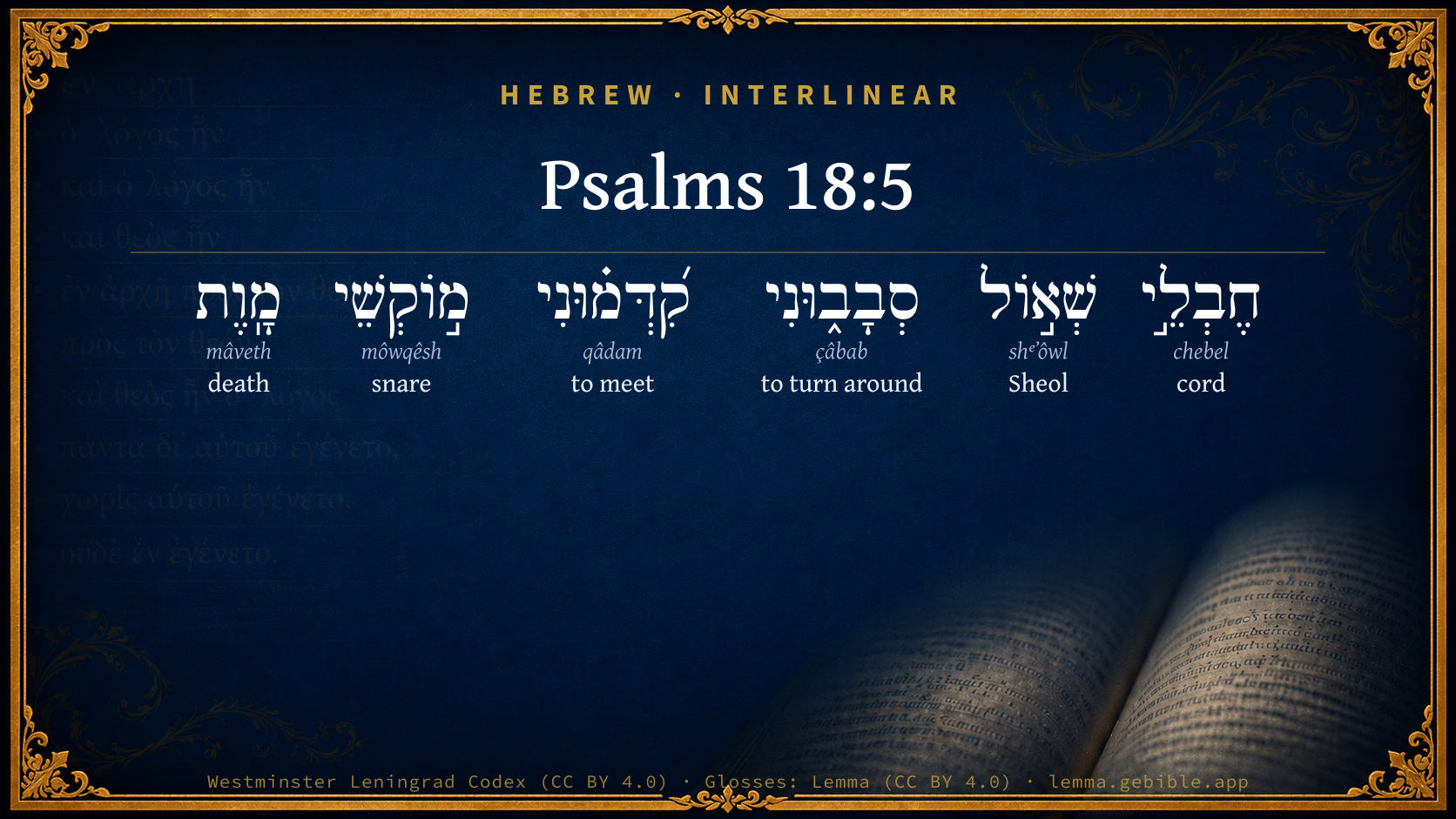
Psalms 18:5

Hebrew (Westminster Leningrad Codex) Psalms 18:5 appears in the Hebrew Old Testament. The text above is from the Westminster Leningrad Codex. Each word links to its Strong’s number, a concise gloss, and parsing drawn from the Open Scriptures Hebrew Bible morphology. Click any word for its full Brown-Driver-Briggs (BDB) entry.
Download image
Cite this verse

Psalms 18:5 (World English Bible). Public Domain. Lemma interlinear Bible study tool, https://lemma.gebible.app/v/psalms/18/5.

Show BibTeX & RIS
BibTeX
RIS
English Translation
The cords of Sheol were round about me; The snares of death came on me.
World English Bible · Public Domain
Download a study sheet

One document with this verse’s original text, its word-by-word gloss line, the meaning frame, cross-references with their text, attributed commentary, and full source and license credits — printable, and it pastes into notes with its structure intact.

This verse Autodidact and up

Study sheet (.html) Plain text (.txt)

A passage Seminary Student

Up to 50 verses in one chapter. A passage sheet keeps up to 6 commentary sources and 12 cross-references per verse, in the order this page ranks them, and says so on the sheet whenever that leaves anything out. Ask for a single verse and you get the Autodidact verse sheet above.

Everything on this page stays free to read, with no account — the sheet is a download of what is already on screen, not access to it.

Want to remove ads? Support Godless Engineer
Compare translations 3

The same verse in 3 English versions, stacked beneath the original-language interlinear above. Click any original word for its lexicon entry.

Each is an independent rendering of the whole verse — the interlinear is not word-aligned to these translations.

Highlighted words mark where these versions differ — a whole-verse word diff, not a word-by-word alignment.

  • World English Bible Public Domain
    The cords of Sheol were round about me; The snares of death came on me.
  • King James Version Public Domain
    The sorrows of hell compassed me about: the snares of death prevented me.
  • unfoldingWord Literal Text CC BY-SA 4.0
    The cords of Sheol surrounded me; the snares of death confronted me.

unfoldingWord Literal Text — © unfoldingWord, licensed CC BY-SA 4.0. Word-aligned USFM3 via Door43 (git.door43.org/unfoldingWord/en_ult).

Versions to compare (up to 4)

3 of 4 selected

Show all 18 translations

Every available English version of this verse, each an independent rendering of the whole verse.

  • World English Bible Public Domain
    The cords of Sheol were round about me; The snares of death came on me.
  • Berean Standard Bible Public Domain
    The cords of Sheol entangled me; the snares of death confronted me.
  • Majority Standard Bible Public Domain
    The cords of Sheol entangled me; the snares of death confronted me.
  • King James Version Public Domain
    The sorrows of hell compassed me about: the snares of death prevented me.
  • American Standard Version (1901) Public Domain
    The cords of Sheol were round about me; The snares of death came upon me.
  • Revised Version (1885) Public Domain
    The cords of Sheol were round about me: the snares of death came on me.
  • Geneva Bible (1599) Public Domain
    The sorowes of the graue haue compassed me about: the snares of death ouertooke me.
  • Douay-Rheims (1899) Public Domain
    The sorrows of death surrounded me: and the torrents of iniquity troubled me.
  • Young's Literal Translation Public Domain
    Cords of Sheol have surrounded me, Before me have been snares of death.
  • Literal Standard Version CC BY-SA 4.0
    Cords of Sheol have surrounded me, || Snares of death have been before me.
  • Unlocked Literal Bible CC BY-SA 4.0
    The cords of Sheol surrounded me; the snares of death trapped me.
  • unfoldingWord Literal Text CC BY-SA 4.0
    The cords of Sheol surrounded me; the snares of death confronted me.
  • Darby Bible Public Domain
    The bands of Sheol surrounded me, the cords of death encountered me.
  • World Messianic Bible Public Domain
    The cords of Sheol were around me. The snares of death came on me.
  • Webster's Bible Public Domain
    \\18:4\\The sorrows of death compassed me, and the floods of ungodly men made me afraid.
  • Free Bible Version CC BY-SA 4.0
    The grave wound its ropes around me; death set snares for me.
  • Bible in Basic English Public Domain
    The cords of hell were round me: the nets of death came on me.
  • JPS Tanakh (1917) Public Domain
    (18-6) The cords of Sheol surrounded me; the snares of Death confronted me.

Literal Standard Version (2020), Covenant Press — licensed CC BY-SA 4.0. Text via the HelloAO Bible API (eBible.org). Unlocked Literal Bible (unfoldingWord) — licensed CC BY-SA 4.0. Text via the HelloAO Bible API (eBible.org). unfoldingWord Literal Text — © unfoldingWord, licensed CC BY-SA 4.0. Word-aligned USFM3 via Door43 (git.door43.org/unfoldingWord/en_ult). Free Bible Version, Dr. Jonathan Gallagher — licensed CC BY-SA 4.0. Text via the HelloAO Bible API (eBible.org).

Word by word

More ways to search: Search by grammar → Find every occurrence → Compare this word →

Practice this passage: Drill this verse → Learn its vocabulary →

About this verse

These counts appear in no published source. They are computed here, from the morphology-tagged text and Lemma’s own curated glosses. What Lemma adds →

6
words
6
distinct lemmas
Wisdom
section

Shared distinctive vocabulary

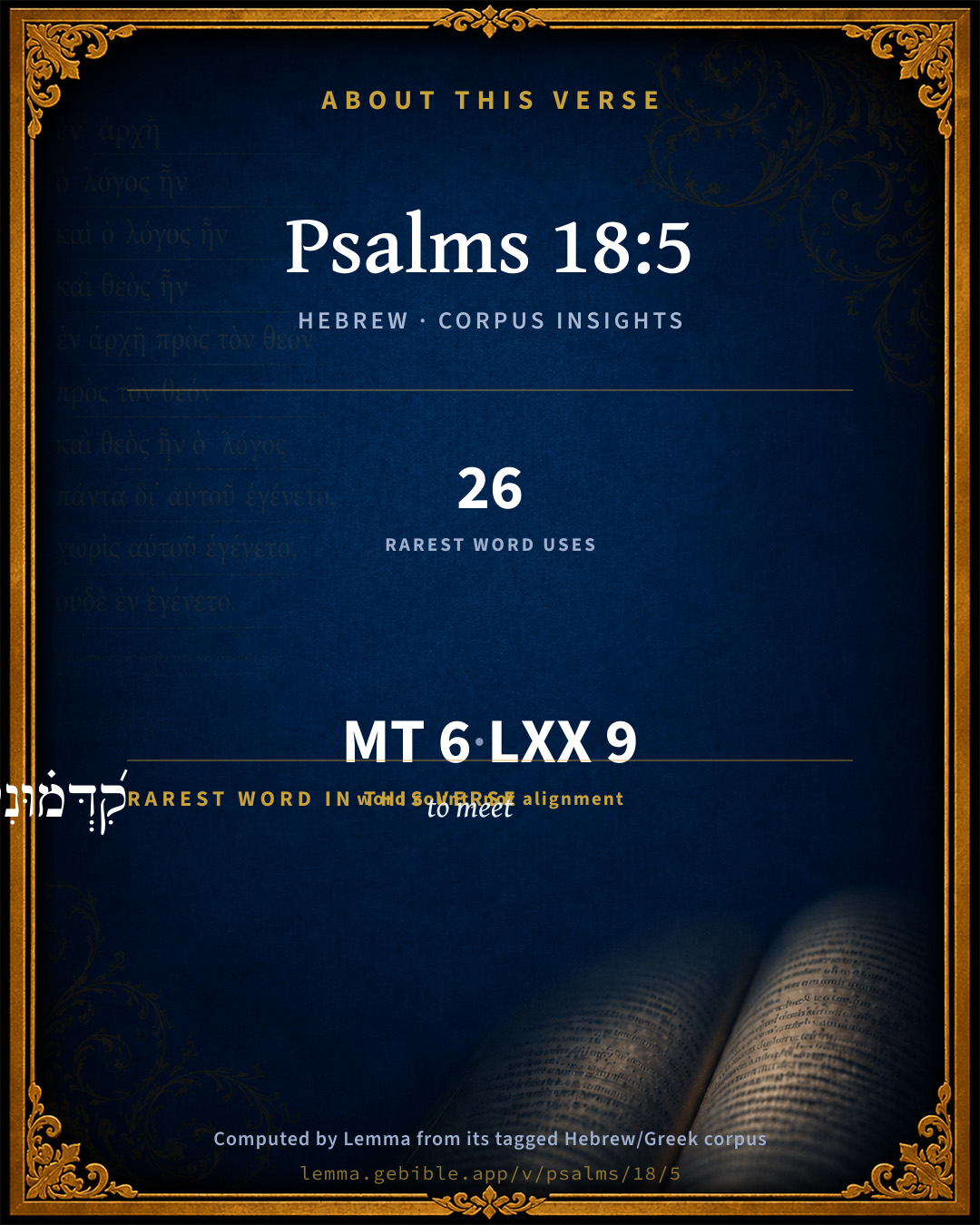
קִ֝דְּמ֗וּנִי to meet H6923 occurs in 25 verses of the Hebrew Bible. Also found in:

Grammatical profile

  • 2 verbs
  • 4 nouns

Verb forms

  • סְבָב֑וּנִי Qal · Perfect
  • קִ֝דְּמ֗וּנִי Piel · Perfect

Hebrew & Septuagint length

In English translation the verse runs 15 words from the Hebrew and 14 from the Septuagint (LXX English) — closely comparable.

A rough comparison of the two English renderings, which tokenize alike — not a word-level alignment.

Word counts can differ between the Hebrew and the Greek without any difference in meaning — e.g. the Hebrew direct-object marker אֵת has no separate Greek word, and Greek often adds the article ὁ.

In the original languages it is 6 Hebrew tokens and 9 Greek tokens — but the two are counted differently (Hebrew bundles its prefixes and suffixes into one token; the Greek is in lemma form), so that isn’t a like-for-like length.

Cross-references

6

Topical passages linked to Psalms 18:5 in the Treasury of Scripture Knowledge — connected by theme and wording, ordered by reader-vote popularity; previews shown in the World English Bible.

  • Psalms 86:13 For your loving kindness is great toward me. You have delivered my soul from the lowest Sheol.
  • Psalms 88:3–8 For my soul is full of troubles. My life draws near to Sheol.
  • Psalms 88:15–17 I am afflicted and ready to die from my youth up. While I suffer your terrors, I am distracted.
  • Acts 2:24 whom God raised up, having freed him from the agony of death, because it was not possible that he should be held by it.
  • Psalms 116:3 The cords of death surrounded me, The pains of Sheol got a hold of me. I found trouble and sorrow.
  • Ecclesiastes 9:12 For man also doesn't know his time. As the fish that are taken in an evil net, and as the birds that are caught in the snare, even so are the sons of men snared in an evil time, when it falls suddenly on them.

Cross-references courtesy of OpenBible.info (CC BY 4.0).

Hebrew and Greek witnesses Masoretic Hebrew ↔ Greek Septuagint

The same verse in the two great witnesses to the Old Testament, shown verse-for-verse.

You’re reading Greek Psalm 17 (Hebrew Psalm 18). The Septuagint counts the superscription, so verse numbers can differ from the Hebrew — chapter-level alignment, not verse-by-verse. Numbering follows Rahlfs.

These are two independent witnesses, not word-aligned to each other, and the Septuagint is shown in lemma (dictionary) form.

Hebrew Psalms 18:5 Masoretic · Westminster Leningrad Codex

חֶבְלֵ֣י שְׁא֣וֹל סְבָב֑וּנִי קִ֝דְּמ֗וּנִי מ֣וֹקְשֵׁי מָֽוֶת

The cords of Sheol were round about me; The snares of death came on me.

World English Bible · Public Domain

Greek LXX Greek Psalm 17:5 Septuagint · lemma form

περιἔχω ἐγώ ὠδίν θάνατος καί χειμάρρους ἀνομία ἐκταράσσω ἐγώ

The pangs of hell came round about me: the snares of death prevented me.

LXX2012 (modern English Septuagint) · Public Domain

On this verse, John Calvin's Commentaries discusses the Septuagint’s reading. Read the note in Commentary ↓

Hebrew: Westminster Leningrad Codex (CC BY 4.0). Greek: Septuagint (public domain); English from LXX2012 (modern English Septuagint) (Public Domain). How the Septuagint differs from the Hebrew →

Commentary

Notes on Psalms 18:5 from classic Christian and Jewish commentators (each source and its license shown beneath its notes). The classic Christian expositions comment on the surrounding passage and are grouped to its opening verse, so a note may address several verses; the Jewish commentaries on the Tanakh (Rashi and others) are per-verse, so they appear only where the commentator wrote on this verse.

Lemma curates 59 commentaries, every one of them public domain or Creative Commons licensed, each selected and text-cleaned for this edition rather than reprinted as found. About our sources →

Trapp's Complete Commentary

John Trapp

Psa 18:5 The sorrows of hell compassed me about: the snares of death prevented me.

Ver. 5. The sorrows] Or, throes, or cords, such as wherewith they bind malefactors led forth to execution.

The snares of death prevented me] David knew how to make the most of a mercy; he means, I was almost surprised, and all hope of help seemed to be anticipated; if help should come, it would some too late.

John Trapp, A Commentary or Exposition upon All the Books of the Old and New Testament (1647–1656) — public domain. Text from a community e-Sword module.

J. A. Alexander on Psalms

Joseph Addison Alexander

6. (Psa 18:5). The bands of hell surrounded me, the snares of death encountered me. This verse merely repeats and amplifies the first clause of the fifth, Hell, in the wide old English sense, is a poetical equivalent to death. See above, on Psa 6:6 (5). The explicit mention of snares in the last clause confirms the explanation before given of bands. Encountered, met me, crossed my path. The sense prevented or anticipated does not suit the context, and that of surprised is not sufficiently justified by usage. See above, on Psa 17:13.

Joseph Addison Alexander, The Psalms Translated and Explained (1850) — public domain. Text from a community e-Sword module.

Geneva Bible (1599)

Geneva Bible translators

Or, cords, or, cables

Geneva Bible (1599) marginal notes — public domain. Text via Bolls.life.

Jamieson, Fausset & Brown

Robert Jamieson, A. R. Fausset & David Brown

death--and hell (compare Psa 16:10) are personified as man's great enemies (compare Rev 20:13-14).

prevented--encountered me, crossed my path, and endangered my safety. He does not mean he was in their power.

Jamieson, Fausset & Brown — Commentary Critical and Explanatory on the Whole Bible (1871) — public domain (CC PDM 1.0). Text via the HelloAO Bible API.

Adam Clarke's Commentary

Verse 5. The sorrows of hell] חבלי שאול chebley sheol, the cables or cords of the grave. Is not this a reference to the cords or ropes with which they lowered the corpse into the grave? or the bandages by which the dead were swathed? He was as good as dead.

The snares of death prevented me.] I was just on the point of dropping into the pit which they had digged for me. In short, I was all but a dead man; and nothing less than the immediate interference of God could have saved my life.

Adam Clarke's Commentary on the Bible (1810–1826) — public domain. Text from a community e-Sword/MySword module.

John Calvin's Commentaries

We shall now make a few observations with respect to the words. The Hebrew word חבלי, chebley, means cords or sorrows, or any deadly evil, “חבל, chebel,” says Hammond, “signifies two things, a cord, and a pang of a woman’s travail, and which it signifies must be resolved still by the context. Here, where it is joined with encompassing, it is most fitly to be understood in the former sense, because ropes or cords are proper for that turn, as for holding and keeping in when they are inclosed.” The Chaldee understands the word in the other sense, and paraphrases the clause thus: ”Distress hath compassed me as a woman in travail which hath not strength to bring forth, and is in danger of death,” The Septuagint adopts the same view, reading, “ὠδινες θανατου, the pangs of death.”

Cocceius renders the words, “the waves of death,” and he observes, that the words “waves’” explains the verb “compassed me about.” Death sent its sorrows thick upon him one after another, as the sea sends forth its waves, and with such violence that he was ready to be overwhelmed. The word משברי, mishberey, is applied both to the breaking waves of the sea, (Psalm 42:7.) — Ainsworth. Horsley translates the phrase, “The breakers of death.” “The metaphor,” says he, “is taken from those dangerous waves our mariners call white breakers.”

Jerome doubtless derived the word from בלי, beli, not or without, and עול, ol, a yoke, and thus the term Belial means those who shake off all restraint. Signifying to profit, or to gain advantage in any respect.

Belial is a compound term, significant of vileness and worthlessness.

“The ‘floods of Belial’ intend large bodies of men, who rush forward in impetuous torrents to overwhelm and destroy whatever opposes them.” - Walford.

John Calvin's Commentaries (1540-1563) — public domain. Text from the Calvin Translation Society English edition (1840s-50s) via the Christian Classics Ethereal Library (ccel.org). Calvin's coverage is partial (roughly two-thirds of the Bible); uncommented books and verses are honest gaps, never fabricated. The 19th-century editor's footnotes and remarks are omitted so the notes are faithfully Calvin's own voice.

Ellicott's Commentary for English Readers

(5) Hell.—Heb., sheôl. (See Note on Psa_6:5.)

Prevented—i.e., suddenly seized upon. The poet seems to feel the cords already tightening on his limbe. He is not dead yet, but like to them who go down to sheôl. This verse has one verbal difference from Samuel.

A Bible Commentary for English Readers, edited by Charles John Ellicott (1878–1897) — public domain. Text from a community e-Sword module.

The Cambridge Bible for Schools and Colleges

gen. ed. J. J. S. Perowne

5. Render with R.V.,

The cords of Sheol were round about me:

The snares of death came upon me.

The Heb. word rendered sorrows in the A.V. may no doubt have the meaning pangs, and is so rendered by the LXX (ὠδῖνες θανάτου … ὠ. ᾁδου, cp. Act_2:24). But the parallelism decides in favour of the rendering cords. Death and Sheol, the mysterious unseen world (see on Psa_6:5), are like hunters lying in wait for their prey with nooses and nets.

prevented] i.e. came before, confronted me (Psa_17:13) with hostile intention. See note on Psa_18:18.

The Cambridge Bible for Schools and Colleges (gen. ed. J. J. S. Perowne; Cambridge University Press, 1878–1918) — public domain. Text from a community e-Sword module.

John Gill's Exposition

In my distress I called upon the Lord,.... The great Jehovah, the everlasting I AM, who is the most High in all the earth, and who is able to save, Heb 5:7;

and cried unto my God; as Jesus did, Mat 27:46; so the members of Christ, when in distress, as they often are, through sin and Satan, through the hidings of God's face, a variety of afflictions, and the persecutions of men, betake themselves to the Lord, and call upon their God: a time of distress is a time for prayer; and sometimes the end God has in suffering them to be in distress is to bring them to the throne of his grace; and a great privilege it is they have that they have such a throne to come to for grace and mercy to help them in time of need, and such a God to sympathize with them, and help them; and their encouragement to call upon him, and cry unto him, is, that he is Jehovah, omniscient, omnipotent, and omnipresent; who knows their wants, is able to help them, and is a God at hand to do it;

He heard my voice out of his temple; that is, out of heaven his dwelling place; for the temple at Jerusalem was not built in David's time; and it may be observed, that the prayer of the psalmist, or whom he represents, was a vocal one, and not merely mental; and hearing it intends a gracious regard unto it, an acceptance of it, and an agreeable answer: for it follows,

and my cry came before him, even into his ears; God did not cover himself with a cloud, that his prayer could not pass through; but it was admitted and received; it came up before him with acceptance; it reached his ears, and even entered into them, and was delightful music to them: see Joh 11:41.

John Gill's Exposition of the Whole Bible (1746–1763) — public domain (CC PDM 1.0). Text via the HelloAO Bible API.

Albert Barnes' Notes on the Bible

The sorrows of hell - Margin, “cords.” The word used here is the same which occurs in the previous verse, and which is there rendered “sorrows.” It is correctly translated here, as in that verse, “sorrows,” though the parallelism would seem to favor the interpretation in the margin - cords. If it means “sorrows,” the idea is, that such sufferings encompassed him, or seized upon him, as we associate in idea with the descent to the under-world, or the going down to the dead. If it means “cords, or bands,” then the idea is, that he was seized with pain as if with cords thrown around him, and that were dragging him down to the abodes of the dead. Luther, DeWette, Prof. Alexander, Hengstenberg, and others render the word, in each of these places, “bands.” On the word here rendered “hell,” שׁאול she'ôl, see the notes at Isa 14:9. It means here the “under-world, the regions of the dead.” It is a description of one who was overcome with the dread of death.

The snares of death - The word “snares” refers to the gins, toils, nets, which are used in taking wild beasts, by suddenly throwing cords around them, and binding them fast. The idea here is, that “Death” had thus thrown around him its toils or snares, and had bound him fast.

Prevented me - The word used here in Hebrew, as our word “prevent” did originally, means to “anticipate, to go before.” The idea here is that those snares had, as it were, suddenly rushed upon him, or seized him. They came before him in his goings, and bound him fast.

Albert Barnes' Notes on the Bible (1834–1885) — public domain. Text from a community e-Sword/MySword module.

Matthew Poole's English Annotations

Of hell; or, of the grave, which brought me to the brink of the grave.

Prevented me; had almost taken hold of me, ere I was aware of my danger.

Matthew Poole's English Annotations on the Holy Bible (1683–1685) — public domain. Text from a community e-Sword/MySword module.

The Treasury of David

Charles H. Spurgeon

Ver. 5. The sorrows of hell compassed me about. From all sides the hell hounds barked furiously. A cordon of devils hemmed in the hunted man of God; every way of escape was closed up. Satan knows how to blockade our coasts with the iron warships of sorrow, but, blessed be God, the port of all prayer is still open, and grace can run the blockade bearing messages from earth to heaven, and blessings in return from heaven to earth.

The snares of death prevented me. The old enemy hunts for his prey, not only with the dogs of the infernal kennel, but also with the snares of deadly craft. The nets were drawn closer and closer until the contracted circle completely prevented the escape of the captive:

"About me the cords of hell were wound, And snares of death my footsteps bound."

Thus hopeless was the case of this good man, as hopeless as a case could be, so utterly desperate that none but an almighty arm could be of any service. According to the four metaphors which he employs, he was bound like a malefactor for execution; overwhelmed like a shipwrecked mariner; surrounded and standing at bay like a hunted stag; and captured in a net like a trembling bird. What more of terror and distress could meet upon one poor defenceless head?

Ver. 5. The snares of death prevented me. The word snares, signifies such traps or gins as are laid for birds and wild beasts. The English word "prevent" has changed its meaning in some measure since our authorised translation of the Bible was made. Its original meaning is to "come before." John Brown.

Ver. 5. (first clause). The condition of a soul convinced of sin.

Ver. 5. (second clause). The way in which snares and temptations are, by Satanic craft, arranged so as to forestall or prevent us.

Psalms 18:6*

Charles H. Spurgeon's The Treasury of David (1869–1885) — public domain. Psalms only. Text from a community e-Sword/MySword module.

The Pulpit Commentary

The sorrows of hell compassed me about; literally, the cords of Sheol, or Hades. Death and Hell are, both of them, personified, and made to join in the chase. The ensnaring nets are drawn nearer and nearer; at last the toils close in, the last cast is made, and the prey is taken. The snares of death prevented me; or, came upon me (Revised Version) me by surprise" (Kay).

The Pulpit Commentary (1880–1919), ed. H.D.M. Spence-Jones & Joseph S. Exell — public domain. Text from a community e-Sword module.

John Wesley's Explanatory Notes

Sorrows - Which brought me to the brink of the grave. Death - Had almost taken hold of me, before I was aware.

John Wesley, Explanatory Notes Upon the Whole Bible (1754–1765) — public domain. Text via the GEBible commentary corpus.

Scofield Reference Notes

C. I. Scofield

hell

Heb. "Sheol," (See Scofield "Hab 2:5")

The Scofield Reference Bible (1917 edition), notes by C. I. Scofield — public domain. Text from a community e-Sword module.

Rashi

Rabbi Shlomo Yitzchaki (Rashi)

Bands of death have encompassed me On many occasions wicked men have surrounded me. אפפוני is like סבבוני. Similarly (below 40:13), “For countless evils...have encompassed (אפפו) me.”

Bands of death Heb. חבלי, camps of enemies, as (in I Sam. 10:5): “a band (חבל) of prophets.” But Jonathan renders: as a woman who sits on a birthstool, an expression of the pangs (חבלי) of a woman in confinement.

and streams of scoundrels That too is an expression of troops that flood like a stream.

Rashi on the Tanakh — English translations: “The Judaica Press complete Tanach with Rashi, translated by A. J. Rosenberg” (CC BY 4.0); “Pentateuch with Rashi's commentary by M. Rosenbaum and A.M. Silbermann, 1929-1934” (public domain); “The Metsudah Tanach series, Lakewood, N.J” (CC BY 4.0); and “The Book of Joshua, Metsudah Publications, 1997” (CC BY 4.0). Text via Sefaria.

Lesson kit

Teaching starters — assembled from the data on this page, not authored interpretation. Every prompt links to the verse data it draws on. Edit before teaching.

Psalms, in the Wisdom, opens this verse with 6 words (6 distinct Hebrew lemmas). Its most distinctive word is qâdam (“to meet”). A historical commentator’s framing appears above. Read the whole chapter for the surrounding context.

Discussion questions

  1. How does “to meet” (qâdam) shape what this verse is saying?
  2. Deuteronomy 23:4 shares the word «to meet» with this verse. How do the two illuminate each other?
  3. The translations on this page render this verse differently — a whole-verse word diff, not a word-by-word alignment. What might account for the different wordings?
  4. The verb «סְבָב֑וּנִי» is Qal Perfect. How does its form color the action?
  5. Reading how Trapp's Complete Commentary and J. A. Alexander on Psalms read this verse, where do the two commentators agree and where do they part?

Things to notice

Reading settings

Reading text

Shown beneath each verse's original-language words.

Old Testament
Old Testament edition

Read the OT as the Masoretic Hebrew (MT) or the Greek Septuagint (LXX).

English shown for the Greek Septuagint (in the Hebrew ↔ Greek comparison).

Comparing translations? Open the Compare panel on any verse page to stack up to four side by side.