
Ezekiel 1:9

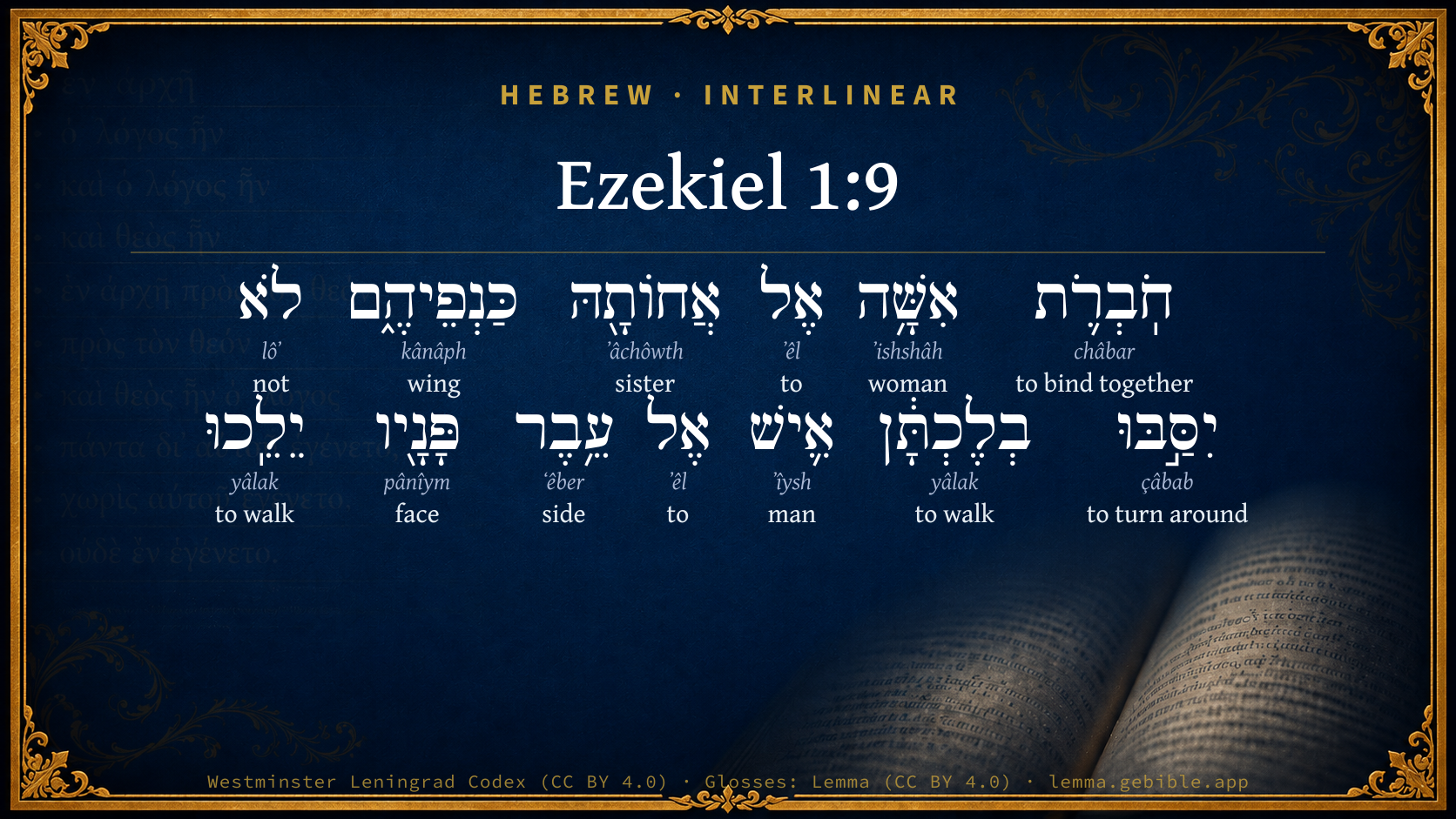
Hebrew (Westminster Leningrad Codex) Ezekiel 1:9 appears in the Hebrew Old Testament. The text above is from the Westminster Leningrad Codex. Each word links to its Strong’s number, a concise gloss, and parsing drawn from the Open Scriptures Hebrew Bible morphology. Click any word for its full Brown-Driver-Briggs (BDB) entry.
Download image
Cite this verse

Ezekiel 1:9 (World English Bible). Public Domain. Lemma interlinear Bible study tool, https://lemma.gebible.app/v/ezekiel/1/9.

Show BibTeX & RIS
BibTeX
RIS
English Translation
their wings were joined one to another; they didn't turn when they went; they went everyone straight forward.
World English Bible · Public Domain
Download a study sheet

One document with this verse’s original text, its word-by-word gloss line, the meaning frame, cross-references with their text, attributed commentary, and full source and license credits — printable, and it pastes into notes with its structure intact.

This verse Autodidact and up

Study sheet (.html) Plain text (.txt)

A passage Seminary Student

Up to 50 verses in one chapter. A passage sheet keeps up to 6 commentary sources and 12 cross-references per verse, in the order this page ranks them, and says so on the sheet whenever that leaves anything out. Ask for a single verse and you get the Autodidact verse sheet above.

Everything on this page stays free to read, with no account — the sheet is a download of what is already on screen, not access to it.

Want to remove ads? Support Godless Engineer
Compare translations 3

The same verse in 3 English versions, stacked beneath the original-language interlinear above. Click any original word for its lexicon entry.

Each is an independent rendering of the whole verse — the interlinear is not word-aligned to these translations.

Highlighted words mark where these versions differ — a whole-verse word diff, not a word-by-word alignment.

  • World English Bible Public Domain
    their wings were joined one to another; they didn't turn when they went; they went everyone straight forward.
  • King James Version Public Domain
    Their wings were joined one to another; they turned not when they went; they went every one straight forward.
  • unfoldingWord Literal Text CC BY-SA 4.0
    their wings were touching the wings of the next creature, and they did not turn as they went; instead, each one went straight forward.

unfoldingWord Literal Text — © unfoldingWord, licensed CC BY-SA 4.0. Word-aligned USFM3 via Door43 (git.door43.org/unfoldingWord/en_ult).

Versions to compare (up to 4)

3 of 4 selected

Show all 18 translations

Every available English version of this verse, each an independent rendering of the whole verse.

  • World English Bible Public Domain
    their wings were joined one to another; they didn't turn when they went; they went everyone straight forward.
  • Berean Standard Bible Public Domain
    and their wings were touching one another. They did not turn as they moved; each one went straight ahead.
  • Majority Standard Bible Public Domain
    and their wings were touching one another. They did not turn as they moved; each one went straight ahead.
  • King James Version Public Domain
    Their wings were joined one to another; they turned not when they went; they went every one straight forward.
  • American Standard Version (1901) Public Domain
    their wings were joined one to another; they turned not when they went; they went every one straight forward.
  • Revised Version (1885) Public Domain
    their wings were joined one to another; they turned not when they went; they went every one straight forward.
  • Geneva Bible (1599) Public Domain
    They where ioyned by their wings one to another, and when they went forth, they returned not, but euery one went streight forward.
  • Douay-Rheims (1899) Public Domain
    And the wings of one were joined to the wings of another. They turned not when they went: but every one went straight forward.
  • Young's Literal Translation Public Domain
    joining one unto another `are' their wings, they turn not round in their going, each straight forward they go.
  • Literal Standard Version CC BY-SA 4.0
    their wings [are] joining to one another, they do not turn around in their going, they each go straight forward.
  • Unlocked Literal Bible CC BY-SA 4.0
    their wings were touching the wings of the next creature, and they did not turn as they went; instead, each one went straight forward.
  • unfoldingWord Literal Text CC BY-SA 4.0
    their wings were touching the wings of the next creature, and they did not turn as they went; instead, each one went straight forward.
  • Darby Bible Public Domain
    their wings were joined one to another; they turned not when they went; they went every one straight forward.
  • World Messianic Bible Public Domain
    Their wings were joined to one another. They didn’t turn when they went. Each one went straight forward.
  • Webster's Bible Public Domain
    Their wings were joined one to another; they turned not when they went; they went every one straight forward.
  • Free Bible Version CC BY-SA 4.0
    and each of their wings touched the wings of the one next to it. As they moved they didn't turn—they all moved straight in one direction.
  • Bible in Basic English Public Domain
    They went without turning, every one went straight forward.
  • JPS Tanakh (1917) Public Domain
    their wings were joined one to another; they turned not when they went; they went every one straight forward.

Literal Standard Version (2020), Covenant Press — licensed CC BY-SA 4.0. Text via the HelloAO Bible API (eBible.org). Unlocked Literal Bible (unfoldingWord) — licensed CC BY-SA 4.0. Text via the HelloAO Bible API (eBible.org). unfoldingWord Literal Text — © unfoldingWord, licensed CC BY-SA 4.0. Word-aligned USFM3 via Door43 (git.door43.org/unfoldingWord/en_ult). Free Bible Version, Dr. Jonathan Gallagher — licensed CC BY-SA 4.0. Text via the HelloAO Bible API (eBible.org).

Word by word

More ways to search: Search by grammar → Find every occurrence → Compare this word →

Practice this passage: Drill this verse → Learn its vocabulary →

חֹֽבְרֹ֛ת
châbar
H2266
“binding together”
Verb, Qal, Participle Active, Feminine, Plural, Absolute
Part of Speech
Verb
Stem
Qal
Form
Participle Active
Gender
Feminine
Number
Plural
State
Absolute
Full BDB Definition

Origin: a primitive root

TWOT: 598

to unite, join, bind together, be joined, be coupled, be in league, heap up, have fellowship with, be compact, be a charmer - (Qal) - to unite, be joined - to tie magic charms, charm - (Piel) - to unite with, make an ally of - to unite, join, ally - (Pual) - to be allied with, be united - to be joined together - (Hiphil) to join together, pile up (words) - (Hithpael) to join oneself to, make an alliance, league together
  1. אִשָּׁ֥ה ʼishshâh H802 “woman” Noun, Common, Feminine, Singular, Absolute
  2. אֶל ʼêl H413 “to” Preposition
  3. אֲחוֹתָ֖הּ ʼâchôwth H269 “sister · her” Noun, Common, Feminine, Singular, Construct + Suffix, Personal, 3rd Person, Feminine, Singular
  4. כַּנְפֵיהֶ֑ם kânâph H3671 “wings · their” Noun, Common, Feminine, Dual, Construct + Suffix, Personal, 3rd Person, Masculine, Plural
  5. לֹא lôʼ H3808 “not” Particle, Negative
  6. יִסַּ֣בּוּ çâbab H5437 “to turn around” Verb, Niphal, Imperfect, 3rd Person, Masculine, Plural
  7. בְלֶכְתָּ֔ן yâlak H3212 “in/at · to walk · them” Preposition + Verb, Qal, Infinitive Construct + Suffix, Personal, 3rd Person, Feminine, Plural
  8. אִ֛ישׁ ʼîysh H376 “man” Noun, Common, Masculine, Singular, Absolute
  9. אֶל ʼêl H413 “to” Preposition
  10. עֵ֥בֶר ʻêber H5676 “side of” Noun, Common, Masculine, Singular, Construct
  11. פָּנָ֖יו pânîym H6440 “face(s) · his” Noun, Common, Both, Plural, Construct + Suffix, Personal, 3rd Person, Masculine, Singular
  12. יֵלֵֽכוּ yâlak H3212 “to walk” Verb, Qal, Imperfect, 3rd Person, Masculine, Plural

About this verse

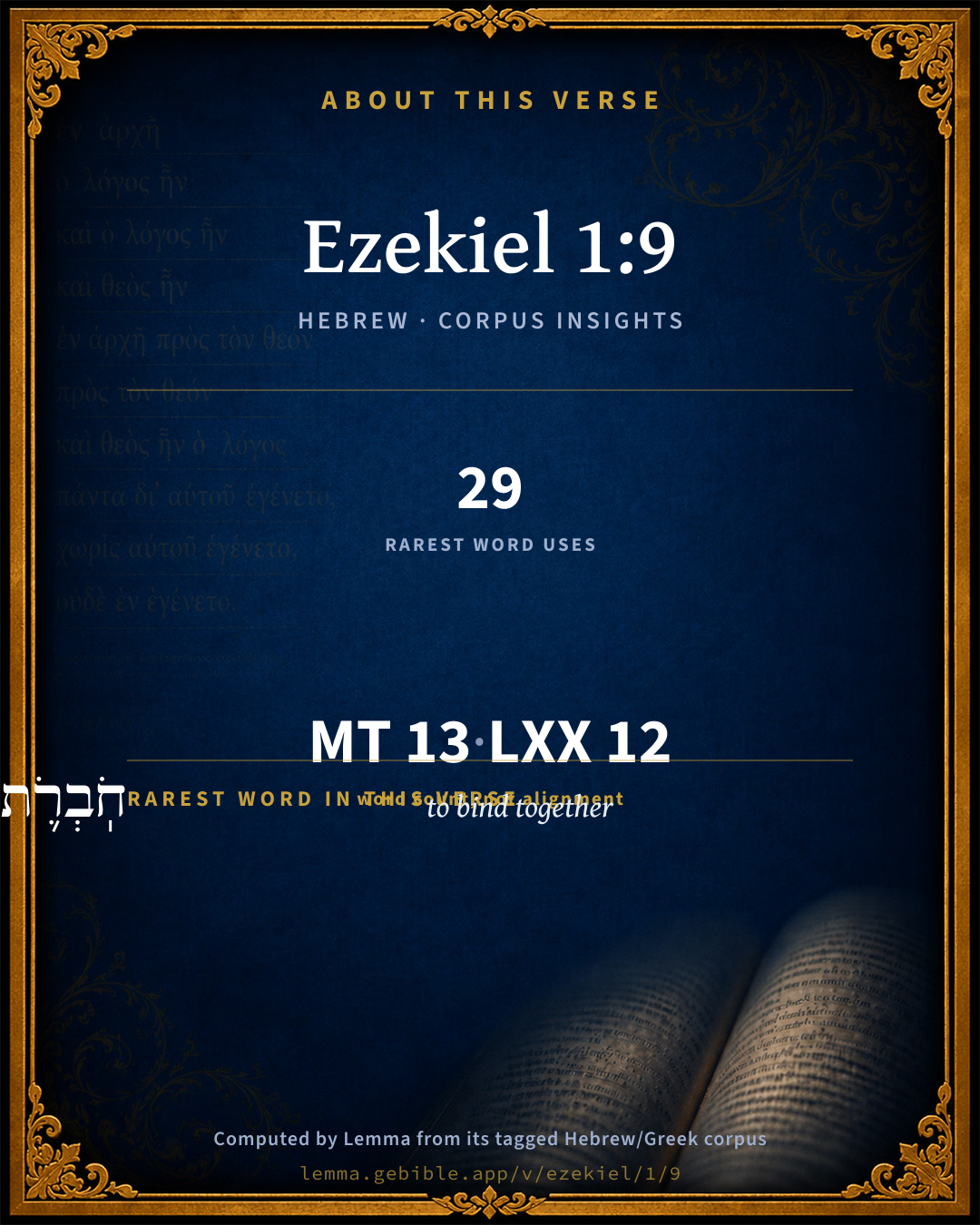
These counts appear in no published source. They are computed here, from the morphology-tagged text and Lemma’s own curated glosses. What Lemma adds →

13
words
11
distinct lemmas
Prophets
section

Shared distinctive vocabulary

חֹֽבְרֹ֛ת to bind together H2266 occurs in 25 verses of the Hebrew Bible. Also found in:

Grammatical profile

  • 4 verbs
  • 6 nouns
  • 2 prepositions
  • 1 particle

Verb forms

  • חֹֽבְרֹ֛ת Qal · Participle Active
  • יִסַּ֣בּוּ Niphal · Imperfect
  • בְלֶכְתָּ֔ן Qal · Infinitive Construct
  • יֵלֵֽכוּ Qal · Imperfect

Repetition

Words recur within this verse — often emphatic in Hebrew:

  • בְלֶכְתָּ֔ן to walk H3212 ×2
  • אֶל to H413 ×2

Hebrew & Septuagint length

In English translation the verse runs 18 words from the Hebrew and 16 from the Septuagint (LXX English) — closely comparable.

A rough comparison of the two English renderings, which tokenize alike — not a word-level alignment.

Word counts can differ between the Hebrew and the Greek without any difference in meaning — e.g. the Hebrew direct-object marker אֵת has no separate Greek word, and Greek often adds the article ὁ.

In the original languages it is 13 Hebrew tokens and 12 Greek tokens — but the two are counted differently (Hebrew bundles its prefixes and suffixes into one token; the Greek is in lemma form), so that isn’t a like-for-like length.

Cross-references

8

Topical passages linked to Ezekiel 1:9 in the Treasury of Scripture Knowledge — connected by theme and wording, ordered by reader-vote popularity; previews shown in the World English Bible.

  • Ezekiel 10:22 As for the likeness of their faces, they were the faces which I saw by the river Chebar, their appearances and themselves; they went every one straight forward.
  • 2 Chronicles 3:11–12 The wings of the cherubim were twenty cubits long: the wing of the one [cherub] was five cubits, reaching to the wall of the house; and the other wing was [likewise] five cubits, reaching to the wing of the other cherub.
  • Proverbs 4:25–27 Let your eyes look straight ahead. Fix your gaze directly before you.
  • Ezekiel 1:11–12 Their faces and their wings were separate above; two [wings] of everyone were joined one to another, and two covered their bodies.
  • Ezekiel 10:11 When they went, they went in their four directions: they didn't turn as they went, but to the place where the head looked they followed it; they didn't turn as they went.
  • Luke 9:51 It came to pass, when the days were near that he should be taken up, he intently set his face to go to Jerusalem,
  • Luke 9:62 But Jesus said to him, "No one, having put his hand to the plow, and looking back, is fit for the Kingdom of God."
  • 1 Corinthians 1:10 Now I beg you, brothers, through the name of our Lord, Jesus Christ, that you all speak the same thing and that there be no divisions among you, but that you be perfected together in the same mind and in the same judgment.

Cross-references courtesy of OpenBible.info (CC BY 4.0).

Hebrew and Greek witnesses Masoretic Hebrew ↔ Greek Septuagint

The same verse in the two great witnesses to the Old Testament, shown verse-for-verse.

These are two independent witnesses, not word-aligned to each other, and the Septuagint is shown in lemma (dictionary) form.

Hebrew Ezekiel 1:9 Masoretic · Westminster Leningrad Codex

חֹֽבְרֹ֛ת אִשָּׁ֥ה אֶל אֲחוֹתָ֖הּ כַּנְפֵיהֶ֑ם לֹא יִסַּ֣בּוּ בְלֶכְתָּ֔ן אִ֛ישׁ אֶל עֵ֥בֶר פָּנָ֖יו יֵלֵֽכוּ

their wings were joined one to another; they didn't turn when they went; they went everyone straight forward.

World English Bible · Public Domain

Greek LXX Ezekiel 1:9 Septuagint · lemma form

οὐ ἐπιστρέφω ἐν ὁ βαδίζω αὐτός ἕκαστος κατέναντι ὁ πρόσωπον αὐτός πορεύομαι

And the faces of them four turned not when they went; they went everyone straight forward.

LXX2012 (modern English Septuagint) · Public Domain

On this verse, Haydock's Catholic Bible Commentary discusses the Septuagint’s reading. Read the note in Commentary ↓

Hebrew: Westminster Leningrad Codex (CC BY 4.0). Greek: Septuagint (public domain); English from LXX2012 (modern English Septuagint) (Public Domain). How the Septuagint differs from the Hebrew →

Targum (Aramaic paraphrase)

1

The Targum is the ancient Jewish Aramaic paraphrase of the Hebrew Scriptures — an interpretive translation, not the Hebrew text itself. Onkelos (literal) and Pseudo-Jonathan (expansive) render the Torah, and Jonathan the Prophets. Coverage is partial: where no permissively-licensed English translation exists for a verse, only the Aramaic is shown. This is verse-level text, not a word-by-word alignment to the Hebrew.

  1. Targum Jonathan Prophets (Joshua–Malachi)
    מְכַוְנָן חֲדָא לִקְבֵיל חֲדָא גַפֵּיהוֹן לָא מִתְחַזְרִין בְּמִיזַלְהֶן בִּרְיָא לִקְבֵיל אַפָּהָא אָזְלַן:

    (no public-domain English translation for this verse)

    Targum Jonathan — Aramaic: “Mikraot Gedolot” (public domain). English: “Sefaria Community Translation” (CC0 1.0 (public-domain dedication)); “London "Chaldee Paraphrase," 1871” (public domain). Text via Sefaria.

Commentary

Notes on Ezekiel 1:9 from classic Christian and Jewish commentators (each source and its license shown beneath its notes). The classic Christian expositions comment on the surrounding passage and are grouped to its opening verse, so a note may address several verses; the Jewish commentaries on the Tanakh (Rashi and others) are per-verse, so they appear only where the commentator wrote on this verse.

Lemma curates 59 commentaries, every one of them public domain or Creative Commons licensed, each selected and text-cleaned for this edition rather than reprinted as found. About our sources →

Trapp's Complete Commentary

John Trapp

Eze 1:9 Their wings [were] joined one to another; they turned not when they went; they went every one straight forward.

Ver. 9. Their wings were joined one to another.] To show the unity of angels, the uniformity also of their motions in God’s service; there is a suitability and agreeability between them.

They turned not when they went,] sc., Till they had effected that which they went for; and then they did. {as Eze 1:14}

They went every one straight forward.] The angels, in the execution of their office, kept a straight course, without deviating or detracting, without cessation or cespitation. Our eyes should also "look right on," {Pro 4:25} and we should make "straight steps for our feet." {Heb 12:13} This is angel-like. St Paul, that earthly angel, did so. {Php 3:13-14}

John Trapp, A Commentary or Exposition upon All the Books of the Old and New Testament (1647–1656) — public domain. Text from a community e-Sword module.

Geneva Bible (1599)

Geneva Bible translators

The wing of the one touched the wing of the other.

Geneva Bible (1599) marginal notes — public domain. Text via Bolls.life.

Jamieson, Fausset & Brown

Robert Jamieson, A. R. Fausset & David Brown

they--had no occasion to turn themselves round when changing their direction, for they had a face (Eze 1:6) looking to each of the four quarters of heaven. They made no mistakes; and their work needed not be gone over again. Their wings were joined above in pairs (see Eze 1:11).

Jamieson, Fausset & Brown — Commentary Critical and Explanatory on the Whole Bible (1871) — public domain (CC PDM 1.0). Text via the HelloAO Bible API.

Adam Clarke's Commentary

Verse 9. Their wings were joined one to another] When their wings were extended, they formed a sort of canopy level with their own heads or shoulders; and on this canopy was the throne, and the "likeness of the man" upon it, Eze 1:26.

They turned not when they went] The wings did not flap in flying, or move in the manner of oars, or of the hands of a man in swimming, in order to their passing through the air; as they glided in reference to their feet, so they soared in reference to their wings.

Adam Clarke's Commentary on the Bible (1810–1826) — public domain. Text from a community e-Sword/MySword module.

John Calvin's Commentaries

He says the wings were conjoined, which he soon more clearly explains: for he will say that the wings were joined together, and that two were so extended that they clothed or ruled the whole body: but here he touches shortly upon what he will soon treat more at length. Their wings then were so joined together that one touched the other: and afterwards he adds, they so went forward that they did not return; and he seems to contradict himself when he afterwards says the animals ran like lightning and then returned: but these two things are not inconsistent, for he will soon add the explanation: namely, that the animals so go forward that they proceed in a perpetual course towards their own end or goal, but it does not follow that they afterwards rest there. Therefore when the animals proceed, they do not turn aside in either one direction or another, nor do they turn back, but go straight on in their destined course afterwards, like lightning, yet they have different meetings: and what this means we have no time to explain now, but must defer it till tomorrow.

John Calvin's Commentaries (1540-1563) — public domain. Text from the Calvin Translation Society English edition (1840s-50s) via the Christian Classics Ethereal Library (ccel.org). Calvin's coverage is partial (roughly two-thirds of the Bible); uncommented books and verses are honest gaps, never fabricated. The 19th-century editor's footnotes and remarks are omitted so the notes are faithfully Calvin's own voice.

Ellicott's Commentary for English Readers

(9) Their wings were joined one to another.—i.e., the outstretched right wing of one cherub was joined at its tip to the left wing of another, so that although four, they yet constituted in some sense but one creature, all moving in harmony and by a common impulse. This applies to the cherubim only when in motion; when they stood, the wings were let down (Eze_1:24). The joining of the extremities of the outstretched wings of the cherubim recalls the arrangement in Solomon’s Temple (1Ki_6:27), in which the wings of the larger cherubim touched one another above the mercy-seat.

They turned not when they went.—Whichever way they wished to go, they could still go “straight forward,” i.e., in the direction towards which they looked, since they looked in all directions, and their round feet made it equally easy to move in any way. It would at first seem that as two of the wings of each cherub were used to cover their bodies (Eze_1:11), the wings would have required their turning when they changed their course; but if we conceive of the four cherubim as arranged to form a square, and with their wings moving as one creature, this difficulty disappears.

A Bible Commentary for English Readers, edited by Charles John Ellicott (1878–1897) — public domain. Text from a community e-Sword module.

John Gill's Exposition

Their wings were joined one to another,.... "A woman to her sister" (n), in the Hebrew; denoting the concord, harmony, and agreement of Gospel ministers, and their affection to one another; they preach the same Gospel; administer the same ordinances; do the same work of the Lord; have the same zeal for the glory of God; the same love for Christ, and affection for the souls of men; are of the same mind and judgment, and help each other in the service of the Lord; and especially so it will be in the latter day glory, when the watchmen shall see eye to eye, Isa 52:8;

they turned not when they went; they went everyone straight forward; they go not into the path of error and immorality; they do not become apostates from the truth; they are not of them that draw back unto perdition; they go on in the course of their ministry straightforward; let what will be in their way, nothing diverts them from it; notwithstanding all difficulties and discouragements in themselves; reproaches, afflictions, and persecutions from men; and the temptations of Satan; See Gill on Eze 1:7.

(n) "foemina adsororem suam", Montanus, Polanus; "vira, sive mulier ad sociam suam", so some in Vatablus.

John Gill's Exposition of the Whole Bible (1746–1763) — public domain (CC PDM 1.0). Text via the HelloAO Bible API.

Albert Barnes' Notes on the Bible

Two of the wings were in the act of flying, so stretched out that the extremity of each touched a wing of a neighboring living creature, similarly stretched out. This was only when they were in motion. See Eze 1:24.

They went every one straight forward - The four together formed a square, and never altered their relative position. From each side two faces looked straight out, one at each corner - and so all moved together toward any of the four quarters, toward which each one had one of its four faces directed; in whatsoever direction the whole moved the four might be said all to go “straight forward.”

Albert Barnes' Notes on the Bible (1834–1885) — public domain. Text from a community e-Sword/MySword module.

Haydock's Catholic Bible Commentary

Another. Two above were extended so as to support the throne, which seemed to rest on these eight wings connected together. The others were joined so as perfectly to cover what was below the breast. (Calmet) --- Septuagint, "And the wings of those four were touching each other, and their faces (Calmet reads with Chaldean and Hebrew, wings) turned not," &c. (Haydock) --- The wings did not imitate those of birds, going to and fro, but were constantly in the same direction; or the animals did not change their respective situations: as they had four faces, there was always one of them turned to the opposite quarters of the world. (Calmet) --- They turned not about, (ver. 12.) but having faces on every side, were ready to go any way. (Worthington)

George Leo Haydock (1774–1849), Haydock's Catholic Family Bible and Commentary, 1859 edition — public domain. Excludes Psalms (Douay-Rheims chapter numbering differs from Protestant) and Deuterocanonical books (Catholic canon only).

Matthew Poole's English Annotations

Their wings were joined one to another; the wings of the living creatures, when stretched out to fly, were joined together; so the wings of those two cherubims which went foremost, and the wings of the two hindermost, were joined together when they moved. It seems to refer to that Exo 25:20. It signifies, however, the equal and uniform readiness of angels, their concord and union with constancy to do the will of God, and it shows us the exact harmony that is between the works of God. These wings, and their being joined, is expressed, Heb. by the union of loving sisters with each other.

They turned not when they went; they lost no time in a difficult or tedious turning, as we see in other chariots, for which way soever they were to go, thither they had faces directed, and so readily moved forward on their way, whether east or west, north or south, and held on till they had finished their course, but then were ready for further action, and returned as quick to their station, where they might receive new commands, as lightning does; so this and that Eze 1:14, there they did return, here they did not, are reconciled.

They went every one straight forward: this explains the former, and confirms it to us, assuring us that every one of those living creatures are ready, faithful, and unwearied in doing the pleasure of their Creator, in his government of the world. See Eze 1:12.

Matthew Poole's English Annotations on the Holy Bible (1683–1685) — public domain. Text from a community e-Sword/MySword module.

Whedon's Commentary on the Bible

Daniel D. Whedon

9. They turned not when they went — Swift and full of activity as they were, there was a calmness and dignity in their movements. There was no hesitancy, no waywardness, no division of purpose; all moved as one, and every one “straight forward.” This active and varied life expressed itself in perfect system and order. Is this symbolic of the calm and quiet way in which all powers, natural and supernatural, fulfill Jehovah’s will? He maketh the “wrath of man” and the guardians of death to praise him. The gods of the heathen are his footstool. (See Appendix to chapter.)

Daniel D. Whedon (gen. ed.), Commentary on the Old and New Testaments (1874–1909) — public domain. Text from a community e-Sword module.

The Pulpit Commentary

Their wings were joined, etc. As interpreted by vers. 11 and 24, two of the wings were always down, and when the living creatures moved, two were extended upwards, so that their tips touched, and were in this sense "joined." When at rest, these were let down again (ver. 24). They turned not, etc. We note the emphasis of the threefold iteration of the fact (vers. 12, 17). None of the four forms revolved on its axis. The motion of what we may call the composite quadrilateral was simply rectilinear. Did the symbolism represent the directness, the straightforwardness, of the Divine energy manifested in the universe?

The Pulpit Commentary (1880–1919), ed. H.D.M. Spence-Jones & Joseph S. Exell — public domain. Text from a community e-Sword module.

John Wesley's Explanatory Notes

Their wings - The wings of the two cherubim which went foremost, and the wings of the two hindermost, were joined together when they moved. Went - This explains the former words, assuring us, that every one of those living creatures are ready, and unwearied in doing the pleasure of their Creator.

John Wesley, Explanatory Notes Upon the Whole Bible (1754–1765) — public domain. Text via the GEBible commentary corpus.

Rashi

Rabbi Shlomo Yitzchaki (Rashi)

Their wings joined one to the other Each one’s wing was spread out to the side of the other one’s wing this way [lit. to here] and that way [lit. to here] until they join and touch each other, thereby covering their faces, for the wings are spread out over the face.

they did not turn when they walked If they wished to walk in any desired direction, they did not need to turn their faces because they have faces on every side; therefore each one went in the direction of his facein the direction of the face on that side where they desired to go, they would go.

Rashi on the Tanakh — English translations: “The Judaica Press complete Tanach with Rashi, translated by A. J. Rosenberg” (CC BY 4.0); “Pentateuch with Rashi's commentary by M. Rosenbaum and A.M. Silbermann, 1929-1934” (public domain); “The Metsudah Tanach series, Lakewood, N.J” (CC BY 4.0); and “The Book of Joshua, Metsudah Publications, 1997” (CC BY 4.0). Text via Sefaria.

Lesson kit

Teaching starters — assembled from the data on this page, not authored interpretation. Every prompt links to the verse data it draws on. Edit before teaching.

Ezekiel, in the Prophets, opens this verse with 13 words (11 distinct Hebrew lemmas). Its most distinctive word is châbar (“to bind together”). A historical commentator’s framing appears above. Read the whole chapter for the surrounding context.

Discussion questions

  1. The word châbar carries the sense “to bind together.” How does it shape the verse?
  2. How does Genesis 14:3, which shares the word «to bind together», read alongside this verse?
  3. What does the repetition of “to walk” (2× in this one verse) do in this verse?
  4. The translations on this page render this verse differently — a whole-verse word diff, not a word-by-word alignment. What might account for the different wordings?
  5. «חֹֽבְרֹ֛ת» is a Qal Participle Active verb. How does that grammatical form shape the action described?
  6. Compare how Trapp's Complete Commentary and Geneva Bible (1599) read this verse. Where do they agree or differ?

Things to notice

Reading settings

Reading text

Shown beneath each verse's original-language words.

Old Testament
Old Testament edition

Read the OT as the Masoretic Hebrew (MT) or the Greek Septuagint (LXX).

English shown for the Greek Septuagint (in the Hebrew ↔ Greek comparison).

Comparing translations? Open the Compare panel on any verse page to stack up to four side by side.