
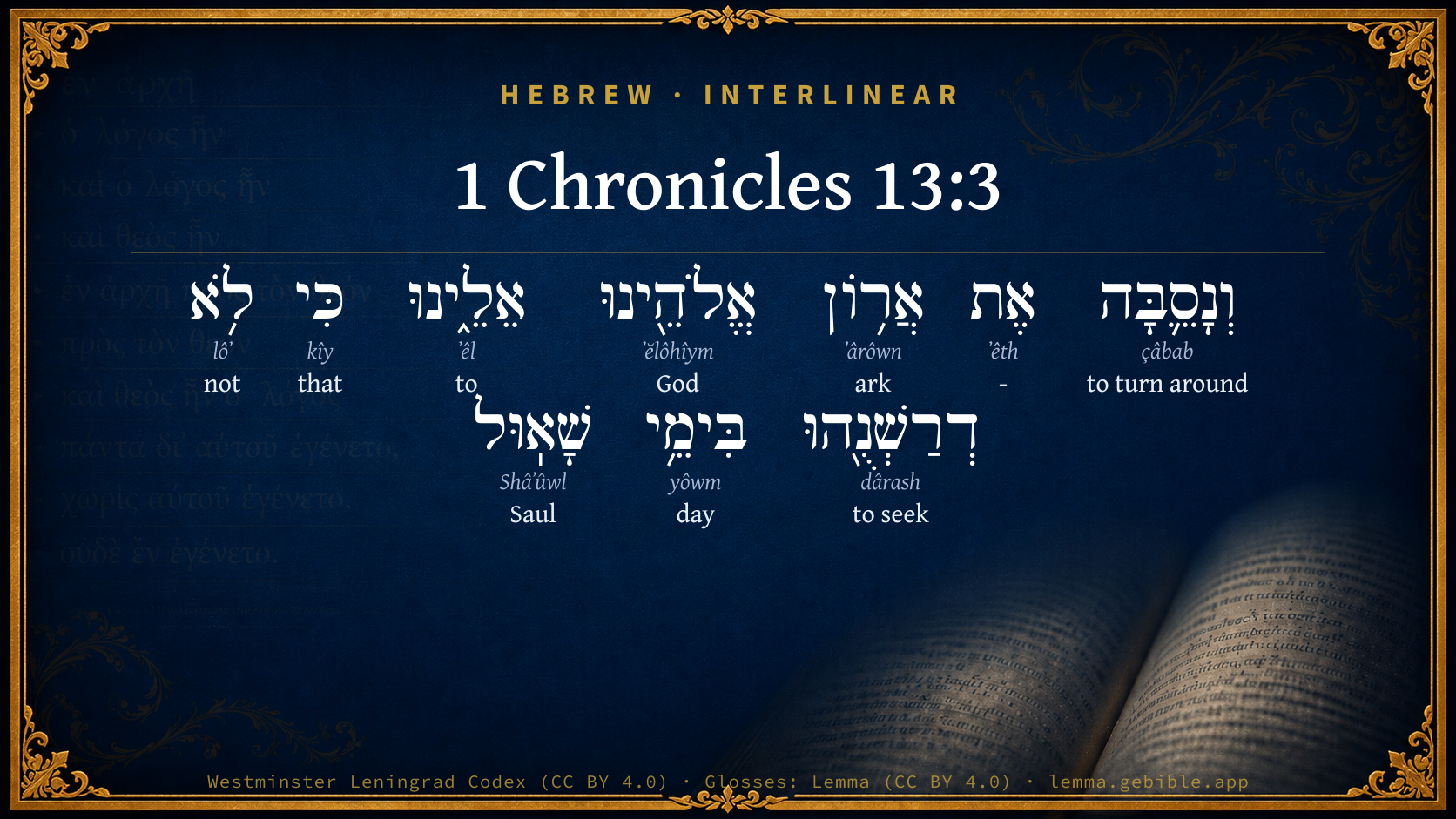
1 Chronicles 13:3

Hebrew (Westminster Leningrad Codex) 1 Chronicles 13:3 appears in the Hebrew Old Testament. The text above is from the Westminster Leningrad Codex. Each word links to its Strong’s number, a concise gloss, and parsing drawn from the Open Scriptures Hebrew Bible morphology. Click any word for its full Brown-Driver-Briggs (BDB) entry.
Download image
Cite this verse

1 Chronicles 13:3 (World English Bible). Public Domain. Lemma interlinear Bible study tool, https://lemma.gebible.app/v/1-chronicles/13/3.

Show BibTeX & RIS
BibTeX
RIS
English Translation
and let us bring again the ark of our God to us: for we didn't seek it in the days of Saul.
World English Bible · Public Domain
Download a study sheet

One document with this verse’s original text, its word-by-word gloss line, the meaning frame, cross-references with their text, attributed commentary, and full source and license credits — printable, and it pastes into notes with its structure intact.

This verse Autodidact and up

Study sheet (.html) Plain text (.txt)

A passage Seminary Student

Up to 50 verses in one chapter. A passage sheet keeps up to 6 commentary sources and 12 cross-references per verse, in the order this page ranks them, and says so on the sheet whenever that leaves anything out. Ask for a single verse and you get the Autodidact verse sheet above.

Everything on this page stays free to read, with no account — the sheet is a download of what is already on screen, not access to it.

Want to remove ads? Support Godless Engineer
Compare translations 3

The same verse in 3 English versions, stacked beneath the original-language interlinear above. Click any original word for its lexicon entry.

Each is an independent rendering of the whole verse — the interlinear is not word-aligned to these translations.

Highlighted words mark where these versions differ — a whole-verse word diff, not a word-by-word alignment.

  • World English Bible Public Domain
    and let us bring again the ark of our God to us: for we didn't seek it in the days of Saul.
  • King James Version Public Domain
    And let us bring again the ark of our God to us: for we inquired not at it in the days of Saul.
  • unfoldingWord Literal Text CC BY-SA 4.0
    And let us return the Box of our God to us, for we did not seek in the days of Saul.”

unfoldingWord Literal Text — © unfoldingWord, licensed CC BY-SA 4.0. Word-aligned USFM3 via Door43 (git.door43.org/unfoldingWord/en_ult).

Versions to compare (up to 4)

3 of 4 selected

Show all 18 translations

Every available English version of this verse, each an independent rendering of the whole verse.

  • World English Bible Public Domain
    and let us bring again the ark of our God to us: for we didn't seek it in the days of Saul.
  • Berean Standard Bible Public Domain
    Then let us bring back the ark of our God, for we did not inquire of Him in the days of Saul.”
  • Majority Standard Bible Public Domain
    Then let us bring back the ark of our God, for we did not inquire of Him in the days of Saul.”
  • King James Version Public Domain
    And let us bring again the ark of our God to us: for we inquired not at it in the days of Saul.
  • American Standard Version (1901) Public Domain
    and let us bring again the ark of our God to us: for we sought not unto it in the days of Saul.
  • Revised Version (1885) Public Domain
    and let us bring again the ark of our God to us: for we sought not unto it in the days of Saul.
  • Geneva Bible (1599) Public Domain
    And we will bring againe the Arke of our God to vs: for we sought not vnto it in the dayes of Saul.
  • Douay-Rheims (1899) Public Domain
    And let us bring again the ark of our God to us: for we sought it not in the days of Saul.
  • Young's Literal Translation Public Domain
    and we bring round the ark of our God unto us, for we sought Him not in the days of Saul.'
  • Literal Standard Version CC BY-SA 4.0
    and we bring around the Ark of our God to us, for we did not seek Him in the days of Saul.”
  • Unlocked Literal Bible CC BY-SA 4.0
    Let us bring the ark of our God back to ourselves, for we did not seek his will in the days of Saul's reign.”
  • unfoldingWord Literal Text CC BY-SA 4.0
    And let us return the Box of our God to us, for we did not seek in the days of Saul.”
  • Darby Bible Public Domain
    and let us bring again the ark of our God to us; for we inquired not of it in the days of Saul.
  • World Messianic Bible Public Domain
    Also, let’s bring the ark of our God back to us again, for we didn’t seek it in the days of Saul.”
  • Webster's Bible Public Domain
    And let us bring again to us the ark of our God: for we inquired not at it in the days of Saul.
  • Free Bible Version CC BY-SA 4.0
    Let us bring the Ark of our God back to us, because we forgot about it during the time of Saul.”
  • Bible in Basic English Public Domain
    And let us get back for ourselves the ark of our God: for in the days of Saul we did not go to it for directions.
  • JPS Tanakh (1917) Public Domain
    and let us bring back the ark of our God to us; for we sought not unto it in the days of Saul.'

Literal Standard Version (2020), Covenant Press — licensed CC BY-SA 4.0. Text via the HelloAO Bible API (eBible.org). Unlocked Literal Bible (unfoldingWord) — licensed CC BY-SA 4.0. Text via the HelloAO Bible API (eBible.org). unfoldingWord Literal Text — © unfoldingWord, licensed CC BY-SA 4.0. Word-aligned USFM3 via Door43 (git.door43.org/unfoldingWord/en_ult). Free Bible Version, Dr. Jonathan Gallagher — licensed CC BY-SA 4.0. Text via the HelloAO Bible API (eBible.org).

Word by word

More ways to search: Search by grammar → Find every occurrence → Compare this word →

Practice this passage: Drill this verse → Learn its vocabulary →

וְנָסֵ֛בָּה
çâbab
H5437
“and · to turn around”
Conjunction + Verb, Hiphil, Cohortative, 1st Person, Common, Plural
Part of Speech
Conjunction + Verb
Stem
Hiphil
Form
Cohortative
Person
1st Person
Gender
Common
Number
Plural
Full BDB Definition

Origin: a primitive root

TWOT: 1456

to turn, turn about or around or aside or back or towards, go about or around, surround, encircle, change direction - (Qal) - to turn, turn about, be brought round, change - to march or walk around, go partly around, circle about, skirt, make a round, make a circuit, go about to, surround, encompass - (Niphal) - to turn oneself, close round, turn round - to be turned over to - (Piel) to turn about, change, transform - (Poel) - to encompass, surround - to come about, assemble round - to march, go about - to enclose, envelop - (Hiphil) - to turn, cause to turn, turn back, reverse, bring over, turn into, bring round - to cause to go around, surround, encompass - (Hophal) - to be turned - to be surrounded
  1. אֶת ʼêth H853 “-” Particle, Direct Object
  2. אֲר֥וֹן ʼârôwn H727 “ark of” Noun, Common, Both, Singular, Construct
  3. אֱלֹהֵ֖ינוּ ʼĕlôhîym H430 “God(s) · our” Noun, Common, Masculine, Plural, Construct + Suffix, Personal, 1st Person, Common, Plural
  4. אֵלֵ֑ינוּ ʼêl H413 “to · us” Preposition + Suffix, Personal, 1st Person, Common, Plural
  5. כִּי kîy H3588 “that” Conjunction
  6. לֹ֥א lôʼ H3808 “not” Particle, Negative
  7. דְרַשְׁנֻ֖הוּ dârash H1875 “to seek · him” Verb, Qal, Perfect, 1st Person, Common, Plural + Suffix, Personal, 3rd Person, Masculine, Singular
  8. בִּימֵ֥י yôwm H3117 “in/at · days of” Preposition + Noun, Common, Masculine, Plural, Construct
  9. שָׁאֽוּל Shâʼûwl H7586 “Saul” Noun, Proper

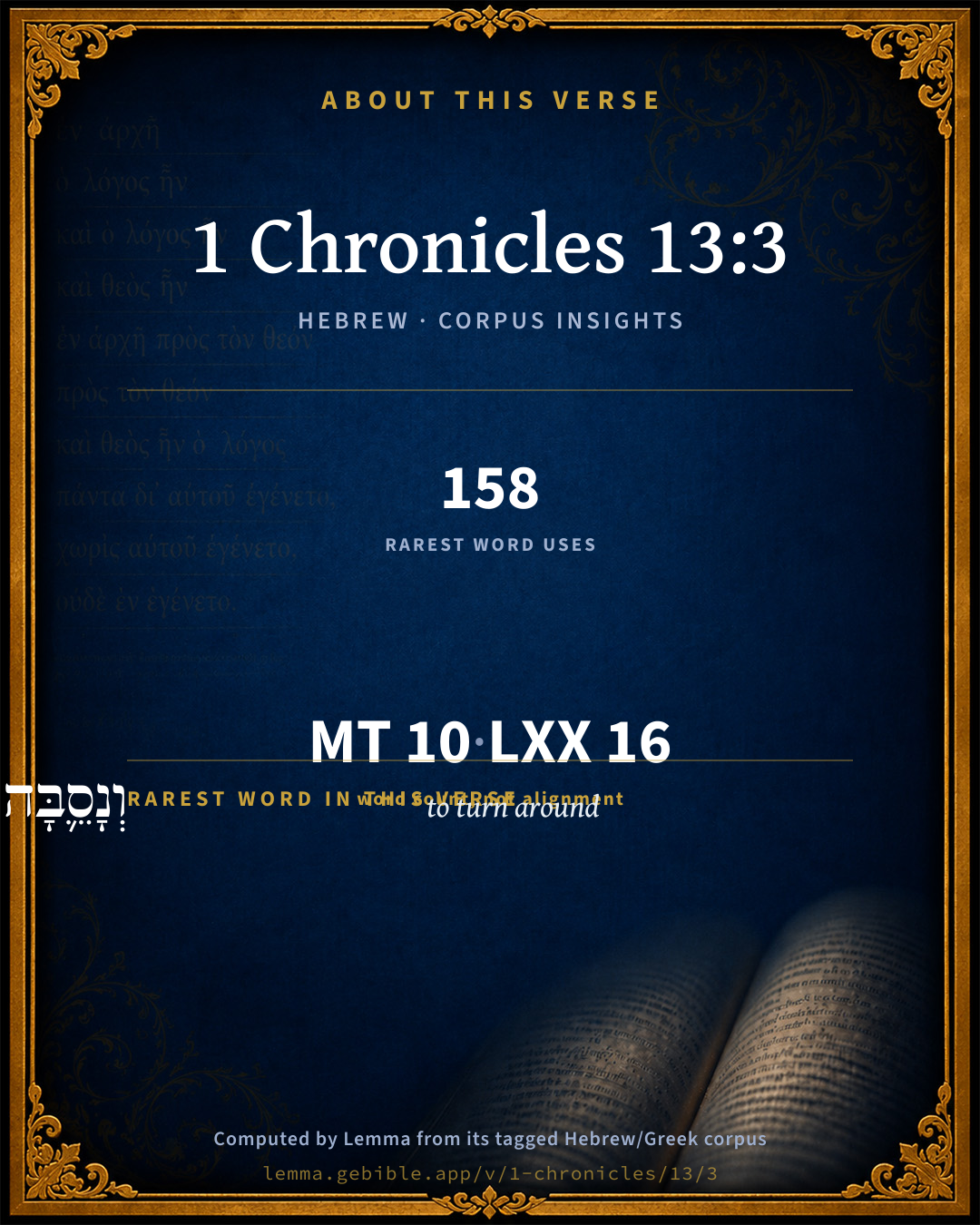
About this verse

These counts appear in no published source. They are computed here, from the morphology-tagged text and Lemma’s own curated glosses. What Lemma adds →

10
words
10
distinct lemmas
Historical
section

Grammatical profile

  • 2 verbs
  • 4 nouns
  • 1 preposition
  • 1 conjunction
  • 2 particles

Verb forms

  • וְנָסֵ֛בָּה Hiphil · Cohortative
  • דְרַשְׁנֻ֖הוּ Qal · Perfect

Hebrew & Septuagint length

In English translation the verse runs 22 words from the Hebrew and 24 from the Septuagint (LXX English) — closely comparable.

A rough comparison of the two English renderings, which tokenize alike — not a word-level alignment.

Word counts can differ between the Hebrew and the Greek without any difference in meaning — e.g. the Hebrew direct-object marker אֵת has no separate Greek word, and Greek often adds the article ὁ.

In the original languages it is 10 Hebrew tokens and 16 Greek tokens — but the two are counted differently (Hebrew bundles its prefixes and suffixes into one token; the Greek is in lemma form), so that isn’t a like-for-like length.

Cross-references

8

Topical passages linked to 1 Chronicles 13:3 in the Treasury of Scripture Knowledge — connected by theme and wording, ordered by reader-vote popularity; previews shown in the World English Bible.

  • 1 Samuel 7:1–2 The men of Kiriath Jearim came, and fetched up the ark of Yahweh, and brought it into the house of Abinadab in the hill, and sanctified Eleazar his son to keep the ark of Yahweh.
  • 1 Samuel 23:2 Therefore David inquired of Yahweh, saying, Shall I go and strike these Philistines? Yahweh said to David, Go, and strike the Philistines, and save Keilah.
  • 1 Samuel 14:18 Saul said to Ahijah, Bring here the ark of God. For the ark of God was [there] at that time with the children of Israel.
  • 1 Samuel 14:36 Saul said, Let us go down after the Philistines by night, and take spoil among them until the morning light, and let us not leave a man of them. They said, Do whatever seems good to you. Then said the priest, Let us draw near here to God.
  • 1 Samuel 22:10 He inquired of Yahweh for him, and gave him food, and gave him the sword of Goliath the Philistine.
  • 1 Samuel 22:15 Have I today begun to inquire of God for him? be it far from me: don't let the king impute anything to his servant, nor to all the house of my father; for your servant knows nothing of all this, less or more.
  • 1 Samuel 23:9–12 David knew that Saul was devising mischief against him; and he said to Abiathar the priest, Bring here the ephod.
  • Psalms 132:6 Behold, we heard of it in Ephrathah. We found it in the field of Jaar:

Cross-references courtesy of OpenBible.info (CC BY 4.0).

Hebrew and Greek witnesses Masoretic Hebrew ↔ Greek Septuagint

The same verse in the two great witnesses to the Old Testament, shown verse-for-verse.

These are two independent witnesses, not word-aligned to each other, and the Septuagint is shown in lemma (dictionary) form.

Hebrew 1 Chronicles 13:3 Masoretic · Westminster Leningrad Codex

וְנָסֵ֛בָּה אֶת אֲר֥וֹן אֱלֹהֵ֖ינוּ אֵלֵ֑ינוּ כִּי לֹ֥א דְרַשְׁנֻ֖הוּ בִּימֵ֥י שָׁאֽוּל

and let us bring again the ark of our God to us: for we didn't seek it in the days of Saul.

World English Bible · Public Domain

Greek LXX 1 Chronicles 13:3 Septuagint · lemma form

καί μεταφέρω ὁ κιβωτός ὁ θεός ἐγώ πρός ἐγώ ὅτι οὐ ζητέω αὐτός ἀπό ἡμέρα σαούλ

And let us bring over to us the ark of our God; for men have not enquired at it since the days of Saul.

LXX2012 (modern English Septuagint) · Public Domain

Hebrew: Westminster Leningrad Codex (CC BY 4.0). Greek: Septuagint (public domain); English from LXX2012 (modern English Septuagint) (Public Domain). How the Septuagint differs from the Hebrew →

Commentary

Notes on 1 Chronicles 13:3 from classic Christian and Jewish commentators (each source and its license shown beneath its notes). The classic Christian expositions comment on the surrounding passage and are grouped to its opening verse, so a note may address several verses; the Jewish commentaries on the Tanakh (Rashi and others) are per-verse, so they appear only where the commentator wrote on this verse.

Lemma curates 59 commentaries, every one of them public domain or Creative Commons licensed, each selected and text-cleaned for this edition rather than reprinted as found. About our sources →

Trapp's Complete Commentary

John Trapp

1Ch 13:3 And let us bring again the ark of our God to us: for we enquired not at it in the days of Saul.

Ver. 3. For we inquired not at it in the days of Saul.] He was so vexed with his enemies without and a spirit of envy and ambition within, that he minded not the ark. Mark here how David faults himself among others as negligent. So Ezr 9:7-15 Dan 9:5-15.

John Trapp, A Commentary or Exposition upon All the Books of the Old and New Testament (1647–1656) — public domain. Text from a community e-Sword module.

The Biblical Illustrator

Joseph S. Exell

1Ch_13:3-6

And let us bring again the ark of our God to us.

The ark in the royal city

A place of honour, influence, and right, as:--

I. The centre of unity.

II. The source of religious life. This act:

1. Purified religious life.

2. Unified religious life.

3. Organised religious life.

III. The sign of Gods presence. (J. Wolfendale.)

The arks progress to Mount Zion

One of the Psalms composed by David to be sung on the removing of the ark (Psa_68:1-35.) is quoted by Paul (Eph_4:7-8) as having foretold what this procession itself foreshadowed, viz., the ascension of Christ, and the blessings which should flow therefrom upon every member of His Mystical Body. We see in all this great procession nothing less than the Universal Church of Christ, partaking with the Divine David in the glory of His ascension into the Heavenly Zion. From the narrative of which the text forms a part we may learn:--

I. General lessons.

1. That periods of reformation, after past neglect, are those in which we need more than ordinary caution, lest we mar the work which is designed to promote Gods glory.

2. That all religious reformation which is the work of man can scarcely fail to be blemished and disfigured more or less by human infirmities.

3. That the effects of those infirmities are not to be acquiesced in, but to be confessed and corrected, if ever we would hope to obtain the Divine approval, or even to escape the Divine chastisement.

4. Not to abandon our good intentions because we have been checked and hindered in our efforts after amendment, but still to hold on and persevere in our exertions; only taking heed to profit by the instruction which the experience of past failure was designed to give.

5. God will be sanctified in all them that come nigh Him, by obedience to His holy laws (Lev_10:2).

6. That ignorance and neglect, even when allowed to pass unchastised in others, may bring upon His ordained ministers the severest punishment.

II. Particular lessons.

1. That every Christian has his place in that great procession, which is occupied in conveying the Ark of the Covenant (Rev_11:19) up to its final resting-place in Mount Zion; but every Christian has not the same place.

2. That it is not enough that we do, whatever we do, with a good intention unless what is done be also good, good in itself, and good in us. (Bishop Chris. Wordsworth.)

The Biblical Illustrator, edited by Joseph S. Exell (c. 1880s–1900s) — public domain. Text from a community e-Sword module.

Joseph Benson's Commentary

1Ch 13:3. We inquired not at it in the days of Saul — The ark was then neglected, and the generality of the people contented themselves with going to Gibeon and offering sacrifices there, not caring, though the ark, the soul of the tabernacle, was in another place. As soon as David had power in his hand, he would use it for the advancement of religion. It ought to be the first care of those that are enriched or preferred, to honour God with their honours, and to serve him, and the interests of his kingdom among men, with their wealth and power.

Joseph Benson's Commentary on the Old and New Testaments (1811–1818) — public domain. Text from a community e-Sword module.

Geneva Bible (1599)

Geneva Bible translators

His first care was to restore religion, which had in Saul’s days been corrupted and neglected.

Geneva Bible (1599) marginal notes — public domain. Text via Bolls.life.

Ellicott's Commentary for English Readers

(3) Let us bring again.—Bring we round: transfer it from Kirjath-jearim to Jerusalem, as the throne was transferred (same verb) from Saul to David (1Ch_10:14; 1Ch_12:23).

The Ark of our God to us.—The Ark was at Kirjath-jearim, a city of Judah, David’s own tribe. But the ting wished to establish it as the centre of the national worship in his new capital and royal residence, Jerusalem.

For we enquired not at it.—Rather, we sought it not, that is, neglected it, cared nothing about it. The Ark had been left in the house of Abinadab at Kirjath-jearim, for twenty years, after the Philistines sent it back (1Sa_7:2). There may be a reference to Saul’s despairing neglect of consulting the Lord (1Ch_10:13); and, perhaps, we should translate, “we sought Him not,” referring the suffix to God (comp. 1Ch_15:13; Isa_9:12). There is no clear evidence that the Ark itself was ever used as an oracle (comp. Exo_25:10-22; 1Ki_8:9).

A Bible Commentary for English Readers, edited by Charles John Ellicott (1878–1897) — public domain. Text from a community e-Sword module.

The Cambridge Bible for Schools and Colleges

gen. ed. J. J. S. Perowne

3. we inquired not at it] R.V. we sought not unto it. The meaning of the Heb. verb is to seek with care, to care for.

The Cambridge Bible for Schools and Colleges (gen. ed. J. J. S. Perowne; Cambridge University Press, 1878–1918) — public domain. Text from a community e-Sword module.

John Gill's Exposition

And let us bring again the ark of our God to us,.... The symbol of the divine Presence, than which nothing was more desirable to David, and he chose to begin his reign overall Israel with it:

for we inquired not at it in the days of Saul; he being indifferent to religion, and careless about it, and the enjoyment of the presence of God, and having direction from him; and the people also content with worship at the tabernacle at Gibeah, though the token of the divine Presence was absent.

John Gill's Exposition of the Whole Bible (1746–1763) — public domain (CC PDM 1.0). Text via the HelloAO Bible API.

Haydock's Catholic Bible Commentary

Sought. Protestants, "inquired not at it." Yet it is certain that many resorted to the ark, at that time. But is was not treated with such honours as David now wished. (Haydock)

George Leo Haydock (1774–1849), Haydock's Catholic Family Bible and Commentary, 1859 edition — public domain. Excludes Psalms (Douay-Rheims chapter numbering differs from Protestant) and Deuterocanonical books (Catholic canon only).

Matthew Poole's English Annotations

The ark was then neglected; and the generality of the people either lived in the gross neglect of the solemn worship of God, or contented themselves with going to Gibeon, and offering sacrifices there, not caring, though the ark, the soul of the tabernacle, was in another place.

In the days of Saul: so it was in the days of Samuel; but it is rather charged upon Saul than him; partly, because Samuel was exercised with continual wars, or expectation of wars, with the Philistines all the time of his regency, and therefore wanted the opportunity to bring back the ark, which Saul had and neglected; partly, because Samuel took care to stir up and maintain religion among them by other means, and in an extraordinary manner; whereas this was but one branch of Saul’s impiety, and was joined with a contempt of all religion, as the history of his life shews; and partly, because it was more proper to accuse himself and the present generation, who were guilty of this neglect, than to rake into the ashes of their deceased progenitors, and lay his charge against those who were dead and gone some good while since.

Matthew Poole's English Annotations on the Holy Bible (1683–1685) — public domain. Text from a community e-Sword/MySword module.

The Pulpit Commentary

Religious resolution based on regretful memories

David certainly wishes to make a contrast, and a decided one, between the days and the administration of Saul and those of himself; for it was ripe time, both that such contrast should be made, and made patent to all the nation. Yet, as we have read what he says and does, we do not take the impression that he desires to make that contrast ostentatiously, invidiously, or with any degree of triumphant antipathy toward his predecessor. What he does desire is to make it effective and real. Indeed, though we cannot hold David responsible for the way in which things went in the days of Saul, and for the neglect and dishonour shown to the ark as well as to not a few other of the observances of religion, yet his tone falls on our ear with something of the sound of self-reproach. And although it is impossible that he could in deep earnest have held himself responsible for those things to profess it could have amounted to mere affectation yet for all this we observe that he now speaks as though he would voluntarily include himself in his measure amongst the number of those involved in the fault and certainly in the disastrous consequences of it. He classes himself and those whom he is exhorting in the one common number of those who, let the causes be what they might, had long lived in neglect of some of the highest exercises and privileges of their religion. May we not justly set this down again to the forgiving temper and delicate feeling and refined nobility of spirit in David, to which his treatment of Saul had already often borne witness while Saul yet lived and though he was his bitterest foe? Therefore is it that David now abstains from making any needless, any profuse references to the chief causes of the irreligion of the past reign. He does not at all enlarge upon the conduct of the arch offender, though in the necessity of things he mentions his name. Two simplest sentences tell the tale of what weighs deeply on his heart: "Let us bring again the ark of our God to us: for we inquired not at it in the days of Saul." Let us notice

I THE RESOLVE UPON IMMEDIATE AMENDMENT, AND THE IMMEDIATE PROCLAMATION OF IT. We cannot doubt that the mind of David was made up, that his resolution was formed. He is no sooner king of the whole people than he acknowledges the necessity of the presence and the ark of the God of the whole people. "Arise, O Lord, into thy rest, thou and the ark of thy strength:" this is his heart"s earnest prayer. And he does not merely "in secret" pray, but takes the responsibility of exhortation. He does not smother his convictions, nor utter them with bated breath, nor hope others will take them up and work them out while he slumbers; but he has the courage of his convictions, and as it were in the audience of the whole people, he rouses their sense of duty and calls them to a practical, even though tardy, repentance. Clear duty is always to be honoured by prompt attention to it and by prompt summons of others to it. And it is to be observed with painful consequence that it is clear interest, clear policy, clear present gain, that too often wins this prompt attention, rather than clear duty in those very highest forms of it which the pure acts of religion involve. First then, the own prompt thought of David, and secondly, his unshrinking call to others, bespoke a genuine religion in this matter in him. He is baulked by no shamefacedness, by no timidity of such as sometimes seem to think that their religion requires apologizing for, and that they may rule it rather than be implicitly ruled by it. But David betrays the real spirit of thorough amendment, and, though the waters of repentance should need to run deep and very deep, they will safely bear a man through them.

II THE FAITHFUL PRESENCE OF ONE OF THE GREATEST HELPS TO THE AMENDMENT OF PRACTICAL REPENTANCE, namely, a frank admission and public confession of the exact facts of the case. Nothing is a surer deterrent for a repentance that might be than an unwilling facing of the exact state of things. Nothing augurs more surely that the repentance will die off with the transitoriness of a "morning cloud" than that it be unaccompanied by an uncompromising confession, or be accompanied with but a feeble, partial confession. But the assertion now made without fear of contradiction is of the most unequivocal: "We did not inquire at it in the days of Saul." As though in our own days a man highly placed and of authority says of himself, and involves a large number of others in the assertion, while he looks them steadfastly in the face, "We were never on our knees;" "We forgot to pray;" "We lived long, perilous, anxious years without prayer." To tell myself honestly my own greatest sin, and make confession thereof to one"s own soul argues two things

(1) some of the truest courage;

(2) the likeliest, surest evidence of genuine conversion.

However that sin was to be shared, and whoever might be justly charged with being chiefly answerable for it, the nation Israel could not be brought in guilty of a greater or more suicidal sin than that of neglecting "to inquire at the ark." Well may we imagine that unmeasured pathos, sincerest selfcondemnation, underlie this confession, "For we inquired not at it in the days of Saul.

III THE ENTIRE ABSENCE OF ANY APPARENT DISPOSITION TO EXPLAIN AWAY THE SIN. No excuse is suggested, no palliation is hinted. The bare fact announced seemed as though to make each one who heard, as well as him who had spoken, hold his breath. There is no offer on the part of David to point to what, so far as fact was concerned, he might justly have pointed the clear, bad example of Saul, and the distracted, divided, worried nation, chief thanks to Saul. Adam, as the most natural thing in the world, early in the world as he was, attempted to push his sin a step further, though to fix it on Eve; and Eve acted after an exactly similar type. But David seems now to teach how convinced, utterly, he is that no such subterfuge can be anything but the subterfuge of an hour. He seems to know well what Ezekiel declared with such unsparing directness, none should elude it, "The soul that sinneth, it shall die." Were there a hundred manifest explanations, a hundred plausible excuses of the fact that Israel for a generation or for one year does "not inquire at the ark," not all these will for one moment deliver Israel from its own inevitable loss, all the worse because self-inflicted, all the more cruel because ushered in by high precedents. And let there be a sin attaching to any one of us, a favourite, a besetting sin; and let us be able to give a hundred explanations and a hundred palliations of it. These hinder our confession, but do not help our soul; they hinder our estimate of our own sin, but lessen not its malignant nature; they hinder our likely breaking free, for ever free, but do not compensate for our not being free.

IV THE ILLUSTRATION PRESENTED OF THE DUTY OF BREAKING AWAY THE EARLIEST POSSIBLE FROM COMPLICITY WITH OTHER MEN"S SINS. Whatever was David"s share in the sin and the loss of the nation that had not for so long a time "inquired at the ark," now there comes for him the time when he has to consider the position he holds with regard to the matter, no longer as a private citizen and as an individual man, but as successor to Saul, and first man in the realm. It is found by some one of the hardest things, not simply to break down their own habits, but to break through others" precedents. Any number of anomalies are condoned and are still permitted to exist because they have existed, and perhaps existed long. But the anomalies of sin against God and sin against man can never be justly condoned on this principle, come they recommended by any number, any length, any kind of precedents. In nothing, perhaps, is the force of precedents more willingly felt, more tamely succumbed to, than in matters of religion and religious significance. And it is here that they should least of all be honoured thus. "To the Law and to the testimony" must they be brought. The ark has been neglected; the Bible has been unstudied, unmeditated; the closet of prayer has been unfrequented. It has got fashionable "to forsake the assembling of ourselves together;" and it is considered wit to level gibe and sarcasm against God"s great ordinance of preaching. To break through all this and subvert it, and begin afresh before the eye of man requires strong conviction, real religion, great courage. David frees himself with few enough words at the expense of his predecessor from any complicity with his career. He sees the steps that may be retraced, the evil courses that may be reformed, and the mischief that may be repaired, and he gives himself no rest till the great task is begun and concluded. With him in this matter to see is to conquer.

The Pulpit Commentary (1880–1919), ed. H.D.M. Spence-Jones & Joseph S. Exell — public domain. Text from a community e-Sword module.

John Wesley's Explanatory Notes

For, &c. - The ark was then neglected; and the generality of the people contented themselves with going to Gibeon and offering sacrifices there, not caring, though the ark, the soul of the tabernacle, was in another place. As soon as David had power in his hand, he would use it for the advancement of religion. It ought to be the first care of those that are enriched or preferred, to honour God with their honours, and to serve him and the interests of his kingdom among men, with their wealth and power.

John Wesley, Explanatory Notes Upon the Whole Bible (1754–1765) — public domain. Text via the GEBible commentary corpus.

Keil & Delitzsch

C. F. Keil & F. Delitzsch

And let us bring again the ark of our God to us,.... The symbol of the divine Presence, than which nothing was more desirable to David, and he chose to begin his reign overall Israel with it:

for we inquired not at it in the days of Saul; he being indifferent to religion, and careless about it, and the enjoyment of the presence of God, and having direction from him; and the people also content with worship at the tabernacle at Gibeah, though the token of the divine Presence was absent.

Keil & Delitzsch — Biblical Commentary on the Old Testament (1861–1891) — public domain (CC PDM 1.0). Text via the HelloAO Bible API. (Old Testament only.)

Lesson kit

Teaching starters — assembled from the data on this page, not authored interpretation. Every prompt links to the verse data it draws on. Edit before teaching.

1 Chronicles, in the Historical, opens this verse with 10 words (10 distinct Hebrew lemmas). Its most distinctive word is çâbab (“to turn around”). A historical commentator’s framing appears above. Read the whole chapter for the surrounding context.

Discussion questions

  1. How does “to turn around” (çâbab) shape what this verse is saying?
  2. 1 Samuel 7:1–2 shares this passage’s theme. How do the two illuminate each other?
  3. These translations render this verse differently; the difference is in the English rendering, not the original. What questions does that raise?
  4. The verb «וְנָסֵ֛בָּה» is Hiphil Cohortative. How does its form color the action?
  5. Reading how Trapp's Complete Commentary and The Biblical Illustrator read this verse, where do the two commentators agree and where do they part?

Things to notice

Reading settings

Reading text

Shown beneath each verse's original-language words.

Old Testament
Old Testament edition

Read the OT as the Masoretic Hebrew (MT) or the Greek Septuagint (LXX).

English shown for the Greek Septuagint (in the Hebrew ↔ Greek comparison).

Comparing translations? Open the Compare panel on any verse page to stack up to four side by side.