Joshua 6:7

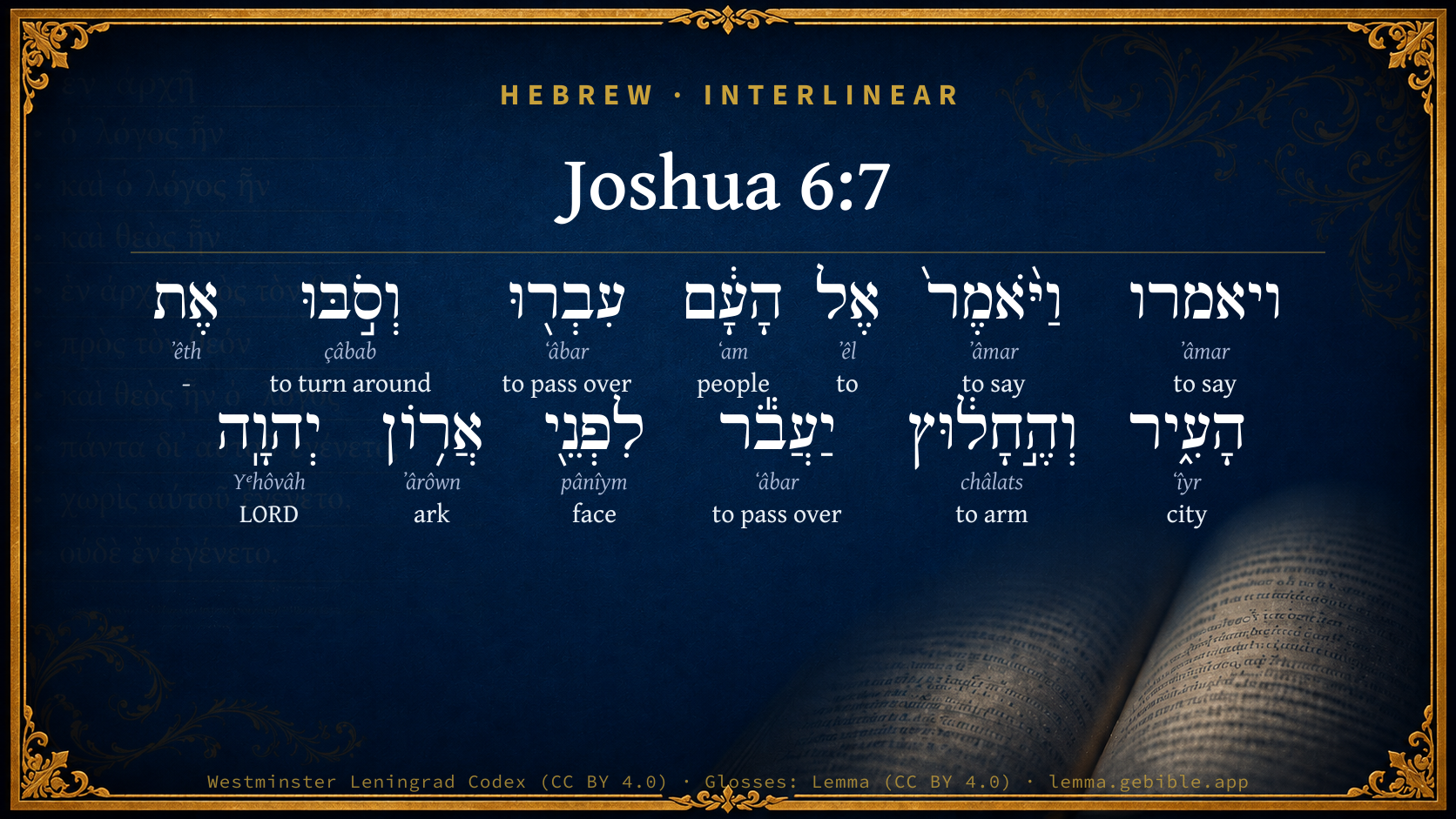
Hebrew (Westminster Leningrad Codex) Joshua 6:7 appears in the Hebrew Old Testament. The text above is from the Westminster Leningrad Codex. Each word links to its Strong’s number, a concise gloss, and parsing drawn from the Open Scriptures Hebrew Bible morphology. Click any word for its full Brown-Driver-Briggs (BDB) entry.
Download image
Cite this verse

Joshua 6:7 (World English Bible). Public Domain. Lemma interlinear Bible study tool, https://lemma.gebible.app/v/joshua/6/7.

Show BibTeX & RIS
BibTeX
RIS
English Translation
They said to the people, Pass on, and compass the city, and let the armed men pass on before the ark of Yahweh.
World English Bible · Public Domain
Download a study sheet

One document with this verse’s original text, its word-by-word gloss line, the meaning frame, cross-references with their text, attributed commentary, and full source and license credits — printable, and it pastes into notes with its structure intact.

This verse Autodidact and up

Study sheet (.html) Plain text (.txt)

A passage Seminary Student

Up to 50 verses in one chapter. A passage sheet keeps up to 6 commentary sources and 12 cross-references per verse, in the order this page ranks them, and says so on the sheet whenever that leaves anything out. Ask for a single verse and you get the Autodidact verse sheet above.

Everything on this page stays free to read, with no account — the sheet is a download of what is already on screen, not access to it.

Want to remove ads? Support Godless Engineer
Compare translations 3

The same verse in 3 English versions, stacked beneath the original-language interlinear above. Click any original word for its lexicon entry.

Each is an independent rendering of the whole verse — the interlinear is not word-aligned to these translations.

Highlighted words mark where these versions differ — a whole-verse word diff, not a word-by-word alignment.

  • World English Bible Public Domain
    They said to the people, Pass on, and compass the city, and let the armed men pass on before the ark of Yahweh.
  • King James Version Public Domain
    And he said unto the people, Pass on, and compass the city, and let him that is armed pass on before the ark of the LORD.
  • unfoldingWord Literal Text CC BY-SA 4.0
    And he said to the people, “Pass over and circle the city, and the armed will pass over to the face of the Box of Yahweh.”

unfoldingWord Literal Text — © unfoldingWord, licensed CC BY-SA 4.0. Word-aligned USFM3 via Door43 (git.door43.org/unfoldingWord/en_ult).

Versions to compare (up to 4)

3 of 4 selected

Show all 18 translations

Every available English version of this verse, each an independent rendering of the whole verse.

  • World English Bible Public Domain
    They said to the people, Pass on, and compass the city, and let the armed men pass on before the ark of Yahweh.
  • Berean Standard Bible Public Domain
    And he told the people, “Advance and march around the city, with the armed troops going ahead of the ark of the LORD.”
  • Majority Standard Bible Public Domain
    And he told the people, “Advance and march around the city, with the armed troops going ahead of the ark of the LORD.”
  • King James Version Public Domain
    And he said unto the people, Pass on, and compass the city, and let him that is armed pass on before the ark of the LORD.
  • American Standard Version (1901) Public Domain
    And they said unto the people, Pass on, and compass the city, and let the armed men pass on before the ark of Jehovah.
  • Revised Version (1885) Public Domain
    And they said unto the people, Pass on, and compass the city, and let the armed men pass on before the ark of the LORD.
  • Geneva Bible (1599) Public Domain
    But he said vnto the people, Goe and compasse the citie: and let him that is armed, go forth before the Arke of the Lord.
  • Douay-Rheims (1899) Public Domain
    And he said to the people: Go, and compass the city, armed, marching before the ark of the Lord.
  • Young's Literal Translation Public Domain
    and He said unto the people, `Pass over, and compass the city, and he who is armed doth pass over before the ark of Jehovah.'
  • Literal Standard Version CC BY-SA 4.0
    and He said to the people, “Pass over, and go around the city, and he who is armed passes over before the Ark of YHWH.”
  • Unlocked Literal Bible CC BY-SA 4.0
    He said to the people, “Go over and march around the city, and the armed men will go ahead of the ark of Yahweh.”
  • unfoldingWord Literal Text CC BY-SA 4.0
    And he said to the people, “Pass over and circle the city, and the armed will pass over to the face of the Box of Yahweh.”
  • Darby Bible Public Domain
    And he said to the people, Pass on, go round the city, and they that are armed shall pass on before the ark of Jehovah.
  • World Messianic Bible Public Domain
    They said to the people, “Advance! March around the city, and let the armed men pass on before the LORD’s ark.”
  • Webster's Bible Public Domain
    And he said to the people, Pass on, and compass the city, and let him that is armed pass on before the ark of the LORD.
  • Free Bible Version CC BY-SA 4.0
    Then he told the people, “Move out! March around the city with the armed men up front ahead of the Ark of the Lord!”
  • Bible in Basic English Public Domain
    And he said to the people, Go forward, circling the town, and let the armed men go before the ark of the Lord.
  • JPS Tanakh (1917) Public Domain
    And he said unto the people: 'Pass on, and compass the city, and let the armed body pass on before the ark of the LORD.'

Literal Standard Version (2020), Covenant Press — licensed CC BY-SA 4.0. Text via the HelloAO Bible API (eBible.org). Unlocked Literal Bible (unfoldingWord) — licensed CC BY-SA 4.0. Text via the HelloAO Bible API (eBible.org). unfoldingWord Literal Text — © unfoldingWord, licensed CC BY-SA 4.0. Word-aligned USFM3 via Door43 (git.door43.org/unfoldingWord/en_ult). Free Bible Version, Dr. Jonathan Gallagher — licensed CC BY-SA 4.0. Text via the HelloAO Bible API (eBible.org).

Word by word

More ways to search: Search by grammar → Find every occurrence → Compare this word →

Practice this passage: Drill this verse → Learn its vocabulary →

וְהֶ֣חָל֔וּץ
châlats
H2502
“and · the · armed”
Conjunction + Particle, Definite Article + Verb, Qal, Participle Passive, Masculine, Singular, Absolute
Part of Speech
Conjunction + Particle + Verb
Stem
Qal
Form
Participle Passive
Gender
Masculine
Number
Singular
State
Absolute
Full BDB Definition

Origin: a primitive root

TWOT: 667 , 668

to remove, draw out, draw off, take off, withdraw, equip (for war), arm for war, rescue, be rescued - (Qal) equipped (participle) - (Niphal) - to be equipped - to go equipped - to be armed - (Hiphil) - to make strong, brace up - to invigorate - to draw off or out, withdraw - (Qal) - to draw, draw off - to withdraw - (Niphal) - to be delivered - to be saved - (Piel) - to pull out, tear out - to rescue, deliver, set free - to take away, plunder
  1. ויאמרו ʼâmar H559 “and · to say” Conjunction + Verb, Qal, Sequential Imperfect, 3rd Person, Masculine, Plural
  2. וַיֹּ֨אמֶר֙ ʼâmar H559 “and · to say” Conjunction + Verb, Qal, Sequential Imperfect, 3rd Person, Masculine, Singular
  3. אֶל ʼêl H413 “to” Preposition
  4. הָעָ֔ם ʻam H5971 “the · people” Particle, Definite Article + Noun, Common, Masculine, Singular, Absolute
  5. עִבְר֖וּ ʻâbar H5674 “pass over” Verb, Qal, Imperative, 2nd Person, Masculine, Plural
  6. וְסֹ֣בּוּ çâbab H5437 “and · turn around” Conjunction + Verb, Qal, Imperative, 2nd Person, Masculine, Plural
  7. אֶת ʼêth H853 “-” Particle, Direct Object
  8. הָעִ֑יר ʻîyr H5892 “the · city” Particle, Definite Article + Noun, Common, Feminine, Singular, Absolute
  9. יַעֲבֹ֕ר ʻâbar H5674 “to pass over” Verb, Qal, Imperfect, 3rd Person, Masculine, Singular
  10. לִפְנֵ֖י pânîym H6440 “to/for · face(s) of” Preposition + Noun, Common, Both, Plural, Construct
  11. אֲר֥וֹן ʼârôwn H727 “ark of” Noun, Common, Both, Singular, Construct
  12. יְהוָֽה Yᵉhôvâh H3068 “LORD” Noun, Proper

About this verse

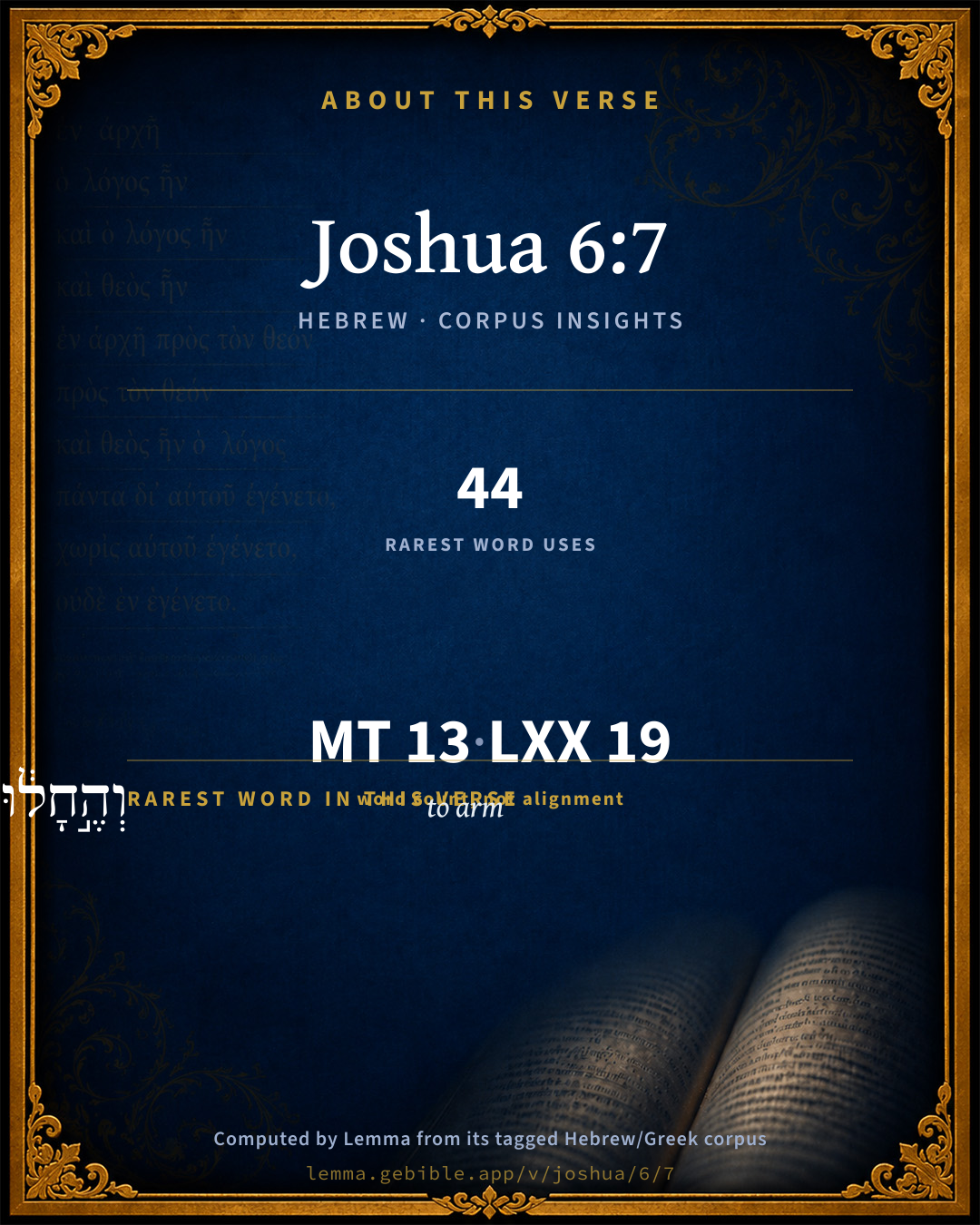
These counts appear in no published source. They are computed here, from the morphology-tagged text and Lemma’s own curated glosses. What Lemma adds →

13
words
11
distinct lemmas
Historical
section

Shared distinctive vocabulary

וְהֶ֣חָל֔וּץ to arm H2502 occurs in 44 verses of the Hebrew Bible. Also found in:

Grammatical profile

  • 6 verbs
  • 5 nouns
  • 1 preposition
  • 1 particle

Verb forms

  • ויאמרו Qal · Sequential Imperfect
  • וַיֹּ֨אמֶר֙ Qal · Sequential Imperfect
  • עִבְר֖וּ Qal · Imperative
  • וְסֹ֣בּוּ Qal · Imperative
  • וְהֶ֣חָל֔וּץ Qal · Participle Passive
  • יַעֲבֹ֕ר Qal · Imperfect

Repetition

Words recur within this verse — often emphatic in Hebrew:

  • ויאמרו to say H559 ×2
  • עִבְר֖וּ to pass over H5674 ×2

Hebrew & Septuagint length

In English translation the verse runs 23 words from the Hebrew and 29 from the Septuagint (LXX English) — closely comparable.

A rough comparison of the two English renderings, which tokenize alike — not a word-level alignment.

Word counts can differ between the Hebrew and the Greek without any difference in meaning — e.g. the Hebrew direct-object marker אֵת has no separate Greek word, and Greek often adds the article ὁ.

In the original languages it is 13 Hebrew tokens and 19 Greek tokens — but the two are counted differently (Hebrew bundles its prefixes and suffixes into one token; the Greek is in lemma form), so that isn’t a like-for-like length.

Cross-references

3

Topical passages linked to Joshua 6:7 in the Treasury of Scripture Knowledge — connected by theme and wording, ordered by reader-vote popularity; previews shown in the World English Bible.

  • Joshua 4:13 about forty thousand ready armed for war passed over before Yahweh to battle, to the plains of Jericho.
  • Joshua 1:14 Your wives, your little ones, and your cattle, shall abide in the land which Moses gave you beyond the Jordan; but you shall pass over before your brothers armed, all the mighty men of valor, and shall help them;
  • Joshua 6:3 You shall compass the city, all the men of war, going about the city once. Thus shall you do six days.

Cross-references courtesy of OpenBible.info (CC BY 4.0).

Hebrew and Greek witnesses Masoretic Hebrew ↔ Greek Septuagint

The same verse in the two great witnesses to the Old Testament, shown verse-for-verse.

These are two independent witnesses, not word-aligned to each other, and the Septuagint is shown in lemma (dictionary) form.

Hebrew Joshua 6:7 Masoretic · Westminster Leningrad Codex

ויאמרו וַיֹּ֨אמֶר֙ אֶל הָעָ֔ם עִבְר֖וּ וְסֹ֣בּוּ אֶת הָעִ֑יר וְהֶ֣חָל֔וּץ יַעֲבֹ֕ר לִפְנֵ֖י אֲר֥וֹן יְהוָֽה

They said to the people, Pass on, and compass the city, and let the armed men pass on before the ark of Yahweh.

World English Bible · Public Domain

Greek LXX Joshua 6:7 Septuagint · lemma form

καί εἶπον αὐτός λέγω παραἀγγέλλω ὁ λαός περιἔρχομαι καί κυκλόω ὁ πόλις καί ὁ μάχιμος παραπορεύομαι ἐνὁπλίζω ἐναντίον κύριος

And let seven priests having seven sacred trumpets proceed thus before the Lord, and let them sound loudly; and let the ark of the covenant of the Lord follow.

LXX2012 (modern English Septuagint) · Public Domain

Hebrew: Westminster Leningrad Codex (CC BY 4.0). Greek: Septuagint (public domain); English from LXX2012 (modern English Septuagint) (Public Domain). How the Septuagint differs from the Hebrew →

Targum (Aramaic paraphrase)

1

The Targum is the ancient Jewish Aramaic paraphrase of the Hebrew Scriptures — an interpretive translation, not the Hebrew text itself. Onkelos (literal) and Pseudo-Jonathan (expansive) render the Torah, and Jonathan the Prophets. Coverage is partial: where no permissively-licensed English translation exists for a verse, only the Aramaic is shown. This is verse-level text, not a word-by-word alignment to the Hebrew.

  1. Targum Jonathan Prophets (Joshua–Malachi)
    וַאֲמַר לְעַמָא עֲבָרוּ וְאַקִיפוּ יַת קַרְתָּא וּמְזַרְזֵי חֵילָא יַעַבְּרוּן קֳדָם אֲרוֹנָא דַיָי:

    (no public-domain English translation for this verse)

    Targum Jonathan — Aramaic: “Mikraot Gedolot” (public domain). English: “Sefaria Community Translation” (CC0 1.0 (public-domain dedication)); “London "Chaldee Paraphrase," 1871” (public domain). Text via Sefaria.

Commentary

Notes on Joshua 6:7 from classic Christian and Jewish commentators (each source and its license shown beneath its notes). The classic Christian expositions comment on the surrounding passage and are grouped to its opening verse, so a note may address several verses; the Jewish commentaries on the Tanakh (Rashi and others) are per-verse, so they appear only where the commentator wrote on this verse.

Lemma curates 59 commentaries, every one of them public domain or Creative Commons licensed, each selected and text-cleaned for this edition rather than reprinted as found. About our sources →

Trapp's Complete Commentary

John Trapp

Jos 6:7 And he said unto the people, Pass on, and compass the city, and let him that is armed pass on before the ark of the LORD.

Ver. 7. And let him that is armed.] Those two tribes and a half especially. {Jos 1:14; Jos 4:12-13}

John Trapp, A Commentary or Exposition upon All the Books of the Old and New Testament (1647–1656) — public domain. Text from a community e-Sword module.

Joseph Benson's Commentary

Jos 6:7-10. Let him that is armed pass on — God would have them armed, both for the defence of themselves and the ark, in case the enemies should make a sally upon them, and for the execution of the Lord’s vengeance upon that city. The rereward — Which, being opposed to the armed men, may seem to denote the unarmed people, who were desirous to be spectators of this wonderful work. Ye shall not shout — Because shouting before the time appointed would be ineffectual, and so might give them some discouragement, and their enemies matter of insulting.

Joseph Benson's Commentary on the Old and New Testaments (1811–1818) — public domain. Text from a community e-Sword module.

Geneva Bible (1599)

Geneva Bible translators

This is chiefly meant by the Reubenites, Gadites, and half the tribe of Manasseh.

Geneva Bible (1599) marginal notes — public domain. Text via Bolls.life.

Ellicott's Commentary for English Readers

(7) Pass on, and compass the city.—The meaning of this proceeding becomes clearer when we remember that the centre of the procession is the written law of God. The ark is the vessel that contains it. The armed men that precede it are its executioners. The priests who blow the trumpets are its heralds. It was this law that had brought Israel over Jordan; this law that was henceforth to be established in Canaan; this law that was about to take vengeance on the transgressors. The whole law of Moses is but the expansion of the Decalogue; and the Pentateuch contains an ample statement of the transgressions which had brought the inhabitants of Canaan under the ban of the Divine law. The seven days’ march round Jericho, in absolute silence, was well calculated to impress on the inhabitants the lesson of “the forbearance of God.” “These things hast thou done, and I kept silence.” For several generations the long-suffering of God had waited, while “the iniquity of the Amorites was not yet full.” In the first year of the Exodus He had threatened them, bringing the sword of Israel to their borders; and then He had drawn back His hand from them, and given them forty years’ respite more. But now the long-suffering of God had waited long enough. The shout that burst from the lips of Israel was a signal that He would wait no longer.

Looked at thus, the shout of Israel at the sound of the trumpet on the seventh day becomes no inapt figure of that which is connected with it by the language of Holy Scripture—“the shout,” accompanied by “the voice of the archangel and the trump of God,” which shall notify to the world our Lord’s second coming. “Our God shall come, and shall not keep silence” any more (Ps. 1. 3 and 21; 1Th_4:16).

A Bible Commentary for English Readers, edited by Charles John Ellicott (1878–1897) — public domain. Text from a community e-Sword module.

John Gill's Exposition

And he said unto the people, pass on, and compass the city,.... The women and children, the young men under twenty years of age, the unarmed part of the camp, as distinguished from the armed men:

and let him that is armed pass on before the ark of the Lord; to guard the ark, protect the priests, and defend the people, should any sally be made by the enemy upon them. These seem to design all the males that were above twenty years of age able to bear arms, and fit for war; though some restrain it to the forty thousand of the tribes of Reuben, Gad, and Manasseh, Jos 1:14.

John Gill's Exposition of the Whole Bible (1746–1763) — public domain (CC PDM 1.0). Text via the HelloAO Bible API.

Albert Barnes' Notes on the Bible

He said - The reading in the Hebrew text is “they said.” Joshua no doubt issued his orders through the “officers of the people” (compare Jos 1:10).

Him that is armed - i. e. the warriors generally, not a division only. “The rereward” Jos 6:9 was merely a detachment, and not a substantial portiere of the host; and was told off, perhaps, from the tribe of Dan (compare the marginal reference) to close the procession and guard the ark from behind. Thus the order would be

(1) the warriors,

(2) the seven priests blowing the cornets,

(3) the ark,

(4) the rear-guard.

Albert Barnes' Notes on the Bible (1834–1885) — public domain. Text from a community e-Sword/MySword module.

Haydock's Catholic Bible Commentary

He said. Some manuscripts and Hebrew editions have, "they said," though the points shew it must be singular, whatever Michaelis may object in favour of the Masora. Leusen foolishly admits here a double literal sense. (Kennicott) (Haydock)

George Leo Haydock (1774–1849), Haydock's Catholic Family Bible and Commentary, 1859 edition — public domain. Excludes Psalms (Douay-Rheims chapter numbering differs from Protestant) and Deuterocanonical books (Catholic canon only).

Matthew Poole's English Annotations

God would have them armed, both for the defence of themselves and the ark, in case the enemies should make a sally upon them, and for the execution of the Lord’s vengeance upon that city.

Matthew Poole's English Annotations on the Holy Bible (1683–1685) — public domain. Text from a community e-Sword/MySword module.

Whedon's Commentary on the Bible

Daniel D. Whedon

7. And he said — Such in the Hebrew is the marginal reading, while the text is plural, and they said; that is, the subordinate officers, to whom Joshua made known the divine plan of the conquest. See chap. Jos_1:10, note.

Him that is armed — Literally, the armed one. The reference is collectively to the armed host of forty thousand from the tribes of Reuben, Gad, and Eastern Manasseh. These, according to chap. Jos_4:13, marched before the ark of the Lord.

Daniel D. Whedon (gen. ed.), Commentary on the Old and New Testaments (1874–1909) — public domain. Text from a community e-Sword module.

The Pulpit Commentary

And he said. The text has they said. Our translators follow the Masoretic emendation. If we follow the original we must suppose that the priests, or, as with Keil and Knobel, the Shoterim, (Jos_1:10) conveyed Joshua"s command to the troops.

The Pulpit Commentary (1880–1919), ed. H.D.M. Spence-Jones & Joseph S. Exell — public domain. Text from a community e-Sword module.

John Wesley's Explanatory Notes

Him that is armed - God would have them armed both for the defense of themselves and the ark, in case the enemies should make a sally upon them, and for the execution of the Lord's vengeance upon that city.

John Wesley, Explanatory Notes Upon the Whole Bible (1754–1765) — public domain. Text via the GEBible commentary corpus.

Lesson kit

Teaching starters — assembled from the data on this page, not authored interpretation. Every prompt links to the verse data it draws on. Edit before teaching.

Joshua, in the Historical, opens this verse with 13 words (11 distinct Hebrew lemmas). Its most distinctive word is châlats (“to arm”). A historical commentator’s framing appears above. Read the whole chapter for the surrounding context.

Discussion questions

  1. The word châlats carries the sense “to arm.” How does it shape the verse?
  2. How does Leviticus 14:40, which shares the word «to arm», read alongside this verse?
  3. What does the repetition of “to say” (2× in this one verse) do in this verse?
  4. These translations render this verse differently. What is at stake in choosing one wording over another?
  5. «ויאמרו» is a Qal Sequential Imperfect verb. How does that grammatical form shape the action described?
  6. Compare how Trapp's Complete Commentary and Joseph Benson's Commentary read this verse. Where do they agree or differ?

Things to notice

Reading settings

Reading text

Shown beneath each verse's original-language words.

Old Testament
Old Testament edition

Read the OT as the Masoretic Hebrew (MT) or the Greek Septuagint (LXX).

English shown for the Greek Septuagint (in the Hebrew ↔ Greek comparison).

Comparing translations? Open the Compare panel on any verse page to stack up to four side by side.