Ecclesiastes 9:14

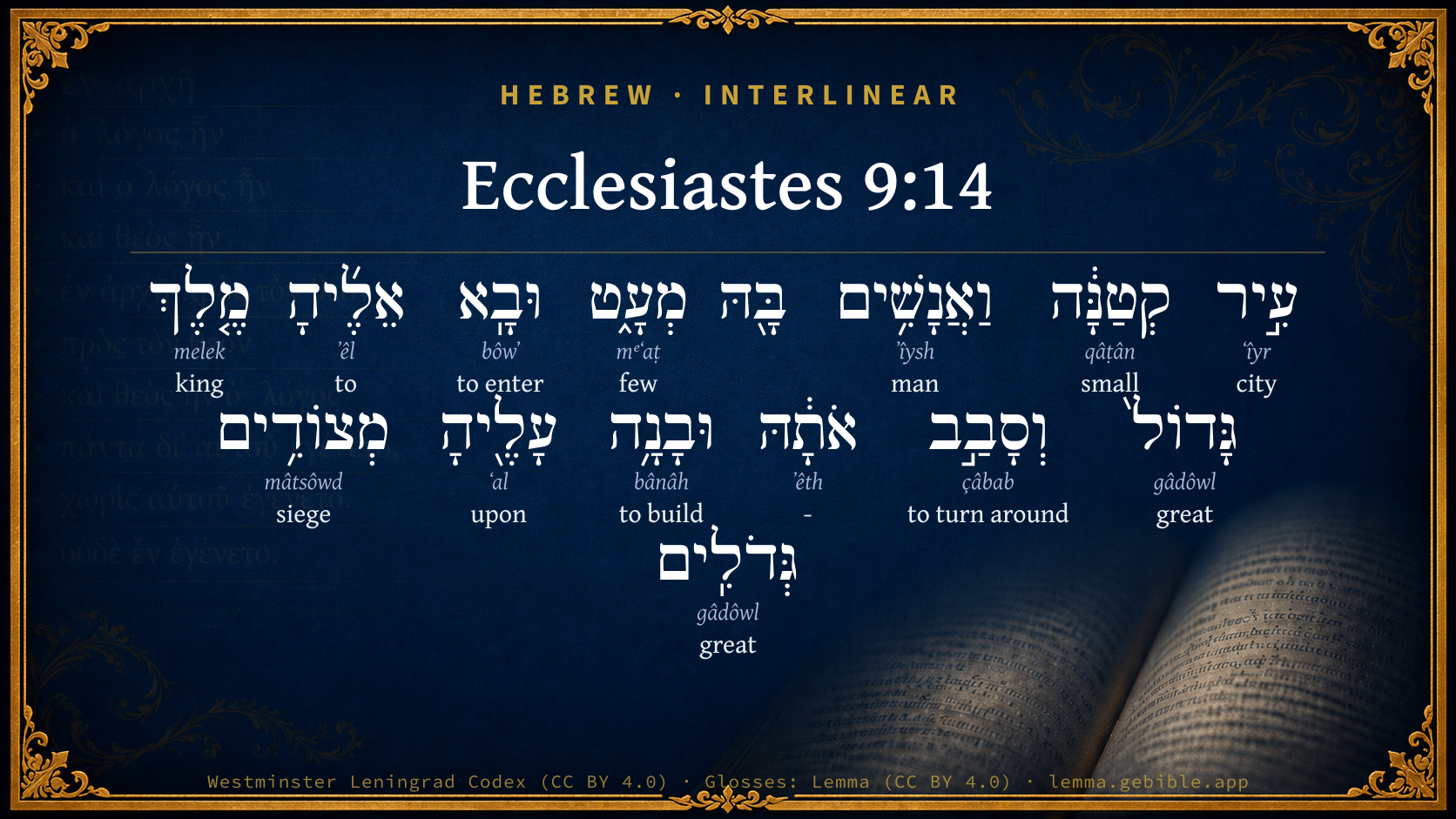
Hebrew (Westminster Leningrad Codex) Ecclesiastes 9:14 appears in the Hebrew Old Testament. The text above is from the Westminster Leningrad Codex. Each word links to its Strong’s number, a concise gloss, and parsing drawn from the Open Scriptures Hebrew Bible morphology. Click any word for its full Brown-Driver-Briggs (BDB) entry.
Download image
Cite this verse

Ecclesiastes 9:14 (World English Bible). Public Domain. Lemma interlinear Bible study tool, https://lemma.gebible.app/v/ecclesiastes/9/14.

Show BibTeX & RIS
BibTeX
RIS
English Translation
There was a little city, and few men within it; and a great king came against it, besieged it, and built great bulwarks against it.
World English Bible · Public Domain
Download a study sheet

One document with this verse’s original text, its word-by-word gloss line, the meaning frame, cross-references with their text, attributed commentary, and full source and license credits — printable, and it pastes into notes with its structure intact.

This verse Autodidact and up

Study sheet (.html) Plain text (.txt)

A passage Seminary Student

Up to 50 verses in one chapter. A passage sheet keeps up to 6 commentary sources and 12 cross-references per verse, in the order this page ranks them, and says so on the sheet whenever that leaves anything out. Ask for a single verse and you get the Autodidact verse sheet above.

Everything on this page stays free to read, with no account — the sheet is a download of what is already on screen, not access to it.

Want to remove ads? Support Godless Engineer
Compare translations 3

The same verse in 3 English versions, stacked beneath the original-language interlinear above. Click any original word for its lexicon entry.

Each is an independent rendering of the whole verse — the interlinear is not word-aligned to these translations.

Highlighted words mark where these versions differ — a whole-verse word diff, not a word-by-word alignment.

  • World English Bible Public Domain
    There was a little city, and few men within it; and a great king came against it, besieged it, and built great bulwarks against it.
  • King James Version Public Domain
    There was a little city, and few men within it; and there came a great king against it, and besieged it, and built great bulwarks against it:
  • unfoldingWord Literal Text CC BY-SA 4.0
    a small city, and a few men in it. And against it came a great king, and he surrounded it, and he built against it great siegeworks.

unfoldingWord Literal Text — © unfoldingWord, licensed CC BY-SA 4.0. Word-aligned USFM3 via Door43 (git.door43.org/unfoldingWord/en_ult).

Versions to compare (up to 4)

3 of 4 selected

Show all 18 translations

Every available English version of this verse, each an independent rendering of the whole verse.

  • World English Bible Public Domain
    There was a little city, and few men within it; and a great king came against it, besieged it, and built great bulwarks against it.
  • Berean Standard Bible Public Domain
    There was a small city with few men. A mighty king came against it, surrounded it, and built large siege ramps against it.
  • Majority Standard Bible Public Domain
    There was a small city with few men. A mighty king came against it, surrounded it, and built large siege ramps against it.
  • King James Version Public Domain
    There was a little city, and few men within it; and there came a great king against it, and besieged it, and built great bulwarks against it:
  • American Standard Version (1901) Public Domain
    There was a little city, and few men within it; and there came a great king against it, and besieged it, and built great bulwarks against it.
  • Revised Version (1885) Public Domain
    There was a little city, and few men within it; and there came a great king against it, and besieged it, and built great bulwarks against it:
  • Geneva Bible (1599) Public Domain
    A litle citie and fewe men in it, and a great King came against it, and compassed it about, and builded fortes against it.
  • Douay-Rheims (1899) Public Domain
    A little city, and few men in it: there came against it a great king, and invested it, and built bulwarks round about it, and the siege was perfect.
  • Young's Literal Translation Public Domain
    A little city, and few men in it, and a great king hath come unto it, and hath surrounded it, and hath built against it great bulwarks;
  • Literal Standard Version CC BY-SA 4.0
    A little city, and few men in it, and a great king has come to it, and has surrounded it, and has built against it great bulwarks;
  • Unlocked Literal Bible CC BY-SA 4.0
    There was a small city with only a few men in it, and a great king came against it and besieged it and built great siege ramps against it.
  • unfoldingWord Literal Text CC BY-SA 4.0
    a small city, and a few men in it. And against it came a great king, and he surrounded it, and he built against it great siegeworks.
  • Darby Bible Public Domain
    There was a little city, and few men within it; and there came a great king against it, and encompassed it, and built great bulwarks against it:
  • World Messianic Bible Public Domain
    There was a little city, and few men within it; and a great king came against it, besieged it, and built great bulwarks against it.
  • Webster's Bible Public Domain
    There was a little city, and few men within it; and there came a great king against it, and besieged it, and built great bulwarks against it:
  • Free Bible Version CC BY-SA 4.0
    Once there was a small town with only a few inhabitants. A powerful king came and besieged the town, building great earth ramps against its walls.
  • Bible in Basic English Public Domain
    There was a little town and the number of its men was small, and there came a great king against it and made an attack on it, building works of war round about it.
  • JPS Tanakh (1917) Public Domain
    there was a little city, and few men within it; and there came a great king against it, and besieged it, and built great bulwarks against it;

Literal Standard Version (2020), Covenant Press — licensed CC BY-SA 4.0. Text via the HelloAO Bible API (eBible.org). Unlocked Literal Bible (unfoldingWord) — licensed CC BY-SA 4.0. Text via the HelloAO Bible API (eBible.org). unfoldingWord Literal Text — © unfoldingWord, licensed CC BY-SA 4.0. Word-aligned USFM3 via Door43 (git.door43.org/unfoldingWord/en_ult). Free Bible Version, Dr. Jonathan Gallagher — licensed CC BY-SA 4.0. Text via the HelloAO Bible API (eBible.org).

Word by word

More ways to search: Search by grammar → Find every occurrence → Compare this word →

Practice this passage: Drill this verse → Learn its vocabulary →

מְצוֹדִ֥ים
mâtsôwd
H4685
“sieges”
Noun, Common, Masculine, Plural, Absolute
Part of Speech
Noun
Type
Common
Gender
Masculine
Number
Plural
State
Absolute
Full BDB Definition

Origin: from H6679

TWOT: 1885d , 1885e

siege-works, bulwark (noun masculine) - hunting implement, net (noun masculine) - net (noun feminine) - fastness, stronghold (noun feminine)
  1. עִ֣יר ʻîyr H5892 “city” Noun, Common, Feminine, Singular, Absolute
  2. קְטַנָּ֔ה qâṭân H6996 “small” Adjective, Adjective, Feminine, Singular, Absolute
  3. וַאֲנָשִׁ֥ים ʼîysh H376 “and · men” Conjunction + Noun, Common, Masculine, Plural, Absolute
  4. מְעָ֑ט mᵉʻaṭ H4592 “few” Noun, Common, Masculine, Singular, Absolute
  5. וּבָֽא bôwʼ H935 “and · to enter” Conjunction + Verb, Qal, Perfect, 3rd Person, Masculine, Singular
  6. אֵלֶ֜יהָ ʼêl H413 “to · her” Preposition + Suffix, Personal, 3rd Person, Feminine, Singular
  7. מֶ֤לֶךְ melek H4428 “king” Noun, Common, Masculine, Singular, Absolute
  8. גָּדוֹל֙ gâdôwl H1419 “great” Adjective, Adjective, Masculine, Singular, Absolute
  9. וְסָבַ֣ב çâbab H5437 “and · to turn around” Conjunction + Verb, Qal, Perfect, 3rd Person, Masculine, Singular
  10. אֹתָ֔הּ ʼêth H853 “- · her” Particle, Direct Object + Suffix, Personal, 3rd Person, Feminine, Singular
  11. וּבָנָ֥ה bânâh H1129 “and · to build” Conjunction + Verb, Qal, Perfect, 3rd Person, Masculine, Singular
  12. עָלֶ֖יהָ ʻal H5921 “upon · her” Preposition + Suffix, Personal, 3rd Person, Feminine, Singular
  13. גְּדֹלִֽים gâdôwl H1419 “great” Adjective, Adjective, Masculine, Plural, Absolute

About this verse

These counts appear in no published source. They are computed here, from the morphology-tagged text and Lemma’s own curated glosses. What Lemma adds →

15
words
13
distinct lemmas
Wisdom
section

Notable vocabulary

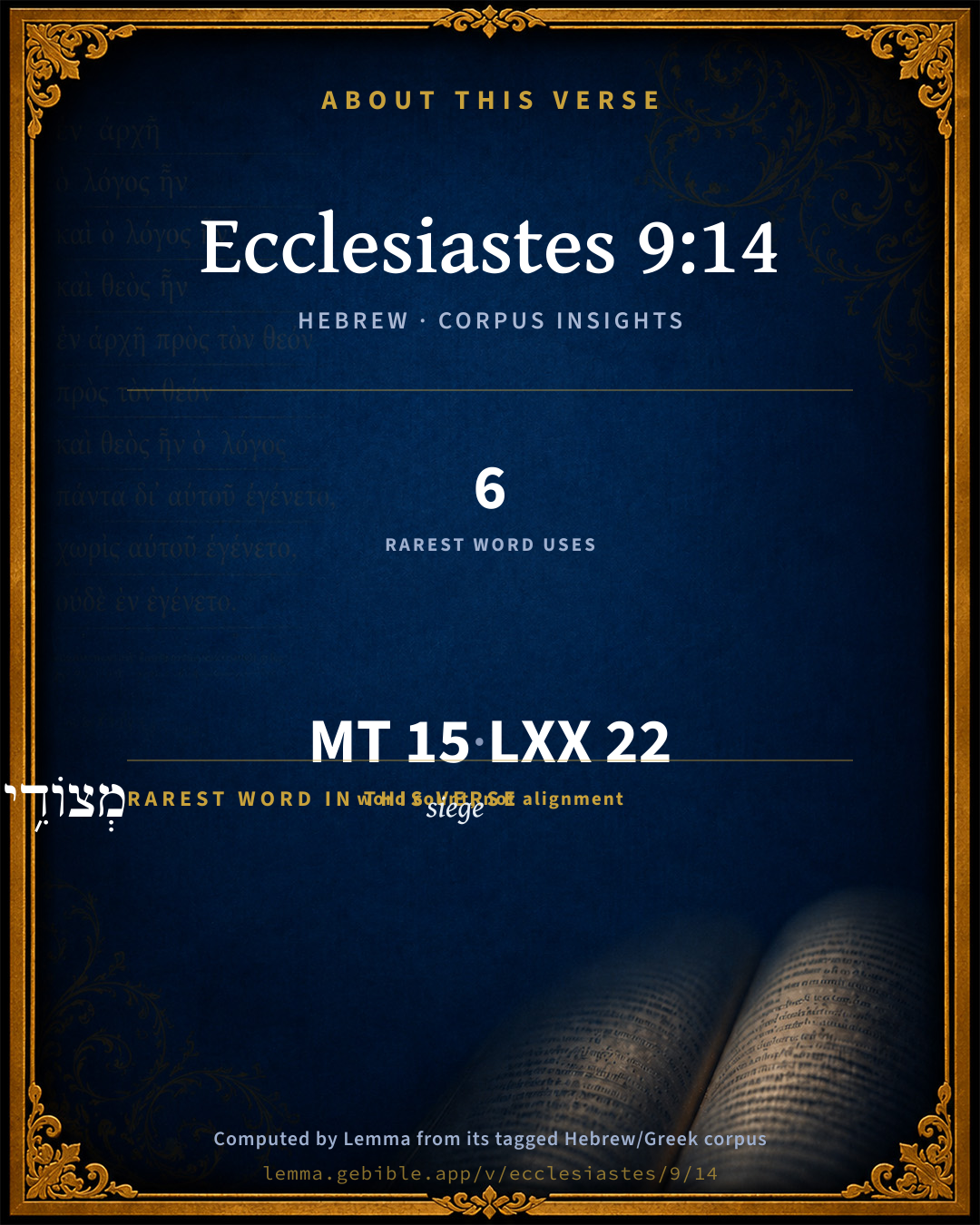
The rarest word here is מְצוֹדִ֥ים siege H4685 — appearing just 6 times in the whole Hebrew Bible.

Shared distinctive vocabulary

מְצוֹדִ֥ים siege H4685 occurs in 6 verses of the Hebrew Bible. Also found in:

Grammatical profile

  • 3 verbs
  • 5 nouns
  • 3 adjectives
  • 3 prepositions
  • 1 particle

Verb forms

  • וּבָֽא Qal · Perfect
  • וְסָבַ֣ב Qal · Perfect
  • וּבָנָ֥ה Qal · Perfect

Repetition

A word recurs within this verse — often emphatic in Hebrew:

  • גָּדוֹל֙ great H1419 ×2

Hebrew & Septuagint length

In English translation the verse runs 25 words from the Hebrew and 29 from the Septuagint (LXX English) — closely comparable.

A rough comparison of the two English renderings, which tokenize alike — not a word-level alignment.

Word counts can differ between the Hebrew and the Greek without any difference in meaning — e.g. the Hebrew direct-object marker אֵת has no separate Greek word, and Greek often adds the article ὁ.

In the original languages it is 15 Hebrew tokens and 22 Greek tokens — but the two are counted differently (Hebrew bundles its prefixes and suffixes into one token; the Greek is in lemma form), so that isn’t a like-for-like length.

Cross-references

2

Topical passages linked to Ecclesiastes 9:14 in the Treasury of Scripture Knowledge — connected by theme and wording, ordered by reader-vote popularity; previews shown in the World English Bible.

  • 2 Samuel 20:15–22 They came and besieged him in Abel of Beth Maacah, and they cast up a mound against the city, and it stood against the rampart; and all the people who were with Joab battered the wall, to throw it down.
  • 2 Kings 6:24–7:20 It happened after this, that Benhadad king of Syria gathered all his host, and went up, and besieged Samaria.

Cross-references courtesy of OpenBible.info (CC BY 4.0).

Hebrew and Greek witnesses Masoretic Hebrew ↔ Greek Septuagint

The same verse in the two great witnesses to the Old Testament, shown verse-for-verse.

These are two independent witnesses, not word-aligned to each other, and the Septuagint is shown in lemma (dictionary) form.

Hebrew Ecclesiastes 9:14 Masoretic · Westminster Leningrad Codex

עִ֣יר קְטַנָּ֔ה וַאֲנָשִׁ֥ים בָּ֖הּ מְעָ֑ט וּבָֽא אֵלֶ֜יהָ מֶ֤לֶךְ גָּדוֹל֙ וְסָבַ֣ב אֹתָ֔הּ וּבָנָ֥ה עָלֶ֖יהָ מְצוֹדִ֥ים גְּדֹלִֽים

There was a little city, and few men within it; and a great king came against it, besieged it, and built great bulwarks against it.

World English Bible · Public Domain

Greek LXX Ecclesiastes 9:14 Septuagint · lemma form

πόλις μικρός καί ἀνήρ ἐν αὐτός ὀλίγος καί ἔρχομαι ἐπί αὐτός βασιλεύς μέγας καί κυκλόω αὐτός καί οἰκοδομέω ἐπί αὐτός χάραξ μέγας

suppose there were a little city, and few men in it; and there should come against it a great king, and surround it, and build great mounds against it;

LXX2012 (modern English Septuagint) · Public Domain

On this verse, The Pulpit Commentary discusses the Septuagint’s reading. Read the note in Commentary ↓

Hebrew: Westminster Leningrad Codex (CC BY 4.0). Greek: Septuagint (public domain); English from LXX2012 (modern English Septuagint) (Public Domain). How the Septuagint differs from the Hebrew →

Commentary

Notes on Ecclesiastes 9:14 from classic Christian and Jewish commentators (each source and its license shown beneath its notes). The classic Christian expositions comment on the surrounding passage and are grouped to its opening verse, so a note may address several verses; the Jewish commentaries on the Tanakh (Rashi and others) are per-verse, so they appear only where the commentator wrote on this verse.

Lemma curates 59 commentaries, every one of them public domain or Creative Commons licensed, each selected and text-cleaned for this edition rather than reprinted as found. About our sources →

Trapp's Complete Commentary

John Trapp

Ecc 9:14 [There was] a little city, and few men within it; and there came a great king against it, and besieged it, and built great bulwarks against it:

Ver. 14. There was a little city.] Such as was Lampsacum, besieged by Alexander, and saved by Anaximenes; Rhodes, besieged by the great Turk; Rochelle, by the French king; Geneva, by the Duke of Savoy. This last, a little city, a small people surrounded with enemies, and barred out from all aid of neighbour cities and churches, yet is strangely upheld. {a} Well may they write as they do on the one side of their coin, Deus noster pugnat pro nobis, Our God fights for us. {b}

{a} Brightman.

{b} Scultet.

John Trapp, A Commentary or Exposition upon All the Books of the Old and New Testament (1647–1656) — public domain. Text from a community e-Sword module.

The Biblical Illustrator

Joseph S. Exell

Ecc_9:14-18

There was a little city, and few men within it.

The little city and the poor wise man

The little city, as first introduced to our notice, is in sore straits. The legion of the foe seem innumerable, while the garrison is reduced to a mere handful. They are fast being brought to extremities, and in a few short hours the unfortunate little city will be, in all human probability, subjected to all the horrors of capture by storm, and will be ultimately razed to the ground. At first sight it may seem rather paradoxical to compare this great world of ours, with its almost innumerable inhabitants, its vast area, its enormous resources, to the little city with few men within it. But do we not, comparatively speaking, take too exalted a view of this little world? For relatively little it is, after all--but an insignificant fraction of Gods great universe. But further, inasmuch as the city spoken of here is represented as being ultimately delivered from its peril, we are hardly justified in applying the figure to humanity at large, for whom indeed deliverance has been provided, but has not by it been accepted. The little city joyfully accepting the benefit of deliverance is a much fitter type of the spiritual Church of Christ, viewed in the foreknowledge of God as a complete whole, redeemed and delivered by the wisdom and love of the poor wise man who has cast in his lot with her: and this is indeed a little city, and few men within her. So that the parallelism thus limited is by no means strained or unintelligible. Now, we know nothing of the circumstances to which the little city owed its danger--it may or may not have been its own fault; but we do know the cause of the peril in which the human family has been involved, and that the blame rests entirely with ourselves. Man has rebelled against the sovereign will of God; the defiant cry of humanity through the long dark ages has still been, We will not have this Man to reign over us. The result of all has been that we have forced God into the position of a foe, although He is in His heart our best and truest friend. God would be false to His own position in the universe were He to permit rebellion against His authority: He would be practically abdicating His throne, and this He will never do. Do you know what it is to have reached the point of self-despair? have you found yourself surrounded by the mighty bulwarks? have you felt what it is to have no escape? Not until then, believe me, will you be disposed to value the deliverance procured by the poor wise man. To him we will now turn our attention. He was but a poor man; but he had a patriots heart and a wise mans head; and, moved doubtless by love for his compatriots, by some extraordinary and unlooked-for effort of wisdom, he delivered the city. How did he do it? Here again we have no information, but it is suggestive to notice that an incident very similar to the one described here actually took place in the time of Solomons father, and must in all probability have made so deep an impression on his own mind that it is scarcely possible that his mind did not recur to it as he wrote these words, though in this case the humble deliverer was a woman, not a man (2Sa_20:15). The guilt of one man here had involved the whole town in peril, because his guilt was imputed to them; but at the suggestion of the wise woman, the guilt was laid on the head of one, himself the guilty party, and one man died for the people, and the whole city perished not. But our Wise Man, Himself the Innocent, offered Himself, with a wisdom which was the child of love, that the guilt of our city might first be imputed to Him the Innocent, and that further His innocence might be imputed to our city, so that by His own voluntary self-sacrifice one man might die for the city, and the city itself might be safe. The wise woman saved the city at the cost of anothers life; but our poor Wise Man has saved His Church at the cost of His own; and in the moment of our despair we see the hostile bulwark withdrawn, the engines of war removed. We too are saved by the interposition of One who, though He was rich, yet for our sakes became poor, that we through His poverty might be made rich. He too was found in the city with no outward distinction of rank or title. He was in the world, and the world was made by Him, and the world knew Him not. Born in a remote province, in an obscure town, brought up in retirement as a peasants son, what was He to the Caesars and Herods of His day? But now I hasten on to the sequel, for I am speaking to the delivered ones to-day. What became of the poor wise man? Did they make him king or governor? Did he continue to be the most prominent figure in the little commonwealth which he had saved? Nay, but he disappears again into his old obscurity, he retires to the back street--to his cellar or his garret. No man remembered that same poor man. Ah, blood-bought souls, ye ransomed from ruin by the death of the Deliverer, is this true of any of us? Having been delivered from impending ruin by the Christ, have we learned to forget the Deliverer, and to live very much as if we had delivered ourselves? (W. H. M. H. Aitken, M. A.)

The poor wise man

A very remarkable case this is indeed. Here is a little city, with few inhabitants, in a weak defenceless condition, and a powerful army at the gates; which is rescued out of the hands of its enemies, and snatched from the jaws of destruction just opened to devour it: war and slavery are driven far away, and peace and liberty at once restored. And all this is ejected by one poor wise man. What would the behaviour of the people be in such a case? Would not their hearts overflow with gratitude toward their deliverer? Would they not render to him all their service who had rendered to them all his; and vie with each other who should do him most honour? Nothing less I they did not so much as thank him. Nay, after the thing was over, he did not even enter into their thoughts--No man remembered that same poor man. This is a very affecting story, considered only in itself: but if we can find an interest in it, and make the case our own, it will be much more so. Let us ask, then, what is to be understood by the city, the great king that besieged it, and the poor wise man that delivered it? The first thing we meet with is a little city with few men in it. Is not this a description which suits well with the Church, or society of believers? (Mat_5:14; Heb_11:10; Psa_87:3). And few and weak indeed we are, in comparison of those that besiege and encompass us round about to destroy us. Who these are, we are next to consider. There came a great king against it, and besieged it, and built great bulwarks against it. That the Christian state, of which this besieged city is a picture, is a state of warfare is known and acknowledged, when it is called the Church militant; and who it is that attacks it we all declare at our baptism, when we promise to fight manfully against sin, the world, and the devil. Sin and the world are but two instruments in this war: it is the devil who uses them; and, therefore, he is the great king that besieges this city and builds bulwarks against it. The bulwarks are raised; the city is ready to fall; and the enemy is about to enter: when lo, there is found in the city a poor wise man; and who is he? If we are the city, he that saves the city must be he that saves us; even our Lord Jesus Christ; than whom none ever was poorer or wiser: He was made poor for our sakes; and in Him were all the treasures of wisdom. This is He who by His wisdom delivers the city; who places Himself in the breach, as Moses did. At the sight of Him the infernal host was in an uproar; and for a time they seemed to overwhelm Him; they shouted for victory, and were hasting forward to the prey: the enemy of Israel, the spiritual Pharaoh, said, I will pursue, I will overtake, etc. And here, except the Lord had kept the city, the watchman had waked but in vain. Had he been an earthly conqueror, the day had been lost. For, to the everlasting confusion of His enemies, He who lay down in his grave the poor wise man, the despised and afflicted Galilean, arose from the dead the Lord mighty in battle; and of the subject of death became the King of Glory. And now, would you think it possible that after all this no man should remember that same poor man? that they should entirely forget him? that they should all forget him? Who at the hearing of this monstrous act of ingratitude is not filled with indignation? Yet we have done all this: we have had this mighty deliverance vouchsafed to us--and we have forgotten it! We have forgotten Him, who so remembered us that He forgot Himself, and made no account of all those sorrows and sufferings, from His birth in the manger to His death upon the cross, which He underwent for us men and our salvation. The first thing we ought; to remember and confess is this, That we got not the land in possession by our own sword, etc. You have now seen how well this parable of Solomon bears an application to the salvation of us citizens of the Church by Jesus Christ; and how it agrees with the same in every particular. There is another ease of the kind, in which the event was quite contrary; and the case of the one city should never be thought of without the other. You have seen the example of a city saved by a poor wise man. I can tell you of another city lost for want of him. The city of Jerusalem fell into the condition of our city in the parable. A great king came against it and encompassed it with armies, and built great bulwarks against it, and prevailed so as to overthrow it to its very foundations, and scatter all its inhabitants. There was found in it none to save; no poor wise man to prevent its destruction. There had been one; but they had cast him out, and refused to he saved by him: for the sake of his poverty they had despised his wisdom; so their destruction was inevitable. And so will it be of all those who east out their Saviour: yea, the time will come when the whole world shall perish for want of Him. (W. Jones, M. A.)

The Biblical Illustrator, edited by Joseph S. Exell (c. 1880s–1900s) — public domain. Text from a community e-Sword module.

Jamieson, Fausset & Brown

Robert Jamieson, A. R. Fausset & David Brown

(Sa2 20:16-22).

bulwarks--military works of besiegers.

Jamieson, Fausset & Brown — Commentary Critical and Explanatory on the Whole Bible (1871) — public domain (CC PDM 1.0). Text via the HelloAO Bible API.

Adam Clarke's Commentary

Verse 14. There was a little city, and few men within it] Here is another proof of the vanity of sublunary things; the ingratitude of men, and the little compensation that genuine merit receives. The little history mentioned here may have either been a fact, or intended as an instructive fable. A little city, with few to defend it, being besieged by a great king and a powerful army, was delivered by the cunning and address on a poor wise man; and afterwards his townsmen forgot their obligation to him.

Those who spiritualize this passage, making the little city the CHURCH, the few men the APOSTLES, the great king the DEVIL, and the poor wise man JESUS CHRIST, abuse the text.

But the Targum is not less whimsical: "The little city is the human body; few men in it, few good affections to work righteousness; the great king, evil concupiscence, which, like a strong and powerful king, enters into the body to oppress it, and besieges the heart so as to cause it to err; built great bulwarks against it - evil concupiscence builds his throne in it wheresoever he wills, and causes it to decline from the ways that are right before God; that it may be taken in the greatest nets of hell, that he may burn it seven times, because of its sins. But there is found in it a poor wise man - a good, wise, and holy affection, which prevails over the evil principle, and snatches the body from the judgment of hell, by the strength of its wisdom. Yet, after this deliverance, the man did not remember what the good principle had done for him; but said in his heart, I am innocent," c.

What a wonderful text has this been in the hands of many a modern Targumist and with what force have the Keachonians preached Christ crucified from it!

Such a passage as this receives a fine illustration from the case of Archimedes saving the city of Syracuse from all the Roman forces besieging it by sea ana land. He destroyed their ships by his burning-glasses, lifted up their galleys out of the water by his machines, dashing some to pieces, and sinking others. One man's wisdom here prevailed for a long time against the most powerful exertions of a mighty nation. In this case, wisdom far exceeded strength. But was not Syracuse taken, notwithstanding the exertions of this poor wise man? No. But it was betrayed by the baseness of Mericus, a Spaniard, one of the Syracusan generals. He delivered the whole district he commanded into the hands of Marcellus, the Roman consul, Archimedes having defeated every attempt made by the Romans, either by sea or land: yet he commanded no company of men, made no sorties, but confounded and destroyed them by his machines. This happened about 208 years before Christ, and nearly about the time in which those who do not consider Solomon as the author suppose this book to have been written. This wise man was not remembered; he was slain by a Roman soldier while deeply engaged in demonstrating a new problem, in order to his farther operations against the enemies of his country. See Plutarch, and the historians of this Syracusan war.

When Alexander the Great was about to destroy the city Lampsacus, his old master Anaximenes came out to meet him. Alexander, suspecting his design, that he would intercede for the city, being determined to destroy it, swore that he would not grant him any thing he should ask. Then said Anaximenes, "I desire that you will destroy this city." Alexander respected his oath, and the city was spared. Thus, says Valerius Maximus, the narrator, (lib. vii. c. iii., No. 4. Extern.,) by this sudden turn of sagacity, this ancient and noble city was preserved from the destruction by which it was threatened. "Haec velocitas sagacitatis oppidum vetusta nobilitate inclytum exitio, cui destinatum erat, subtraxit."

A stratagem of Jaddua, the high priest, was the means of preserving Jerusalem from being destroyed by Alexander, who, incensed because they had assisted the inhabitants of Gaza when he besieged it, as soon as he had reduced it, marched against Jerusalem, with the determination to raze it to the ground; but Jaddua and his priests in their sacerdotal robes, meeting him on the way, he was so struck with their appearance that he not only prostrated himself before the high priest, and spared the city, but also granted it some remarkable privileges. But the case of Archimedes and Syracuse is the most striking and appropriate in all its parts. That of Anaximenes and Lampsacus is also highly illustrative of the maxim of the wise man: "Wisdom is better than strength."

Adam Clarke's Commentary on the Bible (1810–1826) — public domain. Text from a community e-Sword/MySword module.

Ellicott's Commentary for English Readers

(14) Idle attempts have been made to find a historic reference in this passage. What is here told is so like the story (2 Samuel 20) of the deliverance of Abel-beth-Maachah by a wise woman, whose name, nevertheless, has not been preserved, that we cannot even be sure that the writer had any other real history in his mind.

A Bible Commentary for English Readers, edited by Charles John Ellicott (1878–1897) — public domain. Text from a community e-Sword module.

The Cambridge Bible for Schools and Colleges

gen. ed. J. J. S. Perowne

14. there was a little city] The city has been identified by one commentator (Hitzig) with Dora, which was besieged unsuccessfully by Antiochus the Great in b.c. 218 (Polyb. 9:66). Josephus describes it, in his narrative of its siege by Antiochus Sidetes (Ant. xiii. 7, § 2), as “a city hard to be taken,” but we know nothing of any special incidents corresponding to the allusion in this passage. The term “great king” fits in with the hypothesis, as also does the fact that the siege was raised, but that is all. The spiritualising interpretations which have found favour with Jewish and Christian commentators, in which the history represents something like the attack of Satan on the town of Mansoul (as in Bunyan’s Holy War), must be rejected as altogether arbitrary and fantastic.

and built great bulwarks against it] The “bulwarks,” as in the Old Testament generally, are the out-works of the besiegers, the banks or mounds from which missiles were thrown into the city (comp. Deu_20:20; 2Sa_20:15; 2Ch_26:15).

The Cambridge Bible for Schools and Colleges (gen. ed. J. J. S. Perowne; Cambridge University Press, 1878–1918) — public domain. Text from a community e-Sword module.

John Gill's Exposition

There was a little city, and few men within it,.... Which some take to be a piece of history, a real matter of fact; that as the city of Abel, when besieged by Joab, was delivered by the counsel of a wise woman, Sa2 20:15; so there was a city, which Solomon had knowledge of, which was delivered from the siege of a powerful king, by the wise counsel of a poor wise man: though others think it is only a fiction, fable, or parable; the moral of which is, that political wisdom, even in a poor mean person, is sometimes very useful and serviceable, though it does not meet with its proper merit. Many of the Jewish writers understand the whole allegorically and figuratively; so the Targum, by "the little city", understands the body of man; by "few men in it", the little righteousness there is in the heart of man; though, according to the Midrash, Jarchi, and Alshech, they are the members of the body; by "the great king", the evil imagination, or corruption of nature, which is great to oppress, and besieges the heart to cause it to err; and by "the poor wise man", the good imagination or affection, which prevails over the other, and subdues it, and delivers the body from hell, and yet not remembered; and so the Midrash, and the ancient Jews in Aben Ezra, though he himself understands it according to its literal sense. Some Christian interpreters explain it to better purpose, concerning the church attacked by Satan, and delivered by Christ, who, notwithstanding, is unkindly and ungratefully used: the church is often compared to a city, it is the city of God, and of which saints are fellow citizens; it is but a "little" one in comparison of the world, and, in some periods and ages of the world, lesser than in others; it is little and contemptible in the eyes of the world, and the inhabitants of it are mean and low in their own eyes; they are a little flock, Luk 12:32; and "few" in number that are "within it": some are only of it, but not in it, or are external members only, which sometimes are many; or outward, not inward, court worshippers; they are few, comparatively, that belong to the invisible church, that are chosen, redeemed, called, and saved, Mat 20:16; there are but few able men, especially such as are capable of defending the church against its enemies.

and there came a great king against it; Satan, the prince of devils and of the posse of them in the air, the god and prince of the world of the ungodly, who works in their hearts, and leads them captive at his will who may be said to be "great" with respect to the numbers under him, legions of devils, and the whole world that lies in wickedness, or "in" or "under" the wicked one: and on account of the power he exercises, by divine permission, over the bodies and minds of men; and in comparison of the little city, and few men in it, being stronger than they, Mat 12:24; he comes from the region of the air, where his posse are; or from going to and fro in the earth; or from hell, into which he is cast down: he comes by divine permission; in the manner evil spirits do, by temptation; in a hostile way, against the church and people of God, to destroy and devour them, if possible;

and besieged it; surrounded it on all sides, as the Gog and Magog army trader him will encompass the camp of the saints, and the beloved city, Rev 20:9;

and built great bulwarks against it; such as are called strong holds, Co2 10:4. Satan's first attack was upon the elect of God, in Adam; when he brought them, through sin, under a sentence of condemnation and death, though then they were preserved in Christ; and ever since he has been attacking the church by persecution, in order to take it by storm; and by spreading errors and heresies, such as tend to raze the foundation, and to pull down the superstructure of grace; and by promoting schisms, and laying such large principles of church communion, as tend to take away ordinances and discipline, the fence of the city; and by throwing in hand grenades of strife and contention, to raise a civil war among the citizens themselves; and, by various temptations to sin, to gain deserters: these are some of his bulwarks, batteries, and engines.

John Gill's Exposition of the Whole Bible (1746–1763) — public domain (CC PDM 1.0). Text via the HelloAO Bible API.

Albert Barnes' Notes on the Bible

A parable probably without foundation in fact. Critics who ascribe this book to a late age offer no better suggestion than that the “little city” may be Athens delivered 480 b.c. from the host of Xerxes through the wisdom of Themistocles, or Dora besieged 218 b.c. by Antiochus the Great.

Ecc 9:16-17 are comments on the two facts - the deliverance of the city and its forgetfulness of him who delivered it - stated in Ecc 9:15.

Albert Barnes' Notes on the Bible (1834–1885) — public domain. Text from a community e-Sword/MySword module.

Haydock's Catholic Bible Commentary

And the siege, &c. Hebrew has only "great bulwarks over or against it." (Haydock)

George Leo Haydock (1774–1849), Haydock's Catholic Family Bible and Commentary, 1859 edition — public domain. Excludes Psalms (Douay-Rheims chapter numbering differs from Protestant) and Deuterocanonical books (Catholic canon only).

Matthew Poole's English Annotations

It matters not whether this was a real history, or only a parable to represent the common practices of men in such cases.

Matthew Poole's English Annotations on the Holy Bible (1683–1685) — public domain. Text from a community e-Sword/MySword module.

Whedon's Commentary on the Bible

Daniel D. Whedon

14. Little city… great king — It is not known of what city or of what king this is told. There were nations and cities within the limits of the Persian empire that steadily and successfully defied the king’s power. The case of a city thus hemmed in, so that, in the long run, the choice of fate would be between famine and the sword, would be very desperate.

Daniel D. Whedon (gen. ed.), Commentary on the Old and New Testaments (1874–1909) — public domain. Text from a community e-Sword module.

The Pulpit Commentary

There was a little city. The substantive verb is, as commonly, omitted. Commentators have amused themselves with endeavoring to identify the city here mentioned. Thus some see herein Athens, saved by the counsel of Themistocles, who was afterwards driven from Athens and died in misery (Justin., 2:12); or Dora, near Mount Carmel, besieged unsuccessfully by Antiochus the Great, B.C. 218, though we know nothing of the circumstances (Polyb., 5:66); but see note on ver. 13. The Septuagint takes the whole paragraph hypothetically, "Suppose there was a little city," etc. Wright well compares the historical allusions to events fresh in the minds of his hearers made by our Lord in his parable of the pounds. (Luk_19:12, Luk_19:14, Luk_19:15, Luk_19:27) So we may regard the present section as a parable founded on some historical fact well known at the time when the book was written. A great king. The term points to some Persian or Assyrian potentate; or it may mean merely a powerful general. (see 1Ki_11:24; Job_29:25) Built great bulwarks against it. The Septuagint has carakav megalouv, "great palisades;" the Vulgate, Extruxitque munitiones per gyrum . What are meant are embankments or mounds raised high enough to overtop the walls of the town, and to command the positions of the besieged. For the same purpose wooden towers were also used. (see Deu_20:20; 2Sa_20:15; 2Ki_19:32) The Vulgate rounds off the account in the text by adding, et perfects est obsidio, "and the beleaguering was completed."

The Pulpit Commentary (1880–1919), ed. H.D.M. Spence-Jones & Joseph S. Exell — public domain. Text from a community e-Sword module.

Keil & Delitzsch

C. F. Keil & F. Delitzsch

"A little city, and men therein only a few, - to which a great king came near, and he besieged it, and erected against it high bulwarks. And he met therein a poor wise man, and who saved the city by his wisdom; and no man thought of that poor man." What may be said as to the hist. reference of these words has already been noticed. The "great king" is probably an Asiatic monarch, and that the Persian; Jerome translates verbally: Civitas parva et pauci in ea viri, venit contra eam - the former is the subj., and the latter its pred.; the object stands first, plastically rigid, and there then follows what happened to it; the structure of the sentence is fundamentally the same as Psa 104:25. The expression אל בּוא, which may be used of any kind of coming to anything, is here, as at Gen 32:9, meant of a hostile approach. The object of a siege and a hostile attack is usually denoted by על, Kg2 16:5; Isa 7:1. Two Codd. of de Rossi's have the word מצורים, but that is an error of transcription; the plur. of מצור is fem., Isa 29:4. מצודים is, as at Ecc 7:26, plur. of מצוד (from צוּד, to lie in wait); here, as elsewhere, בּחן and דּיק is the siege-tower erected on the ground or on the rampart, from which to spy out the weak points of the beleaguered place so as to assail it.

The words following בהּ וּמצא are rendered by the Targ., Syr., Jerome, Arab., and Luther: "and there was found in it;" most interpreters explain accordingly, as they point to Ecc 1:10, יאמר, dicat aliquis. But that מץ taht in this sequence of thought is = ונמצא (Job 42:15), is only to be supposed if it were impossible to regard the king as the subject, which Ewald with the lxx and the Venet. does in spite of 294b. It is true it would not be possible if, as Vaih. remarks, the finding presupposed a searching; but cf. on the contrary, e.g., Deu 24:1; Psa 116:3. We also say of one whom, contrary to expectation, a superior meets with, that he has found his match, that he has found his man. Thus it is here said of the great king, he found in the city a poor wise man - met therein with such an one, against whom his plan was shattered. חכם is the adjective of the person of the poor man designated by ish miskēn (cf. Ch2 2:13); the accents correctly indicate this relation. Instead of וּמלּט־הוּא, the older language would use וימלּט; it does not, like the author here, use pure perfects, but makes the chief factum prominent by the fut. consec. The ē of millēt is that of limmēd before Makkeph, referred back to the original a. The making prominent of the subject contained in millat by means of hu is favourable to the supposition that umatsa' has the king as its subject; while even where no opposition (as e.g., at Jer 17:18) lies before us this pleonasm belongs to the stylistic peculiarities of the book. Instead of adam lo, the older form is ish lo; perhaps the author here wishes to avoid the repetition of ish, but at Ecc 7:20 he also uses adam instead of ish, where no such reason existed.

Threatened by a powerful assailant, with whom it could not enter into battle, the little city, deserted by its men to a small remainder capable of bearing arms (this idea one appears to be under the necessity of connecting with מעט ... ואן), found itself in the greatest straits; but when all had been given up as lost, it was saved by the wisdom of the poor man (perhaps in the same way as Abel-beth-maacha, 2 Sam 20, by the wisdom of a woman). But after this was done, the wise poor man quickly again fell into the background; no man thought of him, as he deserved to have been thought of, as the saviour of the city; he was still poor, and remained so, and pauper homo raro vifit cum nomine claro. The poor man with his wisdom, Hengst. remarks, is Israel. And Wangemann (1856), generalizing the parable: "The beleaguered city is the life of the individual; the great king who lays siege to it is death and the judgment of the Lord." But sounder and more appropriate is the remark of Luther: Est exemplum generale, cujus in multis historiis simile reperitur; and: Sic Themistocles multa bona fecit suis civibus, sed expertus summam intratitudinem. The author narrates an actual history, in which, on the one hand, he had seen what great things wisdom can do; and from which, on the other hand, he has drawn the following lesson:

Keil & Delitzsch — Biblical Commentary on the Old Testament (1861–1891) — public domain (CC PDM 1.0). Text via the HelloAO Bible API. (Old Testament only.)

Lesson kit

Teaching starters — assembled from the data on this page, not authored interpretation. Every prompt links to the verse data it draws on. Edit before teaching.

Ecclesiastes, in the Wisdom, opens this verse with 15 words (13 distinct Hebrew lemmas). Its most distinctive word is mâtsôwd (“siege”). A historical commentator’s framing appears above. Read the whole chapter for the surrounding context.

Discussion questions

  1. What does “siege” (mâtsôwd) contribute to the verse as a whole?
  2. Proverbs 12:12 shares the word «siege» with this verse. How do the two illuminate each other?
  3. “great” occurs 2× in this one verse. What is the effect of the repetition?
  4. These translations render this verse differently; the difference is in the English rendering, not the original. What questions does that raise?
  5. The verb «וּבָֽא» is Qal Perfect. How does its form color the action?
  6. Reading how Trapp's Complete Commentary and The Biblical Illustrator read this verse, where do the two commentators agree and where do they part?

Things to notice

Reading settings

Reading text

Shown beneath each verse's original-language words.

Old Testament
Old Testament edition

Read the OT as the Masoretic Hebrew (MT) or the Greek Septuagint (LXX).

English shown for the Greek Septuagint (in the Hebrew ↔ Greek comparison).

Comparing translations? Open the Compare panel on any verse page to stack up to four side by side.