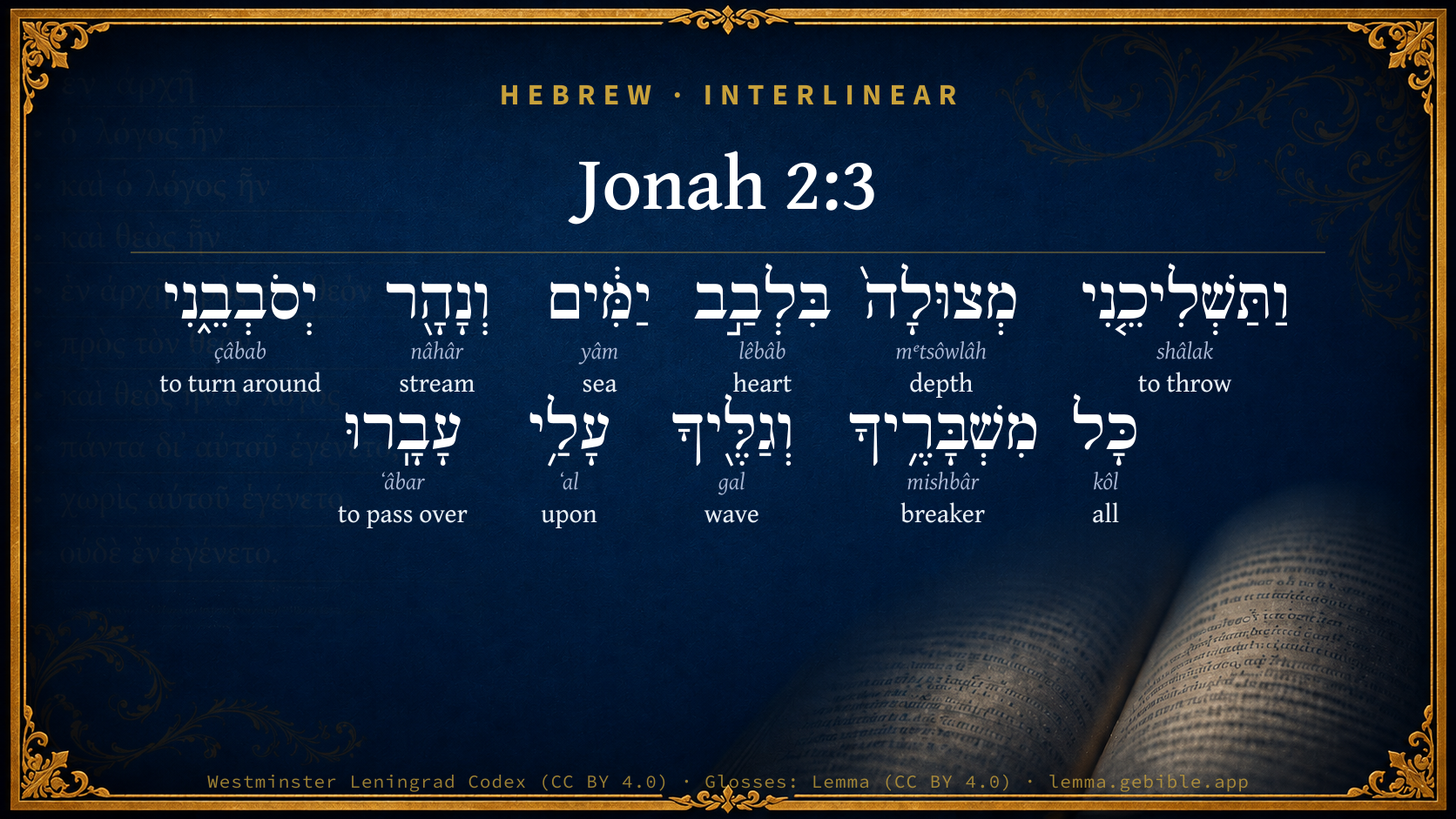
Jonah 2:3

Hebrew (Westminster Leningrad Codex) Jonah 2:3 appears in the Hebrew Old Testament. The text above is from the Westminster Leningrad Codex. Each word links to its Strong’s number, a concise gloss, and parsing drawn from the Open Scriptures Hebrew Bible morphology. Click any word for its full Brown-Driver-Briggs (BDB) entry.
Download image
Cite this verse

Jonah 2:3 (World English Bible). Public Domain. Lemma interlinear Bible study tool, https://lemma.gebible.app/v/jonah/2/3.

Show BibTeX & RIS
BibTeX
RIS
English Translation
For you threw me into the depths, In the heart of the seas. The flood was all around me. All your waves and your billows passed over me.
World English Bible · Public Domain
Download a study sheet

One document with this verse’s original text, its word-by-word gloss line, the meaning frame, cross-references with their text, attributed commentary, and full source and license credits — printable, and it pastes into notes with its structure intact.

This verse Autodidact and up

Study sheet (.html) Plain text (.txt)

A passage Seminary Student

Up to 50 verses in one chapter. A passage sheet keeps up to 6 commentary sources and 12 cross-references per verse, in the order this page ranks them, and says so on the sheet whenever that leaves anything out. Ask for a single verse and you get the Autodidact verse sheet above.

Everything on this page stays free to read, with no account — the sheet is a download of what is already on screen, not access to it.

Want to remove ads? Support Godless Engineer
Compare translations 3

The same verse in 3 English versions, stacked beneath the original-language interlinear above. Click any original word for its lexicon entry.

Each is an independent rendering of the whole verse — the interlinear is not word-aligned to these translations.

Highlighted words mark where these versions differ — a whole-verse word diff, not a word-by-word alignment.

  • World English Bible Public Domain
    For you threw me into the depths, In the heart of the seas. The flood was all around me. All your waves and your billows passed over me.
  • King James Version Public Domain
    For thou hadst cast me into the deep, in the midst of the seas; and the floods compassed me about: all thy billows and thy waves passed over me.
  • unfoldingWord Literal Text CC BY-SA 4.0
    Now you had cast me the deep, into the heart of the seas, and a current surrounded me; all your billows and your waves passed over me.

unfoldingWord Literal Text — © unfoldingWord, licensed CC BY-SA 4.0. Word-aligned USFM3 via Door43 (git.door43.org/unfoldingWord/en_ult).

Versions to compare (up to 4)

3 of 4 selected

Show all 18 translations

Every available English version of this verse, each an independent rendering of the whole verse.

  • World English Bible Public Domain
    For you threw me into the depths, In the heart of the seas. The flood was all around me. All your waves and your billows passed over me.
  • Berean Standard Bible Public Domain
    For You cast me into the deep, into the heart of the seas, and the current swirled about me; all Your breakers and waves swept over me.
  • Majority Standard Bible Public Domain
    For You cast me into the deep, into the heart of the seas, and the current swirled about me; all Your breakers and waves swept over me.
  • King James Version Public Domain
    For thou hadst cast me into the deep, in the midst of the seas; and the floods compassed me about: all thy billows and thy waves passed over me.
  • American Standard Version (1901) Public Domain
    For thou didst cast me into the depth, in the heart of the seas, And the flood was round about me; All thy waves and thy billows passed over me.
  • Revised Version (1885) Public Domain
    For thou didst cast me into the depth, in the heart of the seas, and the flood was round about me; all thy waves and thy billows passed over me.
  • Geneva Bible (1599) Public Domain
    For thou haddest cast me into the bottome in the middes of the sea, and the floods compassed me about: all thy surges, and all thy waues passed ouer me.
  • Douay-Rheims (1899) Public Domain
    And he said: I cried out of my affliction to the Lord, and he heard me: I cried out of the belly of hell, and thou hast heard my voice.
  • Young's Literal Translation Public Domain
    When Thou dost cast me `into' the deep, Into the heart of the seas, Then the flood doth compass me, All Thy breakers and Thy billows have passed over me.
  • Literal Standard Version CC BY-SA 4.0
    When You cast me [into] the deep, || Into the heart of the seas, || Then the flood surrounds me, || All Your breakers and Your billows have passed over me.
  • Unlocked Literal Bible CC BY-SA 4.0
    You had thrown me into the depths, into the heart of the seas, and the currents surrounded me; all your waves and billows passed over me.
  • unfoldingWord Literal Text CC BY-SA 4.0
    Now you had cast me the deep, into the heart of the seas, and a current surrounded me; all your billows and your waves passed over me.
  • Darby Bible Public Domain
    For thou didst cast me into the depth, into the heart of the seas, And the flood was round about me: All thy breakers and thy billows are gone over me.
  • World Messianic Bible Public Domain
    For you threw me into the depths, in the heart of the seas. The flood was all around me. All your waves and your billows passed over me.
  • Webster's Bible Public Domain
    \\2:2\\And said, I cried by reason of my affliction to the LORD, and he heard me; out of the belly of hell cried I, and thou heardst my voice.
  • Free Bible Version CC BY-SA 4.0
    You threw me into the deep, all the way down to the bottom of the sea. Water flooded all around me; your crashing waves rolled over me.
  • Bible in Basic English Public Domain
    In my trouble I was crying to the Lord, and he gave me an answer; out of the deepest underworld I sent up a cry, and you gave ear to my voice.
  • JPS Tanakh (1917) Public Domain
    (2-4) For Thou didst cast me into the depth, in the heart of the seas, and the flood was round about me; all Thy waves and Thy billows passed over me.

Literal Standard Version (2020), Covenant Press — licensed CC BY-SA 4.0. Text via the HelloAO Bible API (eBible.org). Unlocked Literal Bible (unfoldingWord) — licensed CC BY-SA 4.0. Text via the HelloAO Bible API (eBible.org). unfoldingWord Literal Text — © unfoldingWord, licensed CC BY-SA 4.0. Word-aligned USFM3 via Door43 (git.door43.org/unfoldingWord/en_ult). Free Bible Version, Dr. Jonathan Gallagher — licensed CC BY-SA 4.0. Text via the HelloAO Bible API (eBible.org).

Word by word

More ways to search: Search by grammar → Find every occurrence → Compare this word →

Practice this passage: Drill this verse → Learn its vocabulary →

מִשְׁבָּרֶ֥יךָ
mishbâr
H4867
“breakers · your”
Noun, Common, Masculine, Plural, Construct + Suffix, Personal, 2nd Person, Masculine, Singular
Part of Speech
Noun
Type
Common
Gender
Masculine
Number
Plural
State
Construct
Full BDB Definition

Origin: from H7665

TWOT: 2321d

breaker, breaking (of sea)
  1. וַתַּשְׁלִיכֵ֤נִי shâlak H7993 “and · to throw · me” Conjunction + Verb, Hiphil, Sequential Imperfect, 2nd Person, Masculine, Singular + Suffix, Personal, 1st Person, Common, Singular
  2. מְצוּלָה֙ mᵉtsôwlâh H4688 “depth” Noun, Common, Feminine, Singular, Absolute
  3. בִּלְבַ֣ב lêbâb H3824 “in/at · heart of” Preposition + Noun, Common, Masculine, Singular, Construct
  4. יַמִּ֔ים yâm H3220 “seas” Noun, Common, Masculine, Plural, Absolute
  5. וְנָהָ֖ר nâhâr H5104 “and · stream” Preposition + Noun, Common, Masculine, Singular, Absolute
  6. יְסֹבְבֵ֑נִי çâbab H5437 “to turn around · me” Verb, Poel, Imperfect, 3rd Person, Masculine, Singular + Suffix, Personal, 1st Person, Common, Singular
  7. כָּל kôl H3605 “all of” Noun, Common, Masculine, Singular, Construct
  8. וְגַלֶּ֖יךָ gal H1530 “and · waves · your” Conjunction + Noun, Common, Masculine, Plural, Construct + Suffix, Personal, 2nd Person, Masculine, Singular
  9. עָלַ֥י ʻal H5921 “upon · me” Preposition + Suffix, Personal, 1st Person, Common, Singular
  10. עָבָֽרוּ ʻâbar H5674 “to pass over” Verb, Qal, Perfect, 3rd Person, Common, Plural

About this verse

These counts appear in no published source. They are computed here, from the morphology-tagged text and Lemma’s own curated glosses. What Lemma adds →

11
words
11
distinct lemmas
Prophets
section

Notable vocabulary

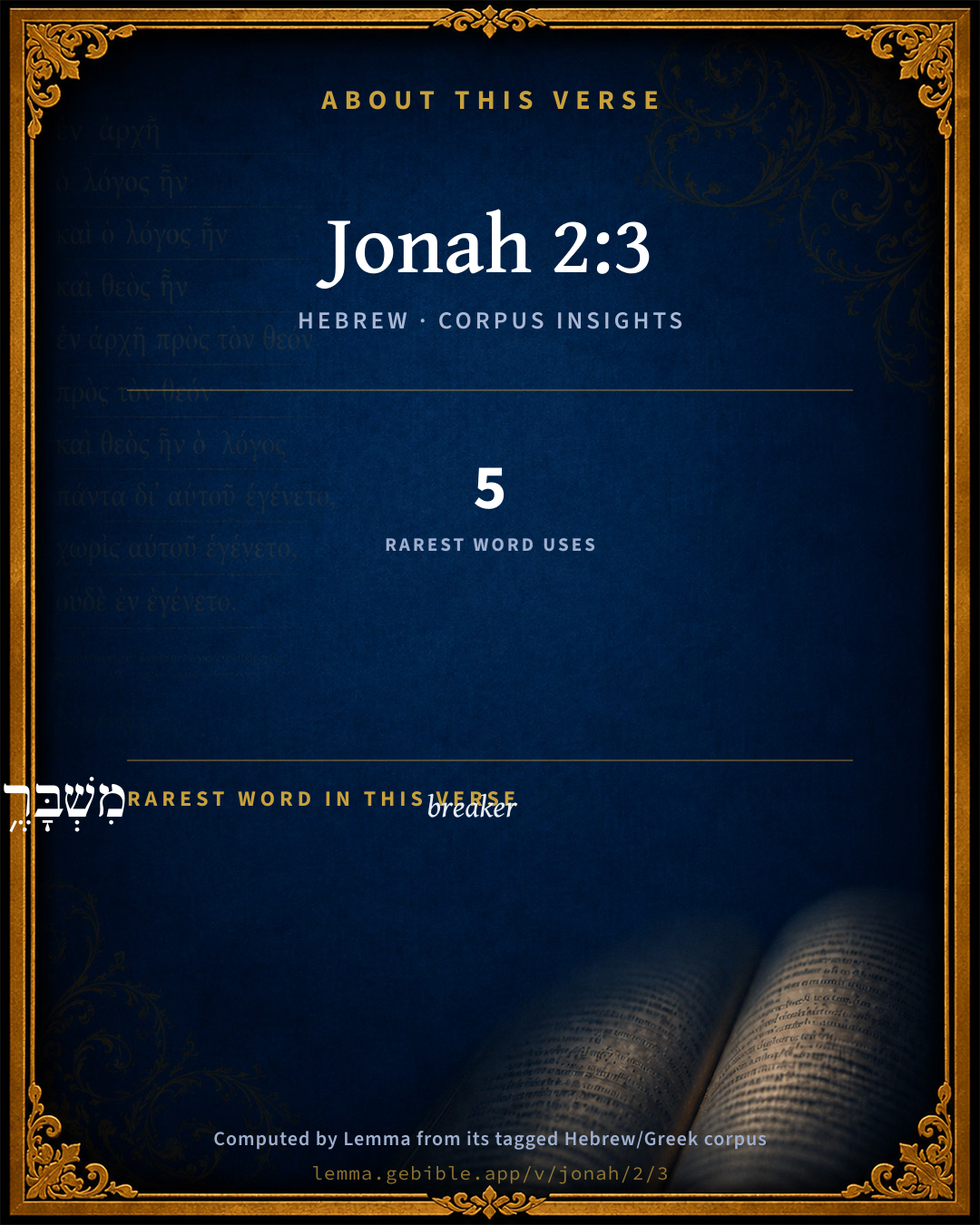
The rarest word here is מִשְׁבָּרֶ֥יךָ breaker H4867 — appearing just 5 times in the whole Hebrew Bible.

Shared distinctive vocabulary

מִשְׁבָּרֶ֥יךָ breaker H4867 occurs in 5 verses of the Hebrew Bible. Also found in:

Grammatical profile

  • 3 verbs
  • 7 nouns
  • 1 preposition

Verb forms

  • וַתַּשְׁלִיכֵ֤נִי Hiphil · Sequential Imperfect
  • יְסֹבְבֵ֑נִי Poel · Imperfect
  • עָבָֽרוּ Qal · Perfect

Hebrew & Septuagint length

In English translation the verse runs 28 words from the Hebrew and 31 from the Septuagint (LXX English) — closely comparable.

A rough comparison of the two English renderings, which tokenize alike — not a word-level alignment.

Word counts can differ between the Hebrew and the Greek without any difference in meaning — e.g. the Hebrew direct-object marker אֵת has no separate Greek word, and Greek often adds the article ὁ.

Cross-references

5

Topical passages linked to Jonah 2:3 in the Treasury of Scripture Knowledge — connected by theme and wording, ordered by reader-vote popularity; previews shown in the World English Bible.

  • Psalms 42:7 Deep calls to deep at the noise of your waterfalls. All your waves and your billows have swept over me.
  • Lamentations 3:54 Waters flowed over my head; I said, I am cut off.
  • Psalms 69:1–2 Save me, God, For the waters have come up to my neck!
  • Psalms 69:14–15 Deliver me out of the mire, and don't let me sink. Let me be delivered from those who hate me, and out of the deep waters.
  • Psalms 88:5–8 Set apart among the dead, Like the slain who lie in the grave, Whom you remember no more. They are cut off from your hand.

Cross-references courtesy of OpenBible.info (CC BY 4.0).

Hebrew and Greek witnesses Masoretic Hebrew ↔ Greek Septuagint

The same verse in the two great witnesses to the Old Testament, shown verse-for-verse.

These are two independent witnesses, not word-aligned to each other, and the Septuagint is shown in lemma (dictionary) form.

Hebrew Jonah 2:3 Masoretic · Westminster Leningrad Codex

וַתַּשְׁלִיכֵ֤נִי מְצוּלָה֙ בִּלְבַ֣ב יַמִּ֔ים וְנָהָ֖ר יְסֹבְבֵ֑נִי כָּל מִשְׁבָּרֶ֥יךָ וְגַלֶּ֖יךָ עָלַ֥י עָבָֽרוּ

For you threw me into the depths, In the heart of the seas. The flood was all around me. All your waves and your billows passed over me.

World English Bible · Public Domain

Greek LXX Jonah 2:3 Septuagint · lemma form

καί εἶπον βοάω ἐν θλῖψις ἐγώ πρός κύριος ὁ θεός ἐγώ καί εἰςἀκούω ἐγώ ἐκ κοιλία ᾅδης κραυγή ἐγώ ἀκούω φωνή ἐγώ

and said, I cried in my affliction to the Lord my God, and he listened to me, even to my cry out of the belly of hell: you heard my voice.

LXX2012 (modern English Septuagint) · Public Domain

On this verse, The Pulpit Commentary discusses the Septuagint’s reading. Read the note in Commentary ↓

Hebrew: Westminster Leningrad Codex (CC BY 4.0). Greek: Septuagint (public domain); English from LXX2012 (modern English Septuagint) (Public Domain). How the Septuagint differs from the Hebrew →

Targum (Aramaic paraphrase)

1

The Targum is the ancient Jewish Aramaic paraphrase of the Hebrew Scriptures — an interpretive translation, not the Hebrew text itself. Onkelos (literal) and Pseudo-Jonathan (expansive) render the Torah, and Jonathan the Prophets. Coverage is partial: where no permissively-licensed English translation exists for a verse, only the Aramaic is shown. This is verse-level text, not a word-by-word alignment to the Hebrew.

  1. Targum Jonathan Prophets (Joshua–Malachi)
    וַאֲמַר צַלֵיתִי מִדְעָקַת לִי קֳדָם יְיָ וְקַבֵּל צְלוֹתִי מֵאַרְעִית תְּהוֹמָא בָּעִיתִי עֲבַדְתָּא בָּעוּתִי:

    And he said: I prayed, since in narrow straits was I, before the LORD, and He received my prayer from the lowest depths; I pleaded, You acted on my plea.

    Targum Jonathan — Aramaic: “Mikraot Gedolot” (public domain). English: “Sefaria Community Translation” (CC0 1.0 (public-domain dedication)); “London "Chaldee Paraphrase," 1871” (public domain). Text via Sefaria.

Commentary

Notes on Jonah 2:3 from classic Christian and Jewish commentators (each source and its license shown beneath its notes). The classic Christian expositions comment on the surrounding passage and are grouped to its opening verse, so a note may address several verses; the Jewish commentaries on the Tanakh (Rashi and others) are per-verse, so they appear only where the commentator wrote on this verse.

Lemma curates 59 commentaries, every one of them public domain or Creative Commons licensed, each selected and text-cleaned for this edition rather than reprinted as found. About our sources →

Trapp's Complete Commentary

John Trapp

Jon 2:3 For thou hadst cast me into the deep, in the midst of the seas; and the floods compassed me about: all thy billows and thy waves passed over me.

Ver. 3. For thou hadst cast me into the deep] A graphic description of his woeful condition, which yet he remembereth now as waters that are past, and is thankful to his Almighty deliverer: see the like in David, Psa 116:3, and learn of these and other saints to acknowledge the uttermost extremity of a calamity after we are delivered out of it. For hereby thy judgment will be the better instructed and the more convinced; thine heart also will be the more enlarged to admire, and thy mouth the wider opened to celebrate the power, wisdom, and mercy of God in thy deliverance. As if this be not done, God will be provoked either to inflict heavier judgments, or else to cease to smite thee any more with the stripes of a father, and to give thee up for a lost child.

For thou hadst cast me into the deep] Not the mariners, but thou didst it, and therefore there was no averting or avoiding it. Thou hadst cast me with a force, as a stone out of a sling, or as that mighty angel, Rev 18:21, that took up a stone like a great millstone, and cast it into the sea, saying, "Thus with violence," &c.

In the midst of the seas] Heb. in the heart of the seas; so Mat 12:40, "So shall the Son of man be three days and three nights in the heart of the earth." And Deu 4:11, we read of the heart of heaven, that is, the middle of it, as the heart sitteth in the midst of the body as king of that Isle of Man. Now, if it were so grievous to be cast into the main sea, what shall it be to be hurled into hell by such a hand, and with such a force into that bottomless gulf, whence nothing was ever yet buoyed up again?

And the floods compassed me about] Aquarum confluges, the sea, whence all floods or rivers issue, and whereto they return (Homer calleth the ocean ποταμον, a river, by the figure meiosis, {a} Pοταμοιο ρεεθρα ωκεανου. Iliad. xiv.). Danaeus here noteth that out of that gulf of the sea, which of Plato is called Tartarus, that is, hell, the waters do flow into the veins of the earth (as it is, Ecc 1:7), losing their saltness in the passage. Here Jonah cried out, as Psa 69:1-2, "Save me, O God; for the waters are come in unto my soul. I sink in deep mire, where there is no standing: I am come into the deep waters, where the floods overflow me." It was only his faith that held him up by the chin; and, like blown feathers, bore him aloft all waters.

All thy billows and thy waves passed over me] All; so it seemed to Jonah, that God had poured out all his displeasure upon him; but he suffereth not his whole wrath to arise against his people; neither remembereth iniquity for ever. Thy billows or surges; not the sea’s, but thine. God seemed to fight against Jonah with his own hand. David likewise in a desertion complains that all God’s waves and floods were gone over him, Psa 42:7. In this case (for it may be any one’s case) let us do as Paul and his company did (in that dismal tempest, Act 27:20, when they saw neither sun nor star for many days and nights together), cast anchor of hope, even beyond hope; and then wait and wish for day. God will appear at length, and all shall clear up; he will deliver our souls from the nethermost hell.

{a} A figure of speech by which the impression is intentionally conveyed that a thing is less in size, importance, etc., than it really is. ŒD

John Trapp, A Commentary or Exposition upon All the Books of the Old and New Testament (1647–1656) — public domain. Text from a community e-Sword module.

Jamieson, Fausset & Brown

Robert Jamieson, A. R. Fausset & David Brown

thou hadst cast . . . thy billows . . . thy waves--Jonah recognizes the source whence his sufferings came. It was no mere chance, but the hand of God which sent them. Compare Job's similar recognition of God's hand in calamities, ; ; and David's, .

Jamieson, Fausset & Brown — Commentary Critical and Explanatory on the Whole Bible (1871) — public domain (CC PDM 1.0). Text via the HelloAO Bible API.

Adam Clarke's Commentary

Verse 3. All thy billows and thy waves passed over me.] This may be understood literally; while the fish, in whose belly he was, sought its pleasure or sustenance in the paths of the deep, the waves and billows of the sea were rolling above. This line seems borrowed from Ps 42:7.

Adam Clarke's Commentary on the Bible (1810–1826) — public domain. Text from a community e-Sword/MySword module.

John Calvin's Commentaries

In this verse are set forth his difficulties: for Jonah, for the sake of amplifying, refers to his condition. It was a great thing that he cried to God from the bowels of the fish; but it was far more difficult for him to raise up his mind in prayer, when he knew or thought God to be angry with him: for had he been thrown into extreme evils, he might yet call upon God; but as it came to his mind that all the evil he suffered was inflicted by God, because he tried to shun his call, how was it possible for him to penetrate into heaven when such an obstacle stood in his way? We hence see the design of these words, But thou hadst cast me into the gulf, into the heart of the sea; the flood surrounded me, all thy billows and waves passed over me.

In short, Jonah shows here what dreadful temptations presented themselves to him while he was endeavoring to offer up prayers. It came first to his mind that God was his most inveterate enemy. For Jonah did not then think of the sailors and the rest who had cast him into the sea; but his mind was fixed on God: this is the reason why he says, Thou, Lord, hadst cast me into the deep, into the heart of the sea; and then, Thy billows, Thy waves He does not here regard the nature of the sea; but he bestows, as I have already said, all his thoughts on God, and acknowledges that he had to do with him; as though he said, “Thou Lord, in pursuing me, drivest me away; but to thee do I come: thou showest by dreadful proofs that thou art offended with me, but yet I seek thee; so far is it that these terrors drive me to a distance from thee, that now, being subdued as it were by thy goads, I come willingly to thee; for nowhere else is there for me any hope of deliverance.” We now then see how much avails the contrast, when Jonah sets the terrible punishment which he endured in opposition to his prayer. Let us now proceed —

John Calvin's Commentaries (1540-1563) — public domain. Text from the Calvin Translation Society English edition (1840s-50s) via the Christian Classics Ethereal Library (ccel.org). Calvin's coverage is partial (roughly two-thirds of the Bible); uncommented books and verses are honest gaps, never fabricated. The 19th-century editor's footnotes and remarks are omitted so the notes are faithfully Calvin's own voice.

Ellicott's Commentary for English Readers

(3) Hadst cast.—Rather, didst cast. (See Psa_88:6.)

Floods.—Literally, river, used here of the ocean currents. (Comp. Psa_24:2.)

All thy billows and thy waves.—More exactly, all thy breakers and billows. (See Psa_42:7, where the same expression is used figuratively for great danger and distress.)

A Bible Commentary for English Readers, edited by Charles John Ellicott (1878–1897) — public domain. Text from a community e-Sword module.

The Cambridge Bible for Schools and Colleges

gen. ed. J. J. S. Perowne

3. hadst cast] There is no pluperf. tense in the Heb. language. There is no need, however, here to depart from the more literal rendering castedst or didst cast, R.V. See note on Jon_2:1.

the deep] The same word is used (in the plur.) literally of Pharaoh and his host, Exo_15:5, “They sank into the bottom,” and metaphorically, Mic_7:19.

the floods] Lit., the river. Used of the current or flowing of the sea. “And the flowing (of the sea) surrounds me.” Gesenius: ‘das strömen.’ The same word occurs in the same sense, Psa_24:2.

All thy billows, &c.] Lit., “all Thy breakers and Thy long rolling waves.” Comp. “Quanti montes volvuntur aquarum.” Ovid. Trist. 1. ii. 19. The whole clause occurs again in Psa_42:7, though there it is used metaphorically and here literally; or rather, to the metaphorical sense is here superadded the literal. For by calling them “Thy” breakers and waves, Jonah shews that to him, as to the Psalmist, the sense of God’s punishment and displeasure was the soul of his affliction.

The Cambridge Bible for Schools and Colleges (gen. ed. J. J. S. Perowne; Cambridge University Press, 1878–1918) — public domain. Text from a community e-Sword module.

John Gill's Exposition

Then I said, I am cast out of thy sight,.... Or, "from before thine eyes" (d); the Targum, from before thy Word; as David also said in his distress, Psa 31:22; not but that he knew he was in the reach and under the eye of his omniscience, which saw him in the fish's belly, in the depths of the sea, for nothing can hide from that; but he thought he was no longer under the eye of his providence; and that he would no more care for him, but leave him in this forlorn condition, and not deliver him; and especially he concluded that he would no more look upon him with an eye of love, grace, and mercy, pity and compassion: these are the words of one in despair, or near unto it; and yet a beam of light, a ray of hope, breaks in, and a holy resolution is formed, as follows:

yet I will look again toward thy holy temple; not the temple at Jerusalem, towards which men used to look when they prayed, being at a distance from it, Kg1 8:29; though there may be an allusion to such a practice; for it can hardly be thought that Jonah, in the fish's belly, could tell which way the temple stood; and look towards that; but he looked upwards and heavenwards; he looked up to God in his holy temple in heaven; and though he was afraid he would not look down upon him in a way of grace and mercy, he was resolved to look up to God in the way of prayer and supplication; and particularly, for the further encouragement of his faith and hope, he looked to the Messiah, the antitype of the temple, ark, and mercy seat, and for whose sake he might hope his prayers would be heard and answered.

(d) "e regione oculorum tuorum", Montanus, Piscator; "a coram oculis tuis", Drusius, Burkius.

John Gill's Exposition of the Whole Bible (1746–1763) — public domain (CC PDM 1.0). Text via the HelloAO Bible API.

Albert Barnes' Notes on the Bible

For Thou hadst (“didst”) cast me into the deep - Jonah continues to describe the extremity of peril, from which God had already delivered him. Sweet is the memory of perils past. For they speak of God’s Fatherly care. Sweet is it, to the prophet to tell God of His mercies; but this is sweet only to the holy, for God’s mercy convicts the careless of ingratitude. Jonah then tells God, how He had cast him vehemently forth into the “eddying depth,” where, when Pharaoh’s army “sank like a stone” (Exo 15:5, add Exo 15:10), they never rose, and that, “in the heart” or center “of the seas,” from where no strong swimmer could escape to shore. “The floods” or “flood,” (literally “river,”) the sea with its currents, “surrounded” him, encompassing him on all sides; and, above, tossed its multitudinous waves, passing over him, like an army trampling one prostrate underfoot. Jonah remembered well the temple psalms, and, using their words, united himself with those other worshipers who sang them, and taught us how to speak them to God. The sons of Korah Psa 42:7. had poured out to God in these self-same words the sorrows which oppressed them. The rolling billows and the breakers , which, as they burst upon the rocks, shiver the vessel and crush man, are, he says to God, “Thine,” fulfilling Thy will on me.

Albert Barnes' Notes on the Bible (1834–1885) — public domain. Text from a community e-Sword/MySword module.

Haydock's Catholic Bible Commentary

I cried. These five verses (Haydock) express his thoughts while he was in the sea, (St. Jerome; Calmet) or in the fish. (Haydock) --- He doubtless prayed before, when he was cast into the sea, and also in the whale’s belly, having then greater confidence that he should arrive safely on dry land, (ver. 5.) and therefore vowing sacrifices of thanks, ver. 10. (Worthington) --- Hell; the whale’s belly, (Theodoret; &c.) or rather the depth of the sea. It may denote any imminent danger.

George Leo Haydock (1774–1849), Haydock's Catholic Family Bible and Commentary, 1859 edition — public domain. Excludes Psalms (Douay-Rheims chapter numbering differs from Protestant) and Deuterocanonical books (Catholic canon only).

Matthew Poole's English Annotations

For: this introduceth the account of his distress, mentioned Jon 2:2.

Thou, the Almighty, offended by my frowardness and obstinacy,

hadst cast me into the deep; though the mariners’ hands heaved me overboard, it was thy hand that did it, and pressed me sore. The deep; the bottom of the sea: by what follows it is probable Jonah was cast into the sea far from shore.

In the midst of the seas, or heart of the seas, but more literally and strictly in the midst of the seas, than that Eze 27:4.

The floods; either the mighty rivers which run into that sea, or the floods, the mighty currents, which the rolling sea and winds with tide made.

All thy billows and thy waves passed over me; the surges of the sea, which explains what before he called the floods. Here is an elegant description of the violence and horror of the seas into which Jonah was cast, which tossed his body, and signified the terrors wherewith his soul was distressed from God’s immediate hand, as Psa 42:7.

Thy waves: Jonah seeth God’s hand and sovereignty in all this, intimating that he prayed for what he knew his God could do for him.

Matthew Poole's English Annotations on the Holy Bible (1683–1685) — public domain. Text from a community e-Sword/MySword module.

The Pulpit Commentary

He describes his danger and distress. Thou hadst cast; rather, thou didst cast, the sailors being the agents of the Divine will. Septuagint, aperRiqav . The deep; bayh , "depths" (Septuagint); Exo_15:8. In the midst; literally, in the heart; Septuagint, kardiav yalasshv : galore, in corde maris. This defines more closely the previous expression. The floods; literally, the river. This may mean the current, (as in Psa_24:2) which in the Mediterranean Sea sets from west to east, and, impinging on the Syrian coast, turns north; or it may have reference to the notion, familiar to us in Homer. which regarded the ocean as a river. All thy billows and thy waves; pantev oi metewrismoi sou kai ta kumata sou "all thy swellings and waves" (Septuagint); omnes gurgites tui, et fluctus tui (Vulgate). The former are "breakers," the latter "rolling billows." The clause is from Psa_42:7, Jonah transferring what is there said metaphorically to his own literal experience, at the same time acknowledging God"s hand in the punishment by speaking of thy billows". (Psa_88:6, Psa_88:7)

The Pulpit Commentary (1880–1919), ed. H.D.M. Spence-Jones & Joseph S. Exell — public domain. Text from a community e-Sword module.

Keil & Delitzsch

C. F. Keil & F. Delitzsch

3 Thou castedst me into the deep, into the heart of the seas,

And the stream surrounded me;

All Thy billows and Thy waves went over me.

4 Then I said, I am thrust away from Thine eyes,

Yet I will look again to Thy holy temple.

The more minute description of the peril of death is attached by Vav consec., to express not sequence in time, but sequence of thought. Jehovah cast him into the depth of the sea, because the seamen were merely the executors of the punishment inflicted upon him by Jehovah. Metsūlâh, the deep, is defined by "the heart of the seas" as the deepest abyss of the ocean. The plural yammı̄m (seas) is used here with distinct significance, instead of the singular, "into the heart of the sea" (yâm) in Exo 15:8, to express the idea of the boundless ocean (see Dietrich, Abhandlung zur hebr. Grammatik, pp. 16, 17). The next clauses are circumstantial clauses, and mean, so that the current of the sea surrounded me, and all the billows and waves of the sea, which Jehovah had raised into a storm, went over me. Nâhâr, a river or stream, is the streaming or current of the sea, as in Psa 24:2. The words of the second hemistich are a reminiscence of Psa 42:8. What the Korahite singer of that psalm had experienced spiritually, viz., that one wave of trouble after another swept over him, that had the prophet literally experienced. Jonah "does not say, The waves and the billows of the sea went over me; but Thy waves and Thy billows, because he felt in his conscience that the sea with its waves and billows was the servant of God and of His wrath, to punish sin" (Luther). Jon 2:4 contains the apodosis to Jon 2:3: "When Thou castedst me into the deep, then I said (sc., in my heart, i.e., then I thought) that I was banished from the sphere of Thine eyes, i.e., of Thy protection and care." These words are formed from a reminiscence of Psa 31:23, נגרשׁתּי being substituted for the נגרזתּי of the psalm. The second hemistich is attached adversatively. אך, which there is no necessity to alter into אך = איך, as Hitzig supposes, introduces the antithesis in an energetic manner, like אכם elsewhere, in the sense of nevertheless, as in Isa 14:15; Psa 49:16; Job 13:15 (cf. Ewald, 354, a). The thought that it is all over with him is met by the confidence of faith that he will still look to the holy temple of the Lord, that is to say, will once more approach the presence of the Lord, to worship before Him in His temple, - an assurance which recals Psa 5:8.

The thought that by the grace of the Lord he has been once more miraculously delivered out of the gates of death, and brought to the light of the world, is carried out still further in the following strophe, in entirely new turns of thought.

Keil & Delitzsch — Biblical Commentary on the Old Testament (1861–1891) — public domain (CC PDM 1.0). Text via the HelloAO Bible API. (Old Testament only.)

unfoldingWord translationNotes

Door43 World Missions Community

General Information:

This is a continuation of Jonah's prayer that started in Jonah 2:2. In verse 4 Jonah spoke of something he had prayed before this prayer.

into the depths, into the heart of the seas

This speaks of the vastness of the ocean Jonah was in. (See: Parallelism)

into the heart of the seas

"to the bottom of the sea"

the currents surrounded me

"the sea water closed in around me"

waves and billows

These are disturbances on the surface of the ocean. (See: Doublet)

I am driven out

This can be stated in active form. AT: "You have driven me away" or "You have sent me away" (See: Active or Passive)

from before your eyes

Here Yahweh is represented by his "eyes." AT: "from you" (See: Synecdoche)

yet I will again look toward your holy temple

Jonah has hope that, in spite of all he is going through, he will see the temple. (See: Rhetorical Question)

translationWords

heart

holy

temple

unfoldingWord translationNotes — © Distant Shores Media and the Door43 World Missions Community, licensed CC BY-SA 4.0. Source: git.door43.org/Door43/en_tn.

Rashi

Rabbi Shlomo Yitzchaki (Rashi)

from the belly of the grave—From the belly of the fish, which is to me as the grave.

Rashi on the Tanakh — English translations: “The Judaica Press complete Tanach with Rashi, translated by A. J. Rosenberg” (CC BY 4.0); “Pentateuch with Rashi's commentary by M. Rosenbaum and A.M. Silbermann, 1929-1934” (public domain); “The Metsudah Tanach series, Lakewood, N.J” (CC BY 4.0); and “The Book of Joshua, Metsudah Publications, 1997” (CC BY 4.0). Text via Sefaria.

Lesson kit

Teaching starters — assembled from the data on this page, not authored interpretation. Every prompt links to the verse data it draws on. Edit before teaching.

Jonah, in the Prophets, opens this verse with 11 words (11 distinct Hebrew lemmas). Its most distinctive word is mishbâr (“breaker”). A historical commentator’s framing appears above. Read the whole chapter for the surrounding context.

Discussion questions

  1. The word mishbâr carries the sense “breaker.” How does it shape the verse?
  2. How does 2 Samuel 22:5, which shares the word «breaker», read alongside this verse?
  3. The translations on this page render this verse differently — a whole-verse word diff, not a word-by-word alignment. What might account for the different wordings?
  4. «וַתַּשְׁלִיכֵ֤נִי» is a Hiphil Sequential Imperfect verb. How does that grammatical form shape the action described?
  5. Compare how Trapp's Complete Commentary and Jamieson, Fausset & Brown read this verse. Where do they agree or differ?

Things to notice

Reading settings

Reading text

Shown beneath each verse's original-language words.

Old Testament
Old Testament edition

Read the OT as the Masoretic Hebrew (MT) or the Greek Septuagint (LXX).

English shown for the Greek Septuagint (in the Hebrew ↔ Greek comparison).

Comparing translations? Open the Compare panel on any verse page to stack up to four side by side.