Jeremiah 41:14

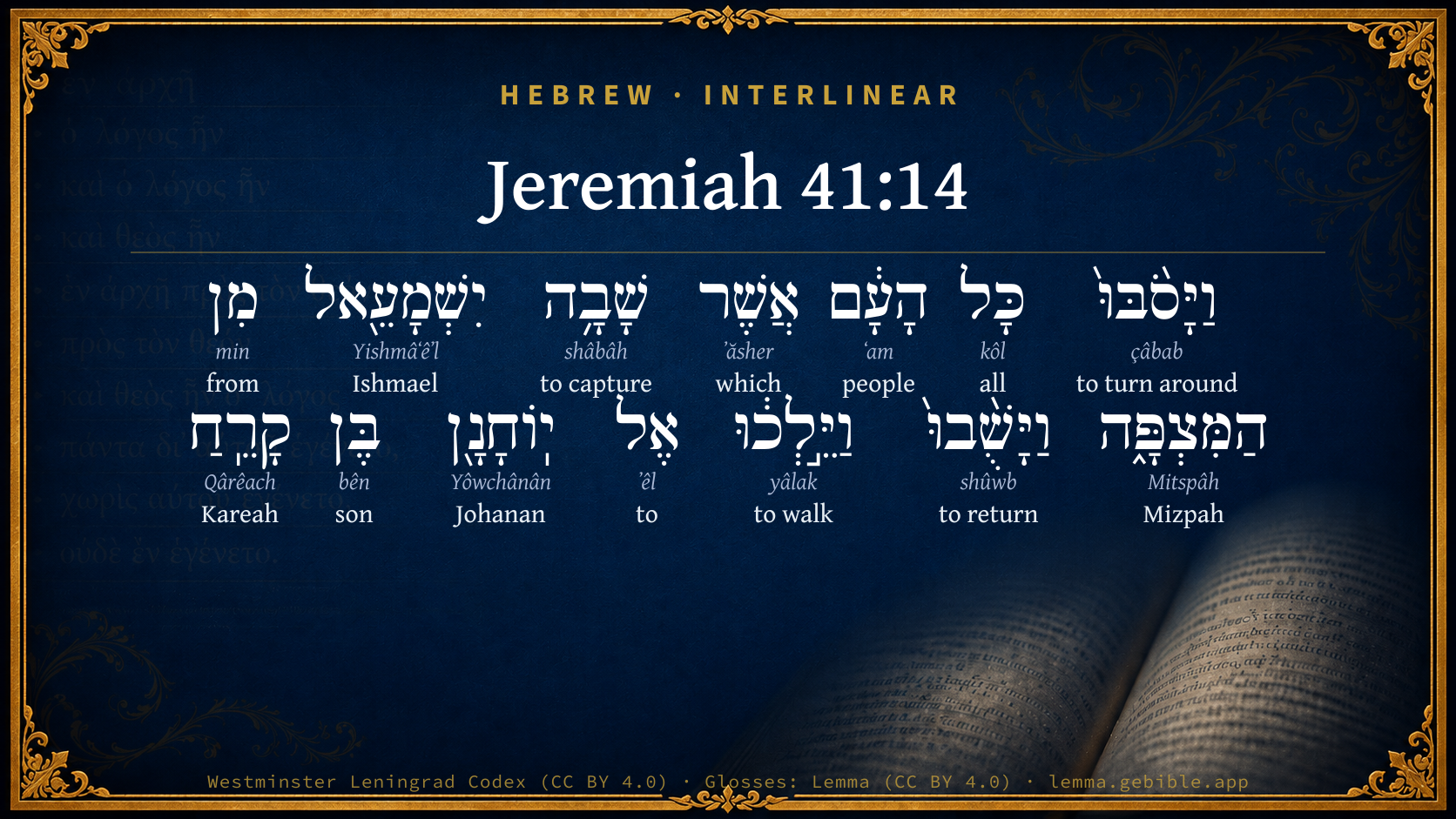
Hebrew (Westminster Leningrad Codex) Jeremiah 41:14 appears in the Hebrew Old Testament. The text above is from the Westminster Leningrad Codex. Each word links to its Strong’s number, a concise gloss, and parsing drawn from the Open Scriptures Hebrew Bible morphology. Click any word for its full Brown-Driver-Briggs (BDB) entry.
Download image
Cite this verse

Jeremiah 41:14 (World English Bible). Public Domain. Lemma interlinear Bible study tool, https://lemma.gebible.app/v/jeremiah/41/14.

Show BibTeX & RIS
BibTeX
RIS
English Translation
So all the people who Ishmael had carried away captive from Mizpah turned about and came back, and went to Johanan the son of Kareah.
World English Bible · Public Domain
Download a study sheet

One document with this verse’s original text, its word-by-word gloss line, the meaning frame, cross-references with their text, attributed commentary, and full source and license credits — printable, and it pastes into notes with its structure intact.

This verse Autodidact and up

Study sheet (.html) Plain text (.txt)

A passage Seminary Student

Up to 50 verses in one chapter. A passage sheet keeps up to 6 commentary sources and 12 cross-references per verse, in the order this page ranks them, and says so on the sheet whenever that leaves anything out. Ask for a single verse and you get the Autodidact verse sheet above.

Everything on this page stays free to read, with no account — the sheet is a download of what is already on screen, not access to it.

Want to remove ads? Support Godless Engineer
Compare translations 3

The same verse in 3 English versions, stacked beneath the original-language interlinear above. Click any original word for its lexicon entry.

Each is an independent rendering of the whole verse — the interlinear is not word-aligned to these translations.

Highlighted words mark where these versions differ — a whole-verse word diff, not a word-by-word alignment.

  • World English Bible Public Domain
    So all the people who Ishmael had carried away captive from Mizpah turned about and came back, and went to Johanan the son of Kareah.
  • King James Version Public Domain
    So all the people that Ishmael had carried away captive from Mizpah cast about and returned, and went unto Johanan the son of Kareah.
  • unfoldingWord Literal Text CC BY-SA 4.0
    So all the people whom Ishmael had captured at Mizpah turned around and went to Johanan son of Kareah.

unfoldingWord Literal Text — © unfoldingWord, licensed CC BY-SA 4.0. Word-aligned USFM3 via Door43 (git.door43.org/unfoldingWord/en_ult).

Versions to compare (up to 4)

3 of 4 selected

Show all 18 translations

Every available English version of this verse, each an independent rendering of the whole verse.

  • World English Bible Public Domain
    So all the people who Ishmael had carried away captive from Mizpah turned about and came back, and went to Johanan the son of Kareah.
  • Berean Standard Bible Public Domain
    and all the people whom Ishmael had taken captive at Mizpah turned and went over to Johanan son of Kareah.
  • Majority Standard Bible Public Domain
    and all the people whom Ishmael had taken captive at Mizpah turned and went over to Johanan son of Kareah.
  • King James Version Public Domain
    So all the people that Ishmael had carried away captive from Mizpah cast about and returned, and went unto Johanan the son of Kareah.
  • American Standard Version (1901) Public Domain
    So all the people that Ishmael had carried away captive from Mizpah turned about and came back, and went unto Johanan the son of Kareah.
  • Revised Version (1885) Public Domain
    So all the people that Ishmael had carried away captive from Mizpah cast about and returned, and went unto Johanan the son of Kareah.
  • Geneva Bible (1599) Public Domain
    So all the people, that Ishmael had caryed away captiue from Mizpah, returned and came againe, and went vnto Iohanan the sonne of Kareah.
  • Douay-Rheims (1899) Public Domain
    And all the people whom Ismahel had taken, went back to Masphath: and they returned and went to Johanan the son of Caree.
  • Young's Literal Translation Public Domain
    And all the people whom Ishmael hath taken captive from Mizpah turn round, yea, they turn back, and go unto Johanan son of Kareah.
  • Literal Standard Version CC BY-SA 4.0
    And all the people whom Ishmael has taken captive from Mizpah turn around, indeed, they turn back, and go to Johanan son of Kareah.
  • Unlocked Literal Bible CC BY-SA 4.0
    So all the people whom Ishmael had captured at Mizpah turned around and went to Johanan son of Kareah.
  • unfoldingWord Literal Text CC BY-SA 4.0
    So all the people whom Ishmael had captured at Mizpah turned around and went to Johanan son of Kareah.
  • Darby Bible Public Domain
    And all the people that Ishmael had carried away captive from Mizpah turned about and came back, and went to Johanan the son of Kareah.
  • World Messianic Bible Public Domain
    So all the people who Ishmael had carried away captive from Mizpah turned about and came back, and went to Yochanan the son of Kareah.
  • Webster's Bible Public Domain
    So all the people that Ishmael had carried away captive from Mizpah cast about and returned, and went to Johanan the son of Kareah.
  • Free Bible Version CC BY-SA 4.0
    All those that Ishmael had taken prisoner at Mizpah turned around and ran back to Johanan.
  • Bible in Basic English Public Domain
    And all the people whom Ishmael had taken away prisoners from Mizpah, turning round, came back and went to Johanan, the son of Kareah.
  • JPS Tanakh (1917) Public Domain
    So all the people that Ishmael had carried away captive from Mizpah cast about and returned, and went unto Johanan the son of Kareah.

Literal Standard Version (2020), Covenant Press — licensed CC BY-SA 4.0. Text via the HelloAO Bible API (eBible.org). Unlocked Literal Bible (unfoldingWord) — licensed CC BY-SA 4.0. Text via the HelloAO Bible API (eBible.org). unfoldingWord Literal Text — © unfoldingWord, licensed CC BY-SA 4.0. Word-aligned USFM3 via Door43 (git.door43.org/unfoldingWord/en_ult). Free Bible Version, Dr. Jonathan Gallagher — licensed CC BY-SA 4.0. Text via the HelloAO Bible API (eBible.org).

Word by word

More ways to search: Search by grammar → Find every occurrence → Compare this word →

Practice this passage: Drill this verse → Learn its vocabulary →

קָרֵֽחַ
Qârêach
H7143
“Kareah”
Noun, Proper
Part of Speech
Noun
Type
Proper
Full BDB Definition

Origin: from H7139

TWOT: None

Kareah = "bald" - father of Johanan and Jonathan who supported Gedaliah's authority and avenged his murder
  1. וַיָּסֹ֨בּוּ֙ çâbab H5437 “and · to turn around” Conjunction + Verb, Qal, Sequential Imperfect, 3rd Person, Masculine, Plural
  2. כָּל kôl H3605 “all of” Noun, Common, Masculine, Singular, Construct
  3. הָעָ֔ם ʻam H5971 “the · people” Particle, Definite Article + Noun, Common, Masculine, Singular, Absolute
  4. אֲשֶׁר ʼăsher H834 “which” Particle, Relative
  5. שָׁבָ֥ה shâbâh H7617 “to capture” Verb, Qal, Perfect, 3rd Person, Masculine, Singular
  6. יִשְׁמָעֵ֖אל Yishmâʻêʼl H3458 “Ishmael” Noun, Proper
  7. מִן min H4480 “from” Preposition
  8. הַמִּצְפָּ֑ה Mitspâh H4709 “the · Mizpah” Particle, Definite Article + Noun, Proper
  9. וַיָּשֻׁ֨בוּ֙ shûwb H7725 “and · to return” Conjunction + Verb, Qal, Sequential Imperfect, 3rd Person, Masculine, Plural
  10. וַיֵּ֣לְכ֔וּ yâlak H3212 “and · to walk” Conjunction + Verb, Qal, Sequential Imperfect, 3rd Person, Masculine, Plural
  11. אֶל ʼêl H413 “to” Preposition
  12. יֽוֹחָנָ֖ן Yôwchânân H3110 “Johanan” Noun, Proper
  13. בֶּן bên H1121 “son of” Noun, Common, Masculine, Singular, Construct

About this verse

These counts appear in no published source. They are computed here, from the morphology-tagged text and Lemma’s own curated glosses. What Lemma adds →

14
words
14
distinct lemmas
Prophets
section

Notable vocabulary

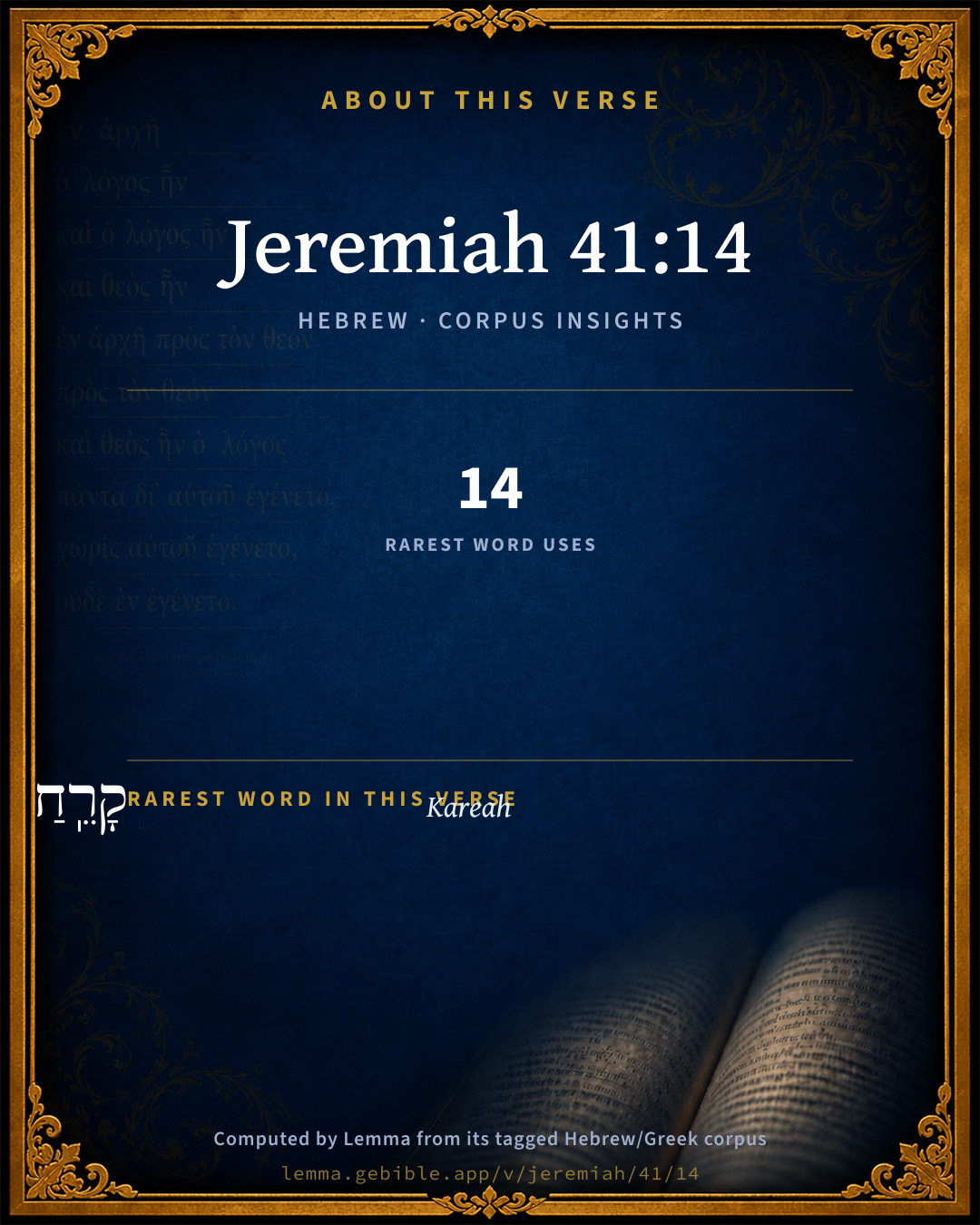
The rarest word here is קָרֵֽחַ Kareah H7143 — appearing just 14 times in the whole Hebrew Bible.

Shared distinctive vocabulary

קָרֵֽחַ Kareah H7143 occurs in 14 verses of the Hebrew Bible. Also found in:

Grammatical profile

  • 4 verbs
  • 7 nouns
  • 2 prepositions
  • 1 particle

Verb forms

  • וַיָּסֹ֨בּוּ֙ Qal · Sequential Imperfect
  • שָׁבָ֥ה Qal · Perfect
  • וַיָּשֻׁ֨בוּ֙ Qal · Sequential Imperfect
  • וַיֵּ֣לְכ֔וּ Qal · Sequential Imperfect
Hebrew and Greek witnesses Masoretic Hebrew ↔ Greek Septuagint

The same verse in the two great witnesses to the Old Testament, shown verse-for-verse.

These are two independent witnesses, not word-aligned to each other, and the Septuagint is shown in lemma (dictionary) form.

Hebrew Jeremiah 41:14 Masoretic · Westminster Leningrad Codex

וַיָּסֹ֨בּוּ֙ כָּל הָעָ֔ם אֲשֶׁר שָׁבָ֥ה יִשְׁמָעֵ֖אל מִן הַמִּצְפָּ֑ה וַיָּשֻׁ֨בוּ֙ וַיֵּ֣לְכ֔וּ אֶל יֽוֹחָנָ֖ן בֶּן קָרֵֽחַ

So all the people who Ishmael had carried away captive from Mizpah turned about and came back, and went to Johanan the son of Kareah.

World English Bible · Public Domain

Greek LXX Structure differs

In the Septuagint, Jeremiah is about an eighth shorter than the Hebrew and arranges its material differently — the Oracles Against the Nations (Hebrew chapters 46–51) appear in the middle of the Greek book, after 25:13. Because the chapter and verse boundaries do not line up, a verse-for-verse comparison with the Hebrew is not shown.

A verse-for-verse comparison isn’t shown here because the chapters and verses don’t line up. Switch to the LXX edition with the MT / LXX toggle above to read the Greek directly.

Hebrew: Westminster Leningrad Codex (CC BY 4.0). Greek: Septuagint (public domain); English from a public-domain English Septuagint. How the Septuagint differs from the Hebrew →

Targum (Aramaic paraphrase)

1

The Targum is the ancient Jewish Aramaic paraphrase of the Hebrew Scriptures — an interpretive translation, not the Hebrew text itself. Onkelos (literal) and Pseudo-Jonathan (expansive) render the Torah, and Jonathan the Prophets. Coverage is partial: where no permissively-licensed English translation exists for a verse, only the Aramaic is shown. This is verse-level text, not a word-by-word alignment to the Hebrew.

  1. Targum Jonathan Prophets (Joshua–Malachi)
    וְאִסְתְּחַרוּ כָּל עַמָא דִשְׁבָא יִשְׁמָעֵאל מִן מִצְפַּיָא וְתָבוּ וַאֲזַלוּ לְוַת יוֹחָנָן בַּר קָרֵחַ:

    (no public-domain English translation for this verse)

    Targum Jonathan — Aramaic: “Mikraot Gedolot” (public domain). English: “Sefaria Community Translation” (CC0 1.0 (public-domain dedication)); “London "Chaldee Paraphrase," 1871” (public domain). Text via Sefaria.

Commentary

Notes on Jeremiah 41:14 from classic Christian and Jewish commentators (each source and its license shown beneath its notes). The classic Christian expositions comment on the surrounding passage and are grouped to its opening verse, so a note may address several verses; the Jewish commentaries on the Tanakh (Rashi and others) are per-verse, so they appear only where the commentator wrote on this verse.

Lemma curates 59 commentaries, every one of them public domain or Creative Commons licensed, each selected and text-cleaned for this edition rather than reprinted as found. About our sources →

Trapp's Complete Commentary

John Trapp

Jer 41:14 So all the people that Ishmael had carried away captive from Mizpah cast about and returned, and went unto Johanan the son of Kareah.

Ver. 14. So all the people cast about and returned.] Their hearts were with Johanan before the battle, as the Athenians’ were with Flaminius the Roman general, who came to rescue them, though their bodies were detained by the tyrants within the walls of their city.

John Trapp, A Commentary or Exposition upon All the Books of the Old and New Testament (1647–1656) — public domain. Text from a community e-Sword module.

Jamieson, Fausset & Brown

Robert Jamieson, A. R. Fausset & David Brown

cast about--came round.

Jamieson, Fausset & Brown — Commentary Critical and Explanatory on the Whole Bible (1871) — public domain (CC PDM 1.0). Text via the HelloAO Bible API.

Adam Clarke's Commentary

Verse 14. Went unto Johanan] They were weary of the tyranny of Ishmael, and were glad of an opportunity to abandon him.

Adam Clarke's Commentary on the Bible (1810–1826) — public domain. Text from a community e-Sword/MySword module.

John Calvin's Commentaries

The people readily passed over to John and his army, because John, and other leaders of the forces, came to them sufficiently armed, and they were, as we have before seen, men trained up for war. And Ishmael could not have been equal to them, when the people went over to John and his associates. Thus we see that the impious man failed in his base purpose, for he thought to render himself very acceptable to the king of Ammon by bringing so many captives to dwell in his land, that he might take possession of Judea. He had then formed many plans for himself, but God frustrated them. But it was God’s will that he should remain alive; for he fled, as it appears from what follows, —

John Calvin's Commentaries (1540-1563) — public domain. Text from the Calvin Translation Society English edition (1840s-50s) via the Christian Classics Ethereal Library (ccel.org). Calvin's coverage is partial (roughly two-thirds of the Bible); uncommented books and verses are honest gaps, never fabricated. The 19th-century editor's footnotes and remarks are omitted so the notes are faithfully Calvin's own voice.

The Cambridge Bible for Schools and Colleges

gen. ed. J. J. S. Perowne

14. cast about] an archaism, meaning turned round. Cp. John Gower (c. 1325–1408), “Then cast I all the world about,” Confessio Amantis; and Sir Philip Sidney (1554–1586), “Musidorus could doe no more but perswade the mariners to cast about againe,” Arcadia.

The Cambridge Bible for Schools and Colleges (gen. ed. J. J. S. Perowne; Cambridge University Press, 1878–1918) — public domain. Text from a community e-Sword module.

John Gill's Exposition

So all the people that Ishmael had carried away captive from Mizpah cast about,.... Or turned about, and wheeled off from Ishmael, and deserted him at once; not at all regarding his authority, nor fearing his menaces or his power; being in sight of the captains and their forces, they were determined to join, and put themselves under their protection, knowing them to be their friends, and that they, came to deliver them:

and returned, and went unto Johanan the son of Kareah; turned their backs on Ishmael, and marched directly to Johanan, and the captains of the forces under them.

John Gill's Exposition of the Whole Bible (1746–1763) — public domain (CC PDM 1.0). Text via the HelloAO Bible API.

Whedon's Commentary on the Bible

Daniel D. Whedon

14. Cast about — Turned around.

Daniel D. Whedon (gen. ed.), Commentary on the Old and New Testaments (1874–1909) — public domain. Text from a community e-Sword module.

The Pulpit Commentary

Cast about; i.e. turned about (an archaism).

The Pulpit Commentary (1880–1919), ed. H.D.M. Spence-Jones & Joseph S. Exell — public domain. Text from a community e-Sword module.

Lesson kit

Teaching starters — assembled from the data on this page, not authored interpretation. Every prompt links to the verse data it draws on. Edit before teaching.

Jeremiah, in the Prophets, opens this verse with 14 words (14 distinct Hebrew lemmas). Its most distinctive word is Qârêach (“Kareah”). A historical commentator’s framing appears above. Read the whole chapter for the surrounding context.

Discussion questions

  1. What does “Kareah” (Qârêach) contribute to the verse as a whole?
  2. How does 2 Kings 25:23, which shares the word «Kareah», read alongside this verse?
  3. The translations on this page render this verse differently — a whole-verse word diff, not a word-by-word alignment. What might account for the different wordings?
  4. «וַיָּסֹ֨בּוּ֙» is a Qal Sequential Imperfect verb. How does that grammatical form shape the action described?
  5. Compare how Trapp's Complete Commentary and Jamieson, Fausset & Brown read this verse. Where do they agree or differ?

Things to notice

Reading settings

Reading text

Shown beneath each verse's original-language words.

Old Testament
Old Testament edition

Read the OT as the Masoretic Hebrew (MT) or the Greek Septuagint (LXX).

English shown for the Greek Septuagint (in the Hebrew ↔ Greek comparison).

Comparing translations? Open the Compare panel on any verse page to stack up to four side by side.