
2 Chronicles 35:22

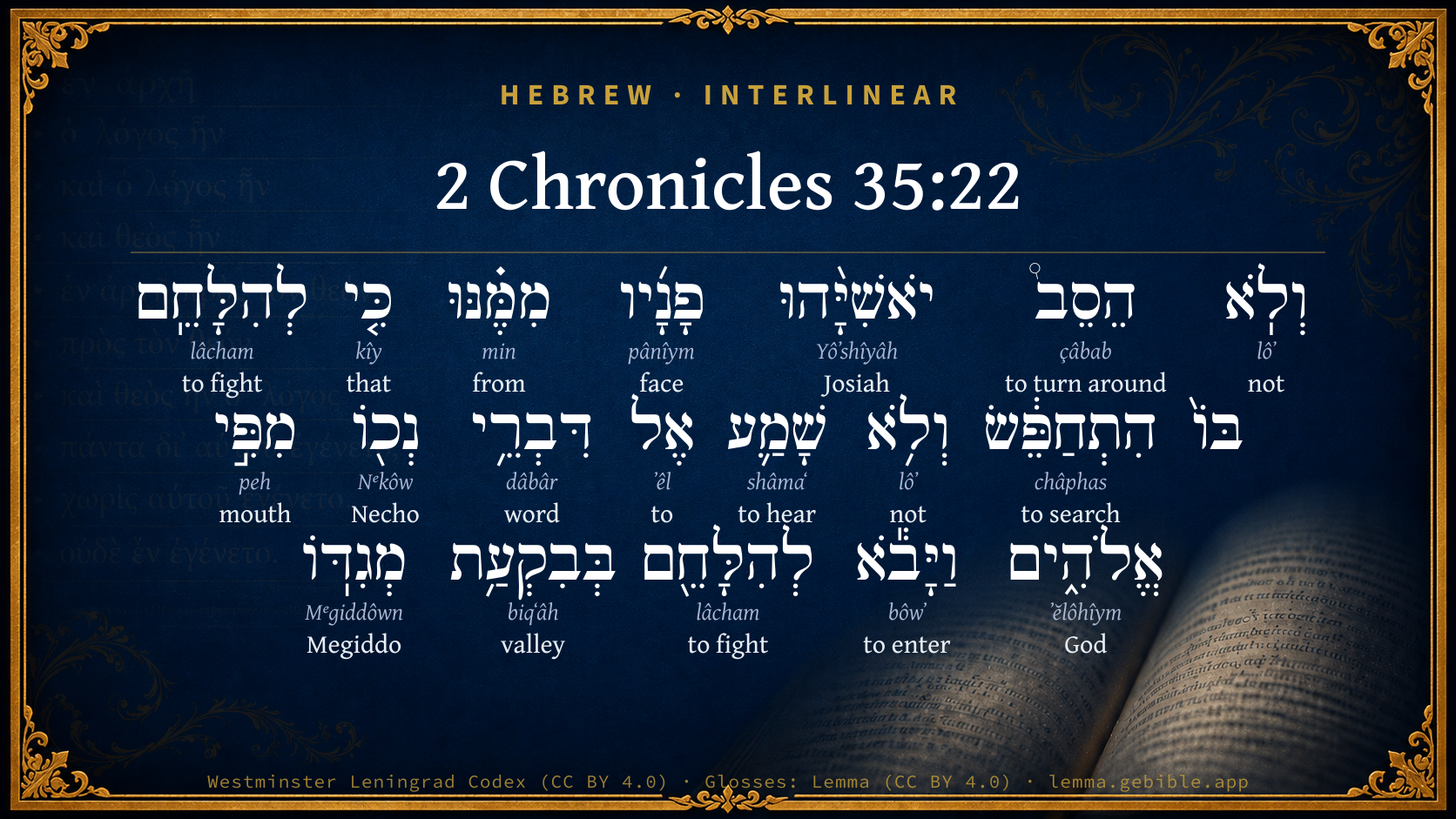
Hebrew (Westminster Leningrad Codex) 2 Chronicles 35:22 appears in the Hebrew Old Testament. The text above is from the Westminster Leningrad Codex. Each word links to its Strong’s number, a concise gloss, and parsing drawn from the Open Scriptures Hebrew Bible morphology. Click any word for its full Brown-Driver-Briggs (BDB) entry.
Download image
Cite this verse

2 Chronicles 35:22 (World English Bible). Public Domain. Lemma interlinear Bible study tool, https://lemma.gebible.app/v/2-chronicles/35/22.

Show BibTeX & RIS
BibTeX
RIS
English Translation
Nevertheless Josiah would not turn his face from him, but disguised himself, that he might fight with him, and didn't listen to the words of Neco from the mouth of God, and came to fight in the valley of Megiddo.
World English Bible · Public Domain
Download a study sheet

One document with this verse’s original text, its word-by-word gloss line, the meaning frame, cross-references with their text, attributed commentary, and full source and license credits — printable, and it pastes into notes with its structure intact.

This verse Autodidact and up

Study sheet (.html) Plain text (.txt)

A passage Seminary Student

Up to 50 verses in one chapter. A passage sheet keeps up to 6 commentary sources and 12 cross-references per verse, in the order this page ranks them, and says so on the sheet whenever that leaves anything out. Ask for a single verse and you get the Autodidact verse sheet above.

Everything on this page stays free to read, with no account — the sheet is a download of what is already on screen, not access to it.

Want to remove ads? Support Godless Engineer
Compare translations 3

The same verse in 3 English versions, stacked beneath the original-language interlinear above. Click any original word for its lexicon entry.

Each is an independent rendering of the whole verse — the interlinear is not word-aligned to these translations.

Highlighted words mark where these versions differ — a whole-verse word diff, not a word-by-word alignment.

  • World English Bible Public Domain
    Nevertheless Josiah would not turn his face from him, but disguised himself, that he might fight with him, and didn't listen to the words of Neco from the mouth of God, and came to fight in the valley of Megiddo.
  • King James Version Public Domain
    Nevertheless Josiah would not turn his face from him, but disguised himself, that he might fight with him, and hearkened not unto the words of Necho from the mouth of God, and came to fight in the valley of Megiddo.
  • unfoldingWord Literal Text CC BY-SA 4.0
    But Josiah did not turn his face from him, but, in order to fight with him, he disguised himself. And he did not listen to the words of Necho, the mouth of God. And he came to fight on the plain of Megiddo.

unfoldingWord Literal Text — © unfoldingWord, licensed CC BY-SA 4.0. Word-aligned USFM3 via Door43 (git.door43.org/unfoldingWord/en_ult).

Versions to compare (up to 4)

3 of 4 selected

Show all 18 translations

Every available English version of this verse, each an independent rendering of the whole verse.

  • World English Bible Public Domain
    Nevertheless Josiah would not turn his face from him, but disguised himself, that he might fight with him, and didn't listen to the words of Neco from the mouth of God, and came to fight in the valley of Megiddo.
  • Berean Standard Bible Public Domain
    Josiah, however, did not turn away from him; instead, in order to engage him in battle, he disguised himself. He did not listen to Neco’s words from the mouth of God, but went to fight him on the Plain of Megiddo.
  • Majority Standard Bible Public Domain
    Josiah, however, did not turn away from him; instead, in order to engage him in battle, he disguised himself. He did not listen to Neco’s words from the mouth of God, but went to fight him on the Plain of Megiddo.
  • King James Version Public Domain
    Nevertheless Josiah would not turn his face from him, but disguised himself, that he might fight with him, and hearkened not unto the words of Necho from the mouth of God, and came to fight in the valley of Megiddo.
  • American Standard Version (1901) Public Domain
    Nevertheless Josiah would not turn his face from him, but disguised himself, that he might fight with him, and hearkened not unto the words of Neco from the mouth of God, and came to fight in the valley of Megiddo.
  • Revised Version (1885) Public Domain
    Nevertheless Josiah would not turn his face from him, but disguised himself, that he might fight with him, and hearkened not unto the words of Neco, from the month of God, and came to fight in the valley of Megiddo.
  • Geneva Bible (1599) Public Domain
    But Iosiah would not turne his face from him, but changed his apparel to fight with him, and hearkened not vnto the wordes of Necho, which were of the mouth of God, but came to fight in the valley of Megiddo.
  • Douay-Rheims (1899) Public Domain
    Josias would not return, but prepared to fight against him, and hearkened not to the words of Nechao from the mouth of God, I but went to fight in the field of Mageddo.
  • Young's Literal Translation Public Domain
    And Josiah hath not turned round his face from him, but to fight against him hath disguised himself, and hath not hearkened unto the words of Necho, from the mouth of God, and cometh in to fight in the valley of Megiddo;
  • Literal Standard Version CC BY-SA 4.0
    And Josiah has not turned around his face from him, but has disguised himself to fight against him, and has not listened to the words of Necho, from the mouth of God, and comes to fight in the Valley of Megiddo;
  • Unlocked Literal Bible CC BY-SA 4.0
    However, Josiah refused to turn away from him. He disguised himself in order to fight with him. He did not listen to the words of Necho that had come from the mouth of God; so he went to fight in the Valley of Megiddo.
  • unfoldingWord Literal Text CC BY-SA 4.0
    But Josiah did not turn his face from him, but, in order to fight with him, he disguised himself. And he did not listen to the words of Necho, the mouth of God. And he came to fight on the plain of Megiddo.
  • Darby Bible Public Domain
    But Josiah would not turn his face from him, but disguised himself, that he might fight against him; and he hearkened not to the words of Necho from the mouth of God; and he came to fight in the valley of Megiddo.
  • World Messianic Bible Public Domain
    Nevertheless Josiah would not turn his face from him, but disguised himself, that he might fight with him, and didn’t listen to the words of Neco from the mouth of God, and came to fight in the valley of Megiddo.
  • Webster's Bible Public Domain
    Nevertheless Josiah would not turn his face from him, but disguised himself that he might fight with him, and hearkened not to the words of Necho from the mouth of God, and came to fight in the valley of Megiddo.
  • Free Bible Version CC BY-SA 4.0
    But Josiah did not turn away and leave. Instead, he disguised himself so he could fight Neco in battle. He ignored Neco's message that came from God, and went to fight him on the Plain of Megiddo.
  • Bible in Basic English Public Domain
    However, Josiah would not go back; but keeping to his purpose of fighting against him, and giving no attention to the words of Neco, which came from God, he went forward to the fight in the valley of Megiddo.
  • JPS Tanakh (1917) Public Domain
    Nevertheless Josiah would not turn his face from him, but disguised himself, that he might fight with him, and hearkened not unto the words of Neco, from the mouth of God, and came to fight in the valley of Megiddo.

Literal Standard Version (2020), Covenant Press — licensed CC BY-SA 4.0. Text via the HelloAO Bible API (eBible.org). Unlocked Literal Bible (unfoldingWord) — licensed CC BY-SA 4.0. Text via the HelloAO Bible API (eBible.org). unfoldingWord Literal Text — © unfoldingWord, licensed CC BY-SA 4.0. Word-aligned USFM3 via Door43 (git.door43.org/unfoldingWord/en_ult). Free Bible Version, Dr. Jonathan Gallagher — licensed CC BY-SA 4.0. Text via the HelloAO Bible API (eBible.org).

Word by word

More ways to search: Search by grammar → Find every occurrence → Compare this word →

Practice this passage: Drill this verse → Learn its vocabulary →

נְכ֖וֹ
Nᵉkôw
H5224
“Necho”
Noun, Proper
Part of Speech
Noun
Type
Proper
Full BDB Definition

Origin: probably of Egyptian origin

TWOT: None

Necho = "lame" - the Pharaoh of Egypt in the time of king Josiah of Judah
  1. וְלֹֽא lôʼ H3808 “and · not” Conjunction + Particle, Negative
  2. הֵסֵב֩ çâbab H5437 “to turn around” Verb, Hiphil, Perfect, 3rd Person, Masculine, Singular
  3. יֹאשִׁיָּ֨הוּ Yôʼshîyâh H2977 “Josiah” Noun, Proper
  4. פָנָ֜יו pânîym H6440 “face(s) · his” Noun, Common, Both, Plural, Construct + Suffix, Personal, 3rd Person, Masculine, Singular
  5. מִמֶּ֗נּוּ min H4480 “from · us” Preposition + Suffix, Personal, 1st Person, Common, Plural
  6. כִּ֤י kîy H3588 “that” Conjunction
  7. לְהִלָּחֵֽם lâcham H3898 “to fight” Preposition + Verb, Niphal, Infinitive Construct
  8. הִתְחַפֵּ֔שׂ châphas H2664 “to search” Verb, Hithpael, Perfect, 3rd Person, Masculine, Singular
  9. וְלֹ֥א lôʼ H3808 “and · not” Conjunction + Particle, Negative
  10. שָׁמַ֛ע shâmaʻ H8085 “to hear” Verb, Qal, Perfect, 3rd Person, Masculine, Singular
  11. אֶל ʼêl H413 “to” Preposition
  12. דִּבְרֵ֥י dâbâr H1697 “words of” Noun, Common, Masculine, Plural, Construct
  13. מִפִּ֣י peh H6310 “from · mouth of” Preposition + Noun, Common, Masculine, Singular, Construct
  14. אֱלֹהִ֑ים ʼĕlôhîym H430 “God(s)” Noun, Common, Masculine, Plural, Absolute
  15. וַיָּבֹ֕א bôwʼ H935 “and · to enter” Conjunction + Verb, Qal, Sequential Imperfect, 3rd Person, Masculine, Singular
  16. לְהִלָּחֵ֖ם lâcham H3898 “to fight” Preposition + Verb, Niphal, Infinitive Construct
  17. בְּבִקְעַ֥ת biqʻâh H1237 “in/at · valley of” Preposition + Noun, Common, Feminine, Singular, Construct
  18. מְגִדּֽוֹ Mᵉgiddôwn H4023 “Megiddo” Noun, Proper

About this verse

These counts appear in no published source. They are computed here, from the morphology-tagged text and Lemma’s own curated glosses. What Lemma adds →

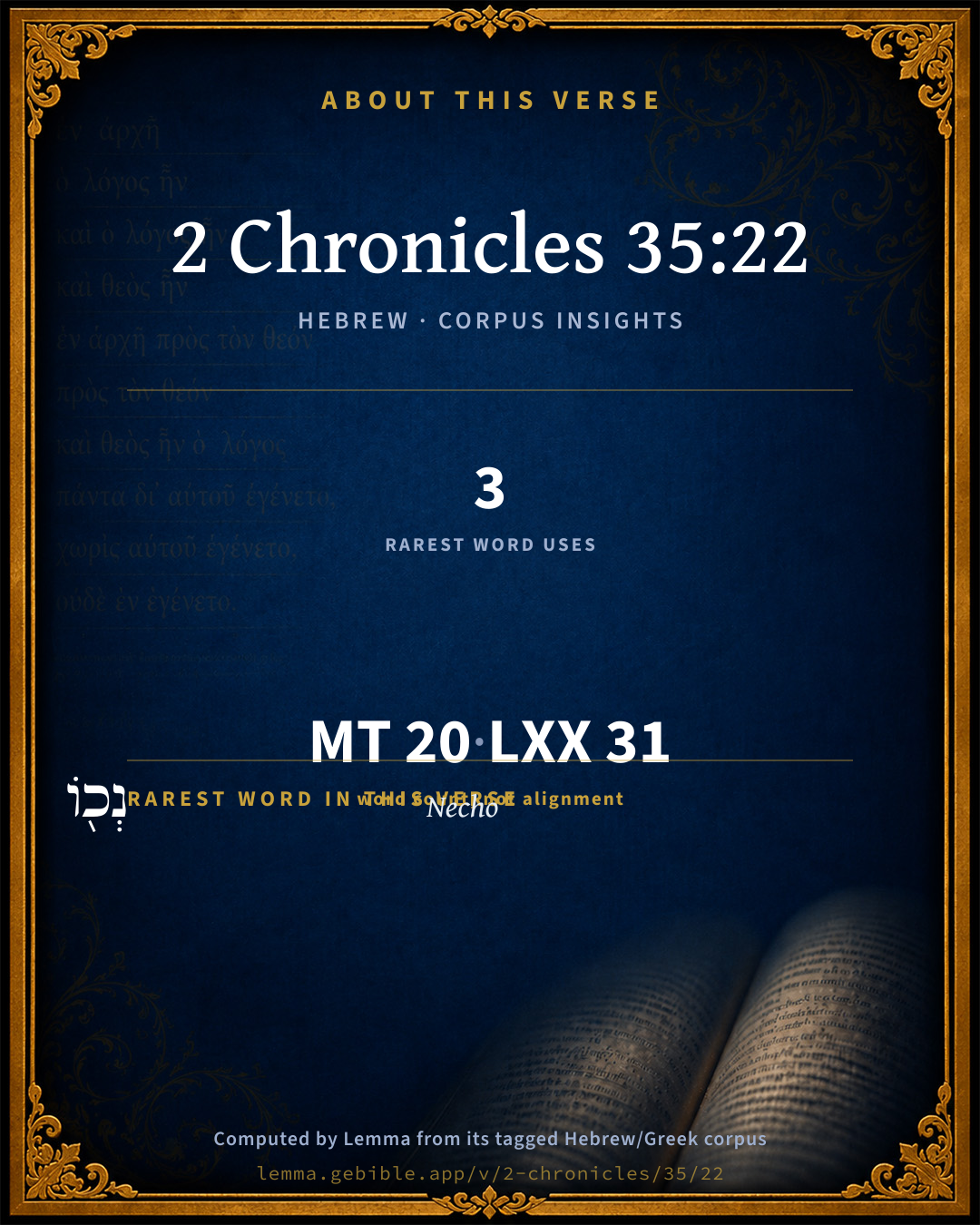
20
words
17
distinct lemmas
Historical
section

Notable vocabulary

The rarest word here is נְכ֖וֹ Necho H5224 — appearing just 3 times in the whole Hebrew Bible.

Shared distinctive vocabulary

נְכ֖וֹ Necho H5224 occurs in 3 verses of the Hebrew Bible. Also found in:

Grammatical profile

  • 6 verbs
  • 8 nouns
  • 3 prepositions
  • 1 conjunction
  • 2 particles

Verb forms

  • הֵסֵב֩ Hiphil · Perfect
  • לְהִלָּחֵֽם Niphal · Infinitive Construct
  • הִתְחַפֵּ֔שׂ Hithpael · Perfect
  • שָׁמַ֛ע Qal · Perfect
  • וַיָּבֹ֕א Qal · Sequential Imperfect
  • לְהִלָּחֵ֖ם Niphal · Infinitive Construct

Repetition

Words recur within this verse — often emphatic in Hebrew:

  • לְהִלָּחֵֽם to fight H3898 ×2
  • וְלֹֽא not H3808 ×2

Hebrew & Septuagint length

In English translation the verse runs 40 words from the Hebrew and 38 from the Septuagint (LXX English) — closely comparable.

A rough comparison of the two English renderings, which tokenize alike — not a word-level alignment.

Word counts can differ between the Hebrew and the Greek without any difference in meaning — e.g. the Hebrew direct-object marker אֵת has no separate Greek word, and Greek often adds the article ὁ.

In the original languages it is 20 Hebrew tokens and 31 Greek tokens — but the two are counted differently (Hebrew bundles its prefixes and suffixes into one token; the Greek is in lemma form), so that isn’t a like-for-like length.

Cross-references

12

Topical passages linked to 2 Chronicles 35:22 in the Treasury of Scripture Knowledge — connected by theme and wording, ordered by reader-vote popularity; previews shown in the World English Bible.

  • Judges 5:19 The kings came and fought; Then fought the kings of Canaan. In Taanach by the waters of Megiddo: They took no gain of money.
  • 2 Chronicles 18:29 The king of Israel said to Jehoshaphat, I will disguise myself, and go into the battle; but put you on your robes. So the king of Israel disguised himself; and they went into the battle.
  • 1 Kings 22:30 The king of Israel said to Jehoshaphat, I will disguise myself, and go into the battle; but put you on your robes. The king of Israel disguised himself, and went into the battle.
  • 2 Chronicles 35:21 But he sent ambassadors to him, saying, What have I to do with you, you king of Judah? [I come] not against you this day, but against the house with which I have war; and God has commanded me to make haste: forbear you from [meddling with] God, who is with me, that he not destroy you.
  • Joshua 9:14 The men took of their provision, and didn't ask counsel at the mouth of Yahweh.
  • 1 Kings 14:2 Jeroboam said to his wife, Please get up and disguise yourself, that you not be known to be the wife of Jeroboam; and get you to Shiloh: behold, there is Ahijah the prophet, who spoke concerning me that I should be king over this people.
  • 1 Kings 22:34 A certain man drew his bow at a venture, and struck the king of Israel between the joints of the armor: therefore he said to the driver of his chariot, Turn your hand, and carry me out of the host; for I am severely wounded.
  • 2 Kings 9:27 But when Ahaziah the king of Judah saw this, he fled by the way of the garden-house. Jehu followed after him, and said, Smite him also in the chariot: [and they struck him] at the ascent of Gur, which is by Ibleam. He fled to Megiddo, and died there.
  • 2 Kings 23:30 His servants carried him in a chariot dead from Megiddo, and brought him to Jerusalem, and buried him in his own tomb. The people of the land took Jehoahaz the son of Josiah, and anointed him, and made him king in his father's place.
  • 2 Chronicles 18:4–6 Jehoshaphat said to the king of Israel, Please inquire first for the word of Yahweh.
  • Zechariah 12:11 In that day there will be a great mourning in Jerusalem, like the mourning of Hadadrimmon in the valley of Megiddon.
  • Revelation 16:16 He gathered them together into the place which is called in Hebrew, Megiddo.

Cross-references courtesy of OpenBible.info (CC BY 4.0).

Hebrew and Greek witnesses Masoretic Hebrew ↔ Greek Septuagint

The same verse in the two great witnesses to the Old Testament, shown verse-for-verse.

These are two independent witnesses, not word-aligned to each other, and the Septuagint is shown in lemma (dictionary) form.

Hebrew 2 Chronicles 35:22 Masoretic · Westminster Leningrad Codex

וְלֹֽא הֵסֵב֩ יֹאשִׁיָּ֨הוּ פָנָ֜יו מִמֶּ֗נּוּ כִּ֤י לְהִלָּחֵֽם בּוֹ֙ הִתְחַפֵּ֔שׂ וְלֹ֥א שָׁמַ֛ע אֶל דִּבְרֵ֥י נְכ֖וֹ מִפִּ֣י אֱלֹהִ֑ים וַיָּבֹ֕א לְהִלָּחֵ֖ם בְּבִקְעַ֥ת מְגִדּֽוֹ

Nevertheless Josiah would not turn his face from him, but disguised himself, that he might fight with him, and didn't listen to the words of Neco from the mouth of God, and came to fight in the valley of Megiddo.

World English Bible · Public Domain

Greek LXX 2 Chronicles 35:22 Septuagint · lemma form

καί οὐ ἀποστρέφω ιωσίας ὁ πρόσωπον αὐτός ἀπό αὐτός ἀλλά ἤ πολεμέω αὐτός κραταιόω καί οὐ ἀκούω ὁ λόγος νεχαω διά στόμα θεός καί ἔρχομαι ὁ πολεμέω ἐν ὁ πεδίον μαγεδων

However, Josias turned not his face from him, but strengthened himself to fight against him, and listened not to the words of Nechao by the mouth of God, and he came to fight in the plain of Mageddo.

LXX2012 (modern English Septuagint) · Public Domain

On this verse, Ellicott's Commentary for English Readers discusses the Septuagint’s reading. Read the note in Commentary ↓

Hebrew: Westminster Leningrad Codex (CC BY 4.0). Greek: Septuagint (public domain); English from LXX2012 (modern English Septuagint) (Public Domain). How the Septuagint differs from the Hebrew →

Commentary

Notes on 2 Chronicles 35:22 from classic Christian and Jewish commentators (each source and its license shown beneath its notes). The classic Christian expositions comment on the surrounding passage and are grouped to its opening verse, so a note may address several verses; the Jewish commentaries on the Tanakh (Rashi and others) are per-verse, so they appear only where the commentator wrote on this verse.

Lemma curates 59 commentaries, every one of them public domain or Creative Commons licensed, each selected and text-cleaned for this edition rather than reprinted as found. About our sources →

Trapp's Complete Commentary

John Trapp

2Ch 35:22 Nevertheless Josiah would not turn his face from him, but disguised himself, that he might fight with him, and hearkened not unto the words of Necho from the mouth of God, and came to fight in the valley of Megiddo.

Ver. 22. Nevertheless Josiah, &c.] See 2Ki 23:29. He should have considered that the chance of war is uncertain, and oft mischievous to both sides, &c.

And hearkened not unto the words of Necho.] Woe then to such as hearken not to the undoubted words of God, in the mouths of his faithful ministers.

In the valley of Megiddo.] Forty-four miles from Jerusalem.

John Trapp, A Commentary or Exposition upon All the Books of the Old and New Testament (1647–1656) — public domain. Text from a community e-Sword module.

Joseph Benson's Commentary

2Ch 35:22. Josiah would not turn his face from him — Being, peradventure, encouraged to go out against him by a misinterpretation of that promise made to him, chap. 2Ch 34:28, Thou shalt be gathered to thy grave in peace. Thus God overrules the errors and miscarriages of men to the accomplishment of his own counsels. But disguised himself — Changed his habit, that he might not give his enemies the advantage of aiming at his person, which he wisely thought they would do, that being a likely course to end their trouble, as indeed it proved. And hearkened not unto the words of Necho from the mouth of God — Either, 1st, which Pharaoh sent to him in the name of God; or rather, 2d, which Pharaoh received from the mouth of God; who was pleased, some way or other, to impart his mind to him, and which Pharaoh acquainted him with by the command of God. And therefore Josiah is here blamed for not hearkening to this message: although, if he sinned herein, it was only a sin of ignorance, for he did not know that God had spoken this to Pharaoh, and was not bound to believe his testimony, which he had good reason to suspect in this matter. Yet, it seems, he ought so far to have regarded it, as to have inquired into the mind of God about it, which he neglected to do, and therefore cannot be wholly excused. How can we think to prosper in our ways, if we do not acknowledge God in them?

Joseph Benson's Commentary on the Old and New Testaments (1811–1818) — public domain. Text from a community e-Sword module.

Geneva Bible (1599)

Geneva Bible translators

That is, armed himself, or disguised himself, because he might not be known.

Geneva Bible (1599) marginal notes — public domain. Text via Bolls.life.

Ellicott's Commentary for English Readers

(22) But disguised himself.—Like Ahab (2Ch_18:29). The LXX. reads, “he strengthened himself,” or “persisted” (ἐκραταιώθη). (Comp. 3 Esdr. 1:28.) This implies the reading hithchazzaq instead of hithchappêsh. It is wholly unlikely that “disguised himself” is used in the figurative sense of “departed from his true cha racter,” as Keil and Zöckler think.

The words of Necho from the mouth of God.—The warning of Necho was really divine, as the event proved. For “words of Necho,” 3 Esdr. 1:26 has, “words of the prophet Jeremiah;” but there is no trace of such a warning in the extant prophecies bearing his name.

In the valley of Megiddo.—The valley of the Kishon, where Deborah and Barak had fought in the olden time against Jabin and Sisera. Herodotus (ii. 159) calls the place Magdolus. (See on 2Ki_23:29.)

A Bible Commentary for English Readers, edited by Charles John Ellicott (1878–1897) — public domain. Text from a community e-Sword module.

The Cambridge Bible for Schools and Colleges

gen. ed. J. J. S. Perowne

22. disguised himself] Josiah, like Ahab (2Ch_18:29), took the warning so far seriously as to think that his life was in danger and that he would be safer fighting in disguise. The ἐκραταιώθη (“was strengthened”) of the LXX. represents an inferior reading.

the valley of Megiddo] Cp. Jdg_5:19; Zec_12:11. In 1Es_1:29, “the plain of Megiddo.” The whole (or perhaps only the western part) of the plain of Esdrelon is meant; cp. 1Ch_10:7, note.

The Cambridge Bible for Schools and Colleges (gen. ed. J. J. S. Perowne; Cambridge University Press, 1878–1918) — public domain. Text from a community e-Sword module.

John Gill's Exposition

And the archers shot at King Josiah,.... For, though disguised, he appeared to be a general officer, and indeed chief commander, and therefore aimed at him, and pressed him hard:

and the king said to his servants, have me away, for I am wounded; as Ahab said, when in the like case, Kg1 22:34.

John Gill's Exposition of the Whole Bible (1746–1763) — public domain (CC PDM 1.0). Text via the HelloAO Bible API.

Albert Barnes' Notes on the Bible

Disguised himself - Compare the marginal reference. But most modern critics are dissatisfied with this sense in this place, and prefer to render “equipped himself;” or - with the Septuagint - adopt another reading, and render “took courage.”

The words of Necho from the mouth of God - The author apparently regarded Necho’s words as actually prophetic - a warning to which Josiah ought to have listened - sent him by God to make him pause - though not spoken by divine inspiration, or in consequence of any supernatural revelation of the divine will to the Egyptian king. Compare the “prophecy” of Caiaphas, Joh 11:51.

Albert Barnes' Notes on the Bible (1834–1885) — public domain. Text from a community e-Sword/MySword module.

Haydock's Catholic Bible Commentary

Prepared. Heb. "disguised himself," like Achab; (C.) or set his army in array. Sept. "he was bent on fighting him." H. --- He supposed that Pharao intended to invade his dominions, and God would withdraw him from the world. W.

George Leo Haydock (1774–1849), Haydock's Catholic Family Bible and Commentary, 1859 edition — public domain. Excludes Psalms (Douay-Rheims chapter numbering differs from Protestant) and Deuterocanonical books (Catholic canon only).

Matthew Poole's English Annotations

Josiah would not turn his face from him; being peradventure encouraged to do so by a misinterpretation of that promise made to him, 2Ch 34:28,

Thou shalt be gathered to thy grave in peace: thus God overrules the errors and miscarriages of men to the accomplishment of his own counsels.

Disguised himself; changed his habit, that he might not give his enemies the advantage of aiming at his person, which he wisely thought they would do, that being a likely course to end their trouble, as indeed it proved.

Unto the words of Necho from the mouth of God; either,

1. Which Pharaoh sent to him in the name of God, or as coming from God’s month. Or rather,

2. Which Pharaoh received from the month of God, who was pleased some way or other to impart his mind to him; and which Pharaoh acquainted him with by the command of God. And therefore Josiah is here blamed for not hearkening to this message. Although, if he sinned herein, it was only a sin of ignorance, for he did not know that God had spoken this to Pharaoh, and was not bound to believe his testimony, which he had good reason to suspect in this matter. Yet, methinks, he ought so far to have regarded it, as to have inquired the mind of God about it; which he neglected to do, and therefore he cannot be wholly excused, and is here taxed for it.

Matthew Poole's English Annotations on the Holy Bible (1683–1685) — public domain. Text from a community e-Sword/MySword module.

The Pulpit Commentary

Would not turn his face. (so 2Ch_25:17 and its parallel, 2Ki_14:8) Disguised himself. This is, possibly enough, the intention of the word, but it is more probable that the simple meaning is fully armed himself. The Septuagint has strengthened himself. Hearkened not unto the words of Necho from the mouth of God. Unless these words are intended to convey really their patent and most natural import, it is tenfold strange that they should find a place in the compilation of the Chronicles. It is indeed possible that they might purport, from the pen of the writer of Chronicles, that in point of fact the words of Necho had been the permitted warning, though not the actually dictated language of God. The genius of the whole passage strongly reminds us of 2Ch_25:17, 2Ch_25:19-21; and its parallel in 2Ki

14. In the valley of Megiddo; i.e. among those hills which separate the country of the coast from Esdraelon a valley as that "of Kishon" (see Stanley"s "Sinai and Palestine," pp. 356, 339, 347; but see also Conder"s "Handbook," p. 287, where a different view is taken).

The Pulpit Commentary (1880–1919), ed. H.D.M. Spence-Jones & Joseph S. Exell — public domain. Text from a community e-Sword module.

John Wesley's Explanatory Notes

Hearkened not - How can we think to prosper in our ways, if we do not acknowledge God in them!

John Wesley, Explanatory Notes Upon the Whole Bible (1754–1765) — public domain. Text via the GEBible commentary corpus.

unfoldingWord translationNotes

Door43 World Missions Community

He disguised himself

Josiah disguised himself so that the other armies would not recognize him.

fight with him

The word "him" refers to Necho who represents himself accompanied by his army. AT: "fight with the army of Egypt" (See: Synecdoche)

that had come from the mouth of God

Here God is represented by his "mouth" to emphasize his speech. AT: "that had come from God" or "that God had said to him" (See: Synecdoche)

so he went

The word "he" refers to Josiah who represents himself accompanied by his army. AT: "so he and his army went" (See: Synecdoche)

the Valley of Megiddo

This is the name of a place. (See: How to Translate Names)

translationWords

turn

word

unfoldingWord translationNotes — © Distant Shores Media and the Door43 World Missions Community, licensed CC BY-SA 4.0. Source: git.door43.org/Door43/en_tn.

Rashi

Rabbi Shlomo Yitzchaki (Rashi)

and he did not hearken to the words of Neco from the mouth of God who said to him from the mouth of God, for so said Isaiah, (19:2): “And I will stir up Egyptians against Egyptians.” This is what the Kallir composed: “He withheld his troops from marching to Aram Naharaim, in order that no single sword should pass through Ephraim; and he did not hearken to the prophet to turn back, for it was decreed that Egyptian be set against Egyptian.”

Rashi on the Tanakh — English translations: “The Judaica Press complete Tanach with Rashi, translated by A. J. Rosenberg” (CC BY 4.0); “Pentateuch with Rashi's commentary by M. Rosenbaum and A.M. Silbermann, 1929-1934” (public domain); “The Metsudah Tanach series, Lakewood, N.J” (CC BY 4.0); and “The Book of Joshua, Metsudah Publications, 1997” (CC BY 4.0). Text via Sefaria.

Lesson kit

Teaching starters — assembled from the data on this page, not authored interpretation. Every prompt links to the verse data it draws on. Edit before teaching.

2 Chronicles, in the Historical, opens this verse with 20 words (17 distinct Hebrew lemmas). Its most distinctive word is Nᵉkôw (“Necho”). A historical commentator’s framing appears above. Read the whole chapter for the surrounding context.

Discussion questions

  1. The word Nᵉkôw carries the sense “Necho.” How does it shape the verse?
  2. 2 Chronicles 35:20 shares the word «Necho» with this verse. How do the two illuminate each other?
  3. “to fight” occurs 2× in this one verse. What is the effect of the repetition?
  4. These translations render this verse differently. What is at stake in choosing one wording over another?
  5. The verb «הֵסֵב֩» is Hiphil Perfect. How does its form color the action?
  6. Reading how Trapp's Complete Commentary and Joseph Benson's Commentary read this verse, where do the two commentators agree and where do they part?

Things to notice

Reading settings

Reading text

Shown beneath each verse's original-language words.

Old Testament
Old Testament edition

Read the OT as the Masoretic Hebrew (MT) or the Greek Septuagint (LXX).

English shown for the Greek Septuagint (in the Hebrew ↔ Greek comparison).

Comparing translations? Open the Compare panel on any verse page to stack up to four side by side.