Ecclesiastes 2:20

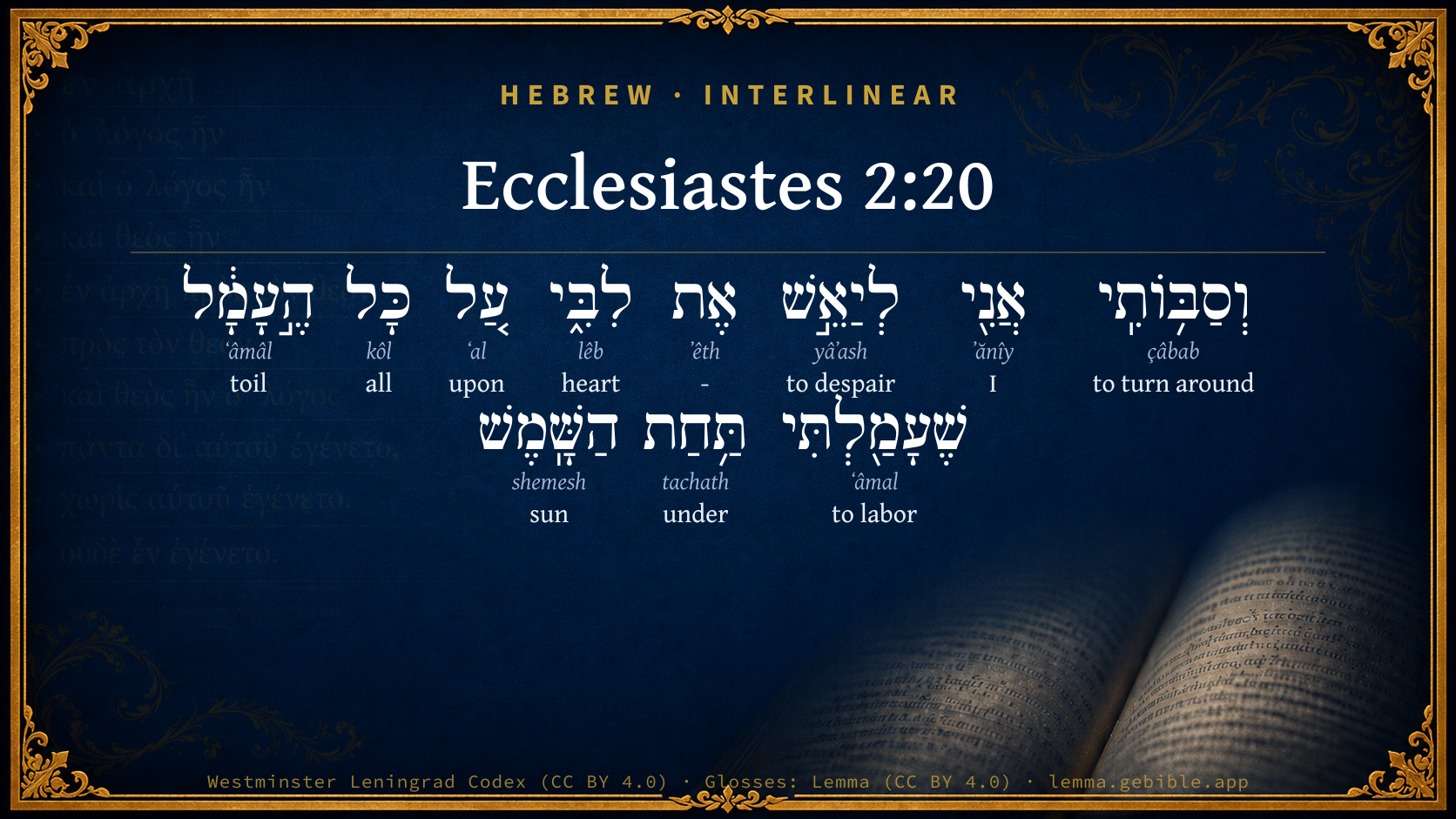
Hebrew (Westminster Leningrad Codex) Ecclesiastes 2:20 appears in the Hebrew Old Testament. The text above is from the Westminster Leningrad Codex. Each word links to its Strong’s number, a concise gloss, and parsing drawn from the Open Scriptures Hebrew Bible morphology. Click any word for its full Brown-Driver-Briggs (BDB) entry.
Download image
Cite this verse

Ecclesiastes 2:20 (World English Bible). Public Domain. Lemma interlinear Bible study tool, https://lemma.gebible.app/v/ecclesiastes/2/20.

Show BibTeX & RIS
BibTeX
RIS
English Translation
Therefore I began to cause my heart to despair concerning all the labor in which I had labored under the sun.
World English Bible · Public Domain
Download a study sheet

One document with this verse’s original text, its word-by-word gloss line, the meaning frame, cross-references with their text, attributed commentary, and full source and license credits — printable, and it pastes into notes with its structure intact.

This verse Autodidact and up

Study sheet (.html) Plain text (.txt)

A passage Seminary Student

Up to 50 verses in one chapter. A passage sheet keeps up to 6 commentary sources and 12 cross-references per verse, in the order this page ranks them, and says so on the sheet whenever that leaves anything out. Ask for a single verse and you get the Autodidact verse sheet above.

Everything on this page stays free to read, with no account — the sheet is a download of what is already on screen, not access to it.

Want to remove ads? Support Godless Engineer
Compare translations 3

The same verse in 3 English versions, stacked beneath the original-language interlinear above. Click any original word for its lexicon entry.

Each is an independent rendering of the whole verse — the interlinear is not word-aligned to these translations.

Highlighted words mark where these versions differ — a whole-verse word diff, not a word-by-word alignment.

  • World English Bible Public Domain
    Therefore I began to cause my heart to despair concerning all the labor in which I had labored under the sun.
  • King James Version Public Domain
    Therefore I went about to cause my heart to despair of all the labour which I took under the sun.
  • unfoldingWord Literal Text CC BY-SA 4.0
    Then I turned, I, to cause my heart to despair concerning all the toil which I toiled under the sun.

unfoldingWord Literal Text — © unfoldingWord, licensed CC BY-SA 4.0. Word-aligned USFM3 via Door43 (git.door43.org/unfoldingWord/en_ult).

Versions to compare (up to 4)

3 of 4 selected

Show all 18 translations

Every available English version of this verse, each an independent rendering of the whole verse.

  • World English Bible Public Domain
    Therefore I began to cause my heart to despair concerning all the labor in which I had labored under the sun.
  • Berean Standard Bible Public Domain
    So my heart began to despair over all the labor that I had done under the sun.
  • Majority Standard Bible Public Domain
    So my heart began to despair over all the labor that I had done under the sun.
  • King James Version Public Domain
    Therefore I went about to cause my heart to despair of all the labour which I took under the sun.
  • American Standard Version (1901) Public Domain
    Therefore I turned about to cause my heart to despair concerning all the labor wherein I had labored under the sun.
  • Revised Version (1885) Public Domain
    Therefore I turned about to cause my heart to despair concerning all the labour wherein I had laboured under the sun.
  • Geneva Bible (1599) Public Domain
    Therefore I went about to make mine heart abhorre all the labour, wherein I had trauailed vnder the sunne.
  • Douay-Rheims (1899) Public Domain
    Wherefore I left off and my heart renounced labouring any more under the sun.
  • Young's Literal Translation Public Domain
    And I turned round to cause my heart to despair concerning all the labour that I laboured at under the sun.
  • Literal Standard Version CC BY-SA 4.0
    And I turned around to cause my heart to despair concerning all the labor that I labored at under the sun.
  • Unlocked Literal Bible CC BY-SA 4.0
    Therefore my heart began to despair over all the work under the sun that I did.
  • unfoldingWord Literal Text CC BY-SA 4.0
    Then I turned, I, to cause my heart to despair concerning all the toil which I toiled under the sun.
  • Darby Bible Public Domain
    Then I went about to cause my heart to despair of all the labour wherewith I had laboured under the sun.
  • World Messianic Bible Public Domain
    Therefore I began to cause my heart to despair concerning all the labor in which I had labored under the sun.
  • Webster's Bible Public Domain
    Therefore I went about to cause my heart to despair of all the labor which I took under the sun.
  • Free Bible Version CC BY-SA 4.0
    I decided to give up, my mind in despair over the significance of all my life's achievements.
  • Bible in Basic English Public Domain
    So my mind was turned to grief for all the trouble I had taken and all my wisdom under the sun.
  • JPS Tanakh (1917) Public Domain
    Therefore I turned about to cause my heart to despair concerning all the labour wherein I had laboured under the sun.

Literal Standard Version (2020), Covenant Press — licensed CC BY-SA 4.0. Text via the HelloAO Bible API (eBible.org). Unlocked Literal Bible (unfoldingWord) — licensed CC BY-SA 4.0. Text via the HelloAO Bible API (eBible.org). unfoldingWord Literal Text — © unfoldingWord, licensed CC BY-SA 4.0. Word-aligned USFM3 via Door43 (git.door43.org/unfoldingWord/en_ult). Free Bible Version, Dr. Jonathan Gallagher — licensed CC BY-SA 4.0. Text via the HelloAO Bible API (eBible.org).

Word by word

More ways to search: Search by grammar → Find every occurrence → Compare this word →

Practice this passage: Drill this verse → Learn its vocabulary →

לְיַאֵ֣שׁ
yâʼash
H2976
“to despair”
Preposition + Verb, Piel, Infinitive Construct
Part of Speech
Preposition + Verb
Stem
Piel
Form
Infinitive Construct
Full BDB Definition

Origin: a primitive root

TWOT: 833

to despair - (Niphal) to be despaired, be desperate - (Piel) to cause to despair - it is hopeless!
  1. וְסַבּ֥וֹתִֽי çâbab H5437 “and · to turn around” Conjunction + Verb, Qal, Perfect, 1st Person, Common, Singular
  2. אֲנִ֖י ʼănîy H589 “I” Pronoun, Personal, 1st Person, Common, Singular
  3. אֶת ʼêth H853 “-” Particle, Direct Object
  4. לִבִּ֑י lêb H3820 “heart · my” Noun, Common, Masculine, Singular, Construct + Suffix, Personal, 1st Person, Common, Singular
  5. עַ֚ל ʻal H5921 “upon” Preposition
  6. כָּל kôl H3605 “all of” Noun, Common, Masculine, Singular, Construct
  7. הֶ֣עָמָ֔ל ʻâmâl H5999 “the · toil” Particle, Definite Article + Noun, Common, Both, Singular, Absolute
  8. שֶׁעָמַ֖לְתִּי ʻâmal H5998 “who/which · to labor” Particle, Relative + Verb, Qal, Perfect, 1st Person, Common, Singular
  9. תַּ֥חַת tachath H8478 “under” Preposition
  10. הַשָּֽׁמֶשׁ shemesh H8121 “the · sun” Particle, Definite Article + Noun, Common, Both, Singular, Absolute

About this verse

These counts appear in no published source. They are computed here, from the morphology-tagged text and Lemma’s own curated glosses. What Lemma adds →

11
words
11
distinct lemmas
Wisdom
section

Notable vocabulary

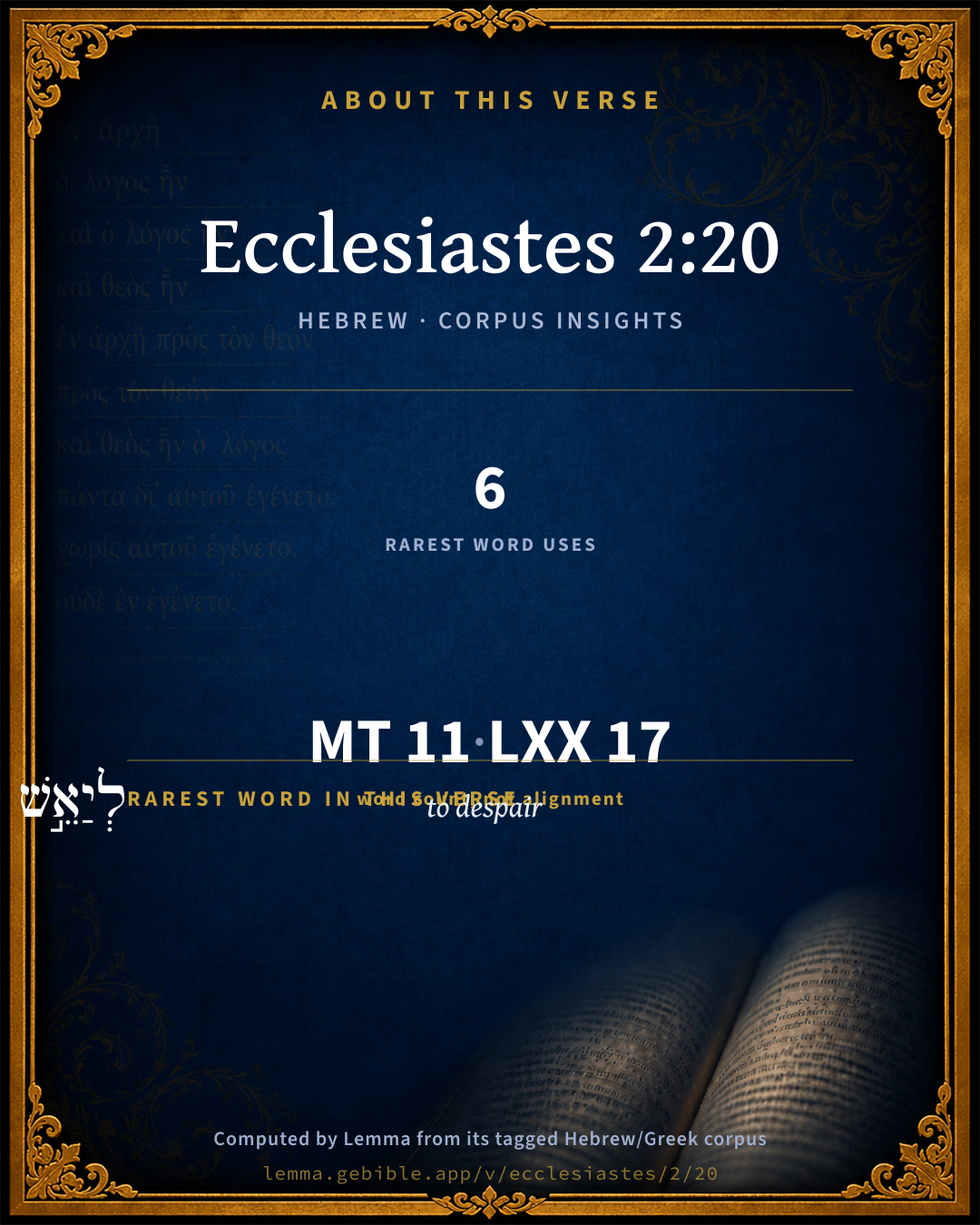
The rarest word here is לְיַאֵ֣שׁ to despair H2976 — appearing just 6 times in the whole Hebrew Bible.

Shared distinctive vocabulary

לְיַאֵ֣שׁ to despair H2976 occurs in 6 verses of the Hebrew Bible. Also found in:

Grammatical profile

  • 3 verbs
  • 4 nouns
  • 1 pronoun
  • 2 prepositions
  • 1 particle

Verb forms

  • וְסַבּ֥וֹתִֽי Qal · Perfect
  • לְיַאֵ֣שׁ Piel · Infinitive Construct
  • שֶׁעָמַ֖לְתִּי Qal · Perfect

Hebrew & Septuagint length

In English translation the verse runs 21 words from the Hebrew and 19 from the Septuagint (LXX English) — closely comparable.

A rough comparison of the two English renderings, which tokenize alike — not a word-level alignment.

Word counts can differ between the Hebrew and the Greek without any difference in meaning — e.g. the Hebrew direct-object marker אֵת has no separate Greek word, and Greek often adds the article ὁ.

In the original languages it is 11 Hebrew tokens and 17 Greek tokens — but the two are counted differently (Hebrew bundles its prefixes and suffixes into one token; the Greek is in lemma form), so that isn’t a like-for-like length.

Cross-references

6

Topical passages linked to Ecclesiastes 2:20 in the Treasury of Scripture Knowledge — connected by theme and wording, ordered by reader-vote popularity; previews shown in the World English Bible.

  • Genesis 43:14 May God Almighty give you mercy before the man, that he may release to you your other brother and Benjamin. If I am bereaved of my children, I am bereaved."
  • Job 17:11–15 My days are past, my plans are broken off, As are the thoughts of my heart.
  • Psalms 39:6–7 "Surely every man walks like a shadow. Surely they busy themselves in vain. He heaps up, and doesn't know who shall gather.
  • 1 Corinthians 15:19 If we have only hoped in Christ in this life, we are of all men most pitiable.
  • 2 Corinthians 1:8–10 For we don't desire to have you uninformed, brothers, concerning our affliction which happened to us in Asia, that we were weighed down exceedingly, beyond our power, so much that we despaired even of life.
  • 1 Thessalonians 3:3–4 that no one be moved by these afflictions. For you know that we are appointed to this task.

Cross-references courtesy of OpenBible.info (CC BY 4.0).

Hebrew and Greek witnesses Masoretic Hebrew ↔ Greek Septuagint

The same verse in the two great witnesses to the Old Testament, shown verse-for-verse.

These are two independent witnesses, not word-aligned to each other, and the Septuagint is shown in lemma (dictionary) form.

Hebrew Ecclesiastes 2:20 Masoretic · Westminster Leningrad Codex

וְסַבּ֥וֹתִֽי אֲנִ֖י לְיַאֵ֣שׁ אֶת לִבִּ֑י עַ֚ל כָּל הֶ֣עָמָ֔ל שֶׁעָמַ֖לְתִּי תַּ֥חַת הַשָּֽׁמֶשׁ

Therefore I began to cause my heart to despair concerning all the labor in which I had labored under the sun.

World English Bible · Public Domain

Greek LXX Ecclesiastes 2:20 Septuagint · lemma form

καί ἐπιστρέφω ἐγώ ὁ ἀποτάσσω ὁ καρδία ἐγώ ἐπί πᾶς ὁ μόχθος ὅς μοχθέω ὑπό ὁ ἥλιος

so I went about to dismiss from my heart all my labor wherein I had laboured under the sun.

LXX2012 (modern English Septuagint) · Public Domain

On this verse, The Pulpit Commentary discusses the Septuagint’s reading. Read the note in Commentary ↓

Hebrew: Westminster Leningrad Codex (CC BY 4.0). Greek: Septuagint (public domain); English from LXX2012 (modern English Septuagint) (Public Domain). How the Septuagint differs from the Hebrew →

Commentary

Notes on Ecclesiastes 2:20 from classic Christian and Jewish commentators (each source and its license shown beneath its notes). The classic Christian expositions comment on the surrounding passage and are grouped to its opening verse, so a note may address several verses; the Jewish commentaries on the Tanakh (Rashi and others) are per-verse, so they appear only where the commentator wrote on this verse.

Lemma curates 59 commentaries, every one of them public domain or Creative Commons licensed, each selected and text-cleaned for this edition rather than reprinted as found. About our sources →

Trapp's Complete Commentary

John Trapp

Ecc 2:20 Therefore I went about to cause my heart to despair of all the labour which I took under the sun.

Ver. 20. Therefore I went about to cause my heart, &c., ] i.e., I set myself to take off the edge of my affections from these outward comforts that are so uncertain, and so unsatisfactory, and to take another course for the attaining of true happiness. The Hebrew word {a} signifies, I set a compass, I turned round, or I turned short again upon myself, by a reflex action of my mind, as Ephraim did, {Jer 31:19-20} as the prodigal did when he "came to himself," who before had been beside himself in the point of salvation, and as Solomon elsewhere prays, that the captive people may bethink themselves, or, as the Hebrew hath it, "bring back to their heart," {1Ki 8:47} "return and discern between the righteous and the wicked." {Mal 3:18} Thus David examined his ways, and finding all to be naught and stark naught - contrary to that of God, who, reviewing His works, found all good and very good - he bethought himself of a better course, he "turned his feet to God’s testimonies." {Psa 119:59} "Set not thy heart upon the asses," said the prophet to Saul, forasmuch as better things abide thee "the desire of all Israel is to thee."

{a} סבותי, Pεριηχθην. Symmachus. Metaph. ab equis, quos qui agitant circumagunt.

John Trapp, A Commentary or Exposition upon All the Books of the Old and New Testament (1647–1656) — public domain. Text from a community e-Sword module.

Joseph Benson's Commentary

Ecc 2:20-21. I went to cause my heart to despair — I gave myself up to despair of ever reaping that satisfaction which I promised to myself. For there is a man whose labour, &c. — Who uses great industry, and prudence, and justice too, in the management of his affairs; yet to a man that hath not laboured therein — shall he leave it for his portion — A portion which he will probably consume upon his lusts. This also is a great evil — A great disorder in itself, and a great torment to a considering mind.

Joseph Benson's Commentary on the Old and New Testaments (1811–1818) — public domain. Text from a community e-Sword module.

Geneva Bible (1599)

Geneva Bible translators

That I might seek the true felicity which is in God.

Geneva Bible (1599) marginal notes — public domain. Text via Bolls.life.

Jamieson, Fausset & Brown

Robert Jamieson, A. R. Fausset & David Brown

I gave up as desperate all hope of solid fruit from my labor.

Jamieson, Fausset & Brown — Commentary Critical and Explanatory on the Whole Bible (1871) — public domain (CC PDM 1.0). Text via the HelloAO Bible API.

Adam Clarke's Commentary

Verse 20. I went about to cause my heart to despair] What makes all worse, there is no remedy. It is impossible in the present state of things to prevent these evils.

Adam Clarke's Commentary on the Bible (1810–1826) — public domain. Text from a community e-Sword/MySword module.

Ellicott's Commentary for English Readers

(20) Went about.—Ecc_7:25; Ecc_9:14; Ecc_12:5.

A Bible Commentary for English Readers, edited by Charles John Ellicott (1878–1897) — public domain. Text from a community e-Sword module.

The Cambridge Bible for Schools and Colleges

gen. ed. J. J. S. Perowne

20. I went about to cause my heart to despair] The verb for despair is not a common one. Another form of it meets us in the emphatic cry, “There is no hope” of Jer_2:25; Jer_18:12. What he had felt had made the seeker renounce the very impulse that led to labour. In the phrase “I went about,” literally, “I turned,” we have, as it were, the attitude of one who looks behind him on the road on which so far he has travelled. The retrospect was so dreary that it made the prospect drearier still.

The Cambridge Bible for Schools and Colleges (gen. ed. J. J. S. Perowne; Cambridge University Press, 1878–1918) — public domain. Text from a community e-Sword module.

John Gill's Exposition

Therefore I went about to cause my heart to despair,.... Of ever finding happiness in anything here below. He "turned about" (y), as the word signifies dropped his severe studies of wisdom, and his eager pursuits of pleasure; and desisted from those toilsome works, in which he had employed himself; and went from one thing to another, and settled and stuck at nothing, on purpose to relax his mind, as the Syriac version renders it; to divest it of all anxious thought and care, and call it off from its vain and fruitless undertakings; and be no more concerned about or thoughtful

of all the labour which I took under the sun; and what will be the consequence and issue of it; but quietly leave all to an all wise disposing Providence; and not seek for happiness in anything under the sun, but in those things that are above it; not in this world, but in the world to come.

(y) "versus sum", Montanus; "et ego verti me", Vatablus, Mercerus, Gejerus.

John Gill's Exposition of the Whole Bible (1746–1763) — public domain (CC PDM 1.0). Text via the HelloAO Bible API.

Haydock's Catholic Bible Commentary

Off, in a sort of despair; suggested by worldly wisdom. Religion alone can impart steady principles. (Calmet) --- Protestants, "I went about, to cause my heart to despair of all the labour which I took under the sun;" in the transactions of the world. (Haydock)

George Leo Haydock (1774–1849), Haydock's Catholic Family Bible and Commentary, 1859 edition — public domain. Excludes Psalms (Douay-Rheims chapter numbering differs from Protestant) and Deuterocanonical books (Catholic canon only).

Matthew Poole's English Annotations

I gave myself up to despondency, and despair of ever reaping that satisfaction which I promised to myself.

Matthew Poole's English Annotations on the Holy Bible (1683–1685) — public domain. Text from a community e-Sword/MySword module.

Whedon's Commentary on the Bible

Daniel D. Whedon

20. Cause my heart to despair — From anxiety Koheleth turns to “despair.” To feel toward the close of life that one’s enterprises and accumulations have been in vain, is a dark and gloomy feeling. Koheleth repeats the sentiments of the previous verses with a deeper sorrow.

Daniel D. Whedon (gen. ed.), Commentary on the Old and New Testaments (1874–1909) — public domain. Text from a community e-Sword module.

The Pulpit Commentary

Therefore I went about to cause my heart to despair; jEpestreya ejgw (Septuagint). "I turned" in order to examine more closely. So in ver. 12 we had, "I turned myself," though the verbs are not the same in the two passages, and in the former the LXX has ejpebleya. I turned from my late course of action to give myself up to despair. I lost all hope in labor; it had no longer any charm or future for me. Septuagint, Tou ajpotaxasqai than mou ejn panticqw mou k.t.l.

The Pulpit Commentary (1880–1919), ed. H.D.M. Spence-Jones & Joseph S. Exell — public domain. Text from a community e-Sword module.

John Wesley's Explanatory Notes

Despair - I gave myself up to despair of ever reaping that satisfaction which I promised to myself.

John Wesley, Explanatory Notes Upon the Whole Bible (1754–1765) — public domain. Text via the GEBible commentary corpus.

Keil & Delitzsch

C. F. Keil & F. Delitzsch

"Then I turned to give up my heart on account of = to despair of all the labour with which I wearied myself under the sun." As at Sa1 22:17., Sol 2:17; Jer 41:14, סבב has here the intrans. meaning, to turn about (lxx ἐπέστρεψα = ἐπεστρεψάμην). Hitzig remarks that פנה and שוב signify, "to turn round in order to see," and סבב, on the contrary, "to turn round in order to do." But פנה can also mean, "to turn round in order to do," e.g., Lev 26:9; and סבב, "to turn in order to examine more narrowly," Ecc 7:25. The distinction lies in this, that פנה signifies a clear turning round; סבב, a turning away from one thing to another, a turning in the direction of something new that presents itself (Ecc 4:1, Ecc 4:7; Ecc 9:11). The phrase, יאשׁ את־בלבּו,

(Note: With Pathach under the yod in the text in Biblia Rabb. and the note ל Thus also in the ms. Parva Masora, and e.g., Cod. P.)

closely corresponds to the Lat. despondet animum, he gives up his spirits, lets them sink, i.e., he despairs. The old language knows only נואשׁ, to give oneself up, i.e., to give up hope in regard to anything; and נואשׁ, given up, having no prospect, in despair. The Talm., however, uses along with nithyāēsh (vid., p. 638) not only noǎsh, but also יאשׁ, in the sense of despair, or the giving up of all hope (subst. יאוּשׁ), Meza 21b, from which it is at once evident that יאשׁ, is not to be thought of as causative (like the Arab. ajjasa and aiasa), but as simply transitive, with which, after the passage before us, לבו is to be thought of as connected. He turned round to give up all heart. He had no more any heart to labour.

Keil & Delitzsch — Biblical Commentary on the Old Testament (1861–1891) — public domain (CC PDM 1.0). Text via the HelloAO Bible API. (Old Testament only.)

Kretzmann's Popular Commentary

Paul E. Kretzmann

The Vanity of Labor in Itself

v. 20. Therefore I went about to cause my heart to despair of all the labor which I took under the sun, he was inclined to regard his life as a failure, if viewed from this standpoint alone.

v. 21. For there is a man whose labor is in wisdom, and in knowledge, and in equity, who possesses wisdom, applies it to the circumstances of every-day life, and uses the proper ability in so doing; yet to a man that hath not labored therein shall he leave it for his portion, another will reap what he sowed. This also is vanity and a great evil, for it seems to place wisdom and its proper application at a disadvantage.

v. 22. For what hath man of all his labor, and of the vexation of his heart, the hard work with which he applies wisdom and knowledge in all his transactions, wherein he hath labored under the sun?

v. 23. For all his days are sorrows, and his travail grief, that seems to be the only result and reward of all his labor; yea, his heart taketh not rest in the night, since he is troubled with anxiety and kept awake by worry. This is also vanity. Solomon therefore states his conclusion, so far as this life in itself is concerned.

v. 24. There is nothing better for a man than that he should eat and drink and that he should make his soul enjoy good in his labor, cheerfully making use of all the blessings which God bestows on His children and accepting them with a grateful heart. This also I saw, that it was from the hand of God, namely, the feeling of quiet and appreciative contentment in the midst of all the wearing vicissitudes of life.

v. 25. For who can eat, or who else can hasten hereunto, to the enjoyment of God’s gifts, more than I? Christians may profit by the sad experiment which Solomon made without paying the high price which the Jewish king had to pay for the wisdom so gained.

v. 26. For God giveth to a man that is good in His sight, who lives before Him in the fear of God, wisdom, and knowledge, and joy, as a reward dealt out by His mercy; but to the sinner, the godless, the unbeliever, he giveth travail, misery and tribulation, to gather and to heap up, that he may give to him that is good before God, unconsciously, of course, and in spite of himself. Solomon, conducting himself with piety, enjoyed his wealth in agreement with God’s blessing upon him; the same king, forsaking the precepts of the Lord, became unhappy, while the riches which he had heaped up became the prey of the Egyptian king, 2 Chronicles 12. This also is vanity and vexation of spirit, but the lesson which it teaches should be heeded well by all believers.

Paul E. Kretzmann, Popular Commentary of the Bible (1921–1924) — public domain. Text from a community e-Sword module.

Rashi

Rabbi Shlomo Yitzchaki (Rashi)

And I turned about to cause my heart to despair not to toil and labor.

Rashi on the Tanakh — English translations: “The Judaica Press complete Tanach with Rashi, translated by A. J. Rosenberg” (CC BY 4.0); “Pentateuch with Rashi's commentary by M. Rosenbaum and A.M. Silbermann, 1929-1934” (public domain); “The Metsudah Tanach series, Lakewood, N.J” (CC BY 4.0); and “The Book of Joshua, Metsudah Publications, 1997” (CC BY 4.0). Text via Sefaria.

Lesson kit

Teaching starters — assembled from the data on this page, not authored interpretation. Every prompt links to the verse data it draws on. Edit before teaching.

Ecclesiastes, in the Wisdom, opens this verse with 11 words (11 distinct Hebrew lemmas). Its most distinctive word is yâʼash (“to despair”). A historical commentator’s framing appears above. Read the whole chapter for the surrounding context.

Discussion questions

  1. How does “to despair” (yâʼash) shape what this verse is saying?
  2. 1 Samuel 27:1 shares the word «to despair» with this verse. How do the two illuminate each other?
  3. The translations on this page render this verse differently — a whole-verse word diff, not a word-by-word alignment. What might account for the different wordings?
  4. The verb «וְסַבּ֥וֹתִֽי» is Qal Perfect. How does its form color the action?
  5. Reading how Trapp's Complete Commentary and Joseph Benson's Commentary read this verse, where do the two commentators agree and where do they part?

Things to notice

Reading settings

Reading text

Shown beneath each verse's original-language words.

Old Testament
Old Testament edition

Read the OT as the Masoretic Hebrew (MT) or the Greek Septuagint (LXX).

English shown for the Greek Septuagint (in the Hebrew ↔ Greek comparison).

Comparing translations? Open the Compare panel on any verse page to stack up to four side by side.