
2 Kings 8:21

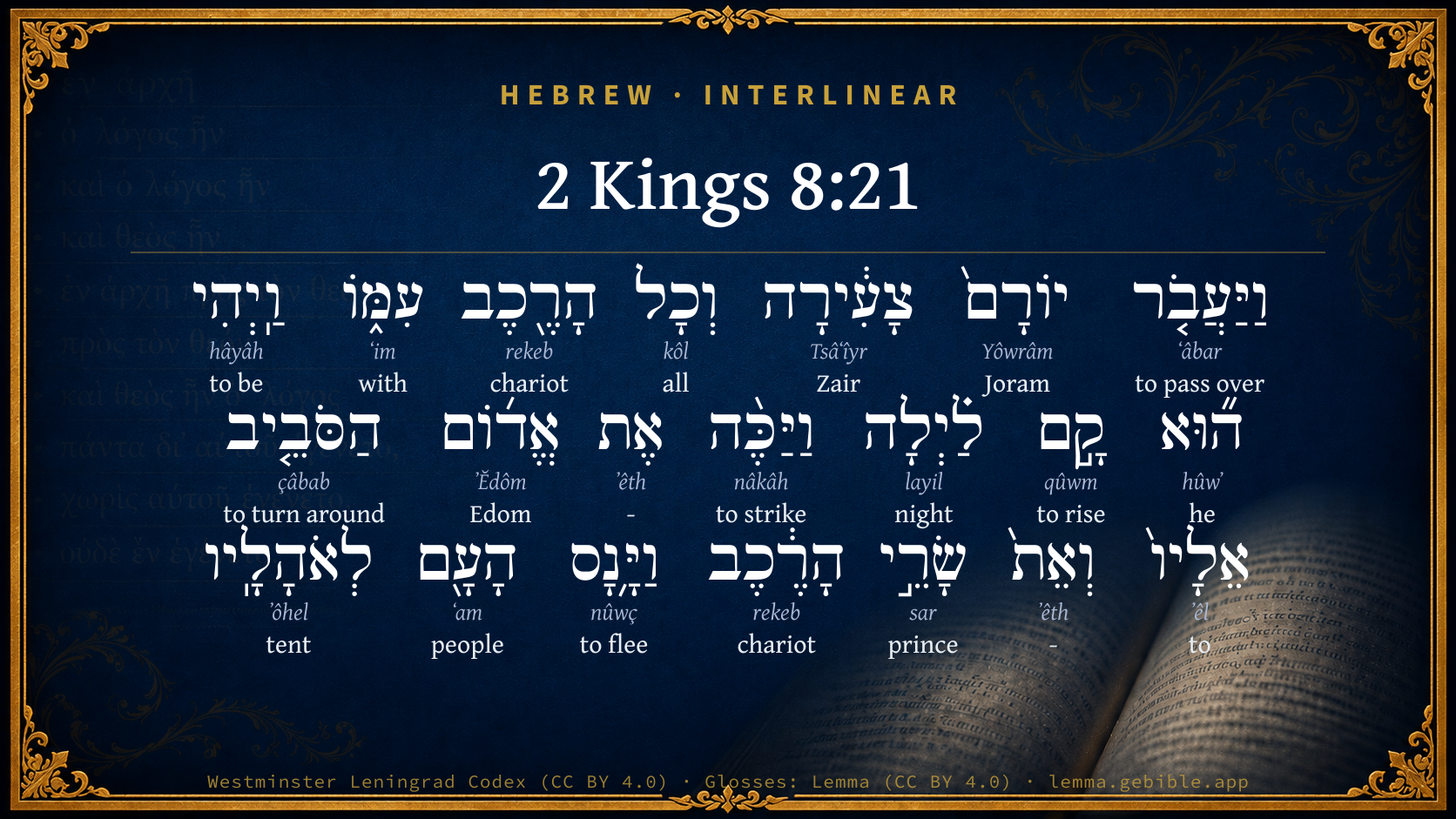
Hebrew (Westminster Leningrad Codex) 2 Kings 8:21 appears in the Hebrew Old Testament. The text above is from the Westminster Leningrad Codex. Each word links to its Strong’s number, a concise gloss, and parsing drawn from the Open Scriptures Hebrew Bible morphology. Click any word for its full Brown-Driver-Briggs (BDB) entry.
Download image
Cite this verse

2 Kings 8:21 (World English Bible). Public Domain. Lemma interlinear Bible study tool, https://lemma.gebible.app/v/2-kings/8/21.

Show BibTeX & RIS
BibTeX
RIS
English Translation
Then Joram passed over to Zair, and all his chariots with him: and he rose up by night, and struck the Edomites who surrounded him, and the captains of the chariots; and the people fled to their tents.
World English Bible · Public Domain
Highlights
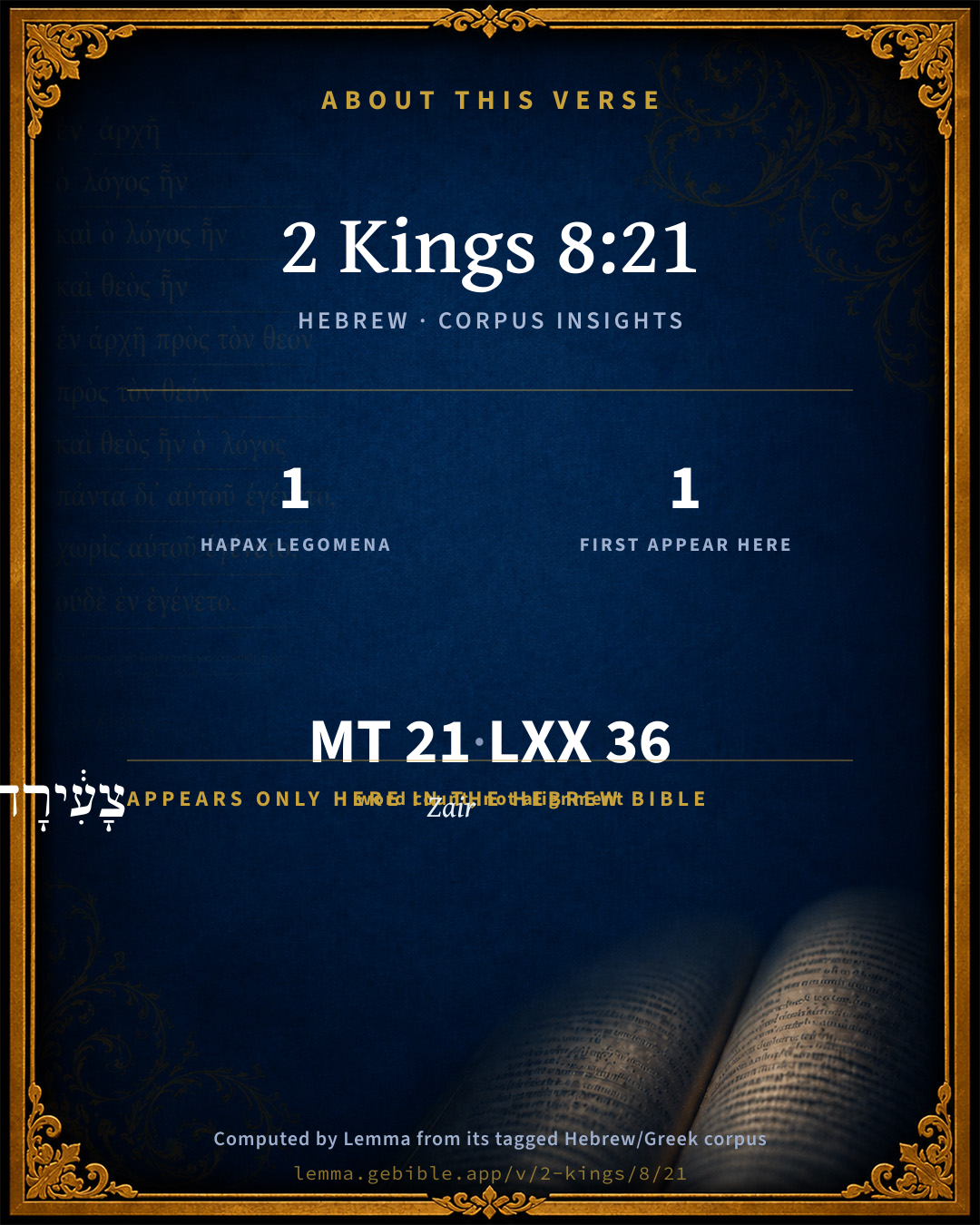
  • 1 hapax legomenon — only here in the Hebrew Bible
  • 1 first appearance in the Hebrew Bible
Full analysis ↓
Download a study sheet

One document with this verse’s original text, its word-by-word gloss line, the meaning frame, cross-references with their text, attributed commentary, and full source and license credits — printable, and it pastes into notes with its structure intact.

This verse Autodidact and up

Study sheet (.html) Plain text (.txt)

A passage Seminary Student

Up to 50 verses in one chapter. A passage sheet keeps up to 6 commentary sources and 12 cross-references per verse, in the order this page ranks them, and says so on the sheet whenever that leaves anything out. Ask for a single verse and you get the Autodidact verse sheet above.

Everything on this page stays free to read, with no account — the sheet is a download of what is already on screen, not access to it.

Want to remove ads? Support Godless Engineer
Compare translations 3

The same verse in 3 English versions, stacked beneath the original-language interlinear above. Click any original word for its lexicon entry.

Each is an independent rendering of the whole verse — the interlinear is not word-aligned to these translations.

Highlighted words mark where these versions differ — a whole-verse word diff, not a word-by-word alignment.

  • World English Bible Public Domain
    Then Joram passed over to Zair, and all his chariots with him: and he rose up by night, and struck the Edomites who surrounded him, and the captains of the chariots; and the people fled to their tents.
  • King James Version Public Domain
    So Joram went over to Zair, and all the chariots with him: and he rose by night, and smote the Edomites which compassed him about, and the captains of the chariots: and the people fled into their tents.
  • unfoldingWord Literal Text CC BY-SA 4.0
    So Joram passed over to Zair, and all of the chariotry with him. And it happened, he, he arose night, and he struck Edom, having surrounded him, and the commanders of the chariotry, but the people fled to its tents.

unfoldingWord Literal Text — © unfoldingWord, licensed CC BY-SA 4.0. Word-aligned USFM3 via Door43 (git.door43.org/unfoldingWord/en_ult).

Versions to compare (up to 4)

3 of 4 selected

Show all 18 translations

Every available English version of this verse, each an independent rendering of the whole verse.

  • World English Bible Public Domain
    Then Joram passed over to Zair, and all his chariots with him: and he rose up by night, and struck the Edomites who surrounded him, and the captains of the chariots; and the people fled to their tents.
  • Berean Standard Bible Public Domain
    So Jehoram crossed over to Zair with all his chariots. When the Edomites surrounded him and his chariot commanders, he rose up and attacked by night. His troops, however, fled to their homes.
  • Majority Standard Bible Public Domain
    So Jehoram crossed over to Zair with all his chariots. When the Edomites surrounded him and his chariot commanders, he rose up and attacked by night. His troops, however, fled to their homes.
  • King James Version Public Domain
    So Joram went over to Zair, and all the chariots with him: and he rose by night, and smote the Edomites which compassed him about, and the captains of the chariots: and the people fled into their tents.
  • American Standard Version (1901) Public Domain
    Then Joram passed over to Zair, and all his chariots with him: and he rose up by night, and smote the Edomites that compassed him about, and the captains of the chariots; and the people fled to their tents.
  • Revised Version (1885) Public Domain
    Then Joram passed over to Zair, and all his chariots with him: and he rose up by night, and smote the Edomites which compassed him about, and the captains of the chariots: and the people fled to their tents.
  • Geneva Bible (1599) Public Domain
    Therefore Ioram went to Zair, and all his charets with him, and he arose by night, and smote the Edomites which were about him with the captains of the charets, and the people fled into their tents.
  • Douay-Rheims (1899) Public Domain
    And Joram came to Seira, and all the chariots with him: and he arose in the night, and defeated the Edomites that had surrounded him, and the captains of the chariots, but the people fled into their tents.
  • Young's Literal Translation Public Domain
    and Joram passeth over to Zair, and all the chariots with him, and he himself hath risen by night, and smiteth Edom, that is coming round about unto him, and the heads of the chariots, and the people fleeth to its tents;
  • Literal Standard Version CC BY-SA 4.0
    and Joram passes over to Zair, and all the chariots with him, and he himself has risen by night, and strikes Edom that is coming around to him, and the heads of the chariots, and the people flee to their tents;
  • Unlocked Literal Bible CC BY-SA 4.0
    Then Jehoram crossed over to Zair with all his chariots. When the Edomites surrounded Jehoram, his chariot commanders rose up and attacked them during the night; but Jehoram's army ran away and went back to their homes.
  • unfoldingWord Literal Text CC BY-SA 4.0
    So Joram passed over to Zair, and all of the chariotry with him. And it happened, he, he arose night, and he struck Edom, having surrounded him, and the commanders of the chariotry, but the people fled to its tents.
  • Darby Bible Public Domain
    And Joram went over to Zair, and all the chariots with him; and he rose up by night, and smote the Edomites who had surrounded him, and the captains of the chariots; and the people fled into their tents.
  • World Messianic Bible Public Domain
    Then Joram crossed over to Zair, and all his chariots with him; and he rose up by night and struck the Edomites who surrounded him with the captains of the chariots; and the people fled to their tents.
  • Webster's Bible Public Domain
    So Joram went over to Zair, and all the chariots with him: and he rose by night, and smote the Edomites who encompassed him, and the captains of the chariots: and the people fled into their tents.
  • Free Bible Version CC BY-SA 4.0
    So Jehoram went over to Zair with all his chariots. The Edomites surrounded him and his chariot commanders, but he took action and attacked at night. But his army ran back to their homes.
  • Bible in Basic English Public Domain
    Then Joram went over to Zair, with all his war-carriages;... made an attack by night on the Edomites, whose forces were all round him,... the captains of the war-carriages; and the people went in flight to their tents.
  • JPS Tanakh (1917) Public Domain
    Then Joram passed over to Zair, and all his chariots with him; and he rose up by night, and smote the Edomites that compassed him about, and the captains of the chariots; and the people fled to their tents.

Literal Standard Version (2020), Covenant Press — licensed CC BY-SA 4.0. Text via the HelloAO Bible API (eBible.org). Unlocked Literal Bible (unfoldingWord) — licensed CC BY-SA 4.0. Text via the HelloAO Bible API (eBible.org). unfoldingWord Literal Text — © unfoldingWord, licensed CC BY-SA 4.0. Word-aligned USFM3 via Door43 (git.door43.org/unfoldingWord/en_ult). Free Bible Version, Dr. Jonathan Gallagher — licensed CC BY-SA 4.0. Text via the HelloAO Bible API (eBible.org).

Word by word

More ways to search: Search by grammar → Find every occurrence → Compare this word →

Practice this passage: Drill this verse → Learn its vocabulary →

צָעִ֔ירָה
Tsâʻîyr
H6811
“Zair · toward”
Noun, Proper + Suffix, Demonstrative
Part of Speech
Noun
Type
Proper
Full BDB Definition

Origin: the same as H6810

TWOT: None

Zair = "small" - a city in Edom
  1. וַיַּעֲבֹ֤ר ʻâbar H5674 “and · to pass over” Conjunction + Verb, Qal, Sequential Imperfect, 3rd Person, Masculine, Singular
  2. יוֹרָם֙ Yôwrâm H3141 “Joram” Noun, Proper
  3. וְכָל kôl H3605 “and · all of” Conjunction + Noun, Common, Masculine, Singular, Construct
  4. הָרֶ֖כֶב rekeb H7393 “the · chariot” Particle, Definite Article + Noun, Common, Masculine, Singular, Absolute
  5. עִמּ֑וֹ ʻim H5973 “with · him” Preposition + Suffix, Personal, 3rd Person, Masculine, Singular
  6. וַֽיְהִי hâyâh H1961 “and · to be” Conjunction + Verb, Qal, Sequential Imperfect, 3rd Person, Masculine, Singular
  7. ה֞וּא hûwʼ H1931 “he” Pronoun, Personal, 3rd Person, Masculine, Singular
  8. קָ֣ם qûwm H6965 “rising” Verb, Qal, Participle Active, Masculine, Singular, Absolute
  9. לַ֗יְלָה layil H3915 “night” Noun, Common, Masculine, Singular, Absolute
  10. וַיַּכֶּ֨ה nâkâh H5221 “and · to strike” Conjunction + Verb, Hiphil, Sequential Imperfect, 3rd Person, Masculine, Singular
  11. אֶת ʼêth H853 “-” Particle, Direct Object
  12. אֱד֜וֹם ʼĔdôm H123 “Edom” Noun, Proper
  13. הַסֹּבֵ֤יב çâbab H5437 “the · turning around” Particle, Definite Article + Verb, Qal, Participle Active, Masculine, Singular, Absolute
  14. אֵלָיו֙ ʼêl H413 “to · him” Preposition + Suffix, Personal, 3rd Person, Masculine, Singular
  15. וְאֵת֙ ʼêth H853 “and · -” Conjunction + Particle, Direct Object
  16. שָׂרֵ֣י sar H8269 “princes of” Noun, Common, Masculine, Plural, Construct
  17. הָרֶ֔כֶב rekeb H7393 “the · chariot” Particle, Definite Article + Noun, Common, Masculine, Singular, Absolute
  18. וַיָּ֥נָס nûwç H5127 “and · to flee” Conjunction + Verb, Qal, Sequential Imperfect, 3rd Person, Masculine, Singular
  19. הָעָ֖ם ʻam H5971 “the · people” Particle, Definite Article + Noun, Common, Masculine, Singular, Absolute
  20. לְאֹהָלָֽיו ʼôhel H168 “to/for · tents · his” Preposition + Noun, Common, Masculine, Plural, Construct + Suffix, Personal, 3rd Person, Masculine, Singular

About this verse

These counts appear in no published source. They are computed here, from the morphology-tagged text and Lemma’s own curated glosses. What Lemma adds →

21
words
19
distinct lemmas
Historical
section

Notable vocabulary

1 hapax legomenon — a word that appears only here in the entire Hebrew Bible:

  • צָעִ֔ירָה Zair H6811

First appearance in Scripture

This word makes its first canonical appearance in the Hebrew Bible here:

  • צָעִ֔ירָה Zair H6811

Shared distinctive vocabulary

יוֹרָם֙ Joram H3141 occurs in 16 verses of the Hebrew Bible. Also found in:

Grammatical profile

  • 6 verbs
  • 10 nouns
  • 1 pronoun
  • 2 prepositions
  • 2 particles

Verb forms

  • וַיַּעֲבֹ֤ר Qal · Sequential Imperfect
  • וַֽיְהִי Qal · Sequential Imperfect
  • קָ֣ם Qal · Participle Active
  • וַיַּכֶּ֨ה Hiphil · Sequential Imperfect
  • הַסֹּבֵ֤יב Qal · Participle Active
  • וַיָּ֥נָס Qal · Sequential Imperfect

Repetition

A word recurs within this verse — often emphatic in Hebrew:

  • הָרֶ֖כֶב chariot H7393 ×2

Hebrew & Septuagint length

In English translation the verse runs 38 words from the Hebrew and 44 from the Septuagint (LXX English) — closely comparable.

A rough comparison of the two English renderings, which tokenize alike — not a word-level alignment.

Word counts can differ between the Hebrew and the Greek without any difference in meaning — e.g. the Hebrew direct-object marker אֵת has no separate Greek word, and Greek often adds the article ὁ.

In the original languages it is 21 Hebrew tokens and 36 Greek tokens — but the two are counted differently (Hebrew bundles its prefixes and suffixes into one token; the Greek is in lemma form), so that isn’t a like-for-like length.

Cross-references

1

Topical passages linked to 2 Kings 8:21 in the Treasury of Scripture Knowledge — connected by theme and wording, ordered by reader-vote popularity; previews shown in the World English Bible.

  • 2 Samuel 18:17 They took Absalom, and cast him into the great pit in the forest, and raised over him a very great heap of stones: and all Israel fled everyone to his tent.

Cross-references courtesy of OpenBible.info (CC BY 4.0).

Hebrew and Greek witnesses Masoretic Hebrew ↔ Greek Septuagint

The same verse in the two great witnesses to the Old Testament, shown verse-for-verse.

These are two independent witnesses, not word-aligned to each other, and the Septuagint is shown in lemma (dictionary) form.

Hebrew 2 Kings 8:21 Masoretic · Westminster Leningrad Codex

וַיַּעֲבֹ֤ר יוֹרָם֙ צָעִ֔ירָה וְכָל הָרֶ֖כֶב עִמּ֑וֹ וַֽיְהִי ה֞וּא קָ֣ם לַ֗יְלָה וַיַּכֶּ֨ה אֶת אֱד֜וֹם הַסֹּבֵ֤יב אֵלָיו֙ וְאֵת֙ שָׂרֵ֣י הָרֶ֔כֶב וַיָּ֥נָס הָעָ֖ם לְאֹהָלָֽיו

Then Joram passed over to Zair, and all his chariots with him: and he rose up by night, and struck the Edomites who surrounded him, and the captains of the chariots; and the people fled to their tents.

World English Bible · Public Domain

Greek LXX 2 Kings 8:21 Septuagint · lemma form

καί ἀναβαίνω ιωραμ εἰς σιωρ καί πᾶς ὁ ἅρμα μετά αὐτός καί γίγνομαι αὐτός ἀναἵστημι καί πατάσσω ὁ εδωμ ὁ κυκλόω ἐπί αὐτός καί ὁ ἄρχων ὁ ἅρμα καί φεύγω ὁ λαός εἰς ὁ σκήνωμα αὐτός

And Joram went up to Sior, and all the chariots that were with him: and it came to pass after he had arisen, that he struck Edom who compassed him about, and the captains of the chariots; and the people fled to their tents.

LXX2012 (modern English Septuagint) · Public Domain

Hebrew: Westminster Leningrad Codex (CC BY 4.0). Greek: Septuagint (public domain); English from LXX2012 (modern English Septuagint) (Public Domain). How the Septuagint differs from the Hebrew →

Targum (Aramaic paraphrase)

1

The Targum is the ancient Jewish Aramaic paraphrase of the Hebrew Scriptures — an interpretive translation, not the Hebrew text itself. Onkelos (literal) and Pseudo-Jonathan (expansive) render the Torah, and Jonathan the Prophets. Coverage is partial: where no permissively-licensed English translation exists for a verse, only the Aramaic is shown. This is verse-level text, not a word-by-word alignment to the Hebrew.

  1. Targum Jonathan Prophets (Joshua–Malachi)
    וַעֲבַר יוֹרָם לְצָעִיר וְכָל רְתִיכַיָא עִמֵיהּ וַהֲוָה הוּא קָם בְּלֵילְיָא וּמְחָא יַת אֱנַשׁ אֱדוֹם דְמַקְפִין לֵיהּ וְיַת רַבָּנֵי רְתִיכַיָא וְאַפֵּךְ עַמָא לְקִירְווֹהִי:

    (no public-domain English translation for this verse)

    Targum Jonathan — Aramaic: “Mikraot Gedolot” (public domain). English: “Sefaria Community Translation” (CC0 1.0 (public-domain dedication)); “London "Chaldee Paraphrase," 1871” (public domain). Text via Sefaria.

Commentary

Notes on 2 Kings 8:21 from classic Christian and Jewish commentators (each source and its license shown beneath its notes). The classic Christian expositions comment on the surrounding passage and are grouped to its opening verse, so a note may address several verses; the Jewish commentaries on the Tanakh (Rashi and others) are per-verse, so they appear only where the commentator wrote on this verse.

Lemma curates 59 commentaries, every one of them public domain or Creative Commons licensed, each selected and text-cleaned for this edition rather than reprinted as found. About our sources →

Trapp's Complete Commentary

John Trapp

2Ki 8:21 So Joram went over to Zair, and all the chariots with him: and he rose by night, and smote the Edomites which compassed him about, and the captains of the chariots: and the people fled into their tents.

Ver. 21. So Joram went over to Zair.] That is, To Idumea, then a flourishing country; now it liveth by fame only, being wholly swallowed up, as very many other countries are, in the greatness of the Turkish empire.

John Trapp, A Commentary or Exposition upon All the Books of the Old and New Testament (1647–1656) — public domain. Text from a community e-Sword module.

Joseph Benson's Commentary

2Ki 8:21. Joram went over to Zair — This word is written differently from Seir, and therefore, it seems, does not signify any part of the country of Edom, but some city near to it. And smote the Edomites which compassed him about — The Edomites were not wanting in their own defence, but had surrounded him with an army; through which he broke in the night, and routed them. And the people fled, &c. — The common soldiers of the Edomites herein following the example of their captains. Yet Edom revolted — Notwithstanding this victory, Joram could not recover his dominion over this country; probably because he was recalled by the revolt of some of his own subjects, who had taken the occasion of his absence to rebel, and he feared that others would follow their example if they had the like opportunity. So that Edom continued a kingdom under its own king. Unto this day — When this record was written. Indeed, they were not brought again under the power of the Jews till after their return from the captivity of Babylon. Then Libnah revolted — A considerable city in Judah belonging to the priests. For the reason why they revolted, see 2Ch 21:10-11. It is probable they returned to their obedience, because those words, unto this day, which are added to the former clause, are omitted here.

Joseph Benson's Commentary on the Old and New Testaments (1811–1818) — public domain. Text from a community e-Sword module.

Adam Clarke's Commentary

Verse 21. Joram went over to Zair] This is the same as Seir, a chief city of Idumea. So Isa 21:11: The burden of Dumah (Idumea.) He calleth to me out of Seir.

Smote the Edomites] It appears that the Israelites were surrounded by the Idumeans; and that in the night Joram and his men cut their way through them, and so got every man to his tent, for they were not able to make any farther head against these enemies; and therefore it is said, that Edom revolted from under the hand of Judah unto this day.

Adam Clarke's Commentary on the Bible (1810–1826) — public domain. Text from a community e-Sword/MySword module.

Ellicott's Commentary for English Readers

(21) So Joram went over to Zair.—No town called Zair is otherwise known. Hitzig and Ewald would read Zoar, but Zoar lay in Moab, not in Edom. (Jer_48:34; Isa_15:5; Gen_19:30; Gen_19:37.) The Vulg. has Seira, and the Arabic Sâ‘îra, which suggest an original reading, “to Seir,” the well-known mountain chain which was the headquarters of the Edomite people. Perhaps the reading of the text Çâ‘îrâh represents a dialectic pronunciation. (Comp. the forms Yishâq and Yiçhâq for Isaac.)

And he rose by night.—There may be a lacuna of a few lines in the text here, or the compiler, in his desire to be brief, may have become obscure. Jehoram appears to have been hemmed in by the Edomites in the mountains, and to have attempted escape under cover of night.

Smote the Edomites which compassed him about.—Cut his way through their ranks.

And the captains of the chariots.—Part of the object of the verb “smote.” Jehoram smote (cut his way through) the Edomites—that is to say, the captains of the Edomite war-chariots which hemmed him and his army in.

And the people fled into (unto) their tents.—That is to say, the army of Jehoram was glad to escape from the scene of its ill success, and made its way homeward as best it could. (Comp. for the proverbial expression, “to their tents,” 1Sa_20:1; 1Ki_8:66.) From Joe_3:19 (“Edom shall be a desolate wilderness for the violence against the children of Judah, because they have shed innocent blood in their land”) it has been conjectured that when the Edomites revolted they massacred the Jews who had settled in the country in the time of subjection. (Comp. Gen_27:40.)

A Bible Commentary for English Readers, edited by Charles John Ellicott (1878–1897) — public domain. Text from a community e-Sword module.

The Cambridge Bible for Schools and Colleges

gen. ed. J. J. S. Perowne

21. So Joram went [R.V. Then Joram passed] over to Zair] The name Zair is only found here. In the parallel passage of 2 Chronicles 21. we find ‘with his princes’ instead of ‘to Zair’, and as there is some similarity of sound between the two Hebrew forms, it has been thought by some that there is a mistake in Kings from some misreading of the scribe. Others have suggested that ‘Zair’ is for ‘Zoar’, through which place troops marching from Judæa into Edom would have to pass. Others with much more probability have taken Zair (צעיר), to be a miswriting for Seir (שׂעיר) the name of the mountain ridge which extends southward from the Dead Sea through the desert. It is true ‘Seir’ is not named elsewhere by the writer of Kings, but there seems to be no occasion where he might be expected to mention it.

and he rose [R.V. inserts up] by night and smote the Edomites which compassed him about] Joram appears to have been surrounded by the Edomite forces, and for some time to have had the worst of the contest. It was only by a sudden sally in the night time that he forced his way out, and escaped. The captains of the Edomite chariots, mentioned here, most likely formed the outer circle of the enclosing force, and through them Joram passed last.

and the people fled into [R.V. to] their tents] ‘The people’ are the army of Joram, which after escaping from their encircling enemy made the best of their way home, feeling that Edom was too strong for them.

The Cambridge Bible for Schools and Colleges (gen. ed. J. J. S. Perowne; Cambridge University Press, 1878–1918) — public domain. Text from a community e-Sword module.

John Gill's Exposition

So Joram went over to Zair,.... A city in Edom, the same with the Zaara of Ptolemy (i); some take it to be the same with Seir, the mountain or country of that name:

and all the chariots with him; all the chariots of war he had:

and he rose by night, and smote the Edomites which compassed him about; who came out of their cities in great numbers, and surrounded him, he having entered into their country in an hostile way, to subdue them:

and the captains of the chariots: which belonged to the Edomites; those he smote, Ch2 21:9.

and the people fled into their tents; the army being routed.

(i) Geograph. l. 5. c. 17.

John Gill's Exposition of the Whole Bible (1746–1763) — public domain (CC PDM 1.0). Text via the HelloAO Bible API.

Albert Barnes' Notes on the Bible

Zair - Perhaps Seir, the famous mountain of Edom Gen 14:6.

The people - i. e., The Edomites. Yet, notwithstanding his success, Joram was forced to withdraw from the country, and to leave the natives to enjoy that independence 2Ki 8:22, which continued until the time of John Hyrcanus, who once more reduced them.

Albert Barnes' Notes on the Bible (1834–1885) — public domain. Text from a community e-Sword/MySword module.

Haydock's Catholic Bible Commentary

Seira, or Idumea, Genesis xiv. 6. --- Defeated. The Syriac and Arabic explain it in a contrary sense, as the Hebrew may well signify, and the sequel seems to prove, as the Edomites became independent. Hebrew, "He rose....and attacked Edom that surrounded him, (with superior numbers) and the princes... and the people (of Israel) fled." But the text will also bear the sense of the Vulgate, which is conformable to 2 Paralipomenon xxi. 9., which does not say the people, &c., though these words may be understood of the Edomites. Joram could not derive such advantage from his victory, as to reduce the nation under his obedience. (Calmet)

George Leo Haydock (1774–1849), Haydock's Catholic Family Bible and Commentary, 1859 edition — public domain. Excludes Psalms (Douay-Rheims chapter numbering differs from Protestant) and Deuterocanonical books (Catholic canon only).

Matthew Poole's English Annotations

i.e. The common soldiers of the Edomites, herein following the example of their captains.

Matthew Poole's English Annotations on the Holy Bible (1683–1685) — public domain. Text from a community e-Sword/MySword module.

Whedon's Commentary on the Bible

Daniel D. Whedon

21. Zair — This some have thought identical with Zoar, others a corruption of Seir, and others an erroneous reading of שׂריו, his princes, which is found in the parallel passage. 2Ch_21:9. But these are all conjectures. It was doubtless the name of a place in the borders of Edom, which is now unknown.

Smote the Edomites which compassed him about — He was victorious in this particular night engagement, but he failed to subdue the rebellion or subjugate the country.

And the captains of the chariots — The captains of the enemies’ chariots; from which it appears that on this occasion the Edomites, as well as the Hebrews, fought with chariots.

The people fled into their tents — That is, the Jewish people, the warriors of Joram. The whole passage is obscure from its brevity, but the general meaning is: Joram went with a great host, particularly strong in war-chariots, to subdue the revolt of the Edomites. Having arrived in their country, he is suddenly surrounded by the enemy, and makes a night attack upon them; smites many of them, especially the captains of their chariots, and succeeds in breaking through their ranks, when his whole army give over the battle and run away to their homes. The Edomites thus threw off the yoke of Judah, and fulfilled the ancient prophecy of Isaac. Gen_27:40.

Daniel D. Whedon (gen. ed.), Commentary on the Old and New Testaments (1874–1909) — public domain. Text from a community e-Sword module.

The Pulpit Commentary

So Joram went over to Zair. Naturally, Joram did not allow Edom to become independent without an attempt to reduce it. He invaded the country in full force, taking up a position at a place called Zair, which is not otherwise known. Zair (ryix) can scarcely be Zoar (rwOx), which, wherever it was, was certainly not in Edom; and it is hardly likely to be a corruption of "Seir" (ryix;), since the utterly unknown ryx would scarcely be put by a copyist in the place of the well-known ryc. Moreover, if Mount Seir were intended, it would probably have had the prefix rh, as in 1Ch_4:42; 2Ch_20:10, 2Ch_20:22, 2Ch_20:23; Eze_35:2, Eze_35:3, Eze_35:7, Eze_35:15. "Seir" alone is poetical rather than historical, especially in the language of the later books of the Old Testament. And all the chariots with him; or, all his chariots (Revised Version) The article has the force of the possessive pronoun. And he rose by night, and smote the Edomites which compassed him about. Josephus understands the writer to mean that Joram made his invasion by night, and smote the Edomites on all sides ("Ant. Jud:," 9:5. but it seems better to suppose, with most modern commentators, that the meaning is the following: Soon after Joram invaded the country, he found himself surrounded and blocked in by the Edomite troops, and could only save himself by a night attack, which was so far successful that he broke through the enemy"s lines and escaped; his army, however, was so alarmed at the danger it had run, that it at once dispersed and returned home. And the captains of the chariots; i.e. the captains of the Edomite chariots. They too were "smitten," having probably taken the chief part in trying to prevent the escape. And the people fled into their tents; i.e. dispersed to their homes. Compare the cry of Jeroboam, (1Ki_12:16) "To your tents, O Israel!"

The Pulpit Commentary (1880–1919), ed. H.D.M. Spence-Jones & Joseph S. Exell — public domain. Text from a community e-Sword module.

Rashi

Rabbi Shlomo Yitzchaki (Rashi)

That were surrounding him. Those near the border.

Rashi on the Tanakh — English translations: “The Judaica Press complete Tanach with Rashi, translated by A. J. Rosenberg” (CC BY 4.0); “Pentateuch with Rashi's commentary by M. Rosenbaum and A.M. Silbermann, 1929-1934” (public domain); “The Metsudah Tanach series, Lakewood, N.J” (CC BY 4.0); and “The Book of Joshua, Metsudah Publications, 1997” (CC BY 4.0). Text via Sefaria.

Lesson kit

Teaching starters — assembled from the data on this page, not authored interpretation. Every prompt links to the verse data it draws on. Edit before teaching.

2 Kings, in the Historical, opens this verse with 21 words (19 distinct Hebrew lemmas). Its most distinctive word is Tsâʻîyr (“Zair”). A historical commentator’s framing appears above. Read the whole chapter for the surrounding context.

Discussion questions

  1. The word Tsâʻîyr carries the sense “Zair.” How does it shape the verse?
  2. 1 word here appears nowhere else in the Hebrew Bible. Why might the author reach for such rare wording?
  3. This is the first place “Zair” appears in Scripture (first appears here). What does its debut here establish?
  4. How does 2 Samuel 8:10, which shares the word «Joram», read alongside this verse?
  5. What does the repetition of “chariot” (2× in this one verse) do in this verse?
  6. These translations render this verse differently. What is at stake in choosing one wording over another?
  7. «וַיַּעֲבֹ֤ר» is a Qal Sequential Imperfect verb. How does that grammatical form shape the action described?
  8. Compare how Trapp's Complete Commentary and Joseph Benson's Commentary read this verse. Where do they agree or differ?

Things to notice

  • 1 word in this verse appears nowhere else in the Hebrew Bible.
  • 1 word makes its first canonical appearance in Scripture here.
  • This verse counts 21 Hebrew ↔ 36 Greek words.
  • These translations choose different wording for 21 words in this verse.
  • “chariot” occurs 2× in this single verse.

Reading settings

Reading text

Shown beneath each verse's original-language words.

Old Testament
Old Testament edition

Read the OT as the Masoretic Hebrew (MT) or the Greek Septuagint (LXX).

English shown for the Greek Septuagint (in the Hebrew ↔ Greek comparison).

Comparing translations? Open the Compare panel on any verse page to stack up to four side by side.