
Proverbs 26:14

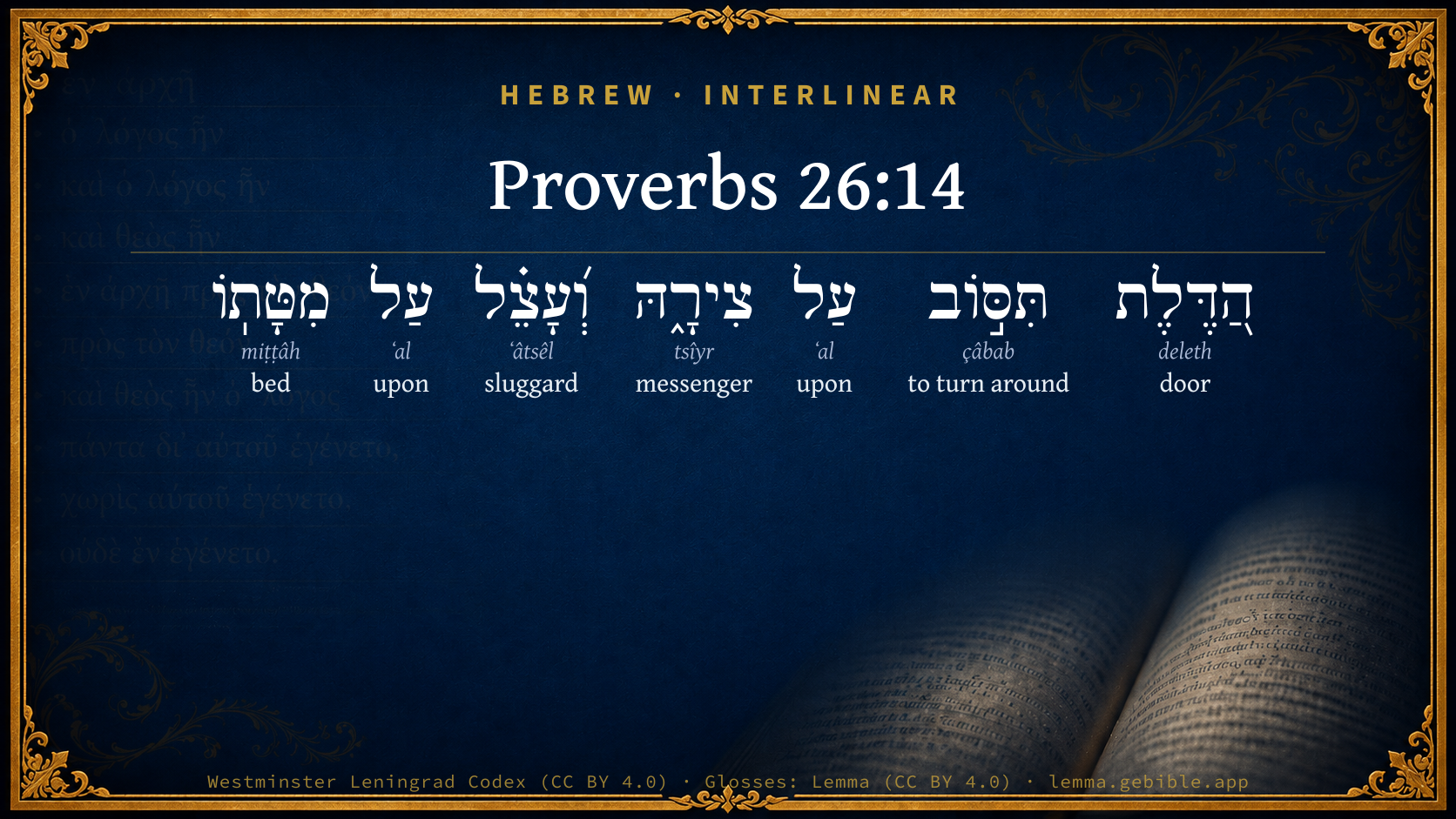
Hebrew (Westminster Leningrad Codex) Proverbs 26:14 appears in the Hebrew Old Testament. The text above is from the Westminster Leningrad Codex. Each word links to its Strong’s number, a concise gloss, and parsing drawn from the Open Scriptures Hebrew Bible morphology. Click any word for its full Brown-Driver-Briggs (BDB) entry.
Download image
Cite this verse

Proverbs 26:14 (World English Bible). Public Domain. Lemma interlinear Bible study tool, https://lemma.gebible.app/v/proverbs/26/14.

Show BibTeX & RIS
BibTeX
RIS
English Translation
As the door turns on its hinges, So does the sluggard on his bed.
World English Bible · Public Domain
Download a study sheet

One document with this verse’s original text, its word-by-word gloss line, the meaning frame, cross-references with their text, attributed commentary, and full source and license credits — printable, and it pastes into notes with its structure intact.

This verse Autodidact and up

Study sheet (.html) Plain text (.txt)

A passage Seminary Student

Up to 50 verses in one chapter. A passage sheet keeps up to 6 commentary sources and 12 cross-references per verse, in the order this page ranks them, and says so on the sheet whenever that leaves anything out. Ask for a single verse and you get the Autodidact verse sheet above.

Everything on this page stays free to read, with no account — the sheet is a download of what is already on screen, not access to it.

Want to remove ads? Support Godless Engineer
Compare translations 3

The same verse in 3 English versions, stacked beneath the original-language interlinear above. Click any original word for its lexicon entry.

Each is an independent rendering of the whole verse — the interlinear is not word-aligned to these translations.

Highlighted words mark where these versions differ — a whole-verse word diff, not a word-by-word alignment.

  • World English Bible Public Domain
    As the door turns on its hinges, So does the sluggard on his bed.
  • King James Version Public Domain
    As the door turneth upon his hinges, so doth the slothful upon his bed.
  • unfoldingWord Literal Text CC BY-SA 4.0
    The door turns on its hinge, and a lazy on his bed.

unfoldingWord Literal Text — © unfoldingWord, licensed CC BY-SA 4.0. Word-aligned USFM3 via Door43 (git.door43.org/unfoldingWord/en_ult).

Versions to compare (up to 4)

3 of 4 selected

Show all 18 translations

Every available English version of this verse, each an independent rendering of the whole verse.

  • World English Bible Public Domain
    As the door turns on its hinges, So does the sluggard on his bed.
  • Berean Standard Bible Public Domain
    As a door turns on its hinges, so the slacker turns on his bed.
  • Majority Standard Bible Public Domain
    As a door turns on its hinges, so the slacker turns on his bed.
  • King James Version Public Domain
    As the door turneth upon his hinges, so doth the slothful upon his bed.
  • American Standard Version (1901) Public Domain
    `As' the door turneth upon its hinges, So doth the sluggard upon his bed.
  • Revised Version (1885) Public Domain
    As the door turneth upon its hinges, so doth the sluggard upon his bed.
  • Geneva Bible (1599) Public Domain
    As the doore turneth vpon his hinges, so doeth the slouthfull man vpon his bed.
  • Douay-Rheims (1899) Public Domain
    As the door turneth upon its hinges, so doth the slothful upon his bed.
  • Young's Literal Translation Public Domain
    The door turneth round on its hinge, And the slothful on his bed.
  • Literal Standard Version CC BY-SA 4.0
    The door turns around on its hinge, || And the slothful on his bed.
  • Unlocked Literal Bible CC BY-SA 4.0
    As the door turns on its hinges, so is the lazy person upon his bed.
  • unfoldingWord Literal Text CC BY-SA 4.0
    The door turns on its hinge, and a lazy on his bed.
  • Darby Bible Public Domain
    [As] the door turneth upon its hinges, so the sluggard upon his bed.
  • World Messianic Bible Public Domain
    As the door turns on its hinges, so does the sluggard on his bed.
  • Webster's Bible Public Domain
    As the door turneth upon its hinges, so doth the slothful upon his bed.
  • Free Bible Version CC BY-SA 4.0
    A lazy person turns in bed like a door turns on its hinge.
  • Bible in Basic English Public Domain
    A door is turned on its pillar, and the hater of work on his bed.
  • JPS Tanakh (1917) Public Domain
    The door is turning upon its hinges, and the sluggard is still upon his bed.

Literal Standard Version (2020), Covenant Press — licensed CC BY-SA 4.0. Text via the HelloAO Bible API (eBible.org). Unlocked Literal Bible (unfoldingWord) — licensed CC BY-SA 4.0. Text via the HelloAO Bible API (eBible.org). unfoldingWord Literal Text — © unfoldingWord, licensed CC BY-SA 4.0. Word-aligned USFM3 via Door43 (git.door43.org/unfoldingWord/en_ult). Free Bible Version, Dr. Jonathan Gallagher — licensed CC BY-SA 4.0. Text via the HelloAO Bible API (eBible.org).

Word by word

More ways to search: Search by grammar → Find every occurrence → Compare this word →

Practice this passage: Drill this verse → Learn its vocabulary →

About this verse

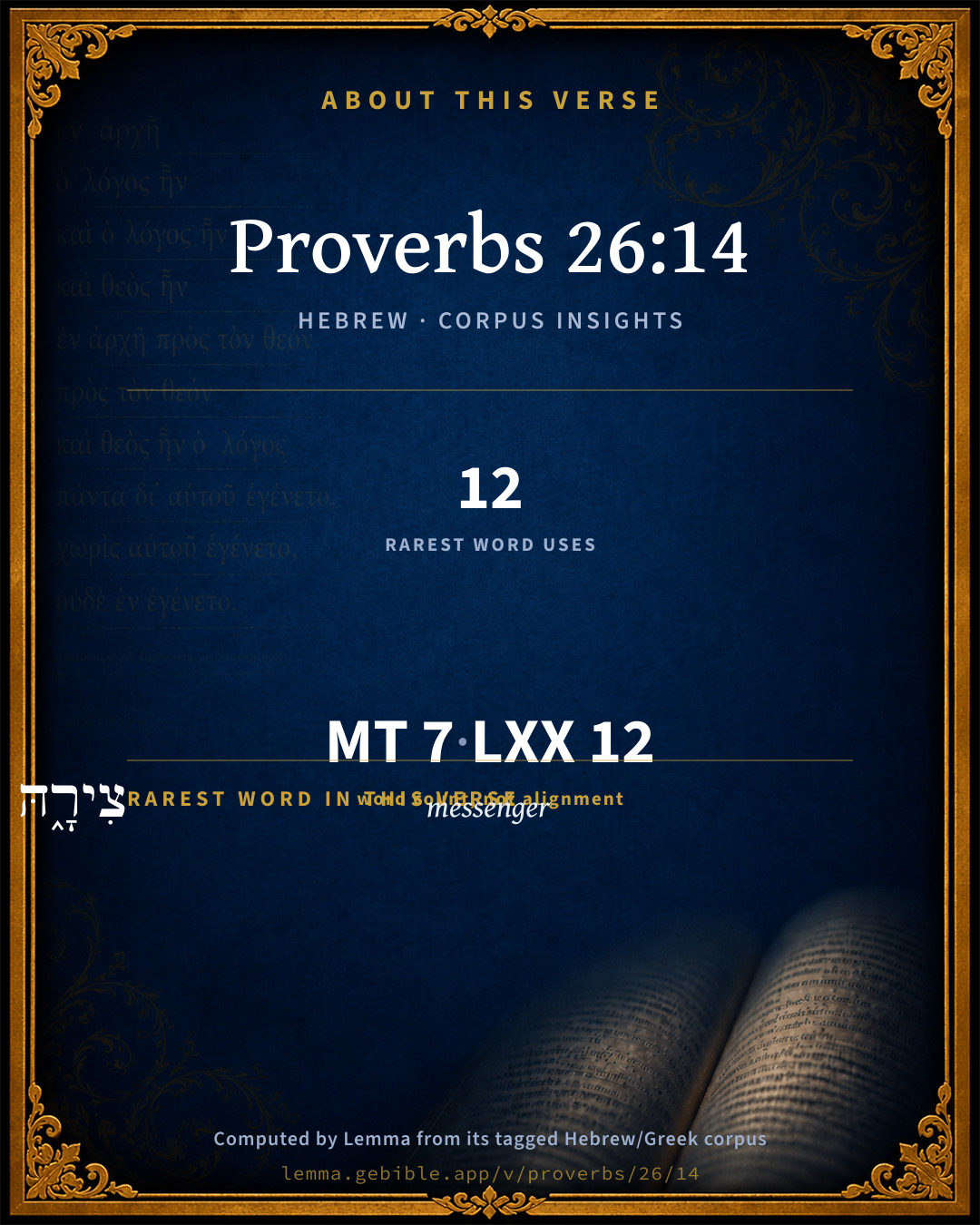
These counts appear in no published source. They are computed here, from the morphology-tagged text and Lemma’s own curated glosses. What Lemma adds →

7
words
6
distinct lemmas
Wisdom
section

Notable vocabulary

The rarest word here is צִירָ֑הּ messenger H6735 — appearing just 12 times in the whole Hebrew Bible.

Shared distinctive vocabulary

צִירָ֑הּ messenger H6735 occurs in 11 verses of the Hebrew Bible. Also found in:

Grammatical profile

  • 1 verb
  • 3 nouns
  • 1 adjective
  • 2 prepositions

Verb forms

  • תִּסּ֣וֹב Qal · Imperfect

Repetition

A word recurs within this verse — often emphatic in Hebrew:

Hebrew & Septuagint length

In English translation the verse runs 14 words from the Hebrew and 14 from the Septuagint (LXX English) — the same length.

A rough comparison of the two English renderings, which tokenize alike — not a word-level alignment.

Word counts can differ between the Hebrew and the Greek without any difference in meaning — e.g. the Hebrew direct-object marker אֵת has no separate Greek word, and Greek often adds the article ὁ.

In the original languages it is 7 Hebrew tokens and 12 Greek tokens — but the two are counted differently (Hebrew bundles its prefixes and suffixes into one token; the Greek is in lemma form), so that isn’t a like-for-like length.

Cross-references

5

Topical passages linked to Proverbs 26:14 in the Treasury of Scripture Knowledge — connected by theme and wording, ordered by reader-vote popularity; previews shown in the World English Bible.

  • Hebrews 6:12 that you won't be sluggish, but imitators of those who through faith and patience inherited the promises.
  • Proverbs 6:9–10 How long will you sleep, sluggard? When will you arise out of your sleep?
  • Proverbs 12:24 The hands of the diligent ones shall rule, But laziness ends in slave labor.
  • Proverbs 12:27 The slothful man doesn't roast his game, But the possessions of diligent men are prized.
  • Proverbs 24:33 A little sleep, a little slumber, A little folding of the hands to sleep;

Cross-references courtesy of OpenBible.info (CC BY 4.0).

Hebrew and Greek witnesses Masoretic Hebrew ↔ Greek Septuagint

The same verse in the two great witnesses to the Old Testament, shown verse-for-verse.

These are two independent witnesses, not word-aligned to each other, and the Septuagint is shown in lemma (dictionary) form.

Hebrew Proverbs 26:14 Masoretic · Westminster Leningrad Codex

הַ֭דֶּלֶת תִּסּ֣וֹב עַל צִירָ֑הּ וְ֝עָצֵ֗ל עַל מִטָּתֽוֹ

As the door turns on its hinges, So does the sluggard on his bed.

World English Bible · Public Domain

Greek LXX Proverbs 26:14 Septuagint · lemma form

ὥσπερ θύρα στρέφω ἐπί ὁ στρόφιγξ οὕτως ὀκνηρός ἐπί ὁ κλίνη αὐτός

As a door turns on the hinge, so does a sluggard on his bed.

LXX2012 (modern English Septuagint) · Public Domain

Hebrew: Westminster Leningrad Codex (CC BY 4.0). Greek: Septuagint (public domain); English from LXX2012 (modern English Septuagint) (Public Domain). How the Septuagint differs from the Hebrew →

Commentary

Notes on Proverbs 26:14 from classic Christian and Jewish commentators (each source and its license shown beneath its notes). The classic Christian expositions comment on the surrounding passage and are grouped to its opening verse, so a note may address several verses; the Jewish commentaries on the Tanakh (Rashi and others) are per-verse, so they appear only where the commentator wrote on this verse.

Lemma curates 59 commentaries, every one of them public domain or Creative Commons licensed, each selected and text-cleaned for this edition rather than reprinted as found. About our sources →

Trapp's Complete Commentary

John Trapp

Pro 26:14 [As] the door turneth upon his hinges, so [doth] the slothful upon his bed.

Ver. 14. As the door turneth upon his hinges.] But comes not off, unless lifted or knocked off. So neither comes the sluggard out of his feathered nest, where he lies soaking and stretching, unless hard hunger or other necessity rouse and raise him. As abroad there is a lion, so at home there is a lusk, a lurdam, and a losel, that lives in the worm to no purpose - yea, to bad purpose, and being wise in his own conceit, will not accept of better counsel. Those whose heads are laid upon down pillows are not apt to hear noises; no more are those that live at ease in Zion to hearken to wholesome advice, or if sometimes they have a kind of willingness and velleity to do better, yet it is but as the door that turns on the hinges, but yet hangs still upon them.

John Trapp, A Commentary or Exposition upon All the Books of the Old and New Testament (1647–1656) — public domain. Text from a community e-Sword module.

Matthew Henry's Commentary

Having seen the slothful man in fear of his work, here we find him in love with his ease; he lies in his bed on one side till he is weary of that, and then turns to the other, but still in his bed, when it is far in the day and work is to be done, as the door is moved, but not removed; and so his business is neglected and his opportunities are let slip. See the sluggard's character. 1. He is one that does not care to get out of his bed, but seems to be hung upon it, as the door upon the hinges. Bodily ease, too much consulted, is the sad occasion of many a spiritual disease. Those that love sleep will prove in the end to have loved death. 2. He does not care to get forward with his business; in that he stirs to and fro a little, but to no purpose; he is where he was. Slothful professors turn, in profession, like the door upon the hinges. The world and the flesh are the two hinges on which they are hung, and though they move in a course of external services, have got into road of duties, and tread around in them like the horse in the mill, yet they get no good, they get no ground, they are never the nearer heaven - sinners unchanged, saints unimproved.

Matthew Henry's Commentary on the Whole Bible (1708–1710) — public domain (CC PDM 1.0). Text via the HelloAO Bible API.

Jamieson, Fausset & Brown

Robert Jamieson, A. R. Fausset & David Brown

(Compare Pro 6:10; Pro 24:33).

Jamieson, Fausset & Brown — Commentary Critical and Explanatory on the Whole Bible (1871) — public domain (CC PDM 1.0). Text via the HelloAO Bible API.

The Cambridge Bible for Schools and Colleges

gen. ed. J. J. S. Perowne

14. “He will not get up in the morning; he turns from side to side, just like a door which swings backward and forward upon its hinges, but of course never gets any further.” Horton, ch. xx. p. 263, where a graphic picture of the sluggard is drawn by bringing together the different notices of him in the Book of Proverbs.

The Cambridge Bible for Schools and Colleges (gen. ed. J. J. S. Perowne; Cambridge University Press, 1878–1918) — public domain. Text from a community e-Sword module.

John Gill's Exposition

As the door turneth upon his hinges,.... And moves this way and that way, and opens and shuts, and yet hangs where it did, is not moved from its place:

so doth the slothful upon his bed; he turns himself from side to side, but is still on his bed, and does not move out of it, and go about his business. Aben Ezra makes mention of another reading and sense, "the door turneth upon his hinges", and is opened to let men out, one and another, to his work; "but yet the slothful man is upon his bed"; though one and another rise and go about business, and he hears the door open again and again, he stirs not, but keeps his, bed. So profane sinners lie on the bed of sinful lusts and sensual pleasures, indulge themselves in chambering and wantonness, and do not care to rise from hence, and walk honestly as in the daytime; and though their consciences are sometimes jogged by inward pricks, and they are moved a little by the reproofs of their friends, or awakened by the judgments of God; yet these are quickly over, and they give themselves a turn and go to sleep again: sometimes there are some motions in them, some thoughts and resolutions of amendment, some purposes to do good works; but, alas! their slothfulness is so great, and the habits and customs of sin so strong, that they cannot break through them, shake off their sloth, and come out, but remain as they were: and so it is with carnal professors, resting in their own works, and in a round of duties; and after ten, twenty, thirty years' profession, or more, they are just where they were; have no spiritual knowledge, judgment, and experience.

John Gill's Exposition of the Whole Bible (1746–1763) — public domain (CC PDM 1.0). Text via the HelloAO Bible API.

Haydock's Catholic Bible Commentary

Bed, which he will scarcely leave, though avarice push him forward. (St. Augustine, ser. xxii. or clxiv.)

George Leo Haydock (1774–1849), Haydock's Catholic Family Bible and Commentary, 1859 edition — public domain. Excludes Psalms (Douay-Rheims chapter numbering differs from Protestant) and Deuterocanonical books (Catholic canon only).

Matthew Poole's English Annotations

Turneth upon his hinges; moving hither and thither upon them, but not removing one jot from its place.

Matthew Poole's English Annotations on the Holy Bible (1683–1685) — public domain. Text from a community e-Sword/MySword module.

Whedon's Commentary on the Bible

Daniel D. Whedon

14. As the door turneth — “Doors anciently turned on vertical pivots. As the door moves on its hinges, but not from them, so the sluggard moves on, but not from, his bed.” — Muenscher. Conant gives it very neatly: “The door turns on its hinges, and the sluggard on his couch.” So also Zockler. Compare Pro_6:10; Pro_24:33.

Daniel D. Whedon (gen. ed.), Commentary on the Old and New Testaments (1874–1909) — public domain. Text from a community e-Sword module.

The Pulpit Commentary

As the door turneth upon its hinges. The door moves on its hinges and makes no progress beyond its own confined sphere of motion; so the slothful man turns himself on his bed from side to side, but never leaves it to do his. work. Other analogies have been found in this proverb. Thus: The door opens to let the diligent go forth to his daily business, while the sluggard is rolling upon his bed; the door creaks when it is moved, so the lazy man groans when he is aroused; the door now is opened, now is shut, so the sluggard at one time intends to rise, and then falls back in his bed, and returns to his sleep. (comp. Pro_6:9, 10 24:33)

The Pulpit Commentary (1880–1919), ed. H.D.M. Spence-Jones & Joseph S. Exell — public domain. Text from a community e-Sword module.

John Wesley's Explanatory Notes

Turneth - Moving hither and thither upon it, but not removing from its place.

John Wesley, Explanatory Notes Upon the Whole Bible (1754–1765) — public domain. Text via the GEBible commentary corpus.

Keil & Delitzsch

C. F. Keil & F. Delitzsch

14 The door turneth on its hinges,

And the sluggard on his bed.

The comparison is clear. The door turns itself on its hinges, on which it hangs, in and out, without passing beyond the narrow space of its motion; so is the fool on his bed, where he turns himself from the one side to the other. He is called עצל, because he is fast glued to the place where he is (Arab. 'azila), and cannot be free (contrast of the active, cf. Arab. ḥafyf, moving nimbly, agilis). But the door offers itself as a comparison, because the diligent goes out by it to begin his work without (Pro 24:27; Psa 104:23), while the sluggard rolls himself about on his bed. The hook, the hinge, on which the door is moved, called ציר, from צוּר, to turn,

(Note: The Arab. verb signifies radically: to turn, like the Persian verbs kashatn and kardydan, and like our "werden" to grow, turn, accords with vertere (Fleischer).)

has thus the name of הסּוב.

Keil & Delitzsch — Biblical Commentary on the Old Testament (1861–1891) — public domain (CC PDM 1.0). Text via the HelloAO Bible API. (Old Testament only.)

Lesson kit

Teaching starters — assembled from the data on this page, not authored interpretation. Every prompt links to the verse data it draws on. Edit before teaching.

Proverbs, in the Wisdom, opens this verse with 7 words (6 distinct Hebrew lemmas). Its most distinctive word is tsîyr (“messenger”). A historical commentator’s framing appears above. Read the whole chapter for the surrounding context.

Discussion questions

  1. What does “messenger” (tsîyr) contribute to the verse as a whole?
  2. 1 Samuel 4:19 shares the word «messenger» with this verse. How do the two illuminate each other?
  3. “upon” occurs 2× in this one verse. What is the effect of the repetition?
  4. These translations render this verse differently; the difference is in the English rendering, not the original. What questions does that raise?
  5. The verb «תִּסּ֣וֹב» is Qal Imperfect. How does its form color the action?
  6. Reading how Trapp's Complete Commentary and Matthew Henry's Commentary read this verse, where do the two commentators agree and where do they part?

Things to notice

Reading settings

Reading text

Shown beneath each verse's original-language words.

Old Testament
Old Testament edition

Read the OT as the Masoretic Hebrew (MT) or the Greek Septuagint (LXX).

English shown for the Greek Septuagint (in the Hebrew ↔ Greek comparison).

Comparing translations? Open the Compare panel on any verse page to stack up to four side by side.