
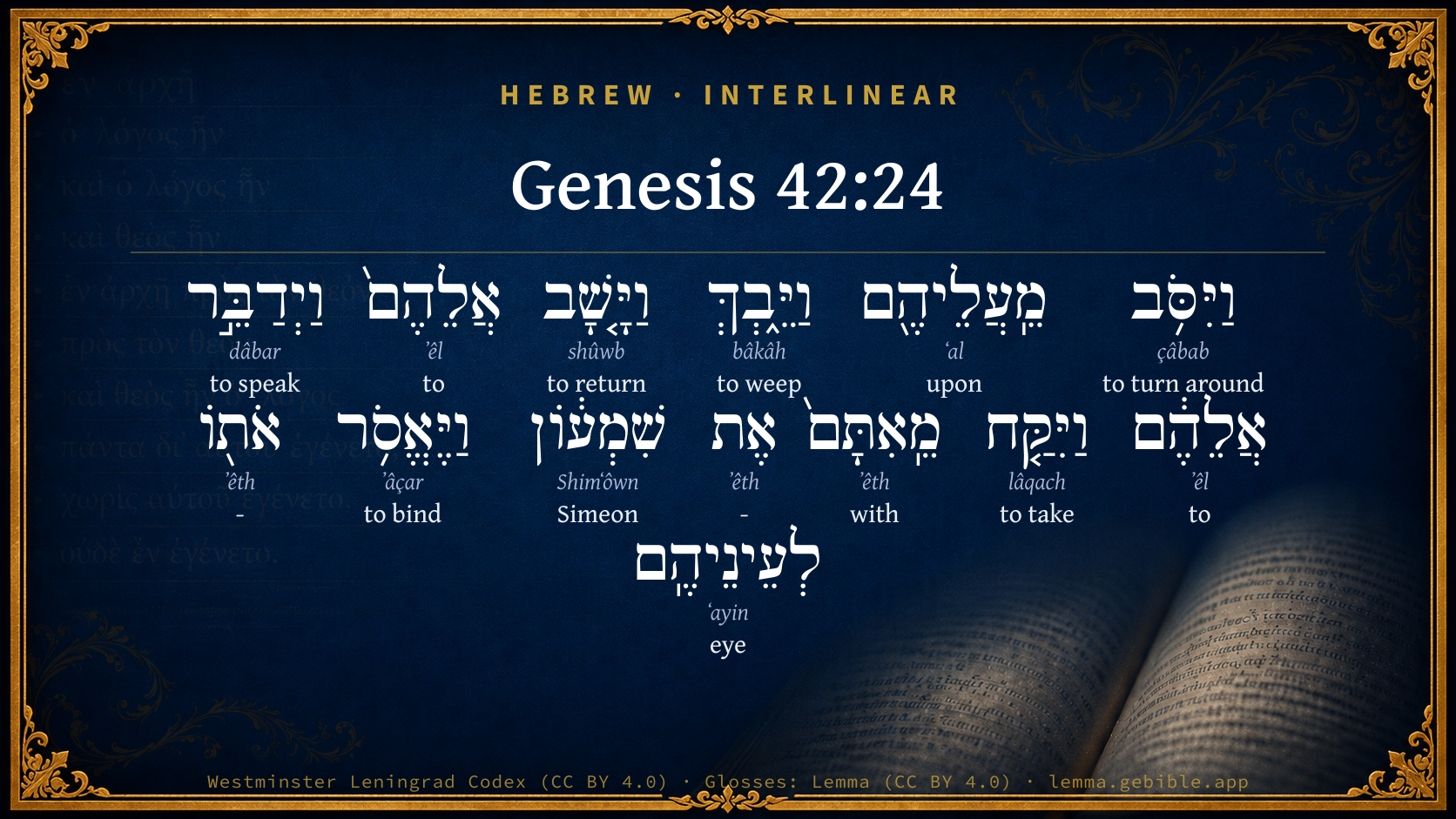
Genesis 42:24

Hebrew (Westminster Leningrad Codex) Genesis 42:24 appears in the Hebrew Old Testament. The text above is from the Westminster Leningrad Codex. Each word links to its Strong’s number, a concise gloss, and parsing drawn from the Open Scriptures Hebrew Bible morphology. Click any word for its full Brown-Driver-Briggs (BDB) entry.
Download image
Cite this verse

Genesis 42:24 (World English Bible). Public Domain. Lemma interlinear Bible study tool, https://lemma.gebible.app/v/genesis/42/24.

Show BibTeX & RIS
BibTeX
RIS
English Translation
He turned himself about from them, and wept, and he returned to them, and spoke to them, and took Simeon from among them, and bound him before their eyes.
World English Bible · Public Domain
Download a study sheet

One document with this verse’s original text, its word-by-word gloss line, the meaning frame, cross-references with their text, attributed commentary, and full source and license credits — printable, and it pastes into notes with its structure intact.

This verse Autodidact and up

Study sheet (.html) Plain text (.txt)

A passage Seminary Student

Up to 50 verses in one chapter. A passage sheet keeps up to 6 commentary sources and 12 cross-references per verse, in the order this page ranks them, and says so on the sheet whenever that leaves anything out. Ask for a single verse and you get the Autodidact verse sheet above.

Everything on this page stays free to read, with no account — the sheet is a download of what is already on screen, not access to it.

Want to remove ads? Support Godless Engineer
Compare translations 3

The same verse in 3 English versions, stacked beneath the original-language interlinear above. Click any original word for its lexicon entry.

Each is an independent rendering of the whole verse — the interlinear is not word-aligned to these translations.

Highlighted words mark where these versions differ — a whole-verse word diff, not a word-by-word alignment.

  • World English Bible Public Domain
    He turned himself about from them, and wept, and he returned to them, and spoke to them, and took Simeon from among them, and bound him before their eyes.
  • King James Version Public Domain
    And he turned himself about from them, and wept; and returned to them again, and communed with them, and took from them Simeon, and bound him before their eyes.
  • unfoldingWord Literal Text CC BY-SA 4.0
    And he turned away from them and cried. Then he turned back toward them and spoke to them. Then he took Simeon from them and bound him before their eyes.

unfoldingWord Literal Text — © unfoldingWord, licensed CC BY-SA 4.0. Word-aligned USFM3 via Door43 (git.door43.org/unfoldingWord/en_ult).

Versions to compare (up to 4)

3 of 4 selected

Show all 18 translations

Every available English version of this verse, each an independent rendering of the whole verse.

  • World English Bible Public Domain
    He turned himself about from them, and wept, and he returned to them, and spoke to them, and took Simeon from among them, and bound him before their eyes.
  • Berean Standard Bible Public Domain
    And he turned away from them and wept. When he turned back and spoke to them, he took Simeon from them and had him bound before their eyes.
  • Majority Standard Bible Public Domain
    And he turned away from them and wept. When he turned back and spoke to them, he took Simeon from them and had him bound before their eyes.
  • King James Version Public Domain
    And he turned himself about from them, and wept; and returned to them again, and communed with them, and took from them Simeon, and bound him before their eyes.
  • American Standard Version (1901) Public Domain
    And he turned himself about from them, and wept; and he returned to them, and spake to them, and took Simeon from among them, and bound him before their eyes.
  • Revised Version (1885) Public Domain
    And he turned himself about from them, and wept; and he returned to them, and spake to them, and took Simeon from among them, and bound him before their eyes.
  • Geneva Bible (1599) Public Domain
    Then he turned from them, and wept, and turned to them againe, and communed with them, and tooke Simeon from among them, and bounde him before their eyes.
  • Douay-Rheims (1899) Public Domain
    And he turned himself away a little while, and wept: and returning he spoke to them.
  • Young's Literal Translation Public Domain
    and he turneth round from them, and weepeth, and turneth back unto them, and speaketh unto them, and taketh from them Simeon, and bindeth him before their eyes.
  • Literal Standard Version CC BY-SA 4.0
    and he turns around from them, and weeps, and turns back to them, and speaks to them, and takes Simeon from them, and binds him before their eyes.
  • Unlocked Literal Bible CC BY-SA 4.0
    He turned from them and wept. He returned to them and spoke to them. He took Simeon from among them and bound him before their eyes.
  • unfoldingWord Literal Text CC BY-SA 4.0
    And he turned away from them and cried. Then he turned back toward them and spoke to them. Then he took Simeon from them and bound him before their eyes.
  • Darby Bible Public Domain
    And he turned away from them, and wept. And he returned to them, and spoke to them, and took Simeon from among them, and bound him before their eyes.
  • World Messianic Bible Public Domain
    He turned himself away from them, and wept. Then he returned to them, and spoke to them, and took Simeon from among them, and bound him before their eyes.
  • Webster's Bible Public Domain
    And he turned himself away from them, and wept; and returned to them again, and communed with them, and took from them Simeon, and bound him before their eyes.
  • Free Bible Version CC BY-SA 4.0
    Joseph stepped away from them because he started crying. He came back when he was able to speak to them again. He chose Simeon and had him tied up as they watched.
  • Bible in Basic English Public Domain
    And turning away from them, he was overcome with weeping; then he went on talking to them again and took Simeon and put chains on him before their eyes.
  • JPS Tanakh (1917) Public Domain
    And he turned himself about from them, and wept; and he returned to them, and spoke to them, and took Simeon from among them, and bound him before their eyes.

Literal Standard Version (2020), Covenant Press — licensed CC BY-SA 4.0. Text via the HelloAO Bible API (eBible.org). Unlocked Literal Bible (unfoldingWord) — licensed CC BY-SA 4.0. Text via the HelloAO Bible API (eBible.org). unfoldingWord Literal Text — © unfoldingWord, licensed CC BY-SA 4.0. Word-aligned USFM3 via Door43 (git.door43.org/unfoldingWord/en_ult). Free Bible Version, Dr. Jonathan Gallagher — licensed CC BY-SA 4.0. Text via the HelloAO Bible API (eBible.org).

Word by word

More ways to search: Search by grammar → Find every occurrence → Compare this word →

Practice this passage: Drill this verse → Learn its vocabulary →

שִׁמְע֔וֹן
Shimʻôwn
H8095
“Simeon”
Noun, Proper
Part of Speech
Noun
Type
Proper
Full BDB Definition

Origin: from H8085

TWOT: None

Simeon or Shimeon = "heard" - the 2nd son of Jacob by his wife Leah and progenitor of the tribe of Simeon - an Israelite of the sons of Bani who had a foreign wife in the time of Ezra
  1. וַיִּסֹּ֥ב çâbab H5437 “and · to turn around” Conjunction + Verb, Qal, Sequential Imperfect, 3rd Person, Masculine, Singular
  2. מֵֽעֲלֵיהֶ֖ם ʻal H5921 “from · upon · them” Preposition + Preposition + Suffix, Personal, 3rd Person, Masculine, Plural
  3. וַיֵּ֑בְךְּ bâkâh H1058 “and · to weep” Conjunction + Verb, Qal, Sequential Imperfect, 3rd Person, Masculine, Singular
  4. וַיָּ֤שָׁב shûwb H7725 “and · to return” Conjunction + Verb, Qal, Sequential Imperfect, 3rd Person, Masculine, Singular
  5. אֲלֵהֶם֙ ʼêl H413 “to · them” Preposition + Suffix, Personal, 3rd Person, Masculine, Plural
  6. וַיְדַבֵּ֣ר dâbar H1696 “and · to speak” Conjunction + Verb, Piel, Sequential Imperfect, 3rd Person, Masculine, Singular
  7. אֲלֵהֶ֔ם ʼêl H413 “to · them” Preposition + Suffix, Personal, 3rd Person, Masculine, Plural
  8. וַיִּקַּ֤ח lâqach H3947 “and · to take” Conjunction + Verb, Qal, Sequential Imperfect, 3rd Person, Masculine, Singular
  9. מֵֽאִתָּם֙ ʼêth H854 “from · with · them” Preposition + Preposition + Suffix, Personal, 3rd Person, Masculine, Plural
  10. אֶת ʼêth H853 “-” Particle, Direct Object
  11. וַיֶּאֱסֹ֥ר ʼâçar H631 “and · to bind” Conjunction + Verb, Qal, Sequential Imperfect, 3rd Person, Masculine, Singular
  12. אֹת֖וֹ ʼêth H853 “- · him” Particle, Direct Object + Suffix, Personal, 3rd Person, Masculine, Singular
  13. לְעֵינֵיהֶֽם ʻayin H5869 “to/for · eyes · their” Preposition + Noun, Common, Both, Dual, Construct + Suffix, Personal, 3rd Person, Masculine, Plural

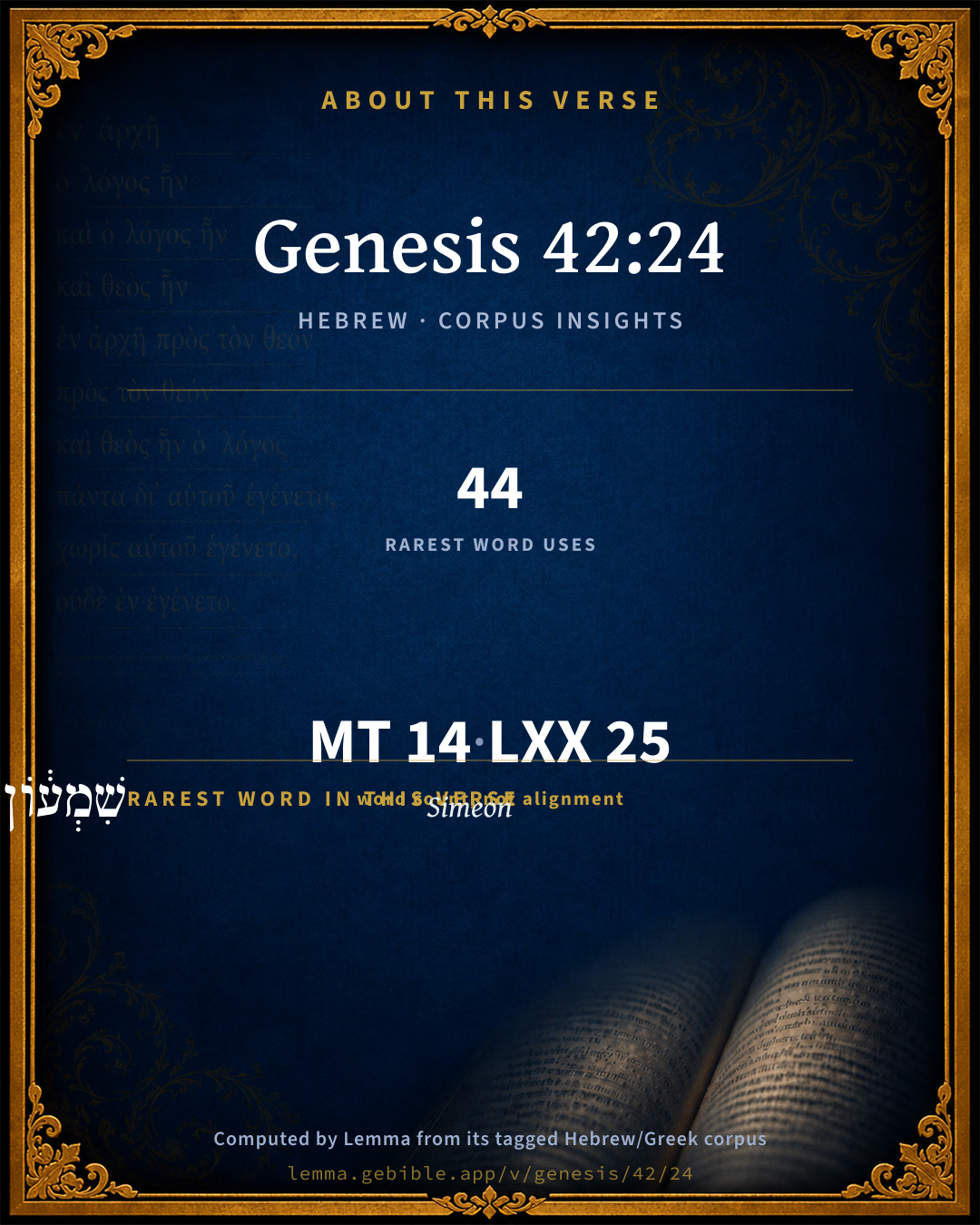
About this verse

These counts appear in no published source. They are computed here, from the morphology-tagged text and Lemma’s own curated glosses. What Lemma adds →

14
words
12
distinct lemmas
Pentateuch
section

Shared distinctive vocabulary

שִׁמְע֔וֹן Simeon H8095 occurs in 39 verses of the Hebrew Bible. Also found in:

Grammatical profile

  • 6 verbs
  • 2 nouns
  • 4 prepositions
  • 2 particles

Verb forms

  • וַיִּסֹּ֥ב Qal · Sequential Imperfect
  • וַיֵּ֑בְךְּ Qal · Sequential Imperfect
  • וַיָּ֤שָׁב Qal · Sequential Imperfect
  • וַיְדַבֵּ֣ר Piel · Sequential Imperfect
  • וַיִּקַּ֤ח Qal · Sequential Imperfect
  • וַיֶּאֱסֹ֥ר Qal · Sequential Imperfect

Repetition

A word recurs within this verse — often emphatic in Hebrew:

  • אֲלֵהֶם֙ to H413 ×2

Hebrew & Septuagint length

In English translation the verse runs 29 words from the Hebrew and 30 from the Septuagint (LXX English) — closely comparable.

A rough comparison of the two English renderings, which tokenize alike — not a word-level alignment.

Word counts can differ between the Hebrew and the Greek without any difference in meaning — e.g. the Hebrew direct-object marker אֵת has no separate Greek word, and Greek often adds the article ὁ.

In the original languages it is 14 Hebrew tokens and 25 Greek tokens — but the two are counted differently (Hebrew bundles its prefixes and suffixes into one token; the Greek is in lemma form), so that isn’t a like-for-like length.

Cross-references

12

Topical passages linked to Genesis 42:24 in the Treasury of Scripture Knowledge — connected by theme and wording, ordered by reader-vote popularity; previews shown in the World English Bible.

  • Genesis 43:30 Joseph made haste; for his heart yearned over his brother: and he sought a place to weep; and he entered into his room, and wept there.
  • Genesis 34:25 It happened on the third day, when they were sore, that two of Jacob's sons, Simeon and Levi, Dinah's brothers, each took his sword, came upon the unsuspecting city, and killed all the males.
  • Genesis 43:14 May God Almighty give you mercy before the man, that he may release to you your other brother and Benjamin. If I am bereaved of my children, I am bereaved."
  • Genesis 43:23 He said, "Peace be to you. Don't be afraid. Your God, and the God of your father, has given you treasure in your sacks. I received your money." He brought Simeon out to them.
  • Genesis 45:14–15 He fell on his brother Benjamin's neck, and wept, and Benjamin wept on his neck.
  • Genesis 49:5–7 "Simeon and Levi are brothers; Weapons of violence are their swords.
  • Isaiah 63:9 In all their affliction he was afflicted, and the angel of his presence saved them: in his love and in his pity he redeemed them; and he bore them, and carried them all the days of old.
  • Luke 19:41 When he drew near, he saw the city and wept over it,
  • Romans 12:15 Rejoice with those who rejoice. Weep with those who weep.
  • 1 Corinthians 12:26 When one member suffers, all the members suffer with it. Or when one member is honored, all the members rejoice with it.
  • Hebrews 4:15 For we don't have a high priest who can't be touched with the feeling of our infirmities, but one who has been in all points tempted like we are, yet without sin.
  • Jude 1:22–23 On some have compassion, making a distinction,

Cross-references courtesy of OpenBible.info (CC BY 4.0).

Hebrew and Greek witnesses Masoretic Hebrew ↔ Greek Septuagint

The same verse in the two great witnesses to the Old Testament, shown verse-for-verse.

These are two independent witnesses, not word-aligned to each other, and the Septuagint is shown in lemma (dictionary) form.

Hebrew Genesis 42:24 Masoretic · Westminster Leningrad Codex

וַיִּסֹּ֥ב מֵֽעֲלֵיהֶ֖ם וַיֵּ֑בְךְּ וַיָּ֤שָׁב אֲלֵהֶם֙ וַיְדַבֵּ֣ר אֲלֵהֶ֔ם וַיִּקַּ֤ח מֵֽאִתָּם֙ אֶת שִׁמְע֔וֹן וַיֶּאֱסֹ֥ר אֹת֖וֹ לְעֵינֵיהֶֽם

He turned himself about from them, and wept, and he returned to them, and spoke to them, and took Simeon from among them, and bound him before their eyes.

World English Bible · Public Domain

Greek LXX Genesis 42:24 Septuagint · lemma form

ἀποστρέφω δέ ἀπό αὐτός κλαίω ιωσηφ καί πάλιν προςἔρχομαι πρός αὐτός καί εἶπον αὐτός καί λαμβάνω ὁ συμεων ἀπό αὐτός καί δέω αὐτός ἐναντίον αὐτός

And Joseph turned away from them, and wept; and again he came to them, and spoke to them; and he took Symeon from them, and bound him before their eyes.

LXX2012 (modern English Septuagint) · Public Domain

Hebrew: Westminster Leningrad Codex (CC BY 4.0). Greek: Septuagint (public domain); English from LXX2012 (modern English Septuagint) (Public Domain). How the Septuagint differs from the Hebrew →

Targum (Aramaic paraphrase)

2

The Targum is the ancient Jewish Aramaic paraphrase of the Hebrew Scriptures — an interpretive translation, not the Hebrew text itself. Onkelos (literal) and Pseudo-Jonathan (expansive) render the Torah, and Jonathan the Prophets. Coverage is partial: where no permissively-licensed English translation exists for a verse, only the Aramaic is shown. This is verse-level text, not a word-by-word alignment to the Hebrew.

  1. Targum Onkelos Torah (Genesis–Deuteronomy)
    וְאִסְתַּחַר מֵעִלָּוֵיהוֹן וּבְכָא וְתָב לְוָתְהוֹן וּמַלֵּיל עִמְּהוֹן וּדְבַר מִלְּוַתְהוֹן יָת שִׁמְעוֹן וַאֲסַר יָתֵהּ לְעֵינֵיהוֹן

    (no public-domain English translation for this verse)

    Targum Onkelos — Aramaic: “Onkelos Genesis” (public domain); “Onkelos Exodus” (public domain); “Onkelos Leviticus” (public domain); “Onkelos Numbers” (public domain); “Onkelos Deuteronomy” (public domain). English: “Sefaria Community Translation” (CC0 1.0 (public-domain dedication)); “J.W. Etheridge. The Targums of Onkelos and Jonathan Ben Uzziel on the Pentateuch. London: Longmans, Green, 1862” (public domain). Text via Sefaria.

  2. Targum Pseudo-Jonathan Torah (Genesis–Deuteronomy)
    וְחָזַר מִלְוַותְהוֹם וּבְכָא וְתַב לְוַותְהוֹם וּמַלֵיל עִמְהוֹן וּדְבַר מִלְוַותְהוֹם יַת שִׁמְעוֹן דְיָעַט לְמִקְטְלֵיהּ וְכָפַת יָתֵיהּ קָמֵיהוֹן

    And he withdrew from them and wept, and returned and, spake with them. And from them he took Shimeon, who had counselled them to kill him, and bound him before them.

    Targum Pseudo-Jonathan — Aramaic: “Targum Jonathan on Genesis” (public domain); “Targum Jonathan on Exodus” (public domain); “Targum Jonathan on Leviticus” (public domain); “Targum Jonathan on Numbers” (public domain); “Targum Jonathan on Deuteronomy” (public domain). English: “The Targum of Jonathan ben Uzziel, trans. J. W. Etheridge, London, 1862” (public domain). Text via Sefaria.

Commentary

Notes on Genesis 42:24 from classic Christian and Jewish commentators (each source and its license shown beneath its notes). The classic Christian expositions comment on the surrounding passage and are grouped to its opening verse, so a note may address several verses; the Jewish commentaries on the Tanakh (Rashi and others) are per-verse, so they appear only where the commentator wrote on this verse.

Lemma curates 59 commentaries, every one of them public domain or Creative Commons licensed, each selected and text-cleaned for this edition rather than reprinted as found. About our sources →

Trapp's Complete Commentary

John Trapp

Gen 42:24 And he turned himself about from them, and wept; and returned to them again, and communed with them, and took from them Simeon, and bound him before their eyes.

Ver. 24. And wept; and returned, &c.] The better any one is, the more inclined to weeping; as David, than Jonathan. {1Sa 20:41}

“Nam faciles motus mens generosa capit.”

Paulus non tam atramento quam lachrymis chartas inficiebat, saith Lorinus.

And took from them Simeon, and bound him.] He is thought to have been the chief doer in the sale of Joseph; and is therefore singled out for punishment. Judas Iscariot is said to come of his tribe. Of a turbulent and restless spirit Joseph knew him to be; and therefore detained him, saith Musculus, lest he should have hindered the motion of bringing down Benjamin.

John Trapp, A Commentary or Exposition upon All the Books of the Old and New Testament (1647–1656) — public domain. Text from a community e-Sword module.

The Biblical Illustrator

Joseph S. Exell

Gen_42:24

He turned himself about from them and wept

Josephs feelings on seeing his brethren

After the lapse of twenty years, Joseph on seeing his brethren wept.

Why, he might have been vengeful! It is easy for us glibly to read the words, Joseph turned himself about and wept. But consider what the words might have been! We oftentimes see results, not processes. We do not see how men have had to bind themselves down, crucify themselves--hands, feet, head, and side--and undergo death in the presence of God, before they could look society in the face with anything like benignity and gentleness and forgiveness. What the words might have been! Joseph, when he saw his brethren, might have said, Now I have you! Once you put me in a pit--I shall shake you over hell; once you sold me--I will imprison you and torture you day and night; you smote me with whips--I shall scourge you with scorpions! It shall be easier to go through a circle of fire than to escape my just and indignant vengeance to-day! He might have said, I shall operate upon the law, A tooth for a tooth and an eye for an eye. That is the law of nature; that is elementary morality. It is not vengeance, it is not resentment; it is alphabetic justice--justice at its lowest point--incipient righteousness. It is not two eyes for an eye, two teeth for a tooth; but an eye for an eye, a tooth for a tooth, a blow for a blow, a pit for a pit, selling for selling, and so on. A great many men are perfectly content with elementary morality and alphabetic justice. People dont educate themselves from this kind of righteousness into Christian nobility of disposition. It is not a question of education; it is a question of sanctification. Few men can rise beyond mere justice. Many men find in mere justice all the moral satisfaction which their shallow natures require; they cannot see that mercy is the very highest point in justice, and that when a man stoops to forgive be becomes a prince and a king and a crowned ruler in the house and kingdom of God. It requires all that God can do to teach men this: That there is something higher than the law of retaliation, that forgiveness is better than resentment, and that to release men is oftentimes-if done from moral consideration and not from moral neglect--the highest form of Christian justice. But revenge is sweet! I am afraid that some of us like just a little revenge; not that we would ourselves personally and directly inflict it, but if our enemies could, somehow or another, be tripped up, and tumble half way at least into a pit, we should not feel that compunction and sorrow and distress of soul which, sentimentally, appears to be so very fine and beautiful. Nothing but God the Holy Ghost can train a man to this greatness of answering the memory of injury with tears, and accepting processes in which men only appear to have a part, as if God, after all, had been over-ruling and directing the whole scheme.. (J. Parker, D. D.)

The secret sorrows of men

And Joseph turned himself about from them and wept. Afterwards he left their presence and went into his chamber and wept. Think of the secret sorrows of men! The tears did not flow in the presence of the ten men. The tears were shed in secret. We do not know one another altogether, because there is a private life. There are secret experiences. Some of us are two men. Joseph was two men. He spake roughly unto his brethren. He put it on, he assumed roughness for the occasion. But if you had seen him when he had got away into his secret chamber, no woman ever shed hotter, bitterer tears than streamed from that mans eyes. We do not know one another altogether. We come to false conclusions about each others character and disposition. Many a time we say about men, They are very harsh, rough, abrupt; not knowing that they have other days when their very souls are dissolved within them; that they can suffer more in one hour than shallower natures could endure in an eternity. Let us be hopeful about the very worst of men. Some men cannot cry in public. Some men are unfortunately afflicted with coarse, harsh voices, which get for them a reputation for austerity, unkindliness, ungeniality. Other men are gifted with fairness and openness of countenance, gentleness and tunefulness of voice. When they curse and swear it seems as though they were half praying, or just about to enter into some religious exercise. When they speak, when they smile, they get a reputation for being very amiable men, yet they do not know what amiability is. They have no secret life. They weep for reputation; they make their tears an investment for a paltry renown. We do not want all our history to be known. We are content for men to read a little of what they see on the outside, and they profoundly mistake that oftentimes. But the secret history, the inner room of life, what we are and what we do when we are alone, no man can ever tell--the dearest, truest, tenderest friend can never understand. Do not let us treat Josephs tears lightly. Under this feeling there are great moral principles and moral impulses. The man might have been stern, vengeful, resentful. Instead of that he is tender as a forgiving sister. When he looks he yearns, when he listens to their voices all the gladness and none of the bitterness of his old home comes back again on his soul. (J. Parker, D. D.)

Josephs emotion

The hearing of the bitter reflections made by his brethren, upon their barbarous treatment of himself, brought rivers of waters from Josephs eyes. Many passions, many unpleasant and many pleasant remembrances, struggled together in his mind. He tenderly sympathized with the distress of his brethren. He was grieved when he found it necessary to inflict such grief upon men so dear to him, after all they had done to ruin his comfort. He wept at the remembrance of that anguish which he had felt in the day of his calamity, and of the unavailing applications to his hard-hearted brethren, extorted by strong necessity and bitter anguish. He called to mind his afflictions and his misery, the wormwood and the gall; but he remembered also how the Lord had sent from above, and taken and drawn him out of many waters, and set him in a large place, and established his goings. Although Joseph was now exalted to glory and power, he was not in the place where all tears are wiped from every eye. We must in this world weep often, even for ourselves; we must often weep for our friends; but they that sow in tears shall reap in joy. He that goeth forth and weepeth, bearing precious seed, shall doubtless come again with rejoicing, bringing his sheaves with him. Joseph wished not that his brethren should see his tears. When he found he could not refrain, he turned himself from them and wept. Tears shed in secret are the truest indication of the heart. Jeremiah wept in secret places for the calamities coming upon his people, when the Lords flock was to be carried away captive. (G. Lawson, D. D.)

Took from them Simeon, and bound him:--

Harsh steps sometimes necessary

The circumstances of the case required such a behaviour from Joseph as ought not to be made a precedent, unless similar circumstances, or different circumstances of a very uncommon kind, render it advisable. It was not sufficient to satisfy Joseph that he heard his brethren sorely regret their conduct towards himself. In the judgment of charity, he hoped their repentance was sincere; but farther proofs of their sincerity were requisite, before he could place that confidence which he wished to do, in any professions they might have made. Parents are not to be blamed when they forgive their offending but penitent children, although they watch over them with anxious jealousy, lest they should not bring forth fruits meet for repentance. The surgeon is not to be blamed although he give great pain to his patient, by incisions deeper than appear to ordinary beholders to be necessary. Joseph had too good reason to know the stubborn spirit of some of his brethren, and in particular of Simeon; and who knows but he had particular directions from God about the proper means for taming it? During the two or three days of his brethrens imprisonment, he had time to acknowledge the Lord in this important affair, and the Lord directed his steps. You must not be rash in passing judgment on mens conduct. A tree, says our Lord, is known by its fruit. And yet there are cases in which the fruit is to be judged of from the tree. If a good man does actions that are certainly bad, that charity which rejoiceth not in iniquity but rejoiceth in the truth, will not hinder you from assigning them that character which they deserve. But if actions are dubious, charity, which believeth all things, hopeth all things, forbids you to pronounce them bad till better evidence appear. He bound Simeon before their eyes. This circumstance of Simeons imprisonment puts us in mind of Nebuchadnezzars cruelty to Zedekiah, king of Judah, whose sons he slew before their fathers eyes, and then caused his eyes to be put out, that he might never behold another object. His intention was to double the calamities of the loss of sight, and of the murder of his children. But those actions may be not only different, but opposite in their nature, which present the same appearance when viewed with a careless eye. An enemy wounds that he may destroy, but faithful are the wounds of a friend. All Josephs brethren now with him, except Reuben, needed severe rebukes; and no reproofs of the tongue were so likely to subdue their haughty spirit, as the sight of the distress of their brother and companion in iniquity. But it is probable that Josephs chief design in presenting this melancholy spectacle to their eyes was, that they might be excited to return more speedily with their younger brother, whom Joseph was impatient to see. The eye affects the heart. Envy hindered them from regarding the distress of Joseph in the pit; but it was to be hoped that they would compassionate the sufferings of that brother who had never offended them by his dreams, nor received from his father a coat of divers colours. We cannot pretend either to the power or to the wisdom of Joseph. We do not enjoy such intercourse with Heaven by immediate revelation as he frequently enjoyed; and therefore, it would be presumptuous in us to pretend to take such methods as he employed, to humble the spirits of those who have offended us. We have never met with usage that can be compared to the treatment which he had received from his brethren. We must not, however, hope to pass through life without trials to our patience and meekness. Who is a wise man, and endued with knowledge among us? let him show out of a good conversation his works with meekness of wisdom. (G. Lawson, D. D.)

The Biblical Illustrator, edited by Joseph S. Exell (c. 1880s–1900s) — public domain. Text from a community e-Sword module.

Tyndale Open Study Notes

Tyndale Open Resources

42:24 Joseph turned away from them and began to weep (cp. 43:30; 45:2, 14; 50:1, 17); perhaps he was hearing part of the story that he had never known (Reuben’s attempt to save him, 37:21-22, 29), or his brothers’ remorse moved him to forgiveness.

Tyndale Open Study Notes — © Tyndale Open Resources, licensed CC BY-SA 4.0. Text via the HelloAO Bible API.

Geneva Bible (1599)

Geneva Bible translators

Though he showed himself rigorous, yet his brotherly affection remained.

Geneva Bible (1599) marginal notes — public domain. Text via Bolls.life.

Jamieson, Fausset & Brown

Robert Jamieson, A. R. Fausset & David Brown

took . . . Simeon, and bound him--He had probably been the chief instigator--the most violent actor in the outrage upon Joseph; and if so, his selection to be the imprisoned and fettered hostage for their return would, in the present course of their reflections, have a painful significance.

Jamieson, Fausset & Brown — Commentary Critical and Explanatory on the Whole Bible (1871) — public domain (CC PDM 1.0). Text via the HelloAO Bible API.

Adam Clarke's Commentary

Verse 24. Took - Simeon and bound him before their eyes.] This was retaliation, if, as the rabbins suppose, it was Simeon who bound Joseph, and put him into the pit. A recollection of this circumstance must exceedingly deepen the sense he had of his guilt.

Adam Clarke's Commentary on the Bible (1810–1826) — public domain. Text from a community e-Sword/MySword module.

Ellicott's Commentary for English Readers

(24) He turned . . . and wept.—There was no bitterness in Joseph’s heart, and at their first word of regret he melted. But lest he should lose Benjamin he overcame his feelings, and commanded that Simeon should be bound, choosing him, probably, as the one chiefly guilty of the wrong done him. As soon as the rest had departed, he would probably make his imprisonment as easy as possible, especially as he was detained, not as an evil-doer, but as a hostage.

A Bible Commentary for English Readers, edited by Charles John Ellicott (1878–1897) — public domain. Text from a community e-Sword module.

The Cambridge Bible for Schools and Colleges

gen. ed. J. J. S. Perowne

24. wept] Cf. Gen_43:30. Joseph’s feelings are deeply stirred by overhearing words that indicate his brethren’s contrition for their inhuman conduct towards himself.

Simeon] Simeon was selected to be retained in prison as the next oldest after Reuben. Reuben may have been spared, either for his previous kindness, or because, as the eldest, he would be responsible for carrying the report to Jacob. That Simeon was also the most cruel is an inference from Gen_34:25 and Gen_49:5-7, taken in conjunction with the present passage. The retention of Simeon provided a pledge tor the return of the others; which otherwise might be rendered improbable through fear of further harshness from “the lord of the land.” The return of their money and the gift of “provision” are meant also to stir their feelings.

The Cambridge Bible for Schools and Colleges (gen. ed. J. J. S. Perowne; Cambridge University Press, 1878–1918) — public domain. Text from a community e-Sword module.

John Gill's Exposition

And he said unto his brethren, my money is restored,.... The money paid for the corn is returned:

and, lo, it is even in my sack; this put them all upon opening their sacks, where every man found his money, though not expressed, see Gen 43:21,

and their heart failed them; through surprise and fear; or "went out" (c) front them, as it were, they were ready to faint and swoon away:

and they were afraid; their consciences being awakened, and loaded with the guilt of their former sins, they were afraid that more evil was coming upon them for them; and that this was a scheme laid to entrap them, and that they should be pursued and seized, and fetched back, and charged with a fraud and trick, as going off with their corn without paying for it:

saying one to another, what is this that God hath done unto us? for whoever was the instrument, they concluded the overruling hand of divine Providence was in it, for the further chastisement and correction of them for their iniquity: instead of being thus frightened and distressed, it is very much it did not give them suspicion of Joseph, that he was the person they had been conversing with, and that he had done this in kindness to them; but their minds were so pressed with the guilt of their sin, that they were possessed of nothing but fears and dreadful apprehensions of things, and put the worst construction upon them they could, as men in such circumstances usually do, even fear where no fear is, or no occasion for it.

(c) "et exiit cor eorum", Montanus, Drusius, Piscator, Schmidt.

John Gill's Exposition of the Whole Bible (1746–1763) — public domain (CC PDM 1.0). Text via the HelloAO Bible API.

Matthew Poole's English Annotations

He turned himself and wept tears, partly of natural affection and compassion towards his brethren, now in great distress and anguish; and partly of joy, to see the happy success of his design and rigorous carriage, in bringing them to the sight of their sins.

He chooseth to punish

Simeon, partly, because next to Reuben he was the eldest, and, as it may be probably gathered from his bloody disposition, Gen 34:25; 49:6, the most fierce and forward against Joseph, when Reuben was for milder counsels, as we see here, Gen 42:22; 38:29; and partly, because the detainment of one of so perverse and furious a temper would least afflict his father, and most secure Benjamin, who was to come with his brethren. He

bound him before their eyes, that it might make deeper impression upon their hard hearts, and make their repentance more effectual.

Matthew Poole's English Annotations on the Holy Bible (1683–1685) — public domain. Text from a community e-Sword/MySword module.

Whedon's Commentary on the Bible

Daniel D. Whedon

24. Turned… and wept — On hearing their words of conscientious fear, he cannot control his feelings in their presence.

Took from them Simeon — Probably his cruel temper (lxix, 5,) had largely instigated and controlled the action of his brethren in making away with Joseph.

Daniel D. Whedon (gen. ed.), Commentary on the Old and New Testaments (1874–1909) — public domain. Text from a community e-Sword module.

The Pulpit Commentary

And he turned himself about from them (in order to hide his emotion), and wept (as he reflected on the wonderful leadings of Divine providence, and beheld the pitiful distress of his brethren); and returned to them again (having previously withdrawn from them a space), and communed with them (probably about the one of them that should remain behind), and took from them by a rough act of authority, since they either could not or would not settle among themselves who should be the prisoner (Candlish)Simeon, passing by Reuben not because he was the firstborn (Tuch, Lengerke), but because he was comparatively guiltless (Keil, Kalisch, Lange, Candlish, and expositors generally), and selecting Simeon either as the eldest of the guilty ones (Aben Ezra, Keil, Lange, Murphy, Wordsworth, Alford, and others), or as the chief instigator of the sale of Joseph (Philo, Rosenm Furst, Kalisch, Gerlach, Lawson, et alii )and bound him before their eyes thus forcibly recalling to their minds what they had done to him (Wordsworth), and perhaps hoping to incite them, through pity for Simeon, to return the more speedily with Benjamin (Lawson).

The Pulpit Commentary (1880–1919), ed. H.D.M. Spence-Jones & Joseph S. Exell — public domain. Text from a community e-Sword module.

John Wesley's Explanatory Notes

He took Simeon - He chose him for the hostage, probably because he remembered him to have been his most bitter enemy, or because he observed him now to be least humbled and concerned. He bound him before their eyes, to affect them all.

John Wesley, Explanatory Notes Upon the Whole Bible (1754–1765) — public domain. Text via the GEBible commentary corpus.

Rashi

Rabbi Shlomo Yitzchaki (Rashi)

ויסב מעליהם AND HE TURNED AWAY FROM THEM — He moved some distance away from them so that they should not see him weeping.

ויבך AND HE WEPT because he heard that they regretted their past conduct to him.

את שמען SIMEON — he had cast him into the pit and it was he who had said to Levi “Behold, this dreamer cometh” (Tanchuma Yashan 1:10:17). Another explanation is: It was Joseph’s intention to separate him from Levi lest the two of them might conspire to kill him.

ויאסור אתו לעיניהם AND HE BOUND HIM BEFORE THEIR EYES — He only kept him in bonds whilst he was before their eyes, but as soon as they departed he freed him and gave him food and drink (Genesis Rabbah 91:8).

Rashi on the Tanakh — English translations: “The Judaica Press complete Tanach with Rashi, translated by A. J. Rosenberg” (CC BY 4.0); “Pentateuch with Rashi's commentary by M. Rosenbaum and A.M. Silbermann, 1929-1934” (public domain); “The Metsudah Tanach series, Lakewood, N.J” (CC BY 4.0); and “The Book of Joshua, Metsudah Publications, 1997” (CC BY 4.0). Text via Sefaria.

Radak

Rabbi David Kimhi (Radak)

ויבך. Overhearing the brothers confess their sin against him caused Joseph to weep.

את שמעון, he shackled him for it had been Shimon who had thrown him into the pit.

ויאסור, he brought him back to jail in front of their eyes. In Bereshit Rabbah 91,8 Rabbi Chani points out that the restrictive addition of the word לעיניהם, “in their presence,” means that Shimon remained tied up only while the brothers could see him. As soon as the brothers started their home-bound journey Shimon was released by Joseph. He fed him, bathed him, anointed him, in other words treated him like a V.I.P not like a suspected criminal.

Radak on the Tanakh — English translations: “Sefaria Community Translation” (CC0 1.0 (public-domain dedication)); “Eliyahu Munk, HaChut Hameshulash” (CC BY 4.0); “Rabbi Mike Feuer, Jerusalem Anthology” (CC BY 4.0); and “R. David Kimhi on the first book of Psalms, Translated by R.G. Finch, London, 1919” (public domain). Text via Sefaria.

Lesson kit

Teaching starters — assembled from the data on this page, not authored interpretation. Every prompt links to the verse data it draws on. Edit before teaching.

Genesis, in the Pentateuch, opens this verse with 14 words (12 distinct Hebrew lemmas). Its most distinctive word is Shimʻôwn (“Simeon”). A historical commentator’s framing appears above. Read the whole chapter for the surrounding context.

Discussion questions

  1. How does “Simeon” (Shimʻôwn) shape what this verse is saying?
  2. Genesis 29:33 shares the word «Simeon» with this verse. How do the two illuminate each other?
  3. “to” occurs 2× in this one verse. What is the effect of the repetition?
  4. These translations render this verse differently. What is at stake in choosing one wording over another?
  5. The verb «וַיִּסֹּ֥ב» is Qal Sequential Imperfect. How does its form color the action?
  6. Reading how Trapp's Complete Commentary and The Biblical Illustrator read this verse, where do the two commentators agree and where do they part?

Things to notice

Reading settings

Reading text

Shown beneath each verse's original-language words.

Old Testament
Old Testament edition

Read the OT as the Masoretic Hebrew (MT) or the Greek Septuagint (LXX).

English shown for the Greek Septuagint (in the Hebrew ↔ Greek comparison).

Comparing translations? Open the Compare panel on any verse page to stack up to four side by side.