
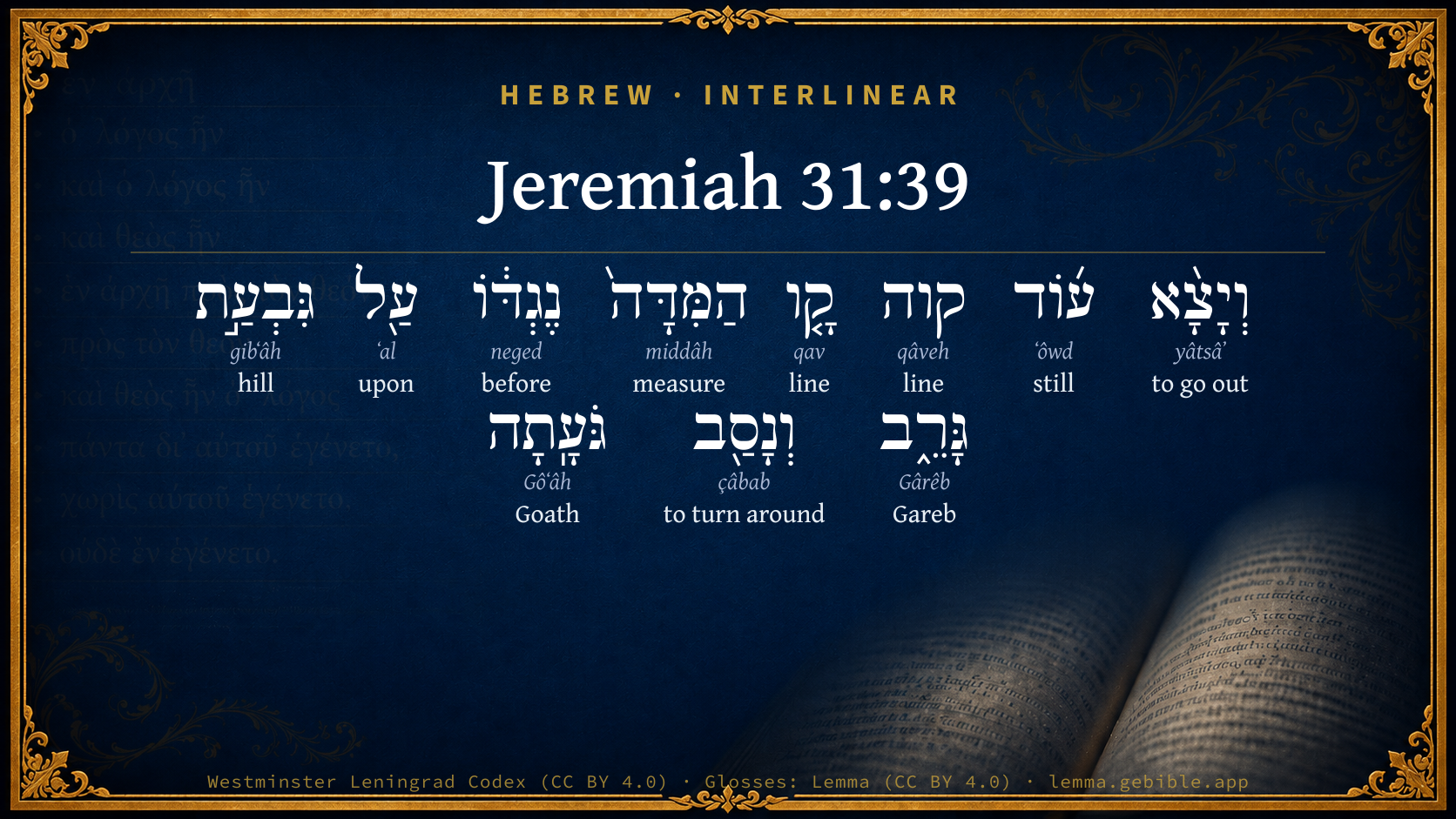
Jeremiah 31:39

Hebrew (Westminster Leningrad Codex) Jeremiah 31:39 appears in the Hebrew Old Testament. The text above is from the Westminster Leningrad Codex. Each word links to its Strong’s number, a concise gloss, and parsing drawn from the Open Scriptures Hebrew Bible morphology. Click any word for its full Brown-Driver-Briggs (BDB) entry.
Download image
Cite this verse

Jeremiah 31:39 (World English Bible). Public Domain. Lemma interlinear Bible study tool, https://lemma.gebible.app/v/jeremiah/31/39.

Show BibTeX & RIS
BibTeX
RIS
English Translation
The measuring line shall go out further straight onward to the hill Gareb, and shall turn about to Goah.
World English Bible · Public Domain
Highlights
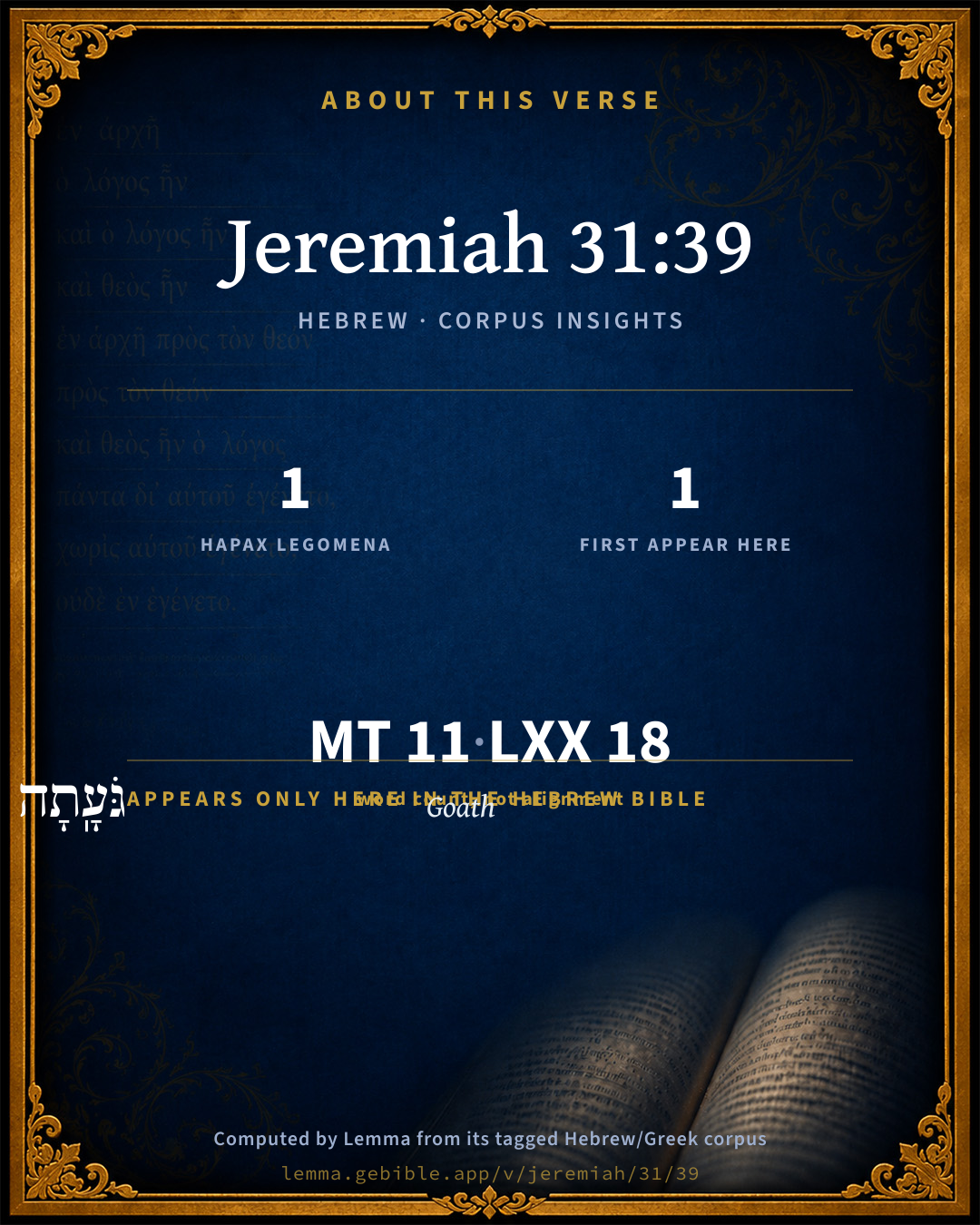
  • 1 hapax legomenon — only here in the Hebrew Bible
  • 1 first appearance in the Hebrew Bible
Full analysis ↓
Download a study sheet

One document with this verse’s original text, its word-by-word gloss line, the meaning frame, cross-references with their text, attributed commentary, and full source and license credits — printable, and it pastes into notes with its structure intact.

This verse Autodidact and up

Study sheet (.html) Plain text (.txt)

A passage Seminary Student

Up to 50 verses in one chapter. A passage sheet keeps up to 6 commentary sources and 12 cross-references per verse, in the order this page ranks them, and says so on the sheet whenever that leaves anything out. Ask for a single verse and you get the Autodidact verse sheet above.

Everything on this page stays free to read, with no account — the sheet is a download of what is already on screen, not access to it.

Want to remove ads? Support Godless Engineer
Compare translations 3

The same verse in 3 English versions, stacked beneath the original-language interlinear above. Click any original word for its lexicon entry.

Each is an independent rendering of the whole verse — the interlinear is not word-aligned to these translations.

Highlighted words mark where these versions differ — a whole-verse word diff, not a word-by-word alignment.

  • World English Bible Public Domain
    The measuring line shall go out further straight onward to the hill Gareb, and shall turn about to Goah.
  • King James Version Public Domain
    And the measuring line shall yet go forth over against it upon the hill Gareb, and shall compass about to Goath.
  • unfoldingWord Literal Text CC BY-SA 4.0
    Then the measuring line will go out again farther, to the hill of Gareb and around Goah.

unfoldingWord Literal Text — © unfoldingWord, licensed CC BY-SA 4.0. Word-aligned USFM3 via Door43 (git.door43.org/unfoldingWord/en_ult).

Versions to compare (up to 4)

3 of 4 selected

Show all 18 translations

Every available English version of this verse, each an independent rendering of the whole verse.

  • World English Bible Public Domain
    The measuring line shall go out further straight onward to the hill Gareb, and shall turn about to Goah.
  • Berean Standard Bible Public Domain
    The measuring line will once again stretch out straight to the hill of Gareb and then turn toward Goah.
  • Majority Standard Bible Public Domain
    The measuring line will once again stretch out straight to the hill of Gareb and then turn toward Goah.
  • King James Version Public Domain
    And the measuring line shall yet go forth over against it upon the hill Gareb, and shall compass about to Goath.
  • American Standard Version (1901) Public Domain
    And the measuring line shall go out further straight onward unto the hill Gareb, and shall turn about unto Goah.
  • Revised Version (1885) Public Domain
    And the measuring line shall yet go out straight onward unto the hill Gareb, and shall turn about unto Goah.
  • Geneva Bible (1599) Public Domain
    And the line of the measure shall go foorth in his presence vpon the hil Gareb, and shall compasse about to Goath.
  • Douay-Rheims (1899) Public Domain
    Thus saith the Lord: If the heavens above can be measured, and the foundations of the earth searched out beneath, I also will cast away all the seed of Israel, for all that they have done, saith the Lord.
  • Young's Literal Translation Public Domain
    And gone out again hath the measuring line Over-against it, unto the height of Gareb, And it hath compassed to Goah.
  • Literal Standard Version CC BY-SA 4.0
    And the measuring line has gone out again before it, over the height of Gareb, || And it has gone around to Goah.
  • Unlocked Literal Bible CC BY-SA 4.0
    Then the measuring line will go out again farther, to the hill of Gareb and around Goah.
  • unfoldingWord Literal Text CC BY-SA 4.0
    Then the measuring line will go out again farther, to the hill of Gareb and around Goah.
  • Darby Bible Public Domain
    And the measuring line shall yet go forth before it unto the hill Gareb, and shall turn toward Goath.
  • World Messianic Bible Public Domain
    The measuring line will go out further straight onward to the hill Gareb, and will turn toward Goah.
  • Webster's Bible Public Domain
    And the measuring line shall yet go forth over against it upon the hill Gareb, and shall compass about to Goath.
  • Free Bible Version CC BY-SA 4.0
    The builder's measuring line will again stretch out directly to Gareb Hill and then turn toward Goah.
  • Bible in Basic English Public Domain
    And the measuring-line will go out in front of it as far as the hill Gareb, going round to Goah.
  • JPS Tanakh (1917) Public Domain
    And the measuring line shall yet go out straight forward unto the hill Gareb, and shall turn about unto Goah.

Literal Standard Version (2020), Covenant Press — licensed CC BY-SA 4.0. Text via the HelloAO Bible API (eBible.org). Unlocked Literal Bible (unfoldingWord) — licensed CC BY-SA 4.0. Text via the HelloAO Bible API (eBible.org). unfoldingWord Literal Text — © unfoldingWord, licensed CC BY-SA 4.0. Word-aligned USFM3 via Door43 (git.door43.org/unfoldingWord/en_ult). Free Bible Version, Dr. Jonathan Gallagher — licensed CC BY-SA 4.0. Text via the HelloAO Bible API (eBible.org).

Word by word

More ways to search: Search by grammar → Find every occurrence → Compare this word →

Practice this passage: Drill this verse → Learn its vocabulary →

About this verse

These counts appear in no published source. They are computed here, from the morphology-tagged text and Lemma’s own curated glosses. What Lemma adds →

11
words
11
distinct lemmas
Prophets
section

Notable vocabulary

1 hapax legomenon — a word that appears only here in the entire Hebrew Bible:

  • גֹּעָֽתָה Goath H1601

First appearance in Scripture

This word makes its first canonical appearance in the Hebrew Bible here:

  • גֹּעָֽתָה Goath H1601

Shared distinctive vocabulary

גָּרֵ֑ב Gareb H1619 occurs in 3 verses of the Hebrew Bible. Also found in:

Grammatical profile

  • 2 verbs
  • 6 nouns
  • 2 prepositions
  • 1 adverb

Verb forms

  • וְיָצָ֨א Qal · Sequential Perfect
  • וְנָסַ֖ב Niphal · Sequential Perfect

Hebrew & Septuagint length

In the original languages it is 11 Hebrew tokens and 18 Greek tokens — but the two are counted differently (Hebrew bundles its prefixes and suffixes into one token; the Greek is in lemma form), so that isn’t a like-for-like length.

Cross-references

2

Topical passages linked to Jeremiah 31:39 in the Treasury of Scripture Knowledge — connected by theme and wording, ordered by reader-vote popularity; previews shown in the World English Bible.

  • Zechariah 2:1–2 I lifted up my eyes, and saw, and, behold, a man with a measuring line in his hand.
  • Ezekiel 40:8 He measured also the porch of the gate toward the house, one reed.

Cross-references courtesy of OpenBible.info (CC BY 4.0).

Hebrew and Greek witnesses Masoretic Hebrew ↔ Greek Septuagint

The same verse in the two great witnesses to the Old Testament, shown verse-for-verse.

These are two independent witnesses, not word-aligned to each other, and the Septuagint is shown in lemma (dictionary) form.

Hebrew Jeremiah 31:39 Masoretic · Westminster Leningrad Codex

וְיָצָ֨א ע֜וֹד קוה קָ֤ו הַמִּדָּה֙ נֶגְדּ֔וֹ עַ֖ל גִּבְעַ֣ת גָּרֵ֑ב וְנָסַ֖ב גֹּעָֽתָה

The measuring line shall go out further straight onward to the hill Gareb, and shall turn about to Goah.

World English Bible · Public Domain

Greek LXX Structure differs

In the Septuagint, Jeremiah is about an eighth shorter than the Hebrew and arranges its material differently — the Oracles Against the Nations (Hebrew chapters 46–51) appear in the middle of the Greek book, after 25:13. Because the chapter and verse boundaries do not line up, a verse-for-verse comparison with the Hebrew is not shown.

A verse-for-verse comparison isn’t shown here because the chapters and verses don’t line up. Switch to the LXX edition with the MT / LXX toggle above to read the Greek directly.

Hebrew: Westminster Leningrad Codex (CC BY 4.0). Greek: Septuagint (public domain); English from a public-domain English Septuagint. How the Septuagint differs from the Hebrew →

Targum (Aramaic paraphrase)

1

The Targum is the ancient Jewish Aramaic paraphrase of the Hebrew Scriptures — an interpretive translation, not the Hebrew text itself. Onkelos (literal) and Pseudo-Jonathan (expansive) render the Torah, and Jonathan the Prophets. Coverage is partial: where no permissively-licensed English translation exists for a verse, only the Aramaic is shown. This is verse-level text, not a word-by-word alignment to the Hebrew.

  1. Targum Jonathan Prophets (Joshua–Malachi)
    וִיהֵי נָפֵיק עוֹד חוּט מְשַׁח בִּנְיָנָא לְקִבְלָא עַד מְטֵי לְגִבְעֲתָא דִסְמִיכָא לְגָרֵב וִיהֵי מִסְתְּחַר לִבְרֵיכַת עִיגְלָה:

    And the line of buildings will go out further until the hill of Gareb and circle around Goah.

    Targum Jonathan — Aramaic: “Mikraot Gedolot” (public domain). English: “Sefaria Community Translation” (CC0 1.0 (public-domain dedication)); “London "Chaldee Paraphrase," 1871” (public domain). Text via Sefaria.

Commentary

Notes on Jeremiah 31:39 from classic Christian and Jewish commentators (each source and its license shown beneath its notes). The classic Christian expositions comment on the surrounding passage and are grouped to its opening verse, so a note may address several verses; the Jewish commentaries on the Tanakh (Rashi and others) are per-verse, so they appear only where the commentator wrote on this verse.

Lemma curates 59 commentaries, every one of them public domain or Creative Commons licensed, each selected and text-cleaned for this edition rather than reprinted as found. About our sources →

Trapp's Complete Commentary

John Trapp

Jer 31:39 And the measuring line shall yet go forth over against it upon the hill Gareb, and shall compass about to Goath.

Ver. 39. Upon the hill Gareb.] Versus collem scabiosi, toward the hill of the scabby, so Tremellius rendereth it; and Junius thinks it was so called because thither they used to send their lepers and lazars. {poor and diseased person} At Geneva in times of Popery there, they had in an empty place certain cottages set up whereunto they sent their lepers, wherewith that city then abounded, through the horrible filthiness that was there in those days committed. But from the year 1535, wherein they embraced the purity of the gospel, there hath been not above one leper seen in that city. So testifieth Matthaeus Cottherius in his Exposition of the Revelation, printed at Sedan in France, A.D. 1625.

And shall compass about to Goath,] alias Golgotha, as some think, but these places here mentioned, as also those Zec 8:3; Zec 14:4, as they were known to the ancients, so to us at this day they are unknown. Travellers tell us that Jerusalem is now a poor obscure place, governed by a Turkisk Sanzak, and that Golgotha, or Calvary, is in the very midst of the town.

John Trapp, A Commentary or Exposition upon All the Books of the Old and New Testament (1647–1656) — public domain. Text from a community e-Sword module.

Tyndale Open Study Notes

Tyndale Open Resources

31:39 Gareb and Goah do not appear elsewhere in Scripture, but they were probably on the west side of the city.

Tyndale Open Study Notes — © Tyndale Open Resources, licensed CC BY-SA 4.0. Text via the HelloAO Bible API.

Jamieson, Fausset & Brown

Robert Jamieson, A. R. Fausset & David Brown

measuring-line-- (Eze 40:8; Zac 2:1).

Gareb--from a Hebrew root, "to scrape"; Syriac, "leprosy"; the locality outside of the city, to which lepers were removed.

Goath--from a root, "to toil," referring to the toilsome ascent there: outside of the city of David, towards the southwest, as Gareb was northwest [JUNIUS].

Jamieson, Fausset & Brown — Commentary Critical and Explanatory on the Whole Bible (1871) — public domain (CC PDM 1.0). Text via the HelloAO Bible API.

Adam Clarke's Commentary

Verse 39. Upon the hill Gareb] Gareb and Goath are out of the limits of this city. The latter is supposed to be Golgotha; that is, the heap of Gotha, which, being the place where our Lord was crucified, was without the city. These hills were a little to the north-west of the old city walls: but are destined to be within the new city. See Dr. Blayney on all these verses.

Adam Clarke's Commentary on the Bible (1810–1826) — public domain. Text from a community e-Sword/MySword module.

John Calvin's Commentaries

He afterwards adds, Yet go forth shall the line of measure before him Some apply this to the gate, because from the gate the line was to be extended to the hill Gareb, and go round to Goath Of these names of places I cannot say much, for we do not know the ancient situation of the city; and the Jews themselves, when they make conjectures about these uncertain things, shew only their own ignorance. However, the greater part of interpreters understand this, — that the city was to be large, as though God promised that he would extend it beyond the walls; and this they illicit from the verb יצא itsa, go forth shall the line, or cord, of measure But when the Prophet says yet, he compares the ancient greatness of the city with that which he perceives it to be hereafter. Then Zechariah seems to promise that it would be such a city as would contain the same measure; for he says,

“Inhabited shall the city be under itself,”

or in its own place. (Zechariah 12:6) As then Zechariah promises that the city would occupy the same place as formerly, I do not conclude anything else from the words of our Prophet, especially as the particle yet intimates the same thing. When it is said before him, I apply this to God and not to the gate; for mention is previously made of God, Built shall be the city to Jehovah; and then he adds, before him I have no doubt but that the Prophet here bids the Israelites to raise up their eyes to God, that they might expect from him what was incredible according to the comprehension of men and of the flesh: then before him, that is, when God restores the city, then Go forth shall the line, that is, he will extend the line to the hill Gareb, and surround Goath

John Calvin's Commentaries (1540-1563) — public domain. Text from the Calvin Translation Society English edition (1840s-50s) via the Christian Classics Ethereal Library (ccel.org). Calvin's coverage is partial (roughly two-thirds of the Bible); uncommented books and verses are honest gaps, never fabricated. The 19th-century editor's footnotes and remarks are omitted so the notes are faithfully Calvin's own voice.

Ellicott's Commentary for English Readers

(39) The hill Gareb . . .—Neither of the two localities named is mentioned elsewhere, and their position is accordingly simply matter for conjecture. The name of the first, as signifying “the leper’s hill” (the term being one that includes leprosy as well as other skin-diseases, Lev_21:20; Lev_22:22), indicates probably a position outside the walls assigned as a dwelling to persons suffering from that disease, corresponding, as some think, with the hill on the north side of Jerusalem which Josephus describes as Bezetha (Wars, v. 4, § 2). Others, however, assign its position to the south-west corner of the walls. The name Gareb appears in 2Sa_23:38 as belonging to one of David’s thirty heroes, but there is nothing to connect him with the locality. Goath is a word of doubtful etymology. Some scholars (Hitzig) interpret it as “high-towering,” and refer it to the height overlooking Kidron, afterwards surmounted by the tower Antonia. The Targum, however, paraphrases it as “the pool of the heifers,” and connects the name with the verb for the lowing of that animal. By some writers it has been identified with Golgotha, but both topography and etymology are against this view.

A Bible Commentary for English Readers, edited by Charles John Ellicott (1878–1897) — public domain. Text from a community e-Sword module.

The Cambridge Bible for Schools and Colleges

gen. ed. J. J. S. Perowne

39. This v., continuing the description from the N. W. corner, takes the W. side of Jerusalem and promises an extension in that direction also towards the valley of Hinnom southwards.

Gareb] Nothing further is known of this name or of “Goah.”

The Cambridge Bible for Schools and Colleges (gen. ed. J. J. S. Perowne; Cambridge University Press, 1878–1918) — public domain. Text from a community e-Sword module.

John Gill's Exposition

And the measuring line shall yet go forth over against it,.... Or, "before it" (p); the gate proceeding right on from it; of the length of the measuring line, or reed; see Eze 40:5; though some render it, "before him" (q); before the Lord, under whose direction and powerful providence the work went on; so the city gates and walls of the New Jerusalem are said to be measured with a reed, Rev 21:15;

upon the hill Gareb; which signifies a "scab", so called, as is supposed, from scabby and leprous persons sent here to dwell, which was a "lazaretto" for them. Lightfoot, following Lyra, takes it to be the same with Mount Calvary: it was on the north side of the city, bending to the west; and, if the same with Calvary, it was on the west side. The Targum renders it,

"the hill which was near to Gareb:''

and shall compass about to Goath; so called perhaps from the difficulty of its ascent, it being a laborious work to go up to it, enough to make a man breathe. Lyra takes it to be Golgotha, which is not very likely; it seems to be at some distance from the former; since from that there was a round about, a compass fetched to this: it is supposed to lie on the west side of the city, towards the south. The Targum renders it the calves' pool, or the round pool; it is thought by some more likely to be the hill Josephus (r) speaks of, that hung over the valley of Siloam.

(p) "ante ipsam", Tigurine version, Gataker (q) "Coram eo", Pagninus, Montanus; "coram ipso", Calvin. (r) De Bello Jud. l. 5. c. 12. sect. 2.

John Gill's Exposition of the Whole Bible (1746–1763) — public domain (CC PDM 1.0). Text via the HelloAO Bible API.

Albert Barnes' Notes on the Bible

Over ... Gareb - Or, straight along the hill Gareb. Probably the hill of lepers, outside the old walls, toward the southwest.

Goath - Goah. Unknown.

Albert Barnes' Notes on the Bible (1834–1885) — public domain. Text from a community e-Sword/MySword module.

Matthew Poole's English Annotations

That is, it shall be built round about upon its old foundations: see Ne 3. We are ignorant of the ancient situation of the city, so are the Jews themselves, therefore it is vain to pretend to an exact skill in these names of places; some say

Gareb signifies a scab, and the hill had its name from leprous persons lying there.

Matthew Poole's English Annotations on the Holy Bible (1683–1685) — public domain. Text from a community e-Sword/MySword module.

Whedon's Commentary on the Bible

Daniel D. Whedon

39. Gareb — Cannot be certainly identified. Probably the etymology of the word (itching) correctly points to a locality set apart for lepers, and hence outside of the city; perhaps toward the southwest. As to Goath nothing is known.

Daniel D. Whedon (gen. ed.), Commentary on the Old and New Testaments (1874–1909) — public domain. Text from a community e-Sword module.

The Pulpit Commentary

Over against it upon the hill Gareb; rather, straight forward unto the hill Gareb. The hill of Gareb is not mentioned elsewhere; its meaning is probably "Leper"s Hill." It must, of course, have been outside the city, and may be identified (after Schleussner and Hitzig) with "the fourth hill, which is called Bezetha" (Josephus, "De Bell. Jud:," 5:4, 2). To Goath; rather, to Goah. But the reading of the Peshito, "to Gibeah," should probably be adopted.

The Pulpit Commentary (1880–1919), ed. H.D.M. Spence-Jones & Joseph S. Exell — public domain. Text from a community e-Sword module.

John Wesley's Explanatory Notes

The line - That is, it shall be built round about upon its old foundations.

John Wesley, Explanatory Notes Upon the Whole Bible (1754–1765) — public domain. Text via the GEBible commentary corpus.

Lesson kit

Teaching starters — assembled from the data on this page, not authored interpretation. Every prompt links to the verse data it draws on. Edit before teaching.

Jeremiah, in the Prophets, opens this verse with 11 words (11 distinct Hebrew lemmas). Its most distinctive word is Gôʻâh (“Goath”). A historical commentator’s framing appears above. Read the whole chapter for the surrounding context.

Discussion questions

  1. What does “Goath” (Gôʻâh) contribute to the verse as a whole?
  2. 1 word here appears nowhere else in the Hebrew Bible. Why might the author reach for such rare wording?
  3. This is the first place “Goath” appears in Scripture (first appears here). What does its debut here establish?
  4. How does 2 Samuel 23:38, which shares the word «Gareb», read alongside this verse?
  5. These translations render this verse differently; the difference is in the English rendering, not the original. What questions does that raise?
  6. «וְיָצָ֨א» is a Qal Sequential Perfect verb. How does that grammatical form shape the action described?
  7. Compare how Trapp's Complete Commentary and Tyndale Open Study Notes read this verse. Where do they agree or differ?

Things to notice

Reading settings

Reading text

Shown beneath each verse's original-language words.

Old Testament
Old Testament edition

Read the OT as the Masoretic Hebrew (MT) or the Greek Septuagint (LXX).

English shown for the Greek Septuagint (in the Hebrew ↔ Greek comparison).

Comparing translations? Open the Compare panel on any verse page to stack up to four side by side.