Judges 18:23

Hebrew (Westminster Leningrad Codex) Judges 18:23 appears in the Hebrew Old Testament. The text above is from the Westminster Leningrad Codex. Each word links to its Strong’s number, a concise gloss, and parsing drawn from the Open Scriptures Hebrew Bible morphology. Click any word for its full Brown-Driver-Briggs (BDB) entry.
Download image
Cite this verse

Judges 18:23 (World English Bible). Public Domain. Lemma interlinear Bible study tool, https://lemma.gebible.app/v/judges/18/23.

Show BibTeX & RIS
BibTeX
RIS
English Translation
They cried to the children of Dan. They turned their faces, and said to Micah, What ails you, that you come with such a company?
World English Bible · Public Domain
Download a study sheet

One document with this verse’s original text, its word-by-word gloss line, the meaning frame, cross-references with their text, attributed commentary, and full source and license credits — printable, and it pastes into notes with its structure intact.

This verse Autodidact and up

Study sheet (.html) Plain text (.txt)

A passage Seminary Student

Up to 50 verses in one chapter. A passage sheet keeps up to 6 commentary sources and 12 cross-references per verse, in the order this page ranks them, and says so on the sheet whenever that leaves anything out. Ask for a single verse and you get the Autodidact verse sheet above.

Everything on this page stays free to read, with no account — the sheet is a download of what is already on screen, not access to it.

Want to remove ads? Support Godless Engineer
Compare translations 3

The same verse in 3 English versions, stacked beneath the original-language interlinear above. Click any original word for its lexicon entry.

Each is an independent rendering of the whole verse — the interlinear is not word-aligned to these translations.

Highlighted words mark where these versions differ — a whole-verse word diff, not a word-by-word alignment.

  • World English Bible Public Domain
    They cried to the children of Dan. They turned their faces, and said to Micah, What ails you, that you come with such a company?
  • King James Version Public Domain
    And they cried unto the children of Dan. And they turned their faces, and said unto Micah, What aileth thee, that thou comest with such a company?
  • unfoldingWord Literal Text CC BY-SA 4.0
    And they called to the sons of Dan, and they turned their faces and they said to Micah, “What to you, that you have assembled yourself?”

unfoldingWord Literal Text — © unfoldingWord, licensed CC BY-SA 4.0. Word-aligned USFM3 via Door43 (git.door43.org/unfoldingWord/en_ult).

Versions to compare (up to 4)

3 of 4 selected

Show all 18 translations

Every available English version of this verse, each an independent rendering of the whole verse.

  • World English Bible Public Domain
    They cried to the children of Dan. They turned their faces, and said to Micah, What ails you, that you come with such a company?
  • Berean Standard Bible Public Domain
    When they called out after them, the Danites turned to face them and said to Micah, “What is the matter with you that you have called out such a company?”
  • Majority Standard Bible Public Domain
    When they called out after them, the Danites turned to face them and said to Micah, “What is the matter with you that you have called out such a company?”
  • King James Version Public Domain
    And they cried unto the children of Dan. And they turned their faces, and said unto Micah, What aileth thee, that thou comest with such a company?
  • American Standard Version (1901) Public Domain
    And they cried unto the children of Dan. And they turned their faces, and said unto Micah, What aileth thee, that thou comest with such a company?
  • Revised Version (1885) Public Domain
    And they cried unto the children of Dan. And they turned their faces, and said unto Micah, What aileth thee, that thou comest with such a company?
  • Geneva Bible (1599) Public Domain
    And cryed vnto the children of Dan: who turned their faces, and said vnto Michah, What ayleth thee, that thou makest an outcrie?
  • Douay-Rheims (1899) Public Domain
    And began to shout out after them. They looked back, and said to Michas: What aileth thee? Why dost thou cry?
  • Young's Literal Translation Public Domain
    and call unto the sons of Dan, and they turn round their faces, and say to Micah, `What -- to thee that thou hast been called together?'
  • Literal Standard Version CC BY-SA 4.0
    and call to the sons of Dan, and they turn their faces around, and say to Micah, “What [is this] to you that you have been called together?”
  • Unlocked Literal Bible CC BY-SA 4.0
    They shouted to the Danites, and they turned and said to Micah, “Why have you been called together?”
  • unfoldingWord Literal Text CC BY-SA 4.0
    And they called to the sons of Dan, and they turned their faces and they said to Micah, “What to you, that you have assembled yourself?”
  • Darby Bible Public Domain
    And they shouted to the Danites, who turned round and said to Micah, "What ails you that you come with such a company?"
  • World Messianic Bible Public Domain
    As they called to the children of Dan, they turned their faces, and said to Micah, “What ails you, that you come with such a company?”
  • Webster's Bible Public Domain
    And they cried to the children of Dan. And they turned their faces, and said to Micah, What aileth thee, that thou comest with such a company?
  • Free Bible Version CC BY-SA 4.0
    shouting at them. The Danites turned around to face them and asked Micah, “What's the matter with you? Why call out these men to come after us?”
  • Bible in Basic English Public Domain
    Crying out to them. And the Danites, turning round, said to Micah, What is your trouble, that you have taken up arms?
  • JPS Tanakh (1917) Public Domain
    And they cried unto the children of Dan. And they turned their faces, and said unto Micah: 'What aileth thee, that thou comest with such a company?'

Literal Standard Version (2020), Covenant Press — licensed CC BY-SA 4.0. Text via the HelloAO Bible API (eBible.org). Unlocked Literal Bible (unfoldingWord) — licensed CC BY-SA 4.0. Text via the HelloAO Bible API (eBible.org). unfoldingWord Literal Text — © unfoldingWord, licensed CC BY-SA 4.0. Word-aligned USFM3 via Door43 (git.door43.org/unfoldingWord/en_ult). Free Bible Version, Dr. Jonathan Gallagher — licensed CC BY-SA 4.0. Text via the HelloAO Bible API (eBible.org).

Word by word

More ways to search: Search by grammar → Find every occurrence → Compare this word →

Practice this passage: Drill this verse → Learn its vocabulary →

לְמִיכָ֔ה
Mîykâh
H4318
“to/for · Micah”
Preposition + Noun, Proper
Part of Speech
Preposition + Noun
Type
Proper
Full BDB Definition

Origin: an abbrev. of H4320

TWOT: None

Micah or Micaiah or Michah = "who is like God" - the 6th in order of the minor prophets; a native of Moresheth, he prophesied during the reigns of Jotham, Ahaz, and Hezekiah of Judah, and was contemporary with the prophets Hosea, Amos, and Isaiah - an Ephraimite during the period of the judges - a descendant of Joel the Reubenite - son of Meribbaal and grandson of Jonathan - a Kohathite Levite, the eldest son of Uzziel the brother of Amram - father of Abdon, a man of high station in the reign of Josiah - son of Imlah and a prophet of Samaria who predicted the defeat and death of king Ahab of Israel
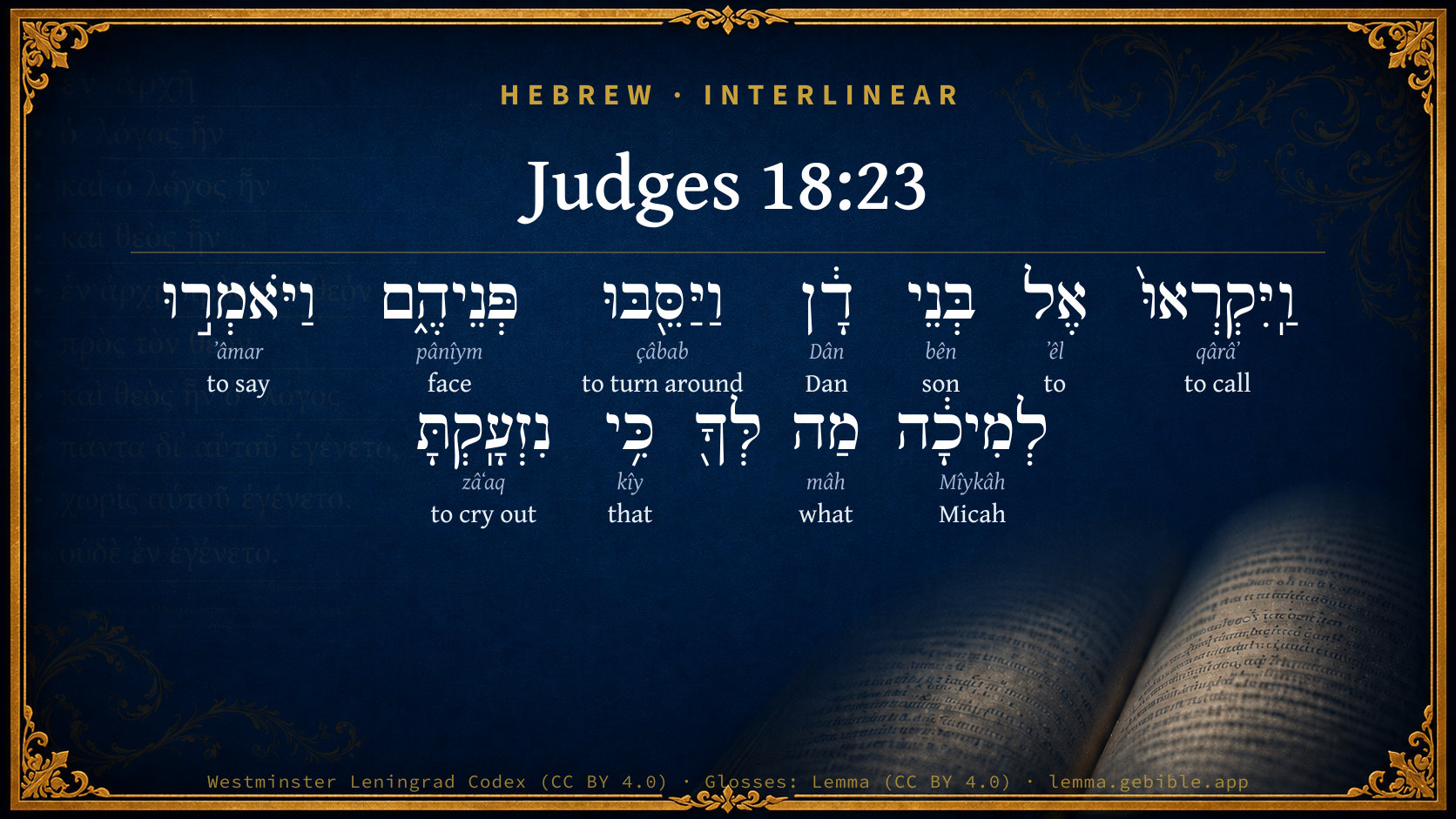
  1. וַֽיִּקְרְאוּ֙ qârâʼ H7121 “and · to call” Conjunction + Verb, Qal, Sequential Imperfect, 3rd Person, Masculine, Plural
  2. אֶל ʼêl H413 “to” Preposition
  3. בְּנֵי bên H1121 “sons of” Noun, Common, Masculine, Plural, Construct
  4. דָ֔ן Dân H1835 “Dan” Noun, Proper
  5. וַיַּסֵּ֖בּוּ çâbab H5437 “and · to turn around” Conjunction + Verb, Hiphil, Sequential Imperfect, 3rd Person, Masculine, Plural
  6. פְּנֵיהֶ֑ם pânîym H6440 “face(s) · their” Noun, Common, Both, Plural, Construct + Suffix, Personal, 3rd Person, Masculine, Plural
  7. וַיֹּאמְר֣וּ ʼâmar H559 “and · to say” Conjunction + Verb, Qal, Sequential Imperfect, 3rd Person, Masculine, Plural
  8. מַה mâh H4100 “what” Particle, Interrogative
  9. כִּ֥י kîy H3588 “that” Conjunction
  10. נִזְעָֽקְתָּ zâʻaq H2199 “to cry out” Verb, Niphal, Perfect, 2nd Person, Masculine, Singular

About this verse

These counts appear in no published source. They are computed here, from the morphology-tagged text and Lemma’s own curated glosses. What Lemma adds →

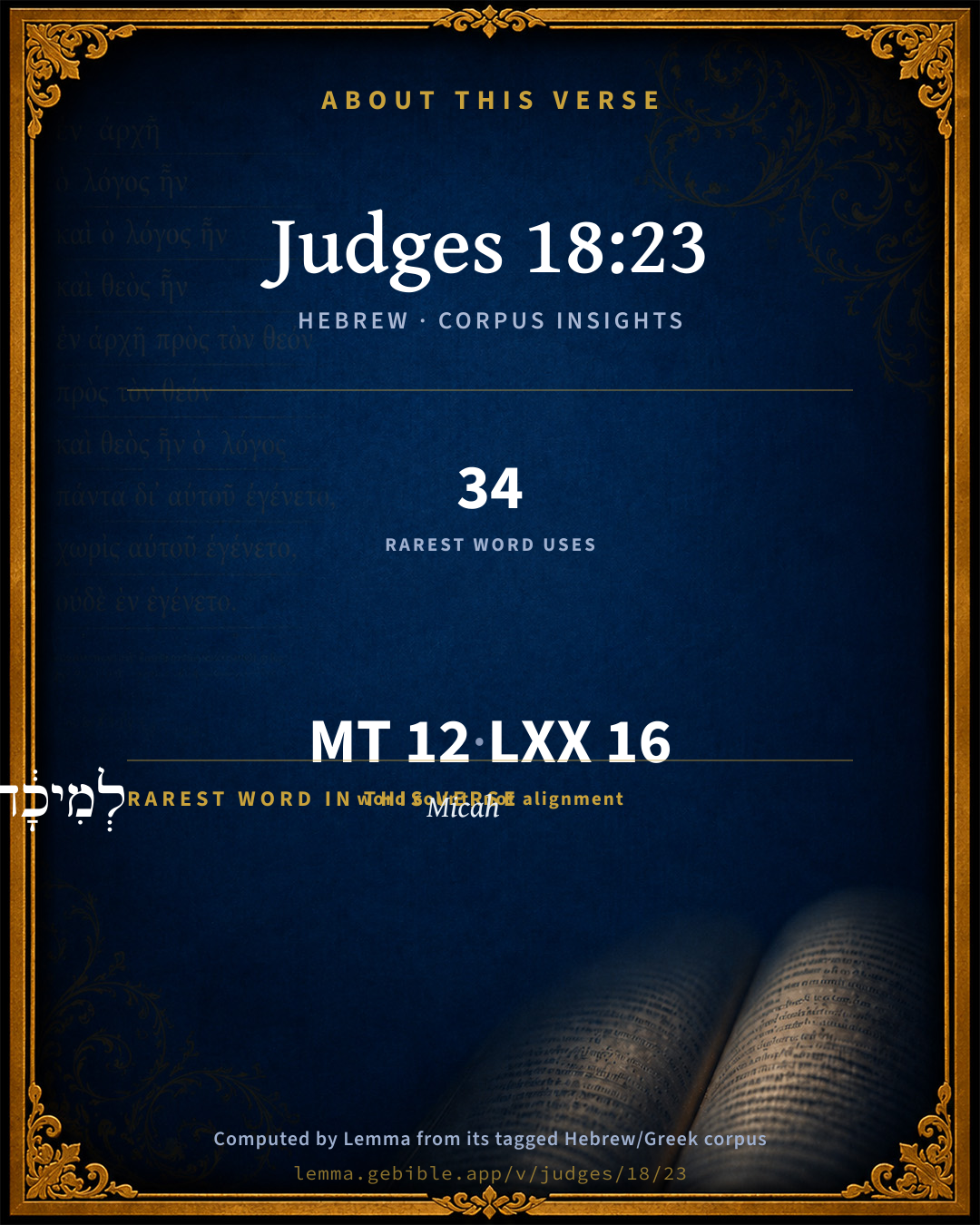
12
words
11
distinct lemmas
Historical
section

Shared distinctive vocabulary

לְמִיכָ֔ה Micah H4318 occurs in 31 verses of the Hebrew Bible. Also found in:

Grammatical profile

  • 4 verbs
  • 4 nouns
  • 2 prepositions
  • 1 conjunction
  • 1 particle

Verb forms

  • וַֽיִּקְרְאוּ֙ Qal · Sequential Imperfect
  • וַיַּסֵּ֖בּוּ Hiphil · Sequential Imperfect
  • וַיֹּאמְר֣וּ Qal · Sequential Imperfect
  • נִזְעָֽקְתָּ Niphal · Perfect

Hebrew & Septuagint length

In English translation the verse runs 25 words from the Hebrew and 23 from the Septuagint (LXX English) — closely comparable.

A rough comparison of the two English renderings, which tokenize alike — not a word-level alignment.

Word counts can differ between the Hebrew and the Greek without any difference in meaning — e.g. the Hebrew direct-object marker אֵת has no separate Greek word, and Greek often adds the article ὁ.

In the original languages it is 12 Hebrew tokens and 16 Greek tokens — but the two are counted differently (Hebrew bundles its prefixes and suffixes into one token; the Greek is in lemma form), so that isn’t a like-for-like length.

Cross-references

6

Topical passages linked to Judges 18:23 in the Treasury of Scripture Knowledge — connected by theme and wording, ordered by reader-vote popularity; previews shown in the World English Bible.

  • Genesis 21:17 God heard the voice of the boy. The angel of God called to Hagar out of the sky, and said to her, "What ails you, Hagar? Don't be afraid. For God has heard the voice of the boy where he is.
  • 1 Samuel 11:5 Behold, Saul came following the oxen out of the field; and Saul said, What ails the people that they weep? They told him the words of the men of Jabesh.
  • 2 Samuel 14:5 The king said to her, What ails you? She answered, Of a truth I am a widow, and my husband is dead.
  • 2 Kings 6:28 The king said to her, What ails you? She answered, This woman said to me, Give your son, that we may eat him today, and we will eat my son tomorrow.
  • Psalms 114:5 What was it, you sea, that you fled? You Jordan, that you turned back?
  • Isaiah 22:1 The burden of the valley of vision. What ails you now, that you are wholly gone up to the housetops?

Cross-references courtesy of OpenBible.info (CC BY 4.0).

Hebrew and Greek witnesses Masoretic Hebrew ↔ Greek Septuagint

The same verse in the two great witnesses to the Old Testament, shown verse-for-verse.

These are two independent witnesses, not word-aligned to each other, and the Septuagint is shown in lemma (dictionary) form.

Hebrew Judges 18:23 Masoretic · Westminster Leningrad Codex

וַֽיִּקְרְאוּ֙ אֶל בְּנֵי דָ֔ן וַיַּסֵּ֖בּוּ פְּנֵיהֶ֑ם וַיֹּאמְר֣וּ לְמִיכָ֔ה מַה לְּךָ֖ כִּ֥י נִזְעָֽקְתָּ

They cried to the children of Dan. They turned their faces, and said to Micah, What ails you, that you come with such a company?

World English Bible · Public Domain

Greek LXX Judges 18:23 Septuagint · lemma form

καί ἐπιστρέφω ὁ πρόσωπον αὐτός υἱός δαν καί εἶπον ὁ μιχαιας τίς εἰμί σύ ὅτι βοάω

And the children of Dan turned their face, and said to Michaias, What is the matter with you that you have cried out?

LXX2012 (modern English Septuagint) · Public Domain

Hebrew: Westminster Leningrad Codex (CC BY 4.0). Greek: Septuagint (public domain); English from LXX2012 (modern English Septuagint) (Public Domain). How the Septuagint differs from the Hebrew →

Targum (Aramaic paraphrase)

1

The Targum is the ancient Jewish Aramaic paraphrase of the Hebrew Scriptures — an interpretive translation, not the Hebrew text itself. Onkelos (literal) and Pseudo-Jonathan (expansive) render the Torah, and Jonathan the Prophets. Coverage is partial: where no permissively-licensed English translation exists for a verse, only the Aramaic is shown. This is verse-level text, not a word-by-word alignment to the Hebrew.

  1. Targum Jonathan Prophets (Joshua–Malachi)
    וּקְרוֹ לִבְנֵי דָן וְאַסְחֲרוּ אַפֵּיהוֹן וַאֲמַרוּ לְמִיכָה מַה לָךְ אֲרֵי אִתְכְּנִישְׁתָּא:

    (no public-domain English translation for this verse)

    Targum Jonathan — Aramaic: “Mikraot Gedolot” (public domain). English: “Sefaria Community Translation” (CC0 1.0 (public-domain dedication)); “London "Chaldee Paraphrase," 1871” (public domain). Text via Sefaria.

Commentary

Notes on Judges 18:23 from classic Christian and Jewish commentators (each source and its license shown beneath its notes). The classic Christian expositions comment on the surrounding passage and are grouped to its opening verse, so a note may address several verses; the Jewish commentaries on the Tanakh (Rashi and others) are per-verse, so they appear only where the commentator wrote on this verse.

Lemma curates 59 commentaries, every one of them public domain or Creative Commons licensed, each selected and text-cleaned for this edition rather than reprinted as found. About our sources →

Trapp's Complete Commentary

John Trapp

Jdg 18:23 And they cried unto the children of Dan. And they turned their faces, and said unto Micah, What aileth thee, that thou comest with such a company?

Ver. 23. What aileth thee, that thou comest?] They knew well enough what ailed him, and yet they expostulate an injury. This is one of the miseries of war, that might overcometh right. Sic cedit viribus aequum, poor men must suffer wrongs and be thankful.

John Trapp, A Commentary or Exposition upon All the Books of the Old and New Testament (1647–1656) — public domain. Text from a community e-Sword module.

Ellicott's Commentary for English Readers

(23) What aileth thee?—There is again a certain grim humour in the narrative, with some sense of irony for the total discomfiture and pathetic outcries of Micah. Dan showed himself in this proceeding like “a serpent on the way, an adder in the path” (Gen_49:17). (Comp. Deu_33:22.)

A Bible Commentary for English Readers, edited by Charles John Ellicott (1878–1897) — public domain. Text from a community e-Sword module.

John Gill's Exposition

And they cried unto the children of Dan,.... When they had got pretty near them, and in their hearing, they called to them aloud, and desired they would stop, having something to say to them:

and they turned their faces; that is, the Danites turned and looked at them, and stopped to hear what they had to say to them; these were they who were in the rear in marching:

and said unto Micah; who was at the head of them:

what aileth thee that thou comest with such a company? as if he intended to attack them in an hostile way, and therefore asks what should be the occasion of it? what affront had been given him, what injury had been done him, that had provoked him to come out and follow them in such a manner?

John Gill's Exposition of the Whole Bible (1746–1763) — public domain (CC PDM 1.0). Text via the HelloAO Bible API.

The Pulpit Commentary

That thou comest, etc. literally, that thou art gathered together, the same word as in ver. 22. It is the idea of the clan, or family, or tribe which causes the phrase. Just as Israel or Judah designates the whole nation, or the whole tribe, under the name of their patriarch, so here Micah would include all the clan who dwelt in Micah"s house; and hence the Danites speak of Micah being gathered together.

Vers. 23, 24. The idolater"s distress.

Micah has at one fell swoop lost gods and ephod and priest. As his chief gains and his fancied importance were derived from this source, he was desolate.

I THOSE WHOSE TRUST IS IN OUTWARD THINGS, AND WHOSE HEART IS BOUND UP IN THEM, ARE EXPOSED TO GRAVE DANGERS AND DISADVANTAGES. The losses of life; the anxieties and dreads; bereavement. The religion of external details, how easily disarranged! The whole "establishment" may be swept away!

II THE SPIRITUALLY-MINDED ARE FREED FROM THESE CARES, AND ALTHOUGH SUFFERING SIMILAR DEPRIVATIONS AND LOSSES, ARE NOT WITHOUT COMFORT. "God is a spirit, and they that worship him," etc. The heart that rests on Christ is secure against all outward perils. Forms, externals, etc. are not essential to true religion. The "means of grace" are not to become an end in themselves, and where the end is reached otherwise they can be dispensed with. M.

The Pulpit Commentary (1880–1919), ed. H.D.M. Spence-Jones & Joseph S. Exell — public domain. Text from a community e-Sword module.

Rashi

Rabbi Shlomo Yitzchaki (Rashi)

They turned their faces. The sons of Don turned towards those who shouted at them.

Rashi on the Tanakh — English translations: “The Judaica Press complete Tanach with Rashi, translated by A. J. Rosenberg” (CC BY 4.0); “Pentateuch with Rashi's commentary by M. Rosenbaum and A.M. Silbermann, 1929-1934” (public domain); “The Metsudah Tanach series, Lakewood, N.J” (CC BY 4.0); and “The Book of Joshua, Metsudah Publications, 1997” (CC BY 4.0). Text via Sefaria.

Lesson kit

Teaching starters — assembled from the data on this page, not authored interpretation. Every prompt links to the verse data it draws on. Edit before teaching.

Judges, in the Historical, opens this verse with 12 words (11 distinct Hebrew lemmas). Its most distinctive word is Mîykâh (“Micah”). A historical commentator’s framing appears above. Read the whole chapter for the surrounding context.

Discussion questions

  1. How does “Micah” (Mîykâh) shape what this verse is saying?
  2. Judges 17:5 shares the word «Micah» with this verse. How do the two illuminate each other?
  3. These translations render this verse differently. What is at stake in choosing one wording over another?
  4. The verb «וַֽיִּקְרְאוּ֙» is Qal Sequential Imperfect. How does its form color the action?
  5. Reading how Trapp's Complete Commentary and Ellicott's Commentary for English Readers read this verse, where do the two commentators agree and where do they part?

Things to notice

Reading settings

Reading text

Shown beneath each verse's original-language words.

Old Testament
Old Testament edition

Read the OT as the Masoretic Hebrew (MT) or the Greek Septuagint (LXX).

English shown for the Greek Septuagint (in the Hebrew ↔ Greek comparison).

Comparing translations? Open the Compare panel on any verse page to stack up to four side by side.