
Jeremiah 52:21

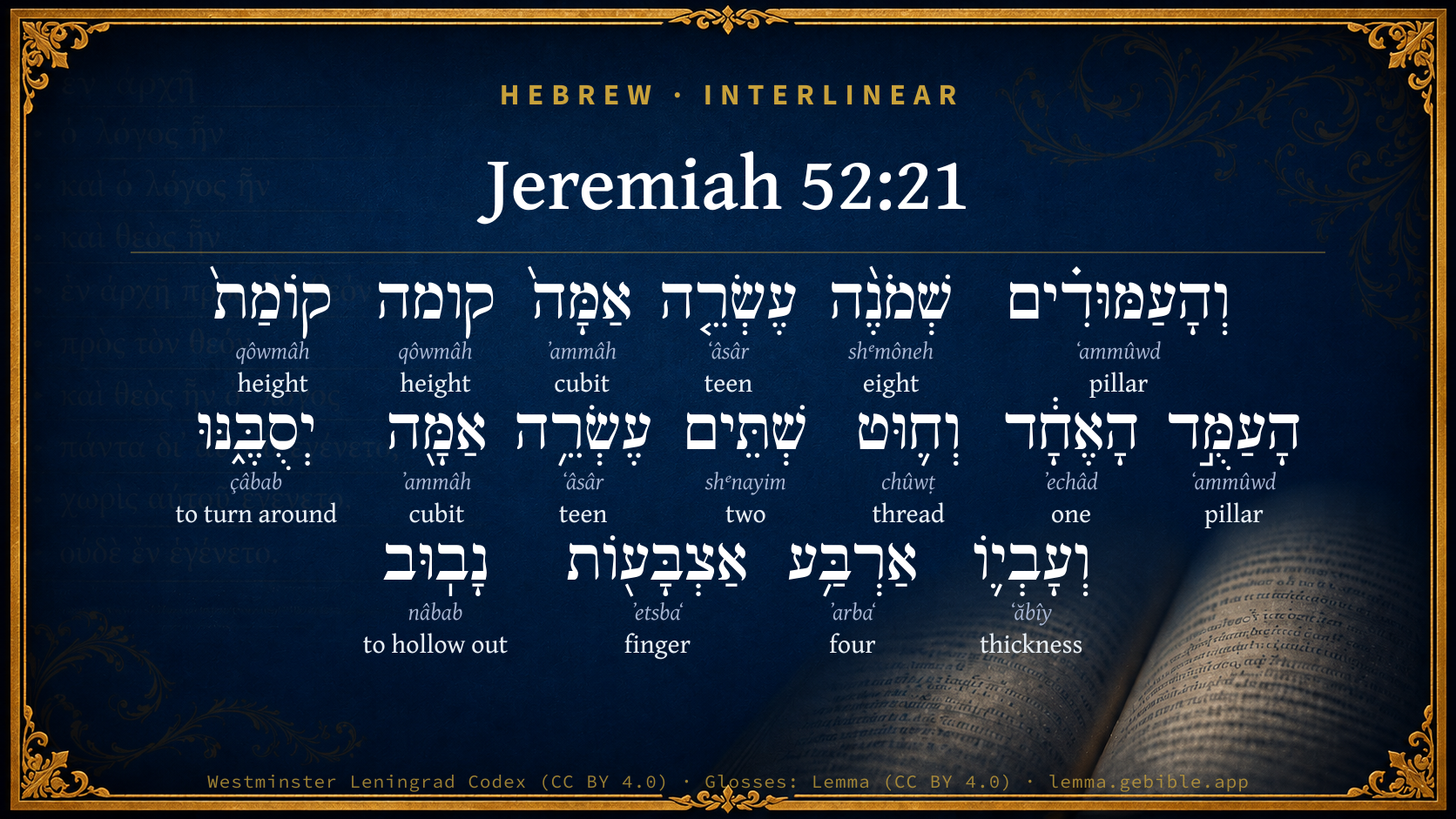
Hebrew (Westminster Leningrad Codex) Jeremiah 52:21 appears in the Hebrew Old Testament. The text above is from the Westminster Leningrad Codex. Each word links to its Strong’s number, a concise gloss, and parsing drawn from the Open Scriptures Hebrew Bible morphology. Click any word for its full Brown-Driver-Briggs (BDB) entry.
Download image
Cite this verse

Jeremiah 52:21 (World English Bible). Public Domain. Lemma interlinear Bible study tool, https://lemma.gebible.app/v/jeremiah/52/21.

Show BibTeX & RIS
BibTeX
RIS
English Translation
As for the pillars, the height of the one pillar was eighteen cubits; and a line of twelve cubits did compass it; and the thickness of it was four fingers: it was hollow.
World English Bible · Public Domain
Download a study sheet

One document with this verse’s original text, its word-by-word gloss line, the meaning frame, cross-references with their text, attributed commentary, and full source and license credits — printable, and it pastes into notes with its structure intact.

This verse Autodidact and up

Study sheet (.html) Plain text (.txt)

A passage Seminary Student

Up to 50 verses in one chapter. A passage sheet keeps up to 6 commentary sources and 12 cross-references per verse, in the order this page ranks them, and says so on the sheet whenever that leaves anything out. Ask for a single verse and you get the Autodidact verse sheet above.

Everything on this page stays free to read, with no account — the sheet is a download of what is already on screen, not access to it.

Want to remove ads? Support Godless Engineer
Compare translations 3

The same verse in 3 English versions, stacked beneath the original-language interlinear above. Click any original word for its lexicon entry.

Each is an independent rendering of the whole verse — the interlinear is not word-aligned to these translations.

Highlighted words mark where these versions differ — a whole-verse word diff, not a word-by-word alignment.

  • World English Bible Public Domain
    As for the pillars, the height of the one pillar was eighteen cubits; and a line of twelve cubits did compass it; and the thickness of it was four fingers: it was hollow.
  • King James Version Public Domain
    And concerning the pillars, the height of one pillar was eighteen cubits; and a fillet of twelve cubits did compass it; and the thickness thereof was four fingers: it was hollow.
  • unfoldingWord Literal Text CC BY-SA 4.0
    The pillars were eighteen cubits high each, and a line around each one measured twelve cubits. Each was four fingers thick and hollow.

unfoldingWord Literal Text — © unfoldingWord, licensed CC BY-SA 4.0. Word-aligned USFM3 via Door43 (git.door43.org/unfoldingWord/en_ult).

Versions to compare (up to 4)

3 of 4 selected

Show all 18 translations

Every available English version of this verse, each an independent rendering of the whole verse.

  • World English Bible Public Domain
    As for the pillars, the height of the one pillar was eighteen cubits; and a line of twelve cubits did compass it; and the thickness of it was four fingers: it was hollow.
  • Berean Standard Bible Public Domain
    Each pillar was eighteen cubits tall and twelve cubits in circumference; each was hollow, four fingers thick.
  • Majority Standard Bible Public Domain
    Each pillar was eighteen cubits tall and twelve cubits in circumference; each was hollow, four fingers thick.
  • King James Version Public Domain
    And concerning the pillars, the height of one pillar was eighteen cubits; and a fillet of twelve cubits did compass it; and the thickness thereof was four fingers: it was hollow.
  • American Standard Version (1901) Public Domain
    And as for the pillars, the height of the one pillar was eighteen cubits; and a line of twelve cubits did compass it; and the thickness thereof was four fingers: it was hollow.
  • Revised Version (1885) Public Domain
    And as for the pillars, the height of the one pillar was eighteen cubits; and a line of twelve cubits did compass it; and the thickness thereof was four fingers: it was hollow.
  • Geneva Bible (1599) Public Domain
    And concerning the pillars, the height of one pillar was eighteene cubites, and a threede of twelue cubites did compasse it, and the thicknesse thereof was foure fingers: it was holowe.
  • Douay-Rheims (1899) Public Domain
    And concerning the pillars, one pillar was eighteen cubits high: and a cord of twelve cubits compassed it about: but the thickness thereof was four fingers, and it was hollow within.
  • Young's Literal Translation Public Domain
    As to the pillars, eighteen cubits `is' the height of the one pillar, and a cord of twelve cubits doth compass it, and its thickness `is' four fingers hollow.
  • Literal Standard Version CC BY-SA 4.0
    As for the pillars, eighteen cubits [is] the height of the one pillar, and a cord of twelve cubits goes around it, and its thickness [is] four fingers hollow.
  • Unlocked Literal Bible CC BY-SA 4.0
    The pillars were eighteen cubits high each, and a line around each one measured twelve cubits. Each was four fingers thick and hollow.
  • unfoldingWord Literal Text CC BY-SA 4.0
    The pillars were eighteen cubits high each, and a line around each one measured twelve cubits. Each was four fingers thick and hollow.
  • Darby Bible Public Domain
    And as to the pillars: the height of one pillar was eighteen cubits, and a line of twelve cubits encompassed it; and the thickness thereof was four fingers: it was hollow.
  • World Messianic Bible Public Domain
    As for the pillars, the height of the one pillar was eighteen cubits; and a line of twelve cubits encircled it; and its thickness was four fingers. It was hollow.
  • Webster's Bible Public Domain
    And concerning the pillars, the hight of one pillar was eighteen cubits; and a fillet of twelve cubits encompassed it; and the thickness of it was four fingers: it was hollow.
  • Free Bible Version CC BY-SA 4.0
    Each column was eighteen cubits tall and twelve cubits around. They were hollow with walls four fingers thick.
  • Bible in Basic English Public Domain
    And as for the pillars, one pillar was eighteen cubits high, and twelve cubits measured all round, and it was as thick as a man's hand: it was hollow.
  • JPS Tanakh (1917) Public Domain
    And as for the pillars, the height of the one pillar was eighteen cubits; and a line of twelve cubits did compass it; and the thickness thereof was four fingers; it was hollow.

Literal Standard Version (2020), Covenant Press — licensed CC BY-SA 4.0. Text via the HelloAO Bible API (eBible.org). Unlocked Literal Bible (unfoldingWord) — licensed CC BY-SA 4.0. Text via the HelloAO Bible API (eBible.org). unfoldingWord Literal Text — © unfoldingWord, licensed CC BY-SA 4.0. Word-aligned USFM3 via Door43 (git.door43.org/unfoldingWord/en_ult). Free Bible Version, Dr. Jonathan Gallagher — licensed CC BY-SA 4.0. Text via the HelloAO Bible API (eBible.org).

Word by word

More ways to search: Search by grammar → Find every occurrence → Compare this word →

Practice this passage: Drill this verse → Learn its vocabulary →

וְעָבְי֛וֹ
ʻăbîy
H5672
“and · thickness · his”
Conjunction + Noun, Common, Masculine, Singular, Construct + Suffix, Personal, 3rd Person, Masculine, Singular
Part of Speech
Conjunction + Noun
Type
Common
Gender
Masculine
Number
Singular
State
Construct
Full BDB Definition

Origin: from H5666

TWOT: 1554a

thickness
  1. וְהָעַמּוּדִ֗ים ʻammûwd H5982 “and · the · pillars” Conjunction + Particle, Definite Article + Noun, Common, Masculine, Plural, Absolute
  2. שְׁמֹנֶ֨ה shᵉmôneh H8083 “eight” Adjective, Cardinal number, Feminine, Singular, Absolute
  3. עֶשְׂרֵ֤ה ʻâsâr H6240 “teen” Adjective, Cardinal number, Feminine, Singular, Absolute
  4. אַמָּה֙ ʼammâh H520 “cubit” Noun, Common, Feminine, Singular, Absolute
  5. קומה qôwmâh H6967 “height of” Noun, Common, Feminine, Singular, Construct
  6. קוֹמַת֙ qôwmâh H6967 “height of” Noun, Common, Feminine, Singular, Construct
  7. הָעַמֻּ֣ד ʻammûwd H5982 “the · pillar” Particle, Definite Article + Noun, Common, Masculine, Singular, Absolute
  8. הָאֶחָ֔ד ʼechâd H259 “the · one” Particle, Definite Article + Adjective, Cardinal number, Masculine, Singular, Absolute
  9. וְח֛וּט chûwṭ H2339 “and · thread of” Conjunction + Noun, Common, Masculine, Singular, Construct
  10. שְׁתֵּים shᵉnayim H8147 “two” Adjective, Cardinal number, Feminine, Dual, Absolute
  11. עֶשְׂרֵ֥ה ʻâsâr H6240 “teen” Adjective, Cardinal number, Feminine, Singular, Absolute
  12. אַמָּ֖ה ʼammâh H520 “cubit” Noun, Common, Feminine, Singular, Absolute
  13. יְסֻבֶּ֑נּוּ çâbab H5437 “to turn around · him” Verb, Qal, Imperfect, 3rd Person, Masculine, Singular + Suffix, Personal, 3rd Person, Masculine, Singular
  14. אַרְבַּ֥ע ʼarbaʻ H702 “four” Adjective, Cardinal number, Feminine, Singular, Absolute
  15. אַצְבָּע֖וֹת ʼetsbaʻ H676 “fingers” Noun, Common, Feminine, Plural, Absolute
  16. נָבֽוּב nâbab H5014 “hollowed out” Verb, Qal, Participle Passive, Masculine, Singular, Absolute

About this verse

These counts appear in no published source. They are computed here, from the morphology-tagged text and Lemma’s own curated glosses. What Lemma adds →

17
words
13
distinct lemmas
Prophets
section

Notable vocabulary

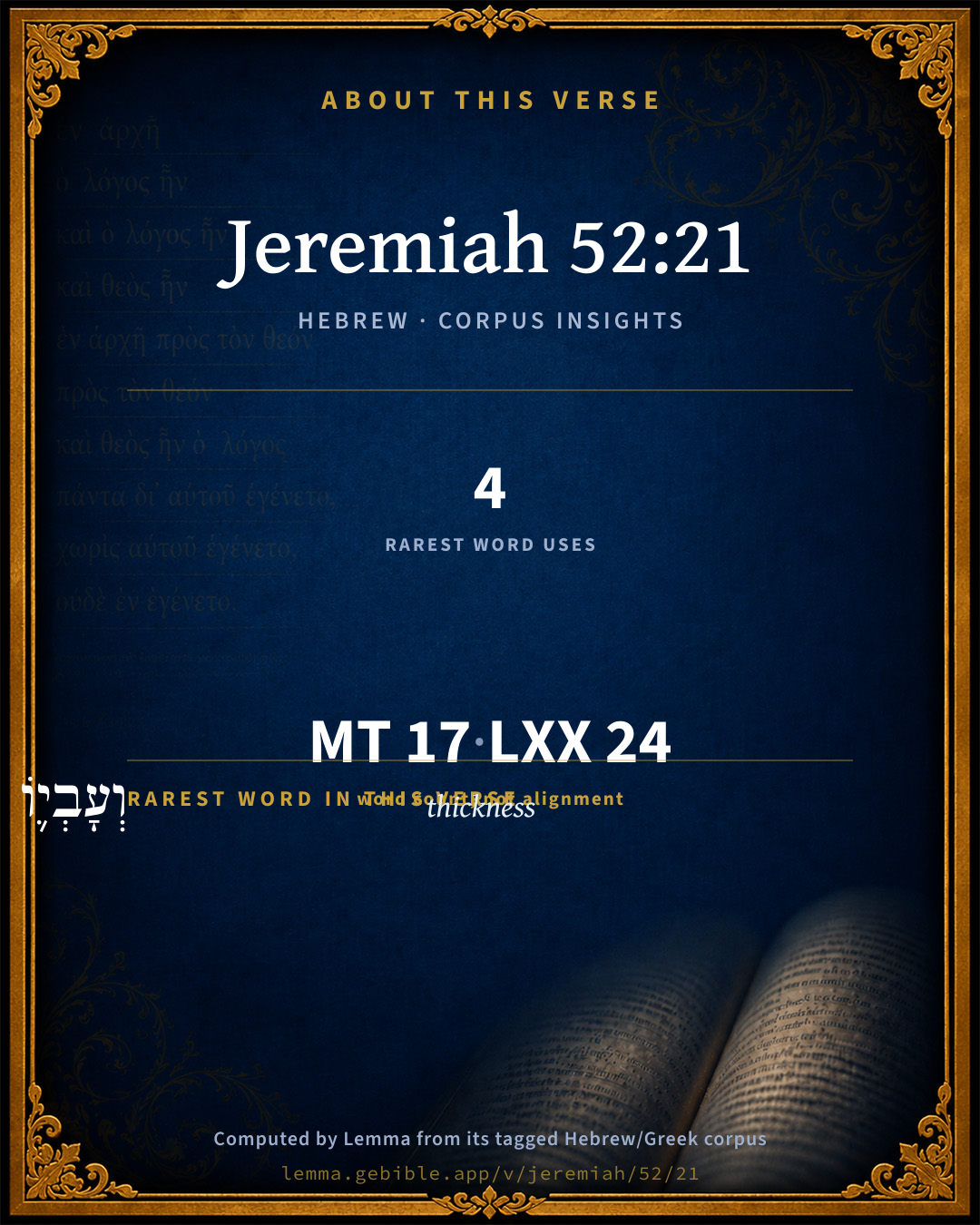
The rarest word here is וְעָבְי֛וֹ thickness H5672 — appearing just 4 times in the whole Hebrew Bible.

Shared distinctive vocabulary

וְעָבְי֛וֹ thickness H5672 occurs in 4 verses of the Hebrew Bible. Also found in:

Grammatical profile

  • 2 verbs
  • 9 nouns
  • 6 adjectives

Verb forms

  • יְסֻבֶּ֑נּוּ Qal · Imperfect
  • נָבֽוּב Qal · Participle Passive

Repetition

Words recur within this verse — often emphatic in Hebrew:

  • וְהָעַמּוּדִ֗ים pillar H5982 ×2
  • עֶשְׂרֵ֤ה teen H6240 ×2
  • אַמָּה֙ cubit H520 ×2
  • קומה height H6967 ×2

Hebrew & Septuagint length

In the original languages it is 17 Hebrew tokens and 24 Greek tokens — but the two are counted differently (Hebrew bundles its prefixes and suffixes into one token; the Greek is in lemma form), so that isn’t a like-for-like length.

Cross-references

3

Topical passages linked to Jeremiah 52:21 in the Treasury of Scripture Knowledge — connected by theme and wording, ordered by reader-vote popularity; previews shown in the World English Bible.

  • 2 Kings 25:17 The height of the one pillar was eighteen cubits, and a capital of brass was on it; and the height of the capital was three cubits, with network and pomegranates on the capital round about, all of brass: and like to these had the second pillar with network.
  • 1 Kings 7:15–21 For he fashioned the two pillars of brass, eighteen cubits high apiece: and a line of twelve cubits compassed either of them about.
  • 2 Chronicles 3:15–17 Also he made before the house two pillars of thirty-five cubits high, and the capital that was on the top of each of them was five cubits.

Cross-references courtesy of OpenBible.info (CC BY 4.0).

Hebrew and Greek witnesses Masoretic Hebrew ↔ Greek Septuagint

The same verse in the two great witnesses to the Old Testament, shown verse-for-verse.

These are two independent witnesses, not word-aligned to each other, and the Septuagint is shown in lemma (dictionary) form.

Hebrew Jeremiah 52:21 Masoretic · Westminster Leningrad Codex

וְהָעַמּוּדִ֗ים שְׁמֹנֶ֨ה עֶשְׂרֵ֤ה אַמָּה֙ קומה קוֹמַת֙ הָעַמֻּ֣ד הָאֶחָ֔ד וְח֛וּט שְׁתֵּים עֶשְׂרֵ֥ה אַמָּ֖ה יְסֻבֶּ֑נּוּ וְעָבְי֛וֹ אַרְבַּ֥ע אַצְבָּע֖וֹת נָבֽוּב

As for the pillars, the height of the one pillar was eighteen cubits; and a line of twelve cubits did compass it; and the thickness of it was four fingers: it was hollow.

World English Bible · Public Domain

Greek LXX Structure differs

In the Septuagint, Jeremiah is about an eighth shorter than the Hebrew and arranges its material differently — the Oracles Against the Nations (Hebrew chapters 46–51) appear in the middle of the Greek book, after 25:13. Because the chapter and verse boundaries do not line up, a verse-for-verse comparison with the Hebrew is not shown.

A verse-for-verse comparison isn’t shown here because the chapters and verses don’t line up. Switch to the LXX edition with the MT / LXX toggle above to read the Greek directly.

Hebrew: Westminster Leningrad Codex (CC BY 4.0). Greek: Septuagint (public domain); English from a public-domain English Septuagint. How the Septuagint differs from the Hebrew →

Targum (Aramaic paraphrase)

1

The Targum is the ancient Jewish Aramaic paraphrase of the Hebrew Scriptures — an interpretive translation, not the Hebrew text itself. Onkelos (literal) and Pseudo-Jonathan (expansive) render the Torah, and Jonathan the Prophets. Coverage is partial: where no permissively-licensed English translation exists for a verse, only the Aramaic is shown. This is verse-level text, not a word-by-word alignment to the Hebrew.

  1. Targum Jonathan Prophets (Joshua–Malachi)
    וְעַמוּדַיָא תַּמְנָא עַסְרֵי אַמִין רוּמֵיהּ דְעַמוּדָא חָד וְחוּט מְשַׁח תַּרְתָּא עַסְרֵי אַמִין מַקֵף לֵיהּ סְחוֹר סְחוֹר וְסוּמְכֵיהּ אַרְבַּע אֶצְבָּעִין חֲלִיל:

    (no public-domain English translation for this verse)

    Targum Jonathan — Aramaic: “Mikraot Gedolot” (public domain). English: “Sefaria Community Translation” (CC0 1.0 (public-domain dedication)); “London "Chaldee Paraphrase," 1871” (public domain). Text via Sefaria.

Commentary

Notes on Jeremiah 52:21 from classic Christian and Jewish commentators (each source and its license shown beneath its notes). The classic Christian expositions comment on the surrounding passage and are grouped to its opening verse, so a note may address several verses; the Jewish commentaries on the Tanakh (Rashi and others) are per-verse, so they appear only where the commentator wrote on this verse.

Lemma curates 59 commentaries, every one of them public domain or Creative Commons licensed, each selected and text-cleaned for this edition rather than reprinted as found. About our sources →

Joseph Benson's Commentary

Jer 52:21-23. The height of one pillar was eighteen cubits — The same account is given of the height of these pillars, 1Ki 7:15 : but in 2Ch 3:15, it is said, that both the pillars made thirty-five cubits; which two texts may be easily reconciled by allowing one cubit for the basis. And a fillet of twelve cubits — So that the diameter was almost four cubits. The thickness whereof was four fingers — The pillar being hollow, the thickness of the work that encompassed the hollow space was four fingers over. There were ninety and six pomegranates on a side — Or, toward every wind, as Blaney very properly renders רוחה. “In 1Ki 7:42, and 2Ch 4:13, it is said, there were four hundred pomegranates for each net-work or wreath. The mode of expression here is different, but amounts to exactly the same. For divide the two pillars into four quarters, according to the four winds; and let ninety-six pomegranates stand opposite to each of the four winds upon the two pillars; the whole number in front of the four winds, taken together, will be three hundred and eighty-four. But they were in four rows, two on each pillar, and in each row must have been four angular pomegranates, that could not be said to be opposite to any of the four winds, consequently, sixteen angular ones in the four rows; which sixteen being added to three hundred and eighty-four, make up the number of pomegranates in all four hundred; that is, a hundred in a row of wreathen work round about.”

Joseph Benson's Commentary on the Old and New Testaments (1811–1818) — public domain. Text from a community e-Sword module.

Tyndale Open Study Notes

Tyndale Open Resources

52:21 Jeremiah added “and 18 feet in circumference” and the last sentence (cp. 2 Kgs 25:17).

Tyndale Open Study Notes — © Tyndale Open Resources, licensed CC BY-SA 4.0. Text via the HelloAO Bible API.

Jamieson, Fausset & Brown

Robert Jamieson, A. R. Fausset & David Brown

eighteen cubits--but in Ch2 3:15, it is "thirty-five cubits." The discrepancy is thus removed. Each pillar was eighteen common cubits. The two together, deducting the base, were thirty-five, as stated in Ch2 3:15 [GROTIUS]. Other ways (for example, by reference to the difference between the common and the sacred cubit) are proposed: though we are not able positively to decide now which is the true way, at least those proposed do show that the discrepancies are not irreconcilable.

Jamieson, Fausset & Brown — Commentary Critical and Explanatory on the Whole Bible (1871) — public domain (CC PDM 1.0). Text via the HelloAO Bible API.

Adam Clarke's Commentary

Verse 21. See Clarke on Jer 52:18.

Adam Clarke's Commentary on the Bible (1810–1826) — public domain. Text from a community e-Sword/MySword module.

Ellicott's Commentary for English Readers

(21-23) And concerning the pillars . . .—In 2Ki_25:16-17 we have a list abbreviated by the omission of some of the measurements and of the number and arrangement of the pomegranates. “Chapiter” is the old English word for the “capital” of a column.

On a side.—The exact meaning of the Hebrew is towards a (=each) wind—i.e., there were twenty-four pomegranates on each side of the square pillars, with one at each corner, making, as in Jer_52:23, one hundred in all.

A Bible Commentary for English Readers, edited by Charles John Ellicott (1878–1897) — public domain. Text from a community e-Sword module.

The Cambridge Bible for Schools and Colleges

gen. ed. J. J. S. Perowne

21. eighteen cubits] a cubit was about 18 inches.

21–23. Cp. 1Ki_7:15-18.

The Cambridge Bible for Schools and Colleges (gen. ed. J. J. S. Perowne; Cambridge University Press, 1878–1918) — public domain. Text from a community e-Sword module.

John Gill's Exposition

And a chapiter of brass was upon it,.... Or a coronet of brass, of molten brass, was set upon the top of the pillar:

and the height of one chapiter was five cubits; as in Kg1 7:16; but in Kg2 25:17; the height is said to be but three cubits; which is reconciled by the Jewish Rabbins thus, the three superior cubits of it were with ornaments, the two inferior without any; the whole together was five cubits; but, as ornamented, only three:

with network and pomegranates upon the chapiters round about, all of brass; the nets were of chequer work, and wreaths of chain work, and there were seven of them to each chapiter, Kg1 7:17;

the second pillar also, and the pomegranates, were like unto these; one pillar was exactly like the other, and the ornaments of it the same.

John Gill's Exposition of the Whole Bible (1746–1763) — public domain (CC PDM 1.0). Text via the HelloAO Bible API.

Albert Barnes' Notes on the Bible

The fillet means a measuring line; the pillars were 12 cubits, i. e., 18 feet, in circumference, and thus the diameter would be 5 feet 9 inches. As the brass was four fingers, i. e., scarcely four inches thick, the hollow center would be more than five feet in diameter.

Albert Barnes' Notes on the Bible (1834–1885) — public domain. Text from a community e-Sword/MySword module.

Matthew Poole's English Annotations

This agreeth with 1Ki 7:15, where what is called here a fillet is called a thread; concerning the height of the pillars, we read the same 2Ki 25:17; 2Ch 3:15.

Matthew Poole's English Annotations on the Holy Bible (1683–1685) — public domain. Text from a community e-Sword/MySword module.

Lesson kit

Teaching starters — assembled from the data on this page, not authored interpretation. Every prompt links to the verse data it draws on. Edit before teaching.

Jeremiah, in the Prophets, opens this verse with 17 words (13 distinct Hebrew lemmas). Its most distinctive word is ʻăbîy (“thickness”). A historical commentator’s framing appears above. Read the whole chapter for the surrounding context.

Discussion questions

  1. What does “thickness” (ʻăbîy) contribute to the verse as a whole?
  2. How does 1 Kings 7:26, which shares the word «thickness», read alongside this verse?
  3. What does the repetition of “pillar” (2× in this one verse) do in this verse?
  4. The translations on this page render this verse differently — a whole-verse word diff, not a word-by-word alignment. What might account for the different wordings?
  5. «יְסֻבֶּ֑נּוּ» is a Qal Imperfect verb. How does that grammatical form shape the action described?
  6. Compare how Joseph Benson's Commentary and Tyndale Open Study Notes read this verse. Where do they agree or differ?

Things to notice

Reading settings

Reading text

Shown beneath each verse's original-language words.

Old Testament
Old Testament edition

Read the OT as the Masoretic Hebrew (MT) or the Greek Septuagint (LXX).

English shown for the Greek Septuagint (in the Hebrew ↔ Greek comparison).

Comparing translations? Open the Compare panel on any verse page to stack up to four side by side.