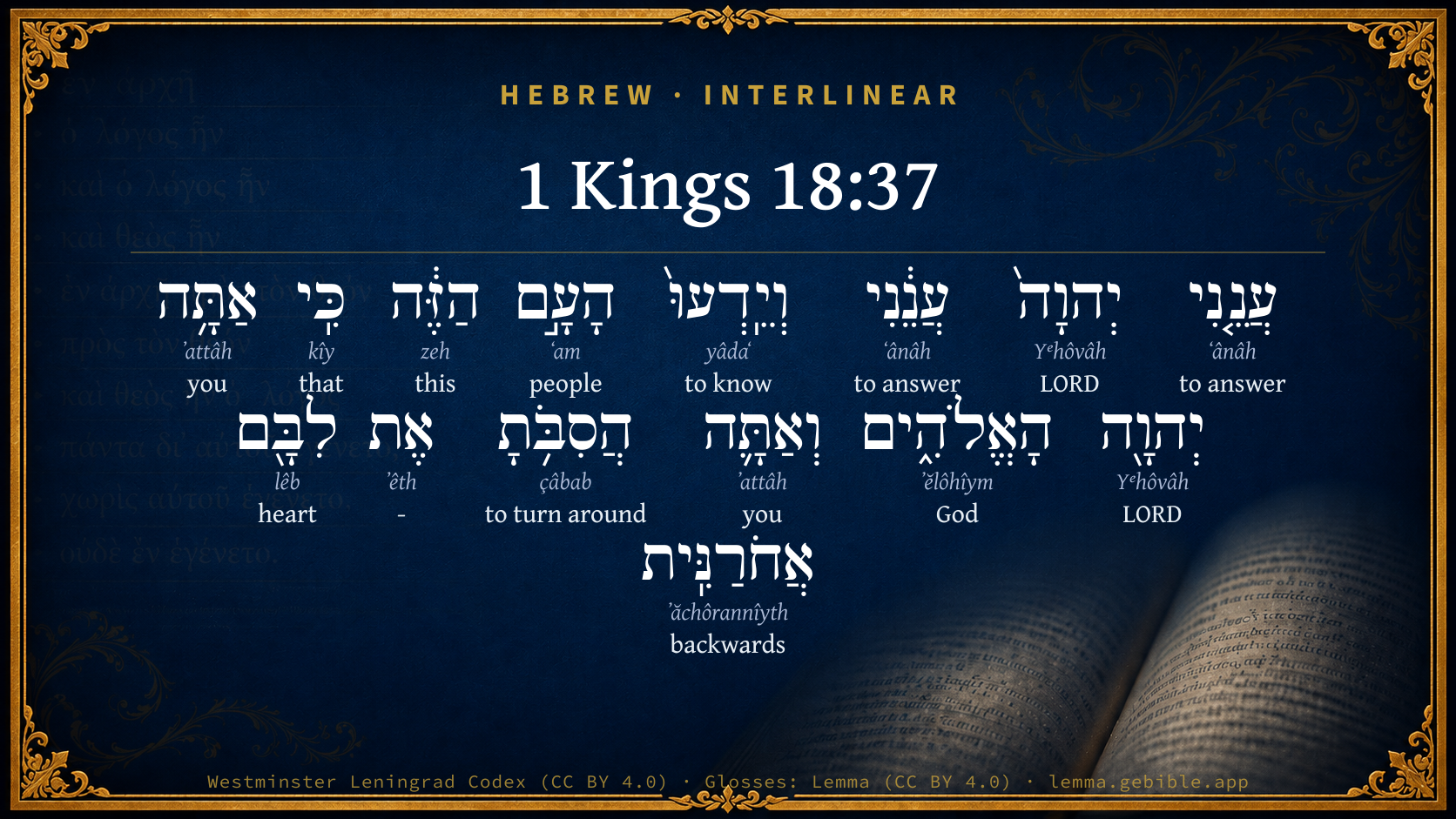
1 Kings 18:37

Hebrew (Westminster Leningrad Codex) 1 Kings 18:37 appears in the Hebrew Old Testament. The text above is from the Westminster Leningrad Codex. Each word links to its Strong’s number, a concise gloss, and parsing drawn from the Open Scriptures Hebrew Bible morphology. Click any word for its full Brown-Driver-Briggs (BDB) entry.
Download image
Cite this verse

1 Kings 18:37 (World English Bible). Public Domain. Lemma interlinear Bible study tool, https://lemma.gebible.app/v/1-kings/18/37.

Show BibTeX & RIS
BibTeX
RIS
English Translation
Hear me, Yahweh, hear me, that this people may know that you, Yahweh, are God, and [that] you have turned their heart back again.
World English Bible · Public Domain
Download a study sheet

One document with this verse’s original text, its word-by-word gloss line, the meaning frame, cross-references with their text, attributed commentary, and full source and license credits — printable, and it pastes into notes with its structure intact.

This verse Autodidact and up

Study sheet (.html) Plain text (.txt)

A passage Seminary Student

Up to 50 verses in one chapter. A passage sheet keeps up to 6 commentary sources and 12 cross-references per verse, in the order this page ranks them, and says so on the sheet whenever that leaves anything out. Ask for a single verse and you get the Autodidact verse sheet above.

Everything on this page stays free to read, with no account — the sheet is a download of what is already on screen, not access to it.

Want to remove ads? Support Godless Engineer
Compare translations 3

The same verse in 3 English versions, stacked beneath the original-language interlinear above. Click any original word for its lexicon entry.

Each is an independent rendering of the whole verse — the interlinear is not word-aligned to these translations.

Highlighted words mark where these versions differ — a whole-verse word diff, not a word-by-word alignment.

  • World English Bible Public Domain
    Hear me, Yahweh, hear me, that this people may know that you, Yahweh, are God, and [that] you have turned their heart back again.
  • King James Version Public Domain
    Hear me, O LORD, hear me, that this people may know that thou art the LORD God, and that thou hast turned their heart back again.
  • unfoldingWord Literal Text CC BY-SA 4.0
    Answer me, Yahweh! Answer me so that this people may know that you, Yahweh, God, and you, you have turned their heart back.”

unfoldingWord Literal Text — © unfoldingWord, licensed CC BY-SA 4.0. Word-aligned USFM3 via Door43 (git.door43.org/unfoldingWord/en_ult).

Versions to compare (up to 4)

3 of 4 selected

Show all 18 translations

Every available English version of this verse, each an independent rendering of the whole verse.

  • World English Bible Public Domain
    Hear me, Yahweh, hear me, that this people may know that you, Yahweh, are God, and [that] you have turned their heart back again.
  • Berean Standard Bible Public Domain
    Answer me, O LORD! Answer me, so that this people will know that You, the LORD, are God, and that You have turned their hearts back again.”
  • Majority Standard Bible Public Domain
    Answer me, O LORD! Answer me, so that this people will know that You, the LORD, are God, and that You have turned their hearts back again.”
  • King James Version Public Domain
    Hear me, O LORD, hear me, that this people may know that thou art the LORD God, and that thou hast turned their heart back again.
  • American Standard Version (1901) Public Domain
    Hear me, O Jehovah, hear me, that this people may know that thou, Jehovah, art God, and `that' thou hast turned their heart back again.
  • Revised Version (1885) Public Domain
    Hear me, O LORD, hear me, that this people may know that thou, LORD, art God, and that thou hast turned their heart back again.
  • Geneva Bible (1599) Public Domain
    Heare me, O Lord, heare me, and let this people know that thou art the Lord God, and that thou hast turned their heart againe at the last.
  • Douay-Rheims (1899) Public Domain
    Hear me, O Lord, hear me: that this people may learn, that thou art the Lord God, and that thou hast turned their heart again.
  • Young's Literal Translation Public Domain
    answer me, O Jehovah, answer me, and this people doth know that Thou `art' Jehovah God; and Thou hast turned their heart backward.'
  • Literal Standard Version CC BY-SA 4.0
    answer me, O YHWH, answer me, and this people [then] knows that You [are] YHWH God; and You have turned their heart backward.”
  • Unlocked Literal Bible CC BY-SA 4.0
    Hear me, Yahweh, hear me, that these people may know that you, Yahweh, are God, and that you have turned their heart back again to yourself.”
  • unfoldingWord Literal Text CC BY-SA 4.0
    Answer me, Yahweh! Answer me so that this people may know that you, Yahweh, God, and you, you have turned their heart back.”
  • Darby Bible Public Domain
    Answer me, Jehovah, answer me, that this people may know that thou Jehovah art God, and [that] *thou* hast turned their heart back again.
  • World Messianic Bible Public Domain
    Hear me, LORD, hear me, that this people may know that you, LORD, are God, and that you have turned their heart back again.”
  • Webster's Bible Public Domain
    Hear me, O LORD, hear me, that this people may know that thou art the LORD God, and that thou hast turned their heart back again.
  • Free Bible Version CC BY-SA 4.0
    Answer me, Lord! Answer me, so that these people will know that you, Lord, are God, and that you are bringing them back to you.”
  • Bible in Basic English Public Domain
    Give me an answer, O Lord, give me an answer, so that this people may see that you are God, and that you have made their hearts come back again.
  • JPS Tanakh (1917) Public Domain
    Hear me, O LORD, hear me, that this people may know that Thou, LORD, art God, for Thou didst turn their heart backward.'

Literal Standard Version (2020), Covenant Press — licensed CC BY-SA 4.0. Text via the HelloAO Bible API (eBible.org). Unlocked Literal Bible (unfoldingWord) — licensed CC BY-SA 4.0. Text via the HelloAO Bible API (eBible.org). unfoldingWord Literal Text — © unfoldingWord, licensed CC BY-SA 4.0. Word-aligned USFM3 via Door43 (git.door43.org/unfoldingWord/en_ult). Free Bible Version, Dr. Jonathan Gallagher — licensed CC BY-SA 4.0. Text via the HelloAO Bible API (eBible.org).

Word by word

More ways to search: Search by grammar → Find every occurrence → Compare this word →

Practice this passage: Drill this verse → Learn its vocabulary →

אֲחֹרַנִּֽית
ʼăchôrannîyth
H322
“backwards”
Adverb
Part of Speech
Adverb
Full BDB Definition

Origin: prolonged from H268

TWOT: 68d

backwards, back part, the rear
  1. עֲנֵ֤נִי ʻânâh H6030 “answer · me” Verb, Qal, Imperative, 2nd Person, Masculine, Singular + Suffix, Personal, 1st Person, Common, Singular
  2. יְהוָה֙ Yᵉhôvâh H3068 “LORD” Noun, Proper
  3. עֲנֵ֔נִי ʻânâh H6030 “answer · me” Verb, Qal, Imperative, 2nd Person, Masculine, Singular + Suffix, Personal, 1st Person, Common, Singular
  4. וְיֵֽדְעוּ֙ yâdaʻ H3045 “and · to know” Conjunction + Verb, Qal, Imperfect, 3rd Person, Masculine, Plural
  5. הָעָ֣ם ʻam H5971 “the · people” Particle, Definite Article + Noun, Common, Masculine, Singular, Absolute
  6. הַזֶּ֔ה zeh H2088 “the · this” Particle, Definite Article + Pronoun, Demonstrative, Masculine, Singular
  7. כִּֽי kîy H3588 “that” Conjunction
  8. אַתָּ֥ה ʼattâh H859 “you” Pronoun, Personal, 2nd Person, Masculine, Singular
  9. יְהוָ֖ה Yᵉhôvâh H3068 “LORD” Noun, Proper
  10. הָאֱלֹהִ֑ים ʼĕlôhîym H430 “the · God(s)” Particle, Definite Article + Noun, Common, Masculine, Plural, Absolute
  11. וְאַתָּ֛ה ʼattâh H859 “and · you” Conjunction + Pronoun, Personal, 2nd Person, Masculine, Singular
  12. הֲסִבֹּ֥תָ çâbab H5437 “to turn around” Verb, Hiphil, Perfect, 2nd Person, Masculine, Singular
  13. אֶת ʼêth H853 “-” Particle, Direct Object
  14. לִבָּ֖ם lêb H3820 “heart · their” Noun, Common, Masculine, Singular, Construct + Suffix, Personal, 3rd Person, Masculine, Plural

About this verse

These counts appear in no published source. They are computed here, from the morphology-tagged text and Lemma’s own curated glosses. What Lemma adds →

15
words
12
distinct lemmas
Historical
section

Notable vocabulary

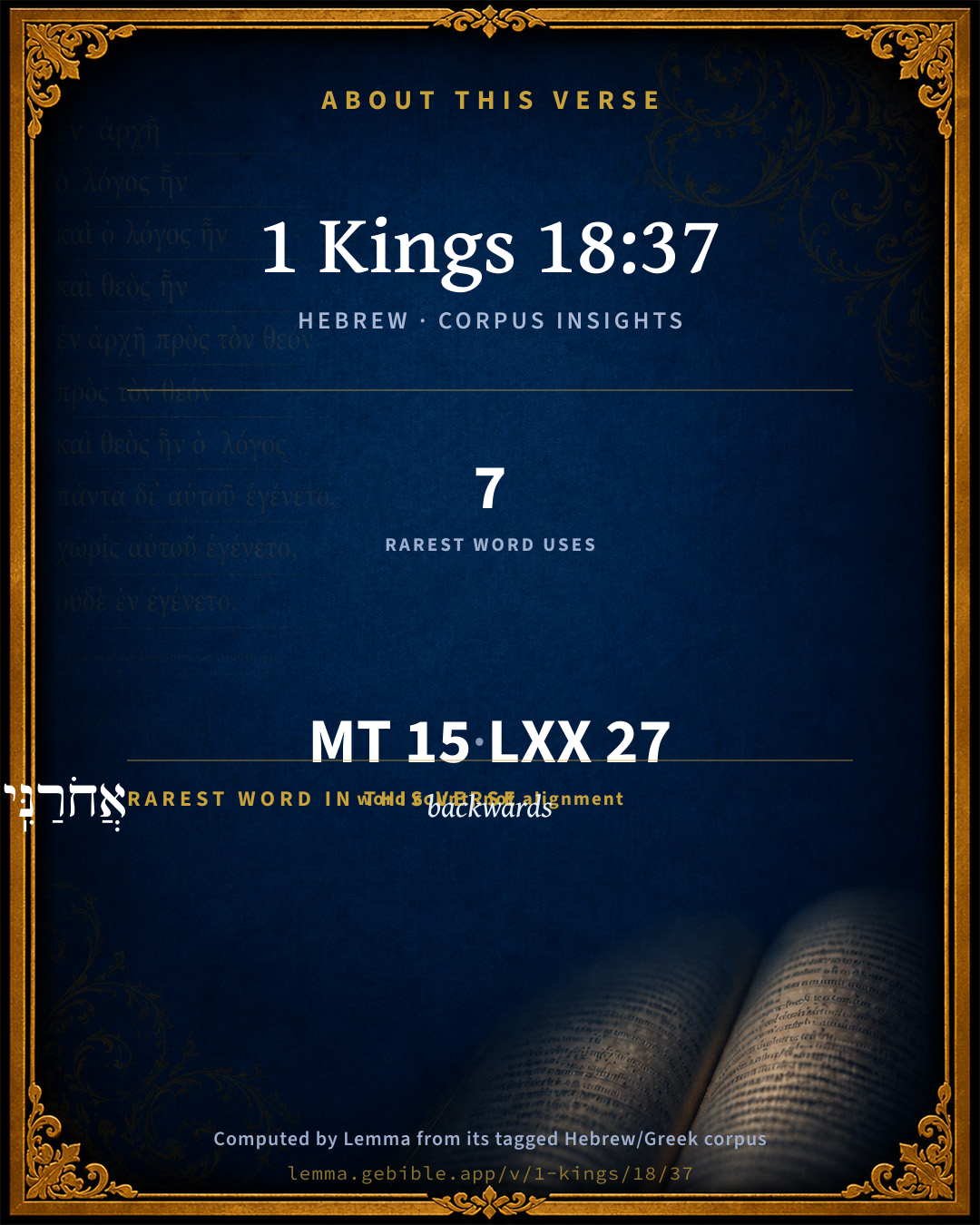
The rarest word here is אֲחֹרַנִּֽית backwards H322 — appearing just 7 times in the whole Hebrew Bible.

Shared distinctive vocabulary

אֲחֹרַנִּֽית backwards H322 occurs in 6 verses of the Hebrew Bible. Also found in:

Grammatical profile

  • 4 verbs
  • 5 nouns
  • 3 pronouns
  • 1 conjunction
  • 1 adverb
  • 1 particle

Verb forms

  • עֲנֵ֤נִי Qal · Imperative
  • עֲנֵ֔נִי Qal · Imperative
  • וְיֵֽדְעוּ֙ Qal · Imperfect
  • הֲסִבֹּ֥תָ Hiphil · Perfect

Repetition

Words recur within this verse — often emphatic in Hebrew:

  • עֲנֵ֤נִי to answer H6030 ×2
  • יְהוָה֙ LORD H3068 ×2
  • אַתָּ֥ה you H859 ×2

Hebrew & Septuagint length

In English translation the verse runs 24 words from the Hebrew and 27 from the Septuagint (LXX English) — closely comparable.

A rough comparison of the two English renderings, which tokenize alike — not a word-level alignment.

Word counts can differ between the Hebrew and the Greek without any difference in meaning — e.g. the Hebrew direct-object marker אֵת has no separate Greek word, and Greek often adds the article ὁ.

In the original languages it is 15 Hebrew tokens and 27 Greek tokens — but the two are counted differently (Hebrew bundles its prefixes and suffixes into one token; the Greek is in lemma form), so that isn’t a like-for-like length.

Cross-references

16

Topical passages linked to 1 Kings 18:37 in the Treasury of Scripture Knowledge — connected by theme and wording, ordered by reader-vote popularity; previews shown in the World English Bible.

  • Daniel 9:17–19 Now therefore, our God, listen to the prayer of your servant, and to his petitions, and cause your face to shine on your sanctuary that is desolate, for the Lord's sake.
  • Luke 1:16–17 He will turn many of the children of Israel to the Lord, their God.
  • Ezekiel 36:25–27 I will sprinkle clean water on you, and you shall be clean: from all your filthiness, and from all your idols, will I cleanse you.
  • 1 Kings 18:24 You call on the name of your god, and I will call on the name of Yahweh; and the God who answers by fire, let him be God." All the people answered, "It is well said."
  • Malachi 4:5–6 Behold, I will send you Elijah the prophet before the great and terrible day of Yahweh comes.
  • Genesis 32:24 Jacob was left alone, and wrestled with a man there until the breaking of the day.
  • Genesis 32:26 The man said, "Let me go, for the day breaks." Jacob said, "I won't let you go, unless you bless me."
  • Genesis 32:28 He said, "Your name will no longer be called 'Jacob,' but, 'Israel,' for you have fought with God and with men, and have prevailed."
  • 1 Kings 18:29 It was so, when midday was past, that they prophesied until the time of the offering of the [evening] offering; but there was neither voice, nor any to answer, nor any who regarded.
  • 1 Kings 18:36 It happened at the time of the offering of the [evening] offering, that Elijah the prophet came near, and said, Yahweh, the God of Abraham, of Isaac, and of Israel, let it be known this day that you are God in Israel, and that I am your servant, and that I have done all these things at your word.
  • 2 Chronicles 14:11 Asa cried to Yahweh his God, and said, Yahweh, there is none besides you to help, between the mighty and him who has no strength: help us, Yahweh our God; for we rely on you, and in your name are we come against this multitude. Yahweh, you are our God; don't let man prevail against you.
  • 2 Chronicles 32:19–20 They spoke of the God of Jerusalem, as of the gods of the peoples of the earth, which are the work of men's hands.
  • Isaiah 37:17–20 Turn your ear, Yahweh, and hear; open your eyes, Yahweh, and behold; and hear all the words of Sennacherib, who has sent to defy the living God.
  • Jeremiah 31:18–19 I have surely heard Ephraim bemoaning himself [thus], You have chastised me, and I was chastised, as a calf unaccustomed [to the yoke]: turn you me, and I shall be turned; for you are Yahweh my God.
  • Luke 11:8 I tell you, although he will not rise and give it to him because he is his friend, yet because of his persistence, he will get up and give him as many as he needs.
  • James 5:16–17 Confess your offenses to one another, and pray one for another, that you may be healed. The effective, earnest prayer of a righteous man is powerfully effective.

Cross-references courtesy of OpenBible.info (CC BY 4.0).

Hebrew and Greek witnesses Masoretic Hebrew ↔ Greek Septuagint

The same verse in the two great witnesses to the Old Testament, shown verse-for-verse.

These are two independent witnesses, not word-aligned to each other, and the Septuagint is shown in lemma (dictionary) form.

Hebrew 1 Kings 18:37 Masoretic · Westminster Leningrad Codex

עֲנֵ֤נִי יְהוָה֙ עֲנֵ֔נִי וְיֵֽדְעוּ֙ הָעָ֣ם הַזֶּ֔ה כִּֽי אַתָּ֥ה יְהוָ֖ה הָאֱלֹהִ֑ים וְאַתָּ֛ה הֲסִבֹּ֥תָ אֶת לִבָּ֖ם אֲחֹרַנִּֽית

Hear me, Yahweh, hear me, that this people may know that you, Yahweh, are God, and [that] you have turned their heart back again.

World English Bible · Public Domain

Greek LXX 1 Kings 18:37 Septuagint · lemma form

ἐπιἀκούω ἐγώ κύριος ἐπιἀκούω ἐγώ ἐν πῦρ καί γιγνώσκω ὁ λαός οὗτος ὅτι σύ εἰμί κύριος ὁ θεός καί σύ στρέφω ὁ καρδία ὁ λαός οὗτος ὀπίσω

Hear me, O Lord, hear me, and let this people know that you are the Lord God, and you have turned back the heart of this people.

LXX2012 (modern English Septuagint) · Public Domain

Hebrew: Westminster Leningrad Codex (CC BY 4.0). Greek: Septuagint (public domain); English from LXX2012 (modern English Septuagint) (Public Domain). How the Septuagint differs from the Hebrew →

Targum (Aramaic paraphrase)

1

The Targum is the ancient Jewish Aramaic paraphrase of the Hebrew Scriptures — an interpretive translation, not the Hebrew text itself. Onkelos (literal) and Pseudo-Jonathan (expansive) render the Torah, and Jonathan the Prophets. Coverage is partial: where no permissively-licensed English translation exists for a verse, only the Aramaic is shown. This is verse-level text, not a word-by-word alignment to the Hebrew.

  1. Targum Jonathan Prophets (Joshua–Malachi)
    קַבֵּל צְלוֹתִי יְיָ בְּאֶשְׁתָּא קַבֵּל צְלוֹתִי יְיָ בְּמִטְרָא וְיֵדְעוּן עַמָא הָדֵין בְּמֶעְבְּדָךְ לְהוֹן נִסָא אֲרֵי אַתְּ יְיָ אֱלֹהִים וְאַתְּ בִּרְחֵימְתָךְ יַתְהוֹן מִשְׁתְּאֵיל לְהוֹן בְּמֵימְרָךְ לַאֲתָבוּתְהוֹן לִדְחַלְתָּךְ וְאִינוּן יְהָבוּ יַת לִבְּהוֹן פְּלִיג:

    (no public-domain English translation for this verse)

    Targum Jonathan — Aramaic: “Mikraot Gedolot” (public domain). English: “Sefaria Community Translation” (CC0 1.0 (public-domain dedication)); “London "Chaldee Paraphrase," 1871” (public domain). Text via Sefaria.

Commentary

Notes on 1 Kings 18:37 from classic Christian and Jewish commentators (each source and its license shown beneath its notes). The classic Christian expositions comment on the surrounding passage and are grouped to its opening verse, so a note may address several verses; the Jewish commentaries on the Tanakh (Rashi and others) are per-verse, so they appear only where the commentator wrote on this verse.

Lemma curates 59 commentaries, every one of them public domain or Creative Commons licensed, each selected and text-cleaned for this edition rather than reprinted as found. About our sources →

Trapp's Complete Commentary

John Trapp

1Ki 18:37 Hear me, O LORD, hear me, that this people may know that thou [art] the LORD God, and [that] thou hast turned their heart back again.

Ver. 37. Hear me, O Lord, hear me.] God is distinguished from all false gods by his hearing of prayers. This the prophet well knew, and therefore crieth, "Hear me, Lord, hear me": the people also acknowledge it, {1Ki 18:39} where seeing God’s answer by fire to the prophet’s prayer, they cry out, as fully convinced, "The Lord," and not Baal, "he is God; the Lord, he is God."

And that thou hast turned.] Or, Turn thou their hearts, &c.

John Trapp, A Commentary or Exposition upon All the Books of the Old and New Testament (1647–1656) — public domain. Text from a community e-Sword module.

Tyndale Open Study Notes

Tyndale Open Resources

18:37 The call-answer motif appears frequently in the Old Testament, often depicting the petitioner’s intimate relationship to the Lord (Job 14:15; Pss 4:1; 91:15; 102:2; Isa 65:24; Jer 33:3).

Tyndale Open Study Notes — © Tyndale Open Resources, licensed CC BY-SA 4.0. Text via the HelloAO Bible API.

Geneva Bible (1599)

Geneva Bible translators

Though God suffer his to run in blindness and error for a time, yet at the length he calleth them home to him by some notorious sign and work.

Geneva Bible (1599) marginal notes — public domain. Text via Bolls.life.

The Cambridge Bible for Schools and Colleges

gen. ed. J. J. S. Perowne

37. that thou art the Lord God] R.V. that thou Lord art God. This is what Elijah desired, that it should be shewn that to apply the name ‘Elohim’ to Baal, and idols like him, was a folly and a delusion. The heathen, and those who went after them, used this name for the objects of their worship, and Elijah in his mockery had employed their phrase (1Ki_18:27) and said of Baal ‘He is Elohim.’ In the present verse, as in 1Ki_18:39 below, the noun has the article before it, which is shewn by the rendering of the A.V. in 1Ki_18:39 ‘he is the God.’ But such an insertion is needless. If we assert that Jehovah is God, it is implied that there is none else. The R.V. therefore omits the article twice over in 1Ki_18:39, reading he is God.

The Cambridge Bible for Schools and Colleges (gen. ed. J. J. S. Perowne; Cambridge University Press, 1878–1918) — public domain. Text from a community e-Sword module.

John Gill's Exposition

And when all the people saw it, they fell on their faces,.... In reverence of God, astonished at the miracle wrought, ashamed of themselves and their sins, particularly their idolatry, that they should turn their backs on the true God, and follow idols:

and they said, the Lord, he is the God, the Lord, he is the God; which acknowledgment of God, as the true God, in opposition to Baal, is repeated, to show their firm belief and strong assurance of it.

John Gill's Exposition of the Whole Bible (1746–1763) — public domain (CC PDM 1.0). Text via the HelloAO Bible API.

Albert Barnes' Notes on the Bible

That thou hast turned their heart - The hearts of the people were turning. Elijah speaks of them as already turned, anticipating the coming change, and helping it on.

Albert Barnes' Notes on the Bible (1834–1885) — public domain. Text from a community e-Sword/MySword module.

Haydock's Catholic Bible Commentary

Again. This effect he hoped for from the miracle.

George Leo Haydock (1774–1849), Haydock's Catholic Family Bible and Commentary, 1859 edition — public domain. Excludes Psalms (Douay-Rheims chapter numbering differs from Protestant) and Deuterocanonical books (Catholic canon only).

Matthew Poole's English Annotations

That thou hast turned their heart; that they may feel so powerful and sudden a change in their hearts, that they may know it is thy work, and the effect of thy grace to them, and in them. Or, when thou hast turned, &c., or, because thou, &c. So the particle vau is oft used; and the sense is, That they may know thee to be the true God, by the effects of thy Divine power, in converting their hearts, and that in so miraculous a way, and in answer to my prayers.

Back again unto thee, from whom they have revolted.

Matthew Poole's English Annotations on the Holy Bible (1683–1685) — public domain. Text from a community e-Sword/MySword module.

Whedon's Commentary on the Bible

Daniel D. Whedon

37. Thou hast turned their heart back again — Back again from idols to thyself. The prophet thus anticipates the results of this contest, and thinks of the people as already reclaimed from their idolatrous practices.

Daniel D. Whedon (gen. ed.), Commentary on the Old and New Testaments (1874–1909) — public domain. Text from a community e-Sword module.

The Pulpit Commentary

Hear me, O Lord Jehovah, hear me or answer me; same word as in vers. 24, 26, and 29, that this people may know that thou art the Lord God Rather, "that thou, Jehovah, art the God." Same expression as in ver. 24, "let him be the God", and that thou hast turned their heart back again. Cf. Mal_4:5, 6: "He "Elijah the prophet" shall turn the heart of the fathers," etc. He speaks as if the miracle were already wrought (cf., Joh_11:41) and the people already repentant. His prayer is that they may understand that the prodigy about to be performed was wrought for their conversion.

The Pulpit Commentary (1880–1919), ed. H.D.M. Spence-Jones & Joseph S. Exell — public domain. Text from a community e-Sword module.

John Wesley's Explanatory Notes

Hast turned - Let them feel so powerful a change in their hearts, that they may know it is thy work. Back again - Unto thee, from whom they have revolted.

John Wesley, Explanatory Notes Upon the Whole Bible (1754–1765) — public domain. Text via the GEBible commentary corpus.

Rashi

Rabbi Shlomo Yitzchaki (Rashi)

Answer me, Adonoy, answer me. Answer me with fire, answer me with rain. So did [Targum] Yonoson render this. But our Rabbis said, “Answer me with fire, (and water) answer me so that they do not say that this deed was accomplished by sorcery.”

[And this people] will know that You are Adonoy. And I am Your servant, and when You will send me to bring them tidings [of the redemption] that is forthcoming, they will believe me, if You will answer me today.

And You have turned their hearts away. You gave them an opportunity to turn away from following You, although You could have directed their hearts toward You. And according to Midrash Aggadah, if You do not answer me, I will deny and say that You turned their hearts. And so did Moshe say, “If as all men die will these men meet their death,” I, too, will deny and say, “then Adonoy has not sent me,” to speak [the words of] the Torah and the commandments, and so did Michoyhu say, “If you really return in peace, Adonoy did not speak to me.”

Rashi on the Tanakh — English translations: “The Judaica Press complete Tanach with Rashi, translated by A. J. Rosenberg” (CC BY 4.0); “Pentateuch with Rashi's commentary by M. Rosenbaum and A.M. Silbermann, 1929-1934” (public domain); “The Metsudah Tanach series, Lakewood, N.J” (CC BY 4.0); and “The Book of Joshua, Metsudah Publications, 1997” (CC BY 4.0). Text via Sefaria.

Lesson kit

Teaching starters — assembled from the data on this page, not authored interpretation. Every prompt links to the verse data it draws on. Edit before teaching.

1 Kings, in the Historical, opens this verse with 15 words (12 distinct Hebrew lemmas). Its most distinctive word is ʼăchôrannîyth (“backwards”). A historical commentator’s framing appears above. Read the whole chapter for the surrounding context.

Discussion questions

  1. How does “backwards” (ʼăchôrannîyth) shape what this verse is saying?
  2. Genesis 9:23 shares the word «backwards» with this verse. How do the two illuminate each other?
  3. “to answer” occurs 2× in this one verse. What is the effect of the repetition?
  4. The translations on this page render this verse differently — a whole-verse word diff, not a word-by-word alignment. What might account for the different wordings?
  5. The verb «עֲנֵ֤נִי» is Qal Imperative. How does its form color the action?
  6. Reading how Trapp's Complete Commentary and Tyndale Open Study Notes read this verse, where do the two commentators agree and where do they part?

Things to notice

Reading settings

Reading text

Shown beneath each verse's original-language words.

Old Testament
Old Testament edition

Read the OT as the Masoretic Hebrew (MT) or the Greek Septuagint (LXX).

English shown for the Greek Septuagint (in the Hebrew ↔ Greek comparison).

Comparing translations? Open the Compare panel on any verse page to stack up to four side by side.