Ezekiel 7:22

Hebrew (Westminster Leningrad Codex) Ezekiel 7:22 appears in the Hebrew Old Testament. The text above is from the Westminster Leningrad Codex. Each word links to its Strong’s number, a concise gloss, and parsing drawn from the Open Scriptures Hebrew Bible morphology. Click any word for its full Brown-Driver-Briggs (BDB) entry.
Download image
Cite this verse

Ezekiel 7:22 (World English Bible). Public Domain. Lemma interlinear Bible study tool, https://lemma.gebible.app/v/ezekiel/7/22.

Show BibTeX & RIS
BibTeX
RIS
English Translation
My face will I turn also from them, and they shall profane my secret [place]; and robbers shall enter into it, and profane it.
World English Bible · Public Domain
Download a study sheet

One document with this verse’s original text, its word-by-word gloss line, the meaning frame, cross-references with their text, attributed commentary, and full source and license credits — printable, and it pastes into notes with its structure intact.

This verse Autodidact and up

Study sheet (.html) Plain text (.txt)

A passage Seminary Student

Up to 50 verses in one chapter. A passage sheet keeps up to 6 commentary sources and 12 cross-references per verse, in the order this page ranks them, and says so on the sheet whenever that leaves anything out. Ask for a single verse and you get the Autodidact verse sheet above.

Everything on this page stays free to read, with no account — the sheet is a download of what is already on screen, not access to it.

Want to remove ads? Support Godless Engineer
Compare translations 3

The same verse in 3 English versions, stacked beneath the original-language interlinear above. Click any original word for its lexicon entry.

Each is an independent rendering of the whole verse — the interlinear is not word-aligned to these translations.

Highlighted words mark where these versions differ — a whole-verse word diff, not a word-by-word alignment.

  • World English Bible Public Domain
    My face will I turn also from them, and they shall profane my secret [place]; and robbers shall enter into it, and profane it.
  • King James Version Public Domain
    My face will I turn also from them, and they shall pollute my secret place: for the robbers shall enter into it, and defile it.
  • unfoldingWord Literal Text CC BY-SA 4.0
    Then I will turn my face away from them when they defile my cherished place; bandits will enter it and defile it.

unfoldingWord Literal Text — © unfoldingWord, licensed CC BY-SA 4.0. Word-aligned USFM3 via Door43 (git.door43.org/unfoldingWord/en_ult).

Versions to compare (up to 4)

3 of 4 selected

Show all 18 translations

Every available English version of this verse, each an independent rendering of the whole verse.

  • World English Bible Public Domain
    My face will I turn also from them, and they shall profane my secret [place]; and robbers shall enter into it, and profane it.
  • Berean Standard Bible Public Domain
    I will turn My face away from them, and they will defile My treasured place. Violent men will enter it, and they will defile it.
  • Majority Standard Bible Public Domain
    I will turn My face away from them, and they will defile My treasured place. Violent men will enter it, and they will defile it.
  • King James Version Public Domain
    My face will I turn also from them, and they shall pollute my secret place: for the robbers shall enter into it, and defile it.
  • American Standard Version (1901) Public Domain
    My face will I turn also from them, and they shall profane my secret `place'; and robbers shall enter into it, and profane it.
  • Revised Version (1885) Public Domain
    My face will I turn also from them, and they shall profane my secret place: and robbers shall enter into it, and profane it.
  • Geneva Bible (1599) Public Domain
    My face will I turne also from them, and they shall pollute my secret place: for the destroyers shall enter into it, and defile it.
  • Douay-Rheims (1899) Public Domain
    And I will turn away my face from them, and they shall violate my secret place: and robbers shall enter into it, and defile it.
  • Young's Literal Translation Public Domain
    And I have turned My face from them, And they have polluted My hidden place, Yea, come into it have destroyers, and polluted it.
  • Literal Standard Version CC BY-SA 4.0
    And I have turned My face from them, || And they have defiled My hidden place, || Indeed, destroyers have come into it, and defiled it.
  • Unlocked Literal Bible CC BY-SA 4.0
    Then I will turn my face away from them when they defile my cherished place; bandits will enter it and defile it.
  • unfoldingWord Literal Text CC BY-SA 4.0
    Then I will turn my face away from them when they defile my cherished place; bandits will enter it and defile it.
  • Darby Bible Public Domain
    And I will turn my face from them; and they shall profane my secret [place]; and the violent shall enter into it, and profane it.
  • World Messianic Bible Public Domain
    I will also turn my face from them, and they will profane my secret place. Robbers will enter into it, and profane it.
  • Webster's Bible Public Domain
    My face will I turn also from them, and they shall pollute my secret place: for the robbers shall enter into it, and defile it.
  • Free Bible Version CC BY-SA 4.0
    I will look away as they make my precious place unclean. Men of violence will enter and make it unclean.
  • Bible in Basic English Public Domain
    And my face will be turned away from them, and they will make my secret place unholy: violent men will go into it and make it unholy.
  • JPS Tanakh (1917) Public Domain
    I will also turn My face from them, and they shall profane My secret place; and robbers shall enter into it, and profane it.

Literal Standard Version (2020), Covenant Press — licensed CC BY-SA 4.0. Text via the HelloAO Bible API (eBible.org). Unlocked Literal Bible (unfoldingWord) — licensed CC BY-SA 4.0. Text via the HelloAO Bible API (eBible.org). unfoldingWord Literal Text — © unfoldingWord, licensed CC BY-SA 4.0. Word-aligned USFM3 via Door43 (git.door43.org/unfoldingWord/en_ult). Free Bible Version, Dr. Jonathan Gallagher — licensed CC BY-SA 4.0. Text via the HelloAO Bible API (eBible.org).

Word by word

More ways to search: Search by grammar → Find every occurrence → Compare this word →

Practice this passage: Drill this verse → Learn its vocabulary →

פָּרִיצִ֖ים
pᵉrîyts
H6530
“robbers”
Noun, Common, Masculine, Plural, Absolute
Part of Speech
Noun
Type
Common
Gender
Masculine
Number
Plural
State
Absolute
Full BDB Definition

Origin: from H6555

TWOT: 1826b

violent one, breaker - robber, murderer
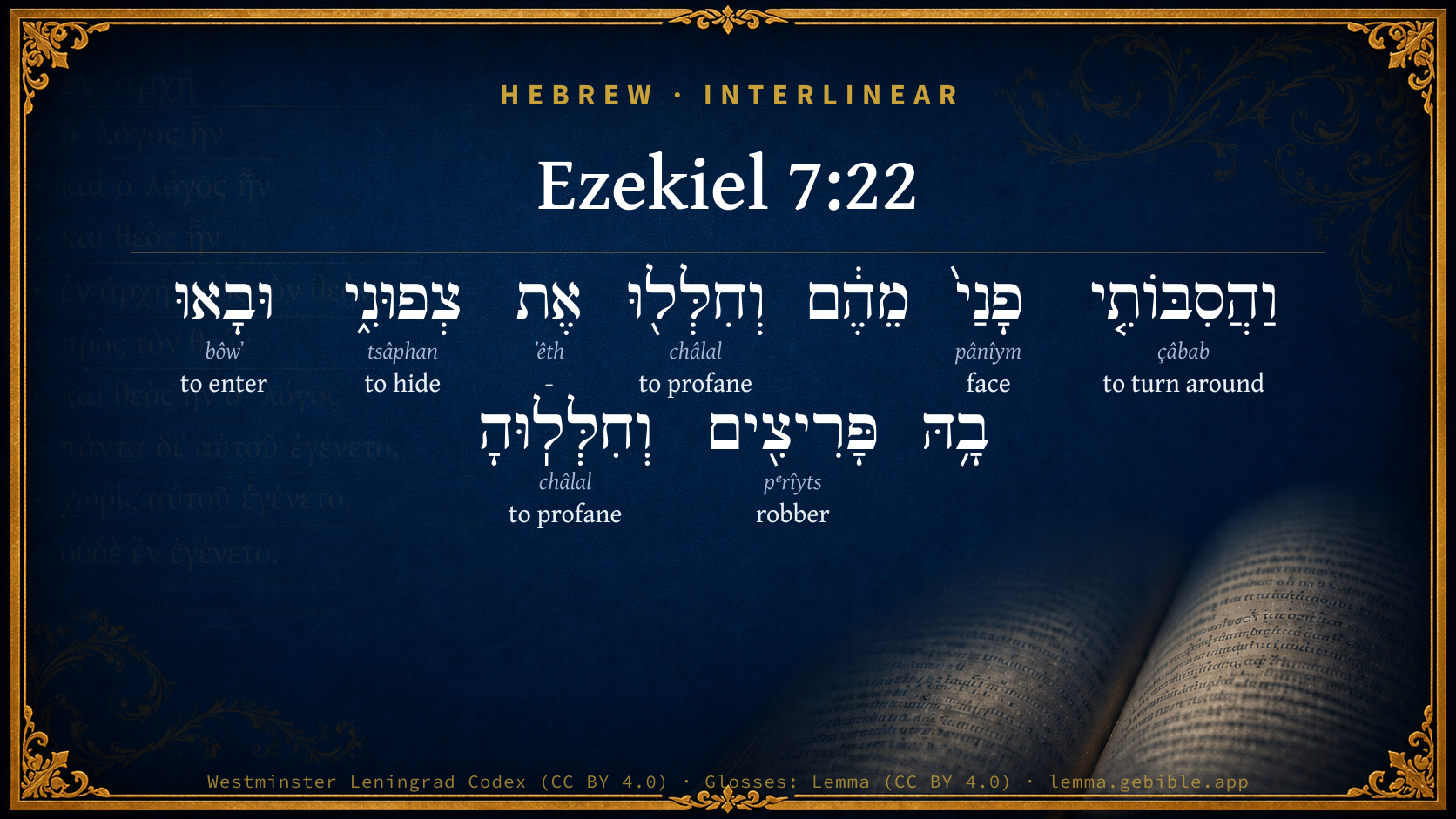
  1. וַהֲסִבּוֹתִ֤י çâbab H5437 “and · to turn around” Conjunction + Verb, Hiphil, Sequential Perfect, 1st Person, Common, Singular
  2. פָנַי֙ pânîym H6440 “face(s) · my” Noun, Common, Both, Plural, Construct + Suffix, Personal, 1st Person, Common, Singular
  3. וְחִלְּל֖וּ châlal H2490 “and · to profane” Conjunction + Verb, Piel, Sequential Perfect, 3rd Person, Common, Plural
  4. אֶת ʼêth H853 “-” Particle, Direct Object
  5. צְפוּנִ֑י tsâphan H6845 “hidden · me” Verb, Qal, Participle Passive, Masculine, Singular, Construct + Suffix, Personal, 1st Person, Common, Singular
  6. וּבָאוּ bôwʼ H935 “and · to enter” Conjunction + Verb, Qal, Sequential Perfect, 3rd Person, Common, Plural
  7. וְחִלְּלֽוּהָ châlal H2490 “and · to profane · her” Conjunction + Verb, Piel, Sequential Perfect, 3rd Person, Common, Plural + Suffix, Personal, 3rd Person, Feminine, Singular

About this verse

These counts appear in no published source. They are computed here, from the morphology-tagged text and Lemma’s own curated glosses. What Lemma adds →

10
words
7
distinct lemmas
Prophets
section

Notable vocabulary

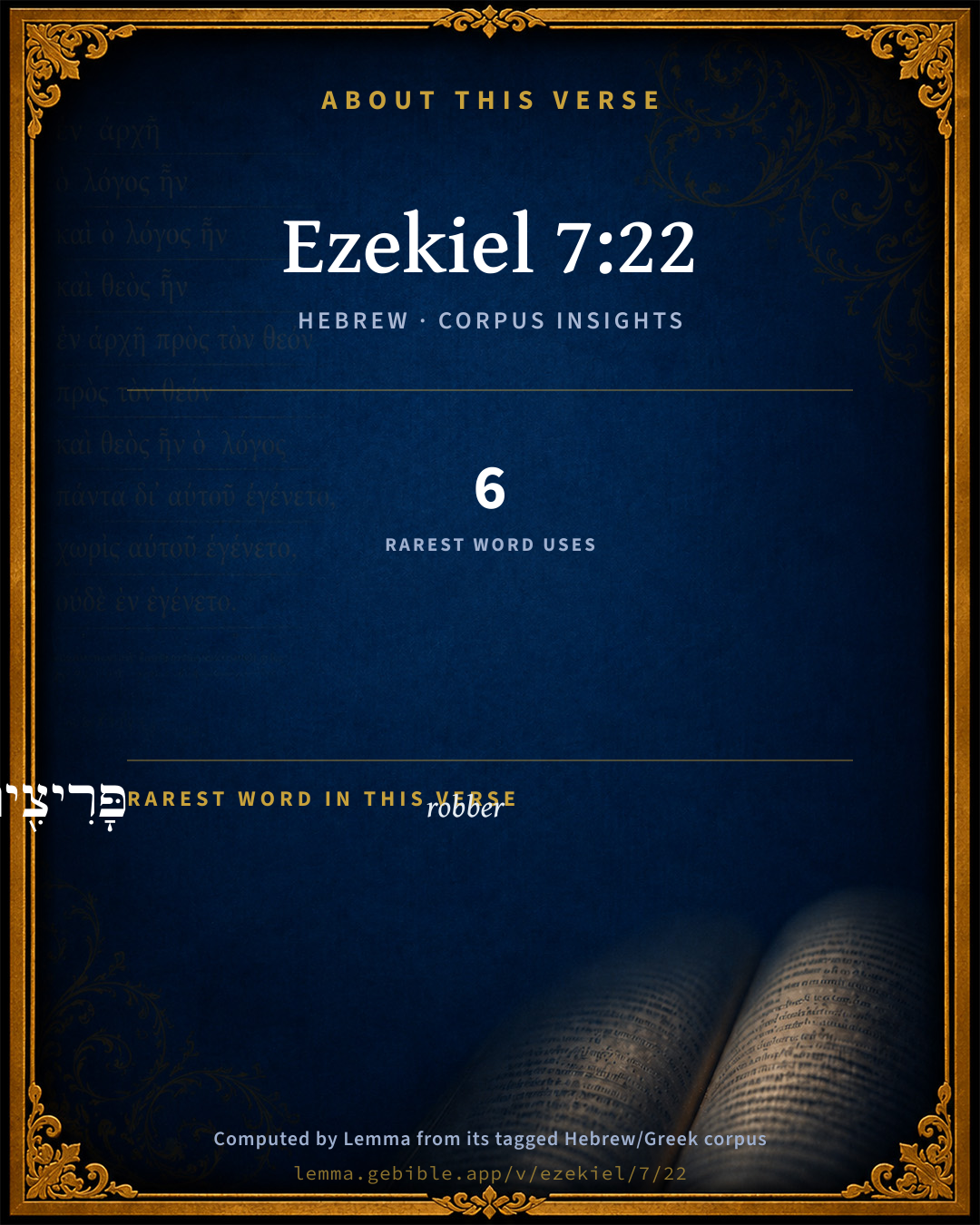
The rarest word here is פָּרִיצִ֖ים robber H6530 — appearing just 6 times in the whole Hebrew Bible.

Shared distinctive vocabulary

פָּרִיצִ֖ים robber H6530 occurs in 6 verses of the Hebrew Bible. Also found in:

Grammatical profile

  • 5 verbs
  • 2 nouns
  • 2 prepositions
  • 1 particle

Verb forms

  • וַהֲסִבּוֹתִ֤י Hiphil · Sequential Perfect
  • וְחִלְּל֖וּ Piel · Sequential Perfect
  • צְפוּנִ֑י Qal · Participle Passive
  • וּבָאוּ Qal · Sequential Perfect
  • וְחִלְּלֽוּהָ Piel · Sequential Perfect

Repetition

A word recurs within this verse — often emphatic in Hebrew:

  • וְחִלְּל֖וּ to profane H2490 ×2

Hebrew & Septuagint length

In English translation the verse runs 24 words from the Hebrew and 25 from the Septuagint (LXX English) — closely comparable.

A rough comparison of the two English renderings, which tokenize alike — not a word-level alignment.

Word counts can differ between the Hebrew and the Greek without any difference in meaning — e.g. the Hebrew direct-object marker אֵת has no separate Greek word, and Greek often adds the article ὁ.

Cross-references

6

Topical passages linked to Ezekiel 7:22 in the Treasury of Scripture Knowledge — connected by theme and wording, ordered by reader-vote popularity; previews shown in the World English Bible.

  • Jeremiah 18:17 I will scatter them as with an east wind before the enemy; I will show them the back, and not the face, in the day of their calamity.
  • Psalms 10:11 He says in his heart, "God has forgotten. He hides his face. He will never see it."
  • Psalms 35:22 You have seen it, Yahweh. Don't keep silent. Lord, don't be far from me.
  • Psalms 74:10–11 How long, God, shall the adversary reproach? Shall the enemy blaspheme your name forever?
  • Psalms 74:18–23 Remember this, that the enemy has mocked you, Yahweh. Foolish people have blasphemed your name.
  • Ezekiel 39:23–24 The nations shall know that the house of Israel went into captivity for their iniquity; because they trespassed against me, and I hid my face from them: so I gave them into the hand of their adversaries, and they fell all of them by the sword.

Cross-references courtesy of OpenBible.info (CC BY 4.0).

Hebrew and Greek witnesses Masoretic Hebrew ↔ Greek Septuagint

The same verse in the two great witnesses to the Old Testament, shown verse-for-verse.

These are two independent witnesses, not word-aligned to each other, and the Septuagint is shown in lemma (dictionary) form.

Hebrew Ezekiel 7:22 Masoretic · Westminster Leningrad Codex

וַהֲסִבּוֹתִ֤י פָנַי֙ מֵהֶ֔ם וְחִלְּל֖וּ אֶת צְפוּנִ֑י וּבָאוּ בָ֥הּ פָּרִיצִ֖ים וְחִלְּלֽוּהָ

My face will I turn also from them, and they shall profane my secret [place]; and robbers shall enter into it, and profane it.

World English Bible · Public Domain

Greek LXX Ezekiel 7:22 Septuagint · lemma form

καί ἀποστρέφω ὁ πρόσωπον ἐγώ ἀπό αὐτός καί μιαίνω ὁ ἐπισκοπή ἐγώ καί εἰςἔρχομαι εἰς αὐτός ἀφυλάκτως καί βεβηλόω αὐτός

And I will turn away my face from them, and they shall defile my charge, and shall go in to them unguardedly, and profane them.

LXX2012 (modern English Septuagint) · Public Domain

Hebrew: Westminster Leningrad Codex (CC BY 4.0). Greek: Septuagint (public domain); English from LXX2012 (modern English Septuagint) (Public Domain). How the Septuagint differs from the Hebrew →

Targum (Aramaic paraphrase)

1

The Targum is the ancient Jewish Aramaic paraphrase of the Hebrew Scriptures — an interpretive translation, not the Hebrew text itself. Onkelos (literal) and Pseudo-Jonathan (expansive) render the Torah, and Jonathan the Prophets. Coverage is partial: where no permissively-licensed English translation exists for a verse, only the Aramaic is shown. This is verse-level text, not a word-by-word alignment to the Hebrew.

  1. Targum Jonathan Prophets (Joshua–Malachi)
    וַאֲסַלֵיק שְׁכִינְתִּי מִנְהוֹן עַל דְאָחִילוּ יַת אַרְעָא בֵּית שְׁכִינְתִּי וְיַעֲלוּן בָּהּ רַשִׁיעִין וְיַחֲלוּנָהּ:

    (no public-domain English translation for this verse)

    Targum Jonathan — Aramaic: “Mikraot Gedolot” (public domain). English: “Sefaria Community Translation” (CC0 1.0 (public-domain dedication)); “London "Chaldee Paraphrase," 1871” (public domain). Text via Sefaria.

Commentary

Notes on Ezekiel 7:22 from classic Christian and Jewish commentators (each source and its license shown beneath its notes). The classic Christian expositions comment on the surrounding passage and are grouped to its opening verse, so a note may address several verses; the Jewish commentaries on the Tanakh (Rashi and others) are per-verse, so they appear only where the commentator wrote on this verse.

Lemma curates 59 commentaries, every one of them public domain or Creative Commons licensed, each selected and text-cleaned for this edition rather than reprinted as found. About our sources →

Trapp's Complete Commentary

John Trapp

Eze 7:22 My face will I turn also from them, and they shall pollute my secret [place]: for the robbers shall enter into it, and defile it.

Ver. 22. My face will I turn also from them.] From the Chaldees, that they may spoil at pleasure; or from the Israelites, that they may perish without help.

And they shall pollute my secret place.] Even the Holy of holies, whereinto none was to enter but the high priest once a year; yet, besides these Babylonian burglars, Heliodorus and Pompey did; but the one fell mad, and the other never prospered after it.

For the robbers shall enter into it.] Effractores; by this name, breach makers, the Jews at this day term our nobles and grandees.

John Trapp, A Commentary or Exposition upon All the Books of the Old and New Testament (1647–1656) — public domain. Text from a community e-Sword module.

Geneva Bible (1599)

Geneva Bible translators

Which signifieth the most holy place, whereinto none might enter but the high Priest.

Geneva Bible (1599) marginal notes — public domain. Text via Bolls.life.

Jamieson, Fausset & Brown

Robert Jamieson, A. R. Fausset & David Brown

pollute my secret place--just retribution for the Jews' pollution of the temple. "Robbers shall enter and defile" the holy of holies, the place of God's manifested presence, entrance into which was denied even to the Levites and priests and was permitted to the high priest only once a year on the great day of atonement.

Jamieson, Fausset & Brown — Commentary Critical and Explanatory on the Whole Bible (1871) — public domain (CC PDM 1.0). Text via the HelloAO Bible API.

Adam Clarke's Commentary

Verse 22. The robbers shall enter into it] The Chaldeans shall not only destroy the city; but they shall enter the temple, deface it, plunder it, and burn it to the ground.

Adam Clarke's Commentary on the Bible (1810–1826) — public domain. Text from a community e-Sword/MySword module.

John Calvin's Commentaries

As to the beginning of the verse there is no ambiguity, for God pronounces that the Jews would be miserable, because he would avert his face from them For in this was situated their happiness, that God, as he had promised, would regard their safety. As long, therefore, as God deigned to look upon them, their safety was certain, so that there was no fear of danger. But when he no longer cared for them, these wretched ones were exposed to all calamities; hence they are said to be deprived of all protection, when alienated from God. This, then, is one clause. As to what follows, expositors interpret it of the sanctuary; and I do not greatly object to this, if any one approves of this sense, but I take it in a wider sense. For God in my view calls the land his hidden place, which was safe under his protection. For he says, that he had extended wings, under which he could hide the people, (Exodus 19:4;) and David prays that God would receive him within the hidden place of his tabernacle. (Psalm 27:5.) Since, therefore, the people was protected by the power of God, the land is deservedly called God’s hidden place, as an asylum, and it will be proper so to translate it. Devastators, therefore, shall profane my asylum, because they shall enter in there, and shall profane it. He repeats the same word. Those who take it for the sanctuary restrict it to the holy of holies, for so they call the shrine or oracle whence the answers were given; and they call it an oracle, not from praying, but because they enquired there of secret things. But as I have said, that seems to be forced, though I will not quarrel with it, but show what I like better. The meaning is, however God had spared the Jews for a long time, nay, had them hidden, as it were, under his wings, and the land was as it were a sacred asylum, since they were so hidden that they felt no injury from foreign enemies: yet this should profit them nothing, because God would throw down all bulwarks, and give easy access to their enemies, so that they might break through, and then profane and confuse all things. It follows —

John Calvin's Commentaries (1540-1563) — public domain. Text from the Calvin Translation Society English edition (1840s-50s) via the Christian Classics Ethereal Library (ccel.org). Calvin's coverage is partial (roughly two-thirds of the Bible); uncommented books and verses are honest gaps, never fabricated. The 19th-century editor's footnotes and remarks are omitted so the notes are faithfully Calvin's own voice.

Ellicott's Commentary for English Readers

(22) My secret place.—The holy of holies, sacredly guarded from all intrusion, and representing the very culmination both of the religion and of the national life of Israel, shall be polluted. If the pronoun “they” represents any one in particular, it must be the Chaldæans; but it is better to take the verb, as often in the third person plural, impersonally, i.e., “shall be polluted.” The agents in this pollution are immediately mentioned as “the robbers,” i.e., the Chaldæan armies.

A Bible Commentary for English Readers, edited by Charles John Ellicott (1878–1897) — public domain. Text from a community e-Sword module.

The Cambridge Bible for Schools and Colleges

gen. ed. J. J. S. Perowne

22. The enemy shall penetrate into the temple and profane it.

turn … from them] This most naturally refers to Israel, from whom the Lord will turn his face in anger, cf. Eze_7:11. It might refer to the invader, whom the Lord will not behold but permit to work his will, cf. Lam_2:3.

secret place] Is probably the temple (Lam_2:1); less natural would be the city. The word “secret,” however, is not to be referred to the arcanum of the Most Holy place; the meaning is “my precious thing.”

for the robbers] and robbers; the Chaldean pillagers. The words “pollute” and “defile” are the same; better, profane.

The Cambridge Bible for Schools and Colleges (gen. ed. J. J. S. Perowne; Cambridge University Press, 1878–1918) — public domain. Text from a community e-Sword module.

John Gill's Exposition

Make a chain,.... To bind them; not the robbers, the Chaldeans, but the Jews; in order either to bring them to the bar to be tried for capital crimes hereafter mentioned, or to be led bound in chains into captivity; see Neh 3:10;

for the land is full of bloody crimes; or, "judgment of bloods" (m); capital crimes, such as are deserving of death, particularly murder, or shedding of innocent blood; so the Targum interprets it of sins of murder:

and the city is full of violence; rapine, oppression, and injury done to the poor, the widow, and the fatherless; meaning the city of Jerusalem, where was the great court of judicature, and where justice ought to have been administered.

(m) "judicio sanguiuum", V. L. Pagninus, Montanus, Calvin, Polanus, Starckius; "criminibus capitalibus", Piscator; "sanguianariis judiciis", Castalio.

John Gill's Exposition of the Whole Bible (1746–1763) — public domain (CC PDM 1.0). Text via the HelloAO Bible API.

Albert Barnes' Notes on the Bible

My secret place - The inner sanctuary, hidden from the multitude, protected by the most high.

Albert Barnes' Notes on the Bible (1834–1885) — public domain. Text from a community e-Sword/MySword module.

Haydock's Catholic Bible Commentary

Secret: the inward sanctuary, the holy of holies. (Challoner) --- God would guard it no longer. (Calmet)

George Leo Haydock (1774–1849), Haydock's Catholic Family Bible and Commentary, 1859 edition — public domain. Excludes Psalms (Douay-Rheims chapter numbering differs from Protestant) and Deuterocanonical books (Catholic canon only).

Matthew Poole's English Annotations

My face will I turn; either from the Jews, who cry under such violence and profaneness; or, from the Chaldeans who act it, neither relieving the one nor restraining the other.

My secret place; either,

1. My enclosed land of Judea. Or,

2. My city Jerusalem. Or,

3. The temple. And,

4. The holy of holies: all which the Babylonian conquerors trampled under their conquering feet. The robbers; the soldiers, who in truth robbed the temple and here have their true style given them, are robbers that used the temple and its consecrated gifts without ally reverence or respect. They should break all open, and rush into the places which Jews, Levites, and priests might not enter.

Matthew Poole's English Annotations on the Holy Bible (1683–1685) — public domain. Text from a community e-Sword/MySword module.

Whedon's Commentary on the Bible

Daniel D. Whedon

22. Jehovah will not turn the wrath of his face upon these enemies of the “holy people” and “holy city,” even when they enter and pillage the temple. He who has always heretofore protected his own sanctuary will do it no more, for it is now a sanctuary of idolatry (chap. 8).

Daniel D. Whedon (gen. ed.), Commentary on the Old and New Testaments (1874–1909) — public domain. Text from a community e-Sword module.

The Pulpit Commentary

My secret place. The work of the spoiler would not stop at the idols of silver and gold. Jehovah would surrender his own "secret place" (secret treasure in margin of Revised Version), that over which he had watched, sc. the sanctuary of his temple, to the hands of the spoiler in Psa_83:4 the same adjective is used of persons, the "hidden" or protected ones of God. In the name of Baal-zephon, "Lord of the secret place," we have possibly a kindred thought. in Psa_17:14 we have "hid treasure.

The averted face.

In the figurative but natural and expressive language of the Hebrews, the shining of God"s countenance means his good pleasure and good will towards those whom he favours, and the hiding or averting of his countenance means his displeasure. Prayer often shaped itself into the familiar expression, "The Lord cause his face to shine upon us;" and the displeasure of Heaven was deprecated in such terms as these: "Turn not thy face from thy servants." The child distinguishes at once between the smile and the frown of the parent; the courtier is at no loss to discriminate between the welcome and favour and the displeasure apparent upon the monarch"s face. To the mind at all sensitive to the moral beauty and glory of God, no sentence can be so dreadful as that uttered in the simple but terrible language of the text, "My face will I turn also from them.

I IN THE SHINING OF GOD"S COUNTENANCE IS LIFE AND JOY. When the sun arises in his strength, and floods the hills and the valleys, the rivers and the forests, the cornfields and the meadows, with his glorious rays, nature returns the smiles, glows in the sunbeams, rejoices in the warmth and the illumination. Where the sun shines brightly, there the colours are radiant, the odour delicious, there the music of the grove is sweet and the harvest of the plain is golden, there life is luxuriant and gladness breaks forth into laughter and song. And in the moral, the spiritual realm, it is the sunlight of God"s countenance, the manifestation of God"s favour, which calls forth and sustains all spiritual life, health, peace, and joy. "In thy favour is life.

II MAN"S UNBELIEF AND SIN OCCASION THE HIDING AND WITHDRAWING OF GOD"S COUNTENANCE. The change is not in him; it is in us. When the sun is not seen in the sky, it is not because he no longer shines, but because clouds, mists, or smoke, ascending from the earth, come between the orb of day and the globe which he illumines. So if God turns his face from an individual, a city, a people, it is because their sins have risen up as a dense, foul fog, intervening between them and a holy, righteous God. "Your iniquities have separated between you and your God." So it was with those against whom the Prophet Ezekiel was called upon to testify. So it is with multitudes whom the ministers of Christ are required to address in language of tender sympathy, yet of expostulation and reproach.

III THE AVERSION OF GOD"S COUNTENANCE IS THE WORST OF ALL CALAMITIES. It is not to be wondered at that men with their composite nature, absorbed as they are in things which affect the body and the earthly life, should think chiefly of the sufferings and privations in which the moral laws of the universe involve them. And these sufferings and privations are realities which no thoughtful man can fail to perceive and to estimate with something like correctness. Yet he who is enlightened and in any measure spiritually sensitive cannot fail to see that it is the regard of God himself which is of chief import. It is better to enjoy the Divine loving kindness, even in poverty, privation, spoliation, and weakness, than to possess luxury, honour, and the delights of sense, and to know that God"s countenance is turned away, is hidden.

IV A MERCIFUL GOD WILL TURN AGAIN HIS FACE AND CAUSE IT TO SHINE UPON PENITENT AND BELIEVING SUPPLIANTS. It is sin which conceals the Divine countenance; it is repentance which seeks the shining anew of that countenance; and salvation consists in the response of God to the prayer of man. Yet the turning of his face towards us is the work of his own mercy, the revelation of his own nature compassionate, gracious, and forgiving. T.

The Pulpit Commentary (1880–1919), ed. H.D.M. Spence-Jones & Joseph S. Exell — public domain. Text from a community e-Sword module.

John Wesley's Explanatory Notes

Turn - Either from the Jews, or from the Chaldeans, neither relieving the one nor restraining the other. Secret place - The temple, and the holy of holies. Robbers - The soldiers.

John Wesley, Explanatory Notes Upon the Whole Bible (1754–1765) — public domain. Text via the GEBible commentary corpus.

Rashi

Rabbi Shlomo Yitzchaki (Rashi)

My secret place The place where I was hidden among them.

Rashi on the Tanakh — English translations: “The Judaica Press complete Tanach with Rashi, translated by A. J. Rosenberg” (CC BY 4.0); “Pentateuch with Rashi's commentary by M. Rosenbaum and A.M. Silbermann, 1929-1934” (public domain); “The Metsudah Tanach series, Lakewood, N.J” (CC BY 4.0); and “The Book of Joshua, Metsudah Publications, 1997” (CC BY 4.0). Text via Sefaria.

Lesson kit

Teaching starters — assembled from the data on this page, not authored interpretation. Every prompt links to the verse data it draws on. Edit before teaching.

Ezekiel, in the Prophets, opens this verse with 10 words (7 distinct Hebrew lemmas). Its most distinctive word is pᵉrîyts (“robber”). A historical commentator’s framing appears above. Read the whole chapter for the surrounding context.

Discussion questions

  1. What does “robber” (pᵉrîyts) contribute to the verse as a whole?
  2. Psalms 17:4 shares the word «robber» with this verse. How do the two illuminate each other?
  3. “to profane” occurs 2× in this one verse. What is the effect of the repetition?
  4. The translations on this page render this verse differently — a whole-verse word diff, not a word-by-word alignment. What might account for the different wordings?
  5. The verb «וַהֲסִבּוֹתִ֤י» is Hiphil Sequential Perfect. How does its form color the action?
  6. Reading how Trapp's Complete Commentary and Geneva Bible (1599) read this verse, where do the two commentators agree and where do they part?

Things to notice

  • These translations choose different wording for 12 words in this verse.
  • “to profane” occurs 2× in this single verse.
  • 7 distinct Hebrew lemmas span 10 words in this verse.

Reading settings

Reading text

Shown beneath each verse's original-language words.

Old Testament
Old Testament edition

Read the OT as the Masoretic Hebrew (MT) or the Greek Septuagint (LXX).

English shown for the Greek Septuagint (in the Hebrew ↔ Greek comparison).

Comparing translations? Open the Compare panel on any verse page to stack up to four side by side.