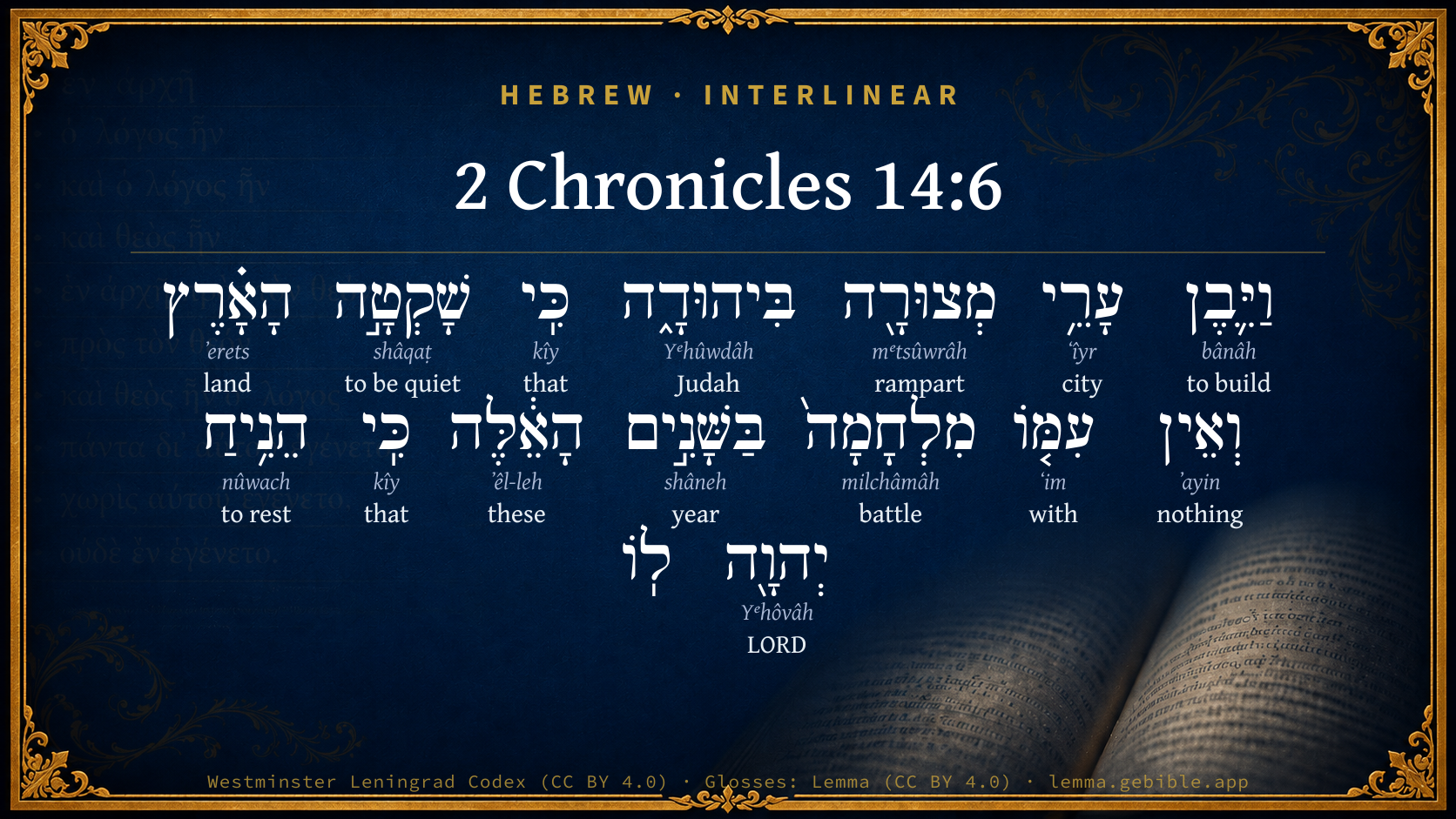
2 Chronicles 14:6

Hebrew (Westminster Leningrad Codex) 2 Chronicles 14:6 appears in the Hebrew Old Testament. The text above is from the Westminster Leningrad Codex. Each word links to its Strong’s number, a concise gloss, and parsing drawn from the Open Scriptures Hebrew Bible morphology. Click any word for its full Brown-Driver-Briggs (BDB) entry.
Download image
Cite this verse

2 Chronicles 14:6 (World English Bible). Public Domain. Lemma interlinear Bible study tool, https://lemma.gebible.app/v/2-chronicles/14/6.

Show BibTeX & RIS
BibTeX
RIS
English Translation
He built fortified cities in Judah; for the land was quiet, and he had no war in those years, because Yahweh had given him rest.
World English Bible · Public Domain
Download a study sheet

One document with this verse’s original text, its word-by-word gloss line, the meaning frame, cross-references with their text, attributed commentary, and full source and license credits — printable, and it pastes into notes with its structure intact.

This verse Autodidact and up

Study sheet (.html) Plain text (.txt)

A passage Seminary Student

Up to 50 verses in one chapter. A passage sheet keeps up to 6 commentary sources and 12 cross-references per verse, in the order this page ranks them, and says so on the sheet whenever that leaves anything out. Ask for a single verse and you get the Autodidact verse sheet above.

Everything on this page stays free to read, with no account — the sheet is a download of what is already on screen, not access to it.

Want to remove ads? Support Godless Engineer
Compare translations 3

The same verse in 3 English versions, stacked beneath the original-language interlinear above. Click any original word for its lexicon entry.

Each is an independent rendering of the whole verse — the interlinear is not word-aligned to these translations.

Highlighted words mark where these versions differ — a whole-verse word diff, not a word-by-word alignment.

  • World English Bible Public Domain
    He built fortified cities in Judah; for the land was quiet, and he had no war in those years, because Yahweh had given him rest.
  • King James Version Public Domain
    And he built fenced cities in Judah: for the land had rest, and he had no war in those years; because the LORD had given him rest.
  • unfoldingWord Literal Text CC BY-SA 4.0
    And he built fortified cities in Judah, for the land was quiet. And there was not with him war in these years, because Yahweh had given rest to him.

unfoldingWord Literal Text — © unfoldingWord, licensed CC BY-SA 4.0. Word-aligned USFM3 via Door43 (git.door43.org/unfoldingWord/en_ult).

Versions to compare (up to 4)

3 of 4 selected

Show all 18 translations

Every available English version of this verse, each an independent rendering of the whole verse.

  • World English Bible Public Domain
    He built fortified cities in Judah; for the land was quiet, and he had no war in those years, because Yahweh had given him rest.
  • Berean Standard Bible Public Domain
    Because the land was at peace, Asa built fortified cities in Judah. In those days no one made war with him, because the LORD had given him rest.
  • Majority Standard Bible Public Domain
    Because the land was at peace, Asa built fortified cities in Judah. In those days no one made war with him, because the LORD had given him rest.
  • King James Version Public Domain
    And he built fenced cities in Judah: for the land had rest, and he had no war in those years; because the LORD had given him rest.
  • American Standard Version (1901) Public Domain
    And he built fortified cities in Judah; for the land was quiet, and he had no war in those years, because Jehovah had given him rest.
  • Revised Version (1885) Public Domain
    And he built fenced cities in Judah: for the land was quiet, and he had no war in those years; because the LORD had given him rest.
  • Geneva Bible (1599) Public Domain
    He built also strong cities in Iudah, because the lande was in rest, and he had no warre in those yeeres: for the Lord had giuen him rest.
  • Douay-Rheims (1899) Public Domain
    He built also strong cities in Juda, for he was quiet, and there had no wars risen in his time, the Lord giving peace.
  • Young's Literal Translation Public Domain
    And he buildeth cities of bulwarks in Judah, for the land hath quiet, and there is no war with him in these years, because Jehovah hath given rest to him.
  • Literal Standard Version CC BY-SA 4.0
    And he builds cities of bulwarks in Judah, for the land has quiet; and there is no war with him in these years, because YHWH has given rest to him.
  • Unlocked Literal Bible CC BY-SA 4.0
    He built fortified cities in Judah, for the land was quiet, and he had no war in those years, because Yahweh had given him peace.
  • unfoldingWord Literal Text CC BY-SA 4.0
    And he built fortified cities in Judah, for the land was quiet. And there was not with him war in these years, because Yahweh had given rest to him.
  • Darby Bible Public Domain
    And he built fortified cities in Judah, for the land had rest, and he had no war in those years; because Jehovah had given him rest.
  • World Messianic Bible Public Domain
    He built fortified cities in Judah; for the land was quiet, and he had no war in those years, because the LORD had given him rest.
  • Webster's Bible Public Domain
    And he built fortified cities in Judah: for the land had rest, and he had no war in those years; because the LORD had given him rest.
  • Free Bible Version CC BY-SA 4.0
    Because the country was at peace he was able to rebuild the fortified towns of Judah. There were no wars during these years because the Lord had granted him peace.
  • Bible in Basic English Public Domain
    He made walled towns in Judah, for the land was quiet and there were no wars in those years, because the Lord had given him rest.
  • JPS Tanakh (1917) Public Domain
    (14-5) And he built fortified cities in Judah; for the land was quiet, and he had no war in those years; because the LORD had given him rest.

Literal Standard Version (2020), Covenant Press — licensed CC BY-SA 4.0. Text via the HelloAO Bible API (eBible.org). Unlocked Literal Bible (unfoldingWord) — licensed CC BY-SA 4.0. Text via the HelloAO Bible API (eBible.org). unfoldingWord Literal Text — © unfoldingWord, licensed CC BY-SA 4.0. Word-aligned USFM3 via Door43 (git.door43.org/unfoldingWord/en_ult). Free Bible Version, Dr. Jonathan Gallagher — licensed CC BY-SA 4.0. Text via the HelloAO Bible API (eBible.org).

Word by word

More ways to search: Search by grammar → Find every occurrence → Compare this word →

Practice this passage: Drill this verse → Learn its vocabulary →

מְצוּרָ֖ה
mᵉtsûwrâh
H4694
“rampart”
Noun, Common, Feminine, Singular, Absolute
Part of Speech
Noun
Type
Common
Gender
Feminine
Number
Singular
State
Absolute
Full BDB Definition

Origin: from H4692

TWOT: 1898b

siege-works, stronghold, rampart - siege-works - rampart
  1. וַיִּ֛בֶן bânâh H1129 “and · to build” Conjunction + Verb, Qal, Sequential Imperfect, 3rd Person, Masculine, Singular
  2. עָרֵ֥י ʻîyr H5892 “cities of” Noun, Common, Feminine, Plural, Construct
  3. בִּיהוּדָ֑ה Yᵉhûwdâh H3063 “in/at · Judah” Preposition + Noun, Proper
  4. כִּֽי kîy H3588 “that” Conjunction
  5. שָׁקְטָ֣ה shâqaṭ H8252 “to be quiet” Verb, Qal, Perfect, 3rd Person, Feminine, Singular
  6. הָאָ֗רֶץ ʼerets H776 “the · land” Particle, Definite Article + Noun, Common, Both, Singular, Absolute
  7. וְאֵין ʼayin H369 “and · nothing” Conjunction + Particle, Negative
  8. עִמּ֤וֹ ʻim H5973 “with · him” Preposition + Suffix, Personal, 3rd Person, Masculine, Singular
  9. מִלְחָמָה֙ milchâmâh H4421 “battle” Noun, Common, Feminine, Singular, Absolute
  10. בַּשָּׁנִ֣ים shâneh H8141 “in/at the · years” Preposition, Determined + Noun, Common, Feminine, Plural, Absolute
  11. הָאֵ֔לֶּה ʼêl-leh H428 “the · these” Particle, Definite Article + Pronoun, Demonstrative, Common, Plural
  12. כִּֽי kîy H3588 “that” Conjunction
  13. הֵנִ֥יחַ nûwach H5117 “to rest” Verb, Hiphil, Perfect, 3rd Person, Masculine, Singular
  14. יְהוָ֖ה Yᵉhôvâh H3068 “LORD” Noun, Proper

About this verse

These counts appear in no published source. They are computed here, from the morphology-tagged text and Lemma’s own curated glosses. What Lemma adds →

16
words
14
distinct lemmas
Historical
section

Notable vocabulary

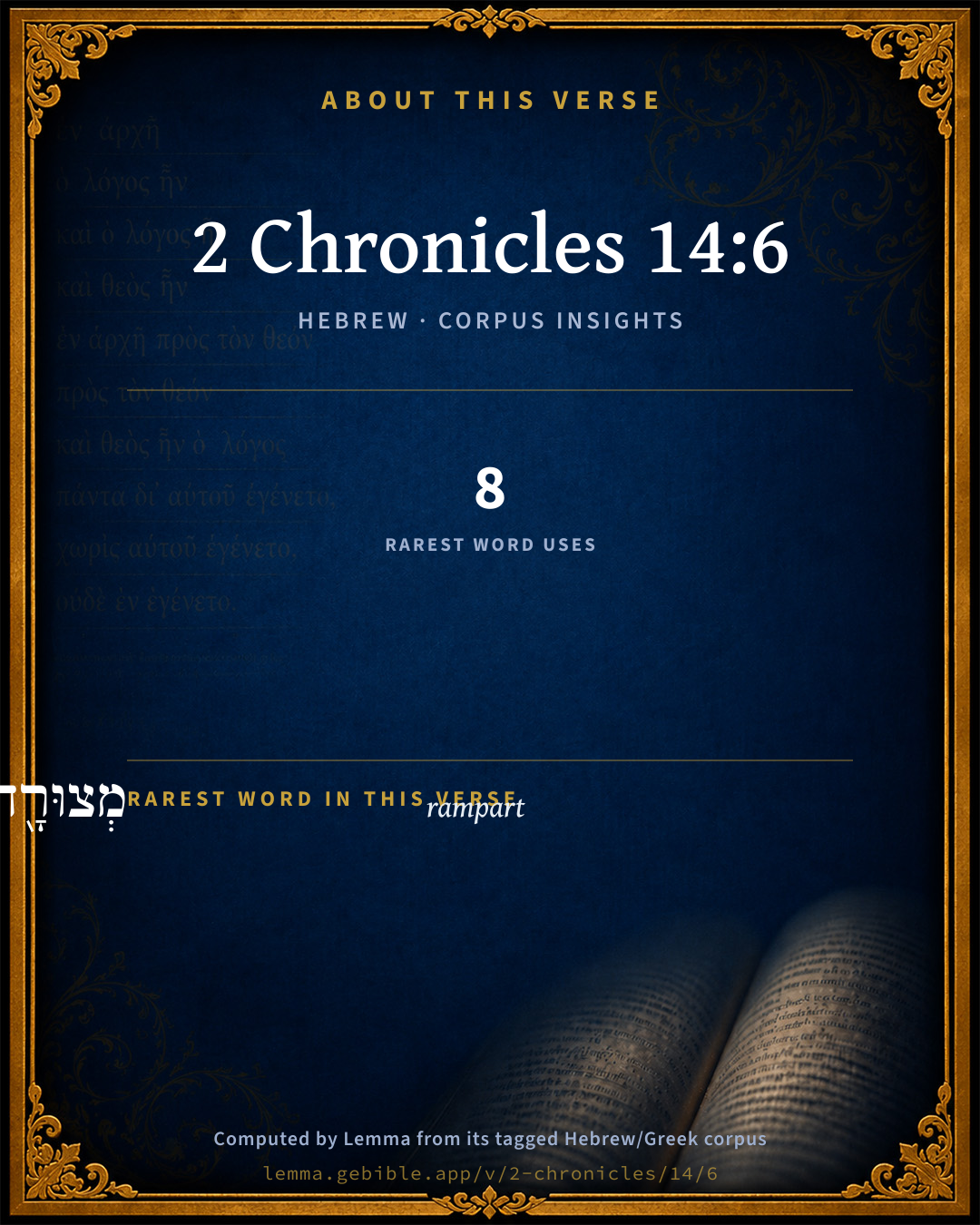
The rarest word here is מְצוּרָ֖ה rampart H4694 — appearing just 8 times in the whole Hebrew Bible.

Shared distinctive vocabulary

מְצוּרָ֖ה rampart H4694 occurs in 8 verses of the Hebrew Bible. Also found in:

Grammatical profile

  • 3 verbs
  • 7 nouns
  • 1 pronoun
  • 2 prepositions
  • 2 conjunctions
  • 1 particle

Verb forms

  • וַיִּ֛בֶן Qal · Sequential Imperfect
  • שָׁקְטָ֣ה Qal · Perfect
  • הֵנִ֥יחַ Hiphil · Perfect

Repetition

A word recurs within this verse — often emphatic in Hebrew:

  • כִּֽי that H3588 ×2

Hebrew & Septuagint length

In English translation the verse runs 25 words from the Hebrew and 26 from the Septuagint (LXX English) — closely comparable.

A rough comparison of the two English renderings, which tokenize alike — not a word-level alignment.

Word counts can differ between the Hebrew and the Greek without any difference in meaning — e.g. the Hebrew direct-object marker אֵת has no separate Greek word, and Greek often adds the article ὁ.

Cross-references

11

Topical passages linked to 2 Chronicles 14:6 in the Treasury of Scripture Knowledge — connected by theme and wording, ordered by reader-vote popularity; previews shown in the World English Bible.

  • 2 Chronicles 15:15 All Judah rejoiced at the oath; for they had sworn with all their heart, and sought him with their whole desire; and he was found of them: and Yahweh gave them rest round about.
  • 1 Chronicles 22:9 Behold, a son shall be born to you, who shall be a man of rest; and I will give him rest from all his enemies round about; for his name shall be Solomon, and I will give peace and quietness to Israel in his days:
  • 2 Chronicles 11:5–12 Rehoboam lived in Jerusalem, and built cities for defense in Judah.
  • Job 34:29 When he gives quietness, who then can condemn? When he hides his face, who then can see him? Alike whether to a nation, or to a man:
  • Joshua 23:1 It happened after many days, when Yahweh had given rest to Israel from all their enemies round about, and Joshua was old and well stricken in years;
  • Judges 3:11 The land had rest forty years. Othniel the son of Kenaz died.
  • Judges 3:30 So Moab was subdued that day under the hand of Israel. The land had rest eighty years.
  • Judges 5:31 So let all your enemies perish, Yahweh: But let those who love him be as the sun when he goes forth in his might. The land had rest forty years.
  • 1 Kings 5:4 But now Yahweh my God has given me rest on every side; there is neither adversary, nor evil occurrence.
  • 2 Chronicles 8:2–6 that the cities which Huram had given to Solomon, Solomon built them, and caused the children of Israel to dwell there.
  • Psalms 46:9 He makes wars cease to the end of the earth. He breaks the bow, and shatters the spear. He burns the chariots in the fire.

Cross-references courtesy of OpenBible.info (CC BY 4.0).

Hebrew and Greek witnesses Masoretic Hebrew ↔ Greek Septuagint

The same verse in the two great witnesses to the Old Testament, shown verse-for-verse.

These are two independent witnesses, not word-aligned to each other, and the Septuagint is shown in lemma (dictionary) form.

Hebrew 2 Chronicles 14:6 Masoretic · Westminster Leningrad Codex

וַיִּ֛בֶן עָרֵ֥י מְצוּרָ֖ה בִּיהוּדָ֑ה כִּֽי שָׁקְטָ֣ה הָאָ֗רֶץ וְאֵין עִמּ֤וֹ מִלְחָמָה֙ בַּשָּׁנִ֣ים הָאֵ֔לֶּה כִּֽי הֵנִ֥יחַ יְהוָ֖ה לֽוֹ

He built fortified cities in Judah; for the land was quiet, and he had no war in those years, because Yahweh had given him rest.

World English Bible · Public Domain

Greek LXX 2 Chronicles 14:6 Septuagint · lemma form

καί εἶπον ὁ ἰουδά οἰκοδομέω ὁ πόλις οὗτος καί ποιέω τεῖχος καί πύργος καί πύλη καί μοχλός ἐν ὅς ὁ γῆ κυριεύω ὅτι καθώς ἐκζητέω κύριος θεός ἐγώ ἐκζητέω ἐγώ καί καταπαύω ἐγώ κυκλόθεν καί εὐοδόω ἐγώ

fortified cities in the land of Juda; for the land was quiet, and he had no war in these years; for the Lord gave him rest.

LXX2012 (modern English Septuagint) · Public Domain

Hebrew: Westminster Leningrad Codex (CC BY 4.0). Greek: Septuagint (public domain); English from LXX2012 (modern English Septuagint) (Public Domain). How the Septuagint differs from the Hebrew →

Commentary

Notes on 2 Chronicles 14:6 from classic Christian and Jewish commentators (each source and its license shown beneath its notes). The classic Christian expositions comment on the surrounding passage and are grouped to its opening verse, so a note may address several verses; the Jewish commentaries on the Tanakh (Rashi and others) are per-verse, so they appear only where the commentator wrote on this verse.

Lemma curates 59 commentaries, every one of them public domain or Creative Commons licensed, each selected and text-cleaned for this edition rather than reprinted as found. About our sources →

Jamieson, Fausset & Brown

Robert Jamieson, A. R. Fausset & David Brown

HAVING PEACE, HE STRENGTHENS HIS KINGDOM WITH FORTS AND ARMIES. (Ch2 14:6-8)

he built fenced cities in Judah--(See on Kg1 15:22).

Jamieson, Fausset & Brown — Commentary Critical and Explanatory on the Whole Bible (1871) — public domain (CC PDM 1.0). Text via the HelloAO Bible API.

Trapp's Complete Commentary

John Trapp

2Ch 14:6 And he built fenced cities in Judah: for the land had rest, and he had no war in those years; because the LORD had given him rest.

Ver. 6. And he built fenced cities.] Though he had no war, yet he provided for it. So did our Queen Elizabeth; and so must every Christian soldier.

John Trapp, A Commentary or Exposition upon All the Books of the Old and New Testament (1647–1656) — public domain. Text from a community e-Sword module.

Joseph Benson's Commentary

2Ch 14:6-7. He built fenced cities in Judah: for the land had rest — He wisely provided for war in the time of peace. The Lord had given him rest — Those have rest indeed to whom God gives rest; peace indeed to whom Christ gives peace. Asa takes notice of the rest they had as the gift of God, and the happy consequence of their seeking the Lord. Because we have sought the Lord, he hath given us rest on every side — Whatever rest we enjoy, whether of body or mind, of our family or country, God ought to be acknowledged with thankfulness as the author of it. For as the frowns and rebukes of Providence should be observed as a check to us in an evil way, so the smiles of Providence should be taken notice of for our encouragement in that which is good. We find by experience that it is good to seek the Lord; it gives us rest. While we pursue the world, we meet with nothing but vexation.

Joseph Benson's Commentary on the Old and New Testaments (1811–1818) — public domain. Text from a community e-Sword module.

Adam Clarke's Commentary

Verse 6. Fenced cities] To preserve his territories from invasion, and strengthen the frontiers of his kingdom, see 2Ch 14:7.

Adam Clarke's Commentary on the Bible (1810–1826) — public domain. Text from a community e-Sword/MySword module.

Ellicott's Commentary for English Readers

(6) And he built fenced cities.—See 2Ch_11:5; 2Ch_12:4; and for the expression “had given him rest,” 2Sa_7:1.

A Bible Commentary for English Readers, edited by Charles John Ellicott (1878–1897) — public domain. Text from a community e-Sword module.

The Cambridge Bible for Schools and Colleges

gen. ed. J. J. S. Perowne

6. in those years] Cp. 2Ch_14:1.

6–8 (cp. 1Ki_15:17-22). The Defensive Measures of Asa

According to 1 Kin., Asa being threatened by Baasha, king of Israel, secured himself a respite by inducing Ben-hadad of Syria with a heavy bribe to invade Baasha’s dominions. On the retirement of Israel Asa built himself two fortresses on his northern frontier to secure himself against Baasha. The Chronicler seems to be referring to the same occasion, but he says nothing of Baasha, nor of the intervention of Ben-hadad, and speaks of Asa building fortresses without mentioning their number.

The Cambridge Bible for Schools and Colleges (gen. ed. J. J. S. Perowne; Cambridge University Press, 1878–1918) — public domain. Text from a community e-Sword module.

John Gill's Exposition

Therefore he said unto Judah,.... To the nobles and principal men of the kingdom:

let us build these cities; which he, no doubt, particularly mentioned by name, and pointed at; that is, repair and fortify them, and put them into a better condition of defence:

and make about them walls and towers, gates and bars; which are always made to fortified places, to protect the inhabitants, and keep out an enemy:

while the land is yet before us; in our power, no enemy in it, nor any to hinder or molest:

because we have sought the Lord our God, we have sought him, and he hath given us rest on every side; had set up his pure worship, reformed abuses in it, and removed idolatry from it, and closely attended to the service of the sanctuary, which was well pleasing to God; the happy effect of which they experienced, rest from all their enemies round about them:

so that they built, and prospered; they began, and went on, and finished, there being nothing to hinder them.

John Gill's Exposition of the Whole Bible (1746–1763) — public domain (CC PDM 1.0). Text via the HelloAO Bible API.

Haydock's Catholic Bible Commentary

Time, as yet. (Tirinus) --- Admirable lesson for all to prepare for war in time of quite! (Haydock)

George Leo Haydock (1774–1849), Haydock's Catholic Family Bible and Commentary, 1859 edition — public domain. Excludes Psalms (Douay-Rheims chapter numbering differs from Protestant) and Deuterocanonical books (Catholic canon only).

Whedon's Commentary on the Bible

Daniel D. Whedon

6. Built fenced cities in Judah — He probably restored the fortresses which Shishak had taken and dismantled. Compare 2Ch_12:4. The kingdom of Judah had probably been tributary to Egypt since the time of Shishak’s invasion, (2Ch_12:8-9;) but now Asa discerned a favourable time to throw off this foreign yoke, and “while the land was yet before” them, (2Ch_14:7, that is, unoccupied and unguarded by the Egyptians, so that they could move about in it at pleasure,) he improved his opportunity to fortify his kingdom. 2Ch_14:8 shows also that the number of valiant warriors in Judah and Benjamin was now much greater than it was in Abijah’s reign. Comp. 2Ch_13:3.

Daniel D. Whedon (gen. ed.), Commentary on the Old and New Testaments (1874–1909) — public domain. Text from a community e-Sword module.

The Pulpit Commentary

He built fenced cities in Judah. Though it is not said so here, it is very probable that Asa did again the work of Rehoboam (2Ch_11:5-12) which Shishak had done so much to undo. (2Ch_12:4, 2Ch_12:5, 2Ch_12:8)

The Pulpit Commentary (1880–1919), ed. H.D.M. Spence-Jones & Joseph S. Exell — public domain. Text from a community e-Sword module.

John Wesley's Explanatory Notes

The land had rest - Those have rest indeed, to whom God gives rest; peace indeed, to whom Christ gives peace. We find by experience, it is good to seek the Lord. While we pursue the world, we meet with nothing but vexation.

John Wesley, Explanatory Notes Upon the Whole Bible (1754–1765) — public domain. Text via the GEBible commentary corpus.

Rashi

Rabbi Shlomo Yitzchaki (Rashi)

as long as the land is before us As long as the kingdom is established before us, so that if we need them, they will be a refuge for us. And all this happened in the ten years about which it is written (above 13:23): “in his time the land was tranquil.” But after those ten years, there was a war between him and Baasha all their lives, for in the third year of Asa, Baasha reigned, and seven years there was peace between them, and so it is proven here as well (verse 5): “and there was no war with him in these years.” But in the other years there was war with him, and below (15:19) it is written: “And there was no war until the thirty-fifth year of Asa’s reign.” We can, however, explain that the war that he had with the Cushites was not until the thirty-fifth year of his reign, but this is difficult to me, for it is written below (16:1): “In the thirty-sixth year of Asa’s reign, Baasha...advanced,” until (verse 9): “you have dealt foolishly concerning this, for from now on there will be wars with you.” It appears from here that prior to this, he did not have wars, and he lived after that only five years, and in I Kings 15:32, it is written: “And there was war between Asa and Baasha, etc. all their lives.” In Seder Olam (ch. 16) it is explained clearly.

for we sought the Lord our God; we sought [Him] Since we sought Him, He gave us peace from round about.

So they built cities.

and prospered And a similar instance is (above 12:7): “And when the Lord saw that they had humbled themselves, etc.”

Rashi on the Tanakh — English translations: “The Judaica Press complete Tanach with Rashi, translated by A. J. Rosenberg” (CC BY 4.0); “Pentateuch with Rashi's commentary by M. Rosenbaum and A.M. Silbermann, 1929-1934” (public domain); “The Metsudah Tanach series, Lakewood, N.J” (CC BY 4.0); and “The Book of Joshua, Metsudah Publications, 1997” (CC BY 4.0). Text via Sefaria.

Lesson kit

Teaching starters — assembled from the data on this page, not authored interpretation. Every prompt links to the verse data it draws on. Edit before teaching.

2 Chronicles, in the Historical, opens this verse with 16 words (14 distinct Hebrew lemmas). Its most distinctive word is mᵉtsûwrâh (“rampart”). A historical commentator’s framing appears above. Read the whole chapter for the surrounding context.

Discussion questions

  1. What does “rampart” (mᵉtsûwrâh) contribute to the verse as a whole?
  2. How does 2 Chronicles 11:10, which shares the word «rampart», read alongside this verse?
  3. What does the repetition of “that” (2× in this one verse) do in this verse?
  4. These translations render this verse differently. What is at stake in choosing one wording over another?
  5. «וַיִּ֛בֶן» is a Qal Sequential Imperfect verb. How does that grammatical form shape the action described?
  6. Compare how Jamieson, Fausset & Brown and Trapp's Complete Commentary read this verse. Where do they agree or differ?

Things to notice

Reading settings

Reading text

Shown beneath each verse's original-language words.

Old Testament
Old Testament edition

Read the OT as the Masoretic Hebrew (MT) or the Greek Septuagint (LXX).

English shown for the Greek Septuagint (in the Hebrew ↔ Greek comparison).

Comparing translations? Open the Compare panel on any verse page to stack up to four side by side.