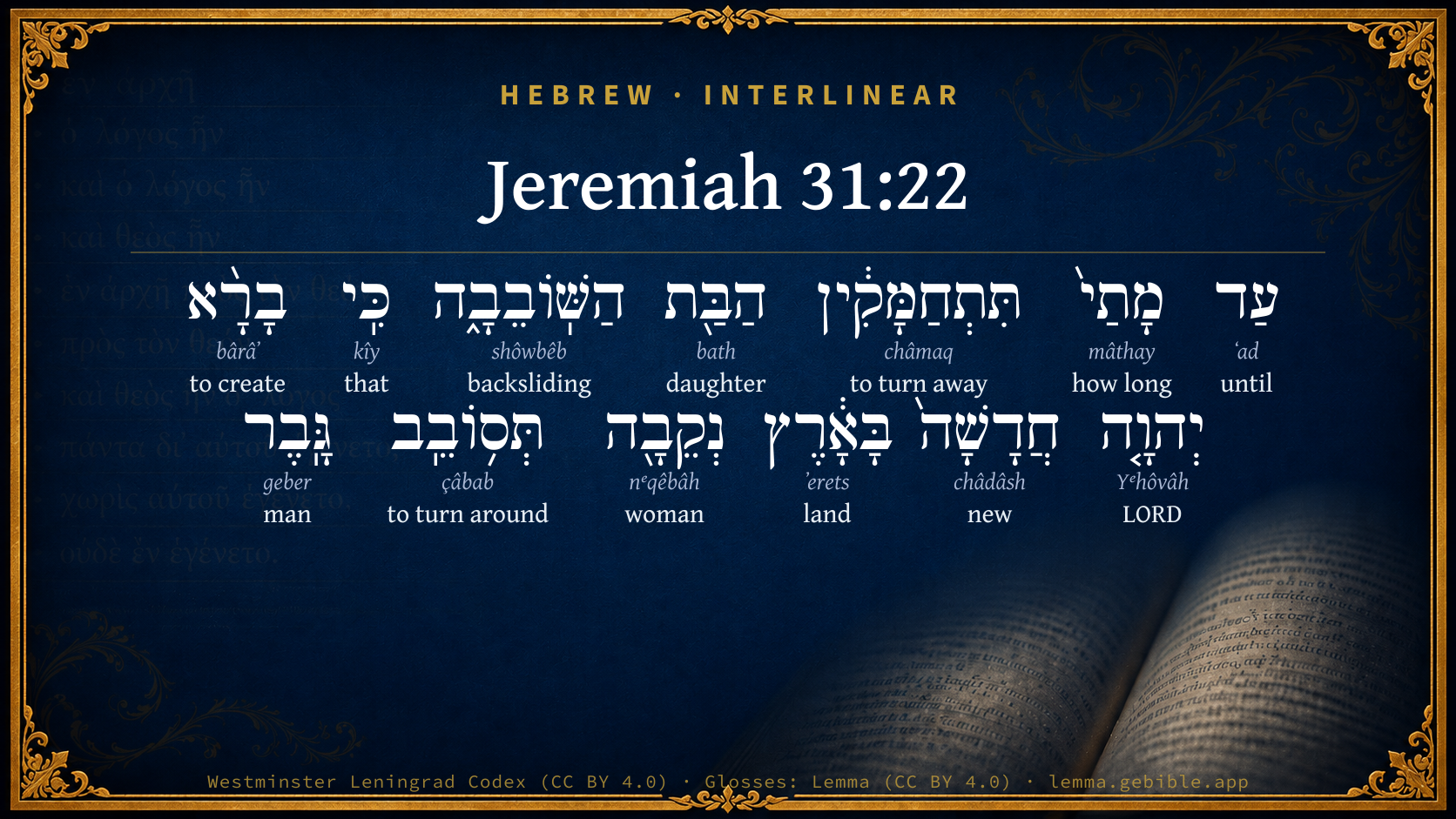
Jeremiah 31:22

Hebrew (Westminster Leningrad Codex) Jeremiah 31:22 appears in the Hebrew Old Testament. The text above is from the Westminster Leningrad Codex. Each word links to its Strong’s number, a concise gloss, and parsing drawn from the Open Scriptures Hebrew Bible morphology. Click any word for its full Brown-Driver-Briggs (BDB) entry.
Download image
Cite this verse

Jeremiah 31:22 (World English Bible). Public Domain. Lemma interlinear Bible study tool, https://lemma.gebible.app/v/jeremiah/31/22.

Show BibTeX & RIS
BibTeX
RIS
English Translation
How long will you go here and there, you backsliding daughter? for Yahweh has created a new thing in the earth: a woman shall encompass a man.
World English Bible · Public Domain
Highlights
  • 1 first appearance in the Hebrew Bible
Full analysis ↓
Download a study sheet

One document with this verse’s original text, its word-by-word gloss line, the meaning frame, cross-references with their text, attributed commentary, and full source and license credits — printable, and it pastes into notes with its structure intact.

This verse Autodidact and up

Study sheet (.html) Plain text (.txt)

A passage Seminary Student

Up to 50 verses in one chapter. A passage sheet keeps up to 6 commentary sources and 12 cross-references per verse, in the order this page ranks them, and says so on the sheet whenever that leaves anything out. Ask for a single verse and you get the Autodidact verse sheet above.

Everything on this page stays free to read, with no account — the sheet is a download of what is already on screen, not access to it.

Want to remove ads? Support Godless Engineer
Compare translations 3

The same verse in 3 English versions, stacked beneath the original-language interlinear above. Click any original word for its lexicon entry.

Each is an independent rendering of the whole verse — the interlinear is not word-aligned to these translations.

Highlighted words mark where these versions differ — a whole-verse word diff, not a word-by-word alignment.

  • World English Bible Public Domain
    How long will you go here and there, you backsliding daughter? for Yahweh has created a new thing in the earth: a woman shall encompass a man.
  • King James Version Public Domain
    How long wilt thou go about, O thou backsliding daughter? for the LORD hath created a new thing in the earth, A woman shall compass a man.
  • unfoldingWord Literal Text CC BY-SA 4.0
    How long will you waver, faithless daughter? For Yahweh has created something new on earth—a woman surrounds a strong man.

unfoldingWord Literal Text — © unfoldingWord, licensed CC BY-SA 4.0. Word-aligned USFM3 via Door43 (git.door43.org/unfoldingWord/en_ult).

Versions to compare (up to 4)

3 of 4 selected

Show all 18 translations

Every available English version of this verse, each an independent rendering of the whole verse.

  • World English Bible Public Domain
    How long will you go here and there, you backsliding daughter? for Yahweh has created a new thing in the earth: a woman shall encompass a man.
  • Berean Standard Bible Public Domain
    How long will you wander, O faithless daughter? For the LORD has created a new thing in the land—a woman will shelter a man.”
  • Majority Standard Bible Public Domain
    How long will you wander, O faithless daughter? For the LORD has created a new thing in the land—a woman will shelter a man.”
  • King James Version Public Domain
    How long wilt thou go about, O thou backsliding daughter? for the LORD hath created a new thing in the earth, A woman shall compass a man.
  • American Standard Version (1901) Public Domain
    How long wilt thou go hither and thither, O thou backsliding daughter? for Jehovah hath created a new thing in the earth: a woman shall encompass a man.
  • Revised Version (1885) Public Domain
    How long wilt thou go hither and thither, O thou backsliding daughter? for the LORD hath created a new thing in the earth, A woman shall encompass a man.
  • Geneva Bible (1599) Public Domain
    How long wilt thou goe astray, O thou rebellious daughter? for the Lord hath created a newe thing in the earth: A WOMAN shall compasse a man.
  • Douay-Rheims (1899) Public Domain
    How long wilt thou be dissolute in deliciousness, O wandering daughter? for the Lord hath created a new thing upon the earth: A WOMAN SHALL COMPASS A MAN.
  • Young's Literal Translation Public Domain
    Till when dost thou withdraw thyself, O backsliding daughter? For Jehovah hath prepared a new thing in the land, Woman doth compass man.
  • Literal Standard Version CC BY-SA 4.0
    Until when do you withdraw yourself, O backsliding daughter? For YHWH has prepared a new thing in the land, || Woman surrounds man.”
  • Unlocked Literal Bible CC BY-SA 4.0
    How long will you waver, faithless daughter? For Yahweh has created something new on earth—a woman surrounds a strong man.
  • unfoldingWord Literal Text CC BY-SA 4.0
    How long will you waver, faithless daughter? For Yahweh has created something new on earth—a woman surrounds a strong man.
  • Darby Bible Public Domain
    How long wilt thou wander about, thou backsliding daughter? For Jehovah hath created a new thing on the earth, a woman shall encompass a man.
  • World Messianic Bible Public Domain
    How long will you go here and there, you backsliding daughter? For the LORD has created a new thing in the earth: a woman will encompass a man.”
  • Webster's Bible Public Domain
    How long wilt thou wander about, O thou backsliding daughter? for the LORD hath created a new thing in the earth, A woman shall compass a man.
  • Free Bible Version CC BY-SA 4.0
    How long are you going to waver in your decision, you unfaithful daughter? For the Lord has made something new happen here: a woman is going to protect a man.
  • Bible in Basic English Public Domain
    How long will you go on turning this way and that, O wandering daughter? for the Lord has made a new thing on the earth, a woman changed into a man.
  • JPS Tanakh (1917) Public Domain
    How long wilt thou turn away coyly, O thou backsliding daughter? For the LORD hath created a new thing in the earth: a woman shall court a man.

Literal Standard Version (2020), Covenant Press — licensed CC BY-SA 4.0. Text via the HelloAO Bible API (eBible.org). Unlocked Literal Bible (unfoldingWord) — licensed CC BY-SA 4.0. Text via the HelloAO Bible API (eBible.org). unfoldingWord Literal Text — © unfoldingWord, licensed CC BY-SA 4.0. Word-aligned USFM3 via Door43 (git.door43.org/unfoldingWord/en_ult). Free Bible Version, Dr. Jonathan Gallagher — licensed CC BY-SA 4.0. Text via the HelloAO Bible API (eBible.org).

Word by word

More ways to search: Search by grammar → Find every occurrence → Compare this word →

Practice this passage: Drill this verse → Learn its vocabulary →

תִּתְחַמָּקִ֔ין
châmaq
H2559
“to turn away”
Verb, Hithpael, Imperfect, 2nd Person, Feminine, Singular + Suffix, n
Part of Speech
Verb
Stem
Hithpael
Form
Imperfect
Person
2nd Person
Gender
Feminine
Number
Singular
Full BDB Definition

Origin: a primitive root

TWOT: TWOT- 682

to withdraw, turn around, turn away - (Qal) to turn away - (Hithpael) to turn about, vacillate, turn hither and thither
  1. עַד ʻad H5704 “until” Preposition
  2. מָתַי֙ mâthay H4970 “how long” Particle, Interrogative
  3. הַבַּ֖ת bath H1323 “the · daughter” Particle, Definite Article + Noun, Common, Feminine, Singular, Absolute
  4. הַשּֽׁוֹבֵבָ֑ה shôwbêb H7728 “the · backsliding” Particle, Definite Article + Adjective, Adjective, Feminine, Singular, Absolute
  5. כִּֽי kîy H3588 “that” Conjunction
  6. בָרָ֨א bârâʼ H1254 “to create” Verb, Qal, Perfect, 3rd Person, Masculine, Singular
  7. יְהוָ֤ה Yᵉhôvâh H3068 “LORD” Noun, Proper
  8. חֲדָשָׁה֙ châdâsh H2319 “new” Adjective, Adjective, Feminine, Singular, Absolute
  9. בָּאָ֔רֶץ ʼerets H776 “in/at the · land” Preposition, Determined + Noun, Common, Both, Singular, Absolute
  10. נְקֵבָ֖ה nᵉqêbâh H5347 “woman” Noun, Common, Feminine, Singular, Absolute
  11. תְּס֥וֹבֵֽב çâbab H5437 “to turn around” Verb, Poel, Imperfect, 3rd Person, Feminine, Singular
  12. גָּֽבֶר geber H1397 “man” Noun, Common, Masculine, Singular, Absolute

About this verse

These counts appear in no published source. They are computed here, from the morphology-tagged text and Lemma’s own curated glosses. What Lemma adds →

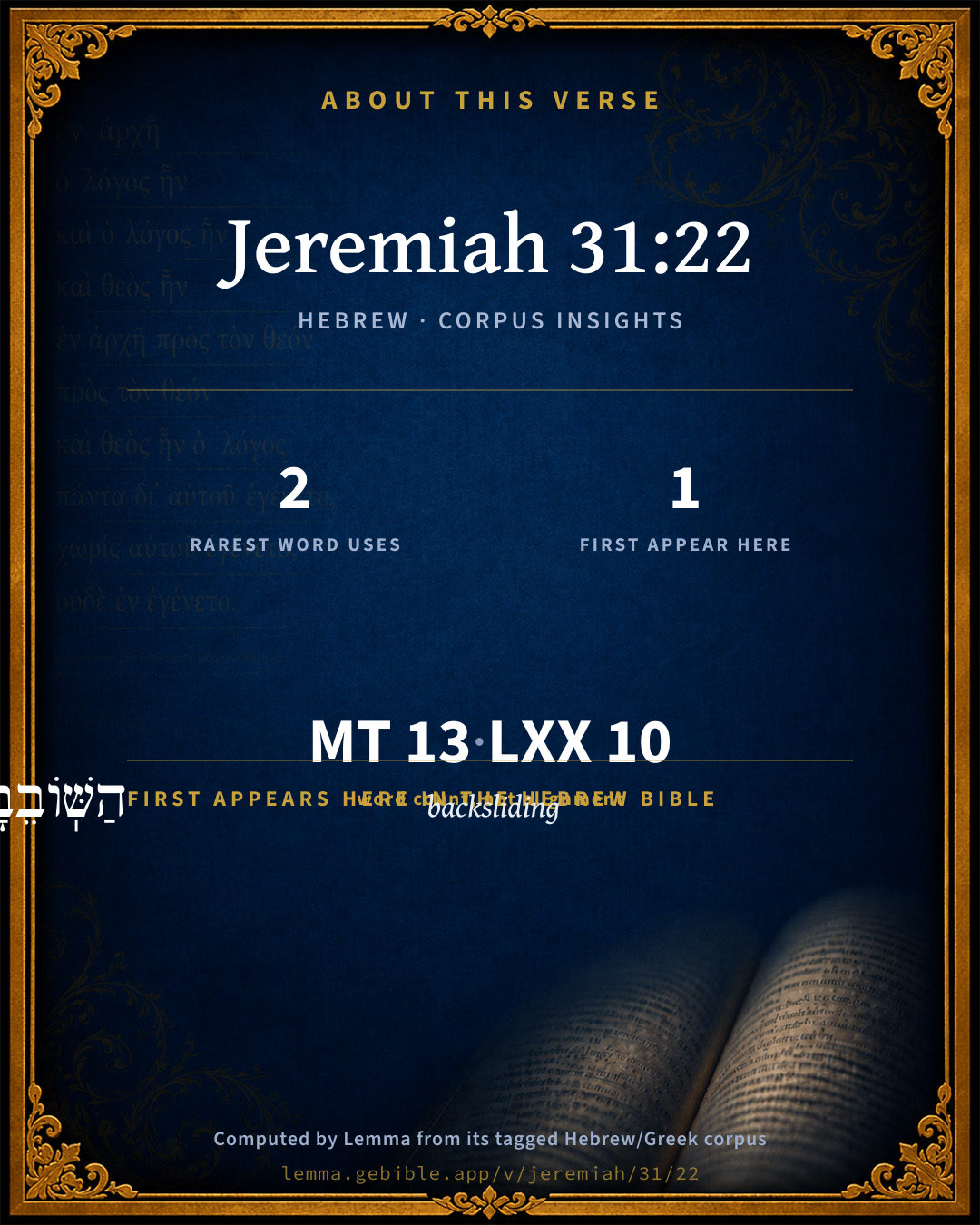
13
words
13
distinct lemmas
Prophets
section

Notable vocabulary

The rarest word here is תִּתְחַמָּקִ֔ין to turn away H2559 — appearing just 2 times in the whole Hebrew Bible.

First appearance in Scripture

This word makes its first canonical appearance in the Hebrew Bible here:

  • הַשּֽׁוֹבֵבָ֑ה backsliding H7728

Shared distinctive vocabulary

תִּתְחַמָּקִ֔ין to turn away H2559 occurs in 2 verses of the Hebrew Bible. Also found in:

Grammatical profile

  • 3 verbs
  • 5 nouns
  • 2 adjectives
  • 1 preposition
  • 1 conjunction
  • 1 particle

Verb forms

  • תִּתְחַמָּקִ֔ין Hithpael · Imperfect
  • בָרָ֨א Qal · Perfect
  • תְּס֥וֹבֵֽב Poel · Imperfect

Hebrew & Septuagint length

In the original languages it is 13 Hebrew tokens and 10 Greek tokens — but the two are counted differently (Hebrew bundles its prefixes and suffixes into one token; the Greek is in lemma form), so that isn’t a like-for-like length.

Cross-references

25

Topical passages linked to Jeremiah 31:22 in the Treasury of Scripture Knowledge — connected by theme and wording, ordered by reader-vote popularity; previews shown in the World English Bible.

  • Jeremiah 7:24 But they didn't listen nor turn their ear, but walked in [their own] counsels [and] in the stubbornness of their evil heart, and went backward, and not forward.
  • Jeremiah 49:4 Why glory you in the valleys, your flowing valley, backsliding daughter? who trusted in her treasures, [saying], Who shall come to me?
  • Matthew 1:21 She shall bring forth a son. You shall call his name Jesus, for it is he who shall save his people from their sins."
  • Luke 1:34–35 Mary said to the angel, "How can this be, seeing I am a virgin?"
  • Genesis 3:15 I will put enmity between you and the woman, and between your offspring and her offspring. He will bruise your head, and you will bruise his heel."
  • Numbers 16:30 But if Yahweh make a new thing, and the ground open its mouth, and swallow them up, with all that appertain to them, and they go down alive into Sheol; then you shall understand that these men have despised Yahweh.
  • Isaiah 7:14 Therefore the Lord himself will give you a sign. Behold, the virgin will conceive, and bear a son, and shall call his name Immanuel.
  • Jeremiah 2:18 Now what have you to do in the way to Egypt, to drink the waters of the Shihor? or what have you to do in the way to Assyria, to drink the waters of the River?
  • Jeremiah 2:23 How can you say, I am not defiled, I have not gone after the Baals? see your way in the valley, know what you have done: [you are] a swift dromedary traversing her ways;
  • Jeremiah 2:36 Why go you about so much to change your way? you shall be ashamed of Egypt also, as you were ashamed of Assyria.
  • Jeremiah 3:6 Moreover Yahweh said to me in the days of Josiah the king, Have you seen that which backsliding Israel has done? she is gone up on every high mountain and under every green tree, and there has played the prostitute.
  • Jeremiah 3:22 Return, you backsliding children, I will heal your backsliding. Behold, we are come to you; for you are Yahweh our God.
  • Jeremiah 4:14 Jerusalem, wash your heart from wickedness, that you may be saved. How long shall your evil thoughts lodge within you?
  • Hosea 4:16 For Israel has behaved extremely stubbornly, like a stubborn heifer. Then how will Yahweh feed them like a lamb in a meadow.
  • Hosea 8:5 Let Samaria throw out his calf-idol! My anger burns against them! How long will it be before the are capable of purity?
  • Hosea 11:7 My people are determined to turn from me. Though they call to the Most High, He certainly won't exalt them.
  • Jeremiah 3:11–12 Yahweh said to me, Backsliding Israel has shown herself more righteous than treacherous Judah.
  • Jeremiah 3:14 Return, backsliding children, says Yahweh; for I am a husband to you: and I will take you one of a city, and two of a family, and I will bring you to Zion:
  • Jeremiah 8:4–6 Moreover you shall tell them, Thus says Yahweh: Shall men fall, and not rise up again? Shall one turn away, and not return?
  • Jeremiah 13:27 I have seen your abominations, even your adulteries, and your neighing, the lewdness of your prostitution, on the hills in the field. Woe to you, Jerusalem! you will not be made clean; how long shall it yet be?
  • Jeremiah 14:7 Though our iniquities testify against us, work you for your name's sake, Yahweh; for our backslidings are many; we have sinned against you.
  • Hosea 14:4 "I will heal their waywardness. I will love them freely; For my anger is turned away from him.
  • Zechariah 7:11 But they refused to listen, and turned their backs, and stopped their ears, that they might not hear.
  • Jeremiah 3:8 I saw, when, for this very cause that backsliding Israel had committed adultery, I had put her away and given her a bill of divorce, yet treacherous Judah, her sister, didn't fear; but she also went and played the prostitute.
  • Galatians 4:4 But when the fullness of the time came, God sent out his Son, born to a woman, born under the law,

Cross-references courtesy of OpenBible.info (CC BY 4.0).

Hebrew and Greek witnesses Masoretic Hebrew ↔ Greek Septuagint

The same verse in the two great witnesses to the Old Testament, shown verse-for-verse.

These are two independent witnesses, not word-aligned to each other, and the Septuagint is shown in lemma (dictionary) form.

Hebrew Jeremiah 31:22 Masoretic · Westminster Leningrad Codex

עַד מָתַי֙ תִּתְחַמָּקִ֔ין הַבַּ֖ת הַשּֽׁוֹבֵבָ֑ה כִּֽי בָרָ֨א יְהוָ֤ה חֲדָשָׁה֙ בָּאָ֔רֶץ נְקֵבָ֖ה תְּס֥וֹבֵֽב גָּֽבֶר

How long will you go here and there, you backsliding daughter? for Yahweh has created a new thing in the earth: a woman shall encompass a man.

World English Bible · Public Domain

Greek LXX Structure differs

In the Septuagint, Jeremiah is about an eighth shorter than the Hebrew and arranges its material differently — the Oracles Against the Nations (Hebrew chapters 46–51) appear in the middle of the Greek book, after 25:13. Because the chapter and verse boundaries do not line up, a verse-for-verse comparison with the Hebrew is not shown.

A verse-for-verse comparison isn’t shown here because the chapters and verses don’t line up. Switch to the LXX edition with the MT / LXX toggle above to read the Greek directly.

On this verse, Haydock's Catholic Bible Commentary discusses the Septuagint’s reading. Read the note in Commentary ↓

Hebrew: Westminster Leningrad Codex (CC BY 4.0). Greek: Septuagint (public domain); English from a public-domain English Septuagint. How the Septuagint differs from the Hebrew →

Targum (Aramaic paraphrase)

1

The Targum is the ancient Jewish Aramaic paraphrase of the Hebrew Scriptures — an interpretive translation, not the Hebrew text itself. Onkelos (literal) and Pseudo-Jonathan (expansive) render the Torah, and Jonathan the Prophets. Coverage is partial: where no permissively-licensed English translation exists for a verse, only the Aramaic is shown. This is verse-level text, not a word-by-word alignment to the Hebrew.

  1. Targum Jonathan Prophets (Joshua–Malachi)
    עַד אֵימָתַי אַתְּ מִתְחַסְנָא לְמִתַּב כְּנִשְׁתָּא דְסַגִיאִין תִּיוּבְתָּהָא אֲרֵי הָא יְיָ בָרָא חַדְתָּא בְּאַרְעָא וְעַמָא בֵּית יִשְׂרָאֵל יִתְנְהוֹן לְאוֹרַיְתָא:

    How long will you refuse to repent, O congregation of much backsliding [or: congregation of much returning]? For behold, Hashem is creating something new on earth: the people, the house of Israel, will return to the Torah.

    Targum Jonathan — Aramaic: “Mikraot Gedolot” (public domain). English: “Sefaria Community Translation” (CC0 1.0 (public-domain dedication)); “London "Chaldee Paraphrase," 1871” (public domain). Text via Sefaria.

Commentary

Notes on Jeremiah 31:22 from classic Christian and Jewish commentators (each source and its license shown beneath its notes). The classic Christian expositions comment on the surrounding passage and are grouped to its opening verse, so a note may address several verses; the Jewish commentaries on the Tanakh (Rashi and others) are per-verse, so they appear only where the commentator wrote on this verse.

Lemma curates 59 commentaries, every one of them public domain or Creative Commons licensed, each selected and text-cleaned for this edition rather than reprinted as found. About our sources →

Trapp's Complete Commentary

John Trapp

Jer 31:22 How long wilt thou go about, O thou backsliding daughter? for the LORD hath created a new thing in the earth, A woman shall compass a man.

Ver. 22. How long will thou go about?] Hunting after human helps, and - refusing to set thy heart on the right straight way {Jer 31:21} - fetch a compass, to thy loss of time and labour.

O thou backsliding daughter.] Who wast at times O virgin of Israel. {Jer 31:21}

For the Lord hath created a new thing in the earth.] Or, Will create; he is even about it.

A woman shall compass a man.] i.e., Say some, the Jews (who are now looked upon as weak women, and may say Imbelles damae, quid nisi turba sumus?). shall compass about, and conquer the Chaldees, those men of might - Sicut hostis circundat hostem. Or, As others sense it, the Church Christian, how weak soever at first it may seem, and inconsiderable, yet shall be able, by the confession of her faith, to resist her most potent persecutors, and by faith to overcome them, {1Jn 5:4} as she did in the apostles, {Act 4:13-14; Act 4:33; Act 5:18-19; Act 5:38-42} in the noble army of martyrs and confessors. The text is generally understood to be Christ’s wonderful conception in the womb of his virgin mother.

John Trapp, A Commentary or Exposition upon All the Books of the Old and New Testament (1647–1656) — public domain. Text from a community e-Sword module.

Joseph Benson's Commentary

Jer 31:22. How long wilt thou go about — Or, go out of the right way, or follow thine own imaginations, O thou backsliding daughter — Thou that didst formerly revolt from thy sovereign Lord, and decline from his worship and service, going after idols, and seeking help from foreign nations, instead of applying to him for it; and who now seemest to loiter when God calls thee to return homeward out of a strange country. The expression is often used of Israel, or the ten tribes: see Jer 3:6-12: and of Judah and Israel together, ibid., Jer 31:14; Jer 31:22; both being comprehended under the title of the virgin of Israel, in the foregoing verse. For the Lord hath created, or doth create, a new thing in the earth, a woman shall compass a man — It is difficult to say, with any certainty, what this obscure passage means. Several ancient Jews expounded it of the Messiah, and most Christian interpreters understand it of the miraculous conception of the child Jesus in the womb of the virgin. “Taking the words in this sense they properly import,” as Lowth justly observes, “a new creation, and such as is the immediate work of God. And that such a prophecy concerning the conception of Christ may not be thought to come in here abruptly, it is to be observed, that as the coming of the Messiah is the foundation of the promises, both of the first and second covenant; so it contains the most powerful arguments to persuade men to obedience: and the covenant, of which Christ was to be the Mediator is plainly foretold and described in the 31st and three following verses of this chapter.” Blaney, however, thinks the original words, נקבה תסיבב גבר, cannot by any construction be brought to imply any such thing as the miraculous conception above mentioned. “Admitting,” he says, “that the word תסובב may signify shall encompass, or, comprehend in the womb, and that גבר, instead of an adult, or, strong man, (which the word generally means,)

may also signify a male child; yet the words, all taken together, still import no more than that a woman shall conceive, or contain, a male child: but this is nothing new or extraordinary, and therefore I presume it not the sense intended.” Being of opinion that the word, which we translate compass, or encompass, may signify to cause to turn about, or repulse, he renders the clause, “A woman shall put to the rout a strong man,” judging it to be a proverbial form of speech, denoting, “The weaker shall prevail over the stronger,” an expression equivalent to, one shall chase a thousand. Now this, says he, it must be confessed, is in itself new and unusual, and contrary to the ordinary course of nature; and accordingly it is ascribed to the interposing power of God, who is said therein to create a new thing, or, in other words, to work a miracle. Interpreting the passage in this sense, he explains its connection with the context as follows: “The virgin of Israel is exhorted not to turn aside, or decline the invitation given her to return, as she might, perhaps, be disposed to do through dread of the power of enemies, who would oppose her deliverance. For her encouragement she is told, that she had no reason to be apprehensive of the superior strength of any enemies, since God would work a miracle in her favour, and enable her, though apparently weak, to overcome and prevail against all their opposition.” By an interpretation nearly allied to this, many understand the passage as being a promise that the Jewish Church in its time, and afterward the gospel church, should prevail over all its enemies; though comparing the fewness and weakness of the church’s members with the multitude of her enemies, and the greatness of their power, it seemed as strange a thing as for a woman to prevail against a strong and mighty man.

Joseph Benson's Commentary on the Old and New Testaments (1811–1818) — public domain. Text from a community e-Sword module.

Geneva Bible (1599)

Geneva Bible translators

Because their deliverance from Babylon, was a figure of their deliverance from sin, he showeth how this should be procured, to wit, by Jesus Christ, whom a woman should conceive and bear in her womb. Which is a strange thing in earth, because he should be born of a virgin without man, or he meaneth that Jerusalem, which was like a barren woman in her captivity, should be fruitful as she, that is joined in marriage, and whom God blesseth with children.

Geneva Bible (1599) marginal notes — public domain. Text via Bolls.life.

Jamieson, Fausset & Brown

Robert Jamieson, A. R. Fausset & David Brown

go about--namely, after human helps (Jer 2:18, Jer 2:23, Jer 2:36). Why not return immediately to me? MAURER translates, as in Sol 5:6, "How long wilt thou withdraw thyself?" Let thy past backslidings suffice thee now that a new era approaches. What God finds fault with in them is, that they looked hither and thither, leaning on contingencies, instead of at once trusting the word of God, which promised their restoration. To assure them of this, God promises to create a new thing in their land, A woman shall compass a man. CALVIN explains this: Israel, who is feeble as a woman, shall be superior to the warlike Chaldeans; the captives shall reduce their captors to captivity. HENGSTENBERG makes the "woman" the Jewish Church, and the "man" Jehovah, her husband, whose love she will again seek (Hos 2:6-7). MAURER, A woman shall protect (Deu 32:10, Margin; Psa 32:10) a man, that is, You need fear no foes in returning, for all things shall be so peaceful that a woman would be able to take man's part, and act as his protector. But the Christian fathers (Augustine, &c.) almost unanimously interpreted it of the Virgin Mary compassing Christ in her womb. This view is favored:--(1) By the connection; it gives a reason why the exiles should desire a return to their country, namely, because Christ was conceived there. (2) The word "created" implies a divine power put forth in the creation of a body in the Virgin's womb by the Holy Ghost for the second Adam, such as was exerted in creating the first Adam (Luk 1:35; Heb 10:5). (3) The phrase, "a new thing," something unprecedented; a man whose like had never existed before, at once God and man; a mother out of the ordinary course of nature, at once mother and virgin. An extraordinary mode of generation; one conceived by the Holy Ghost without man. (4) The specification "in the land" (not "earth," as English Version), namely, of Judah, where probably Christ was conceived, in Hebron (compare Luk 1:39, Luk 1:42, Luk 1:44, with Jos 21:11) or else in Nazareth, "in the territory" of Israel, to whom Jer 31:5-6, Jer 31:15, Jer 31:18, Jer 31:21 refer; His birth was at Beth-lehem (Mic 5:2; Mat 2:5-6). As the place of His nativity, and of His being reared (Mat 2:23), and of His preaching (Hag 2:7; Mal 3:1), are specified, so it is likely the Holy Spirit designated the place of His being conceived. (5) The Hebrew for "woman" implies an individual, as the Virgin Mary, rather than a collection of persons. (6) The restoration of Israel is grounded on God's covenant in Christ, to whom, therefore, allusion is naturally made as the foundation of Israel's hope (compare Isa 7:14). The Virgin Mary's conception of Messiah in the womb answers to the "Virgin of Israel" (therefore so called, Jer 31:21), that is, Israel and her sons at their final restoration, receiving Jesus as Messiah (Zac 12:10). (7) The reference to the conception of the child Messiah accords with the mention of the massacre of "children" referred to in Jer 31:15 (compare Mat 2:17). (8) The Hebrew for "man" is properly "mighty man," a term applied to God (Deu 10:17); and to Christ (Zac 13:7; compare Psa 45:3; Isa 9:6) [CALOVIUS].

Jamieson, Fausset & Brown — Commentary Critical and Explanatory on the Whole Bible (1871) — public domain (CC PDM 1.0). Text via the HelloAO Bible API.

Adam Clarke's Commentary

Verse 22. A woman shall compass a man] נקבה תסובב גבר nekebah tesobeb gaber, "A weak woman shall compass or circumvent a strong man." This place has given much trouble to Biblical critics. By many Christian writers it is considered a prophecy of the miraculous conception of the holy virgin; but as I am sure no such meaning is in the words, nor in the context, so I am satisfied no such meaning can be fairly brought out of them. Houbigant thinks there is a small error in the text, i.e., תשובב teshobeb, shall return, and not תסובב tesobeb, shall compass. This reading is found in two of Kennicott's MSS., and he contends that the passage should be read, "The wife shall return to her husband;" alluding to the conversion of the Jewish people, called above a backsliding daughter. This makes a good sense; but I do not see why this should be called a new thing in the earth. After all, I think it likely that the Jews in their present distressed circumstances are represented under the similitude of a weak defenseless female נקבה nekebah; and the Chaldeans under that of a fierce strong man, גבר gaber, who had prevailed over and oppressed this weak woman. But, notwithstanding the disparity between them, God would cause the woman - the weak defenseless Jews, to compass - to overcome, the strong man - the powerful Babylonians. And this the prophet says would be a new thing in the land; for in such a case the lame would take the prey. The context favours both these meanings. Dr. Blayney gives a sense very near to this: "A weak woman shall repulse a strong or mighty man." It is most likely a proverbial expression.

Adam Clarke's Commentary on the Bible (1810–1826) — public domain. Text from a community e-Sword/MySword module.

John Calvin's Commentaries

As the Prophet had promised a return to the people, he now reproves especially the Israelites, who looked here and there, and never could acquiesce in the word of God alone: for it is a common thing with almost all the unbelieving, that they torment themselves, and, as it were, designedly contrive for themselves many inquietudes. Since then the Israelites were looking forward to what might happen, and could not entertain any hope as to their return, except when some appearance of hope was presented to them, the Prophet now on this account reproves them.

He first calls the people disobedient or rebellions, for they had often been terrified by threatenings, and God had also offered them the hope of pardon. As they had been perverse whenever God spared them, and as they had also rejected all his promises, the Prophet does not without reason call them disobedient or rebellious. And by circuits or wanderings, he means those vain speculations with which the unbelieving are wont to weary themselves; for the word means properly to go around. We may indeed take it in the sense of wandering, and it is the same thing: but as I have said, the Prophet most fitly gives the name of circuits to those crooked and tortuous speculations in which the unbelieving indulged. And there seems to be understood a contrast between the straight way set before theIn by God, and those circuitous courses in which miserable men entangle themselves, when they do not follow God, but are led astray by their own vain devices. Isaiah also makes use of the same similitude, for he says, that the people were carried away by their own inventions, so that they fruitlessly wearied themselves, because they did not proceed in the straight way. (Isaiah 57:10)

We may hence deduce a useful doctrine, — that we are always within the boundary of safety, when we obey God and walk in the way set before us in his word; but that as soon as we turn aside from the right way, we are only drawn here and there through windings and strayings, so that our labor is at last useless and even ruinous.

We now then understand the meaning of the Prophet: as the unbelief of the people was, as it were, a sealed door, so that they did not receive God’s promises as to their liberation and return, his purpose here was to correct this evil, and to reprove the Israelites for wandering and being disobedient.

He afterwards adds, For behold Jehovah will create — literally, has created; but the past tense is here to be taken for the future; and it serves to shew the certainty of a thing when he uses the past tense, as though he was speaking of a thing already done: Jehovah then has created a new thing He intimates that the Israelites acted foolishly in estimating the promise of deliverance according to their own judgment of things, and the state of things as it appeared to them; for he says that the favor promised them would be wonderful, for this is what he means by a new thing, as though he had said, “Ye indeed judge, according to your usual manner, of what God promises to you, as to your return, but it will be a miracle; act not then perversely, by regarding the favor of God as the common order of nature, for God will surpass everything that is usual among men.”

It ought also to be observed, that what Jeremiah said of the redemption of the people is to be extended to the eternal salvation of the Church; for God in a wonderful manner raises the dead, defends and preserves his Church, and succors her in her troubles. Whenever then the Scripture speaks of the state of the Church, we ought to ascend above the world, and above our own conceptions, and to realize the miracle which is hid from us.

Now follows the miracle, A woman shall surround a ‘man Christians, almost with one consent, explain this of the virgin Mary; and the “new thing,” leads them to this opinion, and probably, also, they were anxious to lay hold on whatever might seem to refer to the mystery of our salvation. They, therefore, say that the new thing of which the Prophet speaks is the virgin carrying the infant Christ in her womb, and that he is called man, because he was full of divine power, though he increased according to the flesh in stature, wisdom, and strength. All this is deservedly laughed at by the Jews; yet they themselves, as I think, do not rightly understand the meaning of the Prophet. They apply it to the people of Israel, because they were like a woman divorced from her husband. They then say, “A woman shall embrace a man after having been alienated from him, and prostituted herself to many adulterers.” The Jews seem to think that they give the meaning of the Prophet; but I think otherwise, for there is here a comparison made between a woman and a man, which they do not consider. For the Prophet does not speak here simply of a man, but of a strong man; for the word גבר geber, means a man who is brave or courageous. When, therefore, he compares a woman to a man, I doubt not but the Prophet means that the Israelites, who were like women, without strength, were destitute of any means of help; but then he says, that they would be superior in strength to their enemies, whose power filled the whole world with terror. We, indeed, know what sort of monarchy Babylon was when the Jews were led into exile. If then we consider what the Jews at that time were, we must say that they were like weak women, while their enemies were strong and warlike: A woman then shall surround a man

The word סבב, sebab, means not to embrace, but oftentimes to besiege; and it is taken in many places of Scripture in a bad sense, “Enemies have surrounded me.” When, therefore, a siege is mentioned, the Scripture uses this word. It is then the same as though the Prophet had said, “Women shall bring men into such straits that they shall hold them captive.” But he uses the singular number, as though he had said, “One woman shall be superior to many men, or each Jew shall exceed in valor a Chaldean; so the Jews shall gain the upper hand, though the strength of their enemies be great and terrible.” This is what I regard as the meaning of the Prophet; and justly does he set forth this as a wonderful thing, for it, was a sort of revolution in the world when God thus raised up his servants, so that they who had enslaved them should become far unequal to them. It follows, —

John Calvin's Commentaries (1540-1563) — public domain. Text from the Calvin Translation Society English edition (1840s-50s) via the Christian Classics Ethereal Library (ccel.org). Calvin's coverage is partial (roughly two-thirds of the Bible); uncommented books and verses are honest gaps, never fabricated. The 19th-century editor's footnotes and remarks are omitted so the notes are faithfully Calvin's own voice.

Ellicott's Commentary for English Readers

(22) How long wilt thou go about . . .?—The word describes the restless pacing to and fro of impatient, unsatisfied desire. The backsliding daughter—i.e., the adulterous yet now penitent wife—is described, like Gomer in the parable or history of Hos_2:7, as hesitating between her lovers and her husband.

A woman shall compass a man.—The verse is obscure, and has received very different interpretations. It will be well to begin our inquiry with the meaning which the translators attached to it. On this point the following quotation from Shakespeare is decisive :—

“If I can check my erring love, I will;

If not, to compass her I’ll use my skill.”

Two Gentlemen of Verona, ii. 4.

To “compass” is to woo and win. And this gives, it is believed, the true meaning. The Hebrew verb (which presents a striking assonance with the word for “backsliding”) means literally “to go round about,” and this (as in Psa_26:6; Psa_32:7; Psa_32:10) as an act of reverential tenderness and love. In the normal order of man’s life, the bridegroom woos the bride. In the spiritual relationship which the prophet has in view, this shall be inverted, and Israel, the erring but repentant wife, shall woo her Divine husband. The history of Gomer in Hos_2:14-20 again presents a striking parallel. A like inversion of the normal order is indicated, though with a different meaning, in Isa_4:1, where the seven women might be said to “compass” the one man. It may be noticed that the words used express the contrast of the two sexes in the strongest possible form. A female shall compass (i.e., woo) a male, possibly as emphasising the fact that what the prophet describes was an exception to the normal order, not of human society only, but of the whole animal society. By some interpreters (Ewald) the words are rendered “a woman shall be turned into a man;” meaning that the weak shall be made strong, as a kind of contrast to the opposite kind of transformation in Jer_30:6; but this gives a far less satisfactory meaning, and the same may be said of such translations as “the woman shall protect the man,” and “a woman shall put a man to flight.” The notion that the words can in even the remotest degree be connected with the mystery of the Incarnation belongs to the region of dreams, and not of realities; and, lacking as it does the support of even any allusive reference to it in the New Testament, can only be regarded, in spite of the authority of the many Fathers and divines who have adopted it, as the outgrowth of a devout but uncritical imagination. The word used for “woman,” indeed, absolutely excludes the idea of the virgin-birth.

A Bible Commentary for English Readers, edited by Charles John Ellicott (1878–1897) — public domain. Text from a community e-Sword module.

The Cambridge Bible for Schools and Colleges

gen. ed. J. J. S. Perowne

22. How long wilt thou go hither and thither] How long wilt thou hesitate to return? A sign follows, in order to induce Israel to complete her reconciliation with her offended God.

backsliding] lit. back-turning, i.e. recusant, apostate.

the Lord hath created, etc.] No explanation that has been given of the latter part of the v. is quite satisfactory. But the sense clearly is that in some way the natural order of things shall be reversed. The best interpretation is perhaps that it shall be the bride that shall court her husband, i.e. “instead of shyly keeping aloof or worse (as hitherto), Israel, Jehovah’s bride, shall with eager affection press around her divine husband” (Cheyne). Another explanation is that such is the Lord’s condescension towards Israel, that He will for her glory allow the natural order to be reversed, and deign to accept protection (of His Temple, services, honour, etc.) at her hands. For this sense of cherishing, protecting, as belonging to the Heb. verb of the clause, we may compare Deu_32:10, “He (the Lord) led him (Israel) about, he instructed him, he kept him as the apple of his eye”; and Psa_32:10, “He that trusteth in the Lord, mercy shall compass him about.” Some commentators, by a very slight change in the Heb. vocalisation, obtain the rendering, a woman shall be turned into a man, i.e. shall be given the courage of a man, so that all fear and hesitation on her part may be at an end.

The Cambridge Bible for Schools and Colleges (gen. ed. J. J. S. Perowne; Cambridge University Press, 1878–1918) — public domain. Text from a community e-Sword module.

John Gill's Exposition

How long wilt thou go about, O thou backsliding daughter?.... From place to, place, from country to country, from one kingdom to another, as the Jews do to this day; and not return unto the Lord, and David their king, and to their own country? Or, "how long wilt thou be foolish" (a)? in backsliding from the Lord; in slighting the written word; neglecting the promises and prophecies, the exhortations, cautions, and instructions therein given; in adhering to and extolling the traditions of the elders, even above the Scriptures; in pertinaciously rejecting the Messiah, next prophesied of; all which folly the Jews are still guilty of, and continue in. So the word signifies in the Arabic language (b);

for the Lord hath created a new thing in the earth, a woman shall compass a man; a mighty one, a mighty man, the man Jehovah's fellow; conceived, contained, and encompassed, in the womb of the virgin, the woman, whose seed he was to be of, and of whom he was: this was a "new", unheard of, extraordinary thing, a "creation", a work of almighty power! the human nature of Christ was formed and prepared by the power of the Holy Ghost, without the help of man; and this now is mentioned as an argument and an encouragement to the Jews to return to their own land, since the Messiah is born there of a virgin, as it was foretold he should. This seems to be the true and genuine sense of the words, and other senses weak and impertinent; as when they are made to refer to the heroic spirit in some women superior to men; to the unusual practice of women suing to men for marriage; and to the people of Israel returning to the Lord from their apostasy. So the Targum,

"for, behold, the Lord hath created a new thing in the earth and the people of the house of Israel have given themselves up to the law.''

And very foreign are the senses which some Christian interpreters give of this passage; as when they interpret it of the Jews conquering and oppressing their enemies; or of the Jewish church seeking after God, her husband, when separated from him; or of the Christian church, though weak, resisting her mighty persecutors by her confession of faith, and overcoming them; or of the church under the New Testament embracing Christ; which indeed is preferable to the other, and especially to that Popish one of the eucharist containing the body of Christ (c); but the true sense is what is before given: and even some of the Jewish doctors themselves have acknowledged, that the Messiah is here intended. In an ancient (d) book of theirs, on mention of these words, it is added,

"this shall be in the time of the Messiah, which will be on the sixth day;''

that is, the sixth millennium And elsewhere (e) "a woman shall compass a man"; says R. Hona, in the name of R. Ame, this is the King Messiah. So says R. Joshua ben Levi (f),

"he, that is, God, heals with the same he wounds; so will you find in Israel, they sinned by a virgin, and were punished in virgins, Eze 23:1; so he comforts them by a virgin, according to Jer 31:21; "turn again, O virgin of Israel", &c. "a woman shall compass a man". R Huna, in the name of R. Idi and R. Joshua, said, that this man is the King Messiah, of whom it is said, Psa 2:7, "this day have I begotten thee" (g).''

(a) "quamdiu fatua eris?" Majus apud Stockium, p. 358. (b) "mente laboravit, stultus fuit", Golius, col. 653. "et dementer, more fatui egit", Camus & Giggeius apud Castel. col. 1289. Arab. "fatuatus, nugatus fuit, ineptiit", Schindler, col. 603. (c) Vid. Erlmanni, "novum omnium novorum", &c. ad Jer. xxxi. 22. in Thesaur. Dissert. Theolog. Philolog. tom 1. p. 851. (d) Zohar in Gen. tom. 13. 4. (e) In Abarbinel. Mashmiah Jeshuah, fol. 37. 4. (f) Apud Moses Hadarsan in Gen. c. 41. Vid. Galatin. de Arcanis Cath. Ver. l. 7. c. 14. p. 52, 526. (g) See my book of the "Prophecies of the Messiah", &c. p. 100, 101.

John Gill's Exposition of the Whole Bible (1746–1763) — public domain (CC PDM 1.0). Text via the HelloAO Bible API.

Haydock's Catholic Bible Commentary

Daughter. Bury thy dead, and delay thy return no longer. The Israelites did not soon make use of the leave granted by Cyrus. (Calmet) --- Man. Hebrew, "a hero." (Tirinus) --- The fathers generally explain this of the incarnation. (Calmet) --- Christ had the perfect use of reason in the virgin’s womb. (Haydock) --- He was the brightness of his Father’s glory, Hebrew i. 3. Even some ancient Jews apply this to the Messias. (Galatin. vii. 14.) But the moderns understand that women would offer themselves in marriage; the times would be so happy. This was not so unusual in countries where polygamy prevailed, Ruth iii. 9., Isaias iv. 1., and Canticle of Canticles viii. 1. (Calmet) --- Hence this is hardly the meaning; for God promises something new. (Haydock) --- "The Lord hat created a new thing in a woman." (Aquila) --- Symmachus agrees nearly with the Septuagint, "because the Lord has created thee by salvation a new plantation. Men shall go about in thy salvation." This "might be explained, if it were not sacrilegious to argue respecting God’s word by human sense," says St. Jerome; though this censure of "the Vulgate" (Septuagint) seems rather harsh. He complains here of his copy. Theodoret explains it of the apostles going through the world to spread the gospel. (Haydock) --- Behold whence thy happiness must come, (Menochius) O thou who hast so long proved faithless, going astray after many lovers. (Haydock) --- Christ, in his mother’s womb, was in stature small, but a perfect man (Worthington) in the use of reason, &c. (Haydock)

George Leo Haydock (1774–1849), Haydock's Catholic Family Bible and Commentary, 1859 edition — public domain. Excludes Psalms (Douay-Rheims chapter numbering differs from Protestant) and Deuterocanonical books (Catholic canon only).

Matthew Poole's English Annotations

That the Jews are here meant by the

backsliding daughter is out of question; but what going about is here intended is not so plain. Some interpret it of their running after idols; some, of their seeking help from foreign nations, instead of applying themselves unto God; others, of their wandering up and down in captivity. But the greater difficulty is about this

new thing, which the Lord saith he will

create in the new earth, a woman compassing a man; some by women understanding feeble persons that should prevail against strong men. But the two interpretations of this difficult passage, which seem most reasonably to contend for preference, are,

1. The interpretation of those who think it contains a promise both of the Jewish church in its time, and of the gospel church after the Jewish church’s period, prevailing, over all its enemies, whether temporal or spiritual; though, considering the paucity of the church’s members, with the multitude of its enemies, and their power, it seemed as strange a thing as for a woman to prevail against a strong and mighty man. This the learned author of the English Annotations judgeth the true and genuine sense of these words.

2. Others interpret this woman to be the Virgin Mary, who was to enclose in her womb the Lord Jesus Christ, to whom the converted Jews were to adhere; which sense neither Mr. Calvin nor our learned English Annotator approve of. But it being the received sense of very many interpreters, it is fit we should hear their reasons, which are,

1. They urge the particle כי for God, they say, here gives the reason why the Jews should desire to return into the country of Judea, because the Messias was to be born there.

2. They urge the term created, the body of Christ being not begotten by man, but created by God, though of the flesh of the Virgin.

3. They say this indeed was a new thing. It was a new thing for a virgin to become a mother, still remaining a virgin, and to be the mother of him who was God blessed for ever, though not the mother of the Divine nature; for so Christ answered the type of Melchisedec, without father as man, without mother as God.

4. All other encompassings of a man they say were as well out of Judea as in it, this was in Judea only.

5. The word translated woman in Scripture they say always signifies a particular individual woman, which could be no other than the Virgin.

6. They say the whole context refers to benefits coming by Christ, therefore he must certainly be the man here intended.

7. They urge that this prophecy follows Jer 31:15, which, Mat 2:8, is applied by the evangelist to Herod’s murder of the infants upon the birth of Christ. But on the other side it is objected,

1. That the verb סבב is never used in Scripture to signify such an encompassing.

2. That the word translated a man, signifying a strong man, doth not properly agree to an infant in the mother’s belly. But it is again replied,

1. That this is not the only word in Scripture that is but once read in the same sense.

2. That the Word signifieth any encompassing, and may be properly applied to the Virgin’s womb encompassing an infant. And for the word translated man, they say it is applied to a new-born infant, Job 3:3; Isa 9:6; that it is applied to God, Deu 10:17, and to Christ, Zec 13:7, compared with Mat 26:31. In a matter wherein so many learned men are divided, it is enough for me to give their opinions and reasons, leaving my reader to his own judgment, in a matter wherein neither his faith nor holiness are much concerned; for the question is not concerning the thing, whether Christ was encompassed in the womb of a woman, which is plain enough from other scriptures, but only whether that be the sense of the phrase here.

Matthew Poole's English Annotations on the Holy Bible (1683–1685) — public domain. Text from a community e-Sword/MySword module.

Whedon's Commentary on the Bible

Daniel D. Whedon

22. A woman shall compass a man — Numerous explanations of these unusual words have been given; as “The woman shall be changed to a man,” (Ewald;) “The woman shall court the man,” (Hitzig;) “The woman shall keep close to the man,” (Hengstenberg;) “The woman shall turn the man to herself,” (Nagelsbach;) “The woman shall protect the man,” (Gesenius, et al.,) etc. But neither one of them perfectly suits the connexion, and most of them are lexically indefensible. The new thing is, that the woman (Israel) shall compass the man (Jehovah;) that is, embrace him lovingly and trustfully. This is “new” in that it is an intimacy of union surpassing the former times. Such is Jehovah’s condescension, that Israel is permitted to do what Christ forbade to Mary Magdalene when he said, “Touch me not.”

Daniel D. Whedon (gen. ed.), Commentary on the Old and New Testaments (1874–1909) — public domain. Text from a community e-Sword module.

The Pulpit Commentary

How long wilt thou go about? We must suppose the Israelites to be hesitating whether to set out on their journey or not. They are now admonished to put away their rebellious reluctance, and a special reason for this is added. The Lord hath createdi.e. hath decreed to createa new thing in the earth (or, in the land); comp. Isa_43:19 which suggests that a complete reversal of ordinary experience is indicated, as indeed the word create of itself prepares us to expect. And what is this promise granted as a sign to reluctant Israel? A woman shall compass a man; i.e. instead of shyly keeping aloof, or worse (as hitherto), Israel, Jehovah"s bride, shall, with eager affection, press around her Divine husband. The phrase, however, is extremely difficult. Of other explanations, the most plausible philologically is that of Schnurrer and Gesenius, "a woman shall protect a man". (comp. Deu_32:10) The part of a sentinel, pacing round and round his charge, seems most unfitted for a woman. When enemies are abroad, it is the men"s natural duty to perform this part for the women. But in the coming age, the country shall be so free from danger that the places of men and women may safely be reversed. But would a paradox of this kind be likely to be uttered in this connection? Surely a clearer statement would be necessary to remove the reluctance of the Israelites. Vers. 19, 20 suggest that Ephraim needed reassurance as to the attitude of Jehovah towards him. The promise of ver. 22, as explained above, would give precisely the needed strength and comfort. The exposition of St. Jerome and other Fathers, that the birth of Christ from a virgin is referred to, is altogether inadmissible,

(1) because the nouns which form the subject and the predicate respectively indicate sex, not age, and the first in particular cannot be tortured so as to mean "virgin;" and

(2) there is no article to confine the reference to any particular persons.

The Pulpit Commentary (1880–1919), ed. H.D.M. Spence-Jones & Joseph S. Exell — public domain. Text from a community e-Sword module.

John Wesley's Explanatory Notes

Backsliding - Running after idols; or seeking help from foreign nations, instead of applying to God. A woman - This seems to be a promise of the Jewish church in its time, and of the gospel-church, prevailing over all its enemies; though, considering the fewness of the church's members, with the multitude of its enemies, and their power, it seemed as strange a thing, as for a woman to prevail against a strong and mighty man.

John Wesley, Explanatory Notes Upon the Whole Bible (1754–1765) — public domain. Text via the GEBible commentary corpus.

Rashi

Rabbi Shlomo Yitzchaki (Rashi)

will you hide will you hide from Me, that you are ashamed to return to Me because of your way? Behold, something new has been created on earth, that a woman shall go after a man to seek him that he should marry her. This is an expression of “and I will go around (וַאֲסוֹבְבָה) in the city; I will seek, etc.” (Song 3:2). And in the name of Rabbi Judah the Preacher I heard: A woman shall turn around to become a man. I gave you like a daughter, who receives a tenth of the property of her father, seven nations out of seventy. Ultimately, you shall take everything like a son, a male, who inherits everything.

Rashi on the Tanakh — English translations: “The Judaica Press complete Tanach with Rashi, translated by A. J. Rosenberg” (CC BY 4.0); “Pentateuch with Rashi's commentary by M. Rosenbaum and A.M. Silbermann, 1929-1934” (public domain); “The Metsudah Tanach series, Lakewood, N.J” (CC BY 4.0); and “The Book of Joshua, Metsudah Publications, 1997” (CC BY 4.0). Text via Sefaria.

Lesson kit

Teaching starters — assembled from the data on this page, not authored interpretation. Every prompt links to the verse data it draws on. Edit before teaching.

Jeremiah, in the Prophets, opens this verse with 13 words (13 distinct Hebrew lemmas). Its most distinctive word is châmaq (“to turn away”). A historical commentator’s framing appears above. Read the whole chapter for the surrounding context.

Discussion questions

  1. What does “to turn away” (châmaq) contribute to the verse as a whole?
  2. This is the first place “backsliding” appears in Scripture (first appears here). What does its debut here establish?
  3. How does Song of Solomon 5:6, which shares the word «to turn away», read alongside this verse?
  4. These translations render this verse differently; the difference is in the English rendering, not the original. What questions does that raise?
  5. «תִּתְחַמָּקִ֔ין» is a Hithpael Imperfect verb. How does that grammatical form shape the action described?
  6. Compare how Trapp's Complete Commentary and Joseph Benson's Commentary read this verse. Where do they agree or differ?

Things to notice

Reading settings

Reading text

Shown beneath each verse's original-language words.

Old Testament
Old Testament edition

Read the OT as the Masoretic Hebrew (MT) or the Greek Septuagint (LXX).

English shown for the Greek Septuagint (in the Hebrew ↔ Greek comparison).

Comparing translations? Open the Compare panel on any verse page to stack up to four side by side.