
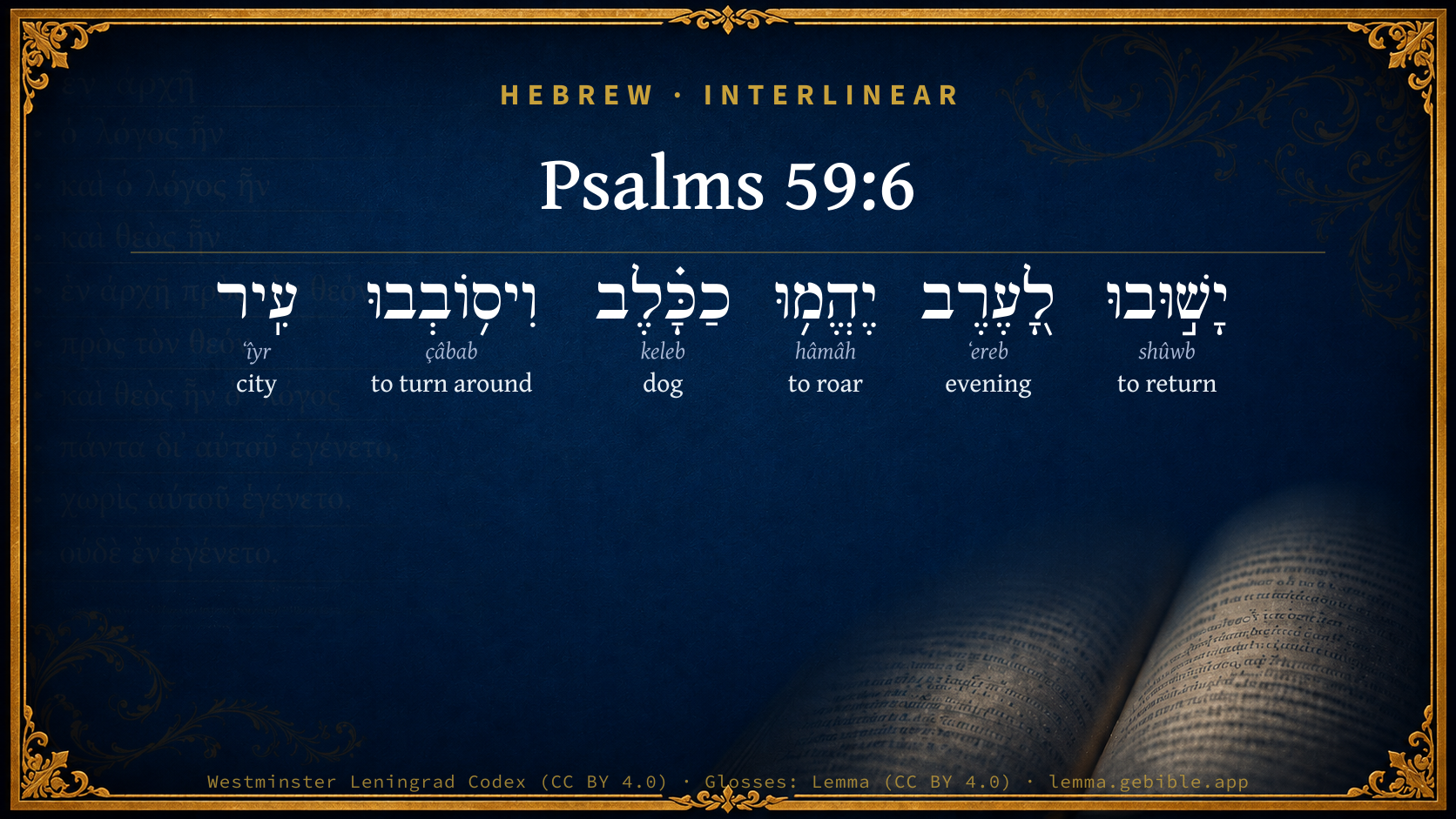
Psalms 59:6

Hebrew (Westminster Leningrad Codex) Psalms 59:6 appears in the Hebrew Old Testament. The text above is from the Westminster Leningrad Codex. Each word links to its Strong’s number, a concise gloss, and parsing drawn from the Open Scriptures Hebrew Bible morphology. Click any word for its full Brown-Driver-Briggs (BDB) entry.
Download image
Cite this verse

Psalms 59:6 (World English Bible). Public Domain. Lemma interlinear Bible study tool, https://lemma.gebible.app/v/psalms/59/6.

Show BibTeX & RIS
BibTeX
RIS
English Translation
They return at evening, howling like dogs, And prowl around the city.
World English Bible · Public Domain
Download a study sheet

One document with this verse’s original text, its word-by-word gloss line, the meaning frame, cross-references with their text, attributed commentary, and full source and license credits — printable, and it pastes into notes with its structure intact.

This verse Autodidact and up

Study sheet (.html) Plain text (.txt)

A passage Seminary Student

Up to 50 verses in one chapter. A passage sheet keeps up to 6 commentary sources and 12 cross-references per verse, in the order this page ranks them, and says so on the sheet whenever that leaves anything out. Ask for a single verse and you get the Autodidact verse sheet above.

Everything on this page stays free to read, with no account — the sheet is a download of what is already on screen, not access to it.

Want to remove ads? Support Godless Engineer
Compare translations 3

The same verse in 3 English versions, stacked beneath the original-language interlinear above. Click any original word for its lexicon entry.

Each is an independent rendering of the whole verse — the interlinear is not word-aligned to these translations.

Highlighted words mark where these versions differ — a whole-verse word diff, not a word-by-word alignment.

  • World English Bible Public Domain
    They return at evening, howling like dogs, And prowl around the city.
  • King James Version Public Domain
    They return at evening: they make a noise like a dog, and go round about the city.
  • unfoldingWord Literal Text CC BY-SA 4.0
    They return at evening, they growl like a dog and go around the city.

unfoldingWord Literal Text — © unfoldingWord, licensed CC BY-SA 4.0. Word-aligned USFM3 via Door43 (git.door43.org/unfoldingWord/en_ult).

Versions to compare (up to 4)

3 of 4 selected

Show all 18 translations

Every available English version of this verse, each an independent rendering of the whole verse.

  • World English Bible Public Domain
    They return at evening, howling like dogs, And prowl around the city.
  • Berean Standard Bible Public Domain
    They return in the evening, snarling like dogs and prowling around the city.
  • Majority Standard Bible Public Domain
    They return in the evening, snarling like dogs and prowling around the city.
  • King James Version Public Domain
    They return at evening: they make a noise like a dog, and go round about the city.
  • American Standard Version (1901) Public Domain
    They return at evening, they howl like a dog, And go round about the city.
  • Revised Version (1885) Public Domain
    They return at evening, they make a noise like a dog, and go round about the city.
  • Geneva Bible (1599) Public Domain
    They goe to and from in the euening: they barke like dogs, and goe about the citie.
  • Douay-Rheims (1899) Public Domain
    Rise up thou to meet me, and behold: even thou, O Lord, the God of hosts, the God of Israel. Attend to visit all the nations: have no mercy on all them that work iniquity.
  • Young's Literal Translation Public Domain
    They turn back at evening, They make a noise like a dog, And go round about the city.
  • Literal Standard Version CC BY-SA 4.0
    They return at evening, || They make a noise like a dog, || And go around the city.
  • Unlocked Literal Bible CC BY-SA 4.0
    They return at evening, they howl like dogs and go around the city.
  • unfoldingWord Literal Text CC BY-SA 4.0
    They return at evening, they growl like a dog and go around the city.
  • Darby Bible Public Domain
    They return in the evening; they howl like a dog, and go round about the city:
  • World Messianic Bible Public Domain
    They return at evening, howling like dogs, and prowl around the city.
  • Webster's Bible Public Domain
    \\59:5\\Thou therefore, O LORD God of hosts, the God of Israel, awake to visit all the heathen: be not merciful to any wicked transgressors. Selah.
  • Free Bible Version CC BY-SA 4.0
    In the evening they return, snarling like dogs as they roam around the city.
  • Bible in Basic English Public Domain
    They come back in the evening; they make a noise like a dog, and go round the town.
  • JPS Tanakh (1917) Public Domain
    (59-7) They return at evening, they howl like a dog, and go round about the city.

Literal Standard Version (2020), Covenant Press — licensed CC BY-SA 4.0. Text via the HelloAO Bible API (eBible.org). Unlocked Literal Bible (unfoldingWord) — licensed CC BY-SA 4.0. Text via the HelloAO Bible API (eBible.org). unfoldingWord Literal Text — © unfoldingWord, licensed CC BY-SA 4.0. Word-aligned USFM3 via Door43 (git.door43.org/unfoldingWord/en_ult). Free Bible Version, Dr. Jonathan Gallagher — licensed CC BY-SA 4.0. Text via the HelloAO Bible API (eBible.org).

Word by word

More ways to search: Search by grammar → Find every occurrence → Compare this word →

Practice this passage: Drill this verse → Learn its vocabulary →

About this verse

These counts appear in no published source. They are computed here, from the morphology-tagged text and Lemma’s own curated glosses. What Lemma adds →

6
words
6
distinct lemmas
Wisdom
section

Shared distinctive vocabulary

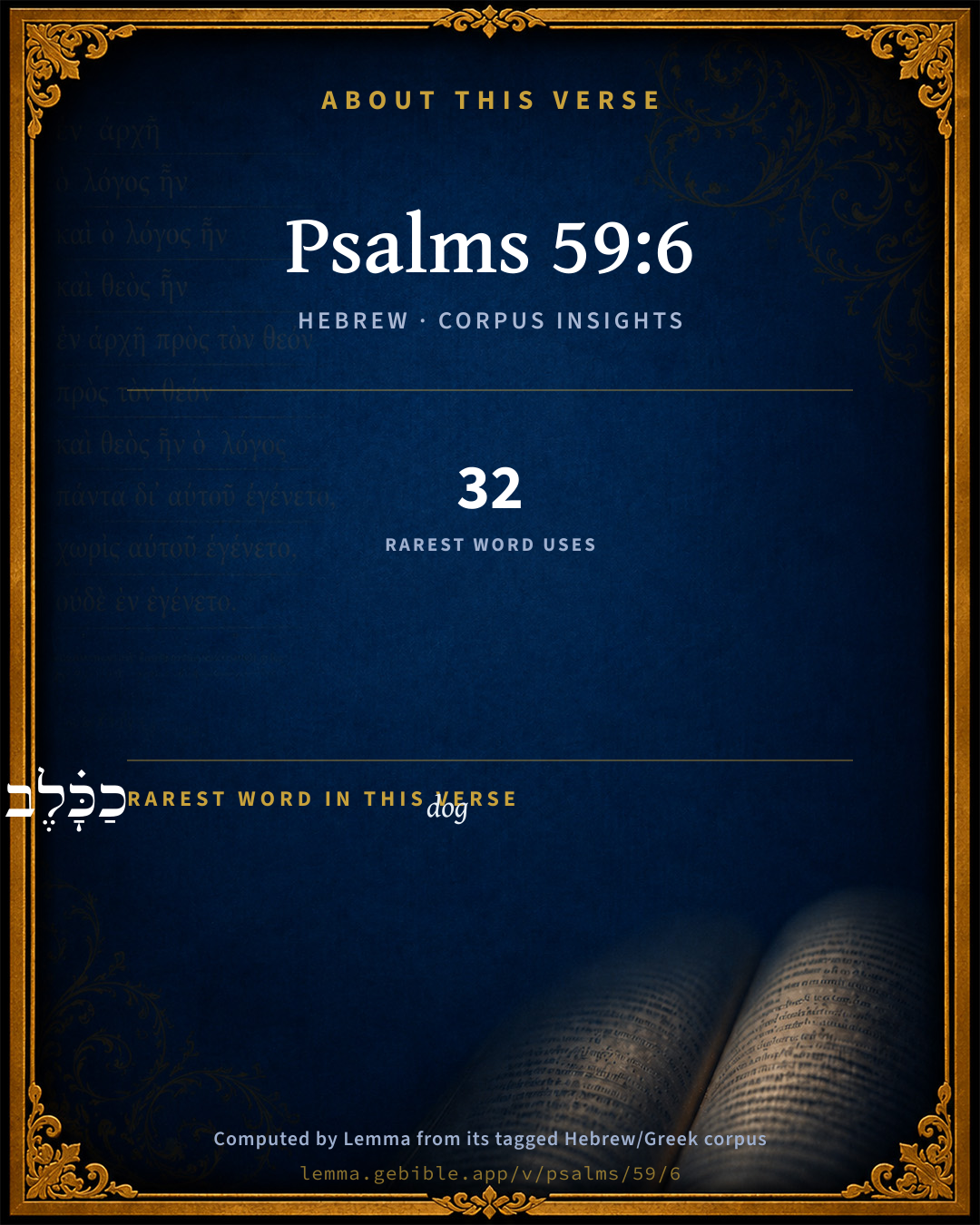
כַכָּ֗לֶב dog H3611 occurs in 31 verses of the Hebrew Bible. Also found in:

Grammatical profile

  • 3 verbs
  • 3 nouns

Verb forms

  • יָשׁ֣וּבוּ Qal · Imperfect
  • יֶהֱמ֥וּ Qal · Imperfect
  • וִיס֥וֹבְבוּ Poel · Imperfect

Hebrew & Septuagint length

In English translation the verse runs 12 words from the Hebrew and 16 from the Septuagint (LXX English) — closely comparable.

A rough comparison of the two English renderings, which tokenize alike — not a word-level alignment.

Word counts can differ between the Hebrew and the Greek without any difference in meaning — e.g. the Hebrew direct-object marker אֵת has no separate Greek word, and Greek often adds the article ὁ.

Cross-references

3

Topical passages linked to Psalms 59:6 in the Treasury of Scripture Knowledge — connected by theme and wording, ordered by reader-vote popularity; previews shown in the World English Bible.

  • Psalms 59:14 At evening let them return. Let them howl like a dog, and go around the city.
  • Psalms 22:16 For dogs have surrounded me. A company of evil-doers have enclosed me. They pierced my hands and my feet.
  • 1 Samuel 19:11 Saul sent messengers to David's house, to watch him, and to kill him in the morning: and Michal, David's wife, told him, saying, If you don't save your life tonight, tomorrow you will be slain.

Cross-references courtesy of OpenBible.info (CC BY 4.0).

Hebrew and Greek witnesses Masoretic Hebrew ↔ Greek Septuagint

The same verse in the two great witnesses to the Old Testament, shown verse-for-verse.

You’re reading Greek Psalm 58 (Hebrew Psalm 59). The Septuagint counts the superscription, so verse numbers can differ from the Hebrew — chapter-level alignment, not verse-by-verse. Numbering follows Rahlfs.

These are two independent witnesses, not word-aligned to each other, and the Septuagint is shown in lemma (dictionary) form.

Hebrew Psalms 59:6 Masoretic · Westminster Leningrad Codex

יָשׁ֣וּבוּ לָ֭עֶרֶב יֶהֱמ֥וּ כַכָּ֗לֶב וִיס֥וֹבְבוּ עִֽיר

They return at evening, howling like dogs, And prowl around the city.

World English Bible · Public Domain

Greek LXX Greek Psalm 58:6 Septuagint · lemma form

καί σύ κύριος ὁ θεός ὁ δύναμις ὁ θεός ἰσραήλ προςἔχω ὁ ἐπισκέπτομαι πᾶς ὁ ἔθνος μή οἰκτείρω πᾶς ὁ ἐργάζομαι ὁ ἀνομία διάψαλμα

They shall return at evening, and hunger like a dog, and go round about the city.

LXX2012 (modern English Septuagint) · Public Domain

Hebrew: Westminster Leningrad Codex (CC BY 4.0). Greek: Septuagint (public domain); English from LXX2012 (modern English Septuagint) (Public Domain). How the Septuagint differs from the Hebrew →

Commentary

Notes on Psalms 59:6 from classic Christian and Jewish commentators (each source and its license shown beneath its notes). The classic Christian expositions comment on the surrounding passage and are grouped to its opening verse, so a note may address several verses; the Jewish commentaries on the Tanakh (Rashi and others) are per-verse, so they appear only where the commentator wrote on this verse.

Lemma curates 59 commentaries, every one of them public domain or Creative Commons licensed, each selected and text-cleaned for this edition rather than reprinted as found. About our sources →

Trapp's Complete Commentary

John Trapp

Psa 59:6 They return at evening: they make a noise like a dog, and go round about the city.

Ver. 6. They return at evening] sc. To mine house at Gibeah of Saul, hoping to find me then at home again; as if, like the hunted hare, I must needs return to my old form.

They make a noise like a dog] When coming the second night also they missed of David they barked and howled like mad dogs, ready to take every one they met by the throat.

And go round about the city] Ferreting and searching after him in all places, and perhaps surrounding the city to surprise him.

John Trapp, A Commentary or Exposition upon All the Books of the Old and New Testament (1647–1656) — public domain. Text from a community e-Sword module.

The Treasury of David

Charles H. Spurgeon

Ver. 6. They return at evening. Like wild beasts that roam at night, they come forth to do mischief. If foiled in the light, they seek the more congenial darkness in which to accomplish their designs. They mean to break into the house in the dead of might.

They make a noise like a dog, and go round about the city. Howling with hunger for their prey, they sneak round and round the walls, prowling with stealthy footstep, and barking in unamiable concert. David compares his foes to Eastern dogs, unowned, loathsome, degraded, lean, and hungry, and he represents them as howling with disappointment, because they cannot find the food they seek. Saul's watchmen and the cruel king himself must have raved and raged fiercely when they found the image and the pillow of goat's hair in the bed instead of David. Vain were their watchings, the victim had been delivered, and that by the daughter of the man who desired his blood. Go, ye dogs, to your kennels and gnaw your bones, for this good man is not meat for your jaws.

Ver. 6. At evening. The evening expresses the time of calamity and want, and alludes to the wild beasts which are wont in the evening to go forth in quest of prey. Hermann Venema.

Ver. 6. They make a noise like a dog. The noise I heard then I shall never forget. To say that if all the sheep dogs in going to Smithfield on a market day, had been kept on the constant bark and pitted against the yelping curs upon all the carts in London, they could have given any idea of the canine uproar that now first astonished me, would be to make the feeblest of images. The whole city rang with one vast riot. Down below me, at Tophane; over about Stamboul; far away at Scutari; the whole sixty thousand dogs that are said to overrun Constantinople, appeared engaged in the most active extermination of each other, without a moment's cessation. The yelping, howling, barking, growling, and snarling, were all merged into one uniform and continuous even sound, as the noise of frogs becomes, when heard at a distance. For hours there was no lull. I went to sleep and woke again, and still, with my windows open, I heard the same tumult going on; nor was it until daybreak that anything like tranquillity was restored. Albert Smith, in "A Month at Constantinople, "1850.

Ver. 6. In bringing their secret plans to bear, they are represented as hungry dogs, prowling about the city in the darkness for prey; ranging, each one with his own object, but in one common cause. To take in the full force of this metaphor it must be remembered that in Eastern cities formerly, as at the present day, it was the custom to cast out all the refuse of food--bones, offal, etc. --into the streets, which was consumed chiefly by dogs, great numbers of which were kept, as it would seem, for that particular purpose. With this idea in mind, the metaphor has great propriety in its application to Christ's enemies.

"Every evening they return

They howl like dogs,

And surround the city." William Hill Tucker.

Ver. 6-7. This is a continued metaphor, which must be well observed, of a famished and rabid dog, unable to satisfy either its hunger or thirst; and describes men, howling formerly like dogs, pursuing, seizing all good things for themselves, and devouring; but now destitute of all things, unable to quench their cupidity, despised, miserable, and desperate wanderers. Such did Saul and his messengers sent against David in Najoth Rama show themselves to be, and give the prelude to their coming misery. Hermann Venema.

Ver. 6-7.

1. They are diligent about it, They return at evening.

2. Mad, and set to do it, They make a noise like a dog, and threaten boldly.

3. Unwearied and obdurate in their purpose: They go round about the city.

4. Impudent, and brag what they will do to me: Behold, they belch out with their mouth.

5. And their words are bloody: Swords are in their lips. Adam Clarke.

None.

Psalms 59:7*

Ver. 6-7. See Psalms on "Ps 59:6" for further information.

Ver. 6-7. See Psalms on "Ps 59:6" for further information.

Charles H. Spurgeon's The Treasury of David (1869–1885) — public domain. Psalms only. Text from a community e-Sword/MySword module.

Joseph Benson's Commentary

Psa 59:6-7. They return at evening — Saul sent once to destroy him, and the messengers went back to inform him that he was ill; but they returned in the evening to bring him even in his bed. They make a noise like a dog — The Hebrew יהמו, jehemu, signifies the confused hum and noise of an assembled crowd. “The psalmist here compares the muttered threats of his enemies to the growlings or snarlings of a dog, ready to bite and tear any person; and the comparison is just and natural.” — Dodd. And go round about the city — When they did not find him in his own house, they sought for him in other parts of the city. They belch out with their mouths — Hebrew, יביעון, jabignun, they pour forth, namely, words, even sharp and bitter words, as the next clause explains it, such as threatenings, calumnies, and imprecations, and that abundantly and vehemently, as a fountain doth waters, as the word signifies. Swords are in their lips — Their expressions are as keen and mischievous as swords; their threats and reproaches are cruel and deadly. For who, they say, doth hear? — David doth not hear us, and God either does not hear, or not regard what we say. They vented their calumnies more freely and dangerously, because privately; so that none could refute them.

Joseph Benson's Commentary on the Old and New Testaments (1811–1818) — public domain. Text from a community e-Sword module.

J. A. Alexander on Psalms

Joseph Addison Alexander

7. (Psa 59:6). Let them return at evening, let them howl like the dog, and go around the city. The verbs may also be rendered as simple futures, expressive of a confident anticipation: they shall return, etc. In either case, the verse contains a metaphorical description of the disappointment of the enemy, who are here compared to the gregarious untamed dogs by which the oriental cities are infested. As these dogs prowl about the streets in search of food, and howl for want of it, so let (or so shall) my wicked enemies. Others, with equal probability, explain this verse as a description of their present fierceness and avidity.

Joseph Addison Alexander, The Psalms Translated and Explained (1850) — public domain. Text from a community e-Sword module.

Tyndale Open Study Notes

Tyndale Open Resources

59:6-8 The wicked threaten like vicious dogs, but the Lord responds with scorn.

Tyndale Open Study Notes — © Tyndale Open Resources, licensed CC BY-SA 4.0. Text via the HelloAO Bible API.

Geneva Bible (1599)

Geneva Bible translators

He compareth their cruelty to hungry dogs, showing that they are never weary in doing evil.

Geneva Bible (1599) marginal notes — public domain. Text via Bolls.life.

Jamieson, Fausset & Brown

Robert Jamieson, A. R. Fausset & David Brown

They are as ravening dogs seeking prey, and as such,

belch out--that is, slanders, their impudent barkings.

Jamieson, Fausset & Brown — Commentary Critical and Explanatory on the Whole Bible (1871) — public domain (CC PDM 1.0). Text via the HelloAO Bible API.

Adam Clarke's Commentary

Verse 6. They return at evening] When the beasts of prey leave their dens, and go prowling about the cities and villages to get offal, and entrap domestic animals, these come about the city to see if they may get an entrance, destroy the work, and those engaged in it.

Adam Clarke's Commentary on the Bible (1810–1826) — public domain. Text from a community e-Sword/MySword module.

John Calvin's Commentaries

6. They will return at evening. He compares his enemies to famished and furious dogs which hunger impels to course with endless circuits in every direction, and under this figure accuses their insatiable fierceness, shown in the ceaseless activity to which they were instigated by the desire of mischief. He says that they return in the evening, to intimate, not that they rested at other times, but were indefatigable in pursuing their evil courses. If they came no speed through the day, yet the night would find them at their work. The barking of dogs aptly expressed as a figure the formidable nature of their assaults.

John Calvin's Commentaries (1540-1563) — public domain. Text from the Calvin Translation Society English edition (1840s-50s) via the Christian Classics Ethereal Library (ccel.org). Calvin's coverage is partial (roughly two-thirds of the Bible); uncommented books and verses are honest gaps, never fabricated. The 19th-century editor's footnotes and remarks are omitted so the notes are faithfully Calvin's own voice.

Ellicott's Commentary for English Readers

(6) A dog.—This comparison to the gaunt half-starved wild dogs of an Eastern town has met us before (Psa_22:16). The verbs should be rendered as futures here and in Psa_59:15.

Make a noise.—Better, howl. (See Note Psa_55:7.) An English traveller has described the noise made by the dogs of Constantinople: “The noise I heard then I shall never forget. The whole city rang with one vast riot. Down below me at Tophane; over about Stamboul; far away at Scutari; the whole 60,000 dogs that are said to overrun Constantinople appeared engaged in the most active extermination of each other without a moment’s cessation. The yelping, howling, barking, growling, and snarling were all merged into one uniform and continuous even sound” (Albert Smith, A Month at Constantinople, quoted from Spurgeon’s Treasury of David).

A Bible Commentary for English Readers, edited by Charles John Ellicott (1878–1897) — public domain. Text from a community e-Sword module.

The Cambridge Bible for Schools and Colleges

gen. ed. J. J. S. Perowne

6. He compares his enemies to a troop of savage and hungry dogs (Psa_22:16) such as still infest Oriental towns, in the day-time sleeping in the sun or slinking lazily about, but as night comes on collecting together, and traversing the streets in search of food, howling dismally. P.B.V. grin means ‘snarl.’ Cp. Shakespeare, 2 Hen. VI, iii. 1. 18, quoted in Wright’s Bible Word-Book,

“Small curs are not regarded when they grin;

But great men tremble when the lion roars.”

6–9. Be his enemies never so threatening and insolent, he can trust in God.

The Cambridge Bible for Schools and Colleges (gen. ed. J. J. S. Perowne; Cambridge University Press, 1878–1918) — public domain. Text from a community e-Sword module.

John Gill's Exposition

They return at evening,.... It was at evening Saul sent messengers to watch David's house, that they might take him in the morning; but missing him, perhaps after a fruitless search for him all the day, returned at evening to watch his house again; or they might come, and go and return the first evening. So it was night when Judas set out from Bethany, to go to the chief priests at Jerusalem, to covenant with them, and betray his master; and it was in the night he did betray him, after he had eaten the passover at evening with him. Or, "let them return" (p), as in Psa 59:14; with shame and confusion, as David's enemies, when they found nothing but an image in the bed, which they reported to Saul; and as Judas returned to the chief priests with confusion and horror. Or, "they shall return" (q); which being prophetically said, had its accomplishment, both in the enemies of David and of Christ; and will be true of all the wicked, who will return from their graves and live again, and give an account of themselves at the evening of the day of the Lord, which is a thousand years; in the morning of which day the dead in Christ will rise, but the rest will not rise until the end of the thousand years;

they make a noise like a dog: which is a very noisy creature, and especially some of them, which are always yelping and barking; though indeed there are some that are naturally dumb, and cannot bark: such there are in the West Indies, as we are told (r); and to which the allusion is in Isa 56:10; and which may serve to illustrate the passage there: but those referred to here are of another kind; and this noise of theirs either respects their bark in the night, as some dogs do continually, as Aben Ezra and Kimchi; or to their howling, as the Syriac and Arabic versions. Wicked men are compared to dogs, Mat 7:6, Rev 22:15; and particularly the enemies of Christ, Psa 22:16, in allusion either to hunting dogs, who make a noise all the while they are pursuing after the game; or hungry ravenous ones, who make a noise for want of food; and this character agrees not only with the Roman soldiers, who were Gentiles, and whom the Jews used to call by this name, Mat 15:26; but the Jews also, even their principal men, as well as the dregs of the people, who were concerned in the death of Christ; and may be truly said to make a noise like dogs when they cried Away with this man, and release unto us Barabbas, crucify him, crucify him; for which they were instant and pressing with loud voices, and their voices prevailed, Luk 23:18;

and go round about the city; as Saul's messengers, very probably, when they found David had made his escape from his house, searched the city round in quest of him; and there was much going about the city of Jerusalem at the time of our Lord's apprehension, trial, and condemnation; after he was taken in the garden: they went with him first to Annas's house, then to Caiaphas's, then to Pilate's, and then to Herod's, and back again to Pilate's, and from thence out of the city to Golgotha. The allusion is still to dogs, who go through a city barking (s) at persons, or in quest of what they can get; so informers and accusers may be called city dogs, as some sort of orators are by Demosthenes (t).

(p) "revertantur", Gejerus, Schmidt. (q) "Convertentur", V. L. Pagninus, Montanus; so Sept. Syr. Ar. (r) P. Martyr. Decad. Ocean decad. 1. l. 3. & de Insulis Occid. Ind. Vid. Iguatii Epist. ad Eph. p. 124. (s) . Theocrit. Idyll. 2. v. 35. (t) Apud Salmuth. in Pancirol. Memorub. Rer. par. 2. tit. 2. p. 97.

John Gill's Exposition of the Whole Bible (1746–1763) — public domain (CC PDM 1.0). Text via the HelloAO Bible API.

Albert Barnes' Notes on the Bible

They return at evening - Many have rendered this in the imperative, as in Psa 59:14, “Let them return at evening,” etc. So Luther renders it, and so also DeWette. But the more natural and obvious interpretation is to render it in the indicative, as describing the manner in which his enemies came upon him - like dogs seeking their prey; fierce mastiffs, howling and ready to spring upon him. From the phrase “they return at evening,” thus explained, it would seem probable that they watched their opportunity, or lay in wait, to secure their object; that having failed at first, they drew off again until evening, perhaps continuing thus for several days unable to accomplish their object.

They make a noise like a dog - So savages, after lurking stealthily all day, raise the war-whoop at night, and come upon their victims. It is possible that an assault of this kind “had” been attempted; or, more probably, it is a description of the manner in which they “would” make their assault, and of the spirit with which it would be done.

And go round about the city - The word “city” is used in a large sense in the Scriptures, and is often applied to places that we should now describe as “villages.” Any town within the limits of which David was lodged, would answer to this term.

Albert Barnes' Notes on the Bible (1834–1885) — public domain. Text from a community e-Sword/MySword module.

Matthew Poole's English Annotations

They return at evening, after they have been busy all day, either in plotting against me, or in hunting after me. In the evening, when they should compose themselves to rest, they return to their old trade of watching for me which they did at this time all the night long, 1Sa 19:11.

They make a noise like a dog; either when he is hungry and pursuing his prey, and howls for meat; or when he is enraged, and grins and snarls where he cannot or dare not bite. And go round about the city: when they did not find him in his own house, they sought for him in other houses and parts of the city, where they supposed him to lurk.

Matthew Poole's English Annotations on the Holy Bible (1683–1685) — public domain. Text from a community e-Sword/MySword module.

Whedon's Commentary on the Bible

Daniel D. Whedon

6. They return at evening—The poetical account, which here gives a deeper insight than the narrative in 1Sa_19:11-16, speaks of a succession of nights. They not only patrolled the city, (see Psa_59:3,) but had now closely beset his house.

They make a noise like a dog—The half wild, gaunt, starved dogs of the East are scarcely less ferocious, and more disgusting, than wolves. They go in packs, and at night their howling, barking, yelping, and growling are as frightful as they are discordant. See on Psa_22:16

Daniel D. Whedon (gen. ed.), Commentary on the Old and New Testaments (1874–1909) — public domain. Text from a community e-Sword module.

The Pulpit Commentary

Vers. 6-9. a new stanza begins" (Cheyne). The "enemies" of ver. 1 and the "workers of iniquity" of ver. 2 are more elaborately portrayed. First they are represented as "dogs such hideous, half-wild dogs as frequent Eastern cities, which sleep during the greater part of the day, and rove about in packs at night unclean, horrid, loathsome animals (ver. 6). Then they appear as men abusive, slanderous, godless (ver. 7). In conclusion, appeal is made to God against them. He will "laugh them to scorn" (ver. 8); and he is a sure Defence against all their efforts (ver. 9).

They return at evening. Having traced David to his house, they disperse for a time, but "return" again at evening, and take up their watch. (1Sa_19:11) They make a noise like a dog; i.e. snarl and growl, quarrelling more or less among themselves during the night time. And go round about the city. Either wander vaguely about, as dogs do for prey, or patrol the walls and gates to see that David does not quit the city, and so escape them.

The Pulpit Commentary (1880–1919), ed. H.D.M. Spence-Jones & Joseph S. Exell — public domain. Text from a community e-Sword module.

John Wesley's Explanatory Notes

Return - Watching for me: which they did at this time all the night long, 1 Sam. xix, 11. A dog - When he is pursuing his prey. Go round - When they did not find him in his own house, they sought for him in other parts of the city.

John Wesley, Explanatory Notes Upon the Whole Bible (1754–1765) — public domain. Text via the GEBible commentary corpus.

unfoldingWord translationNotes

Door43 World Missions Community

They return at evening

The word "they" refers to the wicked transgressors.

they howl like dogs

The psalmist speaks of his enemies threatening to attack people as if they were dogs howling, growling, or barking at people. AT: "they threaten to attack people" (See: Simile)

go around the city

Why they go around the city can be stated clearly. AT: "go around the city to attack anyone they find" (See: Assumed Knowledge and Implicit Information)

See

Here the word "See" is being used to draw attention to something. AT: "Hear"

they belch out with their mouths

Saying terrible things is spoken of as belching. These terrible things may have been insults or threats. AT: "they say terrible things" or "they shout out terrible words" (See: Metaphor)

belch

burp loudly; allow air from the stomach to come out of the mouth with a loud, rude noise

swords are in their lips

The cruel things that the wicked people were saying are spoken of as if they were swords. AT: "they say cruel things that cause people trouble as much as swords destroy people" (See: Metaphor)

Who hears us?

This question is used to show that they believed that God would not hear and punish them. AT: "No one can hear us!" or "Your God does not hear us!" (See: Rhetorical Question)

translationWords

sword

unfoldingWord translationNotes — © Distant Shores Media and the Door43 World Missions Community, licensed CC BY-SA 4.0. Source: git.door43.org/Door43/en_tn.

Rashi

Rabbi Shlomo Yitzchaki (Rashi)

arise to visit upon all the nations And judge these wicked men according to the statutes of the nations. Do not be gracious to them.

Rashi on the Tanakh — English translations: “The Judaica Press complete Tanach with Rashi, translated by A. J. Rosenberg” (CC BY 4.0); “Pentateuch with Rashi's commentary by M. Rosenbaum and A.M. Silbermann, 1929-1934” (public domain); “The Metsudah Tanach series, Lakewood, N.J” (CC BY 4.0); and “The Book of Joshua, Metsudah Publications, 1997” (CC BY 4.0). Text via Sefaria.

Lesson kit

Teaching starters — assembled from the data on this page, not authored interpretation. Every prompt links to the verse data it draws on. Edit before teaching.

Psalms, in the Wisdom, opens this verse with 6 words (6 distinct Hebrew lemmas). Its most distinctive word is keleb (“dog”). A historical commentator’s framing appears above. Read the whole chapter for the surrounding context.

Discussion questions

  1. How does “dog” (keleb) shape what this verse is saying?
  2. Exodus 11:7 shares the word «dog» with this verse. How do the two illuminate each other?
  3. These translations render this verse differently; the difference is in the English rendering, not the original. What questions does that raise?
  4. The verb «יָשׁ֣וּבוּ» is Qal Imperfect. How does its form color the action?
  5. Reading how Trapp's Complete Commentary and The Treasury of David read this verse, where do the two commentators agree and where do they part?

Things to notice

Reading settings

Reading text

Shown beneath each verse's original-language words.

Old Testament
Old Testament edition

Read the OT as the Masoretic Hebrew (MT) or the Greek Septuagint (LXX).

English shown for the Greek Septuagint (in the Hebrew ↔ Greek comparison).

Comparing translations? Open the Compare panel on any verse page to stack up to four side by side.