
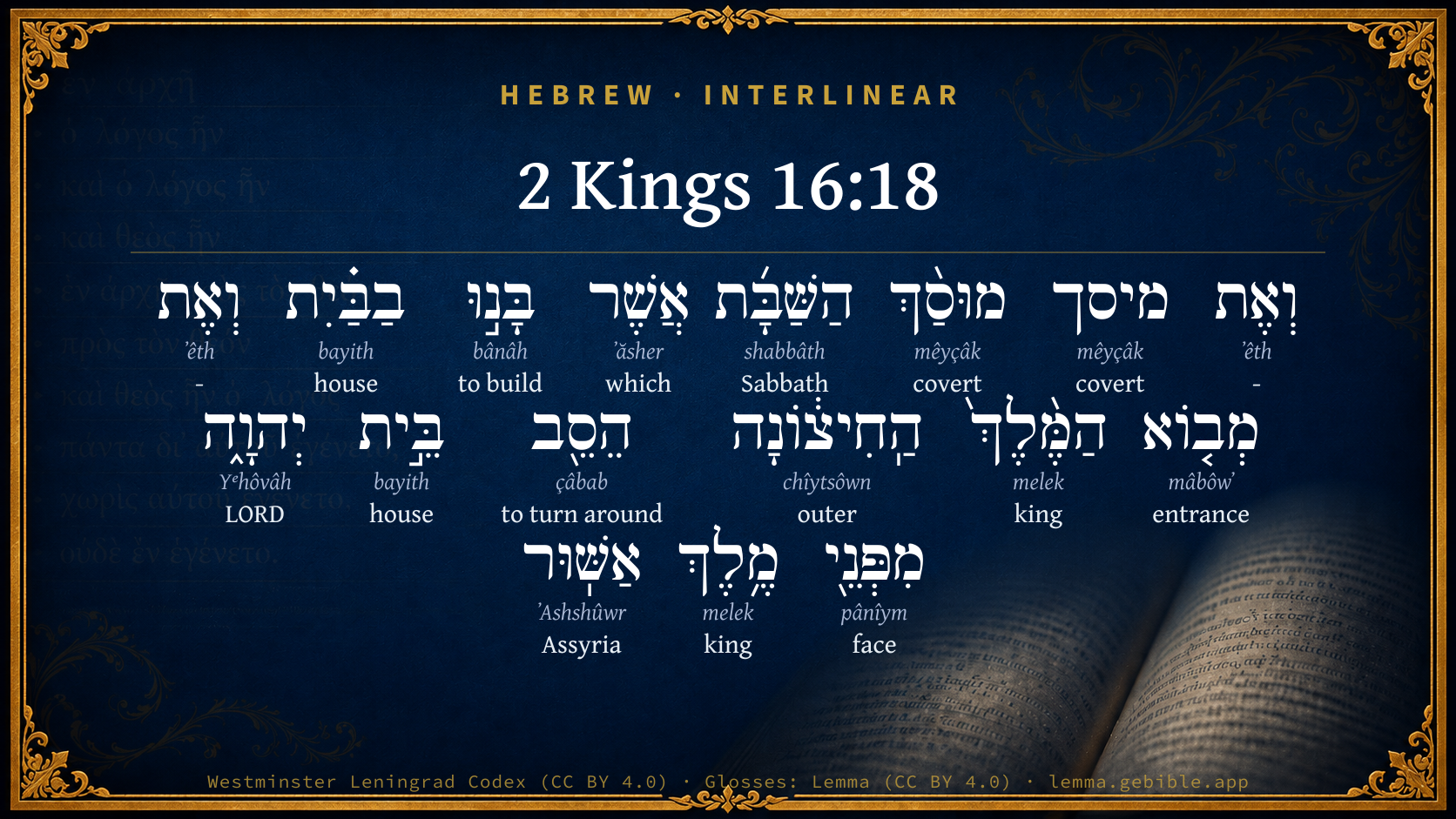
2 Kings 16:18

Hebrew (Westminster Leningrad Codex) 2 Kings 16:18 appears in the Hebrew Old Testament. The text above is from the Westminster Leningrad Codex. Each word links to its Strong’s number, a concise gloss, and parsing drawn from the Open Scriptures Hebrew Bible morphology. Click any word for its full Brown-Driver-Briggs (BDB) entry.
Download image
Cite this verse

2 Kings 16:18 (World English Bible). Public Domain. Lemma interlinear Bible study tool, https://lemma.gebible.app/v/2-kings/16/18.

Show BibTeX & RIS
BibTeX
RIS
English Translation
The covered way for the Sabbath that they had built in the house, and the king's entry outside, turned he to the house of Yahweh, because of the king of Assyria.
World English Bible · Public Domain
Highlights
  • 1 first appearance in the Hebrew Bible
Full analysis ↓
Download a study sheet

One document with this verse’s original text, its word-by-word gloss line, the meaning frame, cross-references with their text, attributed commentary, and full source and license credits — printable, and it pastes into notes with its structure intact.

This verse Autodidact and up

Study sheet (.html) Plain text (.txt)

A passage Seminary Student

Up to 50 verses in one chapter. A passage sheet keeps up to 6 commentary sources and 12 cross-references per verse, in the order this page ranks them, and says so on the sheet whenever that leaves anything out. Ask for a single verse and you get the Autodidact verse sheet above.

Everything on this page stays free to read, with no account — the sheet is a download of what is already on screen, not access to it.

Want to remove ads? Support Godless Engineer
Compare translations 3

The same verse in 3 English versions, stacked beneath the original-language interlinear above. Click any original word for its lexicon entry.

Each is an independent rendering of the whole verse — the interlinear is not word-aligned to these translations.

Highlighted words mark where these versions differ — a whole-verse word diff, not a word-by-word alignment.

  • World English Bible Public Domain
    The covered way for the Sabbath that they had built in the house, and the king's entry outside, turned he to the house of Yahweh, because of the king of Assyria.
  • King James Version Public Domain
    And the covert for the sabbath that they had built in the house, and the king's entry without, turned he from the house of the LORD for the king of Assyria.
  • unfoldingWord Literal Text CC BY-SA 4.0
    and the canopy of the Sabbath that they had built at the house and the outer entrance of the king, he removed the house of Yahweh, from the face of the king of Assyria.

unfoldingWord Literal Text — © unfoldingWord, licensed CC BY-SA 4.0. Word-aligned USFM3 via Door43 (git.door43.org/unfoldingWord/en_ult).

Versions to compare (up to 4)

3 of 4 selected

Show all 18 translations

Every available English version of this verse, each an independent rendering of the whole verse.

  • World English Bible Public Domain
    The covered way for the Sabbath that they had built in the house, and the king's entry outside, turned he to the house of Yahweh, because of the king of Assyria.
  • Berean Standard Bible Public Domain
    And on account of the king of Assyria, he removed the Sabbath canopy they had built in the temple and closed the royal entryway outside the house of the LORD.
  • Majority Standard Bible Public Domain
    And on account of the king of Assyria, he removed the Sabbath canopy they had built in the temple and closed the royal entryway outside the house of the LORD.
  • King James Version Public Domain
    And the covert for the sabbath that they had built in the house, and the king's entry without, turned he from the house of the LORD for the king of Assyria.
  • American Standard Version (1901) Public Domain
    And the covered way for the sabbath that they had built in the house, and the king's entry without, turned he unto the house of Jehovah, because of the king of Assyria.
  • Revised Version (1885) Public Domain
    And the covered way for the sabbath, that they had built in the house, and the king’s entry without, turned he unto the house of the LORD, because of the king of Assyria.
  • Geneva Bible (1599) Public Domain
    And the vaile for the Sabbath (that they had made in the house) and the Kings entrie without turned he to the house of the Lord, because of the King of Asshur.
  • Douay-Rheims (1899) Public Domain
    The Musach also for the sabbath, which he had built in the temple: and the king's entry from without he turned into the temple of the Lord, because of the king of the Assyrians.
  • Young's Literal Translation Public Domain
    And the covered place for the sabbath that they built in the house, and the entrance of the king without, he turned `from' the house of Jehovah, because of the king of Asshur.
  • Literal Standard Version CC BY-SA 4.0
    And the covered place for the Sabbath that they built in the house, and the entrance of the king outside, he turned [from] the house of YHWH, because of the king of Asshur.
  • Unlocked Literal Bible CC BY-SA 4.0
    He removed the covered walkway for the Sabbath that they had built at the temple, along with the king's entry outside the temple of Yahweh, because of the king of Assyria.
  • unfoldingWord Literal Text CC BY-SA 4.0
    and the canopy of the Sabbath that they had built at the house and the outer entrance of the king, he removed the house of Yahweh, from the face of the king of Assyria.
  • Darby Bible Public Domain
    And the covered way of the sabbath that they had built in the house, and the king's entry outside, he turned from the house of Jehovah on account of the king of Assyria.
  • World Messianic Bible Public Domain
    He removed the covered way for the Sabbath that they had built in the house, and the king’s outer entrance to the LORD’s house, because of the king of Assyria.
  • Webster's Bible Public Domain
    And the covert for the sabbath that they had built in the house, and the king's entry without, he turned from the house of the LORD for the king of Assyria.
  • Free Bible Version CC BY-SA 4.0
    He took down the Sabbath canopy they had built in the Temple, as well as the king's outer entrance to the Lord's Temple. He did this to please the king of Assyria.
  • Bible in Basic English Public Domain
    *** the house of the Lord, because of the king of Assyria.
  • JPS Tanakh (1917) Public Domain
    And the covered place for the sabbath that they had built in the house, and the king's entry without, turned he unto the house of the LORD, because of the king of Assyria.

Literal Standard Version (2020), Covenant Press — licensed CC BY-SA 4.0. Text via the HelloAO Bible API (eBible.org). Unlocked Literal Bible (unfoldingWord) — licensed CC BY-SA 4.0. Text via the HelloAO Bible API (eBible.org). unfoldingWord Literal Text — © unfoldingWord, licensed CC BY-SA 4.0. Word-aligned USFM3 via Door43 (git.door43.org/unfoldingWord/en_ult). Free Bible Version, Dr. Jonathan Gallagher — licensed CC BY-SA 4.0. Text via the HelloAO Bible API (eBible.org).

Word by word

More ways to search: Search by grammar → Find every occurrence → Compare this word →

Practice this passage: Drill this verse → Learn its vocabulary →

מיסך
mêyçâk
H4329
“covert of”
Noun, Common, Masculine, Singular, Construct
Part of Speech
Noun
Type
Common
Gender
Masculine
Number
Singular
State
Construct
Full BDB Definition

Origin: from H5526

TWOT: 1492b

covered structure, covert
  1. וְאֶת ʼêth H853 “and · -” Conjunction + Particle, Direct Object
  2. מוּסַ֨ךְ mêyçâk H4329 “covert of” Noun, Common, Masculine, Singular, Construct
  3. הַשַּׁבָּ֜ת shabbâth H7676 “the · Sabbath” Particle, Definite Article + Noun, Common, Both, Singular, Absolute
  4. אֲשֶׁר ʼăsher H834 “which” Particle, Relative
  5. בָּנ֣וּ bânâh H1129 “to build” Verb, Qal, Perfect, 3rd Person, Common, Plural
  6. בַבַּ֗יִת bayith H1004 “in/at the · house” Preposition, Determined + Noun, Common, Masculine, Singular, Absolute
  7. וְאֶת ʼêth H853 “and · -” Conjunction + Particle, Direct Object
  8. מְב֤וֹא mâbôwʼ H3996 “entrance of” Noun, Common, Masculine, Singular, Construct
  9. הַמֶּ֨לֶךְ֙ melek H4428 “the · king” Particle, Definite Article + Noun, Common, Masculine, Singular, Absolute
  10. הַֽחִיצ֔וֹנָה chîytsôwn H2435 “the · outer · toward” Particle, Definite Article + Adjective, Adjective, Masculine, Singular, Absolute + Suffix, Demonstrative
  11. הֵסֵ֖ב çâbab H5437 “to turn around” Verb, Hiphil, Perfect, 3rd Person, Masculine, Singular
  12. בֵּ֣ית bayith H1004 “house of” Noun, Common, Masculine, Singular, Construct
  13. יְהוָ֑ה Yᵉhôvâh H3068 “LORD” Noun, Proper
  14. מִפְּנֵ֖י pânîym H6440 “from · face(s) of” Preposition + Noun, Common, Both, Plural, Construct
  15. מֶ֥לֶךְ melek H4428 “king of” Noun, Common, Masculine, Singular, Construct
  16. אַשּֽׁוּר ʼAshshûwr H804 “Assyria” Noun, Proper

About this verse

These counts appear in no published source. They are computed here, from the morphology-tagged text and Lemma’s own curated glosses. What Lemma adds →

17
words
13
distinct lemmas
Historical
section

Notable vocabulary

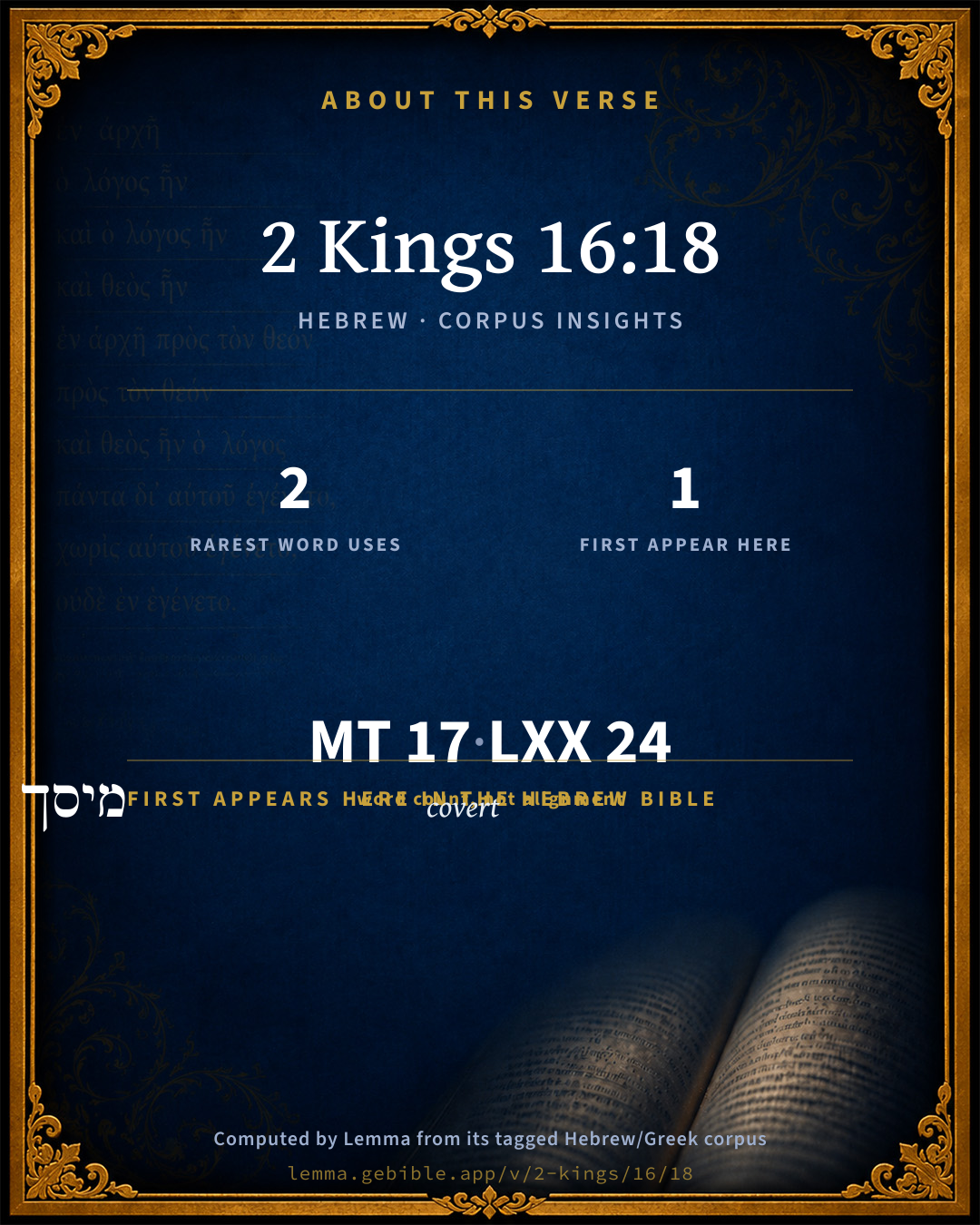
The rarest word here is מיסך covert H4329 — appearing just 2 times in the whole Hebrew Bible.

First appearance in Scripture

This word makes its first canonical appearance in the Hebrew Bible here:

Grammatical profile

  • 2 verbs
  • 11 nouns
  • 1 adjective
  • 3 particles

Verb forms

  • בָּנ֣וּ Qal · Perfect
  • הֵסֵ֖ב Hiphil · Perfect

Repetition

Words recur within this verse — often emphatic in Hebrew:

  • מיסך covert H4329 ×2
  • בַבַּ֗יִת house H1004 ×2
  • הַמֶּ֨לֶךְ֙ king H4428 ×2

Hebrew & Septuagint length

In English translation the verse runs 31 words from the Hebrew and 34 from the Septuagint (LXX English) — closely comparable.

A rough comparison of the two English renderings, which tokenize alike — not a word-level alignment.

Word counts can differ between the Hebrew and the Greek without any difference in meaning — e.g. the Hebrew direct-object marker אֵת has no separate Greek word, and Greek often adds the article ὁ.

In the original languages it is 17 Hebrew tokens and 24 Greek tokens — but the two are counted differently (Hebrew bundles its prefixes and suffixes into one token; the Greek is in lemma form), so that isn’t a like-for-like length.

Cross-references

3

Topical passages linked to 2 Kings 16:18 in the Treasury of Scripture Knowledge — connected by theme and wording, ordered by reader-vote popularity; previews shown in the World English Bible.

  • 1 Kings 10:5 and the food of his table, and the sitting of his servants, and the attendance of his ministers, and their clothing, and his cup bearers, and his ascent by which he went up to the house of Yahweh; there was no more spirit in her.
  • 2 Kings 11:5 He commanded them, saying, This is the thing that you shall do: a third part of you, who come in on the Sabbath, shall be keepers of the watch of the king's house;
  • Ezekiel 46:2 The prince shall enter by the way of the porch of the gate outside, and shall stand by the post of the gate; and the priests shall prepare his burnt-offering and his peace-offerings, and he shall worship at the threshold of the gate: then he shall go forth; but the gate shall not be shut until the evening.

Cross-references courtesy of OpenBible.info (CC BY 4.0).

Hebrew and Greek witnesses Masoretic Hebrew ↔ Greek Septuagint

The same verse in the two great witnesses to the Old Testament, shown verse-for-verse.

These are two independent witnesses, not word-aligned to each other, and the Septuagint is shown in lemma (dictionary) form.

Hebrew 2 Kings 16:18 Masoretic · Westminster Leningrad Codex

וְאֶת מיסך מוּסַ֨ךְ הַשַּׁבָּ֜ת אֲשֶׁר בָּנ֣וּ בַבַּ֗יִת וְאֶת מְב֤וֹא הַמֶּ֨לֶךְ֙ הַֽחִיצ֔וֹנָה הֵסֵ֖ב בֵּ֣ית יְהוָ֑ה מִפְּנֵ֖י מֶ֥לֶךְ אַשּֽׁוּר

The covered way for the Sabbath that they had built in the house, and the king's entry outside, turned he to the house of Yahweh, because of the king of Assyria.

World English Bible · Public Domain

Greek LXX 2 Kings 16:18 Septuagint · lemma form

καί ὁ θεμέλιον ὁ καθέδρα οἰκοδομέω ἐν οἶκος κύριος καί ὁ εἴσοδος ὁ βασιλεύς ὁ ἔξω ἐπιστρέφω ἐν οἶκος κύριος ἀπό πρόσωπον βασιλεύς ἀσσύριος

And he made a base for the throne in the house of the Lord, and he turned the king's entrance without in the house of the Lord because of the king of the Assyrians.

LXX2012 (modern English Septuagint) · Public Domain

On this verse, Haydock's Catholic Bible Commentary discusses the Septuagint’s reading. Read the note in Commentary ↓

Hebrew: Westminster Leningrad Codex (CC BY 4.0). Greek: Septuagint (public domain); English from LXX2012 (modern English Septuagint) (Public Domain). How the Septuagint differs from the Hebrew →

Targum (Aramaic paraphrase)

1

The Targum is the ancient Jewish Aramaic paraphrase of the Hebrew Scriptures — an interpretive translation, not the Hebrew text itself. Onkelos (literal) and Pseudo-Jonathan (expansive) render the Torah, and Jonathan the Prophets. Coverage is partial: where no permissively-licensed English translation exists for a verse, only the Aramaic is shown. This is verse-level text, not a word-by-word alignment to the Hebrew.

  1. Targum Jonathan Prophets (Joshua–Malachi)
    וְיַת טִיקוּס שַׁבְּתָא דִי בְּנוֹ בְבֵיתָא וְיַת מַעַלְנָא דְמַלְכָּא בְּרָאָה אַסְחַר לְבֵית מַקְדְשָׁא דַייָ מִן קֳדָם מַלְכָּא דְאַתּוּר:

    (no public-domain English translation for this verse)

    Targum Jonathan — Aramaic: “Mikraot Gedolot” (public domain). English: “Sefaria Community Translation” (CC0 1.0 (public-domain dedication)); “London "Chaldee Paraphrase," 1871” (public domain). Text via Sefaria.

Commentary

Notes on 2 Kings 16:18 from classic Christian and Jewish commentators (each source and its license shown beneath its notes). The classic Christian expositions comment on the surrounding passage and are grouped to its opening verse, so a note may address several verses; the Jewish commentaries on the Tanakh (Rashi and others) are per-verse, so they appear only where the commentator wrote on this verse.

Lemma curates 59 commentaries, every one of them public domain or Creative Commons licensed, each selected and text-cleaned for this edition rather than reprinted as found. About our sources →

Trapp's Complete Commentary

John Trapp

2Ki 16:18 And the covert for the sabbath that they had built in the house, and the king’s entry without, turned he from the house of the LORD for the king of Assyria.

Ver. 18. And the covert for the Sabbath.] {a} Where the priests, who had served all the week before, reposed themselves on the Sabbath; and next day went home. This place was covered over to keep them from wind and weather. {2Ch 28:24}

For the king of Assyria.] Either to make money for him, or to flatter with him, that he might appear profane enough, and alien from God’s true service; or for fear of his force, lest by that entry he should break into the palace.

{a} Musach quoque sabbati. - Vulg.

John Trapp, A Commentary or Exposition upon All the Books of the Old and New Testament (1647–1656) — public domain. Text from a community e-Sword module.

Joseph Benson's Commentary

2Ki 16:18. The covert for the sabbath, turned he from the house of the Lord — There is a great variety of opinions concerning this מוסךְ השׂבת, musach hahsabbath, or covert of, or for the sabbath, here spoken of, and why it is so called. Mr. Locke says, It was something made for the purpose of covering the people from the injuries of the weather on the sabbath days, when more were wont to assemble at the temple than the porch could contain: and Houbigant supposes it was something of the same kind. It is, indeed, generally understood to have been some building, either where the priests, after their weekly course was ended, abode until the next course came, which they did upon the sabbath day; or in which the guard of the temple kept their station; or some canopy, or other covered place, under which the king used to sit to hear God’s word, and see the sacrifices, which might be called the covert of the sabbath, because the chief times in which the king used it for those ends was the weekly sabbath, and other solemn days of feasting or fasting, (which all come under the name of sabbaths, in the Old Testament,) upon which the king used more solemnly to present himself before the Lord than at other times. “And the reason,” says Dr. Dodd, “why the king ordered this to be taken away was, because he intended to trouble himself no more with coming to the temple, and by this action to express his hatred and contempt of the sabbath, as his removing the bases, the laver, and the brazen sea, was probably with a design to deface the service of God in the temple, and thence to bring it into public disesteem.” The king’s entry without — The passage by which he used to go from his palace to the temple, and which had been made for the convenience of the royal family; turned he — Another way, and for other uses, from the house of the Lord — To show that he did not intend to frequent the house of the Lord any longer. For the king of Assyria — To oblige him, who probably had returned his visit, and found fault with this entry, as inconvenient, and a disparagement to his palace. Thus, to ingratiate himself with this heathen king, he expresses his public contempt and rejection of that religion which had been the only partition wall between the kings of Judah and other kings.

Joseph Benson's Commentary on the Old and New Testaments (1811–1818) — public domain. Text from a community e-Sword module.

Geneva Bible (1599)

Geneva Bible translators

Or, tent, wherein they lay on the Sabbath, which had served their week in the Temple, and so departed home.

Either to flatter the King of Assyria, when he should thus see him change the ordinance of God, or else that the Temple might be a refuge for him if the King should suddenly assail his house.

Geneva Bible (1599) marginal notes — public domain. Text via Bolls.life.

Jamieson, Fausset & Brown

Robert Jamieson, A. R. Fausset & David Brown

the covert for the Sabbath--the portico through which the priests entered the temple on the Sabbath.

the king's entry without--a private external entrance for the king into the temple. The change made by Ahaz consisted in removing both of these into the temple from fear of the king of Assyria, that, in case of a siege, he might secure the entrance of the temple from him.

Next: 2 Kings Chapter 17

Jamieson, Fausset & Brown — Commentary Critical and Explanatory on the Whole Bible (1871) — public domain (CC PDM 1.0). Text via the HelloAO Bible API.

Adam Clarke's Commentary

Verse 18. And the covert for the Sabbath] There are a great number of conjectures concerning this covert, or, as it is in the Hebrew, the מוסך musach, of the Sabbath. As the word, and others derived from the same root, signify covering or booths, it is very likely that this means either a sort of canopy which was erected on the Sabbath days for the accommodation of the people who came to worship, and which Ahaz took away to discourage them from that worship; or a canopy under which the king and his family reposed themselves, and which he transported to some other place to accommodate the king of Assyria when he visited him. Jarchi supposes that it was a sort of covert way that the kings of Judah had to the temple, and Ahaz had it removed lest the king of Assyria, going by that way, and seeing the sacred vessels, should covet them. If that way had been open, he might have gone by it into the temple, and have seen the sacred vessels, and so have asked them from a man who was in no condition to refuse them, however unwilling he might be to give them up. The removing of this, whatever it was, whether throne or canopy, or covered way, cut off the communication between the king's house and the temple; and the king of Assyria would not attempt to go into that sacred place by that other passage to which the priests alone had access.

Adam Clarke's Commentary on the Bible (1810–1826) — public domain. Text from a community e-Sword/MySword module.

Ellicott's Commentary for English Readers

(18) The covert for the sabbath.—A very obscure expression. The best interpretation is “the covered hall (or stand) set apart for the use of the king and his attendants when he visited the Temple on holy days” (reading, with the Hebrew margin, mûsak, which is attested by the Vulg., musach, and the Syriac “house of the sabbath”). The thing is not mentioned anywhere else.

In the house—i.e., in the sacred precincts, probably in the inner forecourt.

The king’s entry without.—The outer entry of the king, i.e., the gate by which the king entered the inner court (Eze_46:1-2).

Turned he from the house of the Lord.—Or, he altered in the house of the Lord, i.e., stripped them of their ornamental work.

For.—Or, from fear of . . .—But comp. Gen_6:13, “through them.” Ahaz durst not appear before Tiglath without a present. It is possible also that he anticipated a visit from the great king.

A Bible Commentary for English Readers, edited by Charles John Ellicott (1878–1897) — public domain. Text from a community e-Sword module.

The Cambridge Bible for Schools and Colleges

gen. ed. J. J. S. Perowne

18. And the covert [R.V. the covered way] for the sabbath] The noun, which occurs nowhere else, signifies some colonnade along which the king could pass when on the sabbath he went to the temple. It is not mentioned in the description of the temple building, and must have been added afterwards, and most likely was richly adorned.

that they had built in the house] i.e. in the temple court, not in the interior of the temple-building.

and the king’s entry without] This is perhaps the ‘ascent’ mentioned 2Ch_9:4 and which called forth the great admiration of the queen of Sheba. We may be sure it was made as beautiful as Solomon’s workmen and wealth could make it. This was outside the temple precincts but perhaps was closely joined to the covered way before mentioned so that the whole of the king’s progress might be made in private.

turned he from [R.V. unto] the house of the Lord] There is considerable difficulty in this clause. One thing however is clear, that ‘from’ cannot be correct. The accusative is the case of direction, and there is no preposition expressed in the original. Hence ‘unto’ must be the sense. The A.V. seems to have intended to describe the removal or alteration of these two passages so as to separate them from the temple, the R.V., which gives in the margin ‘round’, appears to imply that both the erections, the one from the palace to the temple area, the other within the court, were brought into closer proximity to the temple-building. But the verb rendered ‘turned’ signifies ‘changed’ also, and it seems not unlikely that it refers to an alteration made in these colonnades similar to that which had been made with the bases and the brasen sea. From them all the decorative portion had been taken away lest it should excite the cupidity of the Assyrian. And in the richly decorated ascent and covered way a like dismantling took place and for a like reason. If this be the sense, then ‘unto the house of the Lord’ must be taken as an adverbial clause explaining that the removal of ornaments and gold took place throughout the whole length, even up to the very temple building.

for [R.V. because of] the king of Assyria] The preposition=literally ‘from the face of’ is a form constantly employed after verbs of fleeing (Gen_16:8), of seeking help (Isa_19:20) and so of fearing, humbling oneself, trembling, &c. This is its sense here. Ahaz did what he did, because he was fearful that otherwise the Assyrian king would seize on all that was choicest. The tribute already claimed had doubtless been large, and the subject monarch though glad of his deliverance from Rezin and Pekah, felt that the drain on his resources ought to be allowed to extend no farther, if he could prevent it. We need not suppose that Tiglath-pileser was about to come in person to visit Jerusalem. His emissaries were sure to be there, and the report of existing treasure was sure to give rise to enlarged demands.

The Cambridge Bible for Schools and Colleges (gen. ed. J. J. S. Perowne; Cambridge University Press, 1878–1918) — public domain. Text from a community e-Sword module.

Albert Barnes' Notes on the Bible

The covert ... in the house - A canopied seat in the temple for the king and his family when they attended public worship on the sabbath. It stood no doubt in the inner court of the temple.

The king’s entry without - This would seem to have been a private passage by which the king crossed the outer court to the east gate of the inner court when he visited the temple Eze 46:1-2.

Turned he from the house of the Lord for the king of Assyria - This passage is very obscure. Some translate - “altered he in the house of the Lord, because of the kine of Assyria,” supposing the “covert” and the “passage” to have been of rich materials, and Ahaz to have taken them to eke out his “presents to the king of Assyria.” Others render, “removed he into the house of the Lord from fear of the king of Assyria.”

Albert Barnes' Notes on the Bible (1834–1885) — public domain. Text from a community e-Sword/MySword module.

Haydock's Catholic Bible Commentary

Musach. The covert, or pavilion, or tribune for the king. (Challoner) --- Achaz would not have his ally to be in the court, but placed his throne in the temple. (Du Hamel) --- Septuagint, "and the foundation of the chair he built in the house of the Lord." (Haydock) --- Hebrew, "and the (musac) covert, or tribune of the sabbath, which they had built in the temple, and the king’s entry without, the turned (Haydock) round (Menochius) from the temple, for the king of Assur." He despoiled these rich ornaments, to gratify the Assyrian. (Haydock) --- Solomon had built a most magnificent tribune, 2 Paralipomenon vi. 13. See chap. xi. 6. The musach of Juda, was the pulpit; from which the law was read, Isaias xxii. 8. The king’s tribune was near the eastern gate, which was only opened on the sabbath, Ezechiel xlvi. 1. Some believe that the musach was a large curtain, suspended over the court, to keep off the sun’s beams. Eupolemus speaks of some very magnificent ones, (Eusebius, præp. ix. 34.) as does also Josephus; such as those which covered the Roman theatres. Others think it was a tent for the priests to take a little rest, or for the door-keepers, or a chest designed to receive the contributions for the repairs of the temple, or for the king to distribute his alms, or a covered throne for him to sit down on. (Calmet)

George Leo Haydock (1774–1849), Haydock's Catholic Family Bible and Commentary, 1859 edition — public domain. Excludes Psalms (Douay-Rheims chapter numbering differs from Protestant) and Deuterocanonical books (Catholic canon only).

Matthew Poole's English Annotations

The covert for the sabbath; the form and use whereof is now unknown. It is generally understood of some building or covert; either that where the priests, after their weekly course was ended, abode until the next course came and relieved them, which was done upon the sabbath day; see 2Ki 11:5,7; or that in which the guard or watchmen of the temple kept their station; or that under which the king used to sit to hear God’s word, and see the sacrifices; which is called the covert of the sabbath, because the chief times in which the king used it for those ends was the weekly sabbath, and other solemn days of feasting, or fasting, (which all come under the name of sabbaths in the Old Testament,) upon which the king used more certainly and solemnly to present himself before the Lord than at other times.

The king’s entry without; by which the king used to go from his palace to the temple: See Poole "1Ki 10:5,12".

For the king of Assyria, i.e. that he might ingratiate himself with the king of Assyria, by his public contempt and rejection of that religion which had been the only partition-wall between the kings of Judah and other kings; and which possibly the present king of Assyria did vehemently dislike and hate, and therefore required these things from Ahaz.

Matthew Poole's English Annotations on the Holy Bible (1683–1685) — public domain. Text from a community e-Sword/MySword module.

Whedon's Commentary on the Bible

Daniel D. Whedon

18. The covert for the sabbath — Keil renders, the covered sabbath-stand, and explains it with probable correctness as some “covered place, stand, or hall in the court of the temple, to be used by the king whenever he visited the temple with his retinue on the sabbath, or on feast days.” Such a covert would naturally be furnished and ornamented with many precious things, and would be an evidence of wealth.

That they had built — A kind of impersonal expression, equivalent to which had been built. The king’s entry without — Probably the magnificent ascent from the palace to the temple, which, in the days of Solomon, had so overwhelmed the queen of Sheba. 1Ki_10:5.

Turned he from the house of the Lord — That is, he turned them aside from the purposes for which they were built; he changed them, perhaps to other uses. He changed them, as he did the bases, and the laver, and the brazen oxen, by removing them from sight, or else taking away all their costly adornings.

For the king of Assyria — Rather, from the king of Assyria, or from fear of the king, as Bahr explains, referring for this use of the word מפניto Gen_7:7; Jdg_9:21; Isa_20:6, and other passages. Some understand that Ahaz removed all these sacred things from the temple for the purpose of presenting them to the king of Assyria; but 2Ki_25:16, and Jer_52:20, show that some of them were in Jerusalem at the time of the Babylonian conquest. Ahaz removed them, not as a present for the king of Assyria, but to hide them from the king. He desired to hide from the covetous Assyrian monarch these evidences of wealth, and so removed them from their sacred places. Some are of opinion that under the reformation of Hezekiah or of Josiah they were restored to their places again.

This effort of King Ahaz to conceal his treasures from Tiglath-pileser only confirms the statement made, 2Ch_28:20, that his alliance with the Assyrian king “strengthened him not” — was no permanent assistance, but rather a curse, for it “distressed him,” and left him a dishonoured vassal of a great heathen power.

Daniel D. Whedon (gen. ed.), Commentary on the Old and New Testaments (1874–1909) — public domain. Text from a community e-Sword module.

The Pulpit Commentary

And the covert for the sabbath that they had built in the house. The "covert for the sabbath" was probably (as Keil notes) "a covered place or stand in the court of the temple, to be used by the king whenever he visited the temple with his retinue on the sabbath, or on feast-days." It may have been elaborately ornamented. And the king"s entry without. This may have been "the ascent into the house of the Lord," which Solomon constructed for his own use, (1Ki_10:5) and which was among those marvels of art that made the spirit of the Queen of Sheba faint within her. Turned he from the house of the Lord for the King of Assyria. It is not clear what meaning our translators intended to express, and it is still less clear what was the sense intended by the original writer. Ahaz did something to the royal stand inside the temple, and to the;" ascent" which led to it, and what he did was done, not "for the King of Assyria," but for fear of the King of Assyria;" but what exactly his action was, we cannot say. No satisfactory meaning has been assigned to hwOhy tybe bsehe by any commentator.

The Pulpit Commentary (1880–1919), ed. H.D.M. Spence-Jones & Joseph S. Exell — public domain. Text from a community e-Sword module.

John Wesley's Explanatory Notes

The covert - The form and use whereof is now unknown. It is generally understood of some building, either that where the priests after their weekly course was ended, abode until the next course came; which was done upon the sabbath-day: or that in which the guard of the temple kept their station; or that under which the king used to sit to hear God's word, and see the sacrifices; which is called, the covert of the sabbath, because the chief times in which the king used it for those ends, was the weekly sabbath, and other solemn days of feasting, or fasting (which all come under the name of sabbaths in the Old Testament) upon which the king used more solemnly, to present himself before the Lord, than at other times. The entry - By which the king used to go from his palace to the temple.

John Wesley, Explanatory Notes Upon the Whole Bible (1754–1765) — public domain. Text via the GEBible commentary corpus.

Rashi

Rabbi Shlomo Yitzchaki (Rashi)

The canopy for Shabbos. The roof of a tent made for shade, that had served during the week, would stay until after Shabbos. That too he removed.—Radak to sit under it in the [Temple] courtyard on Shabbos.

And the king's … entrance. [The entrance] through which he would come, from his house to the Beis [Hamikdosh] of Adonoy through the outside, he changed to a concealed place because of the king of Ashur, so that he would not covet those vessels, and he also changed the entrance, in case he would have to hide and secretly escape.

Rashi on the Tanakh — English translations: “The Judaica Press complete Tanach with Rashi, translated by A. J. Rosenberg” (CC BY 4.0); “Pentateuch with Rashi's commentary by M. Rosenbaum and A.M. Silbermann, 1929-1934” (public domain); “The Metsudah Tanach series, Lakewood, N.J” (CC BY 4.0); and “The Book of Joshua, Metsudah Publications, 1997” (CC BY 4.0). Text via Sefaria.

Lesson kit

Teaching starters — assembled from the data on this page, not authored interpretation. Every prompt links to the verse data it draws on. Edit before teaching.

2 Kings, in the Historical, opens this verse with 17 words (13 distinct Hebrew lemmas). Its most distinctive word is mêyçâk (“covert”). A historical commentator’s framing appears above. Read the whole chapter for the surrounding context.

Discussion questions

  1. How does “covert” (mêyçâk) shape what this verse is saying?
  2. The word “covert” first appears here in Scripture. What is being introduced at this debut?
  3. 1 Kings 10:5 shares this passage’s theme. How do the two illuminate each other?
  4. “covert” occurs 2× in this one verse. What is the effect of the repetition?
  5. The translations on this page render this verse differently — a whole-verse word diff, not a word-by-word alignment. What might account for the different wordings?
  6. The verb «בָּנ֣וּ» is Qal Perfect. How does its form color the action?
  7. Reading how Trapp's Complete Commentary and Joseph Benson's Commentary read this verse, where do the two commentators agree and where do they part?

Things to notice

Reading settings

Reading text

Shown beneath each verse's original-language words.

Old Testament
Old Testament edition

Read the OT as the Masoretic Hebrew (MT) or the Greek Septuagint (LXX).

English shown for the Greek Septuagint (in the Hebrew ↔ Greek comparison).

Comparing translations? Open the Compare panel on any verse page to stack up to four side by side.