
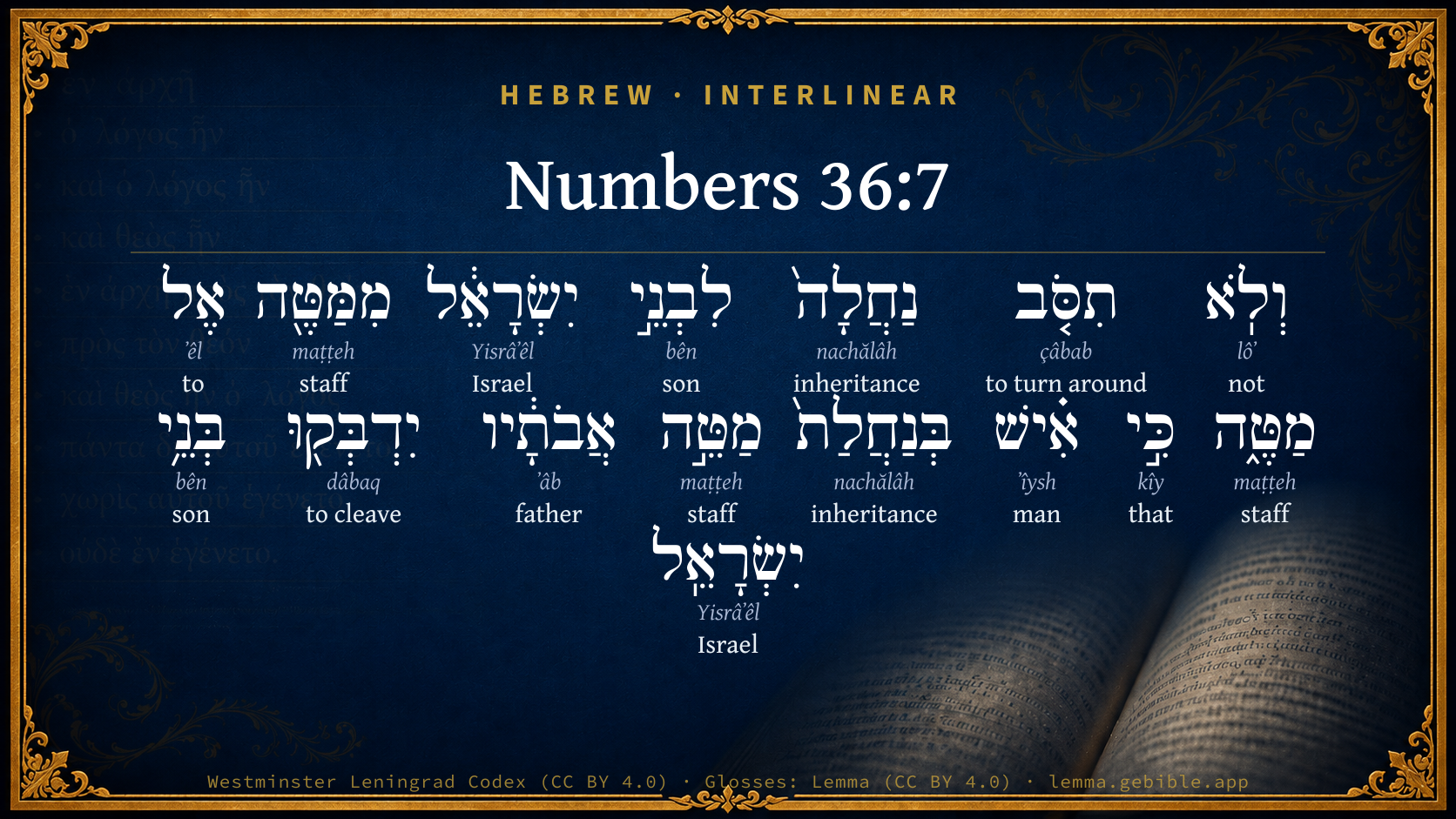
Numbers 36:7

Hebrew (Westminster Leningrad Codex) Numbers 36:7 appears in the Hebrew Old Testament. The text above is from the Westminster Leningrad Codex. Each word links to its Strong’s number, a concise gloss, and parsing drawn from the Open Scriptures Hebrew Bible morphology. Click any word for its full Brown-Driver-Briggs (BDB) entry.
Download image
Cite this verse

Numbers 36:7 (World English Bible). Public Domain. Lemma interlinear Bible study tool, https://lemma.gebible.app/v/numbers/36/7.

Show BibTeX & RIS
BibTeX
RIS
English Translation
So shall no inheritance of the children of Israel remove from tribe to tribe; for the children of Israel shall cleave everyone to the inheritance of the tribe of his fathers.
World English Bible · Public Domain
Download a study sheet

One document with this verse’s original text, its word-by-word gloss line, the meaning frame, cross-references with their text, attributed commentary, and full source and license credits — printable, and it pastes into notes with its structure intact.

This verse Autodidact and up

Study sheet (.html) Plain text (.txt)

A passage Seminary Student

Up to 50 verses in one chapter. A passage sheet keeps up to 6 commentary sources and 12 cross-references per verse, in the order this page ranks them, and says so on the sheet whenever that leaves anything out. Ask for a single verse and you get the Autodidact verse sheet above.

Everything on this page stays free to read, with no account — the sheet is a download of what is already on screen, not access to it.

Want to remove ads? Support Godless Engineer
Compare translations 3

The same verse in 3 English versions, stacked beneath the original-language interlinear above. Click any original word for its lexicon entry.

Each is an independent rendering of the whole verse — the interlinear is not word-aligned to these translations.

Highlighted words mark where these versions differ — a whole-verse word diff, not a word-by-word alignment.

  • World English Bible Public Domain
    So shall no inheritance of the children of Israel remove from tribe to tribe; for the children of Israel shall cleave everyone to the inheritance of the tribe of his fathers.
  • King James Version Public Domain
    So shall not the inheritance of the children of Israel remove from tribe to tribe: for every one of the children of Israel shall keep himself to the inheritance of the tribe of his fathers.
  • unfoldingWord Literal Text CC BY-SA 4.0
    And an inheritance of the sons of Israel shall not go around from tribe to tribe, but a man of the sons of Israel shall cling to the inheritance of the tribe of his father.

unfoldingWord Literal Text — © unfoldingWord, licensed CC BY-SA 4.0. Word-aligned USFM3 via Door43 (git.door43.org/unfoldingWord/en_ult).

Versions to compare (up to 4)

3 of 4 selected

Show all 18 translations

Every available English version of this verse, each an independent rendering of the whole verse.

  • World English Bible Public Domain
    So shall no inheritance of the children of Israel remove from tribe to tribe; for the children of Israel shall cleave everyone to the inheritance of the tribe of his fathers.
  • Berean Standard Bible Public Domain
    No inheritance in Israel may be transferred from tribe to tribe, because each of the Israelites is to retain the inheritance of the tribe of his fathers.
  • Majority Standard Bible Public Domain
    No inheritance in Israel may be transferred from tribe to tribe, because each of the Israelites is to retain the inheritance of the tribe of his fathers.
  • King James Version Public Domain
    So shall not the inheritance of the children of Israel remove from tribe to tribe: for every one of the children of Israel shall keep himself to the inheritance of the tribe of his fathers.
  • American Standard Version (1901) Public Domain
    So shall no inheritance of the children of Israel remove from tribe to tribe; for the children of Israel shall cleave every one to the inheritance of the tribe of his fathers.
  • Revised Version (1885) Public Domain
    So shall no inheritance of the children of Israel remove from tribe to tribe: for the children of Israel shall cleave every one to the inheritance of the tribe of his fathers.
  • Geneva Bible (1599) Public Domain
    So shall not the inheritance of the children of Israel remoue from tribe to tribe, for euery one of the children of Israel shall ioyne himselfe to the inheritance of the tribe of his fathers.
  • Douay-Rheims (1899) Public Domain
    Lest the possession of the children of Israel be mingled from tribe to tribe. For all men shall marry wives of their own tribe and kindred:
  • Young's Literal Translation Public Domain
    and the inheritance of the sons of Israel doth not turn round from tribe unto tribe; for each to the inheritance of the tribe of his fathers, do the sons of Israel cleave.
  • Literal Standard Version CC BY-SA 4.0
    and the inheritance of the sons of Israel does not turn around from tribe to tribe; for each of the sons of Israel cleaves to the inheritance of the tribe of his fathers.
  • Unlocked Literal Bible CC BY-SA 4.0
    No share of the people of Israel must change from one tribe to another. Each one of the people of Israel must continue with the share of his ancestor's tribe.
  • unfoldingWord Literal Text CC BY-SA 4.0
    And an inheritance of the sons of Israel shall not go around from tribe to tribe, but a man of the sons of Israel shall cling to the inheritance of the tribe of his father.
  • Darby Bible Public Domain
    that no inheritance of the children of Israel pass from tribe to tribe; for every one of the children of Israel shall keep to the inheritance of the tribe of his fathers.
  • World Messianic Bible Public Domain
    So shall no inheritance of the children of Israel move from tribe to tribe; for the children of Israel shall all keep the inheritance of the tribe of his fathers.
  • Webster's Bible Public Domain
    So shall not the inheritance of the children of Israel remove from tribe to tribe: for every one of the children of Israel shall keep himself to the inheritance of the tribe of his fathers.
  • Free Bible Version CC BY-SA 4.0
    No land allocation in Israel may be passed from tribe to tribe, because every Israelite is to hold onto the allocation of his father's tribe.
  • Bible in Basic English Public Domain
    And so no property will be handed from tribe to tribe among the children of Israel; but every one of the children of Israel will keep the heritage of his father's tribe.
  • JPS Tanakh (1917) Public Domain
    So shall no inheritance of the children of Israel remove from tribe to tribe; for the children of Israel shall cleave every one to the inheritance of the tribe of his fathers.

Literal Standard Version (2020), Covenant Press — licensed CC BY-SA 4.0. Text via the HelloAO Bible API (eBible.org). Unlocked Literal Bible (unfoldingWord) — licensed CC BY-SA 4.0. Text via the HelloAO Bible API (eBible.org). unfoldingWord Literal Text — © unfoldingWord, licensed CC BY-SA 4.0. Word-aligned USFM3 via Door43 (git.door43.org/unfoldingWord/en_ult). Free Bible Version, Dr. Jonathan Gallagher — licensed CC BY-SA 4.0. Text via the HelloAO Bible API (eBible.org).

Word by word

More ways to search: Search by grammar → Find every occurrence → Compare this word →

Practice this passage: Drill this verse → Learn its vocabulary →

יִדְבְּק֖וּ
dâbaq
H1692
“to cleave”
Verb, Qal, Imperfect, 3rd Person, Masculine, Plural
Part of Speech
Verb
Stem
Qal
Form
Imperfect
Person
3rd Person
Gender
Masculine
Number
Plural
Full BDB Definition

Origin: a primitive root

TWOT: 398

to cling, stick, stay close, cleave, keep close, stick to, stick with, follow closely, join to, overtake, catch - (Qal) - to cling, cleave to - to stay with - (Pual) to be joined together - (Hiphil) - to cause to cleave to - to pursue closely - to overtake - (Hophal) to be made to cleave
  1. וְלֹֽא lôʼ H3808 “and · not” Conjunction + Particle, Negative
  2. תִסֹּ֤ב çâbab H5437 “to turn around” Verb, Qal, Imperfect, 3rd Person, Feminine, Singular
  3. נַחֲלָה֙ nachălâh H5159 “inheritance” Noun, Common, Feminine, Singular, Absolute
  4. לִבְנֵ֣י bên H1121 “to/for · sons of” Preposition + Noun, Common, Masculine, Plural, Construct
  5. יִשְׂרָאֵ֔ל Yisrâʼêl H3478 “Israel” Noun, Proper
  6. מִמַּטֶּ֖ה maṭṭeh H4294 “from · staff” Preposition + Noun, Common, Masculine, Singular, Absolute
  7. אֶל ʼêl H413 “to” Preposition
  8. מַטֶּ֑ה maṭṭeh H4294 “staff” Noun, Common, Masculine, Singular, Absolute
  9. כִּ֣י kîy H3588 “that” Conjunction
  10. אִ֗ישׁ ʼîysh H376 “man” Noun, Common, Masculine, Singular, Absolute
  11. בְּנַחֲלַת֙ nachălâh H5159 “in/at · inheritance of” Preposition + Noun, Common, Feminine, Singular, Construct
  12. מַטֵּ֣ה maṭṭeh H4294 “staff of” Noun, Common, Masculine, Singular, Construct
  13. אֲבֹתָ֔יו ʼâb H1 “fathers · his” Noun, Common, Masculine, Plural, Construct + Suffix, Personal, 3rd Person, Masculine, Singular
  14. בְּנֵ֥י bên H1121 “sons of” Noun, Common, Masculine, Plural, Construct
  15. יִשְׂרָאֵֽל Yisrâʼêl H3478 “Israel” Noun, Proper

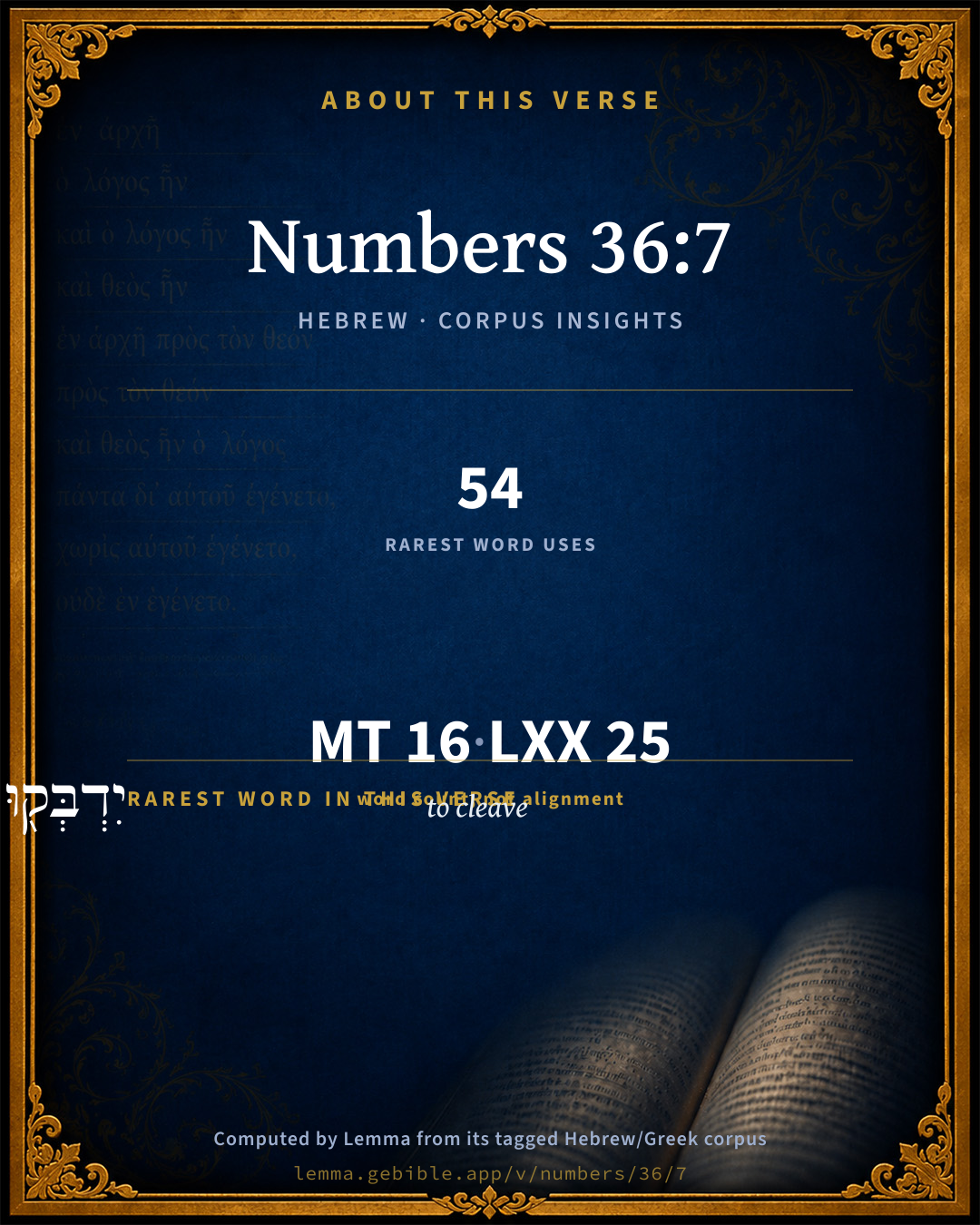
About this verse

These counts appear in no published source. They are computed here, from the morphology-tagged text and Lemma’s own curated glosses. What Lemma adds →

16
words
11
distinct lemmas
Pentateuch
section

Shared distinctive vocabulary

יִדְבְּק֖וּ to cleave H1692 occurs in 52 verses of the Hebrew Bible. Also found in:

Grammatical profile

  • 2 verbs
  • 11 nouns
  • 1 preposition
  • 1 conjunction
  • 1 particle

Verb forms

  • תִסֹּ֤ב Qal · Imperfect
  • יִדְבְּק֖וּ Qal · Imperfect

Repetition

Words recur within this verse — often emphatic in Hebrew:

  • מִמַּטֶּ֖ה staff H4294 ×3
  • נַחֲלָה֙ inheritance H5159 ×2
  • לִבְנֵ֣י son H1121 ×2
  • יִשְׂרָאֵ֔ל Israel H3478 ×2

Hebrew & Septuagint length

In English translation the verse runs 31 words from the Hebrew and 32 from the Septuagint (LXX English) — closely comparable.

A rough comparison of the two English renderings, which tokenize alike — not a word-level alignment.

Word counts can differ between the Hebrew and the Greek without any difference in meaning — e.g. the Hebrew direct-object marker אֵת has no separate Greek word, and Greek often adds the article ὁ.

In the original languages it is 16 Hebrew tokens and 25 Greek tokens — but the two are counted differently (Hebrew bundles its prefixes and suffixes into one token; the Greek is in lemma form), so that isn’t a like-for-like length.

Cross-references

2

Topical passages linked to Numbers 36:7 in the Treasury of Scripture Knowledge — connected by theme and wording, ordered by reader-vote popularity; previews shown in the World English Bible.

  • 1 Kings 21:3 Naboth said to Ahab, Yahweh forbid it me, that I should give the inheritance of my fathers to you.
  • Numbers 36:9 So shall no inheritance remove from one tribe to another tribe; for the tribes of the children of Israel shall cleave everyone to his own inheritance.

Cross-references courtesy of OpenBible.info (CC BY 4.0).

Hebrew and Greek witnesses Masoretic Hebrew ↔ Greek Septuagint

The same verse in the two great witnesses to the Old Testament, shown verse-for-verse.

These are two independent witnesses, not word-aligned to each other, and the Septuagint is shown in lemma (dictionary) form.

Hebrew Numbers 36:7 Masoretic · Westminster Leningrad Codex

וְלֹֽא תִסֹּ֤ב נַחֲלָה֙ לִבְנֵ֣י יִשְׂרָאֵ֔ל מִמַּטֶּ֖ה אֶל מַטֶּ֑ה כִּ֣י אִ֗ישׁ בְּנַחֲלַת֙ מַטֵּ֣ה אֲבֹתָ֔יו יִדְבְּק֖וּ בְּנֵ֥י יִשְׂרָאֵֽל

So shall no inheritance of the children of Israel remove from tribe to tribe; for the children of Israel shall cleave everyone to the inheritance of the tribe of his fathers.

World English Bible · Public Domain

Greek LXX Numbers 36:7 Septuagint · lemma form

καί οὐ περιστρέφω κληρονομία ὁ υἱός ἰσραήλ ἀπό φυλή ἐπί φυλή ὅτι ἕκαστος ἐν ὁ κληρονομία ὁ φυλή ὁ πατριά αὐτός προςκολλάω ὁ υἱός ἰσραήλ

So shall not the inheritance of the children of Israel go about from tribe to tribe, for the children of Israel shall steadfastly continue each in the inheritance of his family's tribe.

LXX2012 (modern English Septuagint) · Public Domain

Hebrew: Westminster Leningrad Codex (CC BY 4.0). Greek: Septuagint (public domain); English from LXX2012 (modern English Septuagint) (Public Domain). How the Septuagint differs from the Hebrew →

Targum (Aramaic paraphrase)

2

The Targum is the ancient Jewish Aramaic paraphrase of the Hebrew Scriptures — an interpretive translation, not the Hebrew text itself. Onkelos (literal) and Pseudo-Jonathan (expansive) render the Torah, and Jonathan the Prophets. Coverage is partial: where no permissively-licensed English translation exists for a verse, only the Aramaic is shown. This is verse-level text, not a word-by-word alignment to the Hebrew.

  1. Targum Onkelos Torah (Genesis–Deuteronomy)
    וְלָא תַסְחַר אַחֲסָנָא לִבְנֵי יִשְׂרָאֵל מִשִׁבְטָא לְשִׁבְטָא אֲרֵי גְבַר בְּאַחֲסָנַת שִׁבְטָא דַאֲבָהָתוֹהִי יִדְבְּקוּן בְּנֵי יִשְׂרָאֵל

    (no public-domain English translation for this verse)

    Targum Onkelos — Aramaic: “Onkelos Genesis” (public domain); “Onkelos Exodus” (public domain); “Onkelos Leviticus” (public domain); “Onkelos Numbers” (public domain); “Onkelos Deuteronomy” (public domain). English: “Sefaria Community Translation” (CC0 1.0 (public-domain dedication)); “J.W. Etheridge. The Targums of Onkelos and Jonathan Ben Uzziel on the Pentateuch. London: Longmans, Green, 1862” (public domain). Text via Sefaria.

  2. Targum Pseudo-Jonathan Torah (Genesis–Deuteronomy)
    מְטוּל דְלָא תִיתְקֵף אַחְסָנָא לִבְנֵי יִשְרָאֵל מִשִׁבְטָא לְשִׁבְטָא חוֹרָנָא אֲרוּם גְבַר בְּאַחְסָנַת שִׁבְטָא דְאַבְהָתוֹי יִדְבְּקוּן בְּנֵי יִשְרָאֵל

    That the inheritance of the children of Israel may not pass about from one tribe to another: for the children of Israel shall every one keep to the inheritance of their father's tribe.

    Targum Pseudo-Jonathan — Aramaic: “Targum Jonathan on Genesis” (public domain); “Targum Jonathan on Exodus” (public domain); “Targum Jonathan on Leviticus” (public domain); “Targum Jonathan on Numbers” (public domain); “Targum Jonathan on Deuteronomy” (public domain). English: “The Targum of Jonathan ben Uzziel, trans. J. W. Etheridge, London, 1862” (public domain). Text via Sefaria.

Commentary

Notes on Numbers 36:7 from classic Christian and Jewish commentators (each source and its license shown beneath its notes). The classic Christian expositions comment on the surrounding passage and are grouped to its opening verse, so a note may address several verses; the Jewish commentaries on the Tanakh (Rashi and others) are per-verse, so they appear only where the commentator wrote on this verse.

Lemma curates 59 commentaries, every one of them public domain or Creative Commons licensed, each selected and text-cleaned for this edition rather than reprinted as found. About our sources →

Trapp's Complete Commentary

John Trapp

Num 36:7 So shall not the inheritance of the children of Israel remove from tribe to tribe: for every one of the children of Israel shall keep himself to the inheritance of the tribe of his fathers.

Ver. 7. Shall keep himself to the inheritance.] This was an excellent law to cut off quarrels, strifes, and law suits, and to frustrate those qui latrocinia intra moenia exercent, as Columella said of the lawyers of his time.

John Trapp, A Commentary or Exposition upon All the Books of the Old and New Testament (1647–1656) — public domain. Text from a community e-Sword module.

John Gill's Exposition

So shall not the inheritance of the children of Israel remove from tribe to tribe,.... Which shows that this concerns all the tribes of Israel, though yet not fully expressed, as it is afterwards:

for everyone of the children of Israel shall keep himself to the inheritance of the tribe of his fathers; or cleave (a) to a wife in that tribe for marriage; this word is used in the original institution of it, Gen 2:24 though they were not strictly obliged to marry in their own tribe; and frequently they did intermarry with other tribes, which, had it been unlawful, would not have been done, as it was by kings, and priests, and others; nor was there any danger of an inheritance going into another tribe by a man's marrying into it; wherefore this signifies only, that they were to be careful to keep their inheritances in their tribe; and therefore if any of them had no sons, only daughters, he was to marry them in his own tribe and family, that the inheritance might not remove, as follows(a) "adhaerebunt", Montanus, Vatablus, Junius & Tremellius.

John Gill's Exposition of the Whole Bible (1746–1763) — public domain (CC PDM 1.0). Text via the HelloAO Bible API.

Haydock's Catholic Bible Commentary

Wives. Hebrew, "shall keep to the inheritance of the tribe of his fathers." Those who marry heiresses must be of the same family: but others may take wives from any of the tribes of Israel, as the most holy did without scruple. (St. Jerome in Jer. xxxii.) (Tirinus) (Estius) --- The Rabbins extend this law to all, with the Vulgate: but only during the time that the land of Chanaan remained undivided. (Selden, Succ. c. xviii.)

George Leo Haydock (1774–1849), Haydock's Catholic Family Bible and Commentary, 1859 edition — public domain. Excludes Psalms (Douay-Rheims chapter numbering differs from Protestant) and Deuterocanonical books (Catholic canon only).

The Pulpit Commentary

Every one...shall keep himself to the inheritance of the tribe of his fathers. This was to be the general rule which governed all such questions. Every Israelite had his own share in the inheritance of his tribe, and with that he was to be content, and not seek to intrude on other tribes. Accordingly the decision in the case of the daughters of Zelophehad is extended to all similar cases.

The Pulpit Commentary (1880–1919), ed. H.D.M. Spence-Jones & Joseph S. Exell — public domain. Text from a community e-Sword module.

unfoldingWord translationNotes

Door43 World Missions Community

No share

The word "share" represents the portion of land that each tribe received as an inheritance. AT: "No portion of the land" (See: Metonymy)

translationWords

Israel

unfoldingWord translationNotes — © Distant Shores Media and the Door43 World Missions Community, licensed CC BY-SA 4.0. Source: git.door43.org/Door43/en_tn.

Ramban (Nachmanides)

Rabbi Moshe ben Nachman (Ramban / Nachmanides)

V’LO THISOV NACHALAH’ (SO SHALL NO INHERITANCE) OF THE CHILDREN OF ISRAEL MOVE FROM TRIBE TO TRIBE. Scripture was only concerned to improve the situation at that time [i.e., for the daughters of Zelophehad who had raised that problem]. For if there were [then] women in Israel [already] married to [men of] another tribe, and they [the women] inherited [a portion of the Land] at that time, or would inherit at some future time if their brothers or fathers died without sons, their inheritance would perforce move from one tribe to another [because their husbands, who were of a different tribe, or their sons, would inherit them when they died], and who can straighten out in time what they have made crooked! The Torah, furthermore, did not want to command that the sons or husbands of these women should not inherit them [if they were not of the same tribe], because it did not deem it fit to abrogate [in this case] the [regular] law of inheritance. Similarly Scripture did not concern itself with events which would occur in the future; for even if those daughters who do not possess an inheritance [before they are married] would be permitted to marry [men from] any of the tribes, yet it is possible that at some future time they might inherit some property, if [all] their brothers die in the lifetime of their father, and thus their father’s inheritance, or that of their relatives would pass on to them. But according to the opinion of our Rabbis who interpreted: “This law — that they marry men of their father’s tribe. only applies to that particular generation,” it is possible etc. (see text) — (Kur Zahav, in the name of Aboab). that [at that time] there were no daughters who inherited a portion amongst all those who were to come into the Land [of Israel] except for the daughters of Zelophehad, and therefore [we do not find that] they [i.e., other women] asked [Moses about it as the daughters of Zelophehad did]. Scripture, then, is commanding that if anyone dies from that day onwards until the Land is divided up amongst their tribes, and his daughter inherits him, she should not marry [anyone] from another tribe, in order that when the Land is divided up, that man should not come to take himself an inheritance amongst another tribe. For the [Torah’s] concern about them [i.e., about the separate inheritance of each tribe] was greater at the time of the division of the Land [than afterwards], so that the [different] tribes should not become mixed up with each other when taking their inheritance, whereas afterwards their [separate] inheritance will have already become known, and they would not be so concerned about it. But since the [exact] time of the division [of the Land] was not yet known, He imposed the prohibition on the whole of that generation. And G-d in Whose hand is the soul of every living thing knew that “until the division of the Land no man would die without leaving a son, so that his daughters would be inheriting him” (Aboab). But such an assurance could naturally not apply if we were to say that the prohibition was for all generations. did not have to be concerned with future events [which might in certain cases result in the transfer of a particular inheritance from one tribe to another].This explanation is correct according to the plain meaning of Scripture, for [the phrase in Verse 9] v’lo thisov nachalah is not a reason [for prohibiting the marriage of a woman who has already an inheritance, with a man from another tribe] “in order that the inheritance shall not be moved [from tribe to tribe],” but there are two separate commandments [in this section]. He commanded [first, in Verses 6-8] that those women who already possess an inheritance [such as the daughters of Zelophehad, who were not married] should only marry into their father’s tribe, and then [in Verse 9] He commanded that [in the case of] those who are already married [to men of other tribes and have no inheritance], or [in the case of all those women] who will come into an inheritance [later on] after they marry a man [of another tribe], the inheritance shall not move from one tribe to another tribe, but their brothers or their relatives are to inherit them, and not their sons or their husbands. Thus at first [in Verses 6-7] He commanded [the law] in connection with the daughters of Zelophehad, and afterwards [in Verse 8] concerning every daughter that possesseth an inheritance; and then He said in connection with all Israel that an inheritance shall not move from one tribe to another tribe [as stated in Verse 9, meaning] that even in the case of women who are [already] married [to men of another tribe], or [unmarried] women who have been commanded [not to marry men of another tribe] and who transgress this commandment, the men of their tribes [i.e., the women’s brothers or other relatives] should inherit them, in order that they should be closely attached to the inheritance of their fathers’ tribes, and their inheritance should not be severed from them, nor they from the inheritance of their fathers. And all these [restrictions] applied only to the generation which took possession of the Land, at the time that it was divided up. Thus He advised them about unmarried women, concerning whom they had asked, and He also made provision for those that were already married.

Thus is completed the Book of the Censuses [i.e., the Book of Numbers] and the standards of the hosts;And to G-d, the G-d of hosts, be praises and thanksgivings, in hundreds, thousands, and myriads.And as He has done for our ancestors great and awesome deeds, may He bring about speedily in our days the end of the wonders. May He build the House and the chambers and the border before the cells. And prepare there the thrones of the house of David, and may our eyes behold it!And may He in His mercies purify us of all [our] hidden [faults] and all errors, 19:13.And show us wondrous things from His Torah!, 119:18.Amen. May His Will be so!Finished and completed.

Ramban (Nachmanides) on the Tanakh — English translation: “Commentary on the Torah by Ramban (Nachmanides). Translated and annotated by Charles B. Chavel. New York, Shilo Pub. House, 1971-1976” (CC BY 4.0). Text via Sefaria.

Lesson kit

Teaching starters — assembled from the data on this page, not authored interpretation. Every prompt links to the verse data it draws on. Edit before teaching.

Numbers, in the Pentateuch, opens this verse with 16 words (11 distinct Hebrew lemmas). Its most distinctive word is dâbaq (“to cleave”). A historical commentator’s framing appears above. Read the whole chapter for the surrounding context.

Discussion questions

  1. What does “to cleave” (dâbaq) contribute to the verse as a whole?
  2. Genesis 2:24 shares the word «to cleave» with this verse. How do the two illuminate each other?
  3. “staff” occurs 3× in this one verse. What is the effect of the repetition?
  4. These translations render this verse differently. What is at stake in choosing one wording over another?
  5. The verb «תִסֹּ֤ב» is Qal Imperfect. How does its form color the action?
  6. Reading how Trapp's Complete Commentary and John Gill's Exposition read this verse, where do the two commentators agree and where do they part?

Things to notice

Reading settings

Reading text

Shown beneath each verse's original-language words.

Old Testament
Old Testament edition

Read the OT as the Masoretic Hebrew (MT) or the Greek Septuagint (LXX).

English shown for the Greek Septuagint (in the Hebrew ↔ Greek comparison).

Comparing translations? Open the Compare panel on any verse page to stack up to four side by side.