
Psalms 118:10

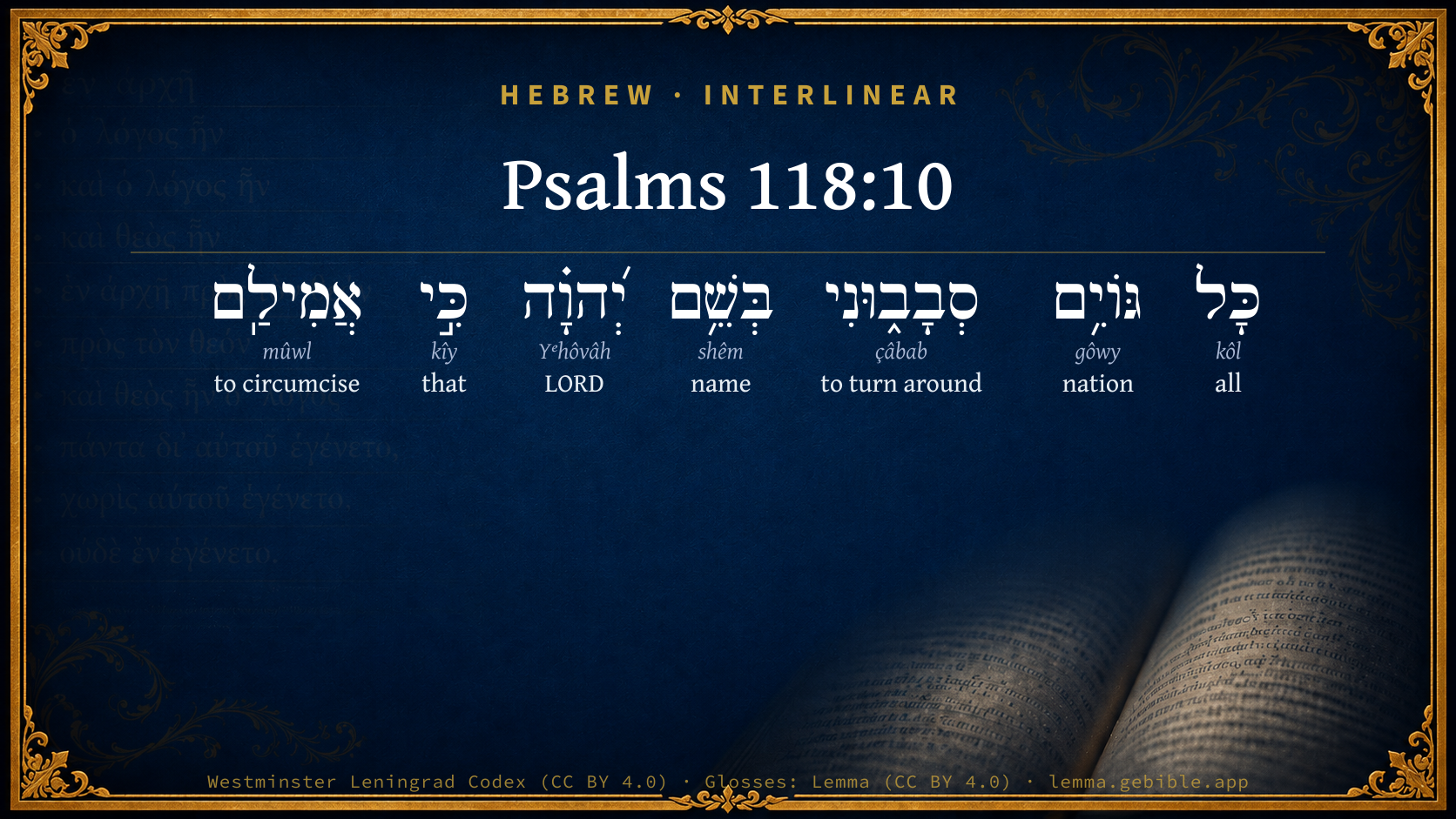
Hebrew (Westminster Leningrad Codex) Psalms 118:10 appears in the Hebrew Old Testament. The text above is from the Westminster Leningrad Codex. Each word links to its Strong’s number, a concise gloss, and parsing drawn from the Open Scriptures Hebrew Bible morphology. Click any word for its full Brown-Driver-Briggs (BDB) entry.
Download image
Cite this verse

Psalms 118:10 (World English Bible). Public Domain. Lemma interlinear Bible study tool, https://lemma.gebible.app/v/psalms/118/10.

Show BibTeX & RIS
BibTeX
RIS
English Translation
All the nations surrounded me, But in the name of Yahweh, I cut them off.
World English Bible · Public Domain
Download a study sheet

One document with this verse’s original text, its word-by-word gloss line, the meaning frame, cross-references with their text, attributed commentary, and full source and license credits — printable, and it pastes into notes with its structure intact.

This verse Autodidact and up

Study sheet (.html) Plain text (.txt)

A passage Seminary Student

Up to 50 verses in one chapter. A passage sheet keeps up to 6 commentary sources and 12 cross-references per verse, in the order this page ranks them, and says so on the sheet whenever that leaves anything out. Ask for a single verse and you get the Autodidact verse sheet above.

Everything on this page stays free to read, with no account — the sheet is a download of what is already on screen, not access to it.

Want to remove ads? Support Godless Engineer
Compare translations 3

The same verse in 3 English versions, stacked beneath the original-language interlinear above. Click any original word for its lexicon entry.

Each is an independent rendering of the whole verse — the interlinear is not word-aligned to these translations.

Highlighted words mark where these versions differ — a whole-verse word diff, not a word-by-word alignment.

  • World English Bible Public Domain
    All the nations surrounded me, But in the name of Yahweh, I cut them off.
  • King James Version Public Domain
    All nations compassed me about: but in the name of the LORD will I destroy them.
  • unfoldingWord Literal Text CC BY-SA 4.0
    All the nations surrounded me; in the name of Yahweh, indeed I fended them off.

unfoldingWord Literal Text — © unfoldingWord, licensed CC BY-SA 4.0. Word-aligned USFM3 via Door43 (git.door43.org/unfoldingWord/en_ult).

Versions to compare (up to 4)

3 of 4 selected

Show all 18 translations

Every available English version of this verse, each an independent rendering of the whole verse.

  • World English Bible Public Domain
    All the nations surrounded me, But in the name of Yahweh, I cut them off.
  • Berean Standard Bible Public Domain
    All the nations surrounded me, but in the name of the LORD I cut them off.
  • Majority Standard Bible Public Domain
    All the nations surrounded me, but in the name of the LORD I cut them off.
  • King James Version Public Domain
    All nations compassed me about: but in the name of the LORD will I destroy them.
  • American Standard Version (1901) Public Domain
    All nations compassed me about: In the name of Jehovah I will cut them off.
  • Revised Version (1885) Public Domain
    All nations compassed me about: in the name of the LORD I will cut them off.
  • Geneva Bible (1599) Public Domain
    All nations haue compassed me: but in the Name of the Lord shall I destroy them.
  • Douay-Rheims (1899) Public Domain
    All nations compassed me about; and in the name of the Lord I have been revenged on them.
  • Young's Literal Translation Public Domain
    All nations have compassed me about, In the name of Jehovah I surely cut them off.
  • Literal Standard Version CC BY-SA 4.0
    All nations have surrounded me, || In the Name of YHWH I surely cut them off.
  • Unlocked Literal Bible CC BY-SA 4.0
    All the nations surrounded me; in Yahweh's name I cut them off.
  • unfoldingWord Literal Text CC BY-SA 4.0
    All the nations surrounded me; in the name of Yahweh, indeed I fended them off.
  • Darby Bible Public Domain
    All nations encompassed me; but in the name of Jehovah have I destroyed them.
  • World Messianic Bible Public Domain
    All the nations surrounded me, but in the LORD’s name I cut them off.
  • Webster's Bible Public Domain
    All nations encompassed me: but in the name of the LORD will I destroy them.
  • Free Bible Version CC BY-SA 4.0
    Even though all the heathen nations surrounded me, I defeated them with the help of the Lord.
  • Bible in Basic English Public Domain
    All the nations have come round me; but in the name of the Lord I will have them cut down.
  • JPS Tanakh (1917) Public Domain
    All nations compass me about; verily, in the name of the LORD I will cut them off.

Literal Standard Version (2020), Covenant Press — licensed CC BY-SA 4.0. Text via the HelloAO Bible API (eBible.org). Unlocked Literal Bible (unfoldingWord) — licensed CC BY-SA 4.0. Text via the HelloAO Bible API (eBible.org). unfoldingWord Literal Text — © unfoldingWord, licensed CC BY-SA 4.0. Word-aligned USFM3 via Door43 (git.door43.org/unfoldingWord/en_ult). Free Bible Version, Dr. Jonathan Gallagher — licensed CC BY-SA 4.0. Text via the HelloAO Bible API (eBible.org).

Word by word

More ways to search: Search by grammar → Find every occurrence → Compare this word →

Practice this passage: Drill this verse → Learn its vocabulary →

About this verse

These counts appear in no published source. They are computed here, from the morphology-tagged text and Lemma’s own curated glosses. What Lemma adds →

7
words
7
distinct lemmas
Wisdom
section

Shared distinctive vocabulary

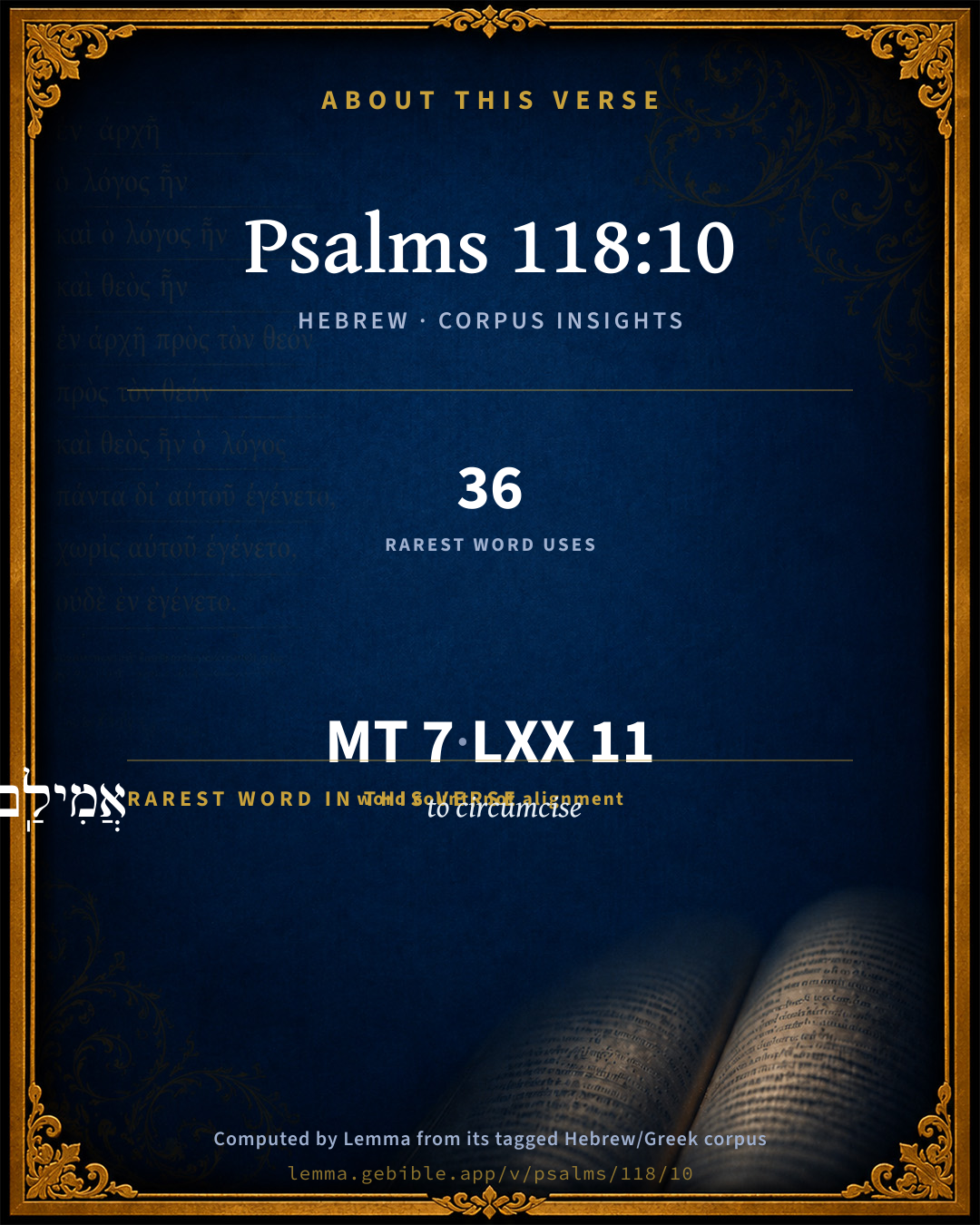
אֲמִילַֽם to circumcise H4135 occurs in 32 verses of the Hebrew Bible. Also found in:

Grammatical profile

  • 2 verbs
  • 4 nouns
  • 1 conjunction

Verb forms

  • סְבָב֑וּנִי Qal · Perfect
  • אֲמִילַֽם Hiphil · Imperfect

Hebrew & Septuagint length

In English translation the verse runs 15 words from the Hebrew and 15 from the Septuagint (LXX English) — the same length.

A rough comparison of the two English renderings, which tokenize alike — not a word-level alignment.

Word counts can differ between the Hebrew and the Greek without any difference in meaning — e.g. the Hebrew direct-object marker אֵת has no separate Greek word, and Greek often adds the article ὁ.

In the original languages it is 7 Hebrew tokens and 11 Greek tokens — but the two are counted differently (Hebrew bundles its prefixes and suffixes into one token; the Greek is in lemma form), so that isn’t a like-for-like length.

Cross-references

9

Topical passages linked to Psalms 118:10 in the Treasury of Scripture Knowledge — connected by theme and wording, ordered by reader-vote popularity; previews shown in the World English Bible.

  • Psalms 88:17 They came around me like water all day long. They completely engulfed me.
  • Revelation 20:8–9 and he will come out to deceive the nations which are in the four corners of the earth, Gog and Magog, to gather them together to the war; the number of whom is as the sand of the sea.
  • 2 Samuel 8:1–18 After this it happened that David struck the Philistines, and subdued them: and David took the bridle of the mother city out of the hand of the Philistines.
  • 2 Samuel 10:1–19 It happened after this, that the king of the children of Ammon died, and Hanun his son reigned in his place.
  • Psalms 18:40 You have also made my enemies turn their backs to me, That I might cut off those who hate me.
  • Zechariah 14:1–3 Behold, a day of Yahweh comes, when your spoil will be divided in your midst.
  • 2 Samuel 5:1–25 Then came all the tribes of Israel to David to Hebron, and spoke, saying, Behold, we are your bone and your flesh.
  • Zechariah 12:3 It will happen in that day, that I will make Jerusalem a burdensome stone for all the peoples. All who burden themselves with it will be severely wounded, and all the nations of the earth will be gathered together against it.
  • Revelation 19:19–21 I saw the beast, and the kings of the earth, and their armies, gathered together to make war against him who sat on the horse, and against his army.

Cross-references courtesy of OpenBible.info (CC BY 4.0).

Hebrew and Greek witnesses Masoretic Hebrew ↔ Greek Septuagint

The same verse in the two great witnesses to the Old Testament, shown verse-for-verse.

You’re reading Greek Psalm 117 (Hebrew Psalm 118). The Septuagint counts the superscription, so verse numbers can differ from the Hebrew — chapter-level alignment, not verse-by-verse. Numbering follows Rahlfs.

These are two independent witnesses, not word-aligned to each other, and the Septuagint is shown in lemma (dictionary) form.

Hebrew Psalms 118:10 Masoretic · Westminster Leningrad Codex

כָּל גּוֹיִ֥ם סְבָב֑וּנִי בְּשֵׁ֥ם יְ֝הוָ֗ה כִּ֣י אֲמִילַֽם

All the nations surrounded me, But in the name of Yahweh, I cut them off.

World English Bible · Public Domain

Greek LXX Greek Psalm 117:10 Septuagint · lemma form

πᾶς ὁ ἔθνος κυκλόω ἐγώ καί ὁ ὄνομα κύριος ἀμύνω αὐτός

All nations compassed me about: but in the name of the Lord I repulsed them.

LXX2012 (modern English Septuagint) · Public Domain

On this verse, John Gill's Exposition discusses the Septuagint’s reading. Read the note in Commentary ↓

Hebrew: Westminster Leningrad Codex (CC BY 4.0). Greek: Septuagint (public domain); English from LXX2012 (modern English Septuagint) (Public Domain). How the Septuagint differs from the Hebrew →

Commentary

Notes on Psalms 118:10 from classic Christian and Jewish commentators (each source and its license shown beneath its notes). The classic Christian expositions comment on the surrounding passage and are grouped to its opening verse, so a note may address several verses; the Jewish commentaries on the Tanakh (Rashi and others) are per-verse, so they appear only where the commentator wrote on this verse.

Lemma curates 59 commentaries, every one of them public domain or Creative Commons licensed, each selected and text-cleaned for this edition rather than reprinted as found. About our sources →

John Gill's Exposition

They compassed me about like bees,.... In great numbers (w); as a swarm of bees, which, being irritated and provoked, will fly upon persons in a body, and with great fury; to which the Amorites and the Assyrian army were compared, Deu 1:44. They will attack horses and kill them, as Aristotle (x) says; and places besieged have been delivered by throwing out hives of bees among the besiegers (y): and yet as they are feeble creatures, so by striking they lose their sting; and either die very quickly, or however become useless. All which denotes the numbers of the enemies of David and of Christ, and of his church and people, and the wrath and fury of them against them, as well as their fruitless and unsuccessful attempts upon them; for though they rage, what they contrive and endeavour to put in execution are vain things, and in the issue end in their own ruin and destruction;

they are quenched as the fire of thorns; which make a blaze, a noise, for a while; but are soon consumed, and leave only a few ashes behind. Wicked men are often compared to thorns, they being like them, unfruitful in themselves, unprofitable to others, harmful to the saints, and whose end is to be burnt; and whose destruction is certain and sudden, and easily effected as the burning of thorns; see Psa 58:9, Ecc 7:6. The Targum renders it,

"they burned as fire among thorns;''

which is easily kindled and soon quenched: and so the Septuagint, Vulgate Latin, Ethiopic, and Arabic versions; as if it was expressive of their wrath and fury, which was soon over; which agrees with what follows:

for; or "but", or "verily" (z),

in the name of the Lord I will destroy them; See Gill on Psa 118:10 and See Gill on Psa 118:11.

(w) , Homer. Iliad. 2. v. 87, Vid. Virgil. Aeneid. 12. v. 587. (x) Hist. Animal. l. 9. c. 40. (y) Vid. Dieteric. Antiqu. Biblic. p. 478. (z) "sed", Junius & Tremellius, Piscator; "certe utique", Polus; "quod certissime", Michaelis.

John Gill's Exposition of the Whole Bible (1746–1763) — public domain (CC PDM 1.0). Text via the HelloAO Bible API.

Trapp's Complete Commentary

John Trapp

Psa 118:10 All nations compassed me about: but in the name of the LORD will I destroy them.

Ver. 10. All nations compassed me about] This is still the condition of Christ’s Church in this evil world, to be hated of all, and set against with utmost might and malice. Haud perinde crimine incendiiquam odio humani generis convicti sunt, saith Tacitus, of those Christians at Rome put to cruel deaths by Nero, who, having for his pleasure fired the city, fathered it upon them, as people hated of all men.

But in the name of the Lord] i.e. By faith in God’s power and promises. We might also do great exploits against our spiritual enemies, did we but set upon them with God’s arms, and with his armour; did we but observe the apostle’s rule, "Whatsoever ye do in word or deed, do all in the name of the Lord Jesus," &c., Col 3:17.

John Trapp, A Commentary or Exposition upon All the Books of the Old and New Testament (1647–1656) — public domain. Text from a community e-Sword module.

Joseph Benson's Commentary

Psa 118:10-12. All nations compassed me about — The neighbouring nations, the Philistines, Syrians, Ammonites, Moabites, who were stirred up by the overthrows which David had given to some of them, by their jealousy at his growing greatness, and by their hatred against the true religion. Yea, they compassed me — The repetition implies their frequency and fervency in this action, and their confidence of success. They compassed me like bees — In great numbers, and with great fury. They are quenched — In this sense the word דעךְis taken, Job 6:17; Job 18:5-6; Job 21:17. The Seventy, however, render it εξεκαυθησαν, they burned, flamed out, or waxed exceeding fierce or vehement; that is, they raged against me like fire: with this interpretation the Chaldee agrees. As the fire of thorns — Which flames out terribly, burns fiercely, and makes a crackling noise, but quickly spends itself without any considerable or lasting effect. For — Or but, as the particle כי, chi, frequently signifies, and is twice rendered in this very phrase, Psa 118:10-11. Thus, as the former part of the verse denotes their hostile attempt, this expresses their ill success and utter ruin. “The reader has here,” says Dr. Delaney, Life of David, book 2. chap. 9. p. 113, “in miniature, two of the finest images in Homer; which, if his curiosity demands to be gratified, he will find illustrated and enlarged in the second book of the Iliad. The first of them stands thus, transcribed from Mr. Pope’s translation:

The following host, Pour’d forth by thousands, darkens all the coast. As from some rocky cleft the shepherd sees, Clust’ring, in heaps on heaps, the driving bees, Rolling and black’ning, swarms succeeding swarms, With deeper murmurs and more hoarse alarms; Dusky they spread, a close-imbodied crowd, And o’er the vale descends the living cloud; So from the tents and ships, &c. V. 109, &c.

The next is in the same book, V. 534, &c.

As on some mountain, through the lofty grove,

The crackling flames ascend and blaze above,

The fires, expanding as the winds arise,

Shoot their long beams, and kindle half the skies;

So from the polished arms, and brazen shields,

A gleamy splendour flash’d along the fields.

Not less their number, &c.

The candid reader will observe, that here the idea of an arm’s resembling a flaming fire is common both to Homer and David; but the idea of that fire being quenched (when the army was conquered) is peculiar to David.”

Joseph Benson's Commentary on the Old and New Testaments (1811–1818) — public domain. Text from a community e-Sword module.

J. A. Alexander on Psalms

Joseph Addison Alexander

10. (Psa 118:10) All the nations surround me; in the name of Jehovah—that I will cut them off. The hyperbolical expression, all the nations, is less strange than it might otherwise appear, because nations had now begun to be familiarly applied to the gentiles or heathen, not as organized bodies merely, but as individuals, especially when numerous. There is nothing unnatural, therefore, in the use of this expression to describe the heathen adversaries of the Jews at the period of the Restoration, not excepting the Samaritans, who, though they claimed to be a mixed race, were really heathen, both in origin and character. Another way in which the hyperbole may be explained, or rather done away, is by supposing the first clause to be substantially although not formally conditional. Should all nations (or though all nations should) surround me. The strongest sense may then be put upon the words all nations, as the act ascribed to them is merely hypothetical. The construction of the last clause is unusual and doubtful. Some arbitrarily make the affirmation, yea, yes, verily, etc. Others gain the same sense by explaining the whole phrase to mean, (it is true, or it is certain) that I will cut them off. The same use of the particle is thought to be exemplified in Isa 7:9. Perhaps the best solution is the one afforded by the Hebrew usage of suppressing the principal verb in oaths or solemn affirmations. If this may be omitted even when there is nothing to denote the character of the expression, and when the form of the expression itself is liable to misconstruction, as for instance in the formula with if, much more may it be omitted where the sense of the expression is quite clear, and its juratory or imprecatory character denoted by accompanying words. The sense will then be, in the name of Jehovah (I swear or solemnly affirm) that I will cut them off. This last verb always means to cut, and except in Psa 90:6, where one of its derived forms is used, to circumcise. It was here used, as some suppose, to suggest that the uncircumcised enemies of Israel, as they are often called, should be cut or cut off in another sense. Compare the play upon the corresponding Greek words in Php 3:2-3.

Joseph Addison Alexander, The Psalms Translated and Explained (1850) — public domain. Text from a community e-Sword module.

Tyndale Open Study Notes

Tyndale Open Resources

118:10-12 Strength comes in the name of the Lord, declared by the threefold mention of the attackers, the Lord’s name, and victory. • Even when hostile people blazed . . . like a crackling fire, the Lord caused them to subside like burning thorns (see Isa 9:18; 10:17).

Tyndale Open Study Notes — © Tyndale Open Resources, licensed CC BY-SA 4.0. Text via the HelloAO Bible API.

Adam Clarke's Commentary

Verse 10. All nations compassed me about] This is by some supposed to relate to David, at the commencement of his reign, when all the neighbouring Philistine nations endeavoured to prevent him from establishing himself in the kingdom. Others suppose it may refer to the Samaritans, Idumeans, Ammonites, and others, who endeavoured to prevent the Jews from rebuilding their city and their temple after their return from captivity in Babylon.

But in the name of the Lord will I destroy them.] Dr. Kennicott renders אמילם amilam, "I shall disappoint them;" Bishop Horsley, "I cut them to pieces;" Mr. N. Berlin, repuli eas, "I have repelled them." "I will cut them off;" Chaldee. Ultus sum in eos, "I am avenged on them;" Vulgate. So the Septuagint.

Adam Clarke's Commentary on the Bible (1810–1826) — public domain. Text from a community e-Sword/MySword module.

John Calvin's Commentaries

10. All nations compassed me In these verses he relates the wonderful deliverance which he had received, that all might know that it was not of human but divine origin. Once and again he declares, that he was compassed not by a few persons, but by a vast multitude. The people, being all inflamed with anger and fury against him, compassed him so that there were no means for his escape, and he could procure help from no quarter but from heaven. Some consider his complaint, that all nations were adverse to him, as referring to the neighboring nations, by whom we know David was surrounded with danger. His meaning, in my opinion, is, that the whole world was adverse to him; because he places God’s help alone in opposition to the deadly and furious hatred both of his own countrymen and of the neighboring nations towards him, so that there was not a spot upon the earth where he could be safe. There was, it is true, no army, collected from several nations, besieging him; still he had no peaceable retreat except among the haunts of wild beasts, from which also he was driven by terror. And in proportion to the number of persons he encountered were the snares laid to entrap him. It is, therefore, not wonderful that he said he was compassed by all nations. Besides, this elliptical mode of speaking is more forcible than if he had merely said that he trusted in God, by reason of which he had become victorious. By publicly mentioning the name of God alone, he maintains that no other means of deliverance were within his reach, and that but for his interposition he must have perished. It appears to me preferable to translate the particle כי, ki, affirmatively. “Besieged as I am on all sides by the world, yet if the power of God help me, that will be more than adequate for the extermination of all mine enemies.” Their obstinate and implacable hatred is pointed out by him in the repetition of the phrase compassed about, and their outrageous fury is set forth in comparing them to bees, which, though not possessed of much strength, are very fierce, and when in their insensate fury they attack a person, they occasion no little fear. He shortly adds, they are quenched as a fire of thorns, which at first makes a great crackling, and throws out a greater flame than a fire of wood, but soon passes away. The amount is, that David’s enemies had furiously assailed him, but that their fury soon subsided. Hence he again repeats, that sustained by the power of God, whatever opposition might rise against him would soon pass away.

John Calvin's Commentaries (1540-1563) — public domain. Text from the Calvin Translation Society English edition (1840s-50s) via the Christian Classics Ethereal Library (ccel.org). Calvin's coverage is partial (roughly two-thirds of the Bible); uncommented books and verses are honest gaps, never fabricated. The 19th-century editor's footnotes and remarks are omitted so the notes are faithfully Calvin's own voice.

The Cambridge Bible for Schools and Colleges

gen. ed. J. J. S. Perowne

10. All nations &c.] Comp. “all the nations that were about us,” Neh_6:16. Arabians, Ammonites, and Philistines of Ashdod, are specially mentioned in Neh_4:7 f. Cp. also Ezr_4:7-23, referring probably to an earlier period in the reign of Artaxerxes.

but in the name &c.] In the name of Jehovah, trusting that He would prove Himself all that He has promised, I did cut them off. The exact meaning of the verb is uncertain. The tense is a ‘graphic imperfect.’ From Psa_118:5; Psa_118:13 it is clear that the crisis was past and the victory won.

10–14. It was in the strength of Jehovah that Israel was enabled to repel the persistent attacks of its enemies.

The Cambridge Bible for Schools and Colleges (gen. ed. J. J. S. Perowne; Cambridge University Press, 1878–1918) — public domain. Text from a community e-Sword module.

Albert Barnes' Notes on the Bible

All nations compassed me about - They surrounded me; they hemmed me in on every side, so that I seemed to have no chance to escape. It would seem from this that the psalm was composed by someone who was at the head of the government, and whose government had been attacked by surrounding nations. This would accord well with many things that occurred in the life of David; but there were also other times in the Jewish history to which it would be applicable, and there is nothing that necessarily confines it to the time of David.

But in the name of the Lord will I destroy them - Margin, as in Hebrew,” cut them off.” This is the language which he used at that time; the purpose which he then formed; an expression of the confidence which he then cherished. He meant to subdue them; he had no doubt that he would be able to do it.

Albert Barnes' Notes on the Bible (1834–1885) — public domain. Text from a community e-Sword/MySword module.

Matthew Poole's English Annotations

All nations compassed me about; the neighbouring and heathen nations, Philistines, Syrians, Ammonites, Moabites, &c., who were stirred up, partly, by the overthrows which David had given some of them; partly, by their jealousy at David’s growing greatness and fear for themselves; and partly, by their hatred against the true religion.

Matthew Poole's English Annotations on the Holy Bible (1683–1685) — public domain. Text from a community e-Sword/MySword module.

The Treasury of David

Charles H. Spurgeon

Ver. 10. All nations compassed me about. The hero of the Psalm, while he had no earthly friend upon whom he could thoroughly rely, was surrounded by innumerable enemies, who heartily hated him. He was hemmed in by his adversaries, and scarce could find a loophole of escape from the bands which made a ring around him. As if by common consent all sorts of people set themselves against him, and yet he was more than a match for them all, because he was trusting in the name of the Lord. Therefore does he joyfully accept the battle, and grasp the victory, crying,

but in the name of the LORD will I destroy them, or "cut them in pieces." They thought to destroy him, but he was sure of destroying them;they meant to blot out his name, but he expected to render not only his own name but the name of the Lord his God more illustrious in the hearts of men. It takes grand faith to be calm in the day of actual battle, and especially when that battle waxes hot; but our hero was as calm as if no fight was raging. Napoleon said that God was always on the side of the biggest battalions, but the Psalmist warrior found that the Lord of hosts was with the solitary champion, and that in his name the battalions were cut to pieces. There is a grand touch of the ego in the last sentence, but it is so overshadowed with the name of the Lord that there is none too much of it. He recognized his own individuality, and asserted it: he did not sit still supinely and leave the work to be done by God by some mysterious means; but he resolved with his own trusty sword to set about the enterprise, and so become in God's hand the instrument of his own deliverance. He did all in the name of the Lord, but he did not ignore his own responsibility, nor screen himself from personal conflict, for he cried, "I will destroy them." Observe that he does not speak of merely escaping from them like a bird out of the snare of the fowler, but he vows that he will carry the war into his enemies' ranks, and overthrow them so thoroughly that there should be no fear of their rising up a second time.

Ver. 10. All nations compassed me about. A multitude of enemies everywhere cannot hinder the presence of God with us. Ac 17:28. They are without; He is within, in our hearts; they are flesh; He is Spirit: they are frail; He is immortal and invincible. Martin Geier.

Ver. 10. Take a wide range and consider what has been done, should be done, and may be done "in the name of the Lord."

Psalms 118:11*

Charles H. Spurgeon's The Treasury of David (1869–1885) — public domain. Psalms only. Text from a community e-Sword/MySword module.

Whedon's Commentary on the Bible

Daniel D. Whedon

10. All nations—All heathen “nations.” The whole world is arrayed against the Church, because the true Church testifies against “all unrighteousness and ungodliness of men.” See Joh_7:7; Joh_15:19

Daniel D. Whedon (gen. ed.), Commentary on the Old and New Testaments (1874–1909) — public domain. Text from a community e-Sword module.

The Pulpit Commentary

All nations compassed me about. This is, of course, hyperbole. But it was a fact that all, or almost all, the nations among whom the Israelites dwelt were at all times hostile to them, and sought their destruction. But in the Name of the Lord will I destroy them; or, "I will mow them down". (comp. Job_24:24)

Acting in the Divine Name.

"In the Name of the Lord I will cut them off." The idea in the mind of the psalmist may be illustrated by the old custom of going into battle in the inspiration of some motto. Thus Gideon gave his heroes this battle cry, "The sword of the Lord, and of Gideon!" Down to quite modern times it was the custom for generals to give their armies a motto, a word, or a name, under the inspiration of which they were to fight; and it does not take much observation of human nature to enable us to recognize the value of such mottoes or names in kindling enthusiasm, and inciting to heroic endeavor or endurance. The psalmist is using martial figures; he is thinking of enemies, and cheering his soul for the conflict with them by looking again and again at his banner, and seeing the Jehovah-name inscribed thereon.

I ACTING IN THE DIVINE NAME IS THE RIGHT OF JEHOVAH"S SERVANTS. The good man from the Christian point of view we say the renewed man is a self-consecrated man to God"s service, and a graciously accepted man as God"s servant. Then he becomes everywhere an ambassador for God, a messenger from God, and has the absolute right of acting everywhere in his Master"s Name. So the apostles persistently call themselves the "servants," bond-slaves, of Jesus Christ, and claim the right of speaking and acting in his Name. This opens up the question What is the nature of the authority which can be claimed for the Christian teacher. He has authority so far only as he speaks and acts, genuinely and wholly, in the Name of his Master. Illustration may be taken from the pope"s assumed infallibility in his ex cathedral utterances.

II ACTING IN THE DIVINE NAME IS THE STRENGTH OF JEHOVAH"S SERVANTS. This may be opened in two ways.

1. The Name acts upon a true-hearted man as a reviving, inspiring, strengthening force, much as the queen"s name does on a field of battle.

2. God actually gives strength for warfare and service to all who loyally act in his Name. Illustrate by 1Sa_17:45.

III ACTING IN THE DIVINE NAME IS THE VICTORY OF JEHOVAH"S SERVANTS. Because God is jealous of the honor of his Divine Name, and cannot permit it to be associated with failure. Let our enemies encompass us as bees do their combs (see LXX), they can do no harm. They flare up, as does the fire of thorns; but they die down at once. The Divine Name has never been dishonored by any permanent defeat; nor has lie ever been who loyally acted in the Divine Name. R.T.

The Pulpit Commentary (1880–1919), ed. H.D.M. Spence-Jones & Joseph S. Exell — public domain. Text from a community e-Sword module.

John Wesley's Explanatory Notes

Nations - The neighbouring nations, Philistines, Syrians, Ammonites, Moabites, who were stirred up, by the overthrows which David had given some of them, by their jealousy at his growing greatness, and by their hatred against the true religion.

John Wesley, Explanatory Notes Upon the Whole Bible (1754–1765) — public domain. Text via the GEBible commentary corpus.

unfoldingWord translationNotes

Door43 World Missions Community

All the nations

Here the word "nations" represents the armies of those nations. The writer uses hyperbole to emphasize the great number of armies that surrounded him. AT: "The armies of many nations" (See: Metonymy and Hyperbole and Generalization)

in Yahweh's name

Here the word "name" represents Yahweh's power. AT: "by Yahweh's power" (See: Metonymy)

I cut them off

The writer speaks of defeating the enemy armies as if he were cutting them off like a person would cut a branch off of a plant. AT: "I defeated them" (See: Metaphor)

They surrounded me like bees

The writer compares the enemy armies to a swarm of bees. AT: "They surrounded me like a swarm of bees would surround a person" (See: Simile)

they disappeared as quickly as fire among thorns

Just like dry thorns burn out quickly, the attack of the enemy armies was quickly over. AT: "their attack lasted only a short time, as a fire that consumes thorns quickly dies" (See: Simile)

translationWords

nation

name

cut off

fire

unfoldingWord translationNotes — © Distant Shores Media and the Door43 World Missions Community, licensed CC BY-SA 4.0. Source: git.door43.org/Door43/en_tn.

Rashi

Rabbi Shlomo Yitzchaki (Rashi)

All nations surrounded me This speaks about the war of Gog and Magog, when all the nations will be there, as it is said (Zech. 14:2): “And I shall gather all the nations to Jerusalem to wage war.”

I shall cut them off Heb. אמלים, I shall cut them off, an expression of (above 90:6): “it is cut off (ימולל) and withers.”

Rashi on the Tanakh — English translations: “The Judaica Press complete Tanach with Rashi, translated by A. J. Rosenberg” (CC BY 4.0); “Pentateuch with Rashi's commentary by M. Rosenbaum and A.M. Silbermann, 1929-1934” (public domain); “The Metsudah Tanach series, Lakewood, N.J” (CC BY 4.0); and “The Book of Joshua, Metsudah Publications, 1997” (CC BY 4.0). Text via Sefaria.

Lesson kit

Teaching starters — assembled from the data on this page, not authored interpretation. Every prompt links to the verse data it draws on. Edit before teaching.

Psalms, in the Wisdom, opens this verse with 7 words (7 distinct Hebrew lemmas). Its most distinctive word is mûwl (“to circumcise”). A historical commentator’s framing appears above. Read the whole chapter for the surrounding context.

Discussion questions

  1. What does “to circumcise” (mûwl) contribute to the verse as a whole?
  2. How does Genesis 17:10, which shares the word «to circumcise», read alongside this verse?
  3. The translations on this page render this verse differently — a whole-verse word diff, not a word-by-word alignment. What might account for the different wordings?
  4. «סְבָב֑וּנִי» is a Qal Perfect verb. How does that grammatical form shape the action described?
  5. Compare how John Gill's Exposition and Trapp's Complete Commentary read this verse. Where do they agree or differ?

Things to notice

Reading settings

Reading text

Shown beneath each verse's original-language words.

Old Testament
Old Testament edition

Read the OT as the Masoretic Hebrew (MT) or the Greek Septuagint (LXX).

English shown for the Greek Septuagint (in the Hebrew ↔ Greek comparison).

Comparing translations? Open the Compare panel on any verse page to stack up to four side by side.