
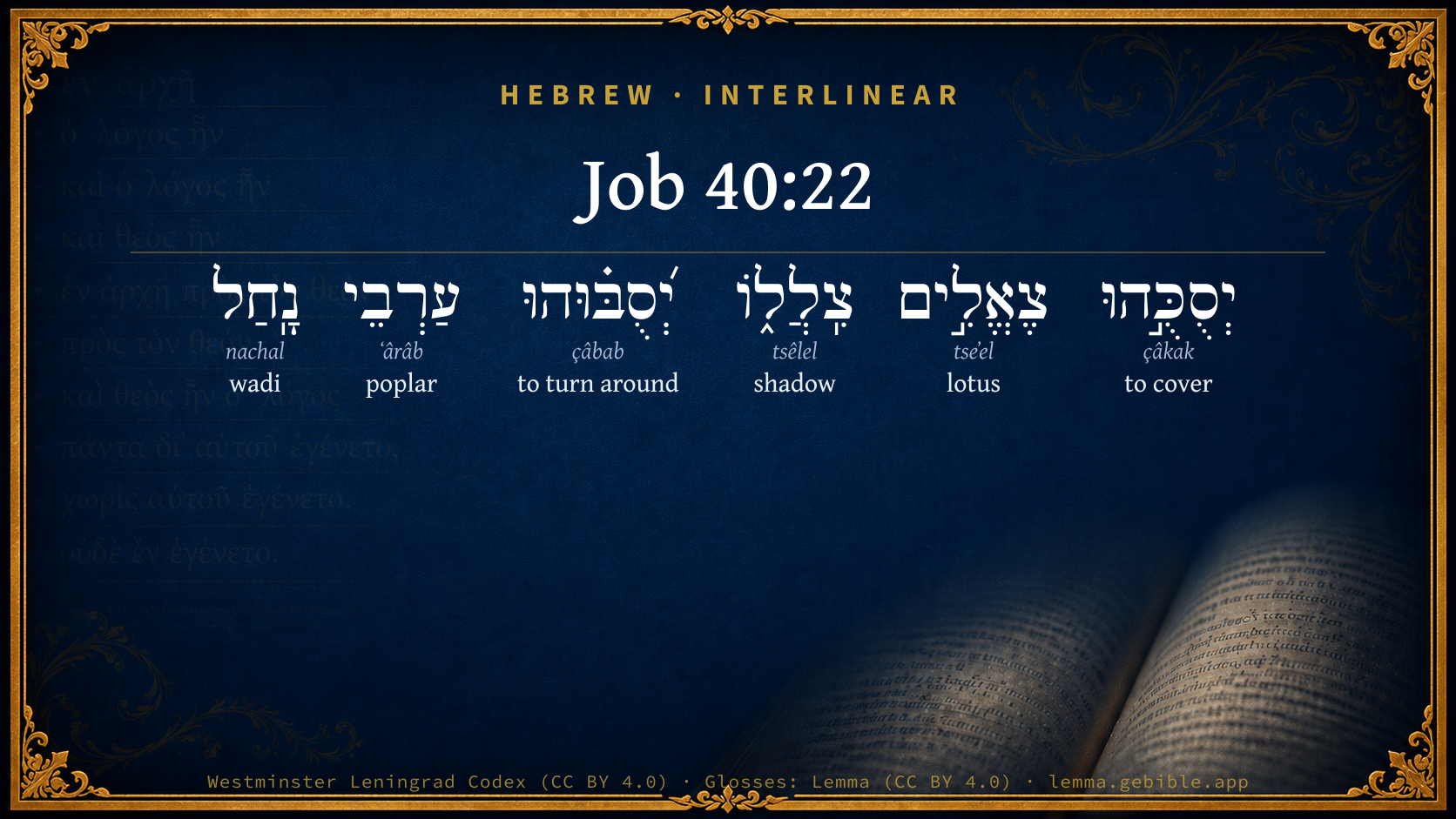
Job 40:22

Hebrew (Westminster Leningrad Codex) Job 40:22 appears in the Hebrew Old Testament. The text above is from the Westminster Leningrad Codex. Each word links to its Strong’s number, a concise gloss, and parsing drawn from the Open Scriptures Hebrew Bible morphology. Click any word for its full Brown-Driver-Briggs (BDB) entry.
Download image
Cite this verse

Job 40:22 (World English Bible). Public Domain. Lemma interlinear Bible study tool, https://lemma.gebible.app/v/job/40/22.

Show BibTeX & RIS
BibTeX
RIS
English Translation
The lotuses cover him with their shade. The willows of the brook surround him.
World English Bible · Public Domain
Highlights
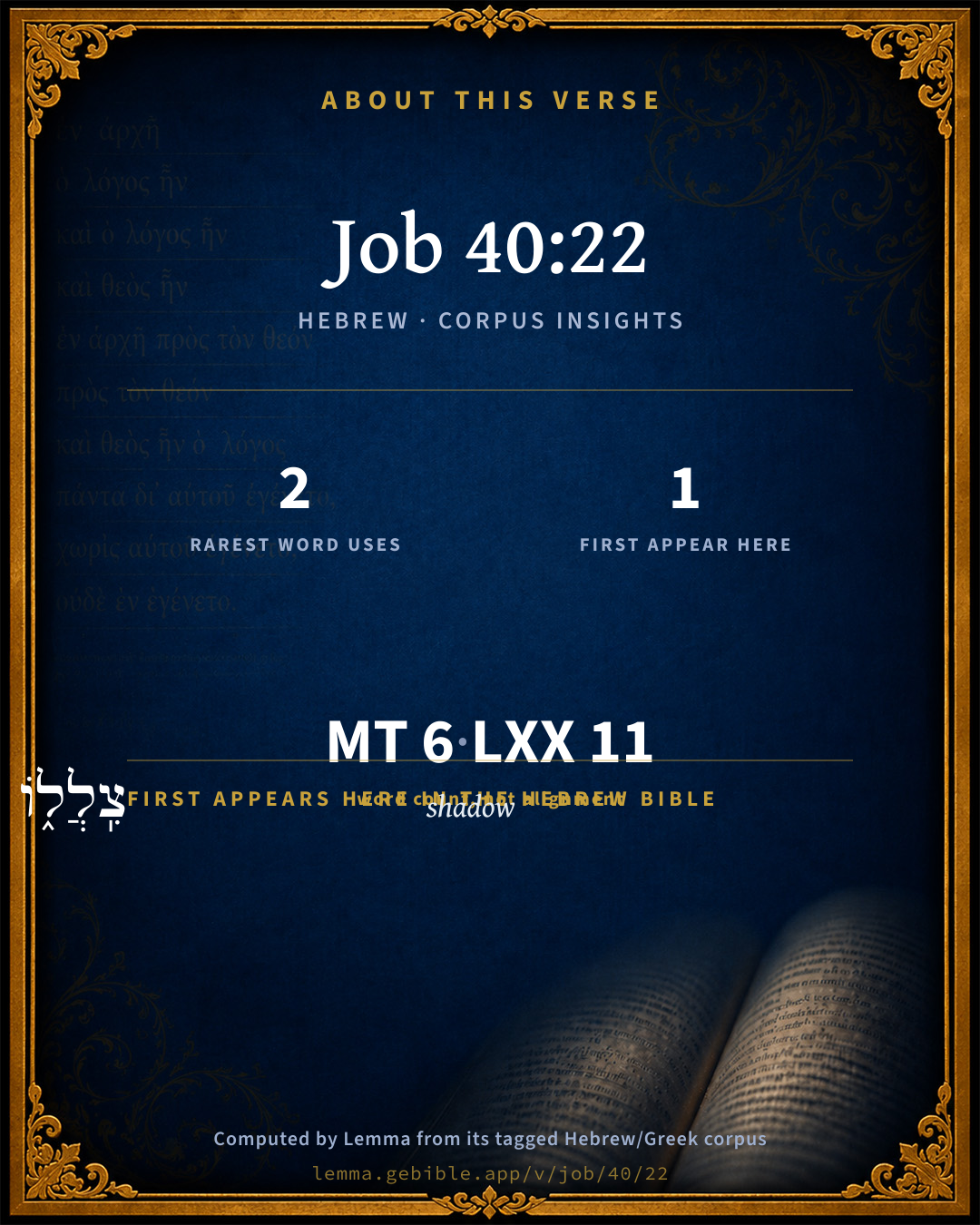
  • 1 first appearance in the Hebrew Bible
Full analysis ↓
Download a study sheet

One document with this verse’s original text, its word-by-word gloss line, the meaning frame, cross-references with their text, attributed commentary, and full source and license credits — printable, and it pastes into notes with its structure intact.

This verse Autodidact and up

Study sheet (.html) Plain text (.txt)

A passage Seminary Student

Up to 50 verses in one chapter. A passage sheet keeps up to 6 commentary sources and 12 cross-references per verse, in the order this page ranks them, and says so on the sheet whenever that leaves anything out. Ask for a single verse and you get the Autodidact verse sheet above.

Everything on this page stays free to read, with no account — the sheet is a download of what is already on screen, not access to it.

Want to remove ads? Support Godless Engineer
Compare translations 3

The same verse in 3 English versions, stacked beneath the original-language interlinear above. Click any original word for its lexicon entry.

Each is an independent rendering of the whole verse — the interlinear is not word-aligned to these translations.

Highlighted words mark where these versions differ — a whole-verse word diff, not a word-by-word alignment.

  • World English Bible Public Domain
    The lotuses cover him with their shade. The willows of the brook surround him.
  • King James Version Public Domain
    The shady trees cover him with their shadow; the willows of the brook compass him about.
  • unfoldingWord Literal Text CC BY-SA 4.0
    The lotus trees cover it their shade; the willows of the river surround it.

unfoldingWord Literal Text — © unfoldingWord, licensed CC BY-SA 4.0. Word-aligned USFM3 via Door43 (git.door43.org/unfoldingWord/en_ult).

Versions to compare (up to 4)

3 of 4 selected

Show all 18 translations

Every available English version of this verse, each an independent rendering of the whole verse.

  • World English Bible Public Domain
    The lotuses cover him with their shade. The willows of the brook surround him.
  • Berean Standard Bible Public Domain
    The lotus plants conceal him in their shade; the willows of the brook surround him.
  • Majority Standard Bible Public Domain
    The lotus plants conceal him in their shade; the willows of the brook surround him.
  • King James Version Public Domain
    The shady trees cover him with their shadow; the willows of the brook compass him about.
  • American Standard Version (1901) Public Domain
    The lotus-trees cover him with their shade; The willows of the brook compass him about.
  • Revised Version (1885) Public Domain
    The lotus trees cover him with their shadow; the willows of the brook compass him about.
  • Geneva Bible (1599) Public Domain
    Will he make many prayers vnto thee, or speake thee faire?
  • Douay-Rheims (1899) Public Domain
    Will he make many supplications to thee, or speak soft words to thee?
  • Young's Literal Translation Public Domain
    Cover him do shades, `with' their shadow, Cover him do willows of the brook.
  • Literal Standard Version CC BY-SA 4.0
    Shades cover him, [with] their shadow, || Willows of the brook cover him.
  • Unlocked Literal Bible CC BY-SA 4.0
    The lotus plants cover him with their shade; the willows of the brook are all around him.
  • unfoldingWord Literal Text CC BY-SA 4.0
    The lotus trees cover it their shade; the willows of the river surround it.
  • Darby Bible Public Domain
    Lotus-bushes cover him with their shade; the willows of the brook surround him.
  • World Messianic Bible Public Domain
    The lotuses cover him with their shade. The willows of the brook surround him.
  • Webster's Bible Public Domain
    \\41:3\\Will he make many supplications to thee? will he speak soft words to thee?
  • Free Bible Version CC BY-SA 4.0
    The lotus covers it with shade; the willow trees of the valley surround it.
  • Bible in Basic English Public Domain
    Will he make prayers to you, or say soft words to you?
  • JPS Tanakh (1917) Public Domain
    The lotus-trees cover him with their shadow; the willows of the brook compass him about.

Literal Standard Version (2020), Covenant Press — licensed CC BY-SA 4.0. Text via the HelloAO Bible API (eBible.org). Unlocked Literal Bible (unfoldingWord) — licensed CC BY-SA 4.0. Text via the HelloAO Bible API (eBible.org). unfoldingWord Literal Text — © unfoldingWord, licensed CC BY-SA 4.0. Word-aligned USFM3 via Door43 (git.door43.org/unfoldingWord/en_ult). Free Bible Version, Dr. Jonathan Gallagher — licensed CC BY-SA 4.0. Text via the HelloAO Bible API (eBible.org).

Word by word

More ways to search: Search by grammar → Find every occurrence → Compare this word →

Practice this passage: Drill this verse → Learn its vocabulary →

About this verse

These counts appear in no published source. They are computed here, from the morphology-tagged text and Lemma’s own curated glosses. What Lemma adds →

6
words
6
distinct lemmas
Wisdom
section

Notable vocabulary

The rarest word here is צֶאֱלִ֣ים lotus H6628 — appearing just 2 times in the whole Hebrew Bible.

First appearance in Scripture

This word makes its first canonical appearance in the Hebrew Bible here:

  • צִֽלֲל֑וֹ shadow H6752

Shared distinctive vocabulary

צֶאֱלִ֣ים lotus H6628 occurs in 2 verses of the Hebrew Bible. Also found in:

Grammatical profile

  • 2 verbs
  • 4 nouns

Verb forms

  • יְסֻכֻּ֣הוּ Qal · Imperfect
  • יְ֝סֻבּ֗וּהוּ Qal · Imperfect

Hebrew & Septuagint length

In English translation the verse runs 14 words from the Hebrew and 14 from the Septuagint (LXX English) — the same length.

A rough comparison of the two English renderings, which tokenize alike — not a word-level alignment.

Word counts can differ between the Hebrew and the Greek without any difference in meaning — e.g. the Hebrew direct-object marker אֵת has no separate Greek word, and Greek often adds the article ὁ.

In the original languages it is 6 Hebrew tokens and 11 Greek tokens — but the two are counted differently (Hebrew bundles its prefixes and suffixes into one token; the Greek is in lemma form), so that isn’t a like-for-like length.

Cross-references

3

Topical passages linked to Job 40:22 in the Treasury of Scripture Knowledge — connected by theme and wording, ordered by reader-vote popularity; previews shown in the World English Bible.

  • Leviticus 23:40 You shall take on the first day the fruit of goodly trees, branches of palm trees, and boughs of thick trees, and willows of the brook; and you shall rejoice before Yahweh your God seven days.
  • Isaiah 15:7 Therefore the abundance they have gotten, and that which they have laid up, shall they carry away over the brook of the willows.
  • Ezekiel 17:5 He took also of the seed of the land, and planted it in a fruitful soil; he placed it beside many waters; he set it as a willow tree.

Cross-references courtesy of OpenBible.info (CC BY 4.0).

Hebrew and Greek witnesses Masoretic Hebrew ↔ Greek Septuagint

The same verse in the two great witnesses to the Old Testament, shown verse-for-verse.

These are two independent witnesses, not word-aligned to each other, and the Septuagint is shown in lemma (dictionary) form.

Hebrew Job 40:22 Masoretic · Westminster Leningrad Codex

יְסֻכֻּ֣הוּ צֶאֱלִ֣ים צִֽלֲל֑וֹ יְ֝סֻבּ֗וּהוּ עַרְבֵי נָֽחַל

The lotuses cover him with their shade. The willows of the brook surround him.

World English Bible · Public Domain

Greek LXX Job 40:22 Septuagint · lemma form

σκιάζω δέ ἐν αὐτός δένδρον μέγας σύν ῥάδαμνος καί κλών ἄγνος

Will he address you with a petition? softly, with the voice of a suppliant?

LXX2012 (modern English Septuagint) · Public Domain

Hebrew: Westminster Leningrad Codex (CC BY 4.0). Greek: Septuagint (public domain); English from LXX2012 (modern English Septuagint) (Public Domain). How the Septuagint differs from the Hebrew →

Commentary

Notes on Job 40:22 from classic Christian and Jewish commentators (each source and its license shown beneath its notes). The classic Christian expositions comment on the surrounding passage and are grouped to its opening verse, so a note may address several verses; the Jewish commentaries on the Tanakh (Rashi and others) are per-verse, so they appear only where the commentator wrote on this verse.

Lemma curates 59 commentaries, every one of them public domain or Creative Commons licensed, each selected and text-cleaned for this edition rather than reprinted as found. About our sources →

Trapp's Complete Commentary

John Trapp

Job 40:22 The shady trees cover him [with] their shadow; the willows of the brook compass him about.

Ver. 22. The shady trees cover him with their shadow, &c.] He leaneth against those trees and sleepeth, for lie down and rise again he cannot, for want of joints in his limbs. And why may not we conceive the trees in those parts big enough to overshade the elephant, when, as in America, but especially in Brazil, the trees are so huge that it is reported of them that several families have lived in several arms of one tree, to such a number as are in some petty village or parish among us? (Abbot’s Geog., p. 271.)

The willows of the brook compass him about] To shelter him from the wind and cold. And although they cannot swim, they are so big, yet they love to be about pools and brooks for shade, and to ease their thirst; for the elephant drinketh off fourteen firkins of water in a morning, saith Aristotle, and eight at night, as it followeth,

John Trapp, A Commentary or Exposition upon All the Books of the Old and New Testament (1647–1656) — public domain. Text from a community e-Sword module.

Jamieson, Fausset & Brown

Robert Jamieson, A. R. Fausset & David Brown

shady trees--Translate: "lotus bushes."

Jamieson, Fausset & Brown — Commentary Critical and Explanatory on the Whole Bible (1871) — public domain (CC PDM 1.0). Text via the HelloAO Bible API.

Adam Clarke's Commentary

Verse 22. The willows of the brook compass him] This would agree well enough with the hippopotamus.

Adam Clarke's Commentary on the Bible (1810–1826) — public domain. Text from a community e-Sword/MySword module.

John Gill's Exposition

Behold, he drinketh up a river, and hasteth not,.... The elephant is indeed a very thirsty animal, and drinks largely; the philosopher (l) says it drinks nine Macedonian bushels at a feeding, and that it will drink fourteen Macedonian measures of water at once, and eight more at noon; but to drink up a river seems to be too great an hyperbole; wherefore the words may be rendered, "Behold, let a river oppress him", or "bear" ever so hard upon him, and come with the greatest force and pressure on him (m), "he hasteth not" to get out of it; or he is not frightened or troubled, as the Targum; which agrees with the river horse, who walks into the river, and proceeds on in it, with the greatest ease and unconcernedness imaginable; now and then lifting up his head above water to take breath, which he can hold a long time; whereas the elephant cannot wade in the water any longer than his trunk is above it, as the philosopher observes (n); and Livy (o) speaks of fear and trembling seizing an elephant, when about to be carried over a river in boats;

he trusteth that he can draw up Jordan in his mouth; so bold and confident he is, and not at all disturbed with its rapidity; or "though Jordan", or rather any descending flowing stream, "gushes into his mouth", so Mr. Broughton: for perhaps Jordan might not be known by Job; nor does it seem to have any connection with the Nile, the seat of the river horse; which has such large holes in its nostrils, and out of which, water being swallowed down, he can throw it with great force. Diodorus Siculus (p) represents it as lying all day in the water, and employing itself at the bottom of it, easy, careless, and unconcerned.

(l) Aristot. ut supra. (l. 9. c. 56.) (m) Vid. Bochart. ut supra, (Apud Hierozic. par. 2. l. 5. c. 14.) col. 766. (n) Aristot. ut supra. (l. 9. c. 56.) Vid Aelian. l. 7. c. 15. (o) Hist. l. 21. c. 28. (p) Bibliothec. l. 1. p. 31. Isidor. Origin. l. 12. c. 6.

John Gill's Exposition of the Whole Bible (1746–1763) — public domain (CC PDM 1.0). Text via the HelloAO Bible API.

Albert Barnes' Notes on the Bible

The shady trees - Probably the “lote-trees;” see the note at Job 40:21. The same word is used here.

The willow-trees of the brook - Of the “stream,” or “rivulet.” The Hebrew word (נחל nachal) means rather “a wady;” a gorge or gulley, which is swollen with torrents in the winter, but which is frequently dry in summer; see the notes at Job 6:15. Willows grew commonly on the banks of rivers. They could not be cultivated in the desert; Isa 15:7.

Albert Barnes' Notes on the Bible (1834–1885) — public domain. Text from a community e-Sword/MySword module.

Haydock's Catholic Bible Commentary

Will it lay aside its ferocity, (Haydock) and flatter thee? (Menochius)

George Leo Haydock (1774–1849), Haydock's Catholic Family Bible and Commentary, 1859 edition — public domain. Excludes Psalms (Douay-Rheims chapter numbering differs from Protestant) and Deuterocanonical books (Catholic canon only).

Matthew Poole's English Annotations

Of the brook; or, of Nilus, of which this word is oft used in Scripture. And this seems to be the chief argument by which the learned Bochart proves this to be meant of the hippopotamus, whose constant residence is in or near the river of Nilus, or the willows that grow by it. But it is well alleged by our learned and judicious Caryl, that this word Naal is never used to express Nilus when it is put by itself, as here it is, but only where the word Egypt is added to it, as it is in all the places which Bochart produceth. And this very phrase,

the willows of the brook, is used of other brooks or rivers besides Nilus, as Lev 23:40; compare Isa 15:7.

Matthew Poole's English Annotations on the Holy Bible (1683–1685) — public domain. Text from a community e-Sword/MySword module.

Whedon's Commentary on the Bible

Daniel D. Whedon

22. The willows — A kind of weeping willow, (salix Babylonica,) same as in Psa_137:2. Of the new Israel, Isaiah tenderly says, they shall spring up as “willows (ibid.) by the water courses.” Chap. Job 44:4.

Daniel D. Whedon (gen. ed.), Commentary on the Old and New Testaments (1874–1909) — public domain. Text from a community e-Sword module.

The Pulpit Commentary

The shady trees (or, the lotus trees) cover him with their shadow (see the comment on ver. 21); the willows of the brook compass him round about. The "willow of the brook" (Lev_23:40) is probably the Saliz Aegyptiaca" or safsaf" which grows plentifully in the Nile valley, fringing the course both of the Nile itself and of the many streams derived from it. The Saliz Babylonica" or "weeping willow," is less likely.

The Pulpit Commentary (1880–1919), ed. H.D.M. Spence-Jones & Joseph S. Exell — public domain. Text from a community e-Sword module.

John Wesley's Explanatory Notes

Brook - Or, of the Nile, of which this word is often used in scripture. His constant residence is in or near this river, or the willows that grow by it.

John Wesley, Explanatory Notes Upon the Whole Bible (1754–1765) — public domain. Text via the GEBible commentary corpus.

unfoldingWord translationNotes

Door43 World Missions Community

lotus plants

flowering plants that float on the water in swampy areas. See how you translated this in Job 40:19.

willows of the brook

Willows are large trees that grow in damp ground. If they are unknown in your culture, you can use a general term for trees that grow near water.

banks

sides of the river

though the Jordan should surge up to his mouth

"even if the flood of the Jordan should come up to his mouth"

Can anyone capture him with a hook ... snare?

This can be translated as a statement. AT: "No one can capture him with a hook or pierce his nose through with a snare." (See: Rhetorical Question)

translationWords

Jordan River

unfoldingWord translationNotes — © Distant Shores Media and the Door43 World Missions Community, licensed CC BY-SA 4.0. Source: git.door43.org/Door43/en_tn.

Rashi

Rabbi Shlomo Yitzchaki (Rashi)

Do the shadows cover him as his shadow [Does] the shadow of the covert of the reeds and the swamp, which is entangled [or surrounded—Berechiah] and hedged around with [many] trees.

Rashi on the Tanakh — English translations: “The Judaica Press complete Tanach with Rashi, translated by A. J. Rosenberg” (CC BY 4.0); “Pentateuch with Rashi's commentary by M. Rosenbaum and A.M. Silbermann, 1929-1934” (public domain); “The Metsudah Tanach series, Lakewood, N.J” (CC BY 4.0); and “The Book of Joshua, Metsudah Publications, 1997” (CC BY 4.0). Text via Sefaria.

Lesson kit

Teaching starters — assembled from the data on this page, not authored interpretation. Every prompt links to the verse data it draws on. Edit before teaching.

Job, in the Wisdom, opens this verse with 6 words (6 distinct Hebrew lemmas). Its most distinctive word is tseʼel (“lotus”). A historical commentator’s framing appears above. Read the whole chapter for the surrounding context.

Discussion questions

  1. How does “lotus” (tseʼel) shape what this verse is saying?
  2. This is the first place “shadow” appears in Scripture (first appears here). What does its debut here establish?
  3. How does Job 40:21, which shares the word «lotus», read alongside this verse?
  4. The translations on this page render this verse differently — a whole-verse word diff, not a word-by-word alignment. What might account for the different wordings?
  5. «יְסֻכֻּ֣הוּ» is a Qal Imperfect verb. How does that grammatical form shape the action described?
  6. Compare how Trapp's Complete Commentary and Jamieson, Fausset & Brown read this verse. Where do they agree or differ?

Things to notice

Reading settings

Reading text

Shown beneath each verse's original-language words.

Old Testament
Old Testament edition

Read the OT as the Masoretic Hebrew (MT) or the Greek Septuagint (LXX).

English shown for the Greek Septuagint (in the Hebrew ↔ Greek comparison).

Comparing translations? Open the Compare panel on any verse page to stack up to four side by side.