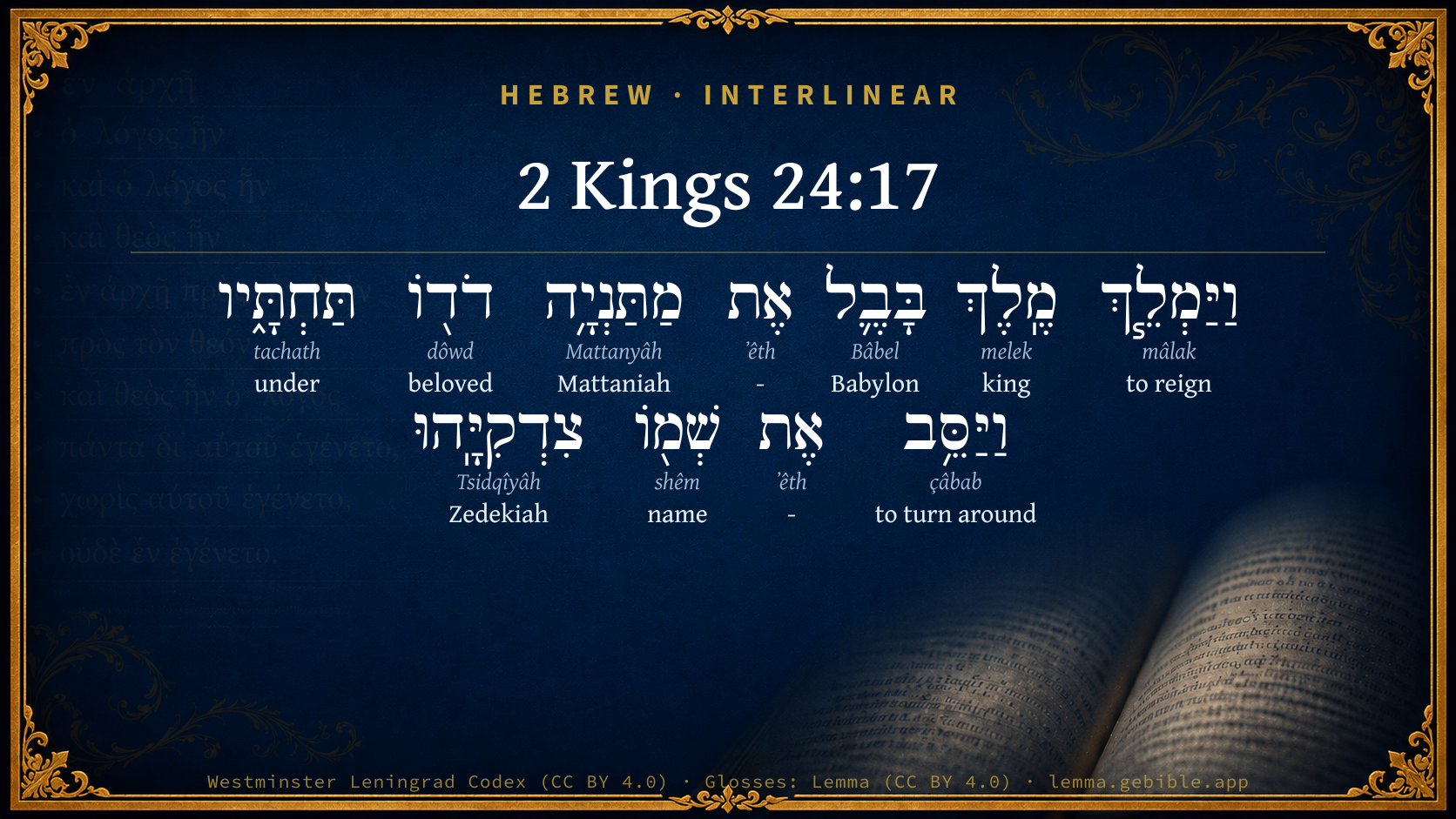
2 Kings 24:17

Hebrew (Westminster Leningrad Codex) 2 Kings 24:17 appears in the Hebrew Old Testament. The text above is from the Westminster Leningrad Codex. Each word links to its Strong’s number, a concise gloss, and parsing drawn from the Open Scriptures Hebrew Bible morphology. Click any word for its full Brown-Driver-Briggs (BDB) entry.
Download image
Cite this verse

2 Kings 24:17 (World English Bible). Public Domain. Lemma interlinear Bible study tool, https://lemma.gebible.app/v/2-kings/24/17.

Show BibTeX & RIS
BibTeX
RIS
English Translation
The king of Babylon made Mattaniah, [Jehoiachin's] father's brother, king is his place, and changed his name to Zedekiah.
World English Bible · Public Domain
Highlights
  • 1 first appearance in the Hebrew Bible
Full analysis ↓
Download a study sheet

One document with this verse’s original text, its word-by-word gloss line, the meaning frame, cross-references with their text, attributed commentary, and full source and license credits — printable, and it pastes into notes with its structure intact.

This verse Autodidact and up

Study sheet (.html) Plain text (.txt)

A passage Seminary Student

Up to 50 verses in one chapter. A passage sheet keeps up to 6 commentary sources and 12 cross-references per verse, in the order this page ranks them, and says so on the sheet whenever that leaves anything out. Ask for a single verse and you get the Autodidact verse sheet above.

Everything on this page stays free to read, with no account — the sheet is a download of what is already on screen, not access to it.

Want to remove ads? Support Godless Engineer
Compare translations 3

The same verse in 3 English versions, stacked beneath the original-language interlinear above. Click any original word for its lexicon entry.

Each is an independent rendering of the whole verse — the interlinear is not word-aligned to these translations.

Highlighted words mark where these versions differ — a whole-verse word diff, not a word-by-word alignment.

  • World English Bible Public Domain
    The king of Babylon made Mattaniah, [Jehoiachin's] father's brother, king is his place, and changed his name to Zedekiah.
  • King James Version Public Domain
    And the king of Babylon made Mattaniah his father's brother king in his stead, and changed his name to Zedekiah.
  • unfoldingWord Literal Text CC BY-SA 4.0
    And the king of Babylon made Mattaniah, his uncle, king in his place, and he changed his name Zedekiah.

unfoldingWord Literal Text — © unfoldingWord, licensed CC BY-SA 4.0. Word-aligned USFM3 via Door43 (git.door43.org/unfoldingWord/en_ult).

Versions to compare (up to 4)

3 of 4 selected

Show all 18 translations

Every available English version of this verse, each an independent rendering of the whole verse.

  • World English Bible Public Domain
    The king of Babylon made Mattaniah, [Jehoiachin's] father's brother, king is his place, and changed his name to Zedekiah.
  • Berean Standard Bible Public Domain
    Then the king of Babylon made Mattaniah, Jehoiachin’s uncle, king in his place and changed his name to Zedekiah.
  • Majority Standard Bible Public Domain
    Then the king of Babylon made Mattaniah, Jehoiachin’s uncle, king in his place and changed his name to Zedekiah.
  • King James Version Public Domain
    And the king of Babylon made Mattaniah his father's brother king in his stead, and changed his name to Zedekiah.
  • American Standard Version (1901) Public Domain
    And the king of Babylon made Mattaniah, `Jehoiachin's' father's brother, king is his stead, and changed his name to Zedekiah.
  • Revised Version (1885) Public Domain
    And the king of Babylon made Mattaniah his father’s brother king in his stead, and changed his name to Zedekiah.
  • Geneva Bible (1599) Public Domain
    And the King of Babel made Mattaniah his vncle King in his steade, and changed his name to Zedekiah.
  • Douay-Rheims (1899) Public Domain
    And he appointed Matthanias his uncle in his stead: and called his name Sedecias.
  • Young's Literal Translation Public Domain
    And the king of Babylon causeth Mattaniah his father's brother to reign in his stead, and turneth his name to Zedekiah.
  • Literal Standard Version CC BY-SA 4.0
    And the king of Babylon causes his father’s brother Mattaniah to reign in his stead, and turns his name to Zedekiah.
  • Unlocked Literal Bible CC BY-SA 4.0
    The king of Babylon made Mattaniah, Jehoiachin's father's brother, king in his place, and changed his name to Zedekiah.
  • unfoldingWord Literal Text CC BY-SA 4.0
    And the king of Babylon made Mattaniah, his uncle, king in his place, and he changed his name Zedekiah.
  • Darby Bible Public Domain
    And the king of Babylon made Mattaniah his uncle king in his stead, and changed his name to Zedekiah.
  • World Messianic Bible Public Domain
    The king of Babylon made Mattaniah, Jehoiachin’s father’s brother, king in his place, and changed his name to Zedekiah.
  • Webster's Bible Public Domain
    And the king of Babylon made Mattaniah his father's brother king in his stead, and changed his name to Zedekiah.
  • Free Bible Version CC BY-SA 4.0
    The king of Babylon made Mattaniah, Jehoiachin's uncle, king instead of him, and changed his name to Zedekiah.
  • Bible in Basic English Public Domain
    And the king of Babylon made Mattaniah, his father's brother, king in place of Jehoiachin, changing his name to Zedekiah.
  • JPS Tanakh (1917) Public Domain
    And the king of Babylon made Mattaniah his father's brother king in his stead, and changed his name to Zedekiah.

Literal Standard Version (2020), Covenant Press — licensed CC BY-SA 4.0. Text via the HelloAO Bible API (eBible.org). Unlocked Literal Bible (unfoldingWord) — licensed CC BY-SA 4.0. Text via the HelloAO Bible API (eBible.org). unfoldingWord Literal Text — © unfoldingWord, licensed CC BY-SA 4.0. Word-aligned USFM3 via Door43 (git.door43.org/unfoldingWord/en_ult). Free Bible Version, Dr. Jonathan Gallagher — licensed CC BY-SA 4.0. Text via the HelloAO Bible API (eBible.org).

Word by word

More ways to search: Search by grammar → Find every occurrence → Compare this word →

Practice this passage: Drill this verse → Learn its vocabulary →

מַתַּנְיָ֥ה
Mattanyâh
H4983
“Mattaniah”
Noun, Proper
Part of Speech
Noun
Type
Proper
Full BDB Definition

Origin: from H4976 and H3050

TWOT: None

Mattaniah = "gift of Jehovah" - the original name of the last king of Judah before the captivity; also known as 'Zedekiah' - a Levite, son of Heman, whose office was to blow the horns in the temple service as appointed by David - a Levite of the family of Asaph - a Levite of the family of Asaph who assisted in the purification of the temple in the reign of Hezekiah - a Levite of the family of Asaph who took part in the dedication of the wall of Jerusalem; leader of the temple choir - a Levite, descendant of Asaph and ancestor of Jahaziel in the time of Jehoshaphat - another Levite in the time of Nehemiah - a Levite, father of Zaccur and ancestor of Hanan the under-treasurer who had charge of the offerings in the time of Nehemiah - a man of the sons of Elam who had and put away a strange wife in the time of Ezra - a man of the sons of Zattu who had and put away a strange wife in the time of Ezra - a man descended from Pahath-moab who had and put away a strange wife in the time of Ezra - a man of the sons of Bani who had and put away a strange wife in the time of Ezra
  1. וַיַּמְלֵ֧ךְ mâlak H4427 “and · to reign” Conjunction + Verb, Hiphil, Sequential Imperfect, 3rd Person, Masculine, Singular
  2. מֶֽלֶךְ melek H4428 “king of” Noun, Common, Masculine, Singular, Construct
  3. בָּבֶ֛ל Bâbel H894 “Babylon” Noun, Proper
  4. אֶת ʼêth H853 “-” Particle, Direct Object
  5. דֹד֖וֹ dôwd H1730 “beloved · his” Noun, Common, Masculine, Singular, Construct + Suffix, Personal, 3rd Person, Masculine, Singular
  6. תַּחְתָּ֑יו tachath H8478 “under · him” Preposition + Suffix, Personal, 3rd Person, Masculine, Singular
  7. וַיַּסֵּ֥ב çâbab H5437 “and · to turn around” Conjunction + Verb, Hiphil, Sequential Imperfect, 3rd Person, Masculine, Singular
  8. אֶת ʼêth H853 “-” Particle, Direct Object
  9. שְׁמ֖וֹ shêm H8034 “name · his” Noun, Common, Masculine, Singular, Construct + Suffix, Personal, 3rd Person, Masculine, Singular
  10. צִדְקִיָּֽהוּ Tsidqîyâh H6667 “Zedekiah” Noun, Proper

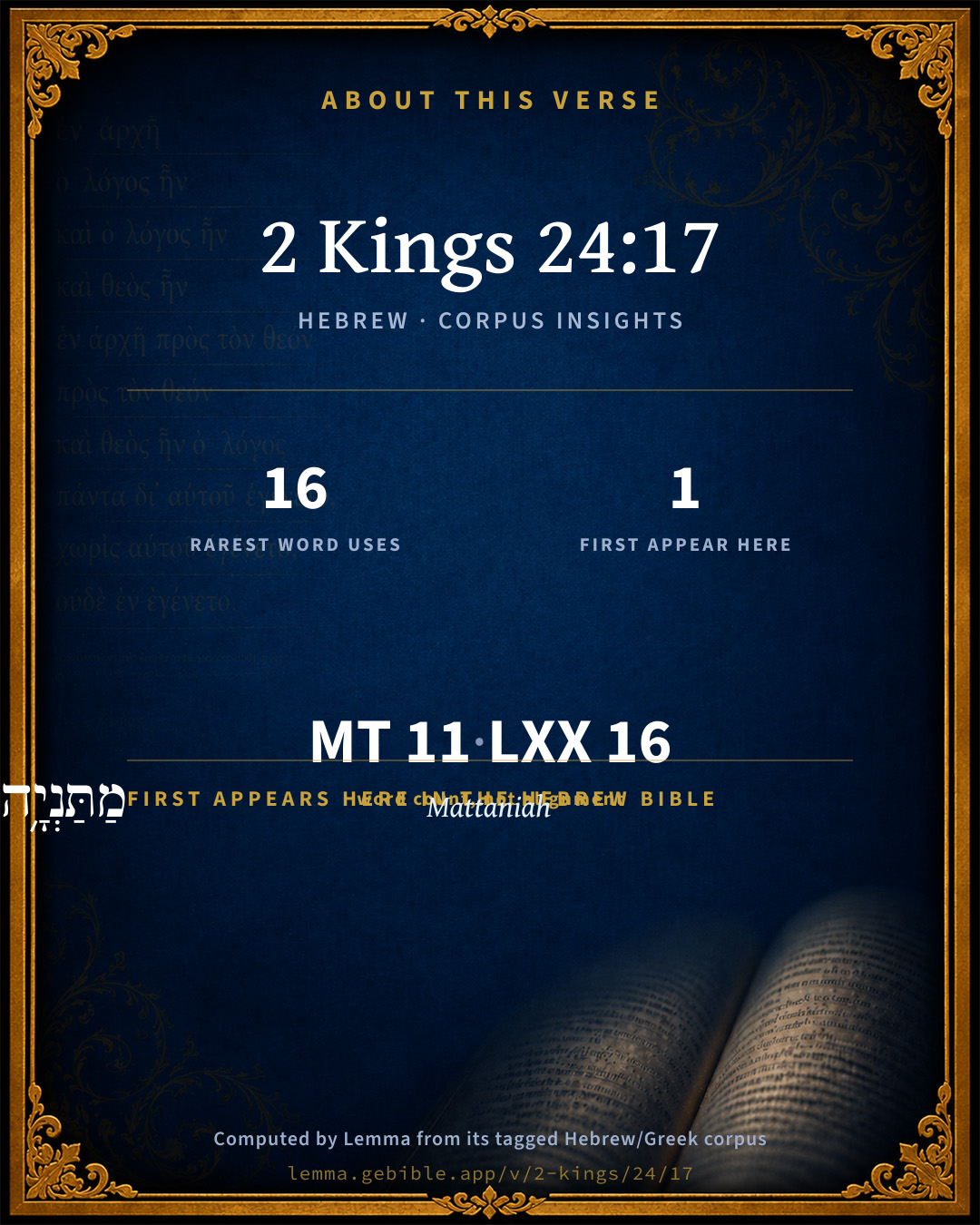
About this verse

These counts appear in no published source. They are computed here, from the morphology-tagged text and Lemma’s own curated glosses. What Lemma adds →

11
words
10
distinct lemmas
Historical
section

Notable vocabulary

The rarest word here is מַתַּנְיָ֥ה Mattaniah H4983 — appearing just 16 times in the whole Hebrew Bible.

First appearance in Scripture

This word makes its first canonical appearance in the Hebrew Bible here:

  • מַתַּנְיָ֥ה Mattaniah H4983

Shared distinctive vocabulary

מַתַּנְיָ֥ה Mattaniah H4983 occurs in 16 verses of the Hebrew Bible. Also found in:

Grammatical profile

  • 2 verbs
  • 6 nouns
  • 1 preposition
  • 2 particles

Verb forms

  • וַיַּמְלֵ֧ךְ Hiphil · Sequential Imperfect
  • וַיַּסֵּ֥ב Hiphil · Sequential Imperfect

Hebrew & Septuagint length

In English translation the verse runs 19 words from the Hebrew and 18 from the Septuagint (LXX English) — closely comparable.

A rough comparison of the two English renderings, which tokenize alike — not a word-level alignment.

Word counts can differ between the Hebrew and the Greek without any difference in meaning — e.g. the Hebrew direct-object marker אֵת has no separate Greek word, and Greek often adds the article ὁ.

In the original languages it is 11 Hebrew tokens and 16 Greek tokens — but the two are counted differently (Hebrew bundles its prefixes and suffixes into one token; the Greek is in lemma form), so that isn’t a like-for-like length.

Cross-references

6

Topical passages linked to 2 Kings 24:17 in the Treasury of Scripture Knowledge — connected by theme and wording, ordered by reader-vote popularity; previews shown in the World English Bible.

  • Jeremiah 37:1 Zedekiah the son of Josiah reigned as king, instead of Coniah the son of Jehoiakim, whom Nebuchadrezzar king of Babylon made king in the land of Judah.
  • 2 Kings 23:34 Pharaoh Necoh made Eliakim the son of Josiah king in the room of Josiah his father, and changed his name to Jehoiakim: but he took Jehoahaz away; and he came to Egypt, and died there.
  • 2 Chronicles 36:4 The king of Egypt made Eliakim his brother king over Judah and Jerusalem, and changed his name to Jehoiakim. Neco took Joahaz his brother, and carried him to Egypt.
  • 1 Chronicles 3:15–16 The sons of Josiah: the firstborn Johanan, the second Jehoiakim, the third Zedekiah, the fourth Shallum.
  • 2 Chronicles 36:10–13 At the return of the year king Nebuchadnezzar sent, and brought him to Babylon, with the goodly vessels of the house of Yahweh, and made Zedekiah his brother king over Judah and Jerusalem.
  • Jeremiah 52:1 Zedekiah was twenty-one years old when he began to reign; and he reigned eleven years in Jerusalem: and his mother's name was Hamutal the daughter of Jeremiah of Libnah.

Cross-references courtesy of OpenBible.info (CC BY 4.0).

Hebrew and Greek witnesses Masoretic Hebrew ↔ Greek Septuagint

The same verse in the two great witnesses to the Old Testament, shown verse-for-verse.

These are two independent witnesses, not word-aligned to each other, and the Septuagint is shown in lemma (dictionary) form.

Hebrew 2 Kings 24:17 Masoretic · Westminster Leningrad Codex

וַיַּמְלֵ֧ךְ מֶֽלֶךְ בָּבֶ֛ל אֶת מַתַּנְיָ֥ה דֹד֖וֹ תַּחְתָּ֑יו וַיַּסֵּ֥ב אֶת שְׁמ֖וֹ צִדְקִיָּֽהוּ

The king of Babylon made Mattaniah, [Jehoiachin's] father's brother, king is his place, and changed his name to Zedekiah.

World English Bible · Public Domain

Greek LXX 2 Kings 24:17 Septuagint · lemma form

καί βασιλεύω βασιλεύς βαβυλών ὁ μαθθανιας υἱός αὐτός ἀντί αὐτός καί ἐπιτίθημι ὁ ὄνομα αὐτός σεδεκια

And the king of Babylon made Batthanias his son king in his stead, and called his name Sedekias.

LXX2012 (modern English Septuagint) · Public Domain

On this verse, Ellicott's Commentary for English Readers discusses the Septuagint’s reading. Read the note in Commentary ↓

Hebrew: Westminster Leningrad Codex (CC BY 4.0). Greek: Septuagint (public domain); English from LXX2012 (modern English Septuagint) (Public Domain). How the Septuagint differs from the Hebrew →

Targum (Aramaic paraphrase)

1

The Targum is the ancient Jewish Aramaic paraphrase of the Hebrew Scriptures — an interpretive translation, not the Hebrew text itself. Onkelos (literal) and Pseudo-Jonathan (expansive) render the Torah, and Jonathan the Prophets. Coverage is partial: where no permissively-licensed English translation exists for a verse, only the Aramaic is shown. This is verse-level text, not a word-by-word alignment to the Hebrew.

  1. Targum Jonathan Prophets (Joshua–Malachi)
    וְאַמְלִיךְ מַלְכָּא דְבָבֶל יַת מַתַּנְיָה אַח אֲבוּהִי תְּחוֹתוֹהִי וְשַׁוִי יַת שְׁמֵיהּ צִדְקִיָהוּ:

    (no public-domain English translation for this verse)

    Targum Jonathan — Aramaic: “Mikraot Gedolot” (public domain). English: “Sefaria Community Translation” (CC0 1.0 (public-domain dedication)); “London "Chaldee Paraphrase," 1871” (public domain). Text via Sefaria.

Commentary

Notes on 2 Kings 24:17 from classic Christian and Jewish commentators (each source and its license shown beneath its notes). The classic Christian expositions comment on the surrounding passage and are grouped to its opening verse, so a note may address several verses; the Jewish commentaries on the Tanakh (Rashi and others) are per-verse, so they appear only where the commentator wrote on this verse.

Lemma curates 59 commentaries, every one of them public domain or Creative Commons licensed, each selected and text-cleaned for this edition rather than reprinted as found. About our sources →

Jamieson, Fausset & Brown

Robert Jamieson, A. R. Fausset & David Brown

ZEDEKIAH'S EVIL REIGN. (Kg2 24:17-20)

the king of Babylon made Mattaniah, his father's brother, king in his stead--Adhering to his former policy of maintaining a show of monarchy, Nebuchadnezzar appointed the third and youngest son of Josiah (Ch1 3:15), full brother of Jehoahaz, and uncle of the captive Jehoiachin. But, according to the custom of conquerors, who changed the names of the great men they took captives in war, in token of their supremacy, he gave him the new name of

Zedekiah--that is, "The righteous of God." This being a purely Hebrew name, it seems that he allowed the puppet king to choose his own name, which was confirmed. His heart towards God was the same as that of Jehoiakim, impenitent and heedless of God's word.

Jamieson, Fausset & Brown — Commentary Critical and Explanatory on the Whole Bible (1871) — public domain (CC PDM 1.0). Text via the HelloAO Bible API.

Trapp's Complete Commentary

John Trapp

2Ki 24:17 And the king of Babylon made Mattaniah his father’s brother king in his stead, and changed his name to Zedekiah.

Ver. 17. And the king of Babylon had made Mattaniah.] His name signifieth God’s gift, the same as Nathanael, Theodore, Diodate. Good Josiah gave all his children good names but they proved all stark naught.

John Trapp, A Commentary or Exposition upon All the Books of the Old and New Testament (1647–1656) — public domain. Text from a community e-Sword module.

Joseph Benson's Commentary

2Ki 24:17. And changed his name to Zedekiah — That he might admonish him of (what his name signifies) the justice of God, which had so severely punished Jehoiakim for his rebellion; and would no less certainly overtake him, if he should be guilty of the same perfidiousness.

Joseph Benson's Commentary on the Old and New Testaments (1811–1818) — public domain. Text from a community e-Sword module.

Tyndale Open Study Notes

Tyndale Open Resources

24:17 Like the three kings before him, Mattaniah received a throne name, Zedekiah. • Jehoiachin’s uncle: See 1 Chr 3:15-16.

Tyndale Open Study Notes — © Tyndale Open Resources, licensed CC BY-SA 4.0. Text via the HelloAO Bible API.

Adam Clarke's Commentary

Verse 17. Made Mattaniah his father's brother king in his stead] He was the son of Josiah, and brother to Jehoiakim.

Changed his name to Zedekiah.] 2Kg 23:34.

Adam Clarke's Commentary on the Bible (1810–1826) — public domain. Text from a community e-Sword/MySword module.

Ellicott's Commentary for English Readers

(17) Mattaniah his father’s brother.—He was the third son of Josiah (comp. Jer_1:3; Jer_37:1), and full brother of Jehoahaz-Shallum (2Ki_23:31). Jehoiachin was childless at the time (comp. 2Ki_24:12; 2Ki_24:15 with 2Ki_25:7 and Jer_22:30). In the exile he had offspring (1Ch_3:17-18). (The LXX. reads, his son, υἱὸν, a corruption of θεῖον, uncle).

And changed his name to Zedekiah.—His former name meant “gift of Jah;” his new one, “Jah is righteousness” (or “myrighteousness”). The prophecy of Jeremiah (Jer_23:1-9), denouncing “the shepherds that destroy and scatter the flock” and promising a future king, whose name shall be “Jehovah is our righteousness” (lahweh çidgçnu), evidently refers to the delusive expectations connected with Zedekiah’s elevation. Nebuchadnezzar’s act of clemency in putting another native prince on the throne may have been the execution of a promise made at the surrender of the city.

A Bible Commentary for English Readers, edited by Charles John Ellicott (1878–1897) — public domain. Text from a community e-Sword module.

The Cambridge Bible for Schools and Colleges

gen. ed. J. J. S. Perowne

17. Mattaniah] He was the brother of Jehoiakim, and as we gather from 1Ch_3:15, he was Josiah’s third son. He is wrongly called ‘the brother’ of Jehoiachin, 2Ch_36:10, unless we accept the word translated ‘brother’ for some general term of relationship and render it ‘kinsman’. Thus Lot is called Abraham’s brother, Gen_14:16 and Bethuel also in Gen_24:48. So also in 2Ki_10:13 ‘the brethren of Ahaziah were not all that king’s brothers’. On the changing of names of persons taken captive or placed in some position of subjection see note on 2Ki_23:34.

Zedekiah] Both this name and Mattaniah have Jah = Jehovah for their termination. We may therefore suppose that the choice of his new name was left to the Jewish king. Mattan-jah = gift of Jehovah; Zedek-jah, righteousness of Jehovah.

The Cambridge Bible for Schools and Colleges (gen. ed. J. J. S. Perowne; Cambridge University Press, 1878–1918) — public domain. Text from a community e-Sword module.

Albert Barnes' Notes on the Bible

Mattaniah, son of Josiah and brother of Jehoahaz, but thirteen years his junior, adopted a name significant of the blessings promised by Jeremiah to the reign of a king whose name should be “Yahweh, our righteousness” Jer 23:5-8.

Albert Barnes' Notes on the Bible (1834–1885) — public domain. Text from a community e-Sword/MySword module.

Haydock's Catholic Bible Commentary

Uncle, the third son of Josias, who was placed on the throne. (Haydock) --- The eldest, (Menochius) called Johanan, seems to have died in his youth. (Calmet) --- Sedecias means, "the justice of God," (Tirinus) as Nabuchodonosor had adjured him, or made him swear by God; (2 Paralipomenon xxxvi. 15.; Haydock) and thus insinuated, that, if he proved faithless, he should feel the effects of God’s justice, as it happened. (Tirinus)

George Leo Haydock (1774–1849), Haydock's Catholic Family Bible and Commentary, 1859 edition — public domain. Excludes Psalms (Douay-Rheims chapter numbering differs from Protestant) and Deuterocanonical books (Catholic canon only).

Matthew Poole's English Annotations

That he might admonish him of (what this name signifies)

the justice of God, which had so severely punished Jehoiakim for his rebellion; and would no less certainly overtake him, if he should be guilty of the same rebellion and perfidiousness of which his predecessor was guilty.

Matthew Poole's English Annotations on the Holy Bible (1683–1685) — public domain. Text from a community e-Sword/MySword module.

Whedon's Commentary on the Bible

Daniel D. Whedon

17. His father’s brother — He was half-brother to Jehoiakim, but own brother to Jehoahaz. Compare 2Ki_24:18 with 2Ki_23:31; 2Ki_23:36.

Changed his name — See note on 2Ki_23:34.

Daniel D. Whedon (gen. ed.), Commentary on the Old and New Testaments (1874–1909) — public domain. Text from a community e-Sword module.

The Pulpit Commentary

Vers. 17-20. EARLIER PORTION OF ZEDEKIAH"S REIGN. Nebuchadnezzar found a son of Josiah, named Mattaniah, still surviving at Jerusalem. At his father"s death he must have been a boy of ten, but he was now, eleven years later, of the age of twenty-one. This youth, only three years older than his nephew Jehoiachin, he appointed king, at the same time requiring him to change his name, which he did from "Mattaniah" to "Zedekiah" (ver. 17). Zedekiah pursued nearly the same course of action as the other recent kings. He showed no religious zeal, instituted no reform, but allowed the idolatrous practices, to which the people were so addicted, to continue (ver. 19). Though less irreligious and less inclined to persecute than Jehoiakim, he could not bring himself to turn to God. He was weak and vacillating, inclined to follow the counsels of Jeremiah, but afraid of the "princes," and ultimately took their advice, which was to ally himself with Egypt, and openly rebel against Nebuchadnezzar. This course of conduct brought about the destruction of the nation (ver. 29). And the King of Babylon made Mattaniah his father"s brother king in his stead. Josiah had four sons (1Ch_3:15) Johanan, the eldest, who probably died before his father; Jehoiakim, or Eliakim, the second, who was twenty-five years old at his father"s death; (2Ki_23:36) Jehoahaz, the third, otherwise called Shallum (1 Chronicles, l.s.c. ; (Jer_22:11) who, when his father died, was aged twenty-three; (2Ki 32) and Mattaniah, the youngest, who must have been then aged ten or nine. It was this fourth son, now grown to manhood, whom Nebuchadnezzar appointed king in Jehoiachin"s room. And changed his name to Zedekiah. (On the practice of changing a king"s name on his accession, see the comment upon 2Ki_23:31, 2Ki_23:34) Mat-lab means "Gift of Jehovah;" Zedekiah, "Righteousness of Jehovah." Josiah had called his son the first of these names in humble acknowledgment of God"s mercy in granting him a fourth son. So other pious Jews called their sons "Nathaniel," and Greeks "Theodotus" or "Theodorus," and Romans "Deodatua." Mattaniah, in taking the second of the names, may have had in his mind the prophecy of Jer_23:5-8, where blessings are promised to the reign of a king whose name should be Jehovah-Tsidkenu," i.e. "The Lord our Righteousness." Or he may simply have intended to declare that "the righteousness of Jehovah" was what he aimed at establishing. In this case it can only be said that it would have been happy for his country, had his professions been corroborated by his acts.

The Pulpit Commentary (1880–1919), ed. H.D.M. Spence-Jones & Joseph S. Exell — public domain. Text from a community e-Sword module.

John Wesley's Explanatory Notes

Zedekiah - That he might admonish him of (what this name signifies) the justice of God, which had so severely punished Jehoiakim for his rebellion; and would no less certainly overtake him, if he should be guilty of the same perfidiousness.

John Wesley, Explanatory Notes Upon the Whole Bible (1754–1765) — public domain. Text via the GEBible commentary corpus.

Keil & Delitzsch

C. F. Keil & F. Delitzsch

Over the lower classes of the people who had been left behind Nebuchadnezzar placed the paternal uncle of the king, who had been led away, viz., Mattaniah, and made him king under the name of Zedekiah. He was the youngest son of Josiah (Jer 1:3; Jer 37:1); was only ten years old when his father died, and twenty-one years old when he ascended the throne; and as the uncle of Jehoiachin, who being only a youth of eighteen could not have a son capable of reigning, had the first claim to the throne. Instead of דּדו, his uncle, we have in Ch2 36:10 אהיו, his brother, i.e., his nearest relation. On the change in the name see at Kg2 23:34. The name צדקיּהוּ, i.e., he who has Jehovah's righteousness, was probably chosen by Mattaniah in the hope that through him or in his reign the Lord would create the righteousness promised to His people.

Keil & Delitzsch — Biblical Commentary on the Old Testament (1861–1891) — public domain (CC PDM 1.0). Text via the HelloAO Bible API. (Old Testament only.)

Kretzmann's Popular Commentary

Paul E. Kretzmann

Zedekiah Begins his Rule

v. 17. And the king of Babylon made Mattaniah, his father’s brother, a third son of Josiah, king in his stead, and changed his name to Zedekiah ("the righteousness of Jehovah," he by whom Jehovah executes justice).

v. 18. Zedekiah was twenty and one years old when he began to reign, and he reigned eleven years in Jerusalem. And his mother’s name was Hamutal, the daughter of Jeremiah of Libnah. Cf 2Ki 23:31.

v. 19. And he did that which was evil in the sight of the Lord, according to all that Jehoiakim had done, thus fulfilling Judah’s measure of iniquity.

v. 20. For through the anger of the Lord it came to pass in Jerusalem and Judah, until He had cast them out from His presence, that Zedekiah rebelled against the king of Babylon. The final execution of the Lord’s judgment took place in his reign, the rebellion which took place in the seventh or eighth year of Zedekiah’s reign being merely the occasion which brought on the catastrophe. If all efforts to gain the hearts by admonition and reproof prove futile, the Lord at last delivers men into the judgment which their sin deserves.

Paul E. Kretzmann, Popular Commentary of the Bible (1921–1924) — public domain. Text from a community e-Sword module.

Rashi

Rabbi Shlomo Yitzchaki (Rashi)

And changed his name to Tzidkiyohu. May God justify the judgment upon you if you rebel against me.

Rashi on the Tanakh — English translations: “The Judaica Press complete Tanach with Rashi, translated by A. J. Rosenberg” (CC BY 4.0); “Pentateuch with Rashi's commentary by M. Rosenbaum and A.M. Silbermann, 1929-1934” (public domain); “The Metsudah Tanach series, Lakewood, N.J” (CC BY 4.0); and “The Book of Joshua, Metsudah Publications, 1997” (CC BY 4.0). Text via Sefaria.

Lesson kit

Teaching starters — assembled from the data on this page, not authored interpretation. Every prompt links to the verse data it draws on. Edit before teaching.

2 Kings, in the Historical, opens this verse with 11 words (10 distinct Hebrew lemmas). Its most distinctive word is Mattanyâh (“Mattaniah”). A historical commentator’s framing appears above. Read the whole chapter for the surrounding context.

Discussion questions

  1. What does “Mattaniah” (Mattanyâh) contribute to the verse as a whole?
  2. The word “Mattaniah” first appears here in Scripture. What is being introduced at this debut?
  3. 1 Chronicles 9:15 shares the word «Mattaniah» with this verse. How do the two illuminate each other?
  4. These translations render this verse differently; the difference is in the English rendering, not the original. What questions does that raise?
  5. The verb «וַיַּמְלֵ֧ךְ» is Hiphil Sequential Imperfect. How does its form color the action?
  6. Reading how Jamieson, Fausset & Brown and Trapp's Complete Commentary read this verse, where do the two commentators agree and where do they part?

Things to notice

Reading settings

Reading text

Shown beneath each verse's original-language words.

Old Testament
Old Testament edition

Read the OT as the Masoretic Hebrew (MT) or the Greek Septuagint (LXX).

English shown for the Greek Septuagint (in the Hebrew ↔ Greek comparison).

Comparing translations? Open the Compare panel on any verse page to stack up to four side by side.