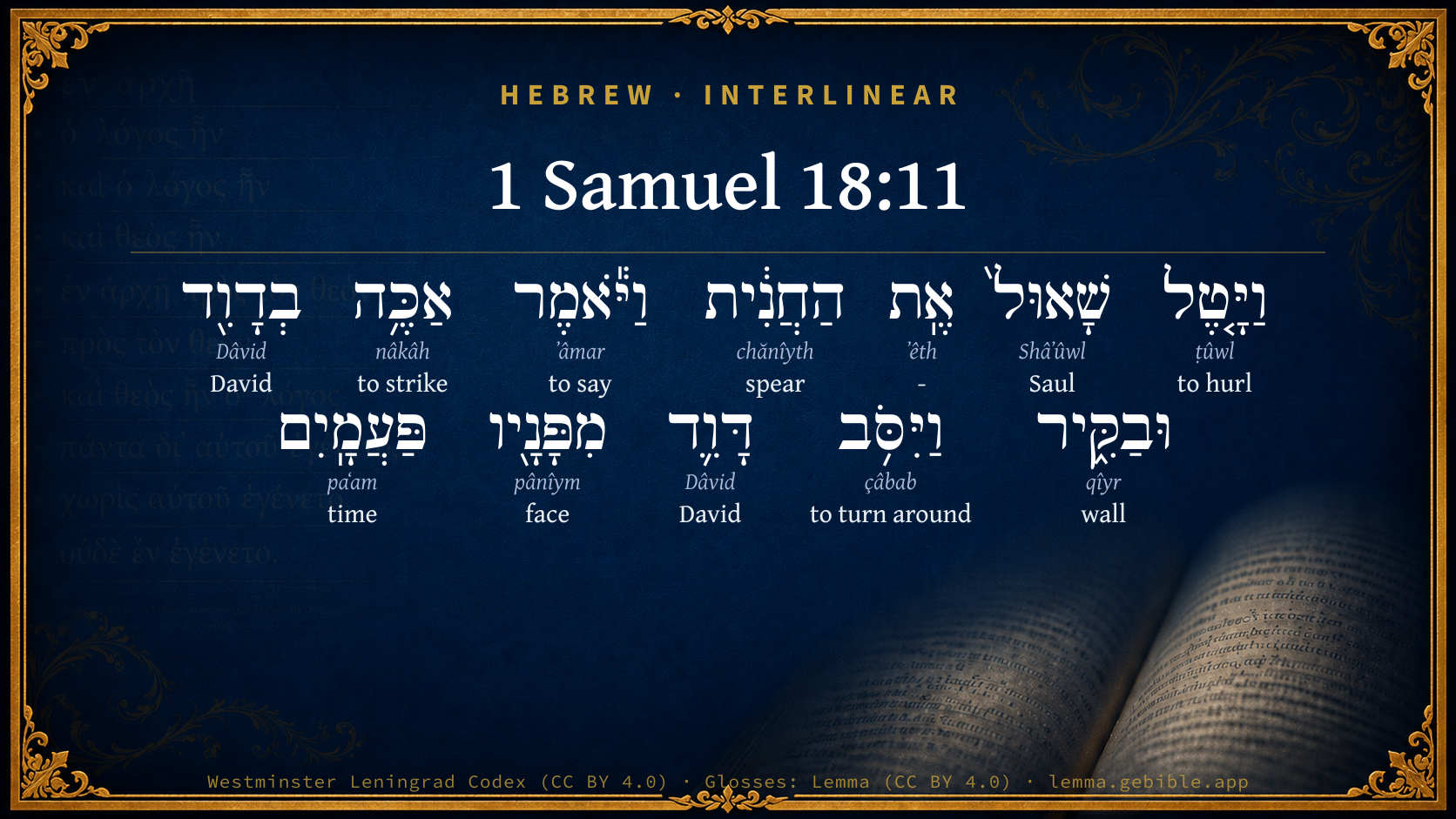
1 Samuel 18:11

Hebrew (Westminster Leningrad Codex) 1 Samuel 18:11 appears in the Hebrew Old Testament. The text above is from the Westminster Leningrad Codex. Each word links to its Strong’s number, a concise gloss, and parsing drawn from the Open Scriptures Hebrew Bible morphology. Click any word for its full Brown-Driver-Briggs (BDB) entry.
Download image
Cite this verse

1 Samuel 18:11 (World English Bible). Public Domain. Lemma interlinear Bible study tool, https://lemma.gebible.app/v/1-samuel/18/11.

Show BibTeX & RIS
BibTeX
RIS
English Translation
and Saul cast the spear; for he said, I will strike David even to the wall. David avoided out of his presence twice.
World English Bible · Public Domain
Highlights
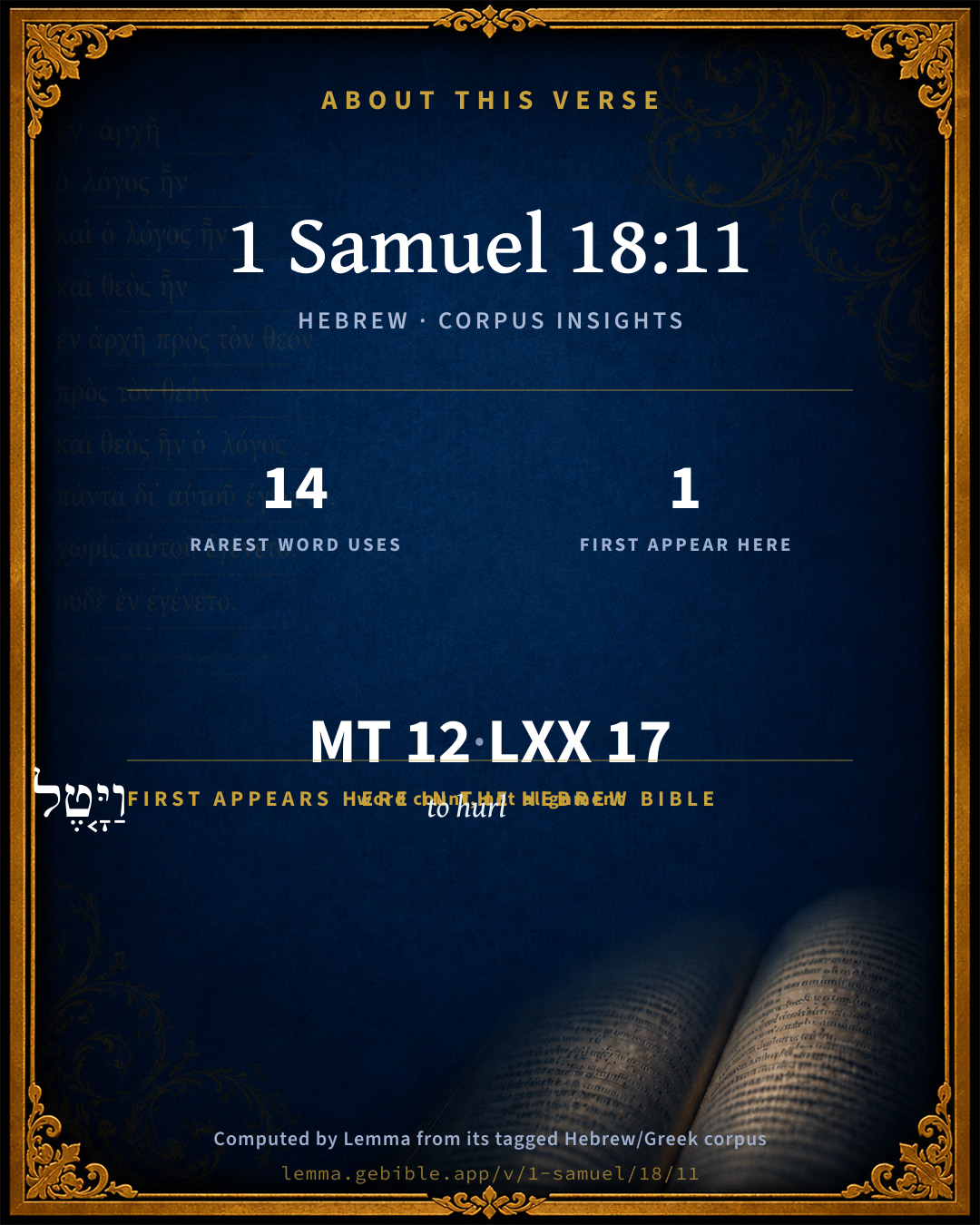
  • 1 first appearance in the Hebrew Bible
Full analysis ↓
Download a study sheet

One document with this verse’s original text, its word-by-word gloss line, the meaning frame, cross-references with their text, attributed commentary, and full source and license credits — printable, and it pastes into notes with its structure intact.

This verse Autodidact and up

Study sheet (.html) Plain text (.txt)

A passage Seminary Student

Up to 50 verses in one chapter. A passage sheet keeps up to 6 commentary sources and 12 cross-references per verse, in the order this page ranks them, and says so on the sheet whenever that leaves anything out. Ask for a single verse and you get the Autodidact verse sheet above.

Everything on this page stays free to read, with no account — the sheet is a download of what is already on screen, not access to it.

Want to remove ads? Support Godless Engineer
Compare translations 3

The same verse in 3 English versions, stacked beneath the original-language interlinear above. Click any original word for its lexicon entry.

Each is an independent rendering of the whole verse — the interlinear is not word-aligned to these translations.

Highlighted words mark where these versions differ — a whole-verse word diff, not a word-by-word alignment.

  • World English Bible Public Domain
    and Saul cast the spear; for he said, I will strike David even to the wall. David avoided out of his presence twice.
  • King James Version Public Domain
    And Saul cast the javelin; for he said, I will smite David even to the wall with it. And David avoided out of his presence twice.
  • unfoldingWord Literal Text CC BY-SA 4.0
    And Saul hurled the spear, and he said, “I will strike David, and into the wall!” But David turned from his face two times.

unfoldingWord Literal Text — © unfoldingWord, licensed CC BY-SA 4.0. Word-aligned USFM3 via Door43 (git.door43.org/unfoldingWord/en_ult).

Versions to compare (up to 4)

3 of 4 selected

Show all 18 translations

Every available English version of this verse, each an independent rendering of the whole verse.

  • World English Bible Public Domain
    and Saul cast the spear; for he said, I will strike David even to the wall. David avoided out of his presence twice.
  • Berean Standard Bible Public Domain
    and he hurled it, thinking, “I will pin David to the wall.” But David eluded him twice.
  • Majority Standard Bible Public Domain
    and he hurled it, thinking, “I will pin David to the wall.” But David eluded him twice.
  • King James Version Public Domain
    And Saul cast the javelin; for he said, I will smite David even to the wall with it. And David avoided out of his presence twice.
  • American Standard Version (1901) Public Domain
    and Saul cast the spear; for he said, I will smite David even to the wall. And David avoided out of his presence twice.
  • Revised Version (1885) Public Domain
    and Saul cast the spear; for he said, I will smite David even to the wall. And David avoided out of his presence twice.
  • Geneva Bible (1599) Public Domain
    And Saul tooke the speare, and sayd, I will smite Dauid through to the wall. But Dauid auoyded twise out of his presence.
  • Douay-Rheims (1899) Public Domain
    And threw it, thinking to nail David to the wall: and David stept aside out of his presence twice.
  • Young's Literal Translation Public Domain
    and Saul casteth the javelin, and saith, `I smite through David, even through the wall;' and David turneth round out of his presence twice.
  • Literal Standard Version CC BY-SA 4.0
    and Saul casts the javelin and says, “I strike through David, even through the wall”; and David turns around out of his presence twice.
  • Unlocked Literal Bible CC BY-SA 4.0
    Saul threw the spear, for he thought, “I will pin David to the wall.” But David escaped from Saul's presence twice in this way.
  • unfoldingWord Literal Text CC BY-SA 4.0
    And Saul hurled the spear, and he said, “I will strike David, and into the wall!” But David turned from his face two times.
  • Darby Bible Public Domain
    And Saul cast the spear, and thought, I will smite David and the wall. But David turned away from him twice.
  • World Messianic Bible Public Domain
    and Saul threw the spear, for he said, “I will pin David to the wall!” David escaped from his presence twice.
  • Webster's Bible Public Domain
    And Saul cast the javelin; for he said, I will smite David even to the wall. And David escaped from his presence twice.
  • Free Bible Version CC BY-SA 4.0
    and he threw it at David, saying to himself, “I'll pin David to the wall.” But David managed to escape him twice.
  • Bible in Basic English Public Domain
    And Saul, balancing the spear in his hand, said, I will give David a blow, pinning him to the wall. And David got away from him twice.
  • JPS Tanakh (1917) Public Domain
    And Saul cast the spear; for he said: 'I will smite David even to the wall.' And David stepped aside out of his presence twice.

Literal Standard Version (2020), Covenant Press — licensed CC BY-SA 4.0. Text via the HelloAO Bible API (eBible.org). Unlocked Literal Bible (unfoldingWord) — licensed CC BY-SA 4.0. Text via the HelloAO Bible API (eBible.org). unfoldingWord Literal Text — © unfoldingWord, licensed CC BY-SA 4.0. Word-aligned USFM3 via Door43 (git.door43.org/unfoldingWord/en_ult). Free Bible Version, Dr. Jonathan Gallagher — licensed CC BY-SA 4.0. Text via the HelloAO Bible API (eBible.org).

Word by word

More ways to search: Search by grammar → Find every occurrence → Compare this word →

Practice this passage: Drill this verse → Learn its vocabulary →

וַיָּ֤טֶל
ṭûwl
H2904
“and · to hurl”
Conjunction + Verb, Hiphil, Sequential Imperfect, 3rd Person, Masculine, Singular
Part of Speech
Conjunction + Verb
Stem
Hiphil
Form
Sequential Imperfect
Person
3rd Person
Gender
Masculine
Number
Singular
Full BDB Definition

Origin: a primitive root

TWOT: 797

to hurl, cast - (Pilpel) to throw away, carry away, hurl - (Hiphil) to throw, cast, cast out - (Hophal) - to be hurled, hurled down - to be cast, be thrown, be cast out, be thrown down
  1. שָׁאוּל֙ Shâʼûwl H7586 “Saul” Noun, Proper
  2. אֶֽת ʼêth H853 “-” Particle, Direct Object
  3. הַחֲנִ֔ית chănîyth H2595 “the · spear” Particle, Definite Article + Noun, Common, Feminine, Singular, Absolute
  4. וַיֹּ֕אמֶר ʼâmar H559 “and · to say” Conjunction + Verb, Qal, Sequential Imperfect, 3rd Person, Masculine, Singular
  5. אַכֶּ֥ה nâkâh H5221 “to strike” Verb, Hiphil, Imperfect, 1st Person, Common, Singular
  6. בְדָוִ֖ד Dâvid H1732 “in/at · David” Preposition + Noun, Proper
  7. וּבַקִּ֑יר qîyr H7023 “and · in/at the · wall” Conjunction + Preposition, Determined + Noun, Common, Masculine, Singular, Absolute
  8. וַיִּסֹּ֥ב çâbab H5437 “and · to turn around” Conjunction + Verb, Qal, Sequential Imperfect, 3rd Person, Masculine, Singular
  9. דָּוִ֛ד Dâvid H1732 “David” Noun, Proper
  10. מִפָּנָ֖יו pânîym H6440 “from · face(s) · his” Preposition + Noun, Common, Both, Plural, Construct + Suffix, Personal, 3rd Person, Masculine, Singular
  11. פַּעֲמָֽיִם paʻam H6471 “times” Noun, Common, Feminine, Dual, Absolute

About this verse

These counts appear in no published source. They are computed here, from the morphology-tagged text and Lemma’s own curated glosses. What Lemma adds →

12
words
11
distinct lemmas
Historical
section

Notable vocabulary

The rarest word here is וַיָּ֤טֶל to hurl H2904 — appearing just 14 times in the whole Hebrew Bible.

First appearance in Scripture

This word makes its first canonical appearance in the Hebrew Bible here:

  • וַיָּ֤טֶל to hurl H2904

Shared distinctive vocabulary

וַיָּ֤טֶל to hurl H2904 occurs in 14 verses of the Hebrew Bible. Also found in:

Grammatical profile

  • 4 verbs
  • 7 nouns
  • 1 particle

Verb forms

  • וַיָּ֤טֶל Hiphil · Sequential Imperfect
  • וַיֹּ֕אמֶר Qal · Sequential Imperfect
  • אַכֶּ֥ה Hiphil · Imperfect
  • וַיִּסֹּ֥ב Qal · Sequential Imperfect

Repetition

A word recurs within this verse — often emphatic in Hebrew:

  • בְדָוִ֖ד David H1732 ×2

Hebrew & Septuagint length

In English translation the verse runs 23 words from the Hebrew and 22 from the Septuagint (LXX English) — closely comparable.

A rough comparison of the two English renderings, which tokenize alike — not a word-level alignment.

Word counts can differ between the Hebrew and the Greek without any difference in meaning — e.g. the Hebrew direct-object marker אֵת has no separate Greek word, and Greek often adds the article ὁ.

In the original languages it is 12 Hebrew tokens and 17 Greek tokens — but the two are counted differently (Hebrew bundles its prefixes and suffixes into one token; the Greek is in lemma form), so that isn’t a like-for-like length.

Cross-references

8

Topical passages linked to 1 Samuel 18:11 in the Treasury of Scripture Knowledge — connected by theme and wording, ordered by reader-vote popularity; previews shown in the World English Bible.

  • 1 Samuel 20:33 Saul cast his spear at him to strike him. By this Jonathan knew that his father was determined to put David to death.
  • Isaiah 54:17 No weapon that is formed against you shall prosper; and every tongue that shall rise against you in judgment you shall condemn. This is the heritage of the servants of Yahweh, and their righteousness which is of me, says Yahweh.
  • Psalms 37:32–33 The wicked watches the righteous, And seeks to kill him.
  • Luke 4:30 But he, passing through the midst of them, went his way.
  • John 8:59 Therefore they took up stones to throw at him, but Jesus was hidden, and went out of the temple, having gone through the midst of them, and so passed by.
  • John 10:39 They sought again to seize him, and he went out of their hand.
  • Proverbs 27:4 Wrath is cruel, And anger is overwhelming; But who is able to stand before jealousy?
  • 1 Samuel 19:9–10 An evil spirit from Yahweh was on Saul, as he sat in his house with his spear in his hand; and David was playing with his hand.

Cross-references courtesy of OpenBible.info (CC BY 4.0).

Hebrew and Greek witnesses Masoretic Hebrew ↔ Greek Septuagint

The same verse in the two great witnesses to the Old Testament, shown verse-for-verse.

These are two independent witnesses, not word-aligned to each other, and the Septuagint is shown in lemma (dictionary) form.

Hebrew 1 Samuel 18:11 Masoretic · Westminster Leningrad Codex

וַיָּ֤טֶל שָׁאוּל֙ אֶֽת הַחֲנִ֔ית וַיֹּ֕אמֶר אַכֶּ֥ה בְדָוִ֖ד וּבַקִּ֑יר וַיִּסֹּ֥ב דָּוִ֛ד מִפָּנָ֖יו פַּעֲמָֽיִם

and Saul cast the spear; for he said, I will strike David even to the wall. David avoided out of his presence twice.

World English Bible · Public Domain

Greek LXX 1 Samuel 18:11 Septuagint · lemma form

καί εἶπον σαούλ δίδωμι αὐτός αὐτός καί εἰμί αὐτός εἰς σκάνδαλον καί εἰμί ἐπί σαούλ χείρ ἀλλόφυλος

And Saul took his spear and said, I will strike David even to the wall. But David escaped twice from his presence.

LXX2012 (modern English Septuagint) · Public Domain

On this verse, Ellicott's Commentary for English Readers discusses the Septuagint’s reading. Read the note in Commentary ↓

Hebrew: Westminster Leningrad Codex (CC BY 4.0). Greek: Septuagint (public domain); English from LXX2012 (modern English Septuagint) (Public Domain). How the Septuagint differs from the Hebrew →

Targum (Aramaic paraphrase)

1

The Targum is the ancient Jewish Aramaic paraphrase of the Hebrew Scriptures — an interpretive translation, not the Hebrew text itself. Onkelos (literal) and Pseudo-Jonathan (expansive) render the Torah, and Jonathan the Prophets. Coverage is partial: where no permissively-licensed English translation exists for a verse, only the Aramaic is shown. This is verse-level text, not a word-by-word alignment to the Hebrew.

  1. Targum Jonathan Prophets (Joshua–Malachi)
    וַאֲרִים שָׁאוּל יַת מוּרְנִיתָא וַאֲמַר אֶמְחִינֵיהּ בְּדָוִד וְאַבְרְזִינֵיהּ בְּכוֹתְלָא וְאִסְתְּחַר דָוִד מִן קֳדָמוֹהִי תַּרְתֵּין זִמְנִין:

    (no public-domain English translation for this verse)

    Targum Jonathan — Aramaic: “Mikraot Gedolot” (public domain). English: “Sefaria Community Translation” (CC0 1.0 (public-domain dedication)); “London "Chaldee Paraphrase," 1871” (public domain). Text via Sefaria.

Commentary

Notes on 1 Samuel 18:11 from classic Christian and Jewish commentators (each source and its license shown beneath its notes). The classic Christian expositions comment on the surrounding passage and are grouped to its opening verse, so a note may address several verses; the Jewish commentaries on the Tanakh (Rashi and others) are per-verse, so they appear only where the commentator wrote on this verse.

Lemma curates 59 commentaries, every one of them public domain or Creative Commons licensed, each selected and text-cleaned for this edition rather than reprinted as found. About our sources →

Trapp's Complete Commentary

John Trapp

1Sa 18:11 And Saul cast the javelin; for he said, I will smite David even to the wall [with it]. And David avoided out of his presence twice.

Ver. 11. And Saul cast the javelin.] At David to kill him, whom he could not have sufficiently honoured, saith Chrysostom, if he had taken the crown from off his own head, and set it upon his, since he owed to David both his kingdom and his life. But this is merces mundi: look for no better. In princes’ courts there are, saith one, lenta beneficia, iniuriae praecipites, slow favours, quick injuries. David, for his music, hath a javelin thrown at him, to pin him to the wall.

And David avoided out of his presence.] So did our Saviour often, when his enemies sought his life. {Luk 4:30 Joh 10:39}

John Trapp, A Commentary or Exposition upon All the Books of the Old and New Testament (1647–1656) — public domain. Text from a community e-Sword module.

Tyndale Open Study Notes

Tyndale Open Resources

18:11 In his jealousy and fear, Saul would have been happier with one dead David than with thousands of dead Philistines (18:7).

Tyndale Open Study Notes — © Tyndale Open Resources, licensed CC BY-SA 4.0. Text via the HelloAO Bible API.

Adam Clarke's Commentary

Verse 11. Saul cast the javelin] The javelin or spear was the emblem of regal authority; kings always had it at hand, and in ancient monuments they are always represented with it.

In ancient times, says Justin, kings used a spear instead of a diadem: Per ea tempora reges hastas pro diademate habebant, Hist. lib. xliii. And as spears were the emblems of supreme power, hence they were reputed as attributes of the Divinity, and were worshipped as representatives of the gods. Ab origne verum, pro DIIS immortalibus veteres HASTAS coluerent, ob cujus religionis memoriam, adhuc deorum simulachris HASTAE adduntur.-Ibid.

Adam Clarke's Commentary on the Bible (1810–1826) — public domain. Text from a community e-Sword/MySword module.

Ellicott's Commentary for English Readers

(11) And Saul cast the javelin.—The Alexandrian MS. of the LXX. and the Chaldee Version translate the Hebrew here “lifted the javelin.” The probable meaning of the verb in this place is “brandished,” or “aimed.” It is hardly credible that if he actually threw it, David would have trusted himself a second time in the king’s chamber.

A Bible Commentary for English Readers, edited by Charles John Ellicott (1878–1897) — public domain. Text from a community e-Sword module.

The Cambridge Bible for Schools and Colleges

gen. ed. J. J. S. Perowne

11. Saul cast the javelin; for he said] Probably; Saul lifted (or brandished) the spear, and said. It does not seem to be meant that he actually cast it, as he did upon the later occasion (1Sa_19:10). The threatening gesture was twice repeated, and David prudently withdrew on both occasions.

avoided] “Withdrew,” “escaped.” The word is connected with the adj. void, and Norm. Fr. voider, to empty, from Lat. viduare. It is generally transitive: comp. “six of us only stayed and the rest avoided the room” (Bacon): but the intransitive usage is supported, e.g., by Shakespeare, Tempest, IV. 1.

“Well done, avoid, no more.”

The Cambridge Bible for Schools and Colleges (gen. ed. J. J. S. Perowne; Cambridge University Press, 1878–1918) — public domain. Text from a community e-Sword module.

John Gill's Exposition

And Saul was afraid of David, because the Lord was with him,.... Protecting and preserving him, prospering and succeeding him, giving him victory over his enemies, and favour among the people; the Targum is,"the Word of the Lord was for his help.''Procopius Gazaeus interprets it of the Holy Ghost, whose grace was vouchsafed unto him: he might be afraid in his melancholy fits, that as he had attempted to take away the life of David, that David would contrive and seek an opportunity, and take away his life, and seize the kingdom which God had given him, and his being with him strengthened these fears:

and was departed from Saul; so that he was destitute of courage, and greatness of mind, and of wisdom and prudence, and became mean and abject, and exposed himself to the contempt of his subjects.

John Gill's Exposition of the Whole Bible (1746–1763) — public domain (CC PDM 1.0). Text via the HelloAO Bible API.

Matthew Poole's English Annotations

Once at this time, and another time upon a like occasion, 1Sa 19:10.

Matthew Poole's English Annotations on the Holy Bible (1683–1685) — public domain. Text from a community e-Sword/MySword module.

Whedon's Commentary on the Bible

Daniel D. Whedon

11. I will smite David even to the wall — Literally, I will smite in David and in the wall; that is, nail him to the wall by the javelin. Twice he made the deadly attempt, and twice the agile youth avoided the blow. Compare

1Sa_19:10.

Daniel D. Whedon (gen. ed.), Commentary on the Old and New Testaments (1874–1909) — public domain. Text from a community e-Sword module.

John Wesley's Explanatory Notes

And Saul cast the javelin - Being now quite under the power of that evil spirit. Twice - Once now, and another time upon a like occasion, chap. xix, 10.

John Wesley, Explanatory Notes Upon the Whole Bible (1754–1765) — public domain. Text via the GEBible commentary corpus.

Rashi

Rabbi Shlomo Yitzchaki (Rashi)

I will strike Dovid and the wall. I will strike one blow so, that the spear will pierce Dovid and the wall.

Rashi on the Tanakh — English translations: “The Judaica Press complete Tanach with Rashi, translated by A. J. Rosenberg” (CC BY 4.0); “Pentateuch with Rashi's commentary by M. Rosenbaum and A.M. Silbermann, 1929-1934” (public domain); “The Metsudah Tanach series, Lakewood, N.J” (CC BY 4.0); and “The Book of Joshua, Metsudah Publications, 1997” (CC BY 4.0). Text via Sefaria.

Lesson kit

Teaching starters — assembled from the data on this page, not authored interpretation. Every prompt links to the verse data it draws on. Edit before teaching.

1 Samuel, in the Historical, opens this verse with 12 words (11 distinct Hebrew lemmas). Its most distinctive word is ṭûwl (“to hurl”). A historical commentator’s framing appears above. Read the whole chapter for the surrounding context.

Discussion questions

  1. How does “to hurl” (ṭûwl) shape what this verse is saying?
  2. This is the first place “to hurl” appears in Scripture (first appears here). What does its debut here establish?
  3. How does 1 Samuel 20:33, which shares the word «to hurl», read alongside this verse?
  4. What does the repetition of “David” (2× in this one verse) do in this verse?
  5. The translations on this page render this verse differently — a whole-verse word diff, not a word-by-word alignment. What might account for the different wordings?
  6. «וַיָּ֤טֶל» is a Hiphil Sequential Imperfect verb. How does that grammatical form shape the action described?
  7. Compare how Trapp's Complete Commentary and Tyndale Open Study Notes read this verse. Where do they agree or differ?

Things to notice

Reading settings

Reading text

Shown beneath each verse's original-language words.

Old Testament
Old Testament edition

Read the OT as the Masoretic Hebrew (MT) or the Greek Septuagint (LXX).

English shown for the Greek Septuagint (in the Hebrew ↔ Greek comparison).

Comparing translations? Open the Compare panel on any verse page to stack up to four side by side.