Song of Solomon 5:7

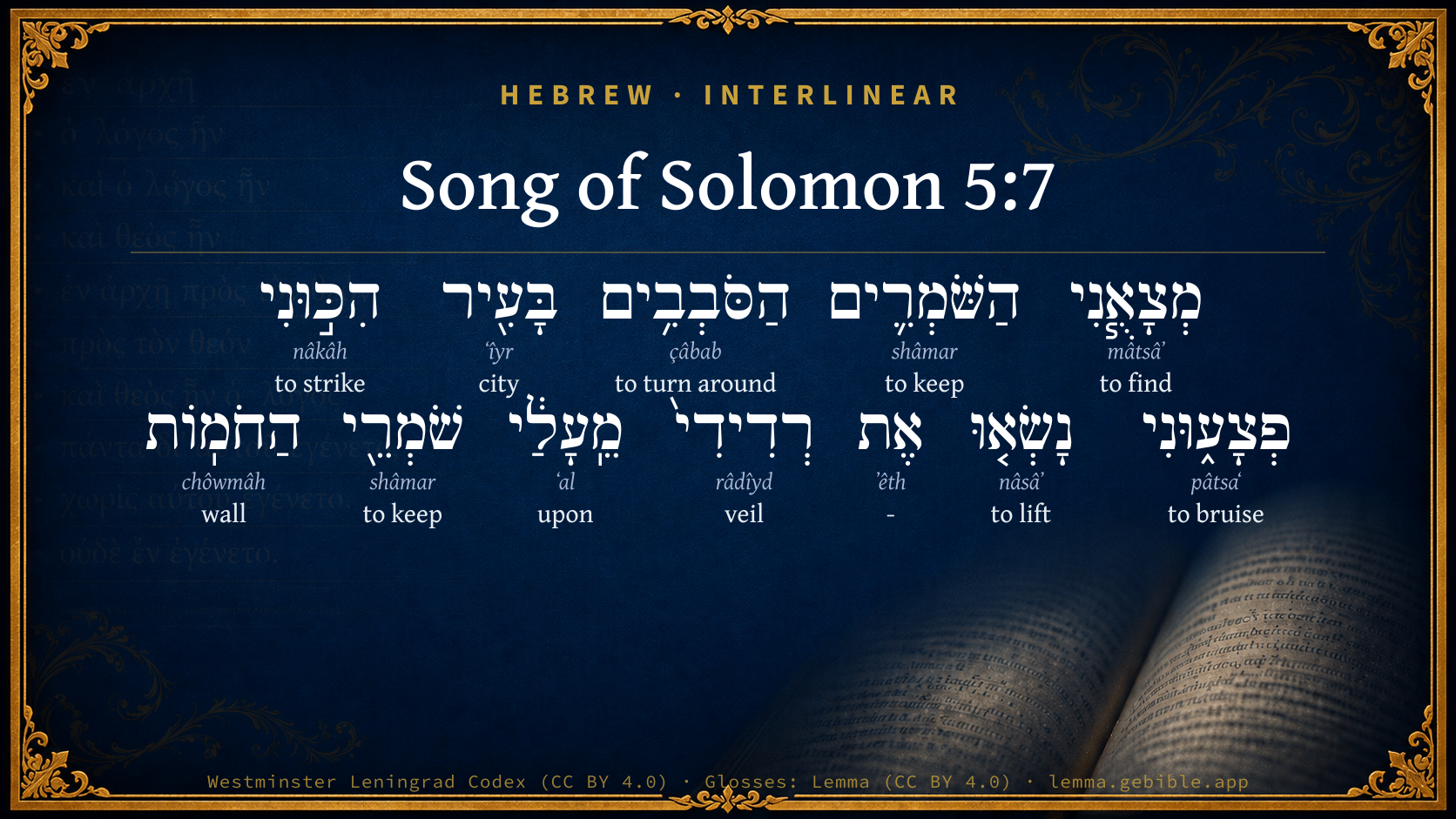
Hebrew (Westminster Leningrad Codex) Song of Solomon 5:7 appears in the Hebrew Old Testament. The text above is from the Westminster Leningrad Codex. Each word links to its Strong’s number, a concise gloss, and parsing drawn from the Open Scriptures Hebrew Bible morphology. Click any word for its full Brown-Driver-Briggs (BDB) entry.
Download image
Cite this verse

Song of Solomon 5:7 (World English Bible). Public Domain. Lemma interlinear Bible study tool, https://lemma.gebible.app/v/song-of-solomon/5/7.

Show BibTeX & RIS
BibTeX
RIS
English Translation
The watchmen who go about the city found me. They beat me. They bruised me. The keepers of the walls took my cloak away from me.
World English Bible · Public Domain
Highlights
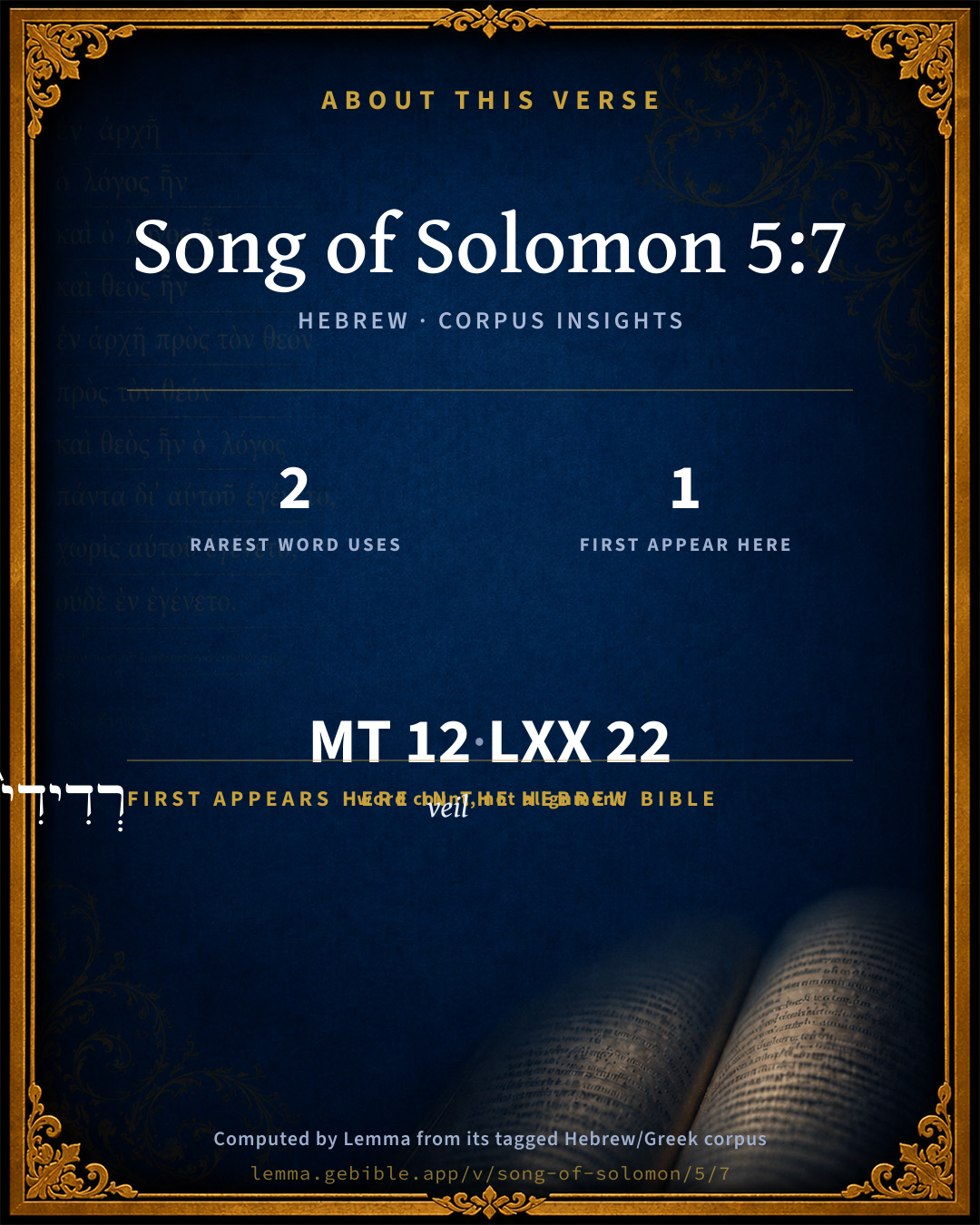
  • 1 first appearance in the Hebrew Bible
Full analysis ↓
Download a study sheet

One document with this verse’s original text, its word-by-word gloss line, the meaning frame, cross-references with their text, attributed commentary, and full source and license credits — printable, and it pastes into notes with its structure intact.

This verse Autodidact and up

Study sheet (.html) Plain text (.txt)

A passage Seminary Student

Up to 50 verses in one chapter. A passage sheet keeps up to 6 commentary sources and 12 cross-references per verse, in the order this page ranks them, and says so on the sheet whenever that leaves anything out. Ask for a single verse and you get the Autodidact verse sheet above.

Everything on this page stays free to read, with no account — the sheet is a download of what is already on screen, not access to it.

Want to remove ads? Support Godless Engineer
Compare translations 3

The same verse in 3 English versions, stacked beneath the original-language interlinear above. Click any original word for its lexicon entry.

Each is an independent rendering of the whole verse — the interlinear is not word-aligned to these translations.

Highlighted words mark where these versions differ — a whole-verse word diff, not a word-by-word alignment.

  • World English Bible Public Domain
    The watchmen who go about the city found me. They beat me. They bruised me. The keepers of the walls took my cloak away from me.
  • King James Version Public Domain
    The watchmen that went about the city found me, they smote me, they wounded me; the keepers of the walls took away my veil from me.
  • unfoldingWord Literal Text CC BY-SA 4.0
    The guards going about in the city found me. They beat me and wounded me; they lifted my shawl from me, the guards of the walls.

unfoldingWord Literal Text — © unfoldingWord, licensed CC BY-SA 4.0. Word-aligned USFM3 via Door43 (git.door43.org/unfoldingWord/en_ult).

Versions to compare (up to 4)

3 of 4 selected

Show all 18 translations

Every available English version of this verse, each an independent rendering of the whole verse.

  • World English Bible Public Domain
    The watchmen who go about the city found me. They beat me. They bruised me. The keepers of the walls took my cloak away from me.
  • Berean Standard Bible Public Domain
    I encountered the watchmen on their rounds of the city. They beat me and bruised me; they took away my cloak, those guardians of the walls.
  • Majority Standard Bible Public Domain
    I encountered the watchmen on their rounds of the city. They beat me and bruised me; they took away my cloak, those guardians of the walls.
  • King James Version Public Domain
    The watchmen that went about the city found me, they smote me, they wounded me; the keepers of the walls took away my veil from me.
  • American Standard Version (1901) Public Domain
    The watchmen that go about the city found me, They smote me, they wounded me; The keepers of the walls took away my mantle from me.
  • Revised Version (1885) Public Domain
    The watchmen that go about the city found me, they smote me, they wounded me; the keepers of the walls took away my mantle from me.
  • Geneva Bible (1599) Public Domain
    The watchmen that went about the citie, founde me: they smote me and wounded me: the watchmen of the walles tooke away my vaile from me.
  • Douay-Rheims (1899) Public Domain
    The keepers that go about the city found me: they struck me: and wounded me: the keepers of the walls took away my veil from me.
  • Young's Literal Translation Public Domain
    The watchmen who go round about the city, Found me, smote me, wounded me, Keepers of the walls lifted up my veil from off me.
  • Literal Standard Version CC BY-SA 4.0
    The watchmen who go around the city, || Found me, struck me, wounded me, || Keepers of the walls lifted up my veil from off me.
  • Unlocked Literal Bible CC BY-SA 4.0
    The watchmen found me as they were making their rounds in the city. They struck me and wounded me; the guards on the walls took away my cloak from me.
  • unfoldingWord Literal Text CC BY-SA 4.0
    The guards going about in the city found me. They beat me and wounded me; they lifted my shawl from me, the guards of the walls.
  • Darby Bible Public Domain
    The watchmen that went about the city found me; They smote me, they wounded me; The keepers of the walls took away my veil from me.
  • World Messianic Bible Public Domain
    The watchmen who go about the city found me. They beat me. They bruised me. The keepers of the walls took my cloak away from me.
  • Webster's Bible Public Domain
    The watchmen that went about the city found me, they smote me, they wounded me; the keepers of the walls took away my vail from me.
  • Free Bible Version CC BY-SA 4.0
    The watchmen found me as they went through the city. They beat me, they hurt me, and stole my cloak, those watchmen of the walls.
  • Bible in Basic English Public Domain
    The keepers who go about the town overtook me; they gave me blows and wounds; the keepers of the walls took away my veil from me.
  • JPS Tanakh (1917) Public Domain
    The watchmen that go about the city found me, they smote me, they wounded me; the keepers of the walls took away my mantle from me.

Literal Standard Version (2020), Covenant Press — licensed CC BY-SA 4.0. Text via the HelloAO Bible API (eBible.org). Unlocked Literal Bible (unfoldingWord) — licensed CC BY-SA 4.0. Text via the HelloAO Bible API (eBible.org). unfoldingWord Literal Text — © unfoldingWord, licensed CC BY-SA 4.0. Word-aligned USFM3 via Door43 (git.door43.org/unfoldingWord/en_ult). Free Bible Version, Dr. Jonathan Gallagher — licensed CC BY-SA 4.0. Text via the HelloAO Bible API (eBible.org).

Word by word

More ways to search: Search by grammar → Find every occurrence → Compare this word →

Practice this passage: Drill this verse → Learn its vocabulary →

רְדִידִי֙
râdîyd
H7289
“veil · my”
Noun, Common, Masculine, Singular, Construct + Suffix, Personal, 1st Person, Common, Singular
Part of Speech
Noun
Type
Common
Gender
Masculine
Number
Singular
State
Construct
Full BDB Definition

Origin: from H7286 in the sense of spreading

TWOT: 2120a

something spread, wide wrapper or large veil
  1. מְצָאֻ֧נִי mâtsâʼ H4672 “to find · me” Verb, Qal, Perfect, 3rd Person, Common, Plural + Suffix, Personal, 1st Person, Common, Singular
  2. הַשֹּׁמְרִ֛ים shâmar H8104 “the · keeping” Particle, Definite Article + Verb, Qal, Participle Active, Masculine, Plural, Absolute
  3. הַסֹּבְבִ֥ים çâbab H5437 “the · turning around” Particle, Definite Article + Verb, Qal, Participle Active, Masculine, Plural, Absolute
  4. בָּעִ֖יר ʻîyr H5892 “in/at the · city” Preposition, Determined + Noun, Common, Feminine, Singular, Absolute
  5. הִכּ֣וּנִי nâkâh H5221 “to strike · me” Verb, Hiphil, Perfect, 3rd Person, Common, Plural + Suffix, Personal, 1st Person, Common, Singular
  6. פְצָע֑וּנִי pâtsaʻ H6481 “to bruise · me” Verb, Qal, Perfect, 3rd Person, Common, Plural + Suffix, Personal, 1st Person, Common, Singular
  7. נָשְׂא֤וּ nâsâʼ H5375 “to lift” Verb, Qal, Perfect, 3rd Person, Common, Plural
  8. אֶת ʼêth H853 “-” Particle, Direct Object
  9. מֵֽעָלַ֔י ʻal H5921 “from · upon · me” Preposition + Preposition + Suffix, Personal, 1st Person, Common, Singular
  10. שֹׁמְרֵ֖י shâmar H8104 “keeping” Verb, Qal, Participle Active, Masculine, Plural, Construct
  11. הַחֹמֽוֹת chôwmâh H2346 “the · walls” Particle, Definite Article + Noun, Common, Feminine, Plural, Absolute

About this verse

These counts appear in no published source. They are computed here, from the morphology-tagged text and Lemma’s own curated glosses. What Lemma adds →

12
words
11
distinct lemmas
Wisdom
section

Notable vocabulary

The rarest word here is רְדִידִי֙ veil H7289 — appearing just 2 times in the whole Hebrew Bible.

First appearance in Scripture

This word makes its first canonical appearance in the Hebrew Bible here:

  • רְדִידִי֙ veil H7289

Shared distinctive vocabulary

רְדִידִי֙ veil H7289 occurs in 2 verses of the Hebrew Bible. Also found in:

Grammatical profile

  • 7 verbs
  • 3 nouns
  • 1 preposition
  • 1 particle

Verb forms

  • מְצָאֻ֧נִי Qal · Perfect
  • הַשֹּׁמְרִ֛ים Qal · Participle Active
  • הַסֹּבְבִ֥ים Qal · Participle Active
  • הִכּ֣וּנִי Hiphil · Perfect
  • פְצָע֑וּנִי Qal · Perfect
  • נָשְׂא֤וּ Qal · Perfect
  • שֹׁמְרֵ֖י Qal · Participle Active

Repetition

A word recurs within this verse — often emphatic in Hebrew:

  • הַשֹּׁמְרִ֛ים to keep H8104 ×2

Hebrew & Septuagint length

In English translation the verse runs 26 words from the Hebrew and 28 from the Septuagint (LXX English) — closely comparable.

A rough comparison of the two English renderings, which tokenize alike — not a word-level alignment.

Word counts can differ between the Hebrew and the Greek without any difference in meaning — e.g. the Hebrew direct-object marker אֵת has no separate Greek word, and Greek often adds the article ὁ.

In the original languages it is 12 Hebrew tokens and 22 Greek tokens — but the two are counted differently (Hebrew bundles its prefixes and suffixes into one token; the Greek is in lemma form), so that isn’t a like-for-like length.

Cross-references

22

Topical passages linked to Song of Solomon 5:7 in the Treasury of Scripture Knowledge — connected by theme and wording, ordered by reader-vote popularity; previews shown in the World English Bible.

  • Song of Solomon 3:3 The watchmen who go about the city found me; "Have you seen him whom my soul loves?"
  • Psalms 141:5 Let the righteous strike me, it is kindness; Let him reprove me, it is like oil on the head; Don't let my head refuse it; Yet my prayer is always against evil deeds.
  • Song of Solomon 8:11 Solomon had a vineyard at Baal Hamon. He leased out the vineyard to keepers. Each was to bring a thousand shekels of silver for its fruit.
  • Isaiah 6:10–11 Make the heart of this people fat; Make their ears heavy, and shut their eyes; Lest they see with their eyes, And hear with their ears, And understand with their heart, And turn again, and be healed."
  • Isaiah 62:6 I have set watchmen on your walls, Jerusalem; they shall never hold their peace day nor night: you who call on Yahweh, take no rest,
  • Hosea 6:5 Therefore I have cut them to pieces with the prophets; I killed them with the words of my mouth. Your judgments are like a flash of lightning.
  • Hosea 9:7–8 The days of visitation have come. The days of reckoning have come. Israel will consider the prophet to be a fool, And the man who is inspired to be insane, Because of the abundance of your sins, And because your hostility is great.
  • Matthew 21:33–41 "Hear another parable. There was a man who was a master of a household, who planted a vineyard, set a hedge about it, dug a winepress in it, built a tower, leased it out to farmers, and went into another country.
  • Matthew 23:2 saying, "The scribes and the Pharisees sat on Moses' seat.
  • Matthew 23:29–36 "Woe to you, scribes and Pharisees, hypocrites! For you build the tombs of the prophets, and decorate the tombs of the righteous,
  • Luke 6:22 Blessed are you when men shall hate you, and when they shall exclude and mock you, and throw out your name as evil, for the Son of Man's sake.
  • John 16:2 They will put you out of the synagogues. Yes, the time comes that whoever kills you will think that he offers service to God.
  • Acts 5:40–41 They agreed with him. Summoning the apostles, they beat them and charged them not to speak in the name of Jesus, and let them go.
  • Acts 20:29–30 For I know that after my departure, vicious wolves will enter in among you, not sparing the flock.
  • Acts 26:9–10 "I myself most assuredly thought that I ought to do many things contrary to the name of Jesus of Nazareth.
  • 1 Corinthians 4:10–13 We are fools for Christ's sake, but you are wise in Christ. We are weak, but you are strong. You have honor, but we have dishonor.
  • 2 Corinthians 11:13 For such men are false apostles, deceitful workers, masquerading as Christ's apostles.
  • Philippians 3:6 concerning zeal, persecuting the assembly; concerning the righteousness which is in the law, found blameless.
  • Hebrews 11:36–37 Others were tried by mocking and scourging, yes, moreover by bonds and imprisonment.
  • Hebrews 12:2 looking to Jesus, the author and perfecter of faith, who for the joy that was set before him endured the cross, despising shame, and has sat down at the right hand of the throne of God.
  • 1 Peter 4:14–16 If you are insulted for the name of Christ, blessed are you; because the Spirit of glory and of God rests on you. On their part he is blasphemed, but on your part he is glorified.
  • Revelation 17:5–6 And on her forehead a name was written, "MYSTERY, BABYLON THE GREAT, THE MOTHER OF THE PROSTITUTES AND OF THE ABOMINATIONS OF THE EARTH."

Cross-references courtesy of OpenBible.info (CC BY 4.0).

Hebrew and Greek witnesses Masoretic Hebrew ↔ Greek Septuagint

The same verse in the two great witnesses to the Old Testament, shown verse-for-verse.

These are two independent witnesses, not word-aligned to each other, and the Septuagint is shown in lemma (dictionary) form.

Hebrew Song of Solomon 5:7 Masoretic · Westminster Leningrad Codex

מְצָאֻ֧נִי הַשֹּׁמְרִ֛ים הַסֹּבְבִ֥ים בָּעִ֖יר הִכּ֣וּנִי פְצָע֑וּנִי נָשְׂא֤וּ אֶת רְדִידִי֙ מֵֽעָלַ֔י שֹׁמְרֵ֖י הַחֹמֽוֹת

The watchmen who go about the city found me. They beat me. They bruised me. The keepers of the walls took my cloak away from me.

World English Bible · Public Domain

Greek LXX Song of Solomon 5:7 Septuagint · lemma form

εὑρίσκω ἐγώ ὁ φύλαξ ὁ κυκλόω ἐν ὁ πόλις πατάσσω ἐγώ τραυματίζω ἐγώ αἴρω ὁ θέριστρον ἐγώ ἀπό ἐγώ φύλαξ ὁ τεῖχος

The watchman that go their rounds in the city found me, they struck me, they wounded me; the keepers of the walls took away my veil from me.

LXX2012 (modern English Septuagint) · Public Domain

On this verse, The Cambridge Bible for Schools and Colleges discusses the Septuagint’s reading. Read the note in Commentary ↓

Hebrew: Westminster Leningrad Codex (CC BY 4.0). Greek: Septuagint (public domain); English from LXX2012 (modern English Septuagint) (Public Domain). How the Septuagint differs from the Hebrew →

Commentary

Notes on Song of Solomon 5:7 from classic Christian and Jewish commentators (each source and its license shown beneath its notes). The classic Christian expositions comment on the surrounding passage and are grouped to its opening verse, so a note may address several verses; the Jewish commentaries on the Tanakh (Rashi and others) are per-verse, so they appear only where the commentator wrote on this verse.

Lemma curates 59 commentaries, every one of them public domain or Creative Commons licensed, each selected and text-cleaned for this edition rather than reprinted as found. About our sources →

The Cambridge Bible for Schools and Colleges

gen. ed. J. J. S. Perowne

7. In this dream all goes ill with her, in comparison with the former dream (Son_3:1 ff.). Oettli suggests that this is due to the anxious state of mind in which she lay down to sleep, shrinking from the return of her undesired lover (Son_4:6).

that went about the city] R.V. rightly, that go about the city; the participle here indicating their duty, what they were accustomed to do.

they smote me, they wounded me] Taking her for a suspicious character, they tried to stop her, but in her wild anxiety she refused, until they used violence.

the keepers of the walls] Better, the watchmen of the walls, the same probably as “the watchmen that go about the city.” They may however be different divisions of the watchmen of the city. Del. thinks that the fact that she sought her beloved, not in the open field, nor in the villages, but in the city, is fatal to the ‘shepherd’ hypothesis here as in the other dream, but see note there.

my vail] The word here is different from that for ‘veil’ in ch. Son_4:1; Son_4:3. There it is tsammâh; here it is rĕdhîdh, a word which occurs again in the O.T. only in Isa_3:23, where the A.V. translates ‘veils,’ as here. But the LXX has in both places θἐριστρον, a thin summer garment, and here it should be translated mantle, or thin outer garment. Riehm, Handwörterbuch, p. 1428, says, “The veil mentioned in Son_5:7 and in Isa_3:23 seems to have been a fine lawn garment which the women of the East still throw over their whole dress. Cp. Susanna v. 32.” Cheyne and Driver translate it mantle. The word occurs in Syriac and in Targum for the Heb. tsâ‘îph=‘a veil,’ and in the Mishnah.

The Cambridge Bible for Schools and Colleges (gen. ed. J. J. S. Perowne; Cambridge University Press, 1878–1918) — public domain. Text from a community e-Sword module.

Trapp's Complete Commentary

John Trapp

Son 5:7 The watchmen that went about the city found me, they smote me, they wounded me; the keepers of the walls took away my veil from me.

Ver. 7. The watchmen that went about the city, &c.] {See Trapp on "Son 3:3"} The ministers that walk the round, that watch for men’s souls, {Heb 13:17 Isa 61:6} that know how to "time a word," {Isa 51:4} these smote her with the tongue, they buffeted her by just and sharp reproofs for her negligence, they unveiled her for being abroad at that time of night (which she needed not to have been, but for her own slothfulness), they dealt little better with her, than as if she had been some light and lewd woman; and all this they might well do out of zeal to God, and godly jealousy for her soul’s good - unless it were that hypocrisy of jealousy exercised by the false apostles over the Galatians; {Gal 4:17} not pastors, but impostors; not overseers, but by seers, {a} potius grassatores, quam custodes, ηομονθμως tamen sic dicti, cut throats rather than keepers, wicked men taking upon them to be watchmen, church officers in name, but church robbers in deed. Such were those {Isa 66:5} that hated and cast out the true worshippers, under a pretence of "Let the Lord be glorified." Such a one was Diotrephes, that prating {b} prelate, that villanously entreated God’s faithful people. {3Jn 1:9-10} And such is that man of sin, that antichrist of Rome, who, for so many hundred years together, hath smitten with the fist of wickedness, hath wounded and drawn blood from Christ’s dearest spouse, and despoiled her of her veil; that is, laboured to disprivilege her, and deprive her of that purity and soundness of doctrine that he hath committed unto her, as a means to hold her in the duty of all holy obedience and subjection unto him. {1Co 11:5-6; 1Co 11:10} Of these false friends and deadly enemies the Church here heavily complains, and might well have proceeded against them, as those six martyrs burnt by Harpsfield, Archdeacon of Canterbury, when Queen Mary lay a-dying. One of those six that were then burnt, and those were the last, John Cornford, stirred with a vehement zeal of God when they were excommunicated, pronounced sentence of excommunication against all Papists in these words: In the name of our Lord Jesus Christ, and by the power of his Holy Spirit, and authority of his holy catholic and apostolic Church, we do give here into the hands of Satan, to be destroyed, the bodies of all those blasphemers and heretics that do maintain any error against his most holy Word, or do condemn his most holy truth for heresy, to the maintenance of any false church or feigned religion; so that by this thy most just judgment, O most mighty God, against thine adversaries, thy true religion may be known, to thy great glory and our comfort, and the edifying of all our nation. Good Lord, so be it. {c}

{a} Non Episcopi, sed Aposcopi.

{b} φλυαρων.

{c} Acts and Mon., fol. 1862.

John Trapp, A Commentary or Exposition upon All the Books of the Old and New Testament (1647–1656) — public domain. Text from a community e-Sword module.

Joseph Benson's Commentary

Son 5:7. The watchman that went about the city — The governors of the church, who, though by their place they are obliged to comfort the faithful, do frequently discourage them. Found me, and smote me — With bitter calumnies and persecutions. The keepers of the walls — The same with the watchmen, whose office it is to keep the gates and walls of the city. Took away my veil from me — Which was an ornament of her sex, and an ensign of her relation to Christ. And so the taking of this veil away signifies their contemptuous usage of her, and endeavours to represent her as one that had no relation to Christ.

Joseph Benson's Commentary on the Old and New Testaments (1811–1818) — public domain. Text from a community e-Sword module.

The Preacher's Complete Homiletical Commentary

Joseph S. Exell (gen. ed.)

THE SEARCH AND ITS RESULTS

Son_5:7

The watchmen that went about the city

Found me; they smote me; they wounded me:

The keepers of the walls

Took away my veil from me.

A painful experience awaited the Bride on returning to herself and her duty. Those who should have been for her protection and her help, now add to her distress. Her character suspected, and her veil taken from her as an immodest woman (Eze_23:25-26). Her experience in seeking the Bridegroom and the conduct of the watchmen towards her, much more painful than in a former search. The reason, that was before marriage, this after it. The greater our privileges, and the higher the degree attained in the Divine life, the greater the sin in backsliding from and unfaithfulness to it. Hence the greater the difficulty and the more painful the experience in returning to it. The ways of transgressors hard, even in the case of

Backsliders.

Often the most painful of all experiences connected with a missing Saviour, and a backslidden state. The very means of grace and messages of the Word often an aggravation of the grief. Promises apparently silent, and threatenings only uttering their voice. The two-edged sword of the Word felt only to cut and wound. Ministers seem only commissioned to smite. The backslider apt to lose the character of the spouse of Christ, and to be taken for a hypocrite. No help now, for a time at least, received from the ministers of the Word, as at a former period. No word now of Shulamite finding her beloved after only passing a little from them as before. Different effects from the preaching of the Word according to the condition of the hearer. Ministers and their messages only what the Master is pleased to make them. When a man’s ways please the Lord, He makes his enemies to be at peace with him. When the opposite is the case, even his friends may be made to appear against him. Nevertheless, the conduct of the watchman unjustifiably rigorous, harsh, and unfeeling. On the part of

Ministers,

the greatest tenderness due to backsliders who are seeking Jesus sorrowing. The example of Jesus towards Peter. The braised reed not to be ruthlessly broken. An un-tender minister a great affliction to an exercised soul. The ‘tongue of the learned’ required to ‘speak a word in season to him that is weary’ (Isa_50:4). Sad when ministers talk to the grief of those whom God has wounded (Psa_69:26). The part of hireling shepherds to thrust with the side and shoulder, and push at the diseased instead of healing them (Eze_34:21). A sore calamity to the Church when its pastors become brutish (Jer_10:21). False shepherds hunt the souls of God’s people, making the righteous sad, instead of binding up their wounds (Eze_13:20). The reproofs of ministers to be an excellent oil which shall not break the head (Psa_141:5). The truth to be spoken, but to be spoken in love. Ministers to be both plain and faithful, but neither harsh nor severe. The conduct of the watchmen in the text realised in that of the Jewish priests and elders in their treatment of the spouse of Jesus after His departure to heaven (Act_4:1-3; Act_5:17-18; Act_5:33; Act_5:40). The same spouse not unfrequently smitten by ecclesiastical rulers, as heretics and schismatics. Church rulers to be themselves a part of the spouse, and so acquainted with her exercises and temptations. Jesus Christ the model of Ministers. Had compassion on the ignorant, and on them that are out of the way. Is touched with the feeling of our infirmities. Having Himself suffered in being tempted, He is able to succour them that are tempted (Heb_2:18; Heb_4:15; Heb_5:2). Ministers to be not only lawfully called, but spiritually qualified.

The Preacher's Complete Homiletical Commentary (gen. ed. Joseph S. Exell; Funk & Wagnalls, c. 1892) — public domain (pre-1929). A full-Bible homiletical/sermon-outline anthology covering 65 of 66 books (2 John is absent from the source module). Text from a community e-Sword module.

Tyndale Open Study Notes

Tyndale Open Resources

5:7 The night watchmen . . . beat and bruised me: The watchmen who were protectors in 3:3 now become demonized characters in her dream (5:2). What they do describes how she feels—pummeled and wounded. • stripped off my veil: She feels that she has lost her dignity.

Tyndale Open Study Notes — © Tyndale Open Resources, licensed CC BY-SA 4.0. Text via the HelloAO Bible API.

Geneva Bible (1599)

Geneva Bible translators

These are the false teachers, which wound the conscience with their traditions.

Geneva Bible (1599) marginal notes — public domain. Text via Bolls.life.

Adam Clarke's Commentary

Verse 7. Took away my veil] They tore it off rudely, to discover who she was. See on So 5:2. To tear the veil signifies, in Eastern phrase, to deflower or dishonour a woman.

Adam Clarke's Commentary on the Bible (1810–1826) — public domain. Text from a community e-Sword/MySword module.

Ellicott's Commentary for English Readers

(7) The watchmen.—See Note on Son_3:3.

Veil.—Heb. redîd; LXX. θέριστρόν. Probably a light summer dress for throwing over the person on going out in a hurry, like the tsaiph put on by Rebecca (Gen_24:65). Only elsewhere in Isa_3:23.

A Bible Commentary for English Readers, edited by Charles John Ellicott (1878–1897) — public domain. Text from a community e-Sword module.

Matthew Poole's English Annotations

The watchmen that went about the city; the governors of the church, as Son 3:3, who, though by their place and office they be obliged, to comfort and protect the faithful, do frequently discourage and oppress them, as they manifestly did both in the days of Isaiah, and Jeremiah, and the other holy prophets, and in the time of Christ and his apostles, and in divers other ages.

They wounded me with bitter calumnies and persecutions.

The keepers of the walls; the same with the watchmen, whose office is to keep the gates and walls of the city.

Took away my veil; which was an ornament of her sex, Isa 3:23, and a badge of her modesty, Gen 24:65, or an ensign of her relation and subjection to Christ, Gen 20:16; 1Co 11:5. And so the taking of this veil away signifies their contemptuous and injurious usage of her, their endeavours to blast her reputation, and to represent and treat her as a common and impudent prostitute, and as one that had no relation to Christ.

Matthew Poole's English Annotations on the Holy Bible (1683–1685) — public domain. Text from a community e-Sword/MySword module.

Whedon's Commentary on the Bible

Daniel D. Whedon

7. The watchmen — The darkness gave no token, and the only words then spoken were her own. The watchmen and keepers treated her as a vagrant.

Veil — An external garment, worn only out of doors. They rudely tore it from her face to see who she was.

Daniel D. Whedon (gen. ed.), Commentary on the Old and New Testaments (1874–1909) — public domain. Text from a community e-Sword module.

The Pulpit Commentary

The watchmen that go about the city found me, they smote me, they wounded me; the keepers of the walls took away my mantle from me. The intention is to show into what evil she fell by having to seek her beloved instead of being with him. She is mistaken and misjudged; she is smitten and wounded with reproaches and false accusations, as though she were a guilty and evil minded woman. She is subjected to abuse and ill treatment from those who should be her guardians. She had hard work to escape, leaving her robe behind her. (cf. Gen_39:12) The redhidh, like ridha in Arabic, is a plaid-like upper garment thrown over the shoulders so says Aben Ezra; but it is derived, no doubt, from the root "to make broad or thin," to spread out perhaps, therefore, "a thin, light upper robe" which was worn over the chiton, a summer overdress, a cloak (LXX, yeristron : Jerome, pallium; Luther, Schleier ). If we take the dream thus described, and which seems to conclude at this point, as related to the surrounding ladies, then we must suppose that it is introduced for the sake of what follows. The bride feels that she does not love her beloved one half enough; she is so conscious of deficiencies, that she might even have acted as her dream represented. It had entered her soul and made her ill with inward grief and self-reproach. She might so act, she might so treat her husband. So she adjures her companions to tell him how much she loves him. The spiritual application is not difficult to see. When the soul loses its joy in Christ, it becomes the prey of fears and self accusations, and even of reproaches from Christ"s servants and the guardians of his Church. For when our religion ceases to be a spontaneous delight to us, we are apt to carry on even the active work of our life in a manner to be misunderstood by sincere believers around us. Yea, the very efforts we make to recover peace may bring reproach upon us. Any Christian minister who has had to deal with religious despondency will quite understand this dream of the bride"s. We may often smite and wound, and even deprive of the garment of reputation and esteem, those who are really seeking for Christ, because we have misunderstood them.

The Pulpit Commentary (1880–1919), ed. H.D.M. Spence-Jones & Joseph S. Exell — public domain. Text from a community e-Sword module.

John Wesley's Explanatory Notes

Watch-men - The governors of the church, who, though by their place they are obliged to comfort the faithful, do frequently discourage them. Smote - With bitter calumnies and persecutions. The keepers - The same with the watchmen, whose office it is to keep the gates and walls of the city. My vine - Which was an ornament of her sex, and an ensign of her relation to Christ. And so the taking of this veil away, signifies their contemptuous usage of her, and endeavours to represent her, as one that had no relation to Christ.

John Wesley, Explanatory Notes Upon the Whole Bible (1754–1765) — public domain. Text via the GEBible commentary corpus.

unfoldingWord translationNotes

Door43 World Missions Community

The watchmen

men who have the job of keeping guard of the town at night to keep the people safe. See how you translated this in Song of Songs 3:3.

as they were making their rounds in the city

"who were walking around the city on the walls." See how you translated this in Song of Songs 3:3.

found me

found the woman

struck me

"beat me" or "hit me"

wounded me

"injured me"

the guards on the walls

"the men who guard the walls"

cloak

a garment that people wore over the other clothing on their upper body when they went outdoors in public

translationWords

watch

unfoldingWord translationNotes — © Distant Shores Media and the Door43 World Missions Community, licensed CC BY-SA 4.0. Source: git.door43.org/Door43/en_tn.

Rashi

Rabbi Shlomo Yitzchaki (Rashi)

The watchmen who patrol the city found me and apprehend the thieves who prowl at night.

they smote me and wounded me They inflicted a wound upon me. Every [instance of] פֶצַע is an expression of a wound [inflicted] by a weapon, navredure in Old French, a wound.

my jewelry Heb. רְדִידִי. My jewelry that was hammered and beaten, upon me, and the entire episode is an expression of a wife of one’s youth who bewails the husband of her youth and searches for him. And this is the allegorical meaning:

[4] My beloved stretched forth his hand from the hole when I said, “I have bathed my feet,” and I will not open for You, and I will not repent of the idolatry that I have chosen.

stretched forth his hand and demonstrated His vengeance in the days of Ahaz, and He brought upon him the army of the king of Aram (II Chron. 28:5f): “and they smote him and captured from him a great captivity, etc. And Pekah the son of Remaliah slew in Judah one hundred and twenty thousand in one day.”

and my insides stirred because of him Hezekiah his son came and repented with all his heart to seek the Holy One, blessed be He, and his entire generation was wholehearted; there never arose a generation in Israel like them, as is delineated in [the chapter entitled] חֵלֶק (Sanh. 94b): They searched from Dan to Beersheba and did not find an ignoramus, from Gebeth to Antioch, and did not find a man or woman who was not well versed in the laws of ritual contamination and purity, and this is the meaning of, “my hands dripped with myrrh, etc.” It is also stated regarding Josiah (II Kings 23:25): “Now before him there was no king like him, etc.,” for he saw the retribution that had come upon Manasseh and upon Amon, to fulfill the words, “he stretched forth his hand from the hole, and my insides stirred because of him.”

[6] I opened for my beloved, but my beloved had hidden and was gone He did not nullify His decree, as it is stated regarding Hezekiah (Isa. 39:6f): “Behold a time shall come when everything in your palace, etc. shall be carried off to Babylonia. And...[some] of your sons...whom you shall beget.” These are Daniel, Hananiah, Mishael and Azariah, and also [as it is stated] concerning Josiah, through Huldah the prophetess (II Kings 22:16): “Behold, I bring calamity upon this place and upon its inhabitants, etc.” And Scripture states: (ibid. 23:25ff): “Now, before him there was no king like him... Nevertheless, the Lord did not turn back from His great wrath, for His wrath was kindled against Judah, because of all the provocations that Manasseh had provoked Him. And the Lord said: I will remove Judah too from before Me as I have removed Israel, and I will reject this city.”

my soul went out when he spoke It left me when He spoke this word.

I sought him, but found him not Now if you ask: Was not Jeremiah standing and prophesying during the days of Jehoiakim and Zedekiah, (Mal. 3: 7): “Return to Me, and I will return to you”? This was not to nullify the decree, but to mitigate the punishment and to prepare their kingdom for the time when they would return from the exile, to plant them without being uprooted and to build it without being demolished.

The watchmen...found me Nebuchadnezzar and his armies.

who patrol the city to wreak the vengeance of the Omnipresent.

took my jewelry the Temple.

the watchmen of the walls Even the ministering angels, who were guarding its walls, as it is stated (Isa. 62:6): “On your walls, O Jerusalem, etc.” They ignited the fire upon it, as it is written (Lam. 1:13): “From above He has hurled fire, etc.”

Rashi on the Tanakh — English translations: “The Judaica Press complete Tanach with Rashi, translated by A. J. Rosenberg” (CC BY 4.0); “Pentateuch with Rashi's commentary by M. Rosenbaum and A.M. Silbermann, 1929-1934” (public domain); “The Metsudah Tanach series, Lakewood, N.J” (CC BY 4.0); and “The Book of Joshua, Metsudah Publications, 1997” (CC BY 4.0). Text via Sefaria.

Lesson kit

Teaching starters — assembled from the data on this page, not authored interpretation. Every prompt links to the verse data it draws on. Edit before teaching.

Song of Solomon, in the Wisdom, opens this verse with 12 words (11 distinct Hebrew lemmas). Its most distinctive word is râdîyd (“veil”). A historical commentator’s framing appears above. Read the whole chapter for the surrounding context.

Discussion questions

  1. The word râdîyd carries the sense “veil.” How does it shape the verse?
  2. This is the first place “veil” appears in Scripture (first appears here). What does its debut here establish?
  3. How does Isaiah 3:23, which shares the word «veil», read alongside this verse?
  4. What does the repetition of “to keep” (2× in this one verse) do in this verse?
  5. These translations render this verse differently; the difference is in the English rendering, not the original. What questions does that raise?
  6. «מְצָאֻ֧נִי» is a Qal Perfect verb. How does that grammatical form shape the action described?
  7. Compare how The Cambridge Bible for Schools and Colleges and Trapp's Complete Commentary read this verse. Where do they agree or differ?

Things to notice

Reading settings

Reading text

Shown beneath each verse's original-language words.

Old Testament
Old Testament edition

Read the OT as the Masoretic Hebrew (MT) or the Greek Septuagint (LXX).

English shown for the Greek Septuagint (in the Hebrew ↔ Greek comparison).

Comparing translations? Open the Compare panel on any verse page to stack up to four side by side.