
1 Samuel 5:10

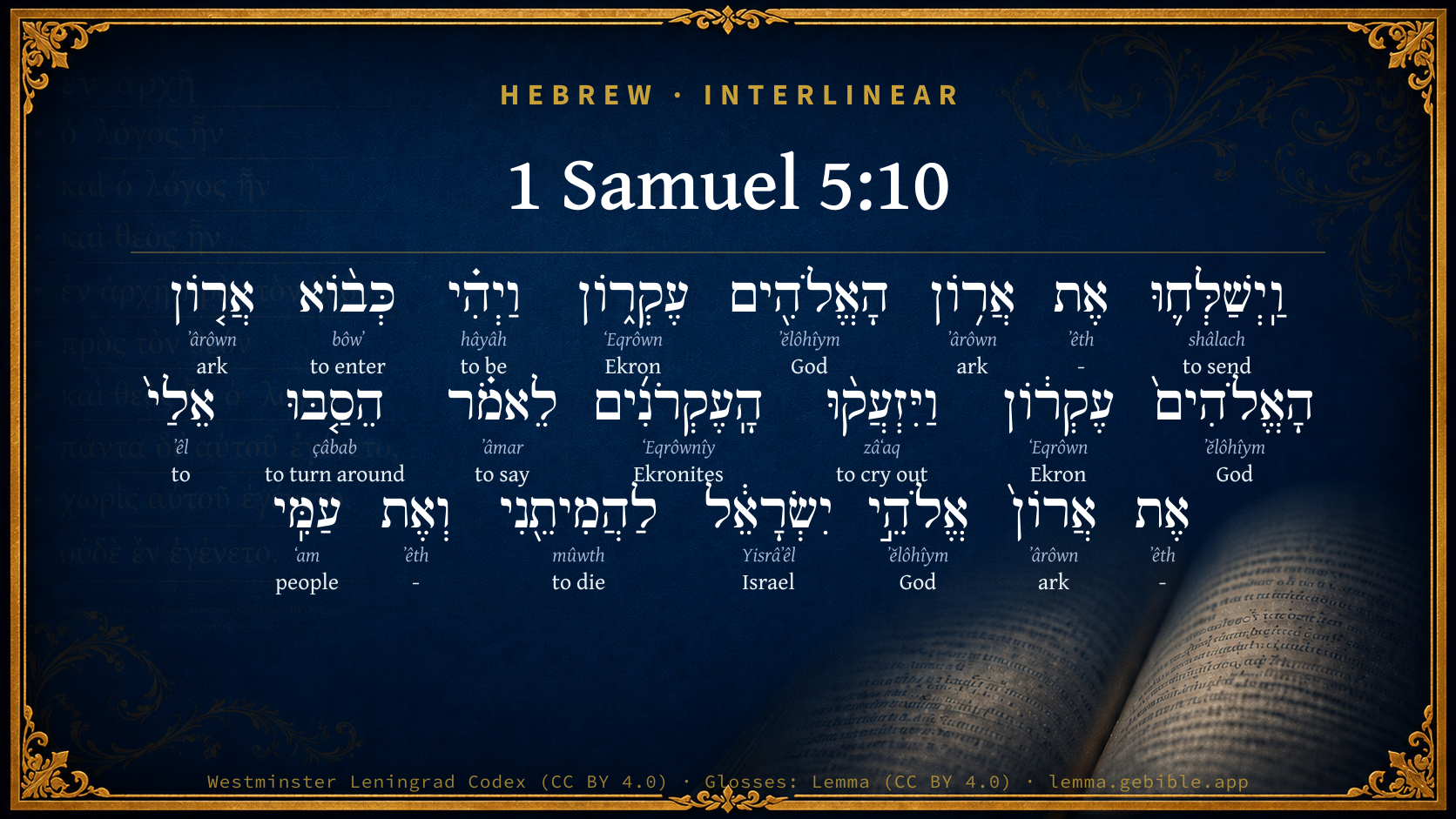
Hebrew (Westminster Leningrad Codex) 1 Samuel 5:10 appears in the Hebrew Old Testament. The text above is from the Westminster Leningrad Codex. Each word links to its Strong’s number, a concise gloss, and parsing drawn from the Open Scriptures Hebrew Bible morphology. Click any word for its full Brown-Driver-Briggs (BDB) entry.
Download image
Cite this verse

1 Samuel 5:10 (World English Bible). Public Domain. Lemma interlinear Bible study tool, https://lemma.gebible.app/v/1-samuel/5/10.

Show BibTeX & RIS
BibTeX
RIS
English Translation
So they sent the ark of God to Ekron. It happened, as the ark of God came to Ekron, that the Ekronites cried out, saying, They have brought about the ark of the God of Israel to us, to kill us and our people.
World English Bible · Public Domain
Download a study sheet

One document with this verse’s original text, its word-by-word gloss line, the meaning frame, cross-references with their text, attributed commentary, and full source and license credits — printable, and it pastes into notes with its structure intact.

This verse Autodidact and up

Study sheet (.html) Plain text (.txt)

A passage Seminary Student

Up to 50 verses in one chapter. A passage sheet keeps up to 6 commentary sources and 12 cross-references per verse, in the order this page ranks them, and says so on the sheet whenever that leaves anything out. Ask for a single verse and you get the Autodidact verse sheet above.

Everything on this page stays free to read, with no account — the sheet is a download of what is already on screen, not access to it.

Want to remove ads? Support Godless Engineer
Compare translations 3

The same verse in 3 English versions, stacked beneath the original-language interlinear above. Click any original word for its lexicon entry.

Each is an independent rendering of the whole verse — the interlinear is not word-aligned to these translations.

Highlighted words mark where these versions differ — a whole-verse word diff, not a word-by-word alignment.

  • World English Bible Public Domain
    So they sent the ark of God to Ekron. It happened, as the ark of God came to Ekron, that the Ekronites cried out, saying, They have brought about the ark of the God of Israel to us, to kill us and our people.
  • King James Version Public Domain
    Therefore they sent the ark of God to Ekron. And it came to pass, as the ark of God came to Ekron, that the Ekronites cried out, saying, They have brought about the ark of the God of Israel to us, to slay us and our people.
  • unfoldingWord Literal Text CC BY-SA 4.0
    So they sent the Box of God Ekron. And it happened as the Box of God entered Ekron that the Ekronites cried out, saying, “They have brought around to me the Box of the God of Israel to kill me and my people!”

unfoldingWord Literal Text — © unfoldingWord, licensed CC BY-SA 4.0. Word-aligned USFM3 via Door43 (git.door43.org/unfoldingWord/en_ult).

Versions to compare (up to 4)

3 of 4 selected

Show all 18 translations

Every available English version of this verse, each an independent rendering of the whole verse.

  • World English Bible Public Domain
    So they sent the ark of God to Ekron. It happened, as the ark of God came to Ekron, that the Ekronites cried out, saying, They have brought about the ark of the God of Israel to us, to kill us and our people.
  • Berean Standard Bible Public Domain
    So they sent the ark of God to Ekron, but as it arrived, the Ekronites cried out, “They have brought us the ark of the God of Israel in order to kill us and our people!”
  • Majority Standard Bible Public Domain
    So they sent the ark of God to Ekron, but as it arrived, the Ekronites cried out, “They have brought us the ark of the God of Israel in order to kill us and our people!”
  • King James Version Public Domain
    Therefore they sent the ark of God to Ekron. And it came to pass, as the ark of God came to Ekron, that the Ekronites cried out, saying, They have brought about the ark of the God of Israel to us, to slay us and our people.
  • American Standard Version (1901) Public Domain
    So they sent the ark of God to Ekron. And it came to pass, as the ark of God came to Ekron, that the Ekronites cried out, saying, They have brought about the ark of the God of Israel to us, to slay us and our people.
  • Revised Version (1885) Public Domain
    So they sent the ark of God to Ekron. And it came to pass, as the ark of God came to Ekron, that the Ekronites cried out, saying, They have brought about the ark of the God of Israel to us, to slay us and our people.
  • Geneva Bible (1599) Public Domain
    Therefore they sent the Arke of God to Ekron: and assoone as the Arke of God came to Ekron, the Ekronites cryed out, saying, They haue brought the Arke of the God of Israel to vs to slay vs and our people.
  • Douay-Rheims (1899) Public Domain
    Therefore they sent the ark of God into Accaron. And when the ark of God was come into Accaron, the Accaronites cried out, saying: They have brought the ark of the God of Israel to us, to kill us and our people.
  • Young's Literal Translation Public Domain
    And they send the ark of God to Ekron, and it cometh to pass, at the coming in of the ark of God to Ekron, that the Ekronites cry out, saying, `They have brought round unto us the ark of the God of Israel, to put us to death -- and our people.'
  • Literal Standard Version CC BY-SA 4.0
    And they send the Ark of God to Ekron, and it comes to pass, at the coming in of the Ark of God to Ekron, that the Ekronites cry out, saying, “They have brought around the Ark of the God of Israel to us, to put us and our people to death.”
  • Unlocked Literal Bible CC BY-SA 4.0
    So they sent the ark of God to Ekron. But as soon as the ark of God came into Ekron, the Ekronites cried out, saying, “They have brought to us the ark of the God of Israel to kill us and our people.”
  • unfoldingWord Literal Text CC BY-SA 4.0
    So they sent the Box of God Ekron. And it happened as the Box of God entered Ekron that the Ekronites cried out, saying, “They have brought around to me the Box of the God of Israel to kill me and my people!”
  • Darby Bible Public Domain
    And they sent the ark of God to Ekron. And it came to pass, when the ark of God came to Ekron, that the Ekronites cried out, saying, They have brought about the ark of the God of Israel to us, to kill us and our people.
  • World Messianic Bible Public Domain
    So they sent God’s ark to Ekron. As God’s ark came to Ekron, the Ekronites cried out, saying, “They have brought the ark of the God of Israel here to us, to kill us and our people.”
  • Webster's Bible Public Domain
    Therefore they sent the ark of God to Ekron. And it came to pass as the ark of God came to Ekron, that the Ekronites cried out, saying, They have brought about the ark of the God of Israel to us, to slay us and our people.
  • Free Bible Version CC BY-SA 4.0
    So they sent the Ark of God to Ekron, but as soon as it arrived, the leaders of Ekron shouted, “They've moved the Ark of the God of Israel here to kill us and our people!”
  • Bible in Basic English Public Domain
    So they sent the ark of God to Ekron. And when the ark of God came to Ekron, the people of the town made an outcry, saying, They have sent the ark of the God of Israel to us for the destruction of us and of our people.
  • JPS Tanakh (1917) Public Domain
    So they sent the ark of God to Ekron. And it came to pass, as the ark of God came to Ekron, that the Ekronites cried out, saying: 'They have brought about the ark of the God of Israel to us, to slay us and our people.'

Literal Standard Version (2020), Covenant Press — licensed CC BY-SA 4.0. Text via the HelloAO Bible API (eBible.org). Unlocked Literal Bible (unfoldingWord) — licensed CC BY-SA 4.0. Text via the HelloAO Bible API (eBible.org). unfoldingWord Literal Text — © unfoldingWord, licensed CC BY-SA 4.0. Word-aligned USFM3 via Door43 (git.door43.org/unfoldingWord/en_ult). Free Bible Version, Dr. Jonathan Gallagher — licensed CC BY-SA 4.0. Text via the HelloAO Bible API (eBible.org).

Word by word

More ways to search: Search by grammar → Find every occurrence → Compare this word →

Practice this passage: Drill this verse → Learn its vocabulary →

הָֽעֶקְרֹנִ֜ים
ʻEqrôwnîy
H6139
“the · Ekronites”
Particle, Definite Article + Noun, Gentilic, Masculine, Plural, Absolute
Part of Speech
Particle + Noun
Type
Gentilic
Gender
Masculine
Number
Plural
State
Absolute
Full BDB Definition

Origin: from H6138

TWOT: None

Ekronites = see Ekron " emigration" - an inhabitant of Ekron
  1. וַֽיְשַׁלְּח֛וּ shâlach H7971 “and · to send” Conjunction + Verb, Piel, Sequential Imperfect, 3rd Person, Masculine, Plural
  2. אֶת ʼêth H853 “-” Particle, Direct Object
  3. אֲר֥וֹן ʼârôwn H727 “ark of” Noun, Common, Both, Singular, Construct
  4. הָאֱלֹהִ֖ים ʼĕlôhîym H430 “the · God(s)” Particle, Definite Article + Noun, Common, Masculine, Plural, Absolute
  5. עֶקְר֑וֹן ʻEqrôwn H6138 “Ekron” Noun, Proper
  6. וַיְהִ֗י hâyâh H1961 “and · to be” Conjunction + Verb, Qal, Sequential Imperfect, 3rd Person, Masculine, Singular
  7. כְּב֨וֹא bôwʼ H935 “like/as · to enter” Preposition + Verb, Qal, Infinitive Construct
  8. אֲר֤וֹן ʼârôwn H727 “ark of” Noun, Common, Both, Singular, Construct
  9. הָאֱלֹהִים֙ ʼĕlôhîym H430 “the · God(s)” Particle, Definite Article + Noun, Common, Masculine, Plural, Absolute
  10. עֶקְר֔וֹן ʻEqrôwn H6138 “Ekron” Noun, Proper
  11. וַיִּזְעֲק֨וּ zâʻaq H2199 “and · to cry out” Conjunction + Verb, Qal, Sequential Imperfect, 3rd Person, Masculine, Plural
  12. לֵאמֹ֗ר ʼâmar H559 “to say” Preposition + Verb, Qal, Infinitive Construct
  13. הֵסַ֤בּוּ çâbab H5437 “to turn around” Verb, Hiphil, Perfect, 3rd Person, Common, Plural
  14. אֵלַי֙ ʼêl H413 “to · me” Preposition + Suffix, Personal, 1st Person, Common, Singular
  15. אֶת ʼêth H853 “-” Particle, Direct Object
  16. אֲרוֹן֙ ʼârôwn H727 “ark of” Noun, Common, Both, Singular, Construct
  17. אֱלֹהֵ֣י ʼĕlôhîym H430 “God(s) of” Noun, Common, Masculine, Plural, Construct
  18. יִשְׂרָאֵ֔ל Yisrâʼêl H3478 “Israel” Noun, Proper
  19. לַהֲמִיתֵ֖נִי mûwth H4191 “to die · me” Preposition + Verb, Hiphil, Infinitive Construct + Suffix, Personal, 1st Person, Common, Singular
  20. וְאֶת ʼêth H853 “and · -” Conjunction + Particle, Direct Object
  21. עַמִּֽי ʻam H5971 “people · my” Noun, Common, Masculine, Singular, Construct + Suffix, Personal, 1st Person, Common, Singular

About this verse

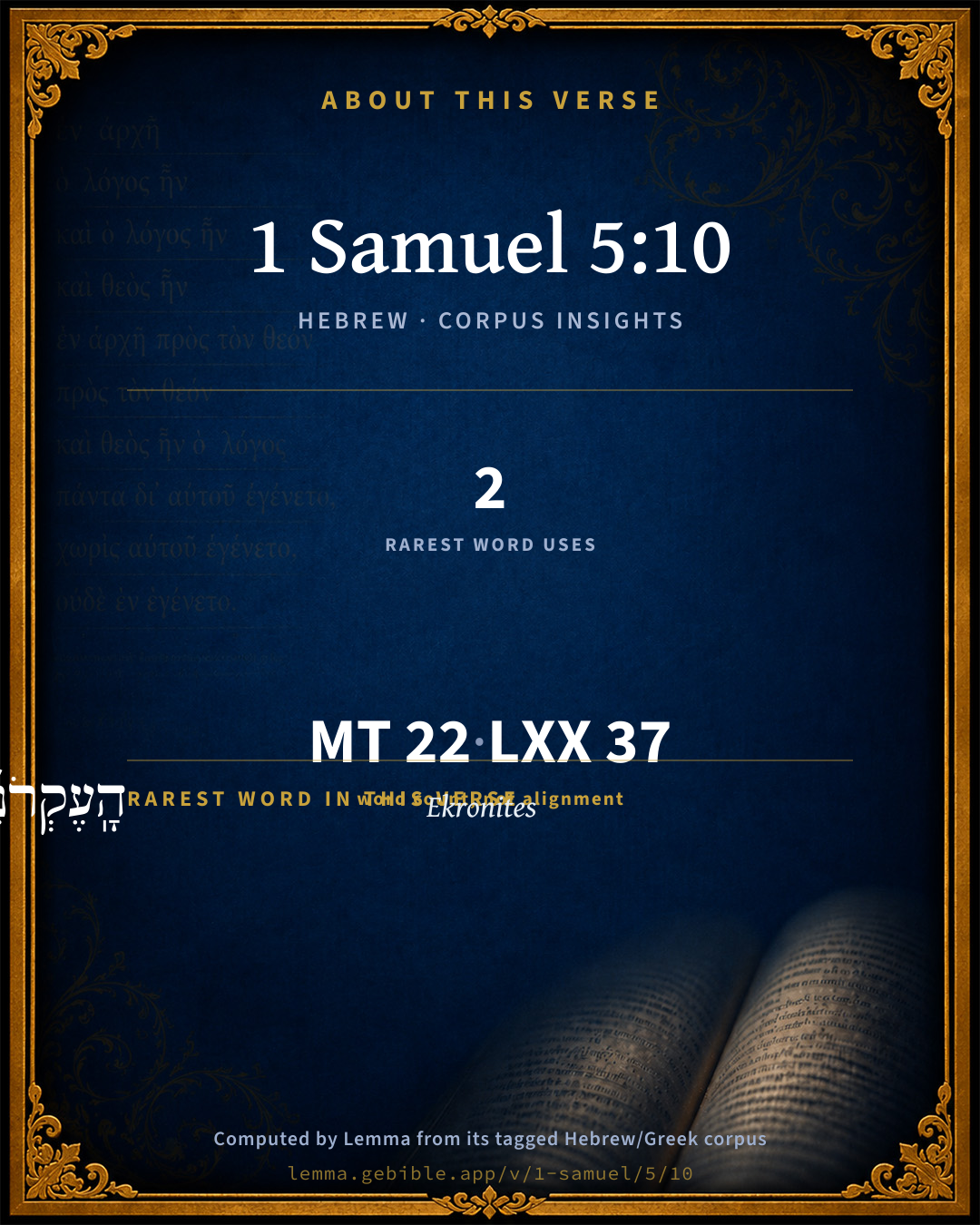
These counts appear in no published source. They are computed here, from the morphology-tagged text and Lemma’s own curated glosses. What Lemma adds →

22
words
15
distinct lemmas
Historical
section

Notable vocabulary

The rarest word here is הָֽעֶקְרֹנִ֜ים Ekronites H6139 — appearing just 2 times in the whole Hebrew Bible.

Shared distinctive vocabulary

הָֽעֶקְרֹנִ֜ים Ekronites H6139 occurs in 2 verses of the Hebrew Bible. Also found in:

Grammatical profile

  • 7 verbs
  • 11 nouns
  • 1 preposition
  • 3 particles

Verb forms

  • וַֽיְשַׁלְּח֛וּ Piel · Sequential Imperfect
  • וַיְהִ֗י Qal · Sequential Imperfect
  • כְּב֨וֹא Qal · Infinitive Construct
  • וַיִּזְעֲק֨וּ Qal · Sequential Imperfect
  • לֵאמֹ֗ר Qal · Infinitive Construct
  • הֵסַ֤בּוּ Hiphil · Perfect
  • לַהֲמִיתֵ֖נִי Hiphil · Infinitive Construct

Repetition

Words recur within this verse — often emphatic in Hebrew:

  • אֲר֥וֹן ark H727 ×3
  • הָאֱלֹהִ֖ים God H430 ×3
  • עֶקְר֑וֹן Ekron H6138 ×2

Hebrew & Septuagint length

In English translation the verse runs 44 words from the Hebrew and 51 from the Septuagint (LXX English) — closely comparable.

A rough comparison of the two English renderings, which tokenize alike — not a word-level alignment.

Word counts can differ between the Hebrew and the Greek without any difference in meaning — e.g. the Hebrew direct-object marker אֵת has no separate Greek word, and Greek often adds the article ὁ.

In the original languages it is 22 Hebrew tokens and 37 Greek tokens — but the two are counted differently (Hebrew bundles its prefixes and suffixes into one token; the Greek is in lemma form), so that isn’t a like-for-like length.

Cross-references

4

Topical passages linked to 1 Samuel 5:10 in the Treasury of Scripture Knowledge — connected by theme and wording, ordered by reader-vote popularity; previews shown in the World English Bible.

  • Amos 1:8 I will cut off the inhabitant from Ashdod, And him who holds the scepter from Ashkelon; And I will turn my hand against Ekron; And the remnant of the Philistines will perish," says the Lord Yahweh.
  • Joshua 15:45 Ekron, with its towns and its villages;
  • Judges 1:18 Also Judah took Gaza with the border of it, and Ashkelon with the border of it, and Ekron with the border of it.
  • 2 Kings 1:2 Ahaziah fell down through the lattice in his upper chamber that was in Samaria, and was sick: and he sent messengers, and said to them, Go, inquire of Baal Zebub, the god of Ekron, whether I shall recover of this sickness.

Cross-references courtesy of OpenBible.info (CC BY 4.0).

Hebrew and Greek witnesses Masoretic Hebrew ↔ Greek Septuagint

The same verse in the two great witnesses to the Old Testament, shown verse-for-verse.

These are two independent witnesses, not word-aligned to each other, and the Septuagint is shown in lemma (dictionary) form.

Hebrew 1 Samuel 5:10 Masoretic · Westminster Leningrad Codex

וַֽיְשַׁלְּח֛וּ אֶת אֲר֥וֹן הָאֱלֹהִ֖ים עֶקְר֑וֹן וַיְהִ֗י כְּב֨וֹא אֲר֤וֹן הָאֱלֹהִים֙ עֶקְר֔וֹן וַיִּזְעֲק֨וּ הָֽעֶקְרֹנִ֜ים לֵאמֹ֗ר הֵסַ֤בּוּ אֵלַי֙ אֶת אֲרוֹן֙ אֱלֹהֵ֣י יִשְׂרָאֵ֔ל לַהֲמִיתֵ֖נִי וְאֶת עַמִּֽי

So they sent the ark of God to Ekron. It happened, as the ark of God came to Ekron, that the Ekronites cried out, saying, They have brought about the ark of the God of Israel to us, to kill us and our people.

World English Bible · Public Domain

Greek LXX 1 Samuel 5:10 Septuagint · lemma form

καί ἐκ ἀποστέλλω ὁ κιβωτός ὁ θεός εἰς ἀσκαλών καί γίγνομαι ὡς εἰςἔρχομαι κιβωτός θεός εἰς ἀσκαλών καί βοάω ὁ ἀσκαλωνίτης λέγω τίς ἀποστρέφω πρός ἐγώ ὁ κιβωτός ὁ θεός ἰσραήλ θανατόω ἐγώ καί ὁ λαός ἐγώ

And they send away the ark of God to Ascalon; and it came to pass when the ark of God went into Ascalon, that the men of Ascalon cried out, saying, Why have you⌃ brought back the ark of the God of Israel to us, to kill us and our people?

LXX2012 (modern English Septuagint) · Public Domain

Hebrew: Westminster Leningrad Codex (CC BY 4.0). Greek: Septuagint (public domain); English from LXX2012 (modern English Septuagint) (Public Domain). How the Septuagint differs from the Hebrew →

Targum (Aramaic paraphrase)

1

The Targum is the ancient Jewish Aramaic paraphrase of the Hebrew Scriptures — an interpretive translation, not the Hebrew text itself. Onkelos (literal) and Pseudo-Jonathan (expansive) render the Torah, and Jonathan the Prophets. Coverage is partial: where no permissively-licensed English translation exists for a verse, only the Aramaic is shown. This is verse-level text, not a word-by-word alignment to the Hebrew.

  1. Targum Jonathan Prophets (Joshua–Malachi)
    וּשְׁלָחוּ יַת אֲרוֹנָא דַייָ לְעֶקְרוֹן וַהֲוָה כְּמֵיתֵי אֲרוֹנָא דַייָ לְעֶקְרוֹן וּזְעִיקוּ עֶקְרוֹנָאֵי לְמֵימָר אַסְחָרוּ לְוָתָנָא יַת אֲרוֹן אֱלָהָא דְיִשְׂרָאֵל לְקַטָלוּתָנָא וְיַת עִמָנָא:

    (no public-domain English translation for this verse)

    Targum Jonathan — Aramaic: “Mikraot Gedolot” (public domain). English: “Sefaria Community Translation” (CC0 1.0 (public-domain dedication)); “London "Chaldee Paraphrase," 1871” (public domain). Text via Sefaria.

Commentary

Notes on 1 Samuel 5:10 from classic Christian and Jewish commentators (each source and its license shown beneath its notes). The classic Christian expositions comment on the surrounding passage and are grouped to its opening verse, so a note may address several verses; the Jewish commentaries on the Tanakh (Rashi and others) are per-verse, so they appear only where the commentator wrote on this verse.

Lemma curates 59 commentaries, every one of them public domain or Creative Commons licensed, each selected and text-cleaned for this edition rather than reprinted as found. About our sources →

Trapp's Complete Commentary

John Trapp

1Sa 5:10 Therefore they sent the ark of God to Ekron. And it came to pass, as the ark of God came to Ekron, that the Ekronites cried out, saying, They have brought about the ark of the God of Israel to us, to slay us and our people.

Ver. 10. Therefore they sent the ark of God to Ekron.] Thus they send the plague of God up and down to their neighbours. Wicked men use to draw others into partnership of their condemnation.

The Ekronites cried out, saying.] The Israel, ites did not more shout for joy when they saw the ark come to them, than the Ekronites cry out for grief to see it brought among them. {a} Spiritual things are either sovereign or hurtful, according to the disposition of the receivers.

{a} Dr Hall.

John Trapp, A Commentary or Exposition upon All the Books of the Old and New Testament (1647–1656) — public domain. Text from a community e-Sword module.

Tyndale Open Study Notes

Tyndale Open Resources

5:10 Ekron, another of the five major Philistine cities (see 6:17), was just five miles north of Gath.

Tyndale Open Study Notes — © Tyndale Open Resources, licensed CC BY-SA 4.0. Text via the HelloAO Bible API.

The Cambridge Bible for Schools and Colleges

gen. ed. J. J. S. Perowne

10. they sent the ark of God to Ekron] The most northerly of the five confederate cities, about 11 miles north of Gath. It was allotted to the tribe of Judah (Jos_15:45-46), and was temporarily occupied (Jdg_1:18). Baal-zebub was the local deity (2Ki_1:2). The site is marked by the modern village of Akir.

to us, to slay us and our people] Lit., as in the margin, “to me, to slay me and my people.” So too in 1Sa_5:11. The singular seems to indicate that the ‘lord’ acted as spokesman.

The Cambridge Bible for Schools and Colleges (gen. ed. J. J. S. Perowne; Cambridge University Press, 1878–1918) — public domain. Text from a community e-Sword module.

John Gill's Exposition

Therefore they sent the ark of God to Ekron,.... Another of the five principalities of the Philistines, about ten miles from Gath, where Baalzebub, or the god of the fly, was worshipped:

and it came to pass, that as the ark of God came to Ekron; and had been there some little time:

that the Ekronites cried out; when they perceived the hand of God was upon them, as upon the other cities; these were the chief magistrates of the city, with the lord of them, as appears by what follows:

saying, they have brought about the ark of the God of Israel to us; from one city to another, and at length to us:

to slay us and our people; not that this was their intention, but so it was eventually.

John Gill's Exposition of the Whole Bible (1746–1763) — public domain (CC PDM 1.0). Text via the HelloAO Bible API.

Matthew Poole's English Annotations

Not that they intended this, but because this would be the event of it.

Matthew Poole's English Annotations on the Holy Bible (1683–1685) — public domain. Text from a community e-Sword/MySword module.

Whedon's Commentary on the Bible

Daniel D. Whedon

10. They sent the ark… to Ekron — A city some ten miles north of Gath. Compare Jos_13:3. From city to city does the ark of Jehovah spread terror and confusion.

Daniel D. Whedon (gen. ed.), Commentary on the Old and New Testaments (1874–1909) — public domain. Text from a community e-Sword module.

The Pulpit Commentary

Vers. 10, 11. The Ekronites cried out. Convinced by this second and more fatal plague that the ark was the cause of their punishment, the people of Ekron, when it was passed on to them from Gath, protested loudly against its presence. Compelled to receive it until the lords of the Philistines could be convened in council to decide upon its ultimate destination, the plague broke out so heavily among them that they were in utter dismay. For the rendering deadly destruction is untenable. Literally the words are, "a dismay of death;" but in Hebrew death added to a word of this sort simply means "very great." So "terrors of death" in Psa_55:4 are very great terrors. In the next verse we learn that many did die,but the words used here describe the mental agony and despair of the people as they saw the ark, which had wrought elsewhere so great misery, brought unto them.

The Pulpit Commentary (1880–1919), ed. H.D.M. Spence-Jones & Joseph S. Exell — public domain. Text from a community e-Sword module.

Keil & Delitzsch

C. F. Keil & F. Delitzsch

They therefore sent the ark of God to Ekron, i.e., Akir, the north-western city of the Philistines (see at Jos 13:3). But the Ekronites, who had been informed of what had taken place in Ashdod and Gath, cried out, when the ark came into their city, "They have brought the ark of the God of Israel to me, to slay me and my people" (these words are to be regarded as spoken by the whole town); and they said to all the princes of the Philistines whom they had called together, "Send away the ark of the God of Israel, that it may return to its place, and not slay me and my people. For deadly alarm (מות מהוּמת, confusion of death, i.e., alarm produced by many sudden deaths) ruled in the whole city; very heavy was the hand of God there. The people who did not die were smitten with boils, and the cry of the city ascended to heaven." From this description, which simply indicates briefly the particulars of the plagues that God inflicted upon Ekron, we may see very clearly that Ekron was visited even more severely than Ashdod and Gath. This was naturally the case. The longer the Philistines resisted and refused to recognise the chastening hand of the living God in the plagues inflicted upon them, the more severely would they necessarily be punished, that they might be brought at last to see that the God of Israel, whose sanctuary they still wanted to keep as a trophy of their victory over that nation, was the omnipotent God, who was able to destroy His foes.

Keil & Delitzsch — Biblical Commentary on the Old Testament (1861–1891) — public domain (CC PDM 1.0). Text via the HelloAO Bible API. (Old Testament only.)

unfoldingWord translationNotes

Door43 World Missions Community

cried out

Why they cried out can be stated clearly. AT: "cried out in fear" (See: Assumed Knowledge and Implicit Information)

translationWords

Ekron

unfoldingWord translationNotes — © Distant Shores Media and the Door43 World Missions Community, licensed CC BY-SA 4.0. Source: git.door43.org/Door43/en_tn.

Lesson kit

Teaching starters — assembled from the data on this page, not authored interpretation. Every prompt links to the verse data it draws on. Edit before teaching.

1 Samuel, in the Historical, opens this verse with 22 words (15 distinct Hebrew lemmas). Its most distinctive word is ʻEqrôwnîy (“Ekronites”). A historical commentator’s framing appears above. Read the whole chapter for the surrounding context.

Discussion questions

  1. How does “Ekronites” (ʻEqrôwnîy) shape what this verse is saying?
  2. Joshua 13:3 shares the word «Ekronites» with this verse. How do the two illuminate each other?
  3. “ark” occurs 3× in this one verse. What is the effect of the repetition?
  4. These translations render this verse differently; the difference is in the English rendering, not the original. What questions does that raise?
  5. The verb «וַֽיְשַׁלְּח֛וּ» is Piel Sequential Imperfect. How does its form color the action?
  6. Reading how Trapp's Complete Commentary and Tyndale Open Study Notes read this verse, where do the two commentators agree and where do they part?

Things to notice

Reading settings

Reading text

Shown beneath each verse's original-language words.

Old Testament
Old Testament edition

Read the OT as the Masoretic Hebrew (MT) or the Greek Septuagint (LXX).

English shown for the Greek Septuagint (in the Hebrew ↔ Greek comparison).

Comparing translations? Open the Compare panel on any verse page to stack up to four side by side.