
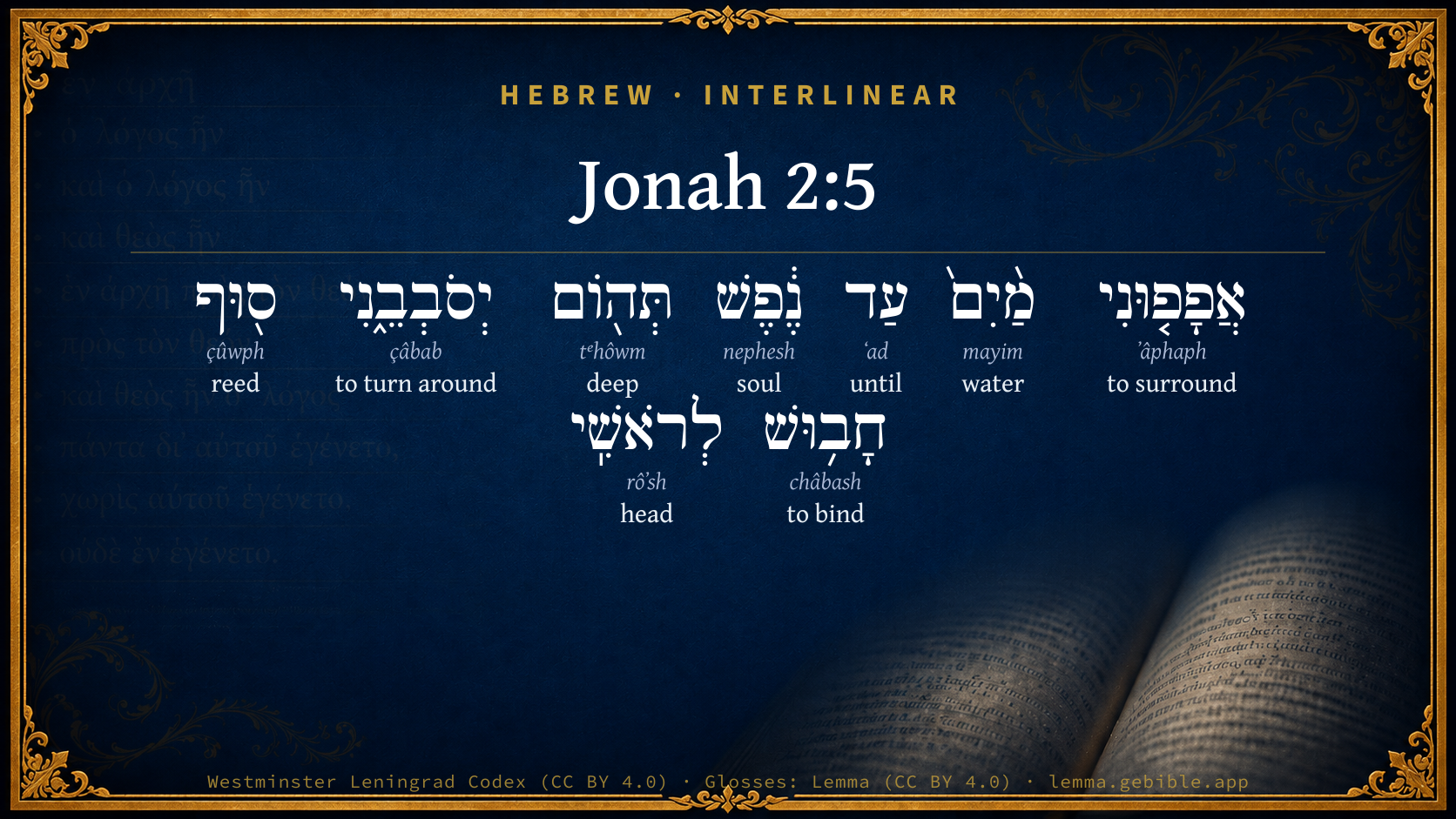
Jonah 2:5

Hebrew (Westminster Leningrad Codex) Jonah 2:5 appears in the Hebrew Old Testament. The text above is from the Westminster Leningrad Codex. Each word links to its Strong’s number, a concise gloss, and parsing drawn from the Open Scriptures Hebrew Bible morphology. Click any word for its full Brown-Driver-Briggs (BDB) entry.
Download image
Cite this verse

Jonah 2:5 (World English Bible). Public Domain. Lemma interlinear Bible study tool, https://lemma.gebible.app/v/jonah/2/5.

Show BibTeX & RIS
BibTeX
RIS
English Translation
The waters surrounded me, Even to the soul. The deep was around me. The weeds were wrapped around my head.
World English Bible · Public Domain
Download a study sheet

One document with this verse’s original text, its word-by-word gloss line, the meaning frame, cross-references with their text, attributed commentary, and full source and license credits — printable, and it pastes into notes with its structure intact.

This verse Autodidact and up

Study sheet (.html) Plain text (.txt)

A passage Seminary Student

Up to 50 verses in one chapter. A passage sheet keeps up to 6 commentary sources and 12 cross-references per verse, in the order this page ranks them, and says so on the sheet whenever that leaves anything out. Ask for a single verse and you get the Autodidact verse sheet above.

Everything on this page stays free to read, with no account — the sheet is a download of what is already on screen, not access to it.

Want to remove ads? Support Godless Engineer
Compare translations 3

The same verse in 3 English versions, stacked beneath the original-language interlinear above. Click any original word for its lexicon entry.

Each is an independent rendering of the whole verse — the interlinear is not word-aligned to these translations.

Highlighted words mark where these versions differ — a whole-verse word diff, not a word-by-word alignment.

  • World English Bible Public Domain
    The waters surrounded me, Even to the soul. The deep was around me. The weeds were wrapped around my head.
  • King James Version Public Domain
    The waters compassed me about, even to the soul: the depth closed me round about, the weeds were wrapped about my head.
  • unfoldingWord Literal Text CC BY-SA 4.0
    Water had closed around me even as far as life, the deep was surrounding me; seaweed was wrapped around my head.

unfoldingWord Literal Text — © unfoldingWord, licensed CC BY-SA 4.0. Word-aligned USFM3 via Door43 (git.door43.org/unfoldingWord/en_ult).

Versions to compare (up to 4)

3 of 4 selected

Show all 18 translations

Every available English version of this verse, each an independent rendering of the whole verse.

  • World English Bible Public Domain
    The waters surrounded me, Even to the soul. The deep was around me. The weeds were wrapped around my head.
  • Berean Standard Bible Public Domain
    The waters engulfed me to take my life; the watery depths closed around me; the seaweed wrapped around my head.
  • Majority Standard Bible Public Domain
    The waters engulfed me to take my life; the watery depths closed around me; the seaweed wrapped around my head.
  • King James Version Public Domain
    The waters compassed me about, even to the soul: the depth closed me round about, the weeds were wrapped about my head.
  • American Standard Version (1901) Public Domain
    The waters compassed me about, even to the soul; The deep was round about me; The weeds were wrapped about my head.
  • Revised Version (1885) Public Domain
    The waters compassed me about, even to the soul; the deep was round about me; the weeds were wrapped about my head.
  • Geneva Bible (1599) Public Domain
    The waters compassed me about vnto the soule: the depth closed me rounde about, and the weedes were wrapt about mine head.
  • Douay-Rheims (1899) Public Domain
    And I said: I am cast away out of the sight of thy eyes: but yet I shall see thy holy temple again.
  • Young's Literal Translation Public Domain
    Compassed me have waters unto the soul, The deep doth compass me, The weed is bound to my head.
  • Literal Standard Version CC BY-SA 4.0
    Waters have surrounded me to the soul, || The deep surrounds me, || The weed is bound to my head.
  • Unlocked Literal Bible CC BY-SA 4.0
    The waters closed around me up to my neck; the deep was all around me; seaweed wrapped around my head.
  • unfoldingWord Literal Text CC BY-SA 4.0
    Water had closed around me even as far as life, the deep was surrounding me; seaweed was wrapped around my head.
  • Darby Bible Public Domain
    The waters encompassed me, to the soul: The deep was round about me, The weeds were wrapped about my head.
  • World Messianic Bible Public Domain
    The waters surrounded me, even to the soul. The deep was around me. The weeds were wrapped around my head.
  • Webster's Bible Public Domain
    \\2:4\\Then I said, I am cast out of thy sight; yet I will look again towards thy holy temple.
  • Free Bible Version CC BY-SA 4.0
    The water swirled over me so I couldn't breathe; the deep sucked me down; seaweed wrapped itself around my head.
  • Bible in Basic English Public Domain
    And I said, I have been sent away from before your eyes; how may I ever again see your holy Temple?
  • JPS Tanakh (1917) Public Domain
    (2-6) The waters compassed me about, even to the soul; the deep was round about me; the weeds were wrapped about my head.

Literal Standard Version (2020), Covenant Press — licensed CC BY-SA 4.0. Text via the HelloAO Bible API (eBible.org). Unlocked Literal Bible (unfoldingWord) — licensed CC BY-SA 4.0. Text via the HelloAO Bible API (eBible.org). unfoldingWord Literal Text — © unfoldingWord, licensed CC BY-SA 4.0. Word-aligned USFM3 via Door43 (git.door43.org/unfoldingWord/en_ult). Free Bible Version, Dr. Jonathan Gallagher — licensed CC BY-SA 4.0. Text via the HelloAO Bible API (eBible.org).

Word by word

More ways to search: Search by grammar → Find every occurrence → Compare this word →

Practice this passage: Drill this verse → Learn its vocabulary →

אֲפָפ֤וּנִי
ʼâphaph
H661
“to surround · me”
Verb, Qal, Perfect, 3rd Person, Common, Plural + Suffix, Personal, 1st Person, Common, Singular
Part of Speech
Verb
Stem
Qal
Form
Perfect
Person
3rd Person
Gender
Common
Number
Plural
Full BDB Definition

Origin: a primitive root

TWOT: 148

to surround, encompass - (Qal) to encompass
  1. מַ֨יִם֙ mayim H4325 “water(s)” Noun, Common, Masculine, Plural, Absolute
  2. עַד ʻad H5704 “until” Preposition
  3. נֶ֔פֶשׁ nephesh H5315 “soul” Noun, Common, Both, Singular, Absolute
  4. תְּה֖וֹם tᵉhôwm H8415 “deep” Noun, Common, Both, Singular, Absolute
  5. יְסֹבְבֵ֑נִי çâbab H5437 “to turn around · me” Verb, Poel, Imperfect, 3rd Person, Masculine, Singular + Suffix, Personal, 1st Person, Common, Singular
  6. ס֖וּף çûwph H5488 “reed” Noun, Common, Masculine, Singular, Absolute
  7. חָב֥וּשׁ châbash H2280 “bound” Verb, Qal, Participle Passive, Masculine, Singular, Absolute
  8. לְרֹאשִֽׁי rôʼsh H7218 “to/for · head · my” Preposition + Noun, Common, Masculine, Singular, Construct + Suffix, Personal, 1st Person, Common, Singular

About this verse

These counts appear in no published source. They are computed here, from the morphology-tagged text and Lemma’s own curated glosses. What Lemma adds →

9
words
9
distinct lemmas
Prophets
section

Notable vocabulary

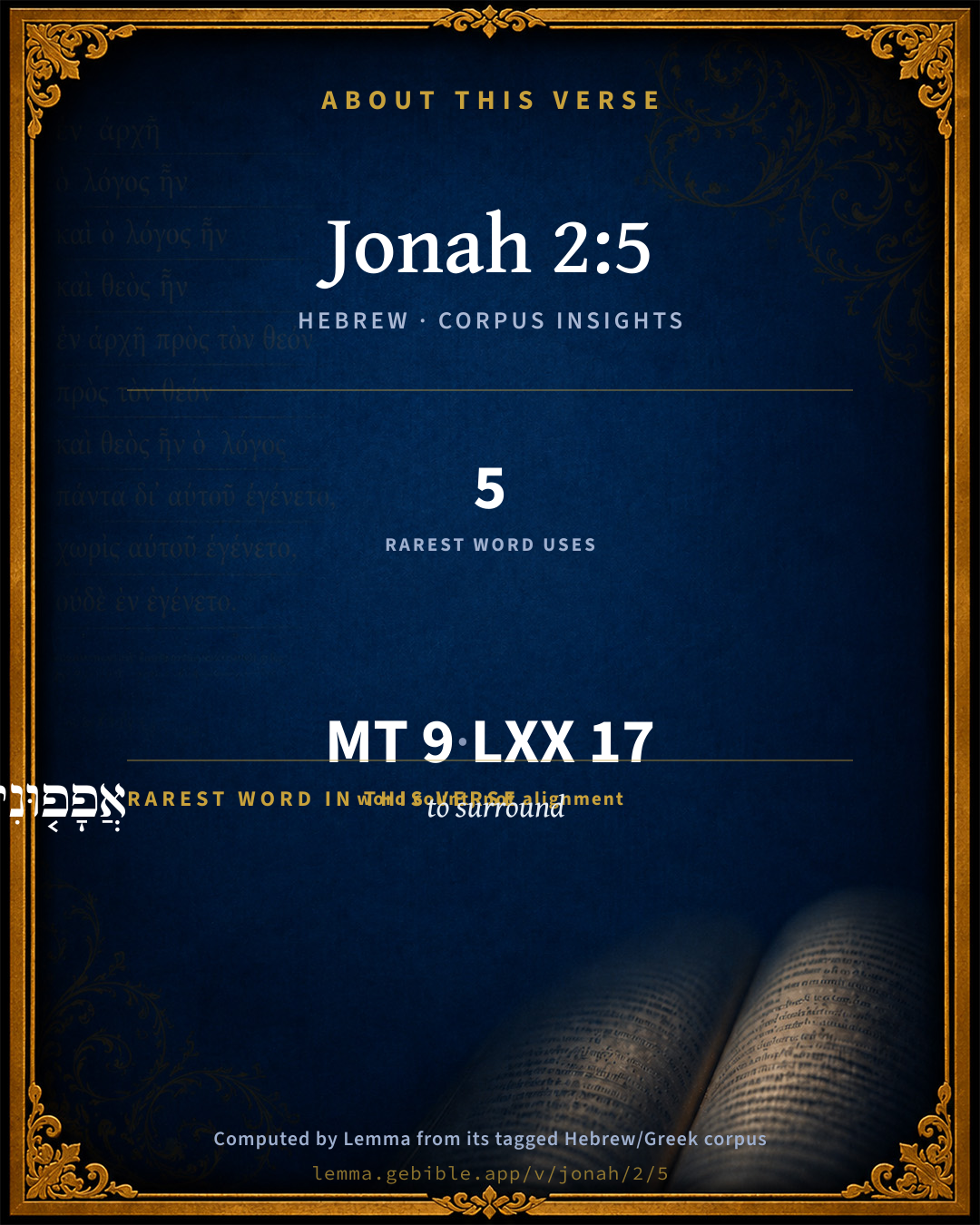
The rarest word here is אֲפָפ֤וּנִי to surround H661 — appearing just 5 times in the whole Hebrew Bible.

Shared distinctive vocabulary

אֲפָפ֤וּנִי to surround H661 occurs in 5 verses of the Hebrew Bible. Also found in:

Grammatical profile

  • 3 verbs
  • 5 nouns
  • 1 preposition

Verb forms

  • אֲפָפ֤וּנִי Qal · Perfect
  • יְסֹבְבֵ֑נִי Poel · Imperfect
  • חָב֥וּשׁ Qal · Participle Passive

Hebrew & Septuagint length

In English translation the verse runs 20 words from the Hebrew and 19 from the Septuagint (LXX English) — closely comparable.

A rough comparison of the two English renderings, which tokenize alike — not a word-level alignment.

Word counts can differ between the Hebrew and the Greek without any difference in meaning — e.g. the Hebrew direct-object marker אֵת has no separate Greek word, and Greek often adds the article ὁ.

In the original languages it is 9 Hebrew tokens and 17 Greek tokens — but the two are counted differently (Hebrew bundles its prefixes and suffixes into one token; the Greek is in lemma form), so that isn’t a like-for-like length.

Cross-references

3

Topical passages linked to Jonah 2:5 in the Treasury of Scripture Knowledge — connected by theme and wording, ordered by reader-vote popularity; previews shown in the World English Bible.

  • Psalms 69:1–2 Save me, God, For the waters have come up to my neck!
  • Lamentations 3:54 Waters flowed over my head; I said, I am cut off.
  • Psalms 40:2 He brought me up also out of a horrible pit, Out of the miry clay. He set my feet on a rock, And gave me a firm place to stand.

Cross-references courtesy of OpenBible.info (CC BY 4.0).

Hebrew and Greek witnesses Masoretic Hebrew ↔ Greek Septuagint

The same verse in the two great witnesses to the Old Testament, shown verse-for-verse.

These are two independent witnesses, not word-aligned to each other, and the Septuagint is shown in lemma (dictionary) form.

Hebrew Jonah 2:5 Masoretic · Westminster Leningrad Codex

אֲפָפ֤וּנִי מַ֨יִם֙ עַד נֶ֔פֶשׁ תְּה֖וֹם יְסֹבְבֵ֑נִי ס֖וּף חָב֥וּשׁ לְרֹאשִֽׁי

The waters surrounded me, Even to the soul. The deep was around me. The weeds were wrapped around my head.

World English Bible · Public Domain

Greek LXX Jonah 2:5 Septuagint · lemma form

καί ἐγώ εἶπον ἀποὠθέω ἐκ ὀφθαλμός σύ ἆρα προςτίθημι ὁ ἐπιβλέπω πρός ὁ ναός ὁ ἅγιος σύ

And I said, I am cast out of your presence: shall I indeed look again toward your holy temple?

LXX2012 (modern English Septuagint) · Public Domain

On this verse, The Pulpit Commentary discusses the Septuagint’s reading. Read the note in Commentary ↓

Hebrew: Westminster Leningrad Codex (CC BY 4.0). Greek: Septuagint (public domain); English from LXX2012 (modern English Septuagint) (Public Domain). How the Septuagint differs from the Hebrew →

Targum (Aramaic paraphrase)

1

The Targum is the ancient Jewish Aramaic paraphrase of the Hebrew Scriptures — an interpretive translation, not the Hebrew text itself. Onkelos (literal) and Pseudo-Jonathan (expansive) render the Torah, and Jonathan the Prophets. Coverage is partial: where no permissively-licensed English translation exists for a verse, only the Aramaic is shown. This is verse-level text, not a word-by-word alignment to the Hebrew.

  1. Targum Jonathan Prophets (Joshua–Malachi)
    וַאֲנָא אֲמָרִית אִתְּרְכִית מִן קֳדָם מֵימְרָךְ בְּרַם אוֹסִיף לְאִסְתַּכְּלָא בְּהֵיכְלָא דְקוּדְשָׁךְ:

    And I had said: “I am driven out from before Your Word; will I again gaze upon the palace of Your Holiness?”

    Targum Jonathan — Aramaic: “Mikraot Gedolot” (public domain). English: “Sefaria Community Translation” (CC0 1.0 (public-domain dedication)); “London "Chaldee Paraphrase," 1871” (public domain). Text via Sefaria.

Commentary

Notes on Jonah 2:5 from classic Christian and Jewish commentators (each source and its license shown beneath its notes). The classic Christian expositions comment on the surrounding passage and are grouped to its opening verse, so a note may address several verses; the Jewish commentaries on the Tanakh (Rashi and others) are per-verse, so they appear only where the commentator wrote on this verse.

Lemma curates 59 commentaries, every one of them public domain or Creative Commons licensed, each selected and text-cleaned for this edition rather than reprinted as found. About our sources →

Trapp's Complete Commentary

John Trapp

Jon 2:5 The waters compassed me about, [even] to the soul: the depth closed me round about, the weeds were wrapped about my head.

Ver. 5. The waters compassed me about, even to the soul] That is, usque ad animae deliquium, till I laboured for life, and was as good as gone.

The depth closed me round about] {See Trapp on "Jon 2:3"} and further observe, that God’s dear children may fall into desperate and deadly dangers, see Psa 18:3; Psa 88:3; Psa 116:3. And this for, 1. Prevention, 2. Purgation, 3. Probation, 4. Preparations to further both mercies and duties. Let us not therefore censure ourselves or others as hated of God, because greatly distressed; but encourage ourselves in them, as did David at Ziklag, 1Sa 30:6. The right hand of the Lord shall change all this.

“ Flebile principium melior fortuna sequetur. ”

The weeds were wrapped about mine head] Alga as Alligando. The weeds which the fish had devoured, or whereunto the fish, wherein I was, had dived and lain down among them. Or this might befall Jonah in the bottom of the sea, before the fish had swallowed him; for weeds easily wrap about those that swim, or are drowned.

John Trapp, A Commentary or Exposition upon All the Books of the Old and New Testament (1647–1656) — public domain. Text from a community e-Sword module.

The Preacher's Complete Homiletical Commentary

Joseph S. Exell (gen. ed.)

CRITICAL NOTES.

Jon_2:5] This strophe opens like the first, sets forth the peril of death, and describes the thought of miraculous deliverance. Surrounded] Pressed even to the soul (Psa_69:2; Psa_18:5). Weeds] Sea-weeds, vast quantities of which were found in the Mediterranean, were bound about his head “like a grave band. A peril even to the strong swimmer, entangling him the more he struggles to extricate himself. But to one below, powerless to struggle, it was as his winding-sheet” [Pusey].

Jon_2:6. Bottoms] Cuttings off, ends or extremities, hence foundations (cf. Psa_18:7-15). It seemed as if the earth itself formed the vault, the living coffin into which he was shut up (Deu_3:5; Job_38:10). “The bolts of the sea are the walls of the sea-basin, which set bounds to the sea that it cannot pass over” [Keil]. Corruption] Lit. the pit (Isa_38:17; Job_17:4).

HOMILETICS

THE HORRIBLE PIT.—Jon_2:5-6

The prophet again enlarges on his terrible and apparently hopeless condition, reviews the awful deep from whence he was delivered, and admires the power of God in his salvation.

I. The depth of the pit. The poet or the painter can add nothing to the description here given of the prisoner in the deep. He was cast down into a dark, fearful dungeon, amid horrible gloom and rushing torrents. Forgotten of mankind; confined in anguish and hell. Sin always casts men into extremity and death.

II. The dangers of the pit. His peril was imminent. The terrors of the Almighty, the elements of nature, set themselves in array against him.

1. He was encompassed by waters. Excluded from the atmosphere and light on the surface, he felt almost suffocated beneath the waves. His very soul was submerged, and pressed by the floods so that life was almost extinct. “Encompassed me even to the soul.”

2. He was barred by the earth. He was carried to the base of the rocks, the roots of the mountains, whose summits overtopped the waves.

3. He was enclosed in the deep. “The deep closed me in.” He could sink no lower, and it was impossible to rise higher. He was confined on all sides. Earth and sea formed the vault within which he was for ever shut.

4. He was wrapped round with sea-weeds. The alga or weed was bound about his head, and made it like a state of death or living corruption. “As the monster within which he was caverned glided through the vast submarine forests, they seemed to enclose him in their green and slippery coverts, or portions of sea-weed, swallowed by the fish, wrapped itself around him.”

III. The deliverance from the pit. “Thou hast brought up my life.” His rescue was like a resurrection of the body, and displayed the grace and power of Jehovah. God delivered him from sufferings described and recorded when he was on dry land. His soul also was recovered to true penitence, and the light of God’s countenance. He could now say, “O Lord, my God.” “A sweet renewed sense of pardoning love is often the pleasant shore on which we step out of the deep mire of our sorrowful troubles.”

IV. The gratitude to the deliverer. It is a good thing to give thanks to God for blessings received. It is common with God to deliver when nobody else can. Every mercy is the expression of a thought, the manifestation of a purpose. God’s mercies are innumerable, and must be publicly acknowledged to quicken our own hearts and those of others (Isa_38:17). “He brought me up also out of an horrible pit out of the miry clay, and set my feet upon a rock, and established my goings” (Psa_40:2-3).

HOMILETIC HINTS AND OUTLINES

Jon_2:5. Trials like water. Deep, heavy, and overwhelming. It is sad to be perfectly sensible of your situation, yet not able to do anything for relief; to struggle, and become more fettered by the effort.

The deliverance.

1. This deliverance was, humanly speaking, most unlikely.

2. It was highly benevolent. “Brought up my life.” It was a treasure beyond all price that was restored to the prophet.

3. It was Divinely wrought. “Yet hast thou.”

4. It was recognized and appreciated by Jonah. “O Lord, my God.” These words are full of meaning, and express the faith and joy of the Prophet [Exell].

Jon_2:5-6. Bringing up and preservation. Two great blessings traced to the hand of God, and prompting to gratitude on account of the evils described.

The Preacher's Complete Homiletical Commentary (gen. ed. Joseph S. Exell; Funk & Wagnalls, c. 1892) — public domain (pre-1929). A full-Bible homiletical/sermon-outline anthology covering 65 of 66 books (2 John is absent from the source module). Text from a community e-Sword module.

Jamieson, Fausset & Brown

Robert Jamieson, A. R. Fausset & David Brown

even to the soul--that is, threatening to extinguish the animal life.

weeds--He felt as if the seaweeds through which he was dragged were wrapped about his head.

Jamieson, Fausset & Brown — Commentary Critical and Explanatory on the Whole Bible (1871) — public domain (CC PDM 1.0). Text via the HelloAO Bible API.

Adam Clarke's Commentary

Verse 5. The waters compassed me about even to the soul] So as to seem to deprive me of life. I had no hope left.

The weeds were wrapped about my head.] This may be understood literally also. He found himself in the fish's stomach, together with sea weeds, and such like marine substances, which the fish had taken for its aliment.

Adam Clarke's Commentary on the Bible (1810–1826) — public domain. Text from a community e-Sword/MySword module.

John Calvin's Commentaries

Here in many words Jonah relates how many things had happened to him, which were calculated to overwhelm his mind with terror and to drive him far from God, and to take away every desire for prayer. But we must ever bear in mind what we have already stated, — that he had to do with God: and this ought to be well considered by us. The case was the same with David, when he says in Psalm 39:9, ‘Thou hast yet done it;’ for, after having complained of his enemies, he turned his mind to God: “What then do I? what do I gain by these complaints? for men alone do not vex me; thou, God, he says, hast done this.” So it was with Jonah; he ever set before him the wrath of God, for he knew that such a calamity had not happened to him but on account of his sins.

He therefore says that he was by waters beset, and then, that he was surrounded by the deep; but at length he adds, that God made his life to ascend, etc. All these circumstances tend to show that Jonah could not have raised up his mind to God except through an extraordinary miracle, as his life was in so many ways oppressed. When he says that he was beset with waters even to the soul, I understand it to have been to the peril of his life; for other explanations seem frigid and strained. And the Hebrews says that to be pressed to the soul, is to be in danger of one’s life; as the Latins, meaning the same thing, say that the heart, or the inside, or the bowels, are wounded. So also in this place the same thing is meant, ‘The waters beset me even to the soul,’ and then, ‘the abyss surrounds me.’ Some render סוף, suph, sedge; others sea-weed; others bulrush: but the sense amounts to the same thing. No doubt סוף, suph, is a species of sedge; and some think that the Red Sea was thus called, because it is full of sedges or bulrushes. They think also that bulrushes are thus called, because they soon putrefy. But what Jonah means is certain and that is, that weed enveloped his head, or that weed grew around his head: but to refer this to the head of the fish, as some do, is improper: Jonah speaks metaphorically when he says that he was entangled in the sedge, inasmuch as there is no hope when any one is rolled in the sedge at the bottom of the sea. How, indeed, can he escape from drowning who is thus held, as it were, tied up? It is then to be understood metaphorically; for Jonah meant that he was so sunk that he could not swim, except through the ineffable power of God.

John Calvin's Commentaries (1540-1563) — public domain. Text from the Calvin Translation Society English edition (1840s-50s) via the Christian Classics Ethereal Library (ccel.org). Calvin's coverage is partial (roughly two-thirds of the Bible); uncommented books and verses are honest gaps, never fabricated. The 19th-century editor's footnotes and remarks are omitted so the notes are faithfully Calvin's own voice.

Ellicott's Commentary for English Readers

(5) The waters.—See reference in margin.

The weeds were wrapped about my head.—This graphic touch is quite original. The figure of overwhelming waters is a common one in Hebrew song to represent some crushing sorrow, but nowhere is the picture so vivid as here. At the same time the entire absence of any reference to the fish, which would, indeed, be altogether out of place in this picture of a drowning man entangled in seaweed, should be noticed. That on which the prophet lays stress is not on the mode of his escape, but his escape itself.

A Bible Commentary for English Readers, edited by Charles John Ellicott (1878–1897) — public domain. Text from a community e-Sword module.

The Cambridge Bible for Schools and Colleges

gen. ed. J. J. S. Perowne

5. compassed me about] It would be better, perhaps, to render surrounded me, in order to show that this is a different word from that in Jon_2:3, and then in the second clause of this verse, where the word is the same as in Jon_2:3, to render compassed me about, instead of closed me round about.

to the soul] i. e. so as to endanger my soul, or life. Comp. Psa_69:1 (where similar language is used figuratively) and Jer_4:10.

the weeds] The Heb. word is sûph, which so often occurs in the name Red Sea (lit., sea of sûph). “The sûph of the sea, it seems quite certain, is a seaweed resembling wool. Such sea-weed is thrown up abundantly on the shores of the Red Sea.”—Smith’s Bible Dict., Art. Red Sea.

The Cambridge Bible for Schools and Colleges (gen. ed. J. J. S. Perowne; Cambridge University Press, 1878–1918) — public domain. Text from a community e-Sword module.

John Gill's Exposition

I went down to the bottom of the mountains,.... Which are in the midst of the sea, whither the fish carried him, and where the waters are deep; or the bottom of rocks and promontories on the shore of the sea; and such vast rocks hanging over the sea, whose bottoms were in it, it seems are on the shore of Joppa, near to which Jonah was cast into the sea, as Egesippus (f) relates:

the earth with her bars was about me for ever; that is, the earth with its cliffs and rocks on the seashore, which are as bars to the sea, that it cannot overflow it; these were such bars to Jonah, that could he have got clear of the fish's belly, and attempted to swim to shore, he could never get to it, or over these bars, the rocks and cliffs, which were so steep and high:

yet hast thou brought up my life from corruption, O Lord my God; notwithstanding these difficulties, which were insuperable by human power, and these seeming impossibilities of, deliverance; yet the Lord brought him out of the fish's belly, as out of a grave, the pit of corruption, and where he must otherwise have lain and rotted, and freed his soul from those terrors which would have destroyed him; and by this also we learn, that this form of words was composed after he came to dry land: herein likewise he was a type of Christ, who, though laid in the grave, was not left there so long as to see corruption, Psa 16:10.

(f) "De excidio", Urb. Hieros. l. 3. c. 20.

John Gill's Exposition of the Whole Bible (1746–1763) — public domain (CC PDM 1.0). Text via the HelloAO Bible API.

Albert Barnes' Notes on the Bible

The waters compassed me about even to the soul - Words which to others were figures of distress (Psa 69:2. See the introduction to Jonah), “the waters have come even to the soul,” were to Jonah realities. Sunk in the deep seas, the water strove to penetrate at every opening. To draw breath, which sustains life, to him would have been death. There was but a breath between him and death. “The deep encompassed me,” encircling, meeting him wherever he turned, holding him imprisoned on every side, so that there was no escape, and, if there otherwise had been, he was bound motionless, “the weed was wrapped around my head, like a grave-band.” “The weed” was the well known seaweed, which, even near the surface of the sea where man can struggle, twines round him, a peril even to the strong swimmer, entangling him often the more, the more he struggles to extricate himself from it. But to one below, powerless to struggle, it was as his winding sheet.

Albert Barnes' Notes on the Bible (1834–1885) — public domain. Text from a community e-Sword/MySword module.

Haydock's Catholic Bible Commentary

Eyes, in a sort of despair, like the psalmist, xxx. 23. Yet he presently resumes fresh confidence in God, notwithstanding the greatness of his offences. --- Temple. He went to Jerusalem, like other good Israelites.

George Leo Haydock (1774–1849), Haydock's Catholic Family Bible and Commentary, 1859 edition — public domain. Excludes Psalms (Douay-Rheims chapter numbering differs from Protestant) and Deuterocanonical books (Catholic canon only).

Matthew Poole's English Annotations

The former part of this verse seems to be an ingeminating of what was said Jon 2:3, and bears the self-same meaning and interpretation.

The waters; literally, the waters of the sea; metaphorically, afflictions; mystically, temptations; these last arising from his own guilt, and from the tokens of God’s displeasure against him in so unusual a manner.

Compassed me about, even to the soul; to the endangering his life, and were forerunners (as he apprehended) of worse miseries, the foretastes of an eternal damnation: it was a miracle of providence to preserve my life, it was no less wonder of free grace to save my soul.

The depth closed me round about; he was carried to the bottom of the sea, lay as in the deepest hole of the sea.

The weeds were wrapped about my head; not immediately, as some conjecture, by the fish pulling them from the bottom of the sea and swallowing them down, where they wrapped Jonah’s head; but mediately, when the fish swam amidst these: or rather it is a comparative speech; I was no more likely to escape drowning, than a man in the depth of the sea, wrapped up in, and held fast down by, the weeds in the bottom of the sea.

Matthew Poole's English Annotations on the Holy Bible (1683–1685) — public domain. Text from a community e-Sword/MySword module.

The Pulpit Commentary

Vers. 5, 6. In parallel clauses, Jonah describes still more vividly the horrors that surrounded him.

Compassed me about. Not the same word as in ver. 3. Septuagint, perieciyh moi "was poured around me." Even to the soul; so as to reach his life. (comp. Psa_18:5 Psa_69:1, 2 Lam_3:54) The depth closed me round about. The verb is the lame as in ver. 3, translated there, "compassed me about" Vulgate, abyssus vallavit me. The weeds (suph); seaweed. Jonah sank to the bottom before he was swallowed by the fish. The LXX omits the word. The Vulgate gives pelagus, which is probably derived from the fact of the Red Sea being called "the Sea of Suph," the term being thence applied to any sea.

Vers. 5-10. Deliverance waiting on the assured hope of it.

It is an obvious remark that all men are ingenuous with God. There is no thought of trying to mislead his judgment or escape his lidless eye. They know that he knows them, knows them truly, knows them thoroughly. Accordingly, when religious profession is false and religious converse is suppressive, and other religious acts are hollow and formal, secret prayer, if it be, offered at all, is both honest and open. Only tell us what a man says into the secret ear of God, and you have told us all that is in his heart have revealed what microscope could not detect, nor scalpel lay bare. It is in this way that our text is apocalyptic. It unveils for us the inner life of Jonah as this is done by no other portion of his book. And the revelation raises him not a little in our estimation. It shows him at bottom a regenerate and saintly man. It reveals a beaten path between his soul and God"s throne, a path unused during a wayward hour, but resorted to instinctively when disaster has come and has sobered him into thought. Learn here

I THE ESSENTIAL SOLITUDE OF SUFFERING. (Vers. 5, 6) We find matter around us of different degrees of density, from the light volcanic ash to the heavy metallic ore. But men of science tell us that no material substance is absolutely solid. In the closest-grained rock, in the diamond itself, the ultimate particles are not in actual contact. They approach each other inconceivably close, but when attraction has brought them thus far, a mysterious repulsion intervenes and forbids that they should altogether touch. This fact of the material world has, no doubt, its counterpart in the world of spirit. There is an individuality about the soul that cannot be destroyed. We may be united to others by the closest ties. We may be of one mind, and one heart, and one taste, and one aim. We may thus approach men and be approached by them on many sides, and feel in union, and, to many effects and purposes, be in union with each other. But it is plain that we never coalesce, never actually touch. The shock of personal disaster proves this. Then all ties seem loosened and fall away. Friends drift apart. We are thrown in upon ourselves. Others cannot follow us into the depths. We are in a relation to the event into which no one else can come. In the last appeal we have to meet it alone. It was so with Christ. (Joh_16:31, Joh_16:32) Disciples, friends, kinsmen, with none of them could the Redeemer share the pangs of death. He had to die alone. Even the earlier thought, "I am not alone, the Father is with me" gave way in the hour of mortal agony to the question of sore amaze, "My God, my God, why hast thou forsaken me?" It was so with Jonah. He was pressed by a feeling of utter isolation. The depths closed over him. The earth with her bars Was about him. This he felt, and in proportion as he felt it did he realize that he was cut off from his kind, engulled in the horrors of a living grave, and left to face them all alone. "I shall die alone." "Yes; and alone you live. No soul touches another soul except at one or two points, and those chiefly external a fearful and lonely thought, but one of the truest life. Death only realizes that which has been the fact all along. In the central deeps of our being we are alone (F.W. Robertson).

II THREE IS AN ANTICIPATIVE POWER IN ALL TRUE FAITH. (Vers. 7, 9) Jonah"s prayer has really no petition in it. It becomes in the offering a song of praise. Still m the shark"s maw, with the sea grass around his head, and going down through the deep sea caves to the foundations of the mountains, he speaks as a man delivered, and knowing only occasion of thanks. This is the grand attitude and achievement of faith. It sees the end from the beginning. It expects the end because them has been a beginning. It anticipates the end at the beginning, and deals with it as an accomplished fact. "Thou hast brought up my life from corruption, O Lord my God." "I know nothing more sublime in all the range of recorded human utterances. What could dictate assured and triumphant language like this, but marvellous, miraculous faith? His deliverance is not yet come; yet faith speaks of it as if it were. O noble faith! it is in thy power to bring in the deliverance that is still future, with the sweetness of that which is already present, and the sureness of that which is already past (Rev. Hugh Martin, D.D.). This quality of Jonah"s faith appeared also in that of Paul. Crying for deliverance from indwelling sin, he forestalls the event, and prepays the thanks. (Rom_7:24, Rom_7:25) So surely is prayer answered, so infallibly does needed help accrue, that from an adequate faith the gratitude may go up when as yet the blessing has not come down. And there is this prophetic realizing power in all faith. It "is the substance of things hoped for, the evidence of things not seen." It carries in its head the jewel of hope; and where the one reaches the other shines. Faith trusts God that he can do all things, and hope looks for the doing of them. The potential deliverance seen by faith becomes actual deliverance in the eye of hope. And so to the believing soul "the things that shall be" already are, and the present is bright with the borrowed light of not yet risen suns.

III IT IS JUST IN THE MOMENT OF REALIZED HELPLESSNESS THAT THE THOUGHT OF GOD COMES TO A SOUL. (Ver. 7) Jonah, as is evident, had up till now forgotten God. Not only so, but he had deliberately driven and persistently kept him out of his thoughts. The bursting of a fearful storm impressed him so little that, if left alone, he would have slept it through. The rude piety of the sailors, calling every man upon his god, sent no responsive thrill through him. The captain"s reproachful summons to arise and pray was disregarded or ignored. Even the ominous lot casting, on the issue of which his life hung, was watched with apparent calm. His self-possessed and iron obstinacy died hard. But it died. Angry Omnipotence will not be denied; and God took measures that not even Jonah"s hardihood could survive. The prophet broke down. Flesh and heart failed together. And then he came back to first principles, and remembered God. God, if they knew it, is the one need of human hearts. "Every finite spirit is inherently related to the Infinite, in him to live, and move, and have its being. It wants the knowledge of God, the society of God, the approbation of God, the internal manifestation of God, a consciousness lighted up by his presence, to receive of his fulness, to be strong in his might, to rest in his love, and be centred everlastingly in his glory (Horace Bushnell, D.D.). But the natural man has no idea of this.

Conscious of incompleteness, he knows not in what it consists. And he prescribes at random for his own case. He absorbs himself in business, he struggles up the path of ambition, he plunges into mad indulgence, he runs breathless from sensation to sensation, seeking rest and satisfaction, and finding none. Everything gets stale and tiresome, and the soul finds itself unprovided for and orphan still. Not seldom the man spends his days thus in feverish search of good, and dies unsatisfied and unfed at last. But sometimes, in the providence of God, disaster comes at this stage. He is losing his idol. He is being robbed of all he loved, or abandoned of all he trusted in. He is being brought to the grave"s mouth by a resistless Providence. It becomes with him a question of God"s help or none. And shut up to it thus, he chooses it, albeit only as a last resource. "I cried unto the Lord with my voice. In the day of my trouble I sought the Lord". (Psa_116:3, Psa_116:4) This is the natural history of the soul"s resort to God. It is the last resort. All other help has been tried and found wanting before the sinner turns to him. What grace, that he waits till then! that while every conceivable earthly nostrum is being tried, the Balm of Gilead is kept in store, and is available in the extremest hour! Truly a God "long suffering and slow to wrath, and plenteous in mercy," is our God, who wearies not at our long wandering, and welcomes even the latest return.

IV THE SIGHT OF GOD AND THE SIGHT OF SIN INVOLVE EACH OTHER. (Ver. 8) Jonah had lost sight of Cod and of his own guiltiness together. In his conduct up to this point we see the most astounding oblivion of both. And now the two matters come to mind together, suggesting a logical connection between them. And so there is. Sin is a conscious offence against God. Its antagonism to him is its essential element. Accordingly, the sense of it will come and go with the thought of God, and will be adequate as this is adequate. You cannot remember the offence and yet forget the offended Being. Neither can you realize God as near and cognizant without a consciousness of your moral attitude toward him. The thought of sin and the thought of God, in fact, bring up each other. And not only is the fact of sin, but the extent and evil of it are revealed in the revelation of God. Contact with the plumb line betrays the curve in the bowing wall. So, side by side with God"s ideal holiness, sin looks itself and looks its worst. (Job_42:5) When a man sees his sinfulness, he has also, as the condition of it, got a glimpse of God. To Jonah his late conduct seems nothing now but the pursuit of lying vanities. He had no fruit in It. Every promise of good it held out had been falsified. He had not escaped. He had not improved matters in any way. He had only intensified existing evils and involved himself and others in new troubles. And that is a true picture of sin the world over and all history through. It is a following of delusive fantasies, and a running away from our own mercies. Its prospective blessings burst like bubbles in our hands the hands that, but for it, would have been full of the choicest gifts of God.

V THE RECEIVING OF SPIRITUAL GOOD IS FOLLOWED BY A DESIRE TO MAKE SOME RETURN. (Ver. 9) Gratitude is a universal duty, and ought to be a universal grace. All men receive blessing from God, and as a consequence owe him thanks. Of the gratitude due, however, they fall tar short. Some good things come incognito, and are thus received unthankfully. Other good things, God"s free gifts, are traced to some earthly source, and so produce no thankful feeling. And then the multitude of life"s mercies, so obviously Divine, are yet so common that their origin is forgotten, and they are received as a matter of course. But spiritual gifts can never be ungratefully received. They are too conspicuously gracious to be taken as a matter of right. They are too immeasurably great to be lightly deemed of. They involve the gift of a new heart itself, in which gratitude is a native growth, because grace has made it God-like. There are no thankless Christians. Ingratitude possibly means the spiritual nature absent or in abeyance, and points, where we find it, to previous spiritual deforcement. Such deforcement Jonah had suffered during the continuance of his rebellious freak. Now that religious principle had resumed the sway in his soul, the gratitude is restored that had been exiled during the spiritual interregnum. And everywhere and always the heart that has been blessed to saving effect is one in which infallibly is mooted the question of making grateful return.

VI DIVINE DELIVERANCE IS ALWAYS TIMED TO ARRIVE WHEN THERE IS RIPENESS FOR IT. (Ver. 10) Deliverance any sooner would have been too soon. It would have anticipated repentance, and so have left the erring prophet unreclaimed. It would, in fact, have defeated the object for which the entire disciplinary course had been adopted. It could not therefore occur in a divinely ordered life history. God"s providence never counterworks his scheme of grace. The one is adjusted to the other. His backsliding Jonahs are converted before his disciplinary whales vomit them forth. See you to the repentance, and God will see to your relief. Refining silver, at a certain stage the molten metal becomes for an instant so still and bright that the refiner can see his image in it as in a glass. And this, it is said, is the moment to pour it out, to anticipate which or delay beyond it is to spoil the whole experiment. In the visitations of his hand, God sits, we read, "as a refiner and purifier of silver," to "purify the sons of Levi, and purge them as gold and silver". (Mal_3:3) No fear that he will spoil the process by taking you out of the fire a single moment out of date. He will keep you under discipline till he sees his image in your purified soul, and in that moment precisely will remove his hand. "He that from dross would win the precious ore, Bends o"er the crucible an earnest eye, The subtle searching process to explore, Lest the one brilliant moment should pass by When, in the molten silver"s virgin mass, He meets his pictured face as in a glass. "Thus in God"s furnace are his people tried, Thrice happy they who to the end endure. But who the fiery trial may abide? Who from the crucible come forth so pure That he whose eyes of flame look through the whole May see his image perfect in the soul? (J. Montgomery.)

The Pulpit Commentary (1880–1919), ed. H.D.M. Spence-Jones & Joseph S. Exell — public domain. Text from a community e-Sword module.

John Wesley's Explanatory Notes

The weeds - It seems to mean, my case was as hopeless as that of a man wrapt about with weeds in the depth of the sea.

John Wesley, Explanatory Notes Upon the Whole Bible (1754–1765) — public domain. Text via the GEBible commentary corpus.

Keil & Delitzsch

C. F. Keil & F. Delitzsch

5 Waters surrounded me even to the soul: the flood encompassed me,

Sea-grass was wound round my head.

6 I went down to the foundations of the mountains;

The earth, its bolts were behind me for ever:

Then raisedst Thou my life out of the pit, O Jehovah my God.

7 When my soul fainted within me, I thought of Jehovah;

And my prayer came to Thee into Thy holy temple.

This strophe opens, like the last, with a description of the peril of death, to set forth still more perfectly the thought of miraculous deliverance which filled the prophet's mind. The first clause of the fifth verse recals to mind Psa 18:5 and Psa 69:2; the words "the waters pressed (בּאוּ) even to the soul" (Psa 69:2) being simply strengthened by אפפוּני after Psa 18:5. The waters of the sea girt him round about, reaching even to the soul, so that it appeared to be all over with his life. Tehōm, the unfathomable flood of the ocean, surrounded him. Sūph, sedge, i.e., sea-grass, which grows at the bottom of the sea, was bound about his head; so that he had sunk to the very bottom. This thought is expressed still more distinctly in Psa 18:6. קצבי הרים, "the ends of the mountains" (from qâtsabh, to cut off, that which is cut off, then the place where anything is cut off), are their foundations and roots, which lie in the depths of the earth, reaching even to the foundation of the sea (cf. Psa 18:16). When he sank into the deep, the earth shut its bolts behind him (הארץ is placed at the head absolutely). The figure of bolts of the earth that were shut behind Jonah, which we only meet with here (בּעד from the phrase סגר הדּלת בּעד, to shut the door behind a person: Gen 7:16; Kg2 4:4-5, Kg2 4:33; Isa 26:20), has an analogy in the idea which occurs in Job 38:10, of bolts and doors of the ocean. The bolts of the sea are the walls of the sea-basin, which set bounds to the sea, that it cannot pass over. Consequently the bolts of the earth can only be such barriers as restrain the land from spreading over the sea. These barriers are the weight and force of the waves, which prevent the land from encroaching on the sea. This weight of the waves, or of the great masses of water, which pressed upon Jonah when he had sunk to the bottom of the sea, shut or bolted against him the way back to the earth (the land), just as the bolts that are drawn before the door of a house fasten up the entrance into it; so that the reference is neither to "the rocks jutting out above the water, which prevented any one from ascending from the sea to the land," nor "densissima terrae compages, qua abyssus tecta Jonam in hac constitutum occludebat" (Marck). Out of this grave the Lord "brought up his life." Shachath is rendered φθορά, corruptio, by the early translators (lxx, Chald., Syr., Vulg.); and this rendering, which many of the more modern translators entirely reject, is unquestionably the correct one in Job 17:14, where the meaning "pit" is quite unsuitable. But it is by no means warranted in the present instance. The similarity of thought to Psa 30:4 points rather to the meaning pit = cavern or grave, as in Psa 30:10, where shachath is used interchangeably with בּור and שׁאול in Jon 2:4 as being perfectly synonymous. Jon 2:7 is formed after Psa 142:4 or Psa 143:4, except that נפשׁי is used instead of רוּחי, because Jonah is not speaking of the covering of the spirit with faintness, but of the plunging of the life into night and the darkness of death by drowning in the water. התעטּף, lit., to veil or cover one's self, hence to sink into night and faintness, to pine away. עלי, upon or in me, inasmuch as the I, as a person, embraces the soul or life (cf. Psa 42:5). When his soul was about to sink into the night of death, he thought of Jehovah in prayer, and his prayer reached to God in His holy temple, where Jehovah is enthroned as God and King of His people (Psa 18:7; Psa 88:3).

But when prayer reaches to God, then He helps and also saves. This awakens confidence in the Lord, and impels to praise and thanksgiving. These thoughts form the last strophe, with which the Psalm of thanksgiving is appropriately closed.

Keil & Delitzsch — Biblical Commentary on the Old Testament (1861–1891) — public domain (CC PDM 1.0). Text via the HelloAO Bible API. (Old Testament only.)

unfoldingWord translationNotes

Door43 World Missions Community

General Information:

This is a continuation of Jonah's prayer that started in Jonah 2:2.

The waters

"The waters" refers to the sea.

my neck

Some versions understand the Hebrew word in this expression to mean "my life." In that interpretation, the waters were about to take away Jonah's life.

the deep was all around me

"the deep water was all around me"

seaweed

grass that grows in the sea

the earth with its bars closed upon me forever

Jonah used a metaphor to compare the earth to a prison. AT: "the earth was like a prison that was about to lock me in forever" (See: Metaphor)

Yet you brought up my life from the pit

Jonah speaks of the place of the dead as if it were a pit. AT: "But you saved my life from the place of the dead" or "But you saved me from the place where the dead people are" (See: Metaphor)

Yahweh, my God!

In some languages, it may be more natural to put this at the beginning of the sentence or next to the word "you."

translationWords

Yahweh

unfoldingWord translationNotes — © Distant Shores Media and the Door43 World Missions Community, licensed CC BY-SA 4.0. Source: git.door43.org/Door43/en_tn.

Rashi

Rabbi Shlomo Yitzchaki (Rashi)

And I said—when they cast me into the sea, “Behold I am dead, and I have been driven away from before Your eyes.”

Instead—I saw that You have kept me alive all these days. I know that I will continue to gaze upon Your Holy Temple.

Rashi on the Tanakh — English translations: “The Judaica Press complete Tanach with Rashi, translated by A. J. Rosenberg” (CC BY 4.0); “Pentateuch with Rashi's commentary by M. Rosenbaum and A.M. Silbermann, 1929-1934” (public domain); “The Metsudah Tanach series, Lakewood, N.J” (CC BY 4.0); and “The Book of Joshua, Metsudah Publications, 1997” (CC BY 4.0). Text via Sefaria.

Lesson kit

Teaching starters — assembled from the data on this page, not authored interpretation. Every prompt links to the verse data it draws on. Edit before teaching.

Jonah, in the Prophets, opens this verse with 9 words (9 distinct Hebrew lemmas). Its most distinctive word is ʼâphaph (“to surround”). A historical commentator’s framing appears above. Read the whole chapter for the surrounding context.

Discussion questions

  1. The word ʼâphaph carries the sense “to surround.” How does it shape the verse?
  2. How does 2 Samuel 22:5, which shares the word «to surround», read alongside this verse?
  3. These translations render this verse differently; the difference is in the English rendering, not the original. What questions does that raise?
  4. «אֲפָפ֤וּנִי» is a Qal Perfect verb. How does that grammatical form shape the action described?
  5. Compare how Trapp's Complete Commentary and The Preacher's Complete Homiletical Commentary read this verse. Where do they agree or differ?

Things to notice

Reading settings

Reading text

Shown beneath each verse's original-language words.

Old Testament
Old Testament edition

Read the OT as the Masoretic Hebrew (MT) or the Greek Septuagint (LXX).

English shown for the Greek Septuagint (in the Hebrew ↔ Greek comparison).

Comparing translations? Open the Compare panel on any verse page to stack up to four side by side.